
THE HISTORY OF THE LSA Frederick J Newmeyer

- Slides: 47
THE HISTORY OF THE LSA Frederick J. Newmeyer University of Washington, University of British Columbia, and Simon Fraser University
THE HISTORY OF THE LSA • This talk will not attempt to be comprehensive. • 90 years in 20 minutes! • Other talks also cover part of the history of the LSA.
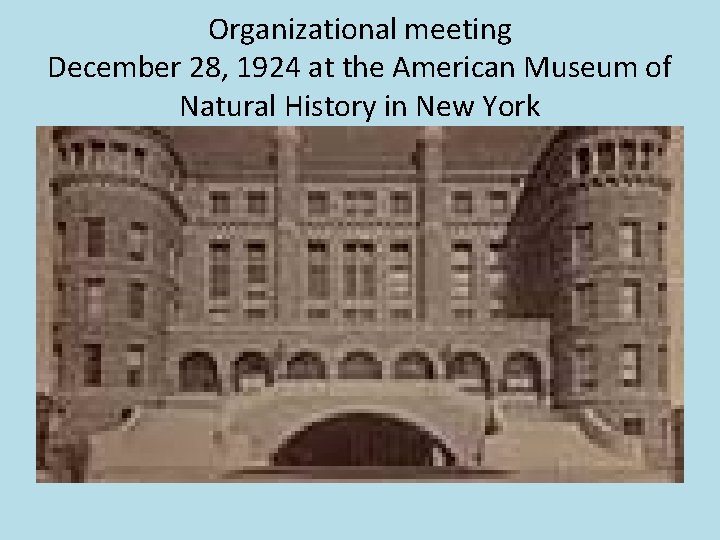
Organizational meeting December 28, 1924 at the American Museum of Natural History in New York
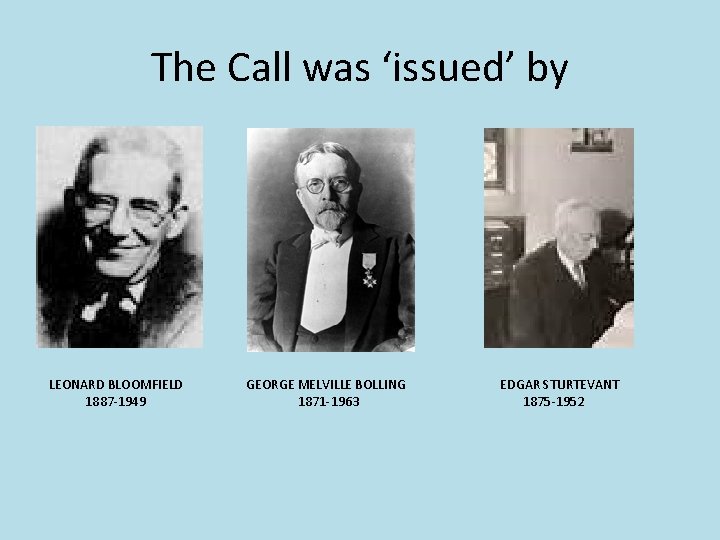
The Call was ‘issued’ by LEONARD BLOOMFIELD 1887 -1949 GEORGE MELVILLE BOLLING 1871 -1963 EDGAR STURTEVANT 1875 -1952
Founding the LSA • There were 29 signers of the call. • 69 attended the organizational meeting. • The motivation for a new society was so that language scholars in different areas could get together. It had nothing to do with providing a forum for structural linguists.
Founding the LSA • Bloomfield was certainly by then a ‘structural linguist’. • But Bolling was a Classical Greek philologist. • And Sturtevant was the world’s leading Hittite scholar.
‘Why a Linguistic Society? ’ (Bloomfield 1925) • [There are] are scholars who for a generation or more have worked in linguistics and have never met; some of them saw each other for the first time at our initial meeting. • The layman, natural scientist, philologian, or man in the street-does not know that there is a science of language. • Linguistics finds a similarity, repugnant to the common-sense view, between the languages of highly civilized people and those of savages. • The notion seems to prevail that a student of language is merely a kind of crowbaited student of literature. • The American Indian languages, which are disappearing forever, more rapidly than they can be recorded, what with the almost total lack of funds and organization; or the case of American English, of which we know only that, both as to dialects and as to distribution of standard forms, it would present a complex and instructive picture, had we but the means and the equipment to study it.
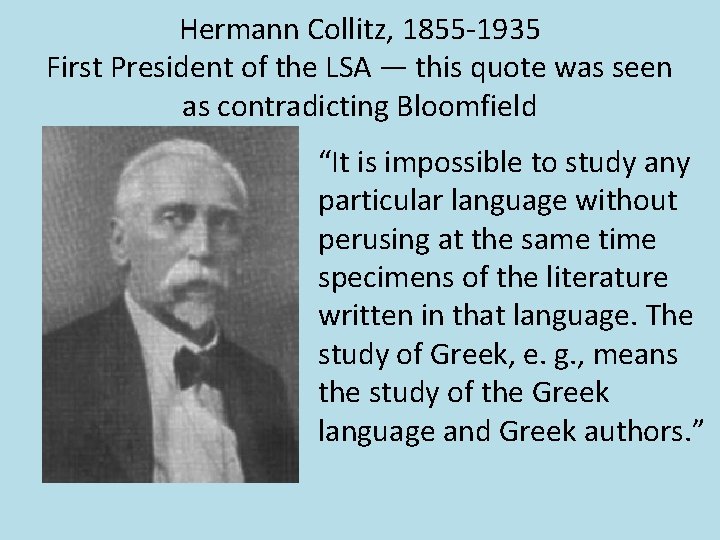
Hermann Collitz, 1855 -1935 First President of the LSA — this quote was seen as contradicting Bloomfield “It is impossible to study any particular language without perusing at the same time specimens of the literature written in that language. The study of Greek, e. g. , means the study of the Greek language and Greek authors. ”
Of the 214 members of the LSA polled in 1925… • 88 belonged to the Modern Language Association • 77 belonged to the American Philological Association • 61 belonged to the American Oriental Society • 17 belonged to the American Anthropological Association • 18 belonged to none of the four societies.
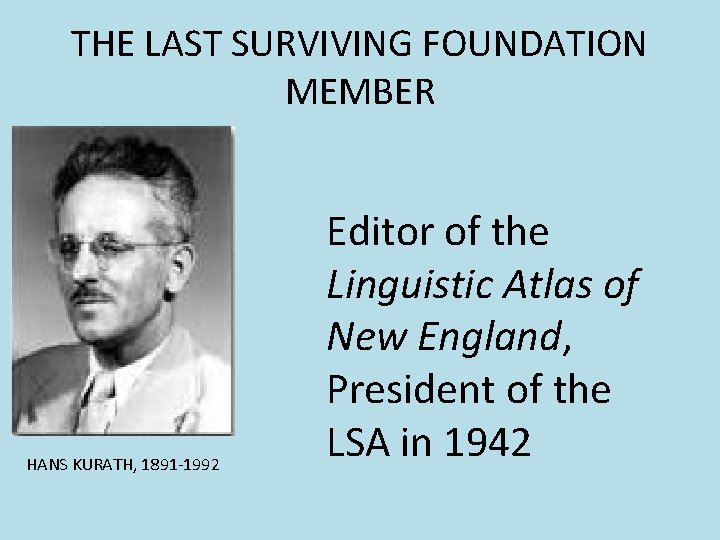
THE LAST SURVIVING FOUNDATION MEMBER HANS KURATH, 1891 -1992 Editor of the Linguistic Atlas of New England, President of the LSA in 1942
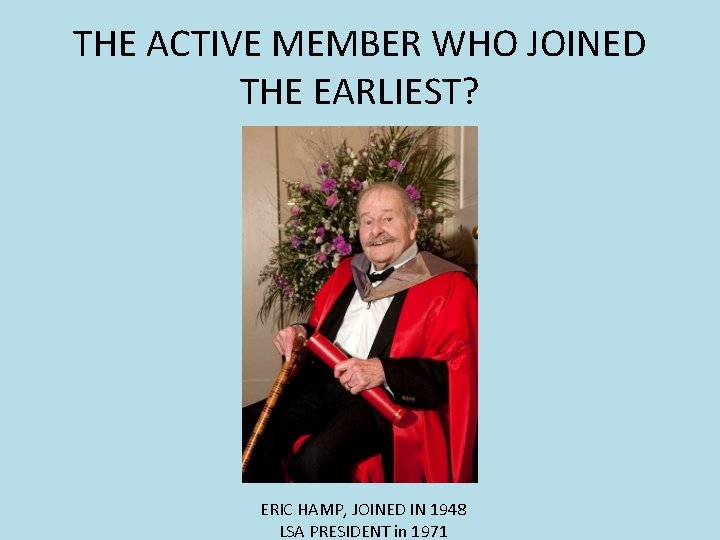
THE ACTIVE MEMBER WHO JOINED THE EARLIEST? ERIC HAMP, JOINED IN 1948 LSA PRESIDENT in 1971
A TRIVIA QUESTION – WHO WAS THE MOST FAMOUS FOUNDATION MEMBER? • ANSWER: MOE BERG
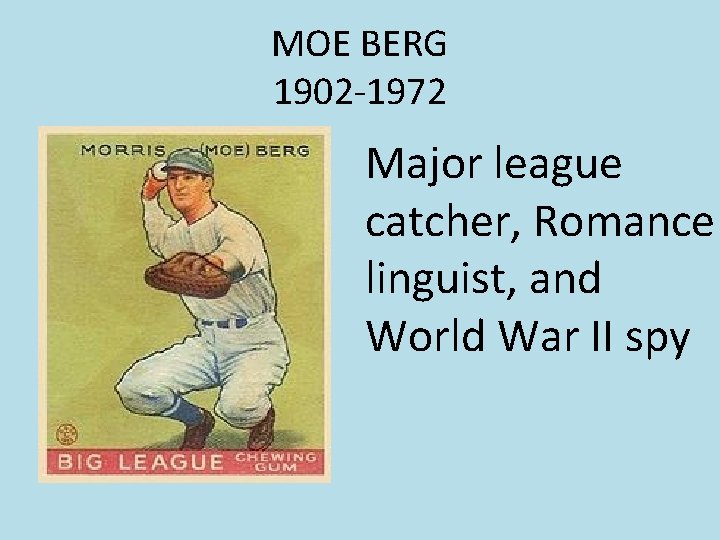
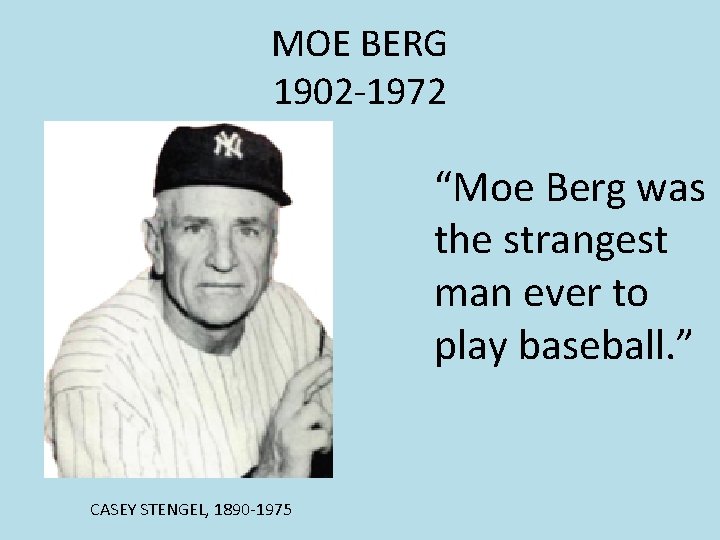
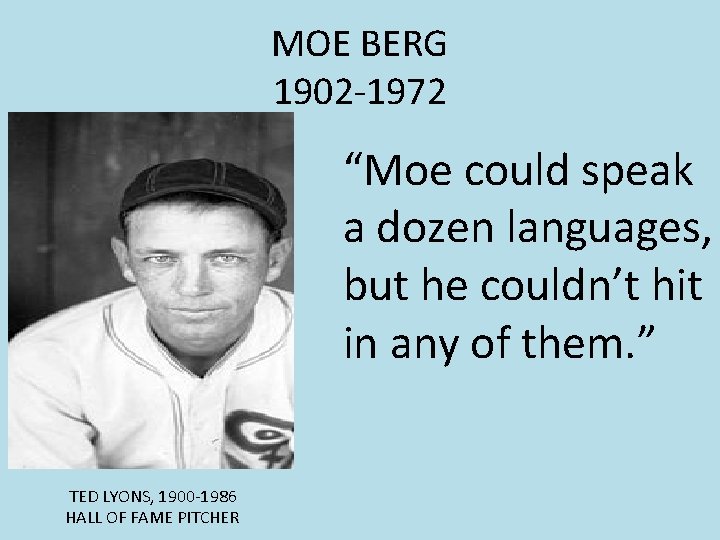
MOE BERG 1902 -1972 Major league catcher, Romance linguist, and World War II spy
MOE BERG 1902 -1972 “Moe Berg was the strangest man ever to play baseball. ” CASEY STENGEL, 1890 -1975
MOE BERG 1902 -1972 “Moe could speak a dozen languages, but he couldn’t hit in any of them. ” TED LYONS, 1900 -1986 HALL OF FAME PITCHER
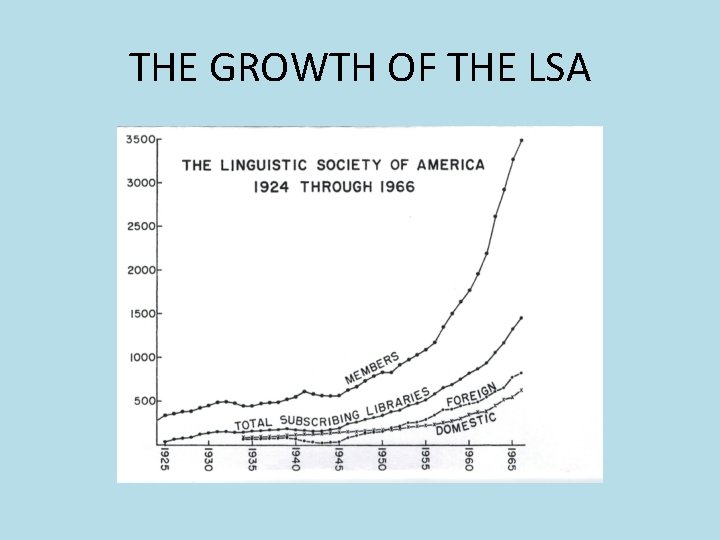
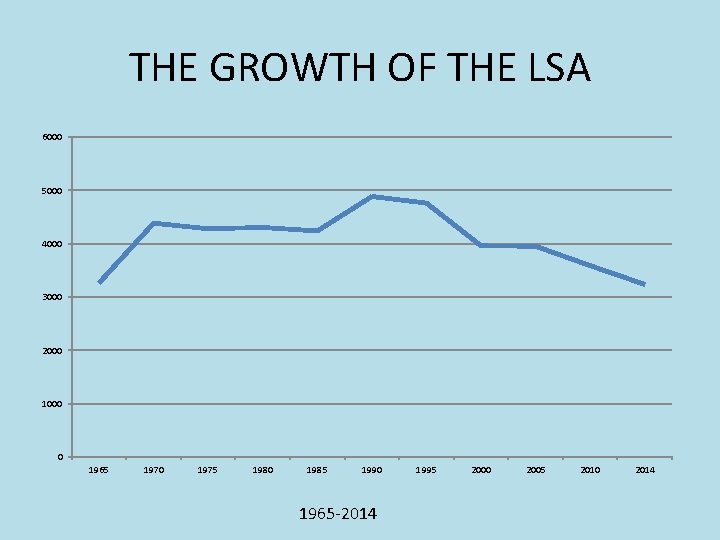
THE GROWTH OF THE LSA • Exponential growth until the 1970 s, leveling off for a decade, ten a steady decline.
THE GROWTH OF THE LSA
THE GROWTH OF THE LSA 6000 5000 4000 3000 2000 1000 0 1965 1970 1975 1980 1985 1990 1965 -2014 1995 2000 2005 2010 2014
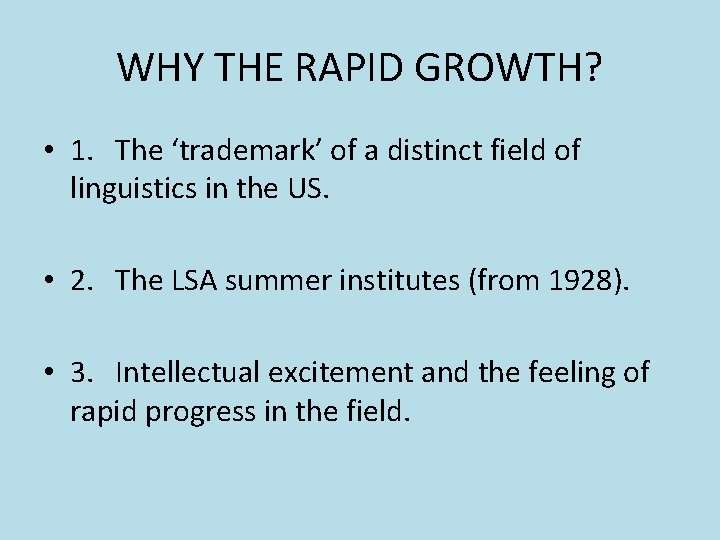
WHY THE RAPID GROWTH? • 1. The ‘trademark’ of a distinct field of linguistics in the US. • 2. The LSA summer institutes (from 1928). • 3. Intellectual excitement and the feeling of rapid progress in the field.
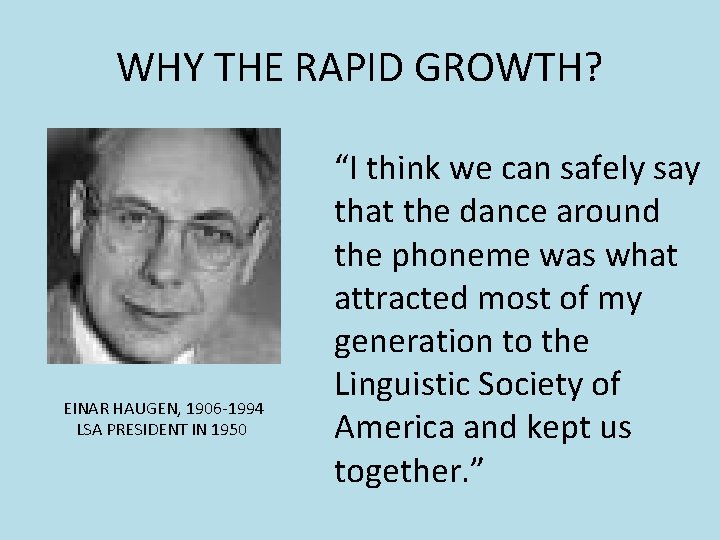
WHY THE RAPID GROWTH? EINAR HAUGEN, 1906 -1994 LSA PRESIDENT IN 1950 “I think we can safely say that the dance around the phoneme was what attracted most of my generation to the Linguistic Society of America and kept us together. ”
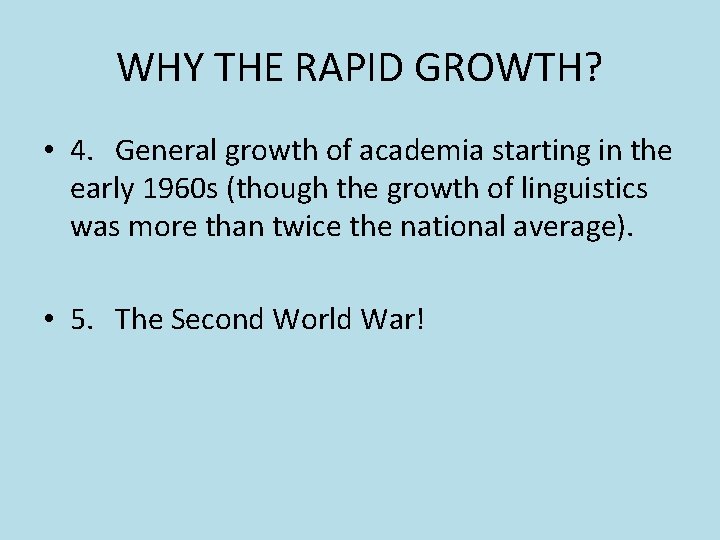
WHY THE RAPID GROWTH? • 4. General growth of academia starting in the early 1960 s (though the growth of linguistics was more than twice the national average). • 5. The Second World War!
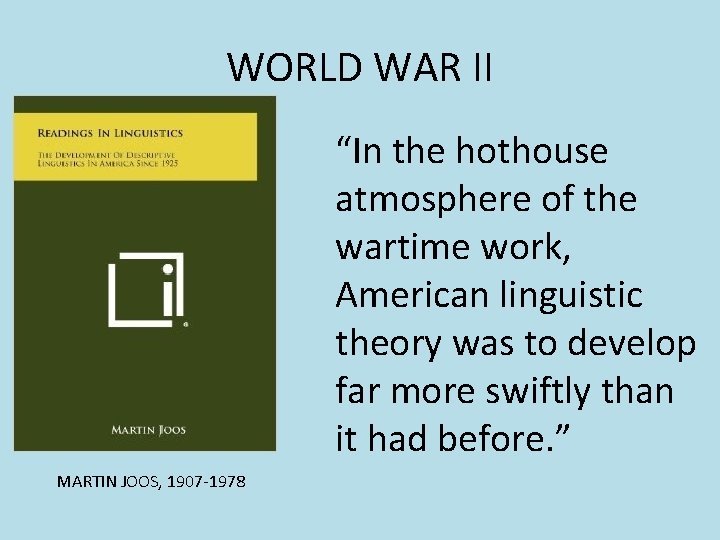
WORLD WAR II “In the hothouse atmosphere of the wartime work, American linguistic theory was to develop far more swiftly than it had before. ” MARTIN JOOS, 1907 -1978
WORLD WAR II The leading American descriptive linguists were housed in one building — 165 Broadway, in New York City — throughout the war. 165 BROADWAY, NEW YORK CITY (I THINK) 1908 - 1968
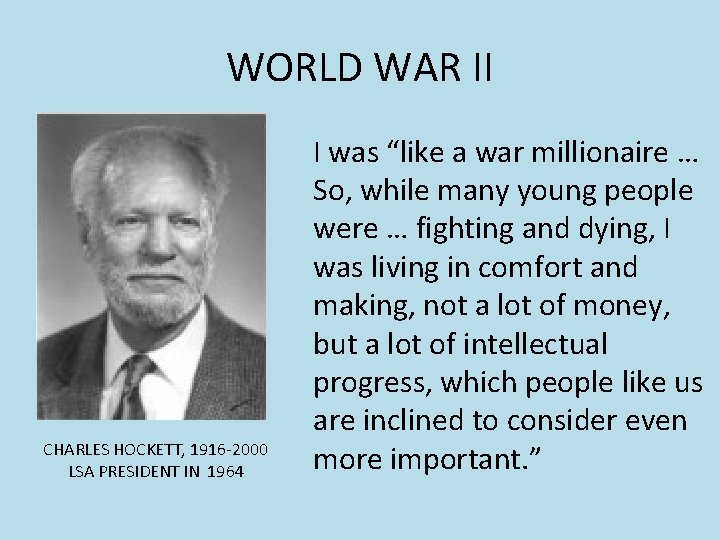
WORLD WAR II CHARLES HOCKETT, 1916 -2000 LSA PRESIDENT IN 1964 I was “like a war millionaire … So, while many young people were … fighting and dying, I was living in comfort and making, not a lot of money, but a lot of intellectual progress, which people like us are inclined to consider even more important. ”
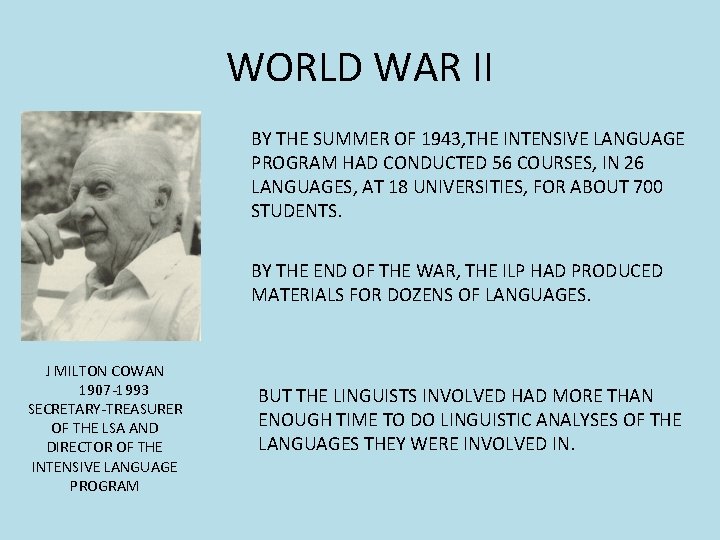
WORLD WAR II BY THE SUMMER OF 1943, THE INTENSIVE LANGUAGE PROGRAM HAD CONDUCTED 56 COURSES, IN 26 LANGUAGES, AT 18 UNIVERSITIES, FOR ABOUT 700 STUDENTS. BY THE END OF THE WAR, THE ILP HAD PRODUCED MATERIALS FOR DOZENS OF LANGUAGES. J MILTON COWAN 1907 -1993 SECRETARY-TREASURER OF THE LSA AND DIRECTOR OF THE INTENSIVE LANGUAGE PROGRAM BUT THE LINGUISTS INVOLVED HAD MORE THAN ENOUGH TIME TO DO LINGUISTIC ANALYSES OF THE LANGUAGES THEY WERE INVOLVED IN.
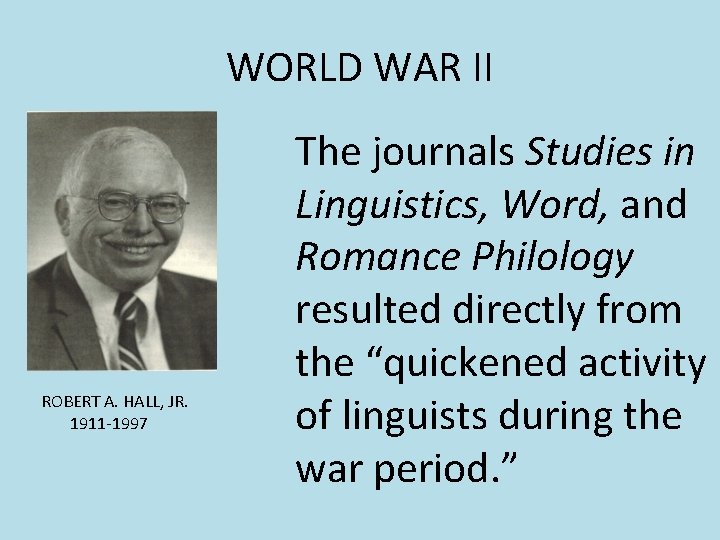
WORLD WAR II ROBERT A. HALL, JR. 1911 -1997 The journals Studies in Linguistics, Word, and Romance Philology resulted directly from the “quickened activity of linguists during the war period. ”
WHERE THE LSA HAS BEEN ‘HOUSED’ • 1924 — 1969: In the back room of whoever happened to be LSA Secretary. • 1969 — 1985: In space rented from the Center for Applied Linguistics. • 1985 — present: In a suite of offices that it owns.
THE BIGGEST CHANGE IN THE LSA — FROM THE MID 1930 S TO THE MID 1940 S • The LSA went from an organization dominated by language-and-literature people to one dominated by descriptive linguists and structurally-oriented historical linguists.
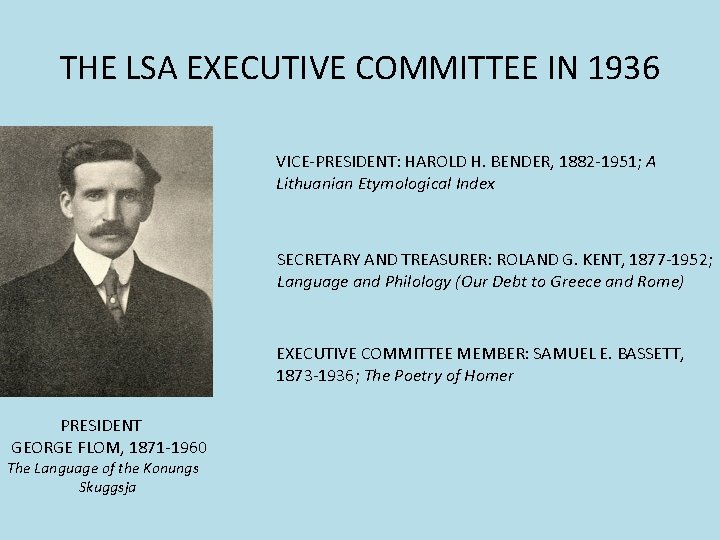
THE LSA EXECUTIVE COMMITTEE IN 1936 VICE-PRESIDENT: HAROLD H. BENDER, 1882 -1951; A Lithuanian Etymological Index SECRETARY AND TREASURER: ROLAND G. KENT, 1877 -1952; Language and Philology (Our Debt to Greece and Rome) EXECUTIVE COMMITTEE MEMBER: SAMUEL E. BASSETT, 1873 -1936; The Poetry of Homer PRESIDENT GEORGE FLOM, 1871 -1960 The Language of the Konungs Skuggsja
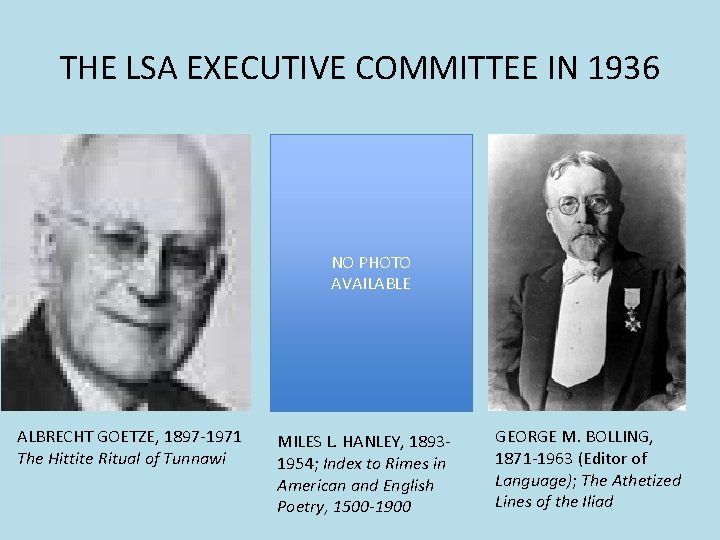
THE LSA EXECUTIVE COMMITTEE IN 1936 NO PHOTO AVAILABLE ALBRECHT GOETZE, 1897 -1971 The Hittite Ritual of Tunnawi MILES L. HANLEY, 18931954; Index to Rimes in American and English Poetry, 1500 -1900 GEORGE M. BOLLING, 1871 -1963 (Editor of Language); The Athetized Lines of the Iliad
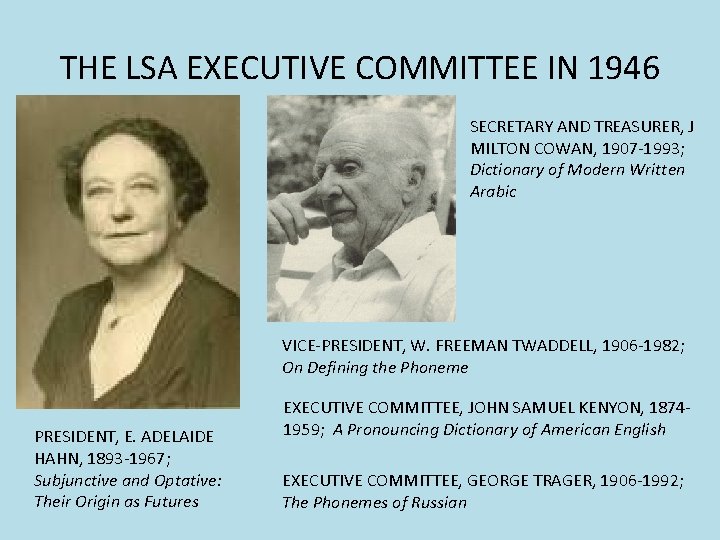
THE LSA EXECUTIVE COMMITTEE IN 1946 SECRETARY AND TREASURER, J MILTON COWAN, 1907 -1993; Dictionary of Modern Written Arabic VICE-PRESIDENT, W. FREEMAN TWADDELL, 1906 -1982; On Defining the Phoneme PRESIDENT, E. ADELAIDE HAHN, 1893 -1967; Subjunctive and Optative: Their Origin as Futures EXECUTIVE COMMITTEE, JOHN SAMUEL KENYON, 18741959; A Pronouncing Dictionary of American English EXECUTIVE COMMITTEE, GEORGE TRAGER, 1906 -1992; The Phonemes of Russian
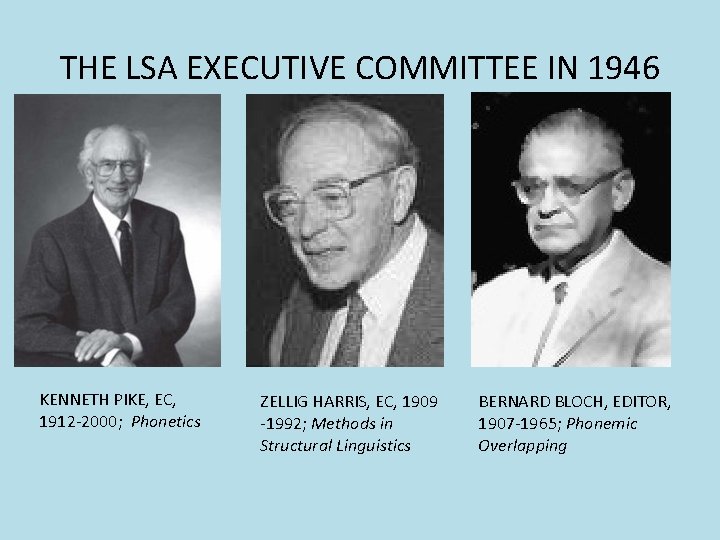
THE LSA EXECUTIVE COMMITTEE IN 1946 KENNETH PIKE, EC, 1912 -2000; Phonetics ZELLIG HARRIS, EC, 1909 -1992; Methods in Structural Linguistics BERNARD BLOCH, EDITOR, 1907 -1965; Phonemic Overlapping
GENERATIVE GRAMMAR AND THE LSA • People were talking about a ‘Chomskyan revolution’ in the field as early as the mid 1960 s. • But the first generative-majority LSA Executive Committee was not until 1992 — being very generous about who to call a ‘generative grammarian’.
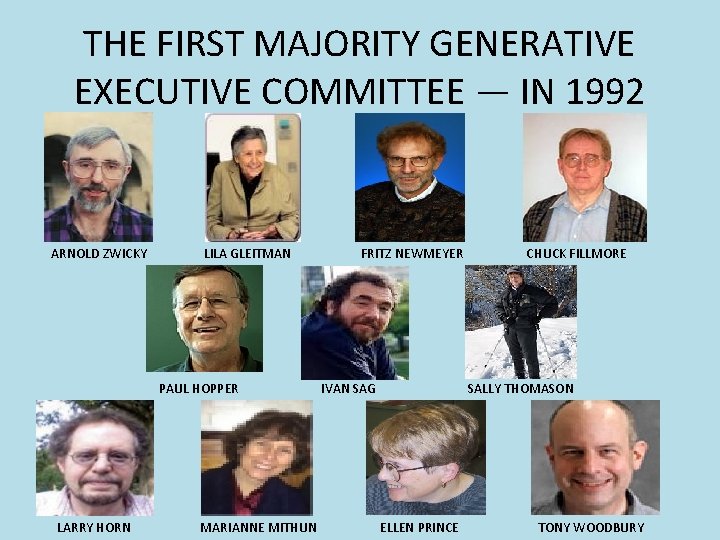
THE FIRST MAJORITY GENERATIVE EXECUTIVE COMMITTEE — IN 1992 ARNOLD ZWICKY LILA GLEITMAN PAUL HOPPER LARRY HORN MARIANNE MITHUN FRITZ NEWMEYER IVAN SAG CHUCK FILLMORE SALLY THOMASON ELLEN PRINCE TONY WOODBURY
GENERATIVE GRAMMAR AND THE LSA • The number of members of the EC involved in developing the latest model of syntax from MIT has ranged from zero to one. • On the other hand, a majority of papers presented at the annual meeting have been generative-oriented since the 1970 s.
LSA MEETINGS • Parallel sessions were first instituted in 1968 — to much opposition. • Many members though that every attendee should be able to go to (and understand) every talk.
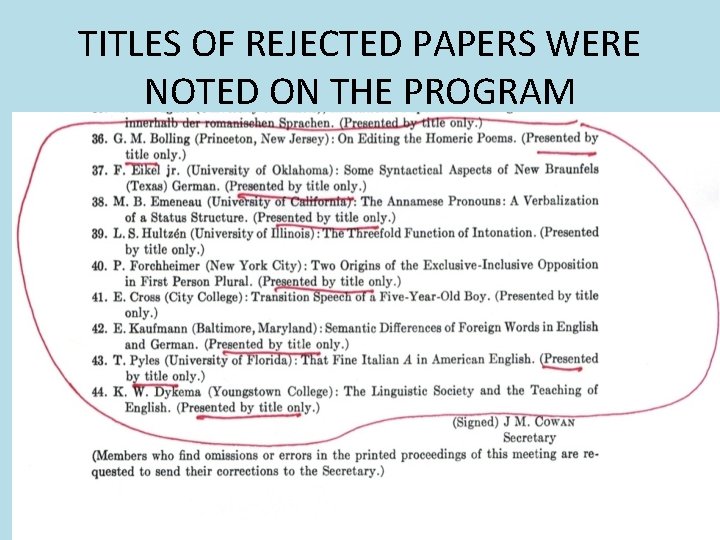
TITLES OF REJECTED PAPERS WERE NOTED ON THE PROGRAM
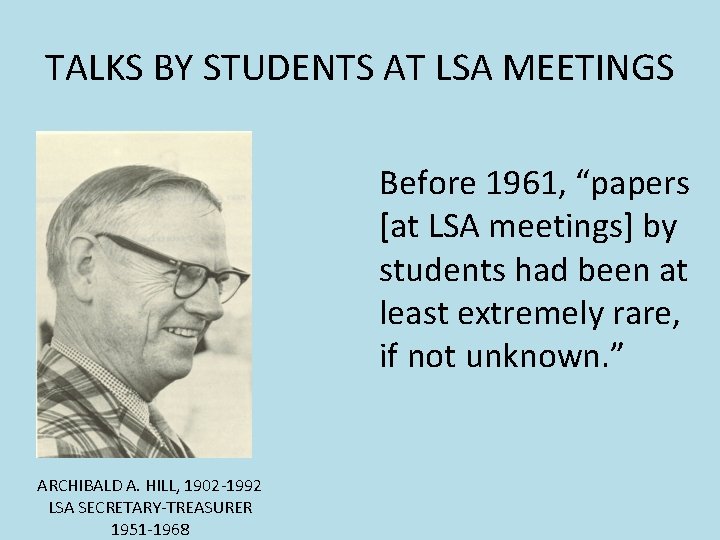
TALKS BY STUDENTS AT LSA MEETINGS Before 1961, “papers [at LSA meetings] by students had been at least extremely rare, if not unknown. ” ARCHIBALD A. HILL, 1902 -1992 LSA SECRETARY-TREASURER 1951 -1968
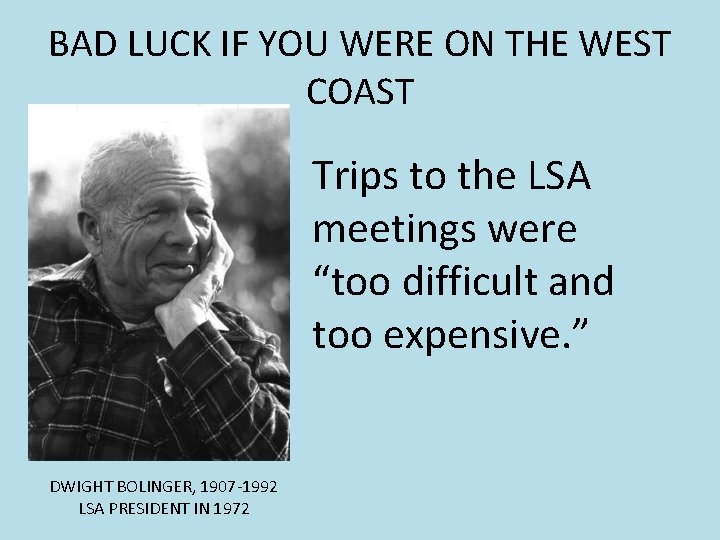
BAD LUCK IF YOU WERE ON THE WEST COAST Trips to the LSA meetings were “too difficult and too expensive. ” DWIGHT BOLINGER, 1907 -1992 LSA PRESIDENT IN 1972
BAD LUCK IF YOU WERE ON THE WEST COAST • The first 2 members of the EC from the west coast — 1933 and 1938 — couldn’t make it to the annual meetings (Washington and New York) • The first President from the West Coast — A. L. Kroeber in 1940 — made it to the annual meeting in Providence, but couldn’t make it to the summer meeting in Ann Arbor • Only one other West Coast president in the 1940 s and only 2 in the 1950 s • After then proportional to their numbers in the Society
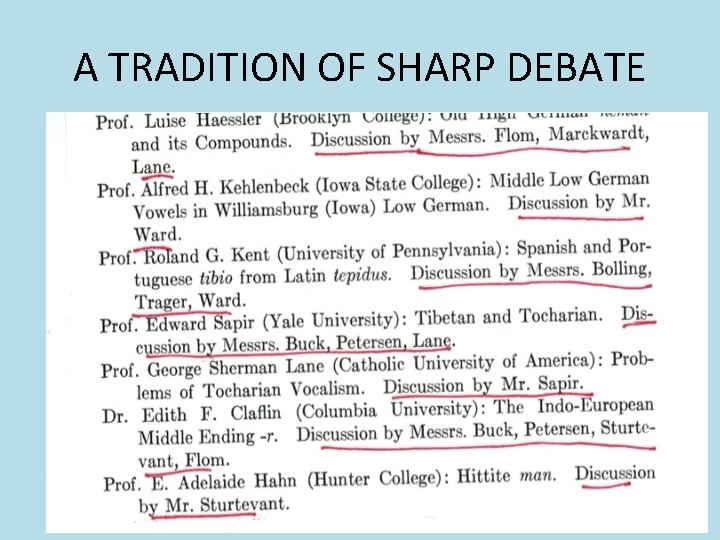
A TRADITION OF SHARP DEBATE Archibald Hill : Some papers in the early days ‘were met with hostile laughter’. Edgar Sturtevant commented after a talk: ‘This is the worst paper ever given before the Linguistic Society’.
A TRADITION OF SHARP DEBATE
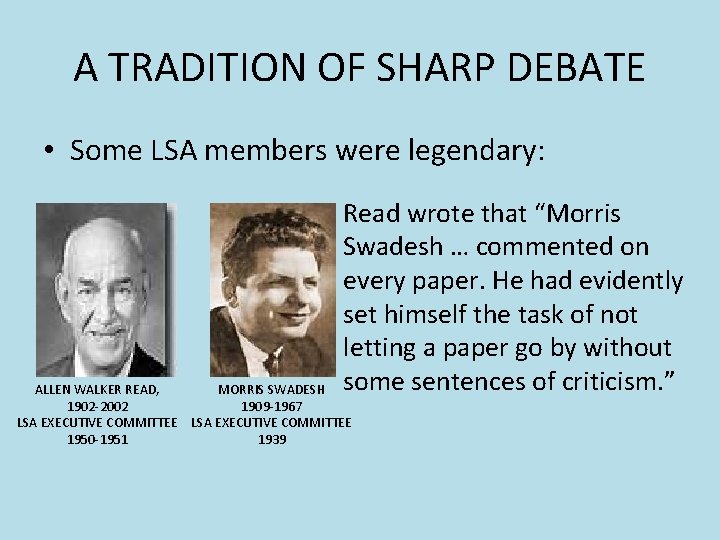
A TRADITION OF SHARP DEBATE • Some LSA members were legendary: Read wrote that “Morris Swadesh … commented on every paper. He had evidently set himself the task of not letting a paper go by without some sentences of criticism. ” MORRIS SWADESH ALLEN WALKER READ, 1909 -1967 1902 -2002 LSA EXECUTIVE COMMITTEE 1939 1950 -1951
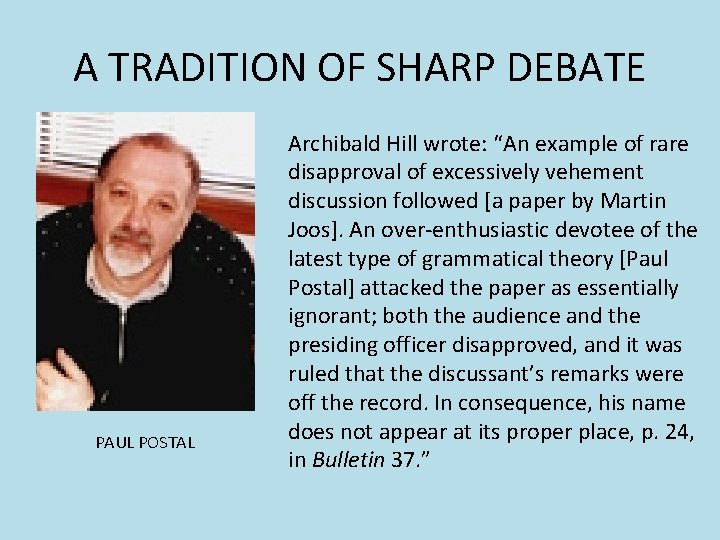
A TRADITION OF SHARP DEBATE PAUL POSTAL Archibald Hill wrote: “An example of rare disapproval of excessively vehement discussion followed [a paper by Martin Joos]. An over-enthusiastic devotee of the latest type of grammatical theory [Paul Postal] attacked the paper as essentially ignorant; both the audience and the presiding officer disapproved, and it was ruled that the discussant’s remarks were off the record. In consequence, his name does not appear at its proper place, p. 24, in Bulletin 37. ”
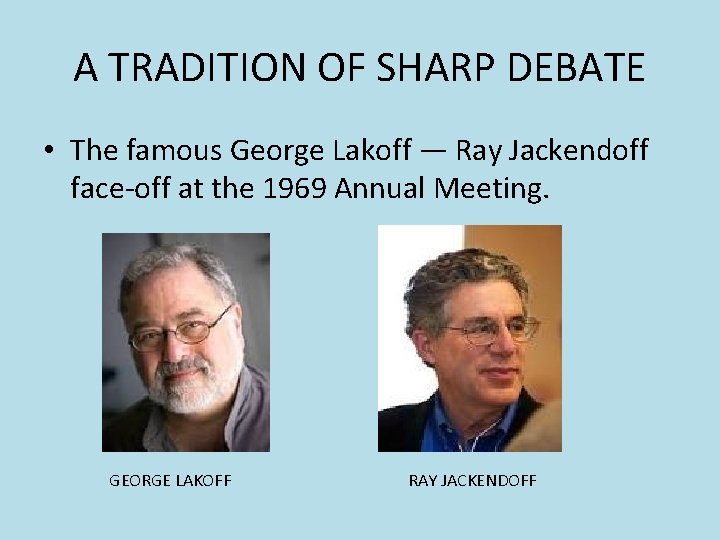
A TRADITION OF SHARP DEBATE • The famous George Lakoff — Ray Jackendoff face-off at the 1969 Annual Meeting. GEORGE LAKOFF RAY JACKENDOFF
A TRADITION OF SHARP DEBATE • Meetings are pretty tame now. Why? • Maybe because people tend to go only to talks that they know in advance that they will agree with?
THANK YOU!!!!!