
The History of the Earth Origin of the









- Slides: 43
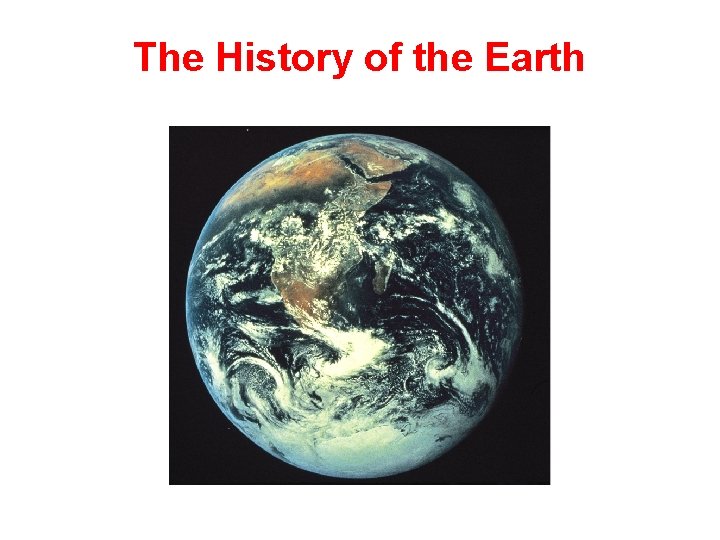
The History of the Earth
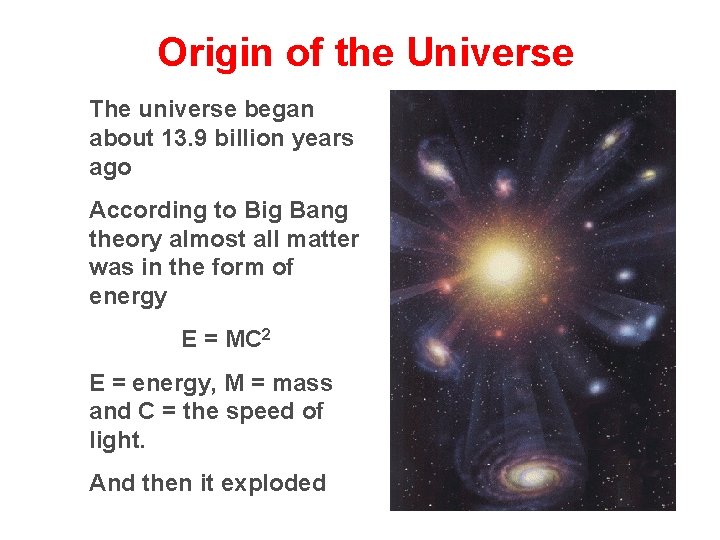
Origin of the Universe The universe began about 13. 9 billion years ago According to Big Bang theory almost all matter was in the form of energy E = MC 2 E = energy, M = mass and C = the speed of light. And then it exploded
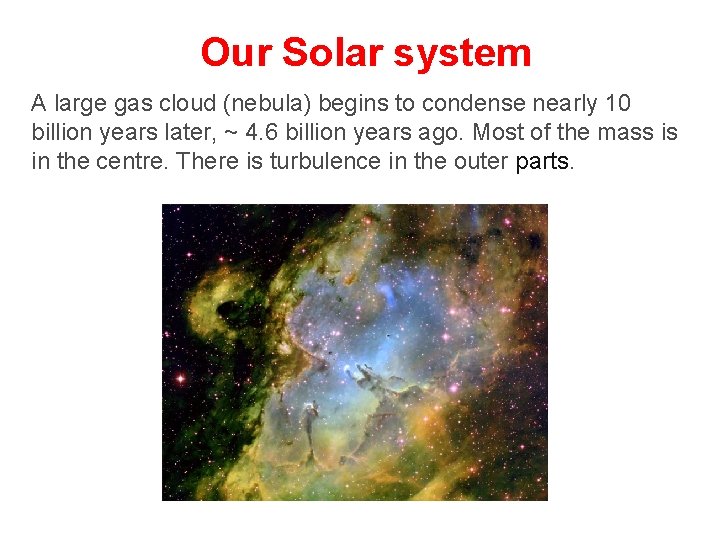
Our Solar system A large gas cloud (nebula) begins to condense nearly 10 billion years later, ~ 4. 6 billion years ago. Most of the mass is in the centre. There is turbulence in the outer parts.
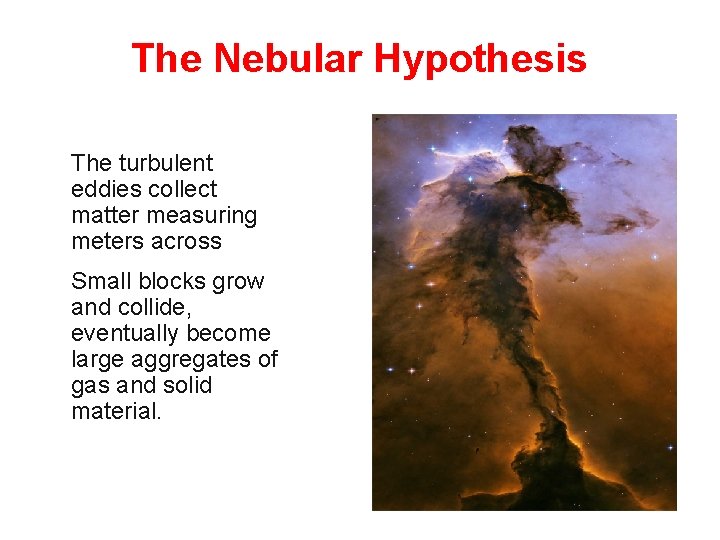
The Nebular Hypothesis The turbulent eddies collect matter measuring meters across Small blocks grow and collide, eventually become large aggregates of gas and solid material.
False Color Image of Protostar The multi-colored area shows a dust disk surrounding a newborn star The red-orange area at the center represents the brightest region, which contains the young star It is surrounded by the cooler, dusty disk (yellow, green and blue)
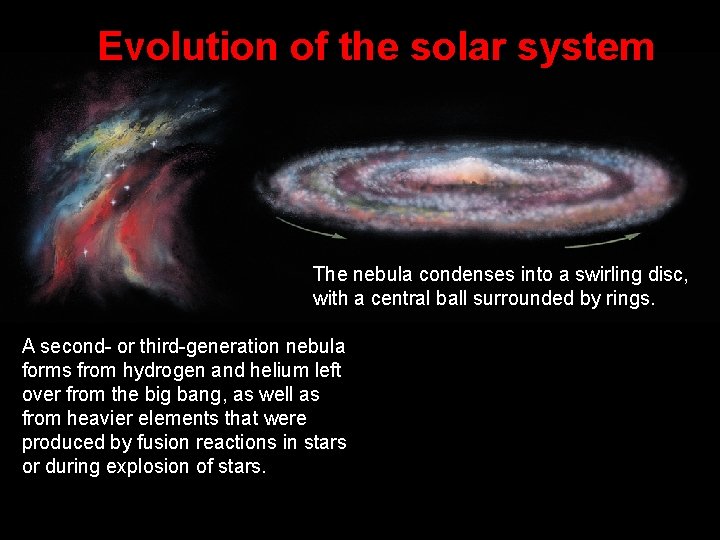
Evolution of the solar system The nebula condenses into a swirling disc, with a central ball surrounded by rings. A second- or third-generation nebula forms from hydrogen and helium left over from the big bang, as well as from heavier elements that were produced by fusion reactions in stars or during explosion of stars.
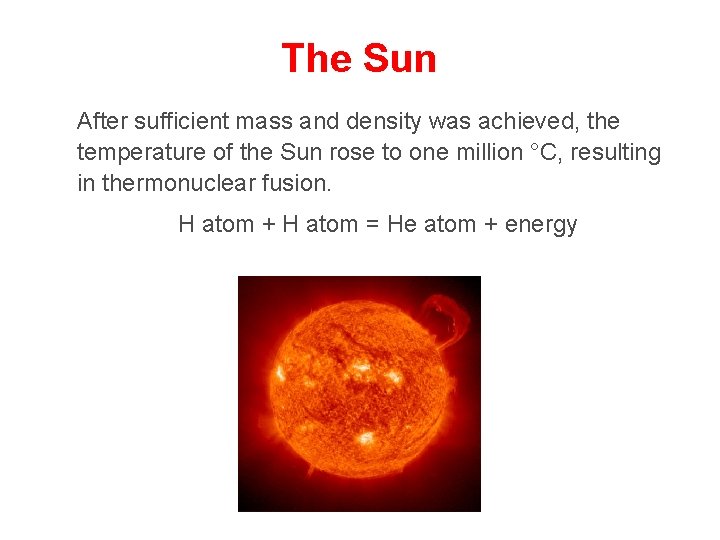
The Sun After sufficient mass and density was achieved, the temperature of the Sun rose to one million °C, resulting in thermonuclear fusion. H atom + H atom = He atom + energy
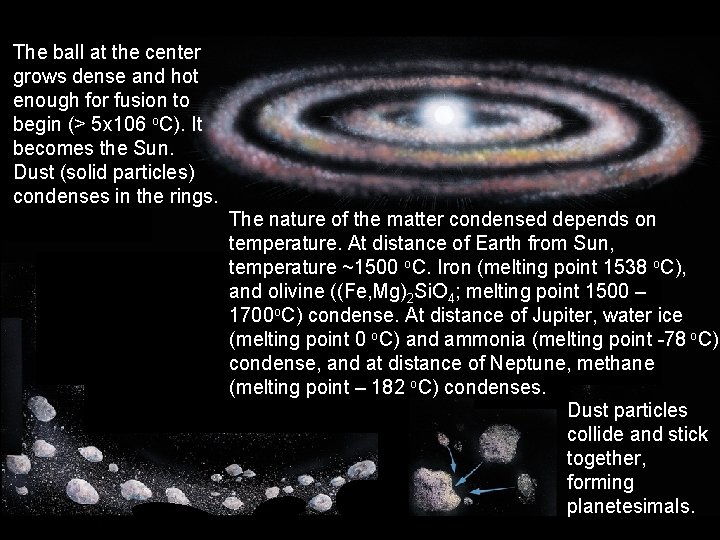
The ball at the center grows dense and hot enough for fusion to begin (> 5 x 10⁶ o. C). It becomes the Sun. Dust (solid particles) condenses in the rings. The nature of the matter condensed depends on temperature. At distance of Earth from Sun, temperature ~1500 o. C. Iron (melting point 1538 o. C), and olivine ((Fe, Mg)2 Si. O 4; melting point 1500 – 1700 o. C) condense. At distance of Jupiter, water ice (melting point 0 o. C) and ammonia (melting point -78 o. C) condense, and at distance of Neptune, methane (melting point – 182 o. C) condenses. Dust particles collide and stick together, forming planetesimals.
Protoplanets Gravitational forces allow the inner planets to accrue and compact solid matter (including light and heavy atoms) Solar radiation blew gases (primarily hydrogen, helium) away from inner planets These gases were collected and condensed into the gas giants (Jupiter, Saturn, Uranus, Neptune) Beyond Neptune, ice and frozen gases form Pluto, Sedna and the Kuiper Belt Objects Left-over debris form comets and asteroids
Birth of the Solar System
Planetesimals grow by continuous collisions. Gradually a proto-Earth develops. The Interior heats up and becomes soft. Gravity reshapes the proto-Earth into a sphere.
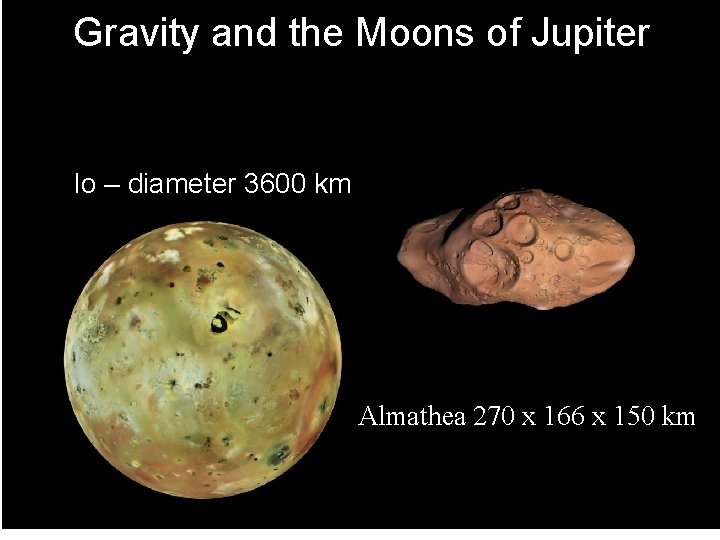
Gravity and the Moons of Jupiter Io – diameter 3600 km Almathea 270 x 166 x 150 km
The Solar System
The Age of the Earth The Earth is ~ 4. 57 million years old Meteorites give us access to debris left over from the formation of the solar system We can date meteorites using radioactive isotopes and their decay products
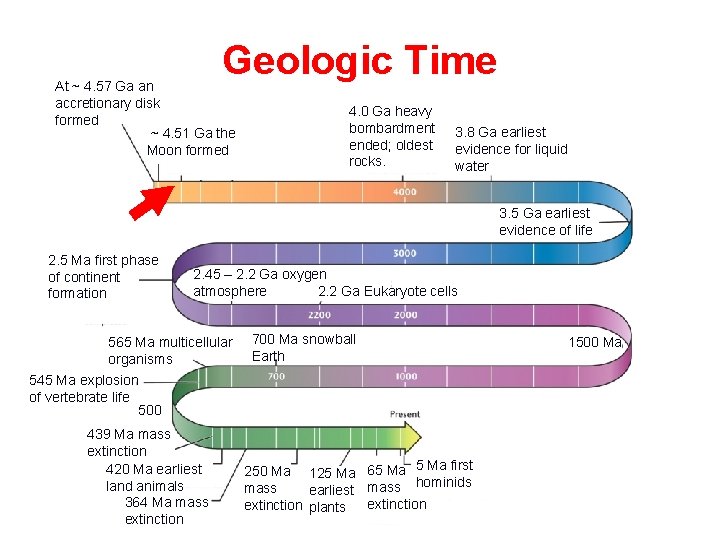
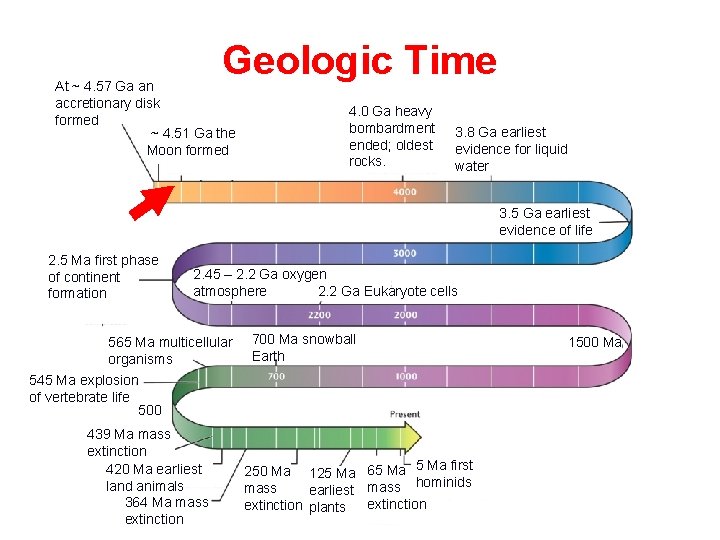
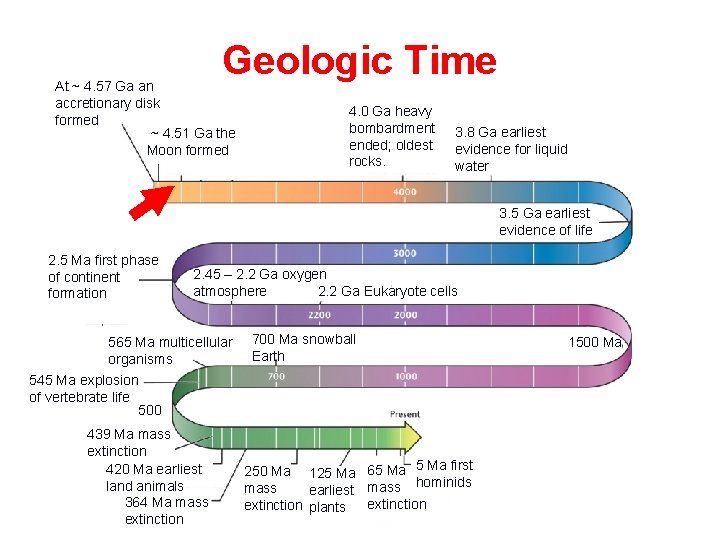
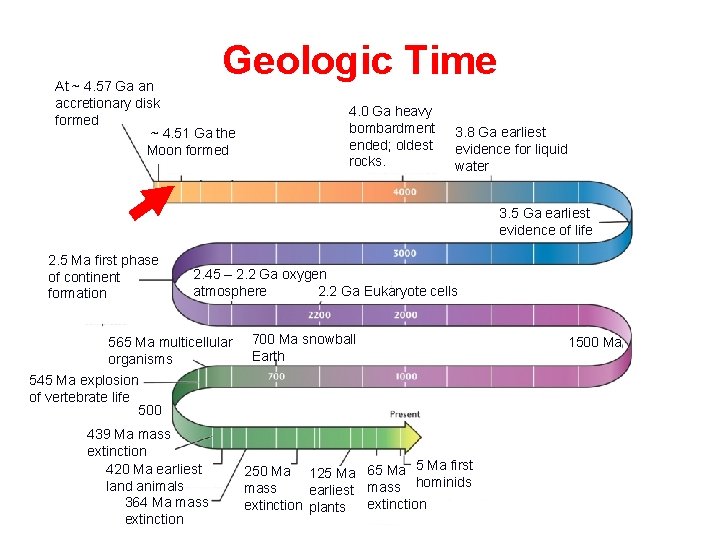
Geologic Time At ~ 4. 57 Ga an accretionary disk formed ~ 4. 51 Ga the Moon formed 4. 0 Ga heavy bombardment ended; oldest rocks. 3. 8 Ga earliest evidence for liquid water 3. 5 Ga earliest evidence of life 2. 5 Ma first phase of continent formation 2. 45 – 2. 2 Ga oxygen 2. 2 Ga Eukaryote cells atmosphere 565 Ma multicellular organisms 545 Ma explosion of vertebrate life 500 439 Ma mass extinction 420 Ma earliest land animals 364 Ma mass extinction 700 Ma snowball Earth 250 Ma 125 Ma 65 Ma first hominids mass earliest mass extinction plants 1500 Ma
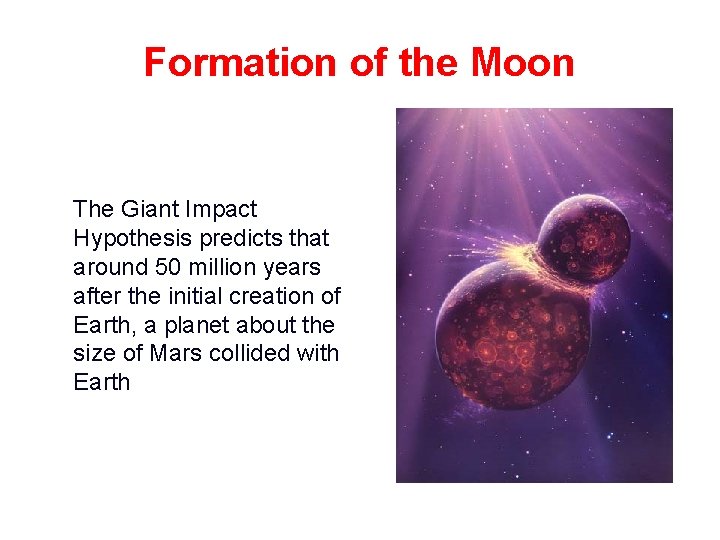
Formation of the Moon The Giant Impact Hypothesis predicts that around 50 million years after the initial creation of Earth, a planet about the size of Mars collided with Earth
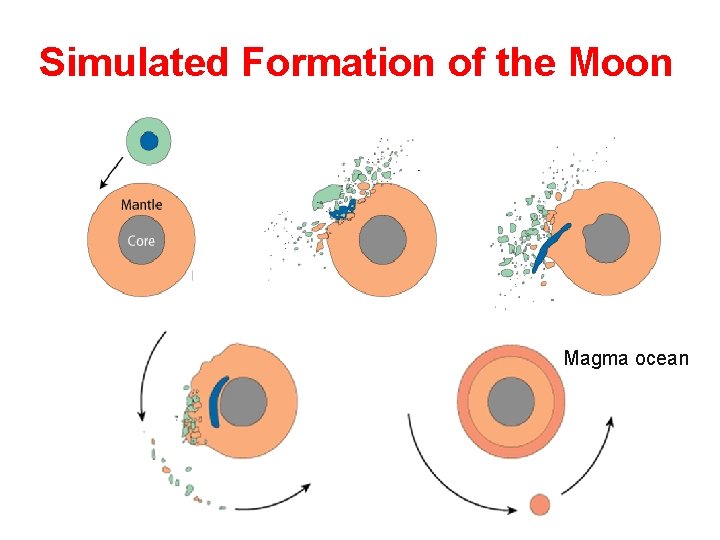
Simulated Formation of the Moon Magma ocean
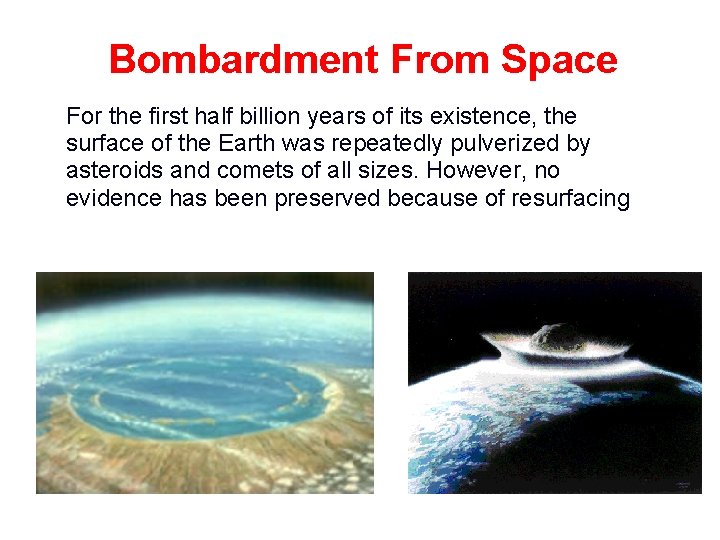
Bombardment From Space For the first half billion years of its existence, the surface of the Earth was repeatedly pulverized by asteroids and comets of all sizes. However, no evidence has been preserved because of resurfacing
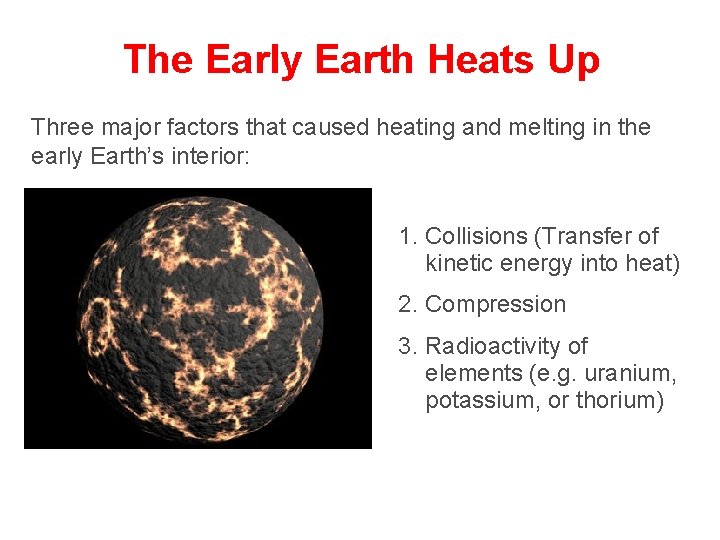
The Early Earth Heats Up Three major factors that caused heating and melting in the early Earth’s interior: 1. Collisions (Transfer of kinetic energy into heat) 2. Compression 3. Radioactivity of elements (e. g. uranium, potassium, or thorium)
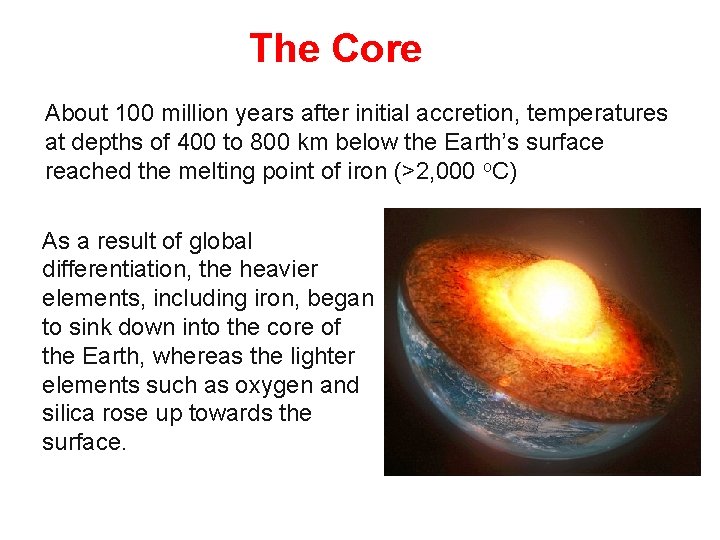
The Core About 100 million years after initial accretion, temperatures at depths of 400 to 800 km below the Earth’s surface reached the melting point of iron (>2, 000 o. C) As a result of global differentiation, the heavier elements, including iron, began to sink down into the core of the Earth, whereas the lighter elements such as oxygen and silica rose up towards the surface.
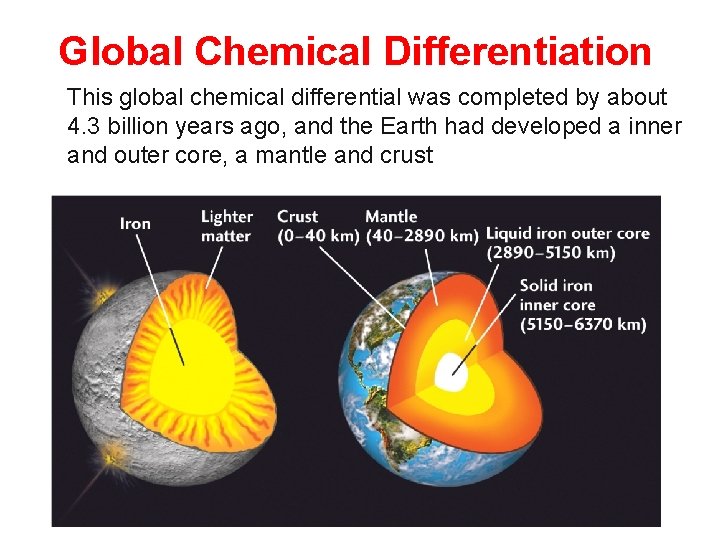
Global Chemical Differentiation This global chemical differential was completed by about 4. 3 billion years ago, and the Earth had developed a inner and outer core, a mantle and crust
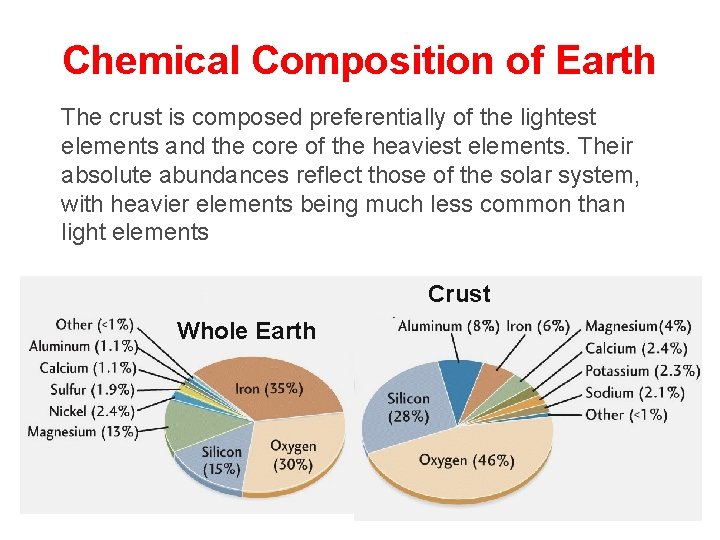
Chemical Composition of Earth The crust is composed preferentially of the lightest elements and the core of the heaviest elements. Their absolute abundances reflect those of the solar system, with heavier elements being much less common than light elements Crust Whole Earth
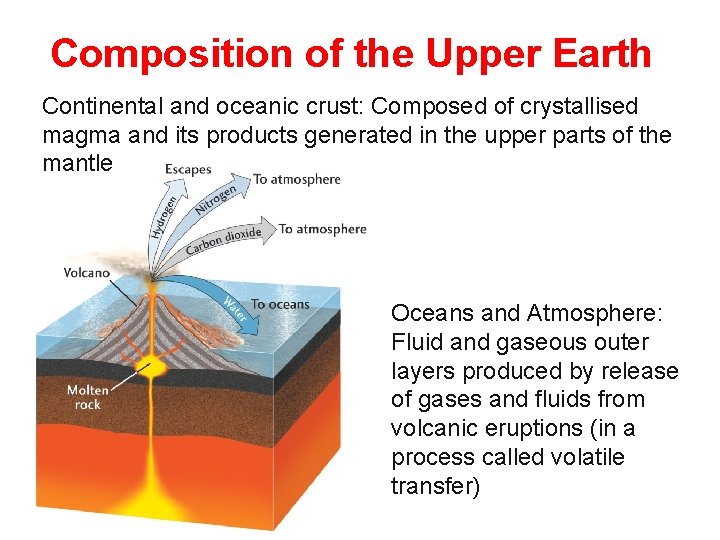
Composition of the Upper Earth Continental and oceanic crust: Composed of crystallised magma and its products generated in the upper parts of the mantle Oceans and Atmosphere: Fluid and gaseous outer layers produced by release of gases and fluids from volcanic eruptions (in a process called volatile transfer)
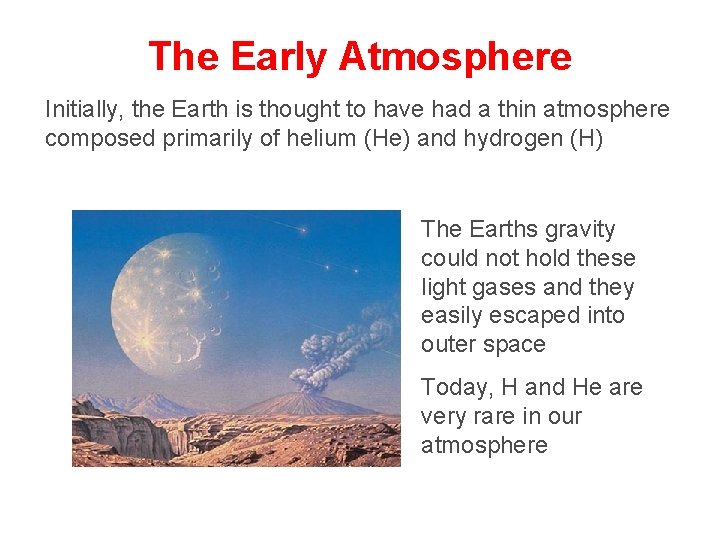
The Early Atmosphere Initially, the Earth is thought to have had a thin atmosphere composed primarily of helium (He) and hydrogen (H) The Earths gravity could not hold these light gases and they easily escaped into outer space Today, H and He are very rare in our atmosphere
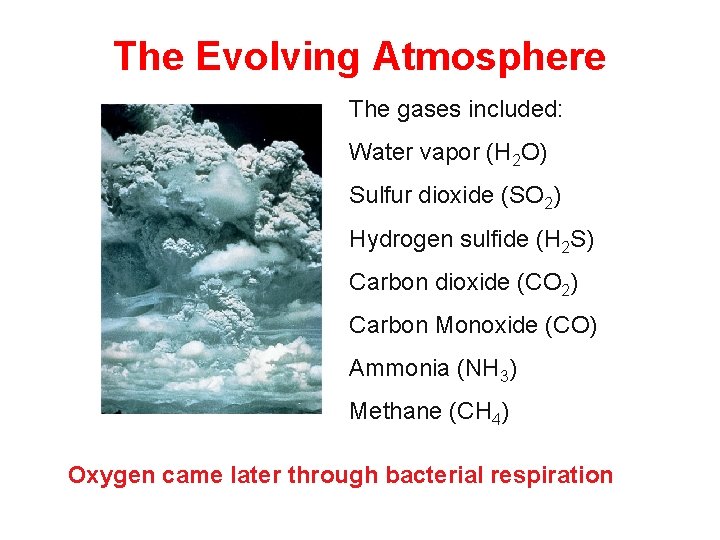
The Evolving Atmosphere For the next several hundred million years, volcanic out -gassing began to create a thicker atmosphere composed of a wide variety of gases
The Evolving Atmosphere The gases included: Water vapor (H 2 O) Sulfur dioxide (SO 2) Hydrogen sulfide (H 2 S) Carbon dioxide (CO 2) Carbon Monoxide (CO) Ammonia (NH 3) Methane (CH 4) Oxygen came later through bacterial respiration
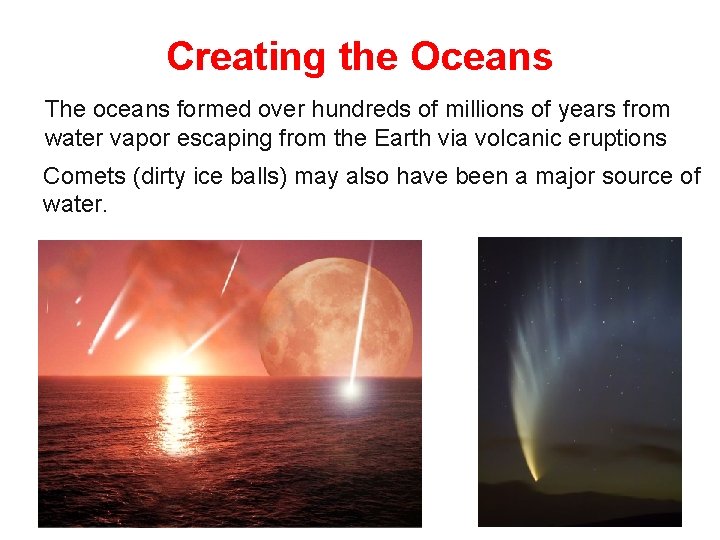
Creating the Oceans The oceans formed over hundreds of millions of years from water vapor escaping from the Earth via volcanic eruptions Comets (dirty ice balls) may also have been a major source of water.
Geologic Time At ~ 4. 57 Ga an accretionary disk formed ~ 4. 51 Ga the Moon formed 4. 0 Ga heavy bombardment ended; oldest rocks. 3. 8 Ga earliest evidence for liquid water 3. 5 Ga earliest evidence of life 2. 5 Ma first phase of continent formation 2. 45 – 2. 2 Ga oxygen 2. 2 Ga Eukaryote cells atmosphere 565 Ma multicellular organisms 545 Ma explosion of vertebrate life 500 439 Ma mass extinction 420 Ma earliest land animals 364 Ma mass extinction 700 Ma snowball Earth 250 Ma 125 Ma 65 Ma first hominids mass earliest mass extinction plants 1500 Ma
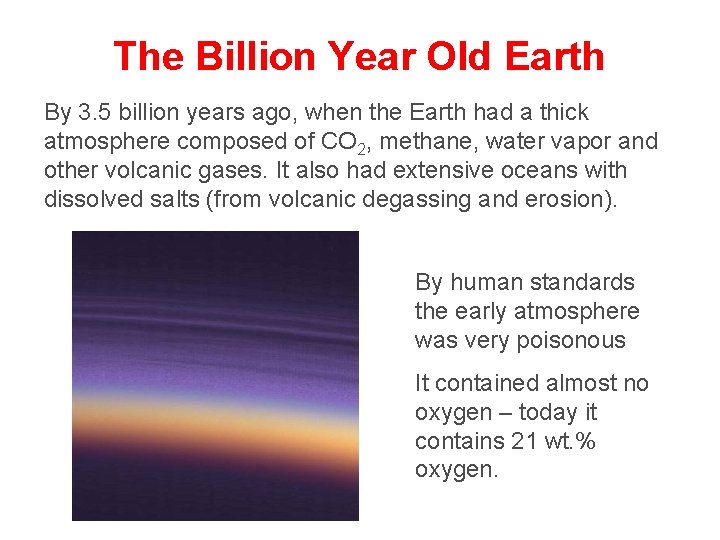
The Billion Year Old Earth By 3. 5 billion years ago, when the Earth had a thick atmosphere composed of CO 2, methane, water vapor and other volcanic gases. It also had extensive oceans with dissolved salts (from volcanic degassing and erosion). By human standards the early atmosphere was very poisonous It contained almost no oxygen – today it contains 21 wt. % oxygen.
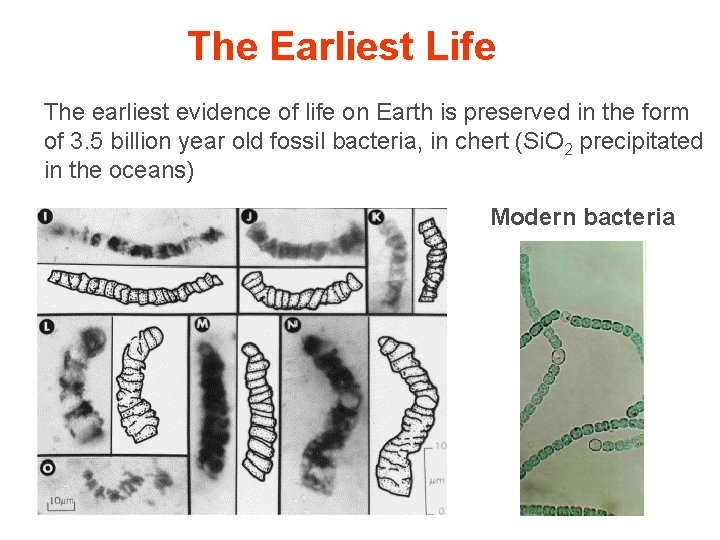
The Earliest Life Bacteria in 3. 5 billion yr chert, Australia Modern bacteria The earliest evidence of life on Earth is preserved in the form of 3. 5 billion year old fossil bacteria, in chert (Si. O 2 precipitated in the oceans) Modern bacteria
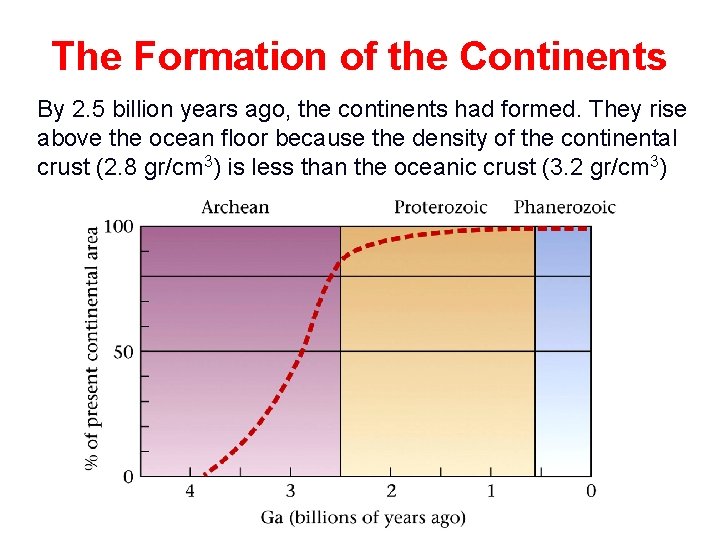
The Formation of the Continents By 2. 5 billion years ago, the continents had formed. They rise above the ocean floor because the density of the continental crust (2. 8 gr/cm 3) is less than the oceanic crust (3. 2 gr/cm 3)
Geologic Time At ~ 4. 57 Ga an accretionary disk formed ~ 4. 51 Ga the Moon formed 4. 0 Ga heavy bombardment ended; oldest rocks. 3. 8 Ga earliest evidence for liquid water 3. 5 Ga earliest evidence of life 2. 5 Ma first phase of continent formation 2. 45 – 2. 2 Ga oxygen 2. 2 Ga Eukaryote cells atmosphere 565 Ma multicellular organisms 545 Ma explosion of vertebrate life 500 439 Ma mass extinction 420 Ma earliest land animals 364 Ma mass extinction 700 Ma snowball Earth 250 Ma 125 Ma 65 Ma first hominids mass earliest mass extinction plants 1500 Ma
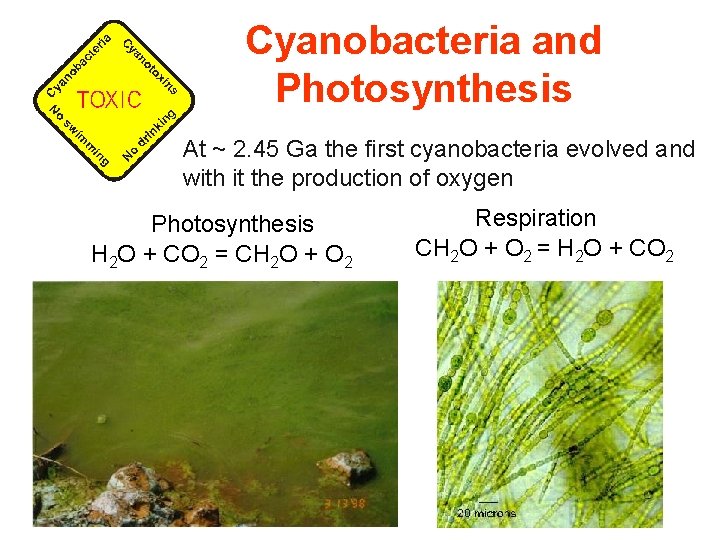
Cyanobacteria and Photosynthesis At ~ 2. 45 Ga the first cyanobacteria evolved and with it the production of oxygen Photosynthesis H 2 O + CO 2 = CH 2 O + O 2 Respiration CH 2 O + O 2 = H 2 O + CO 2
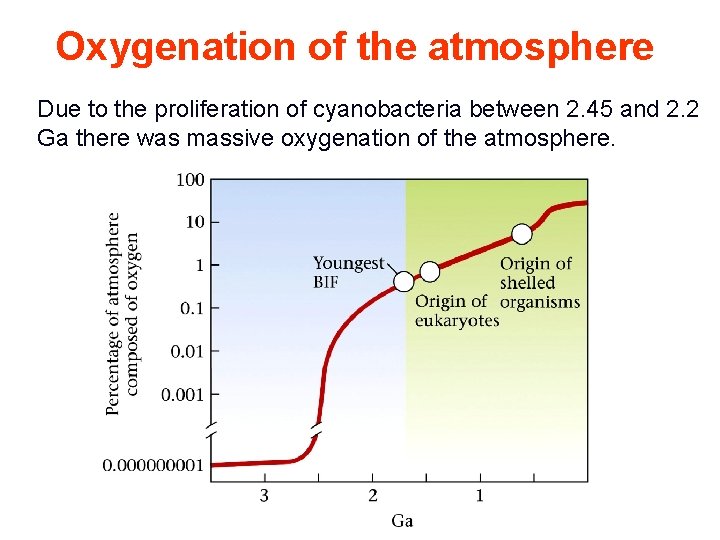
Oxygenation of the atmosphere Due to the proliferation of cyanobacteria between 2. 45 and 2. 2 Ga there was massive oxygenation of the atmosphere.
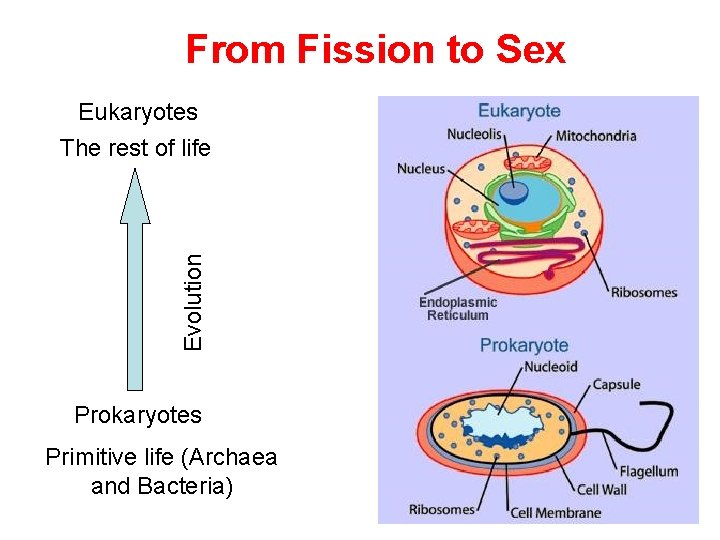
From Fission to Sex Eukaryotes Evolution The rest of life Prokaryotes Primitive life (Archaea and Bacteria)
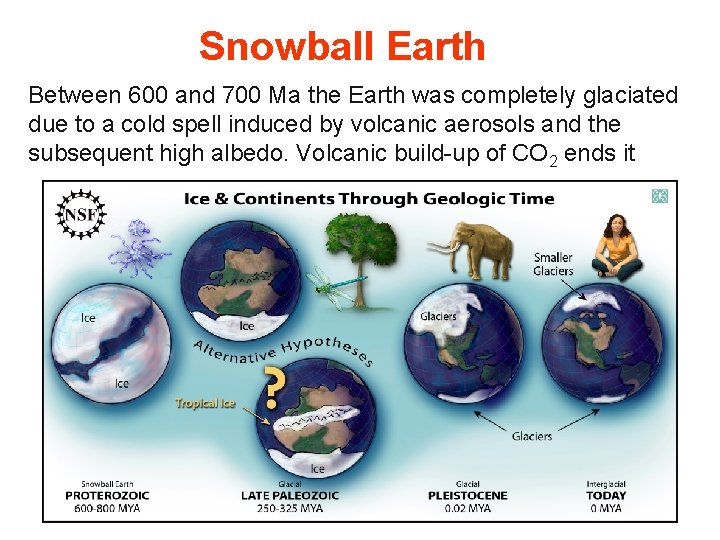
Snowball Earth Between 600 and 700 Ma the Earth was completely glaciated due to a cold spell induced by volcanic aerosols and the subsequent high albedo. Volcanic build-up of CO 2 ends it
Geologic Time At ~ 4. 57 Ga an accretionary disk formed ~ 4. 51 Ga the Moon formed 4. 0 Ga heavy bombardment ended; oldest rocks. 3. 8 Ga earliest evidence for liquid water 3. 5 Ga earliest evidence of life 2. 5 Ma first phase of continent formation 2. 45 – 2. 2 Ga oxygen 2. 2 Ga Eukaryote cells atmosphere 565 Ma multicellular organisms 545 Ma explosion of vertebrate life 500 439 Ma mass extinction 420 Ma earliest land animals 364 Ma mass extinction 700 Ma snowball Earth 250 Ma 125 Ma 65 Ma first hominids mass earliest mass extinction plants 1500 Ma
The Cambrian Explosion in Life At 545 Ma there was a massive explosion in life forms, during which all phyla present today formed. Reasons for the explosion may have been the development of the ozone layer, higher O 2 levels, elevated Ca, or ecological factors (e. g. , eyesight).
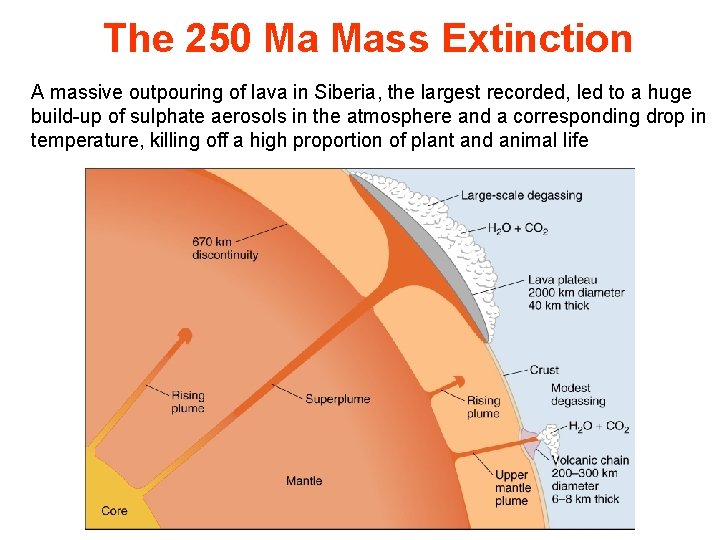
The 250 Ma Mass Extinction A massive outpouring of lava in Siberia, the largest recorded, led to a huge build-up of sulphate aerosols in the atmosphere and a corresponding drop in temperature, killing off a high proportion of plant and animal life
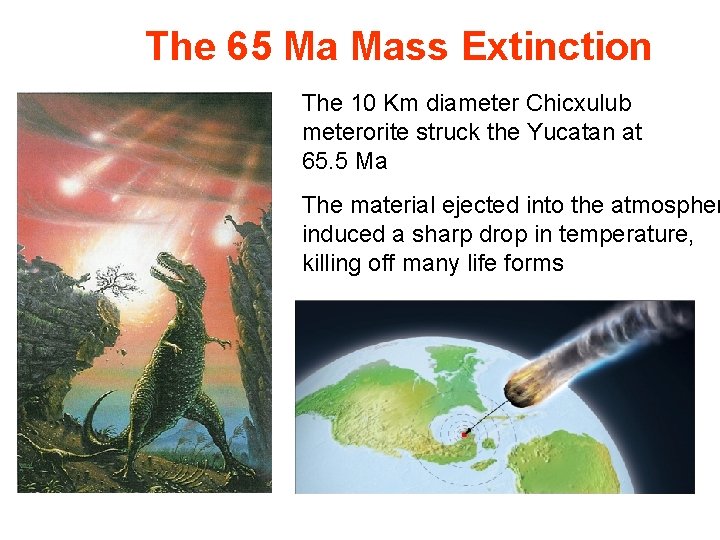
The 65 Ma Mass Extinction The 10 Km diameter Chicxulub meterorite struck the Yucatan at 65. 5 Ma The material ejected into the atmospher induced a sharp drop in temperature, killing off many life forms
The Arrival of the Hominids at 5 Ma
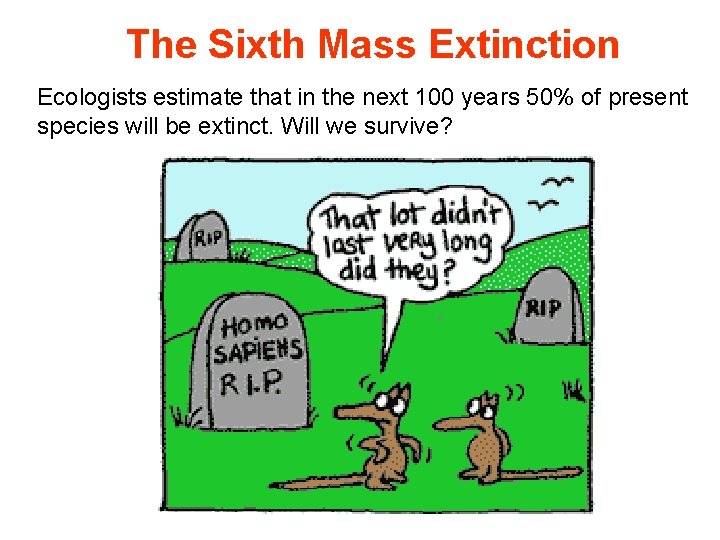
The Sixth Mass Extinction Ecologists estimate that in the next 100 years 50% of present species will be extinct. Will we survive?