
The History of the Atom Part 1 The

- Slides: 13
The History of the Atom Part 1 – The concept of the Atom
A long time ago, in a galaxy country far, far away There were two philosophers
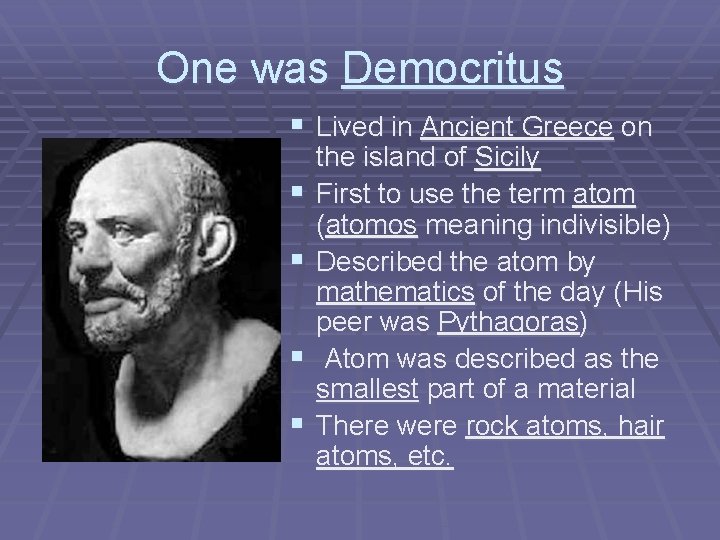
One was Democritus § Lived in Ancient Greece on § § the island of Sicily First to use the term atom (atomos meaning indivisible) Described the atom by mathematics of the day (His peer was Pythagoras) Atom was described as the smallest part of a material There were rock atoms, hair atoms, etc.
Democritus’s atom would have looked like this: § Solid and Indestructible § No electrons § No nucleus § No protons § No neutrons § No Experiments to support his ideas
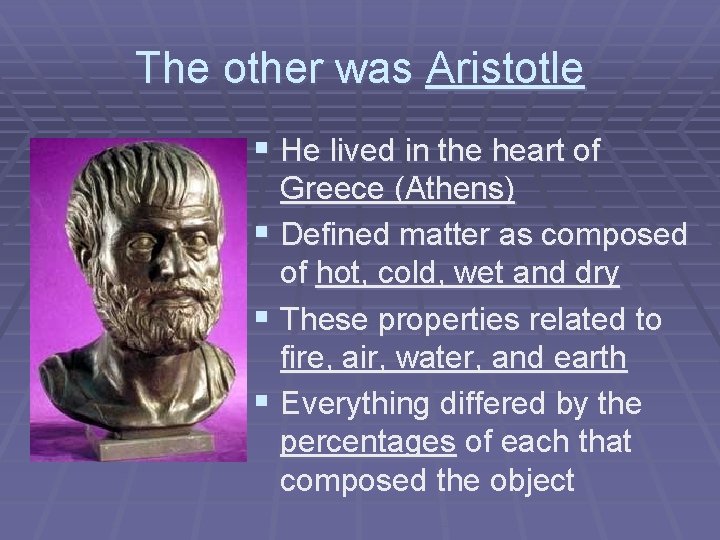
The other was Aristotle § He lived in the heart of Greece (Athens) § Defined matter as composed of hot, cold, wet and dry § These properties related to fire, air, water, and earth § Everything differed by the percentages of each that composed the object
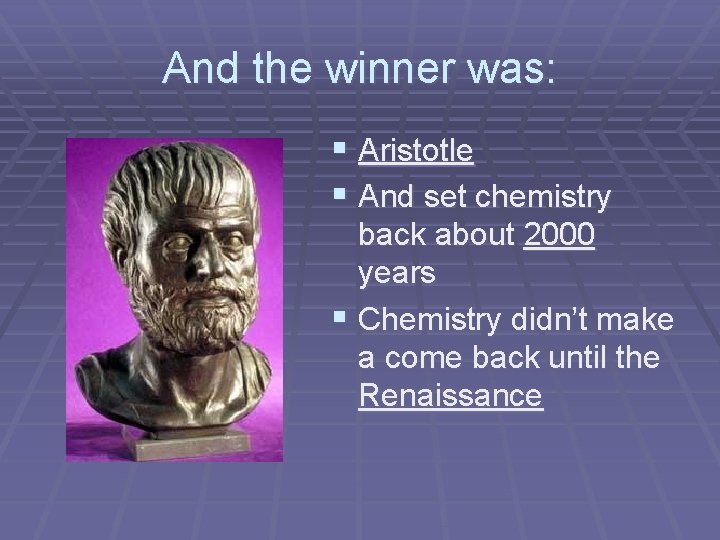
And the winner was: § Aristotle § And set chemistry back about 2000 years § Chemistry didn’t make a come back until the Renaissance
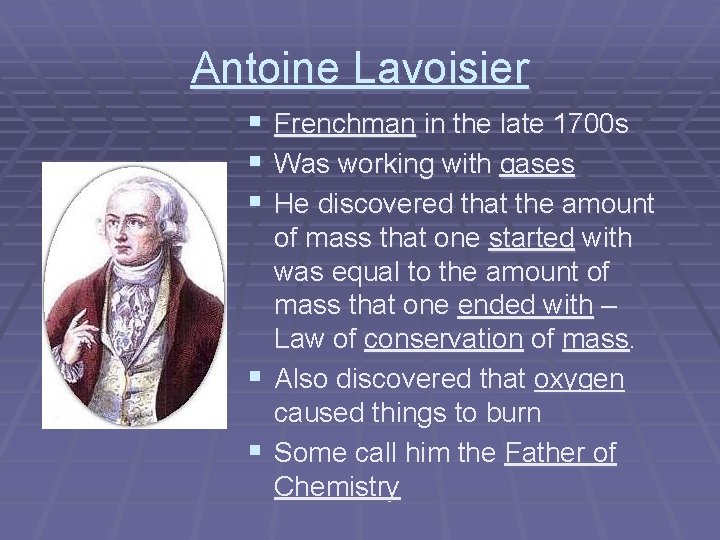
Antoine Lavoisier § Frenchman in the late 1700 s § Was working with gases § He discovered that the amount of mass that one started with was equal to the amount of mass that one ended with – Law of conservation of mass. § Also discovered that oxygen caused things to burn § Some call him the Father of Chemistry
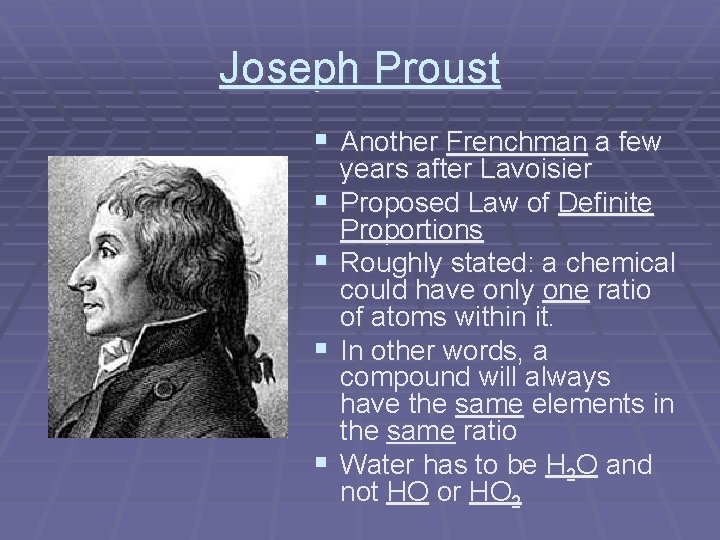
Joseph Proust § Another Frenchman a few § § years after Lavoisier Proposed Law of Definite Proportions Roughly stated: a chemical could have only one ratio of atoms within it. In other words, a compound will always have the same elements in the same ratio Water has to be H 2 O and not HO or HO 2
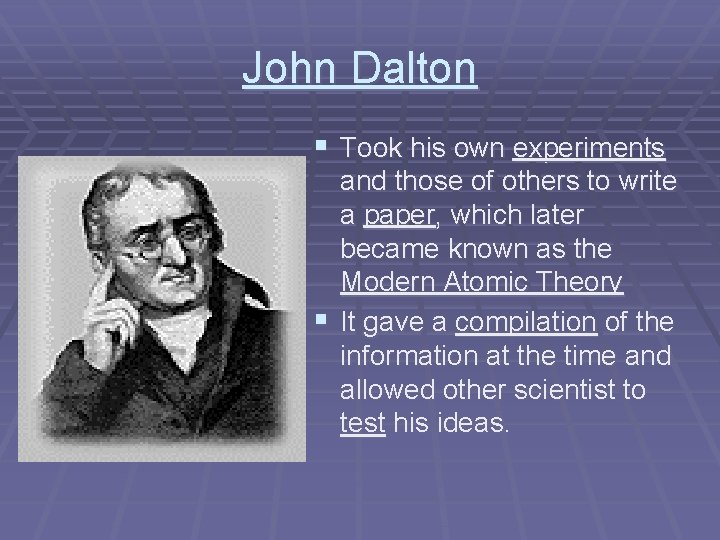
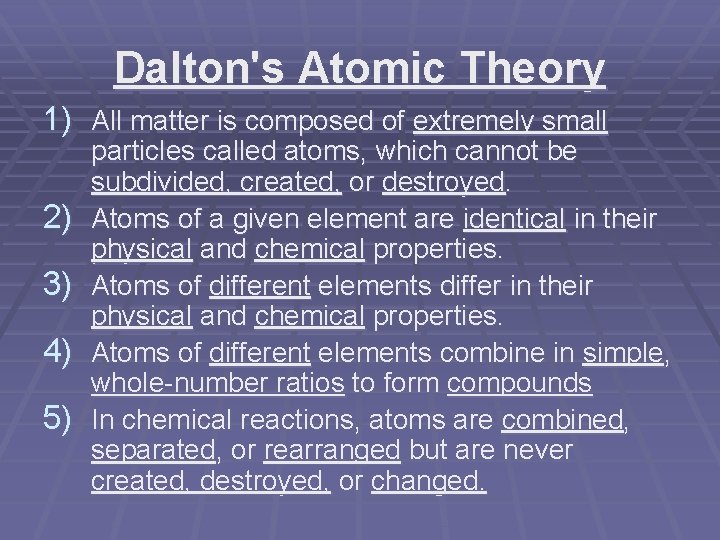
John Dalton § Took his own experiments and those of others to write a paper, which later became known as the Modern Atomic Theory § It gave a compilation of the information at the time and allowed other scientist to test his ideas.
Dalton's Atomic Theory 1) All matter is composed of extremely small 2) 3) 4) 5) particles called atoms, which cannot be subdivided, created, or destroyed. Atoms of a given element are identical in their physical and chemical properties. Atoms of different elements differ in their physical and chemical properties. Atoms of different elements combine in simple, whole-number ratios to form compounds In chemical reactions, atoms are combined, separated, or rearranged but are never created, destroyed, or changed.
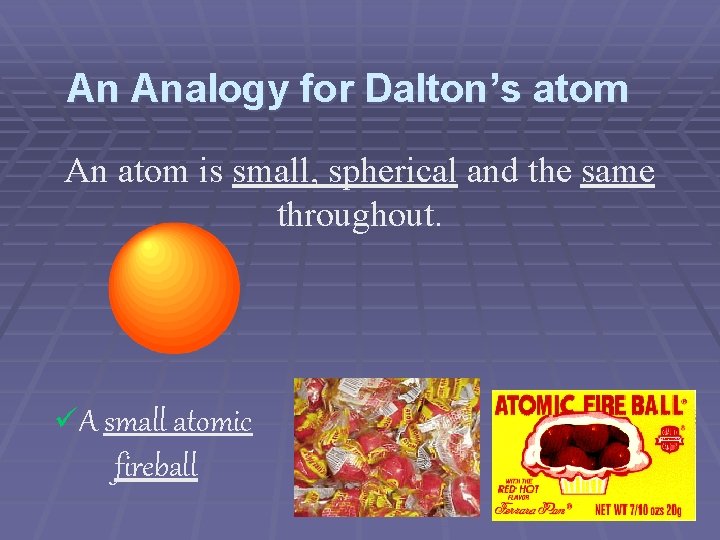
An Analogy for Dalton’s atom An atom is small, spherical and the same throughout. üA small atomic fireball
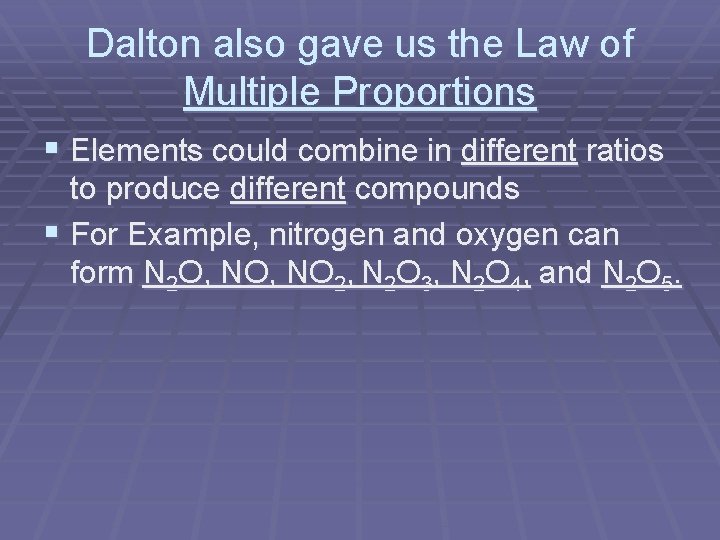
Dalton also gave us the Law of Multiple Proportions § Elements could combine in different ratios to produce different compounds § For Example, nitrogen and oxygen can form N 2 O, NO 2, N 2 O 3, N 2 O 4, and N 2 O 5.
His ideas weren’t 100% correct, but they gave scientist a good start