
The History of the Asilomar Guidelines Terasem Movement
- Slides: 7
The History of the Asilomar Guidelines Terasem Movement, Inc. 5 th Annual Workshop on Geoethical Nanotechnology Lori Rhodes lori@terasemcentral. org
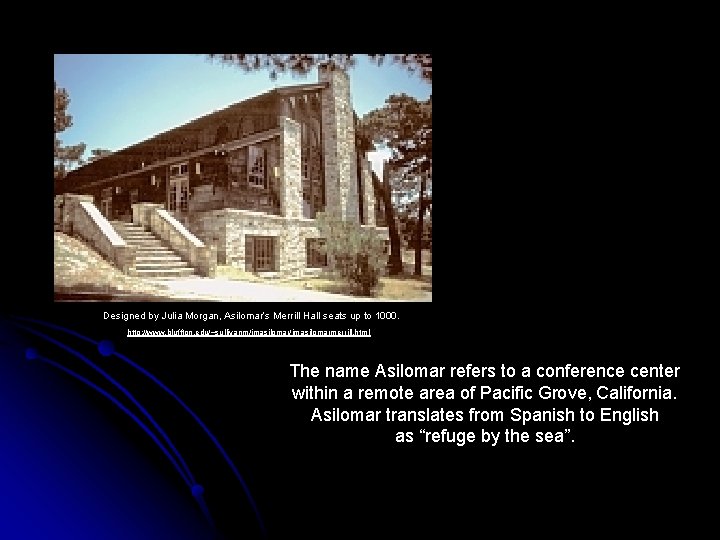
Designed by Julia Morgan, Asilomar’s Merrill Hall seats up to 1000. http: //www. bluffton. edu/~sullivanm/jmasilomarmerrill. html The name Asilomar refers to a conference center within a remote area of Pacific Grove, California. Asilomar translates from Spanish to English as “refuge by the sea”.
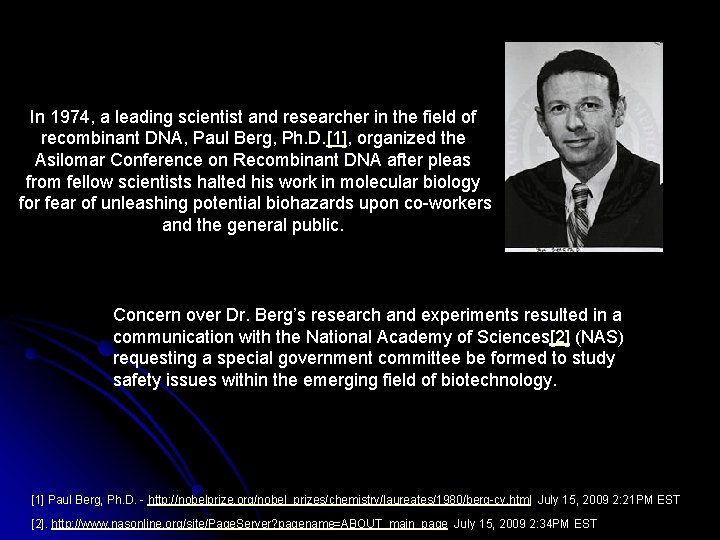
In 1974, a leading scientist and researcher in the field of recombinant DNA, Paul Berg, Ph. D. [1], organized the Asilomar Conference on Recombinant DNA after pleas from fellow scientists halted his work in molecular biology for fear of unleashing potential biohazards upon co-workers and the general public. Concern over Dr. Berg’s research and experiments resulted in a communication with the National Academy of Sciences[2] (NAS) requesting a special government committee be formed to study safety issues within the emerging field of biotechnology. [1] Paul Berg, Ph. D. - http: //nobelprize. org/nobel_prizes/chemistry/laureates/1980/berg-cv. html July 15, 2009 2: 21 PM EST [2]. http: //www. nasonline. org/site/Page. Server? pagename=ABOUT_main_page July 15, 2009 2: 34 PM EST
Conference Recommendations formulated within the Asilomar Conference were: Minimal risk level of containment was intended for experiments in which the biohazards could be accurately assessed and were expected to be minimal; l Low risk level of containment was appropriate for experiments that generated novel biotypes but where the available information indicated that the recombinant DNA could not either alter appreciably the ecological behavior of the recipient species , increase significantly its pathogenicity or prevent effective treatments of any resulting infections; l Moderate risk level of containment was intended for experiments in which there was a probability of generating an agent with a significant potential for pathogenicity or ecological disruption; l High risk level of containment was intended for experiments in which the potential for ecological disruption or pathogenicity of the modified organism could be severe and thereby pose a serious biohazard to laboratory personnel or to the public. [3] l [3] Berg et al. (1975), p. 1982
Prohibited Experiments These guidelines expressly forbid experiments involving the cloning of recombinant DNA taken from highly pathogenic organisms, those containing toxin genes, and any used in the making of products potentially harmful to humans, animals or plants as could not be contained by the [then] current safety precautions. [4] Berg et al. (1975), p. 1983
Conclusion The collective efforts of the Asilomar Conference participants, through a desire to bring science to the forefront and in the public eye, developed a well respected set of protective regulations within a professional and open forum, avoiding the limits and restrictions of government legislation. Annual conferences to reassess and update these guidelines, coupled with continued biotechnology education were emphasized toward readily identifying and evaluating new and existing hazards.
Today’s Workshop Theme This scholarly workshop will focus on reconciling conflicts, apprehensions, and scientific ambitions regarding selfreplicating nanotechnology via use of the practical guidelines developed for biotechnology.