
The History of Space Travel Through the eyes



- Slides: 35
The History of Space Travel Through the eyes of Ms. Harris, Fred and Mildred.
The History of Space Travel
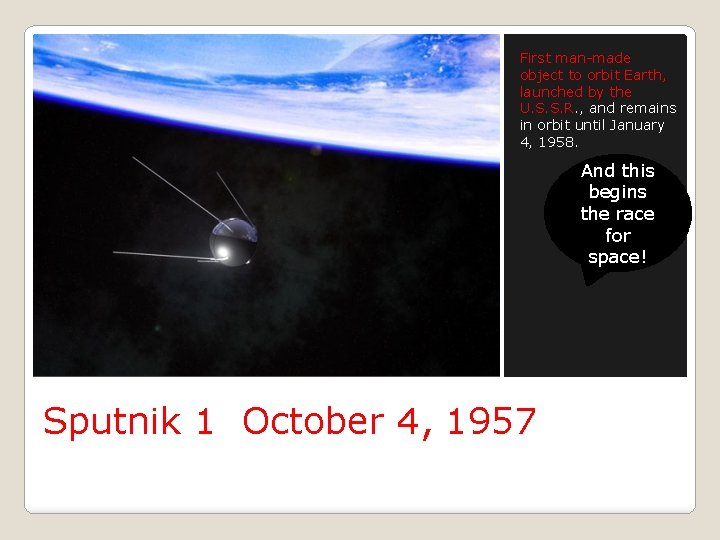
First man-made object to orbit Earth, launched by the U. S. S. R. , and remains in orbit until January 4, 1958. And this begins the race for space! Sputnik 1 October 4, 1957
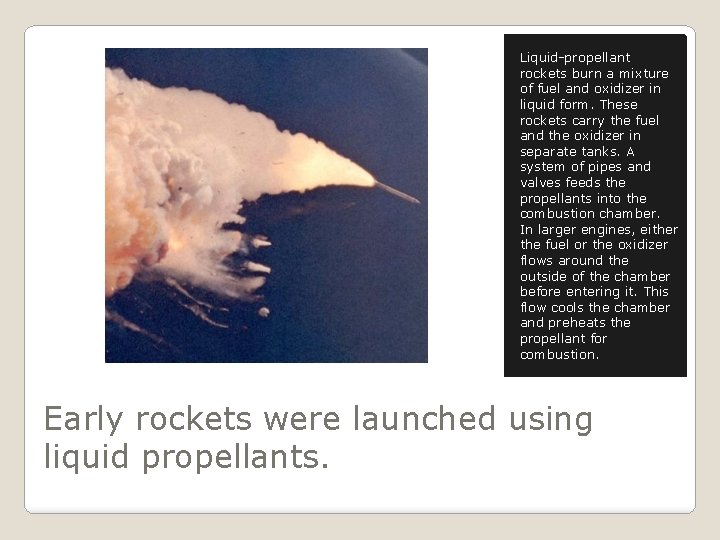
Liquid-propellant rockets burn a mixture of fuel and oxidizer in liquid form. These rockets carry the fuel and the oxidizer in separate tanks. A system of pipes and valves feeds the propellants into the combustion chamber. In larger engines, either the fuel or the oxidizer flows around the outside of the chamber before entering it. This flow cools the chamber and preheats the propellant for combustion. Early rockets were launched using liquid propellants.
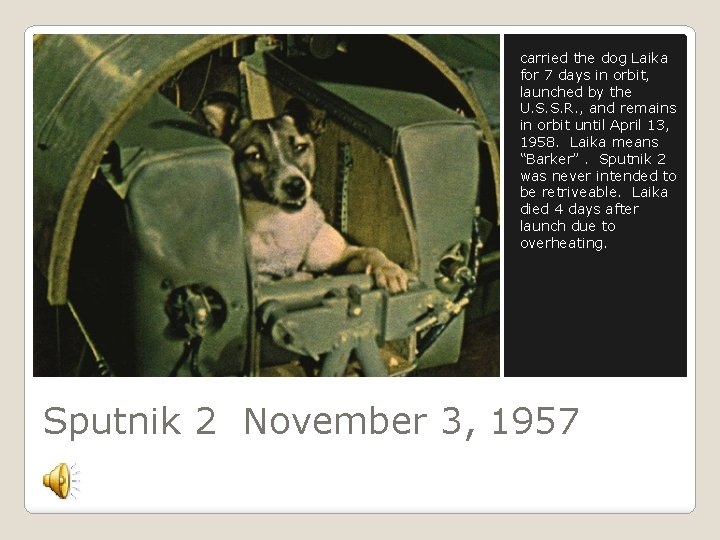
carried the dog Laika for 7 days in orbit, launched by the U. S. S. R. , and remains in orbit until April 13, 1958. Laika means “Barker”. Sputnik 2 was never intended to be retriveable. Laika died 4 days after launch due to overheating. Sputnik 2 November 3, 1957
the first U. S. satellite in orbit, left Cape Canaveral carrying a scientific experiment of James A. Van Allen, and discovers the Earth's radiation belt. This belt is later named the Van Allen Belt. The Russians launched their rocket in secret so the US was in a hurry to get into the race. Explorer 1 January 31, 1958
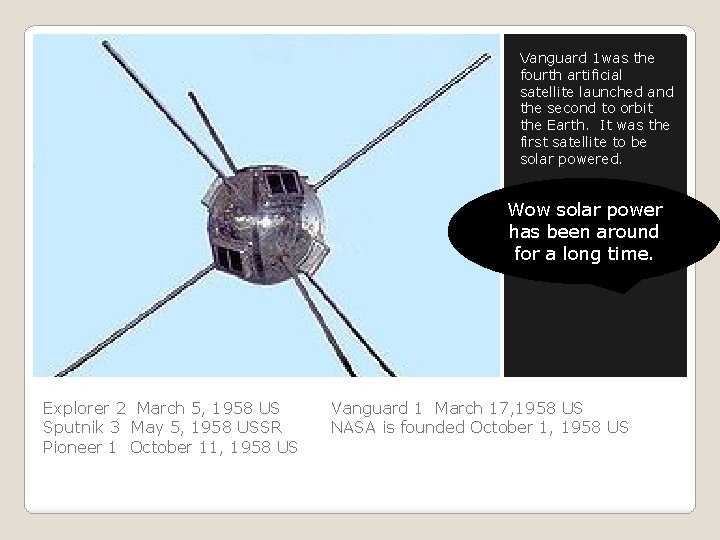
Vanguard 1 was the fourth artificial satellite launched and the second to orbit the Earth. It was the first satellite to be solar powered. Wow solar power has been around for a long time. Explorer 2 March 5, 1958 US Sputnik 3 May 5, 1958 USSR Pioneer 1 October 11, 1958 US Vanguard 1 March 17, 1958 US NASA is founded October 1, 1958 US
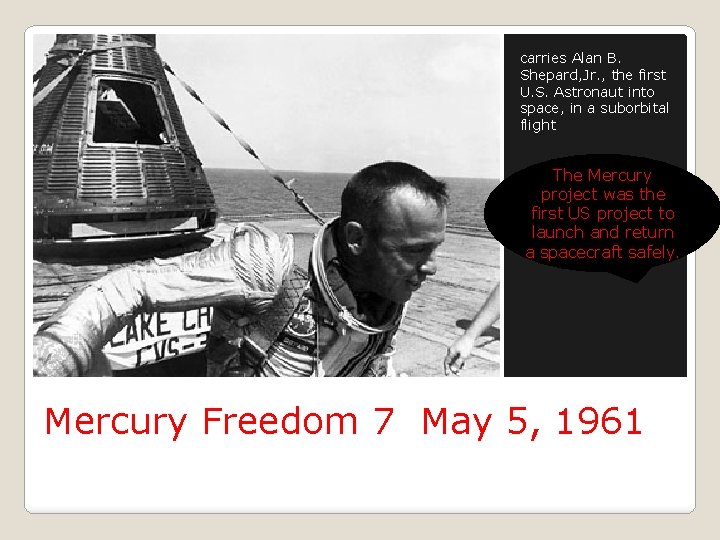
carries Alan B. Shepard, Jr. , the first U. S. Astronaut into space, in a suborbital flight The Mercury project was the first US project to launch and return a spacecraft safely. Mercury Freedom 7 May 5, 1961
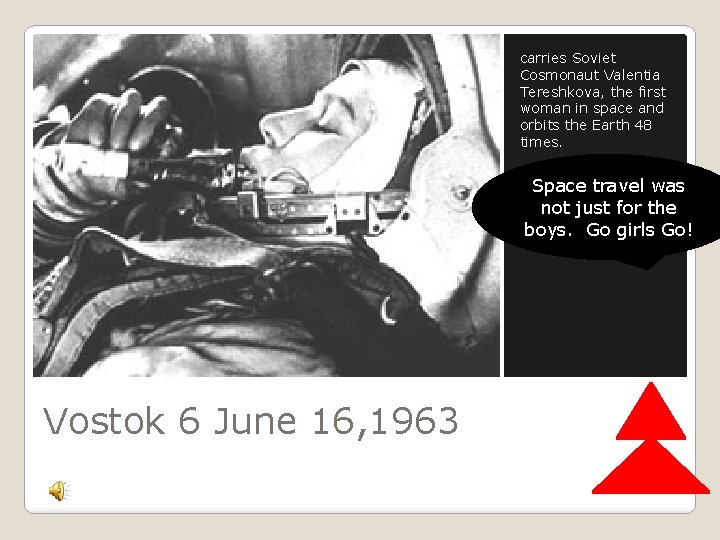
carries Soviet Cosmonaut Valentia Tereshkova, the first woman in space and orbits the Earth 48 times. Space travel was not just for the boys. Go girls Go! Vostok 6 June 16, 1963
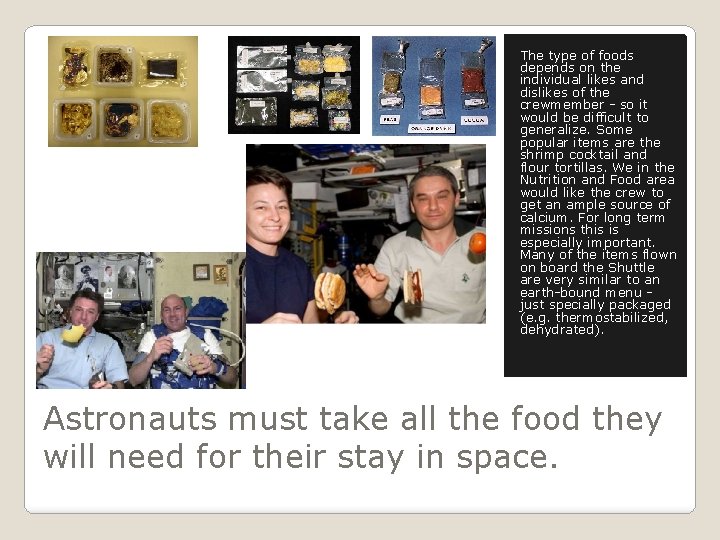
The type of foods depends on the individual likes and dislikes of the crewmember - so it would be difficult to generalize. Some popular items are the shrimp cocktail and flour tortillas. We in the Nutrition and Food area would like the crew to get an ample source of calcium. For long term missions this is especially important. Many of the items flown on board the Shuttle are very similar to an earth-bound menu just specially packaged (e. g. thermostabilized, dehydrated). Astronauts must take all the food they will need for their stay in space.
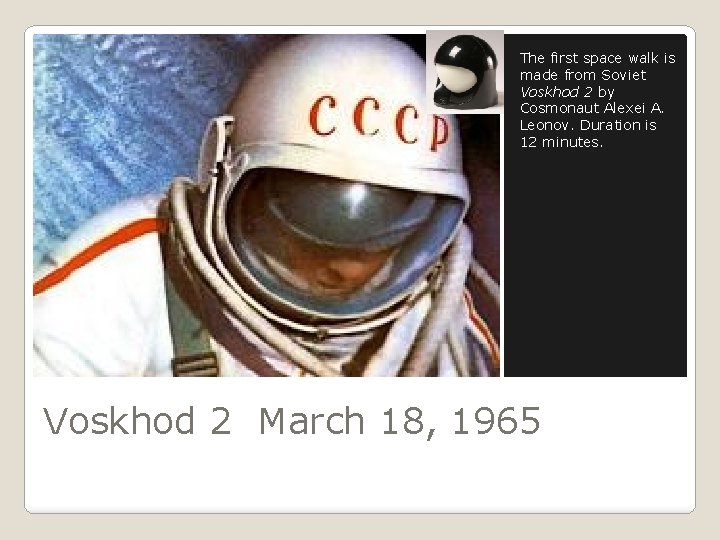
The first space walk is made from Soviet Voskhod 2 by Cosmonaut Alexei A. Leonov. Duration is 12 minutes. Voskhod 2 March 18, 1965
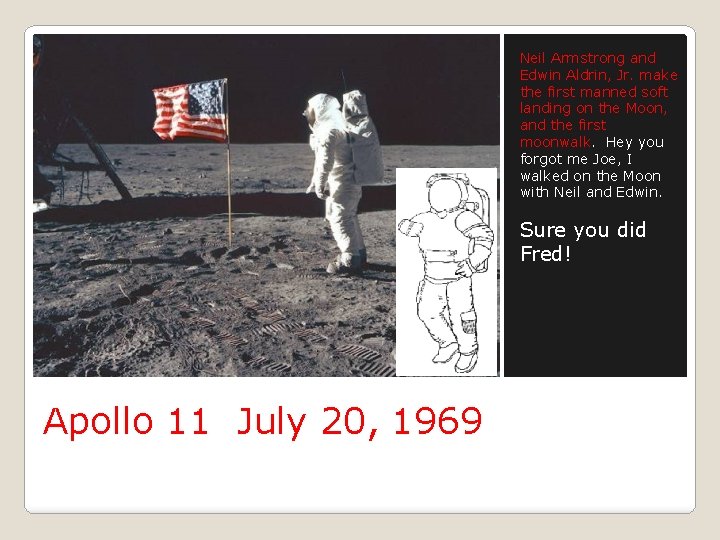
Neil Armstrong and Edwin Aldrin, Jr. make the first manned soft landing on the Moon, and the first moonwalk. Hey you forgot me Joe, I walked on the Moon with Neil and Edwin. Sure you did Fred! Apollo 11 July 20, 1969
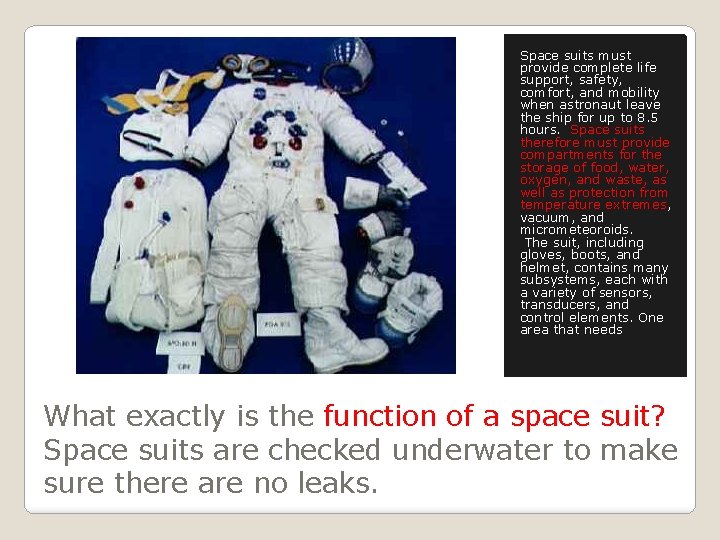
Space suits must provide complete life support, safety, comfort, and mobility when astronaut leave the ship for up to 8. 5 hours. Space suits therefore must provide compartments for the storage of food, water, oxygen, and waste, as well as protection from temperature extremes, vacuum, and micrometeoroids. The suit, including gloves, boots, and helmet, contains many subsystems, each with a variety of sensors, transducers, and control elements. One area that needs What exactly is the function of a space suit? Space suits are checked underwater to make sure there are no leaks.
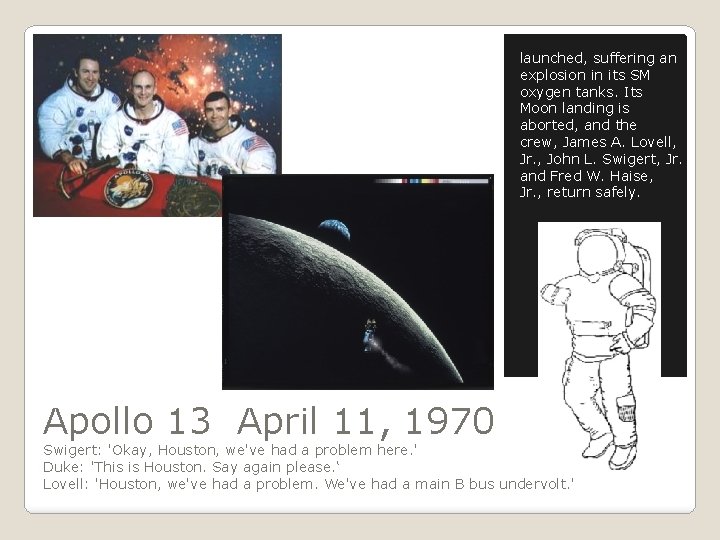
launched, suffering an explosion in its SM oxygen tanks. Its Moon landing is aborted, and the crew, James A. Lovell, Jr. , John L. Swigert, Jr. and Fred W. Haise, Jr. , return safely. Apollo 13 April 11, 1970 Swigert: 'Okay, Houston, we've had a problem here. ' Duke: 'This is Houston. Say again please. ‘ Lovell: 'Houston, we've had a problem. We've had a main B bus undervolt. '
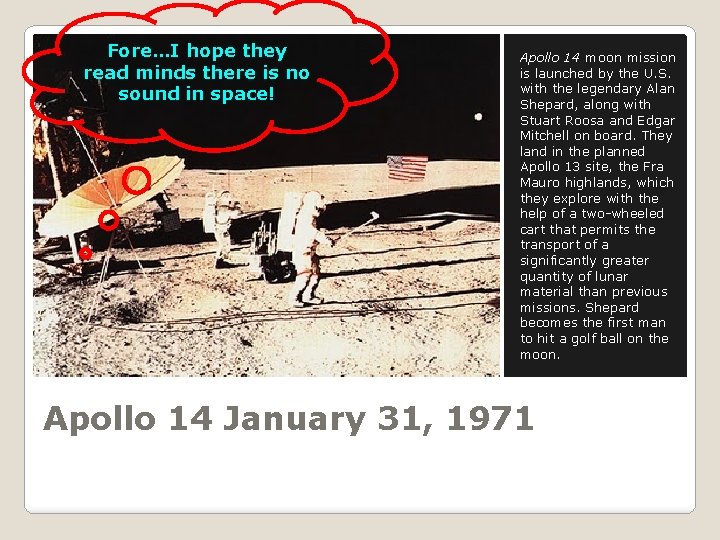
Fore…I hope they read minds there is no sound in space! Apollo 14 moon mission is launched by the U. S. with the legendary Alan Shepard, along with Stuart Roosa and Edgar Mitchell on board. They land in the planned Apollo 13 site, the Fra Mauro highlands, which they explore with the help of a two-wheeled cart that permits the transport of a significantly greater quantity of lunar material than previous missions. Shepard becomes the first man to hit a golf ball on the moon. Apollo 14 January 31, 1971
America's first experimental space station. To prove that humans could live and work in space for extended periods, and to expand our knowledge of solar astronomy well beyond Earth-based observations. Skylab Workshop is launched by the U. S. , and maintained by three crews. First crew to Skylab, Skylab 2, are launched, repairing damage incurred to Skylab during its launch. Skylab May 14, 1973 Skylab 2 May 25, 1973
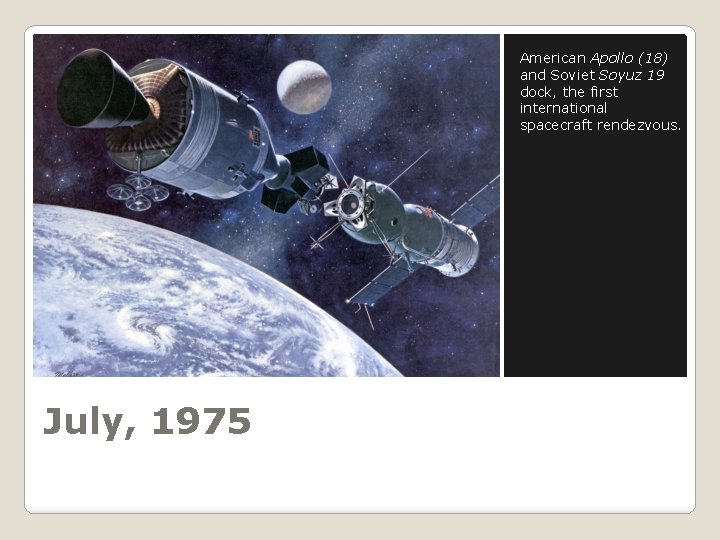
American Apollo (18) and Soviet Soyuz 19 dock, the first international spacecraft rendezvous. July, 1975
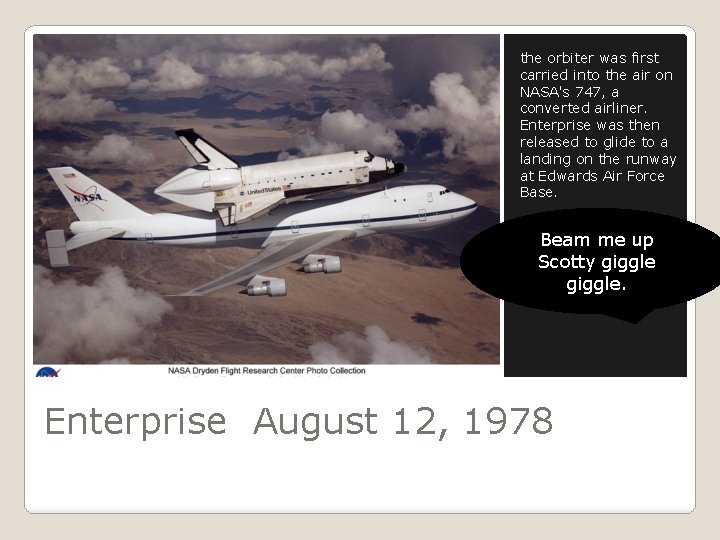
the orbiter was first carried into the air on NASA's 747, a converted airliner. Enterprise was then released to glide to a landing on the runway at Edwards Air Force Base. Beam me up Scotty giggle. Enterprise August 12, 1978
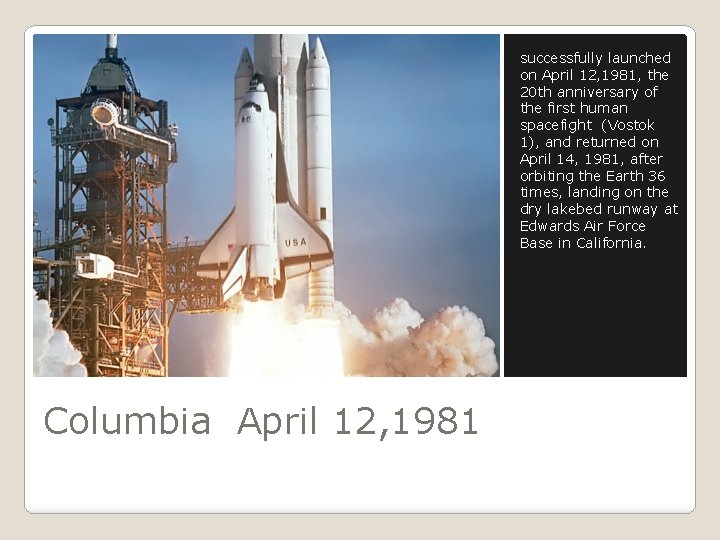
successfully launched on April 12, 1981, the 20 th anniversary of the first human spacefight (Vostok 1), and returned on April 14, 1981, after orbiting the Earth 36 times, landing on the dry lakebed runway at Edwards Air Force Base in California. Columbia April 12, 1981
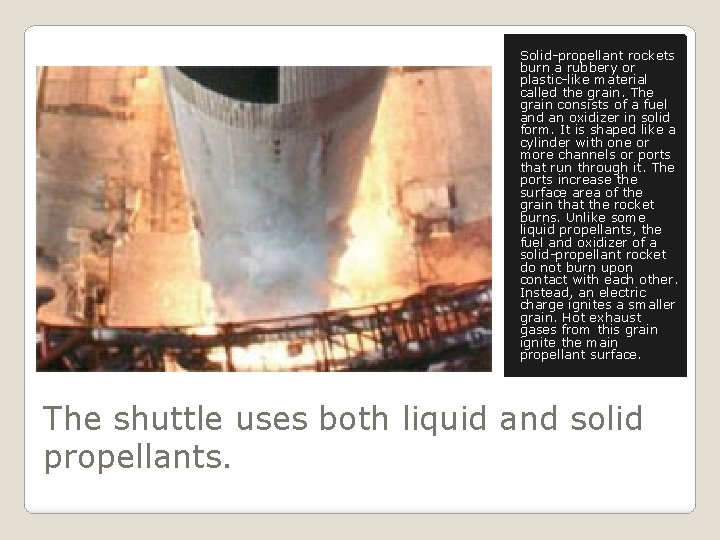
Solid-propellant rockets burn a rubbery or plastic-like material called the grain. The grain consists of a fuel and an oxidizer in solid form. It is shaped like a cylinder with one or more channels or ports that run through it. The ports increase the surface area of the grain that the rocket burns. Unlike some liquid propellants, the fuel and oxidizer of a solid-propellant rocket do not burn upon contact with each other. Instead, an electric charge ignites a smaller grain. Hot exhaust gases from this grain ignite the main propellant surface. The shuttle uses both liquid and solid propellants.
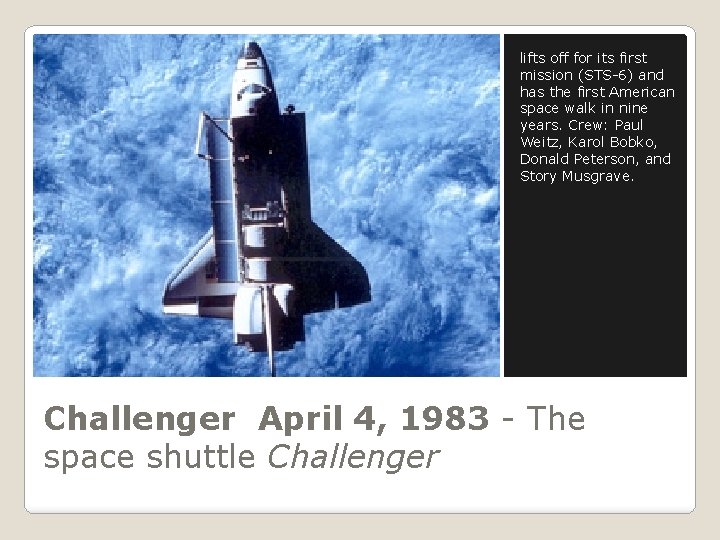
lifts off for its first mission (STS-6) and has the first American space walk in nine years. Crew: Paul Weitz, Karol Bobko, Donald Peterson, and Story Musgrave. Challenger April 4, 1983 - The space shuttle Challenger
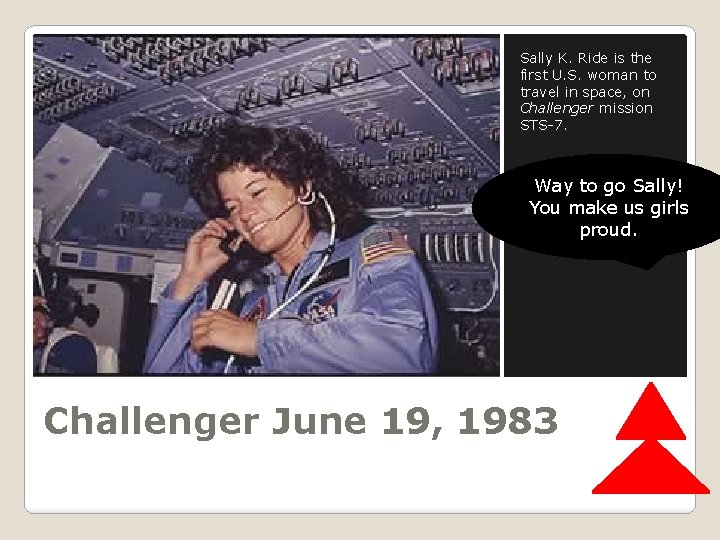
Sally K. Ride is the first U. S. woman to travel in space, on Challenger mission STS-7. Way to go Sally! You make us girls proud. Challenger June 19, 1983
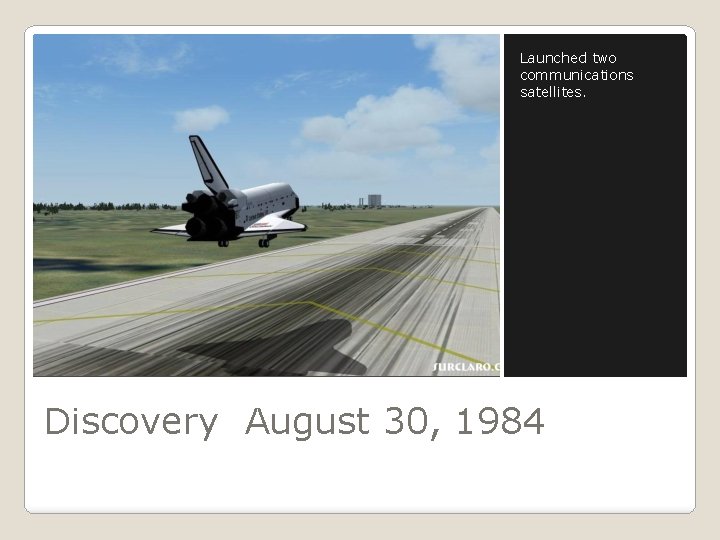
Launched two communications satellites. Discovery August 30, 1984
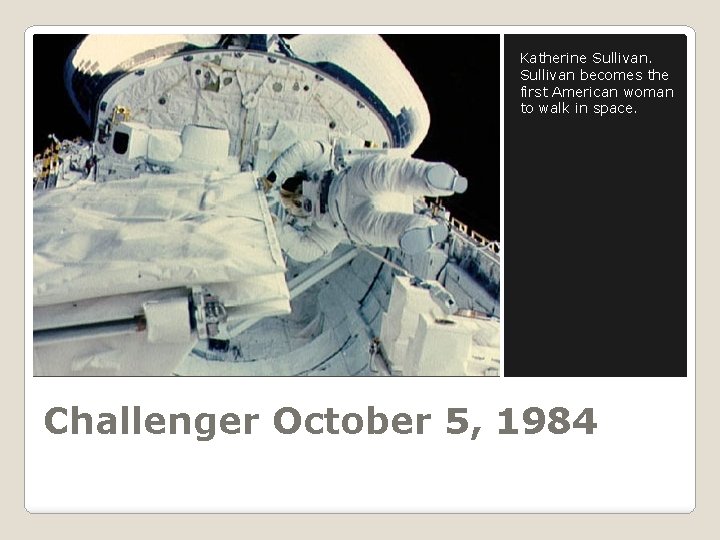
Katherine Sullivan becomes the first American woman to walk in space. Challenger October 5, 1984
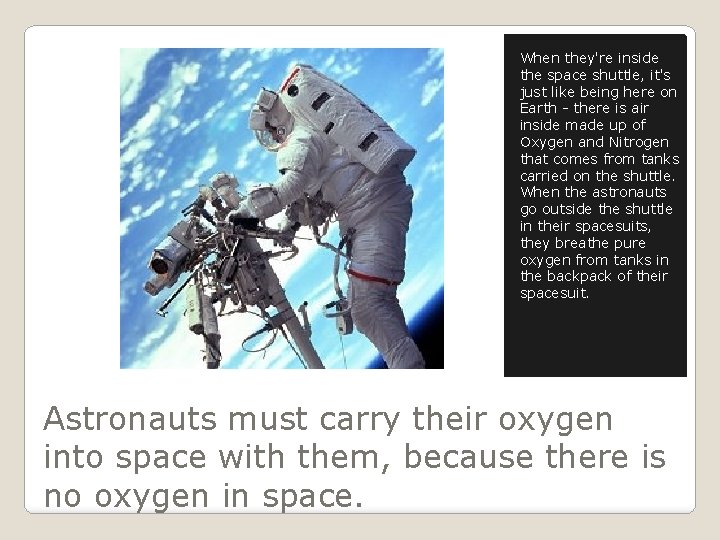
When they're inside the space shuttle, it's just like being here on Earth - there is air inside made up of Oxygen and Nitrogen that comes from tanks carried on the shuttle. When the astronauts go outside the shuttle in their spacesuits, they breathe pure oxygen from tanks in the backpack of their spacesuit. Astronauts must carry their oxygen into space with them, because there is no oxygen in space.
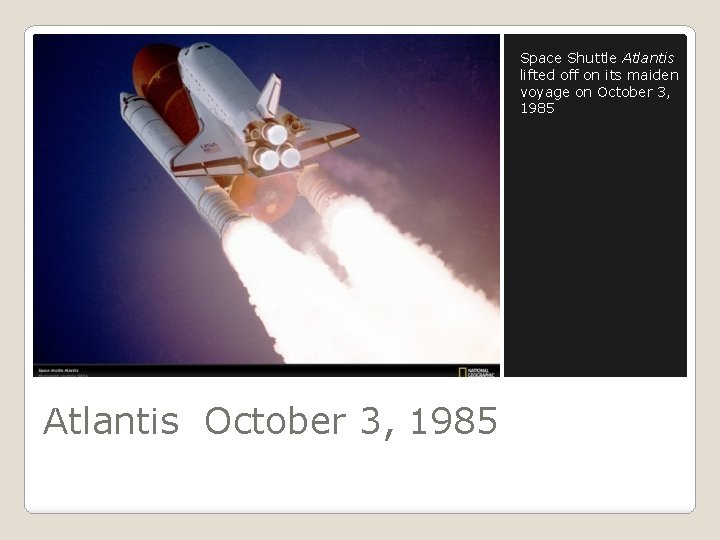
Space Shuttle Atlantis lifted off on its maiden voyage on October 3, 1985 Atlantis October 3, 1985
Press the link below to see a recent launch of the space shuttle Discovery. http: //www. nasa. gov/mp 4/193873 main_ksc _102307_sts 120_launch_pod. mp 4 Rocket engines generate thrust by putting a gas under pressure. The pressure forces the gas out the end of the rocket. The gas escaping the rocket is called exhaust. As it escapes, the exhaust produces thrust according to the laws of motion developed by the English scientist Isaac Newton's third law of motion states that for every action, there is an equal and opposite reaction. Thus, as the rocket pushes the exhaust backward, the exhaust pushes the rocket forward. The rockets are the part of the spacecraft that produces the forces needed to launch a rocket.
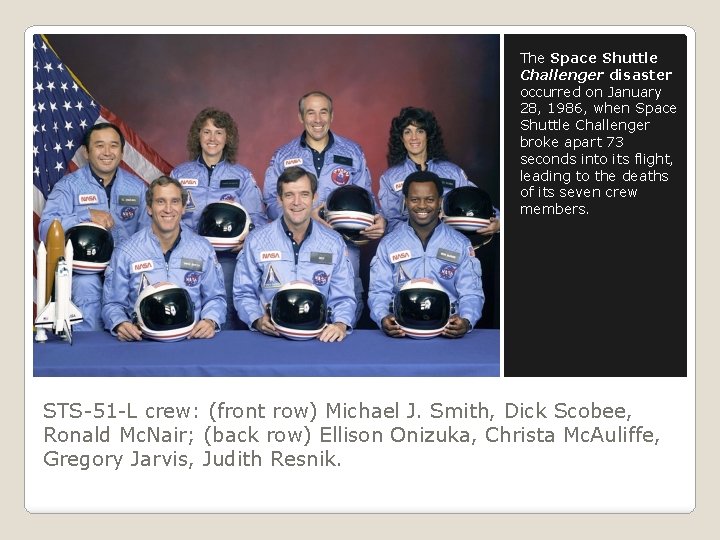
The Space Shuttle Challenger disaster occurred on January 28, 1986, when Space Shuttle Challenger broke apart 73 seconds into its flight, leading to the deaths of its seven crew members. STS-51 -L crew: (front row) Michael J. Smith, Dick Scobee, Ronald Mc. Nair; (back row) Ellison Onizuka, Christa Mc. Auliffe, Gregory Jarvis, Judith Resnik.
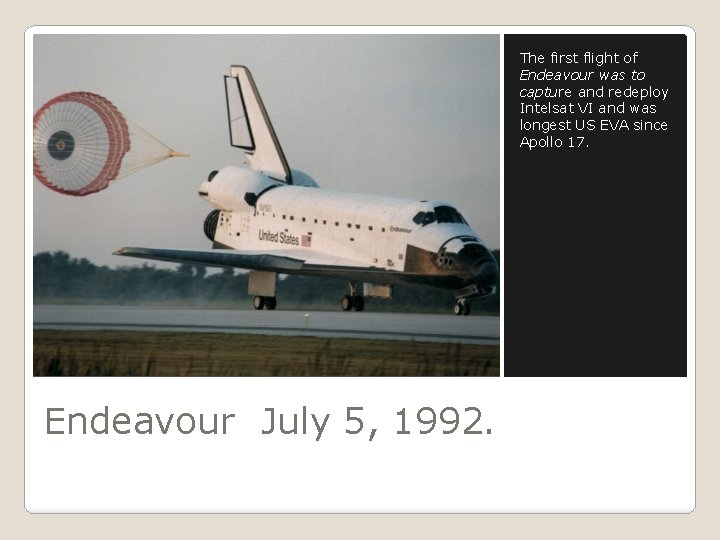
The first flight of Endeavour was to capture and redeploy Intelsat VI and was longest US EVA since Apollo 17. Endeavour July 5, 1992.
The Space Shuttle Columbia disaster occurred on February 1, 2003, when the Space Shuttle Columbia disintegrated over Texas during re-entry into the Earth’s atmosphere, with the loss of all seven crew members, shortly before it was scheduled to conclude its 28 th mission The crew of STS-107 L to R: David M. Brown, Rick D Husband, Laurel Clark, Kalpana Chawla, Michael P. Anderson, William C Mc. Cool, Ilan Ramon.
Press the link below to view a tribute to the crew members of Columbia. http: //www. nasa. gov/mov/2410 main_labell hi. mov Since the loss of Columbia and her crew the only missions flown by the shuttles have been to the International Space Station or the Hubble Telescope.
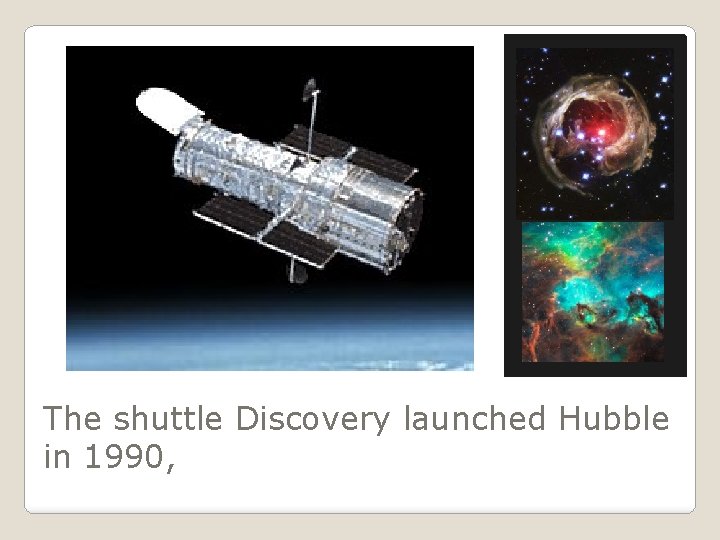
The shuttle Discovery launched Hubble in 1990,
Discovery July 4, 2006, July 26, 2005 & Dec. 22, 2006 International Space Station Assembly
Atlantis Sept. 9, 2006, Oct. 23, 2007 International Space Station Assembly
Endeavor June 8, 2007, Aug. 8, 2007 & Oct. 23, 2007