
The History of Protest Music Class 2 The




- Slides: 70
The History of Protest Music Class 2: The Civil Rights Era Jim Dunphy dunphyjj@aol. com
When did the Civil Rights Era Begin? • April 1947 – Jackie Robinson plays for the Brooklyn Dodgers • May 1954 – Brown v. Board of Education • August 1955 – Emmitt Till murdered • December 1955 – Rosa Parks refuses to give up her seat
When did the Civil Rights Era Begin? • For this course: ØWe will use these dates ØThere may be another class for abolition songs from the 1800’s
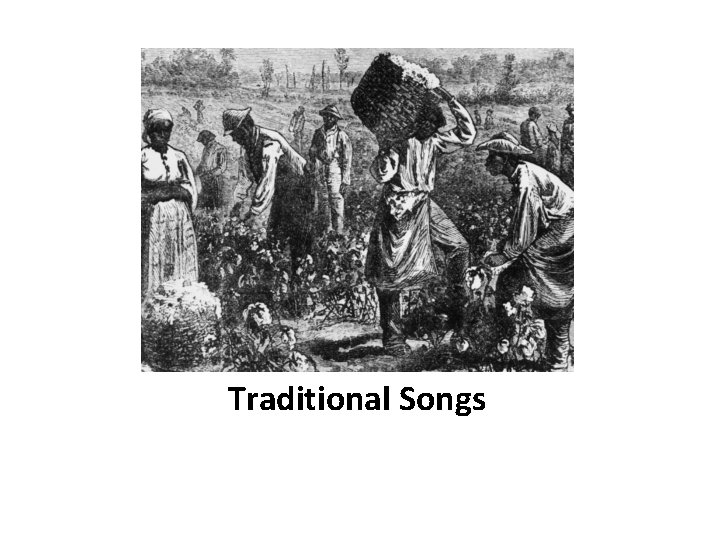
Traditional Songs
Traditional Songs – Work Songs • Arises out of a number of traditions: • Work songs ØArose out of slavery, so only passed down orally ØUse African rhythms ØVery often are in a “call and response” format ØBesides slavery, work songs were used by railroad gangs and boat workers
Gospel • Church music marked by strong lyrics and harmony • Usually a capella • Many songs passed down in oral tradition • Marked by repetition and call and response
Blues • Shares many characteristics with other forms – particularly call and response • Songs provide a narrative, usually of hard times • Repetition, particularly of the opening lines, is also common in the blues
Eyes on the Prize https: //www. youtube. com/watch? v=0 ZWd. DI_fkns
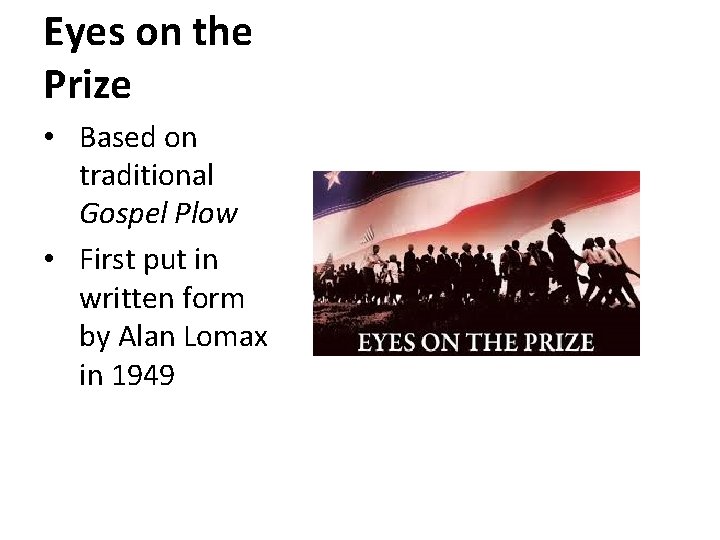
Eyes on the Prize • Based on traditional Gospel Plow • First put in written form by Alan Lomax in 1949
Eyes on the Prize • Sung in the call and response format of traditional folk songs • Full of bible imagery • Was the title and theme music for the 1987 PBS history of the Civil rights years
Ain’t Gonna Let Nobody Turn me Around https: //www. youtube. com/watch? v=WPu. BGcn g 6 Tw
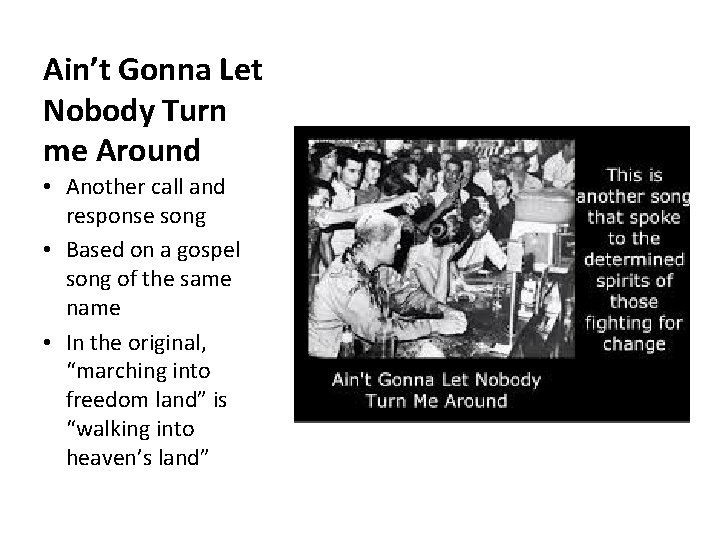
Ain’t Gonna Let Nobody Turn me Around • Another call and response song • Based on a gospel song of the same name • In the original, “marching into freedom land” is “walking into heaven’s land”
Ain’t Gonna Let Nobody Turn me Around • Like many songs of the Civil Rights era, more verses could be topically added • Some other examples ØAin’t gonna let no politicans ØAin’t gonna let no Bull Conner
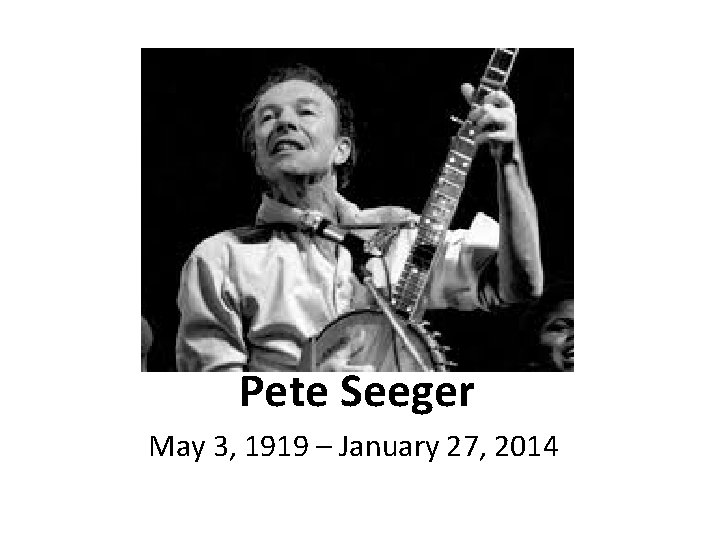
Pete Seeger May 3, 1919 – January 27, 2014
Pete Seeger • Was one of the earliest singers in support of Civil Rights • Was able to merge traditional folk music into gospel
We Shall Overcome https: //www. youtube. com/watch? v=M_Ld 8 JGv 56 E
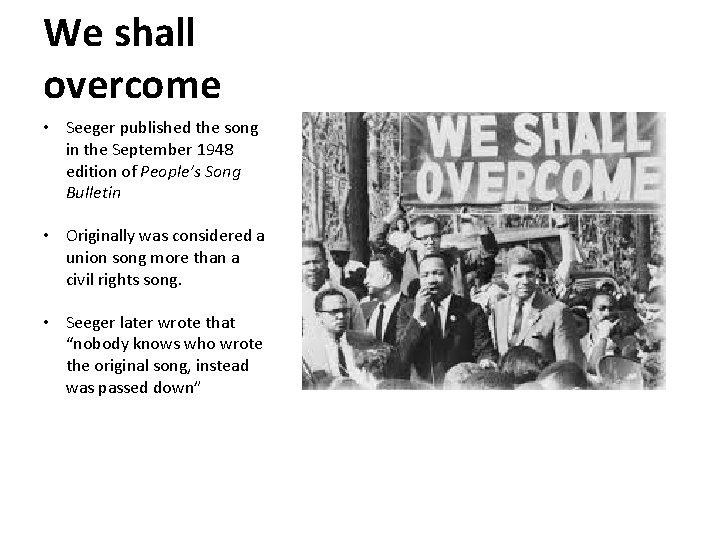
We shall overcome • Seeger published the song in the September 1948 edition of People’s Song Bulletin • Originally was considered a union song more than a civil rights song. • Seeger later wrote that “nobody knows who wrote the original song, instead was passed down”
We Shall Overcome • Recent research indicates that it was based on the gospel song If My Jesus Wills • Other sources are the Methodist hymn I Shall Overcome and the Spritual No More Auction Block for Me
We Shall Overcome • Was used first as a union song in 1950, and published first as We Shall Overcome in a union songbook in 1950 • Became first associated with the Civil Rights movement when Pete Seeger played it at the Highlander Folk School for an audience that include Dr. Martin Luther King
We Shall Overcome • Became the most famous of the Movement songs • Many of the Movement’s leaders, to include Dr. King and others, used it in speeches
We Shall Overcome Most famously used by LBJ in addressing Congress in March 1965 in support of the voting rights bill https: //www. youtube. com/watch? v=b. KDV NSps. BZE
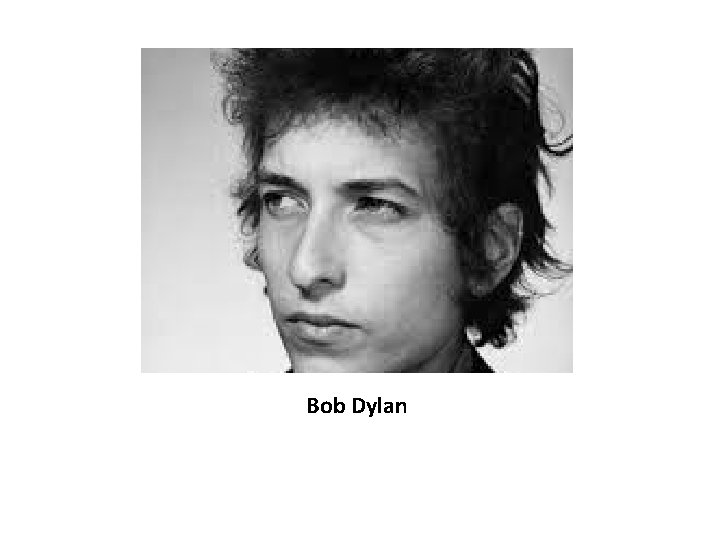
Bob Dylan
The Lonesome Death of Hattie Carroll https: //www. youtube. com/watch? v=1 ji. YV UU 1 RXQ
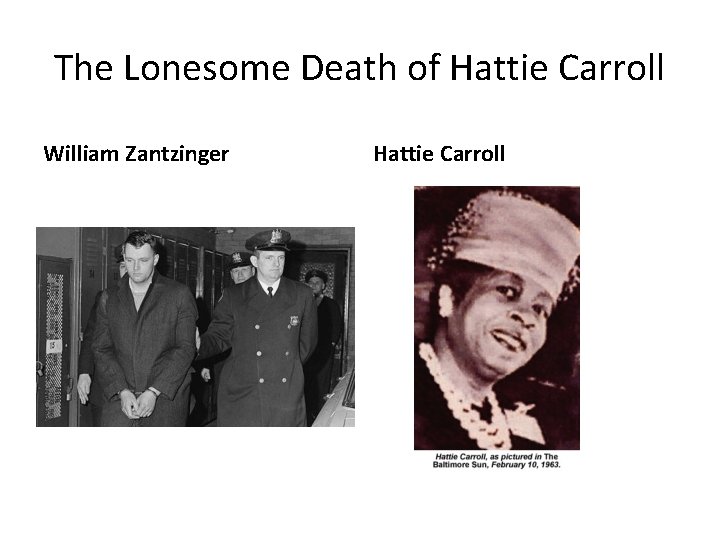
The Lonesome Death of Hattie Carroll William Zantzinger Hattie Carroll
The Lonesome Death of Hattie Carroll • Largely based on fact – arose out of an incident in Baltimore in February 1963 • William Zantzinger (Dylan dropped the “t” to make the name more melodic) showed up drunk at a ball and harrassed members of the staff
The Lonesome Death of Hattie Carroll • After Carroll did not supply a drink fast enough, he cursed her (calling her a black bitch) and striking her with a toy cane • Zantzinger also struck his wife with the cane and then his shoe
The Lonesome Death of Hattie Carroll • After the incident, Carroll told a coworker "I feel deathly ill, that man has upset me so. " • She collapsed, and was taken to the hospital, where she died 8 hours later
The Lonesome Death of Hattie Carroll • Zantzinger was initially charged with murder, with his defense being he was too drunk and had no memory of the attack • The charge was reduced to manslaughter and assault • His attorneys were able to get a change of venue to rural Hagerstown
The Lonesome Death of Hattie Carroll • Sentence: ØFor assault: a $125 fine ØFor the death of Hattie Carroll: a $500 fine and six months in jail (postponed for six months so Zantzinger could bring in his tobacco crop)
The Lonesome Death of Hattie Carroll • The judgement – by a panel of three judges and not a jury – was handed down the same day Dr. King gave his “I have a dream” speech • Zantzinger began his sentence in September 1963, and Dylan had written the song and released it in October 1963 • Note that the fact that Zantzinger was white and Carroll black is never mentioned or even implied in the song – you just understand it to be so
The Lonesome Death of Hattie Carroll • Zantzinger was later charged with rental fraud against poor blacks • He was convicted in 1991 and sentenced to 19 months in prison – 13 more than for the death of Hattie Carroll
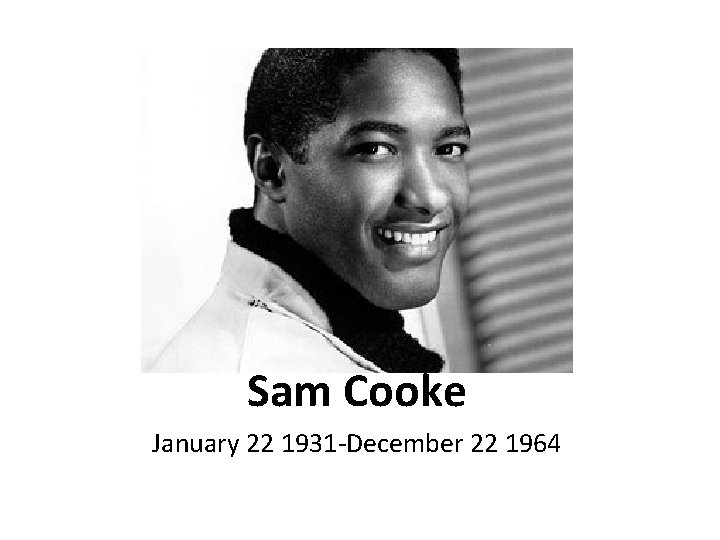
Sam Cooke January 22 1931 -December 22 1964
Sam Cooke • Born in Mississippi, but raised in Chicago • Father was a minister • Began his career as lead singer in a gospel group • Crossed over to R&B, and his song You Send Me made it to #1 on the R&B charts
Sam Cooke • Other hits include Another Saturday Night and Twisting the Night Away • In December 1964, he was killed in a motel under questionable circumstances, still unresolved to this day • A Change is Going to Come was a posthumous hit
Sam Cooke • Honors included ØMember of the initial class of the Rock and Roll Hall of Fame ØMember of the Songwriters Hall of Fame ØGiven Grammy Lifetime Achievement Award
A Change is Gonna Come https: //www. youtube. com/watch? v=w. EBla. MO m. KV 4
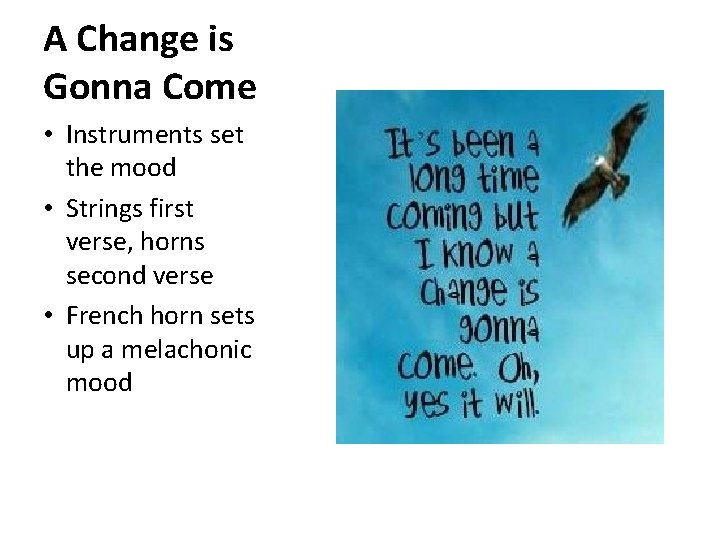
A Change is Gonna Come • Instruments set the mood • Strings first verse, horns second verse • French horn sets up a melachonic mood
A Change is Gonna Come • Shortly before writing the song, Cooke was arrested for disturbing the peace at a motel that refused him service because he was black • Cooke later wrote that the song came to him quickly and without effort
A Change is Gonna Come • Given the arrangement, it was only played once live before his death • Continues to be an anthem of hope and change
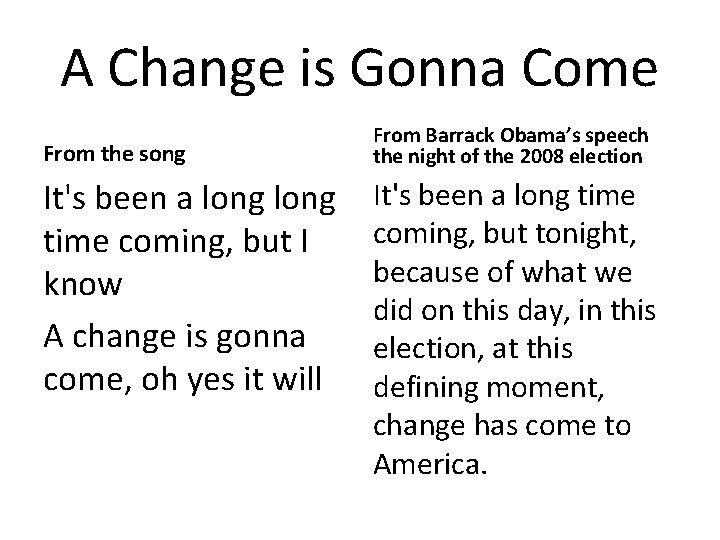
A Change is Gonna Come From the song It's been a long time coming, but I know A change is gonna come, oh yes it will From Barrack Obama’s speech the night of the 2008 election It's been a long time coming, but tonight, because of what we did on this day, in this election, at this defining moment, change has come to America.
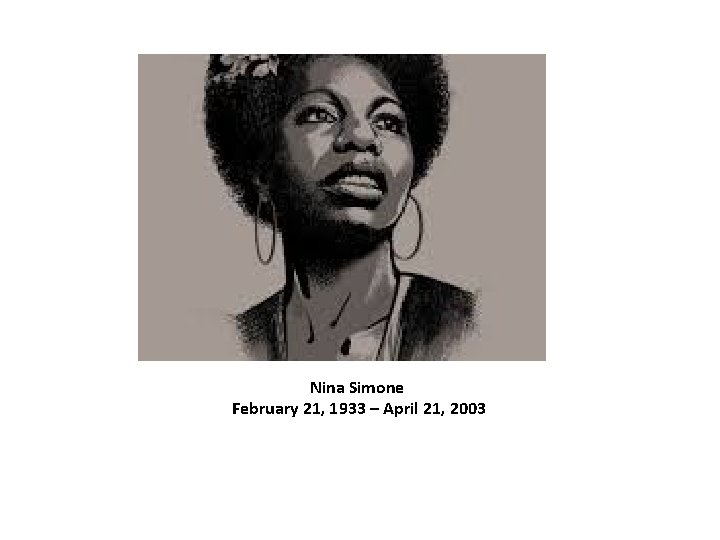
Nina Simone February 21, 1933 – April 21, 2003
Nina Simone • Born in SC and raised in NC • Like many singers of her generation, first sang in a church choir • Applied to a prestiguous music school in Philadelphia, but was denied, and believed it was based on race.
Nina Simone • Began singing in a nightclub • Took the name Nina Simone (nina – young girl in Spanish and Simone – from Simone Signoret) so her mother would not know she was singing “the devil’s music” • Her first and only top 20 song was a song from Porgy and Bess
Nina Simone • Became more associated with civil rights songs in the mid 1960’s • Disappointed at her lack of success, she left for Barbados • She had begun to refuse to pay taxes in protest of the Vietnam War • When she attempted to return to the US, she was arrested and fled again to Barbados
Nina Simone • She later lived in a number of countries, but never returned to the US • Diagnosed with bipolar disease, she died from breast cancer in France in 2003
Mississippi Goddam https: //www. youtube. com/watch? v=De 0 JKNsi 58 g
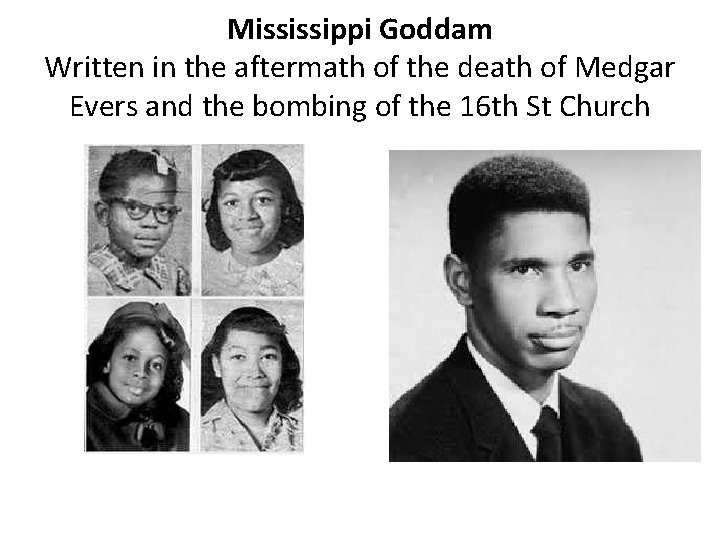
Mississippi Goddam Written in the aftermath of the death of Medgar Evers and the bombing of the 16 th St Church
Mississippi Goddam • Key line: This is a show tune, but the show hasn’t been written for it yet • Calls out three states: Alabama and Tennessee, but Mississippi is the worst (before the killings of the three civil rights workers) • No specific incidents (such as Evers or the killing of the 4 girls) is mentioned in the song
Mississippi Goddam • In a way, it is a hopeful song – Simone is not calling for riots, but just give me my equality. • She even prefaces that with you don’t need to live next to me • Song was banned in a number of southern states, and the records were returned broken
Mississippi Goddam • Simone also uses as a device the mid 60’s call to “go slow” • The thinking’s crazy, do it slow • Desegretation, do it slow • But • Bring more tragedy, do it slow
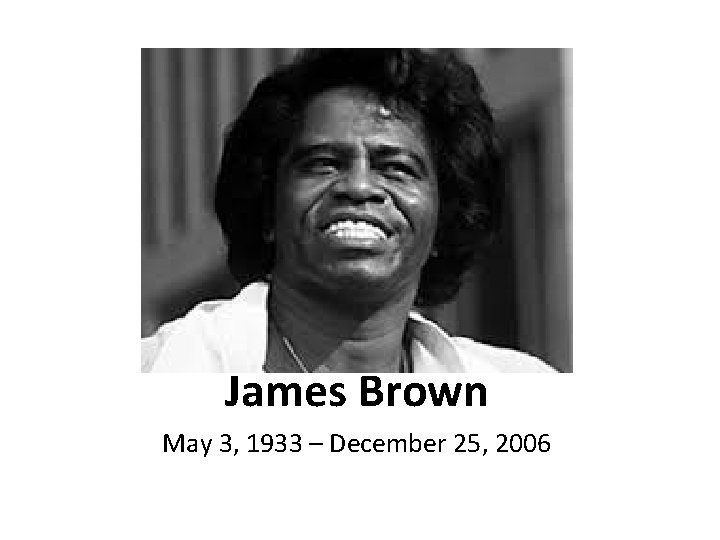
James Brown May 3, 1933 – December 25, 2006
James Brown • Known as “The Godfather of Soul” • Born in SC and began singing in his church choir • Was arrested for robbery at age 16, and one story has him being paroled to join a musical act
James Brown • Joined the group the Fabulous Flames • Group was taken under the wing of Little Richard in the mid 1950’s • Brown’s first #1 hit was Try Me in October 1958, the first of 17 #1 R&B hits • Hit #1 on the pop charts in 1965 with Papa’s Got a Brand New Bag, which also won a Grammy
James Brown • After the killing of Dr. King in 1968, famously appeared on stage at a concert in Boston with the Mayor, and Boston was not visited by riots • Also visited troops in Vietnam, where he played in combat zones • Continued to record until his death on Christmas Day 2006 • One of his last projects was a duet with Annie Lennox of the Eurythmics
Say it Loud – I’m Black and Proud https: //www. youtube. com/watch? v=9 b. JA 6 W 9 Cqv. E
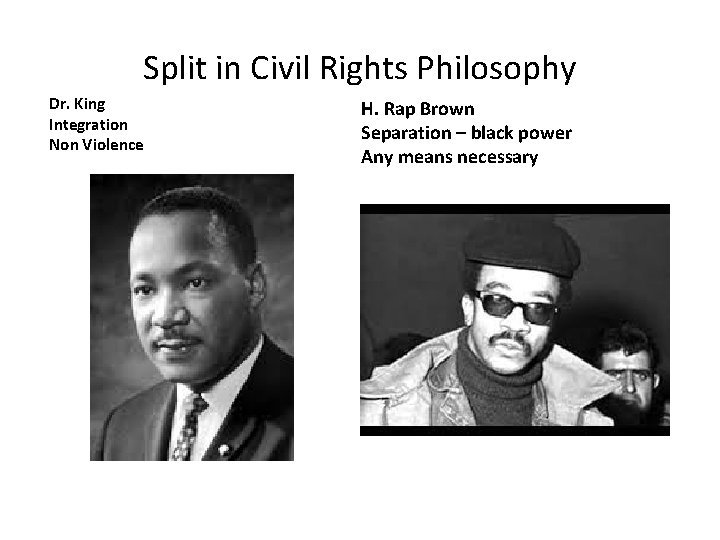
Split in Civil Rights Philosophy Dr. King Integration Non Violence H. Rap Brown Separation – black power Any means necessary
Say it Loud – I’m Black and Proud • Prior to the late 1960’s James Brown was not political • His joke was the most important color was green • H. Rap Brown encouraged James Brown to become more political • Released in the summer of 1968, after Dr. King’s death, Say it Loud was released against a backdrop of riots
Say it Loud – I’m Black and Proud • Reached #1 on the R&B charts in the fall of 1968 and stayed there for 6 weeks • Brown did not make the song part of his regular playlist • He later stated he regretted the song • In his 1986 autobiography, he stated: The song is obsolete now. . . But it was necessary to teach pride then, and I think the song did a lot of good for a lot of people
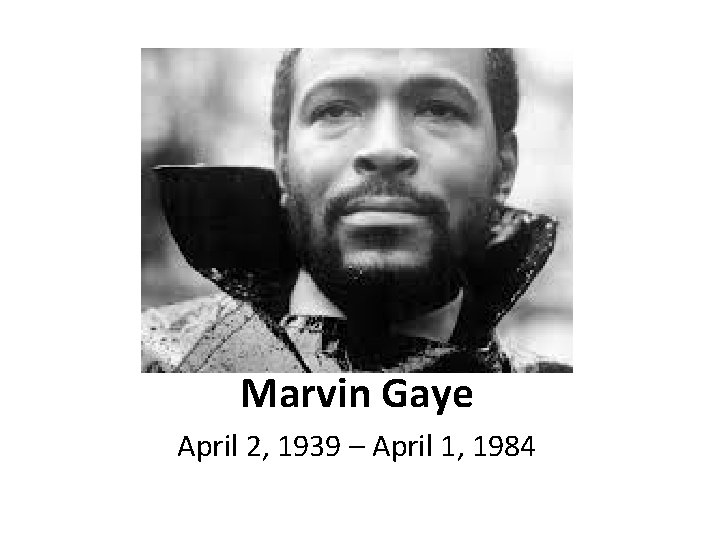
Marvin Gaye April 2, 1939 – April 1, 1984
Marvin Gaye • Born in DC, father (Marvin Gaye Sr) was a minister (more about his father later!) • Like others, first started singing in church at age 4 • Attended Cardozo HS in DC, and after dropping out, had a short stint in the USAF
Marvin Gaye • Moved to Detroit, and worked for Motown, first as a songwriter and drummer then as a singer • Became famous for duets with Mary Wells, Kim Weston and most often, Tammi Terrell • In 1968, his solo hit I Heard it Through the Grapevine became his first #1 hit
Marvin Gaye • Married and later divorced the sister of Motown founder Barry Gordy • Struggle with tax evasion charges and an addiction to cocaine
Marvin Gaye • In April 1984, after he intervened in an argument between his parents, his father fatally shot the singer • The father was brought to trial for manslaughter after it was revealed the father had a brain tumor and Marvin was on drugs • Father convicted and sentenced to a suspended six year sentence
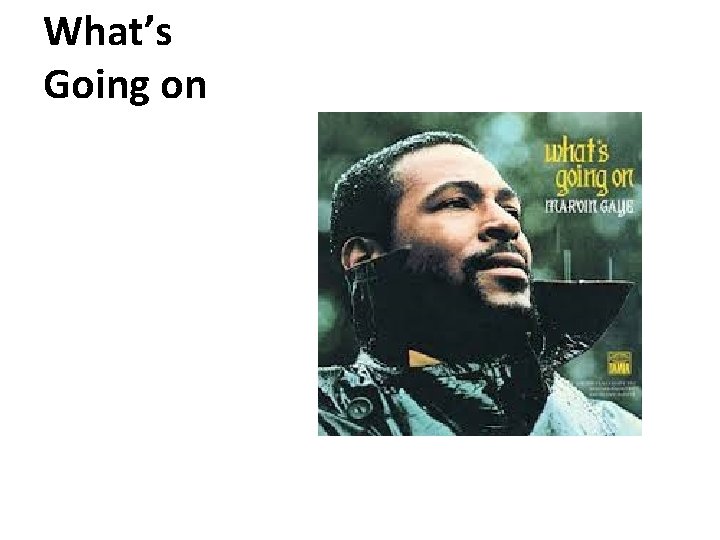
What’s Going on https: //www. youtube. com/watch? v=r 6 j. KE 6 YIxmc
What’s Going on
What’s Going On • Inspired by an incident of police brutality seen by Obie Benson of the 4 Tops while touring in Berkeley CA • With the question of “What is happening here” he turned to songwriter Al Cleveland to write the song • Benson offered it to the 4 Tops but they turned it down – they said they didn’t do “protest songs”
What’s Going On • It was then presented to Gaye, who tweaked both the words and melody • Gaye used a combination of Motown studio bands and others, to include 2 Detroit Lions football players, on the recording. • Motown head Gordy called the song “the worst thing I ever heard in my life”
What’s Going On • Stations were desperate for new Gaye material, so it was shipped • Later became a huge hit • Allowed Gaye the opportunity to expand the song into a concept album, reflecting his take on the current world situation • Both the song and the album are regularly on lists of greatest songs and albums
What’s Going On • The overall concept of the album is that the singer is a returning VN veteran, disillusioned by poverty, drug abuse and police brutality • Gaye’s brother was a VN veteran and Gaye used many of his thoughts and feelings • Song appeals to unnamed “mother, ” “father” and “brother” • Call for peace and understanding rather than struggle – somewhat out of tune for the early 1970’s
Other songs • Bob Dylan Only a Pawn in their Game • Bob Dylan Hurricane • Nina Simone To Be Young, Gifted and Black • Traditional This Little Light of Mine • Mavis Staples We Shall Not be Moved