
The History of Probability Math 5400 History of
The History of Probability Math 5400 History of Mathematics York University Department of Mathematics and Statistics 1
Text: n The Emergence of Probability, 2 nd Ed. , by Ian Hacking Math 5400 2
Hacking’s thesis Probability emerged as a coherent concept in Western culture around 1650. n Before then, there were many aspects of chance phenomena noted, but not dealt with systematically. n Math 5400 3
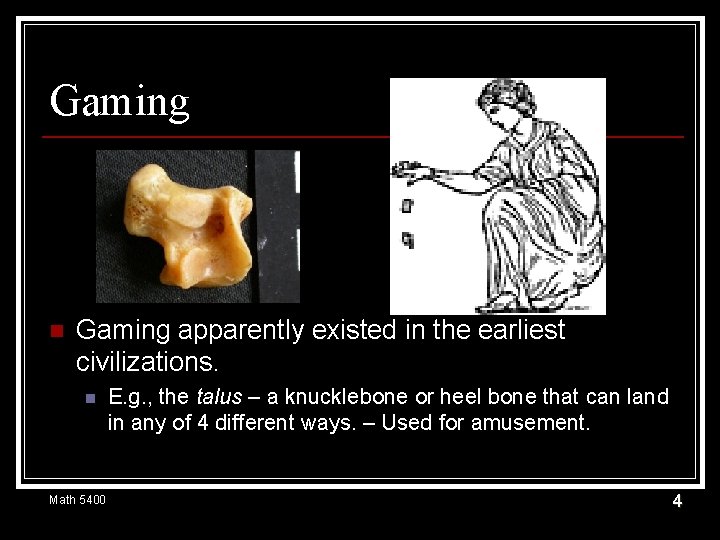
Gaming n Gaming apparently existed in the earliest civilizations. n Math 5400 E. g. , the talus – a knucklebone or heel bone that can land in any of 4 different ways. – Used for amusement. 4
Randomizing n The talus is a randomizer. Other randomizers: n n Dice. Choosing lots. Reading entrails or tea leaves. Purpose: n n Math 5400 Making “fair” decisions. Consulting the gods. 5

Emergence of probability n All the things that happened in the middle of the 17 th century, when probability “emerged”: n n n Math 5400 Annuities sold to raise public funds. Statistics of births, deaths, etc. , attended to. Mathematics of gaming proposed. Models for assessing evidence and testimony. “Measurements” of the likelihood/possibility of miracles. “Proofs” of the existence of God. 6
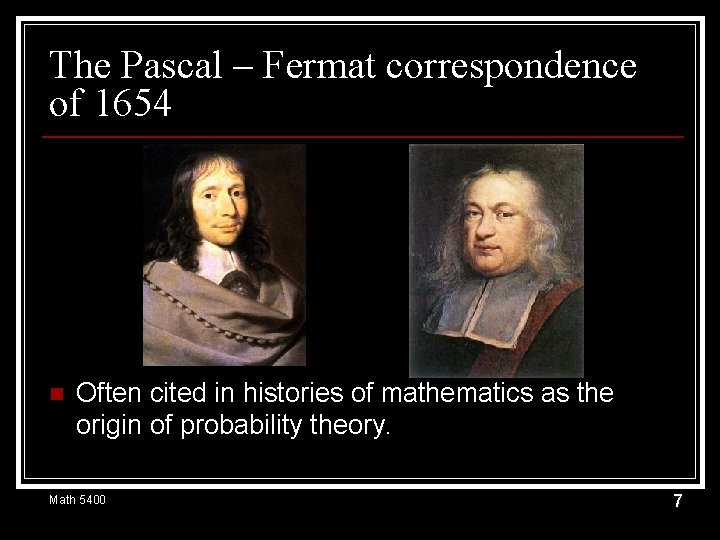
The Pascal – Fermat correspondence of 1654 n Often cited in histories of mathematics as the origin of probability theory. Math 5400 7
The Problem of Points n Question posed by a gambler, Chevalier De Mere and then discussed by Pascal and Fermat. n n n There are many versions of this problem, appearing in print as early as 1494 and discussed earlier by Cardano and Tartaglia, among others. Two players of equal skill play a game with an ultimate monetary prize. The first to win a fixed number of rounds wins everything. How should the stakes be divided if the game is interrupted after several rounds, but before either player has won the required number? Math 5400 8
Example of the game n Two players, A and B. n n n Math 5400 The game is interrupted when A needs a more points to win and B needs b more points. Hence the game can go at most a + b -1 further rounds. E. g. if 6 is the total number of points needed to win and the game is interrupted when A needs 1 more point while B needs 5 more points, then the maximum number of rounds remaining is 1+51=5. 9

The Resolution Pascal and Fermat together came to a resolution amounting to the following: n A list of all possible future outcomes has size 2 a+b-1 n The fair division of the stake will be the proportion of these outcomes that lead to a win by A versus the proportion that lead to a win by B. n Math 5400 10
The Resolution, 2 n n n Previous solutions had suggested that the stakes should be divided in the ratio of points already scored, or a formula that deviates from a 50: 50 split by the proportion of points won by each player. These are all reasonable, but arbitrary, compared with Pascal & Fermat’s solution. Note: It is assumed that all possible outcomes are equally likely. Math 5400 11
The historian’s question: why 1650 s? Gambling had been practiced for millennia, also deciding by lot. Why was there no mathematical analysis of them? n The Problem of Points appeared in print in 1494, but was only solved in 1654. n n Math 5400 What prevented earlier solutions? 12

The “Great Man” answer: Pascal and Fermat were great mathematical minds. Others simply not up to the task. n Yet, all of a sudden around 1650, many problems of probability became commonplace and were understood widely. n Math 5400 13
The Determinism answer: n Science and the laws of Nature were deterministic. What sense could be made of chance if everything that happened was fated? Why try to understand probability if underneath was a certainty? Math 5400 14
“Chance” is divine intervention n Therefore it could be viewed as impious to try to understand or to calculate the mind of God. n Math 5400 If choosing by lot was a way of leaving a decision to the gods, trying to calculate the odds was an impious intervention. 15
The equiprobable set Probability theory is built upon a fundamental set of equally probable outcomes. n If the existence of equiprobable outcomes was not generally recognized, theory of them would not be built. n n Math 5400 Viz: the ways a talus could land were note equally probable. But Hacking remarks on efforts to make dice fair in ancient Egypt. 16
The Economic necessity answer: n Science develops to meet economic needs. There was no perceived need for probability theory, so the explanation goes. n n n Math 5400 Error theory developed to account for discrepancies in astronomical observations. Thermodynamics spurred statistical mechanics. Biometrics developed to analyze biological data for evolutionary theory. 17
Economic theory rebuffed: n Hacking argues that there was plenty of economic need, but it did not spur development: n n Gamblers had plenty of incentive. Countries sold annuities to raise money, but did so without an adequate theory. n Math 5400 Even Isaac Newton endorsed a totally faulty method of calculating annuity premiums. 18
A mathematical answer: n n Western mathematics was not developed enough to foster probability theory. Arithmetic: Probability calculations require considerable arithmetical calculation. Greek mathematics, for example, lacked a simple numerical notation system. n n Math 5400 Perhaps no accident that the first probabilists in Europe were Italians, says Hacking, who first worked with Arabic numerals and Arabic mathematical concepts. Also, a “science of dicing” may have existed in India as early as year 400. Indian culture had many aspects that European culture lacked until much later. 19
Duality n The dual nature of the understanding of probability that emerged in Europe in the middle of the 17 th century: n n Math 5400 Statistical: concerned with stochastic laws of chance processes. Epistemological: assessing reasonable degrees of belief. 20
The Statistical view Represented by the Pascal-Fermat analysis of the problem of points. n Calculation of the relative frequencies of outcomes of interest within the universe of all possible outcomes. n n Math 5400 Games of chance provide the characteristic models. 21
The Degree of Belief view Represented by efforts to quantify the weighing of evidence and/or the reliability of witnesses in legal cases. n Investigated by Gottfried Leibniz and others. n Math 5400 22
The controversy n Vast and unending controversy over which is the “correct” view of probability: n n The frequency of a particular outcome among all possible outcomes, either in an actual finite set of trials or in the limiting case of infinite trials. Or n Math 5400 The rational expectation that one might hold that a particular outcome will be a certain result. 23
Independent concepts, or two sides of the same issue? Hacking opines that the distinction will not go away, neither will the controversy. n Compares it to distinct notions of, say, weight and mass. n Math 5400 24
The “probable” n Earlier uses of the term probable sound strange to us: n Probable meant approved by some authority, worthy of approprobation. n Math 5400 Examples from Gibbon’s Decline and Fall of the Roman Empire: one version of Hannibal’s route across the Alps having more probability, while another had more truth. Or: “Such a fact is probable but undoubtedly false. ” 25
Probability versus truth Pascal’s contribution to the usage of the word probability was to separate it from authority. n Hacking calls it the demolition of probabilism, decision based upon authority instead of upon demonstrated fact. n Math 5400 26
Opinion versus truth Renaissance scientists had little use for probability because they sought incontrovertible demonstration of truth, not approbation or endorsement. n Opinion was not important, certainty was. n n Math 5400 Copernicus’s theory was “improbable” but true. 27
Look to the lesser sciences Physics and astronomy sought certainties with definitive natural laws. No room for probabilities. n Medicine, alchemy, etc. , without solid theories, made do with evidence, indications, signs. The probable was all they had. n This is the breeding ground for probability. n Math 5400 28
Evidence n Modern philosophical claim: n n Probability is a relation between an hypothesis and the evidence for it. Hence, says Hacking, we have an explanation for the late emergence of probability: n Math 5400 Until the 17 th century, there was no concept of evidence (in any modern sense). 29
Evidence and Induction The concept of evidence emerges as a necessary element in a theory of induction. n Induction is the basic step in the formation of an empirical scientific theory. n n Math 5400 None of this was clarified until the Scientific Revolution of the 16 th and 17 th centuries. 30

The classic example of evidence supporting an induction: n Galileo’s inclined plane experiments. n Math 5400 Galileo rolled a ball down an inclined plane hundreds of times, at different angles, for different distances, obtaining data (evidence) that supported his theory that objects fell (approached the Earth) at a constantly accelerating rate. 31
Kinds of evidence n Evidence of things – i. e. , data, what we would accept as proper evidence today. n Called “internal” in the Port Royal Logic. Versus n Evidence of testimony – what was acceptable prior to the scientific revolution. n Called “external” in the Port Royal Logic. n Math 5400 The Port Royal Logic, published in 1662. To be discussed later. 32
Signs: the origin of evidence The tools of the “low” sciences: alchemy, astrology, mining, and medicine. n Signs point to conclusions, deductions. n n n Math 5400 Example of Paracelsus, appealing to evidence rather than authority (yet his evidence includes astrological signs as well as physiological symptoms) The “book” of nature, where the signs are to be read from. 33
Transition to a new authority The book written by the “Author of the Universe” appealed to by those who want to cite evidence of the senses, e. g. Galileo. n High science still seeking demonstration. Had no use for probability, the tool of the low sciences. n Math 5400 34
Calculations n The incomplete game problem. n n Dice problems n n This is the same problem that concerned Pascal and Fermat. Unsuccessful attempts at solving it by Cardano, Tartaglia, and G. F. Peverone. Success came with the realization that every possible permutation needs to be enumerated. Confusion between combinations and permutations Basic difficulty of establishing the Fundamental Set of equiprobable events. Math 5400 35
- Slides: 35