
The History of Our country Timeline of other

- Slides: 19
The History of Our country
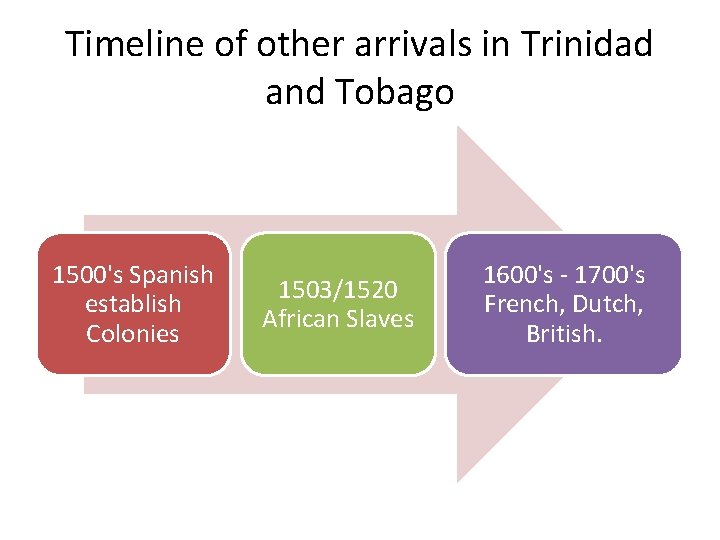
Timeline of other arrivals in Trinidad and Tobago 1500's Spanish establish Colonies 1503/1520 African Slaves 1600's - 1700's French, Dutch, British.
The Africans came to the Caribbean from as early as 1500’s as slaves. This meant that they were captured and brought here unwillingly. They were: • forced to work on the sugar plantations and • were separated from their family, • given a new name and identity, • beaten, • starved and made to work for free even if they were sick. • Lets look and listen: https: //youtu. be/3 NXC 4 Q_4 JVg
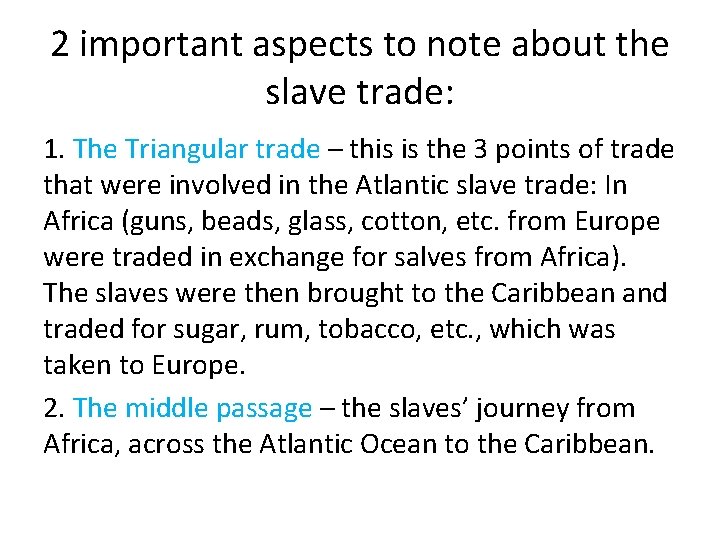
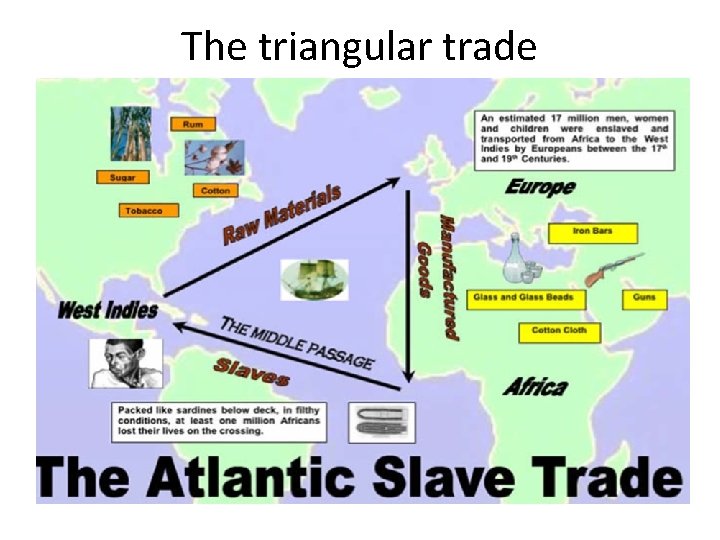
2 important aspects to note about the slave trade: 1. The Triangular trade – this is the 3 points of trade that were involved in the Atlantic slave trade: In Africa (guns, beads, glass, cotton, etc. from Europe were traded in exchange for salves from Africa). The slaves were then brought to the Caribbean and traded for sugar, rum, tobacco, etc. , which was taken to Europe. 2. The middle passage – the slaves’ journey from Africa, across the Atlantic Ocean to the Caribbean.
The triangular trade
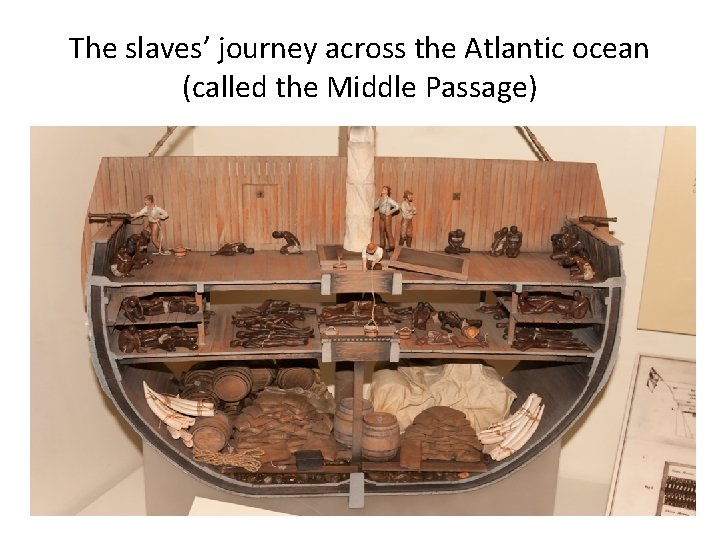
The slaves’ journey across the Atlantic ocean (called the Middle Passage)
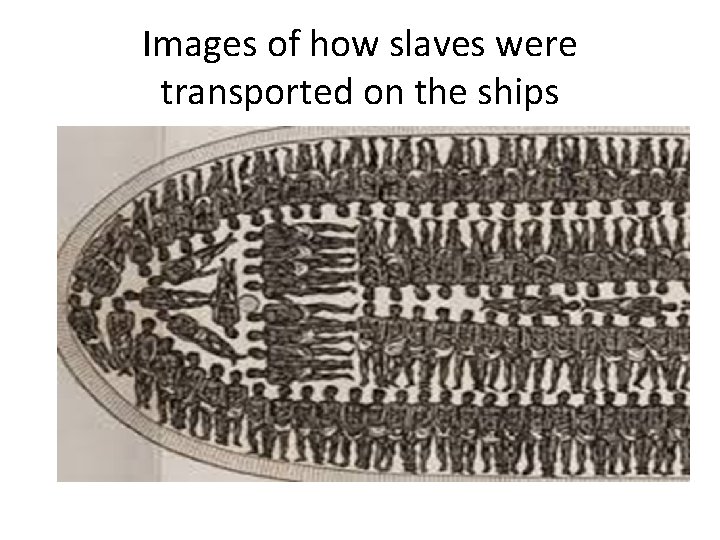
Images of how slaves were transported on the ships
The middle passage • The middle passage is the route between African and the Caribbean • The conditions on board the ships were horrible – as can be seen, the slaves were packed like ‘sardines in a can’ for the journey which lasted about 2 -3 months • The more slaves that could be carried, the more profits would be made. • Many died from suffocation because there was only room to lie down. Occasionally they would be let out to walk and return below deck.
The middle passage • Some decided to jump over-board and die rather than face those conditions • Others refused to eat, in those instances some were force-fed. • Occasionally some escaped when their ship sank close to the shore in bad weather or due to bad maintenance or in very rare instances when some were able to overpower the crew.
The Africans • Plantation work was intense and so the average lifespan of a slave was approximately 7 -9 years on a typical plantation. • It is estimated that around 15 million slaves were brought to the region.
The influence of the Africans • Folk medicine – African ‘Obeah man’ and ‘witch doctor’ who administered teas, bush baths, oils, etc. Eg – cane bush to cure fever, soursoup for worms. • Music – Calypso, rapso, reggae born out of resistance to oppression, drums, xylophone, Jamaican banjo are of African influence • Dances – belair, pique, limbo • Art & craft - wooden carvings, basket weaving, tie dye, batik, leather and calabash works (sandals, belts, bowls, etc); copper, brass and shell jewelry making. • Fashion – head ties, bandanas, braiding, cornrows
The influence of the Africans • Religion elements – Shango, Obeah, Voodoo, Islam to an extent. African elements – Shouter Baptist (T & T), Rastafarianism & Myalism in Jamaica, Santeria in Cuba. • Creation of creole/Patios language • Foods & Culinary practices – yams, cocoa, akam, ashum, ackee, peanut, plantain, Hybrid foods emerged – callaloo, pelau (sharing French origin), pone, paimee.
The English • Believed to have come to the Caribbean region as early as 1609/1612 (colonization). • Although they were one of the later groups to come to the region, they were the first to abolish the slave trade and slavery in the region. • Abolished slavery in 1834. Influence of the English: • Political system – Westminister system, British electoral system. • English language • Food – Irish potato, breakfast items such as hash browns, tea, cookies, biscuits, pies. • Religion – Anglican, Protestant faiths. • Dance – ballroom? • Architecture • Sport - cricket
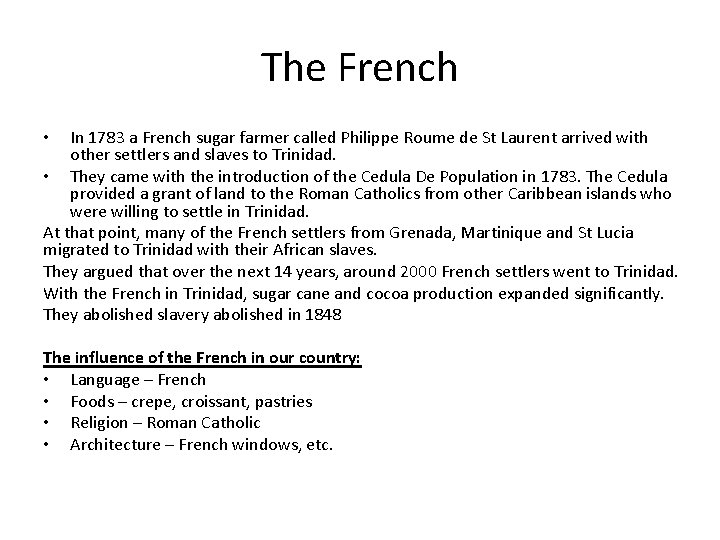
The French In 1783 a French sugar farmer called Philippe Roume de St Laurent arrived with other settlers and slaves to Trinidad. • They came with the introduction of the Cedula De Population in 1783. The Cedula provided a grant of land to the Roman Catholics from other Caribbean islands who were willing to settle in Trinidad. At that point, many of the French settlers from Grenada, Martinique and St Lucia migrated to Trinidad with their African slaves. They argued that over the next 14 years, around 2000 French settlers went to Trinidad. With the French in Trinidad, sugar cane and cocoa production expanded significantly. They abolished slavery abolished in 1848 • The influence of the French in our country: • Language – French • Foods – crepe, croissant, pastries • Religion – Roman Catholic • Architecture – French windows, etc.
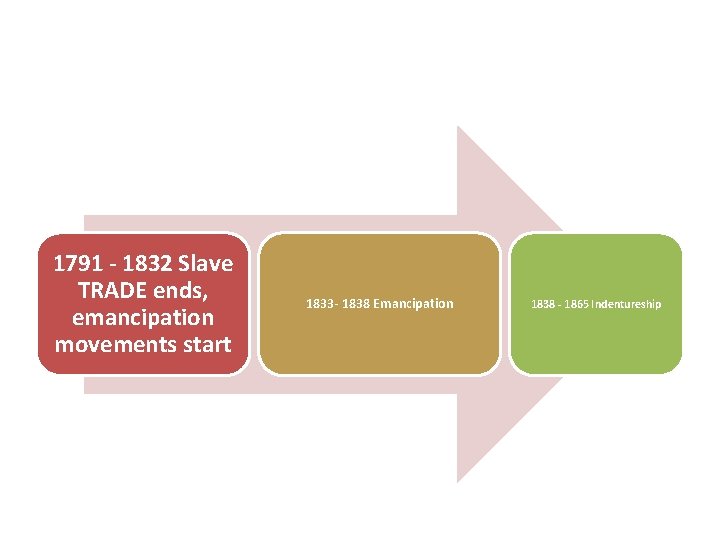
1791 - 1832 Slave TRADE ends, emancipation movements start 1833 - 1838 Emancipation 1838 - 1865 Indentureship
Emancipation of slaves To emancipate means to free. • As persons became more aware of religious teachings in the year 1800’s, persons started to express the belief that slavery was wrong and that it went against religious teachings. • Some persons decided to fight for the emancipation of the slaves. Among them were: William Wilberforce, Thomas Buxton and Thomas Clarkson. These people went to the British Parliament to try to put an end to slavery. They argued that it should be ended not just for religious reasons but for humanitarian reasons and economic reasons such as – it would have cost the British less money to import sugar from Mauritius. Also, slavery was no longer bringing a lot of money to Britain. The cost of maintaining the slaves on the plantation was high now.
Emancipation • In the year 1833, the British Parliament abolished (ended) slavery in the Englishspeaking Caribbean countries, but only on the condition that the slaves had to work as ‘ an apprentice’ on the plantation for 4 years first. This was called the Apprenticeship period. • As an apprenticeship they had to perform 45 hours of free labour each week for their owner. They were only paid for additional hours worked. • On August 1838, slaves in our country were emancipated. This day is now commemorated in the form of a public holiday every year in our country.
Indentureship • This means the state or period of being a servant bound to service for a specified time in return for passage to a colony. • After slavery was abolished, there was a need for labour on the plantations • The planters felt that the ex slaves would charge too much for their labour, and that if they introduced other labour to the colonies, it would prove to be a source of competition and would keep the price of labour down. • Labour from Ireland, Germany and Scotland were recruited from 1834 to 1841. • Around 5000 European labourers went to Jamaica, around 200 to St Kitts • That system failed because a lot of Europeans could not handle to rigors and restrictions of plantations. • A lot of them walked away from the plantations
The Chinese indentured • They came from Canton, Hong Kong • Went to British Guiana, Trinidad and Jamaica • They drifted off the plantations and went to businesses – bakeries, groceries, etc. The influence of the Chinese in our country: • Language • Food – chow mein, fried rice, stir-fry style preparation, wonton, etc. • Buddhism – religion