
The History of our Constitution The Declaration of






- Slides: 56
The History of our Constitution
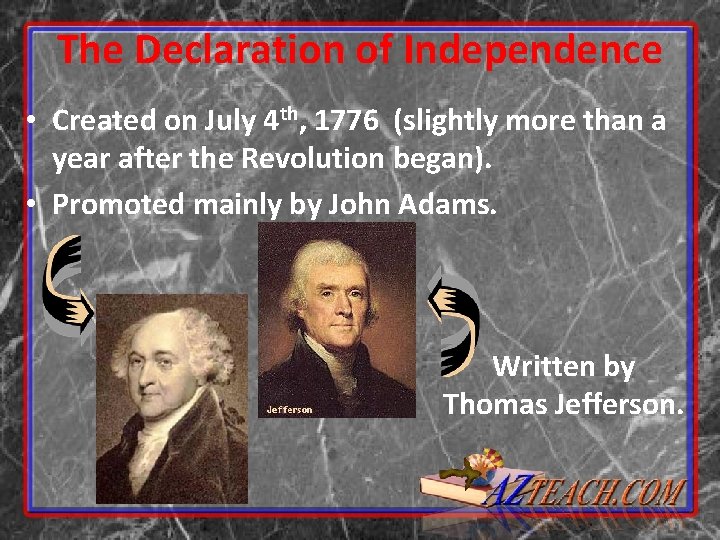
The Declaration of Independence • Created on July 4 th, 1776 (slightly more than a year after the Revolution began). • Promoted mainly by John Adams. Written by Thomas Jefferson.
Declaration of Independence Continued…. • Proclaimed the Natural Rights: Life, Liberty, and the Pursuit of Happiness. • Justification for separation: “Whenever any Form of Government becomes destructive of these ends it is the Right of the People to alter or to abolish it, and to institute new Government…”
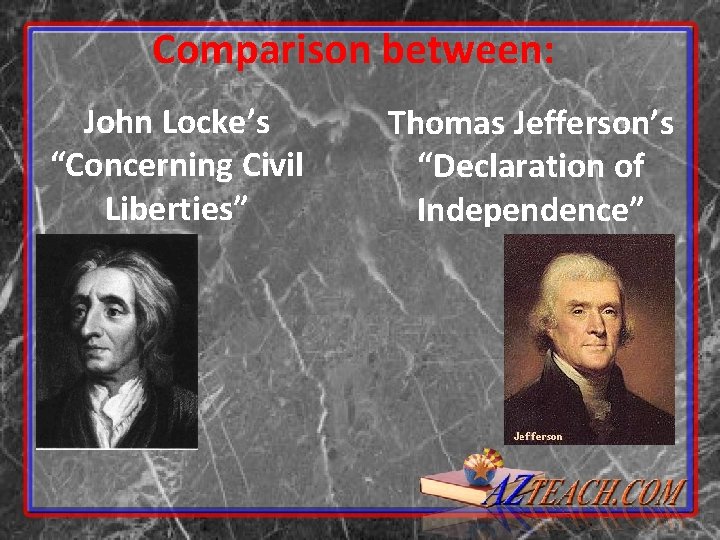
Comparison between: John Locke’s “Concerning Civil Liberties” Thomas Jefferson’s “Declaration of Independence”
State Constitutions • Congress urged each of the colonies to adopt: “such governments as shall in the opinion of the representatives of the people, best conduce to the happiness and safety of their constituents. ” • Common features among all state constitutions were: popular sovereignty, limited government, civil rights and liberties, and separation of powers and checks and balances.
States still remembered the evils of a monarch… They made sure to have: • Short elective terms of office • Limited right to vote to adult males with property ownership • Authority given mostly to the legislature – not the governor.
Articles of Confederation st • 1 attempt to establish a national government. • Power was in the STATES. Small central government. – Each state kept “its sovereignty, freedom, and independence”. – Came together only for “common defense, the security of their Liberties, and their mutual and general welfare”.
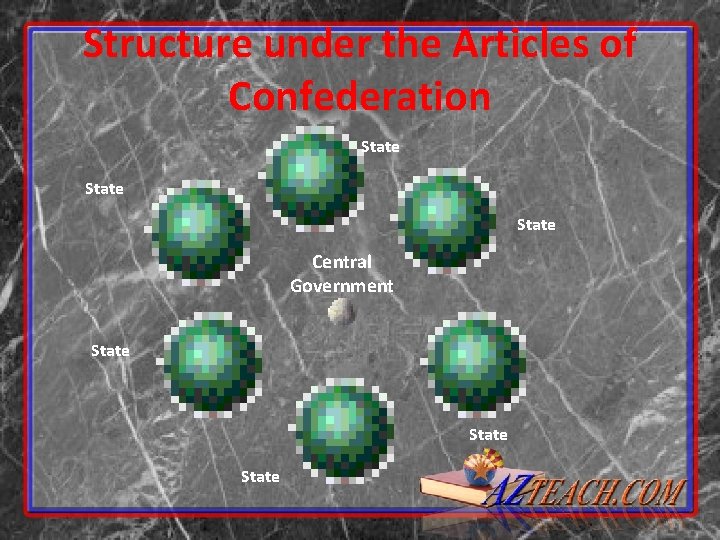
Structure under the Articles of Confederation State Central Government State
What were the Strengths and Weaknesses of the Articles of Confederation
Articles of Confederation
The Articles of Confederation was a constitution written during the American Revolution to establish the powers of the new national government
Weaknesses of the Articles of Confederation 1. Provided for a weak national government
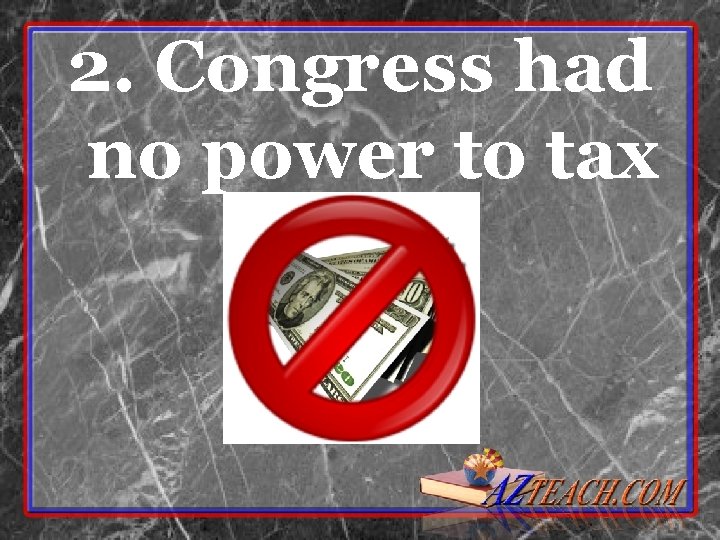
2. Congress had no power to tax
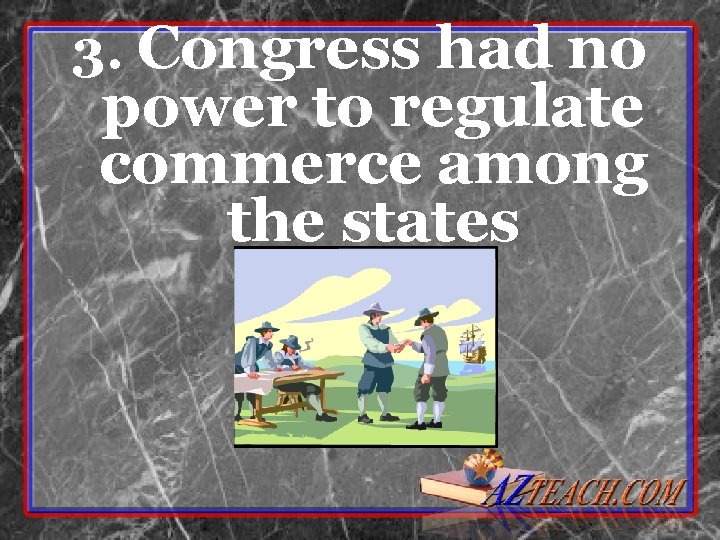
3. Congress had no power to regulate commerce among the states
4. Provided no common currency
5. One vote per state regardless of size
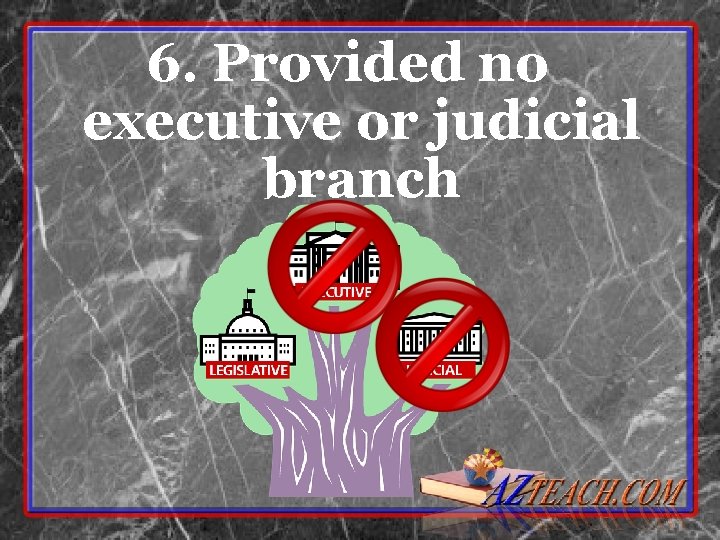
6. Provided no executive or judicial branch
“We are one nation today and 13 tomorrow. Who will treat with us on such terms? ” - George Washington • States bickered among themselves and grew jealous and suspicious of one another. • States often refused to support the new central government. • Some made agreements with foreign countries without approval. • Most organized their own military forces. • Printed money without backing – Economic chaos.
Creating the Constitution In this section you will learn how state delegates attempted to solve the problems of the Articles of Confederation.
A Constitutional Convention is called The states send delegates to a convention to solve the problems of the Articles of Confederation
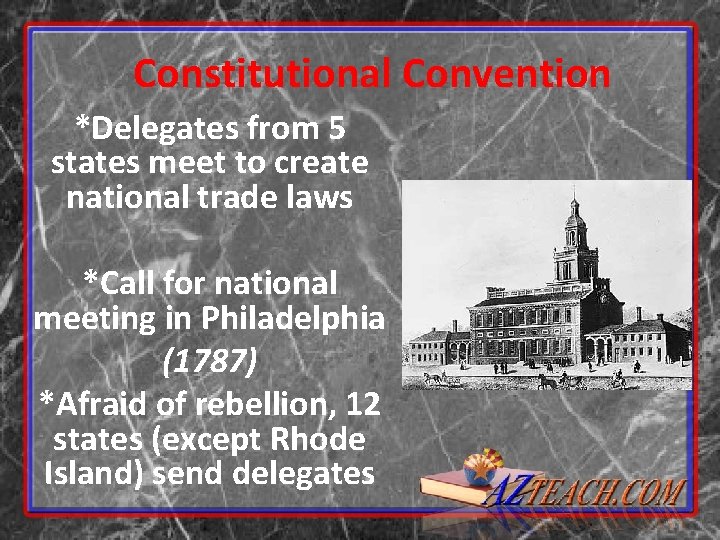
Constitutional Convention *Delegates from 5 states meet to create national trade laws *Call for national meeting in Philadelphia (1787) *Afraid of rebellion, 12 states (except Rhode Island) send delegates
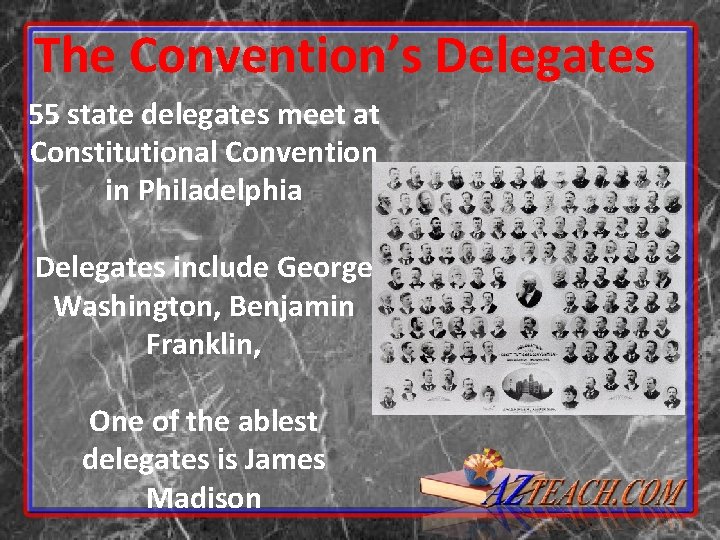
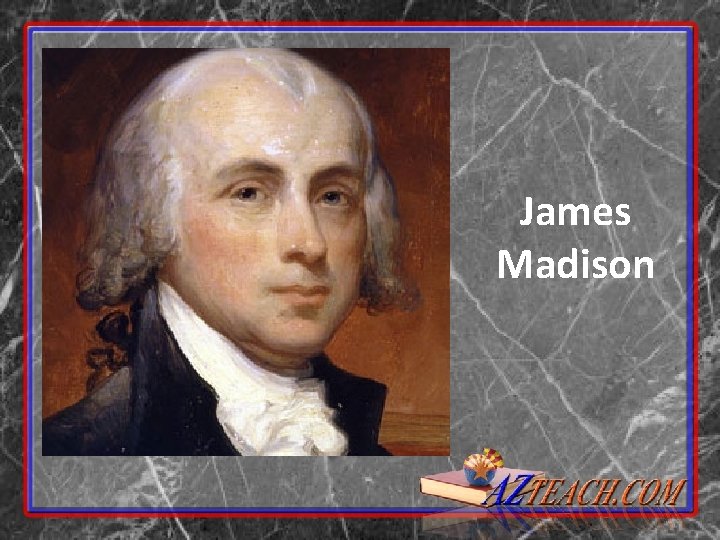
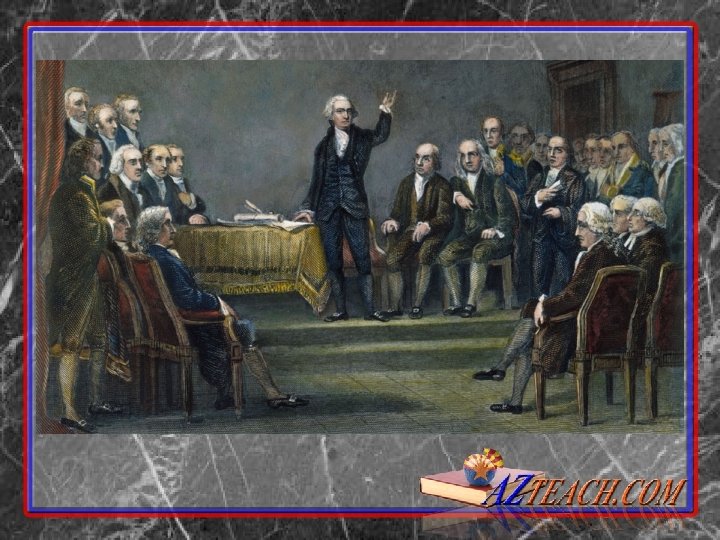
The Convention’s Delegates 55 state delegates meet at Constitutional Convention in Philadelphia Delegates include George Washington, Benjamin Franklin, One of the ablest delegates is James Madison
James Madison
The Delegates Assemble • Delegates want to create government strong enough to maintain order • But also want government that protects people’s rights.
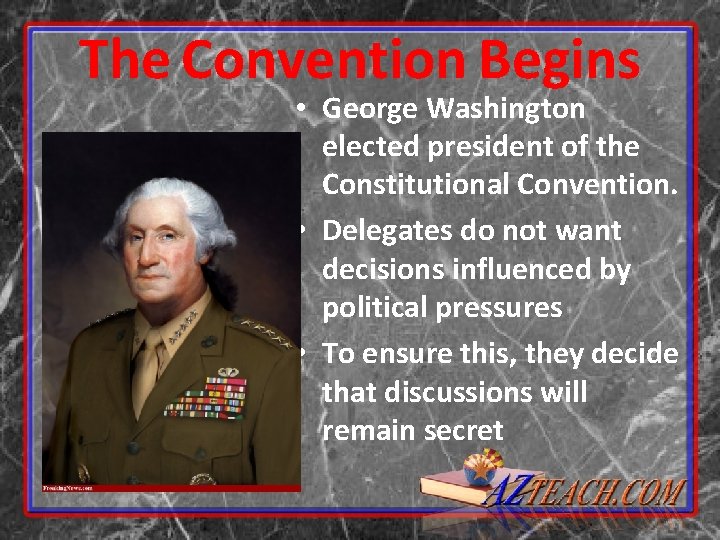
The Convention Begins • George Washington elected president of the Constitutional Convention. • Delegates do not want decisions influenced by political pressures • To ensure this, they decide that discussions will remain secret
The Virginia Plan divides government into 3 branches: -legislature makes the laws -executive enforces the laws -judiciary interprets the laws
The Virginia Plan • Legislature has two houses Representation is based on each state’s population or wealth • Larger states support the plan, smaller states oppose • Smaller states are afraid larger states will control them
FOR UNDERSTANDING
The purpose of the Constitutional Convention was: 1) to divide up the lands west of the Appalachian Mountains. 2) to resolve problems with the Articles of Confederation. 3) to declare independence from Great Britain 4) to set up a confederate governmental system.
. The Constitutional Convention was held in: 1) 1785 2) 1787 3) 1789 4) 1791
Who of the following was present at the Constitutional Convention? • 1) Thomas Jefferson • 3) James Madison • 2) John Adams • 4) Patrick Henry
Who of the following was absent from the Constitutional Convention? • 1) George Washington • 2) Patrick Henry • 3) James Madison • 4) Benjamin Franklin
______ served as the president of the convention. • 1) George Washington • 2) Benjamin Franklin • 3) James Madison • 4) Edmond Randolph
The ______, proposed a government with three branches. • 1) Great Compromise • 3) Three-Fifths Compromise • 2) delegates from Philadelphia • 4) Virginia Plan
The three branches proposed by the Virginia Plan were: • 1) an executive, a • 3) an elite, a legislative, and a congressional. judiciary. • 2) an executive, a • 4) an executive, a litigious, and a legislative, and a judiciary.
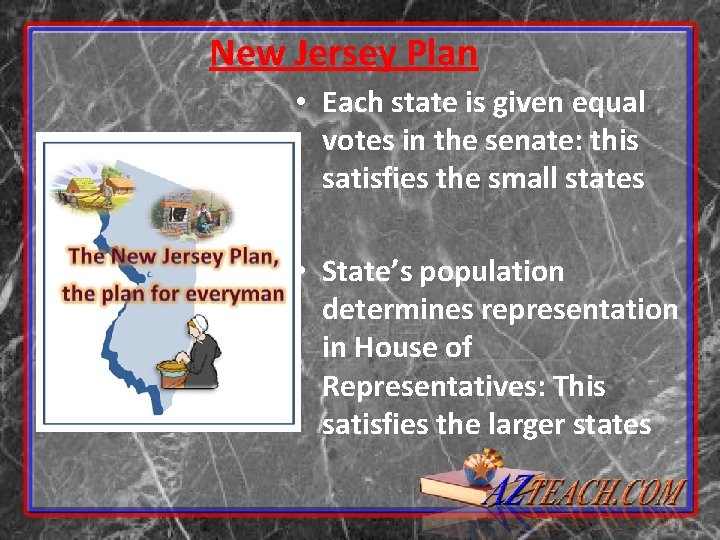
New Jersey Plan is an alternative plan for U. S. government -legislature has one house -each state has one vote
New Jersey Plan • Each state is given equal votes in the senate: this satisfies the small states • State’s population determines representation in House of Representatives: This satisfies the larger states
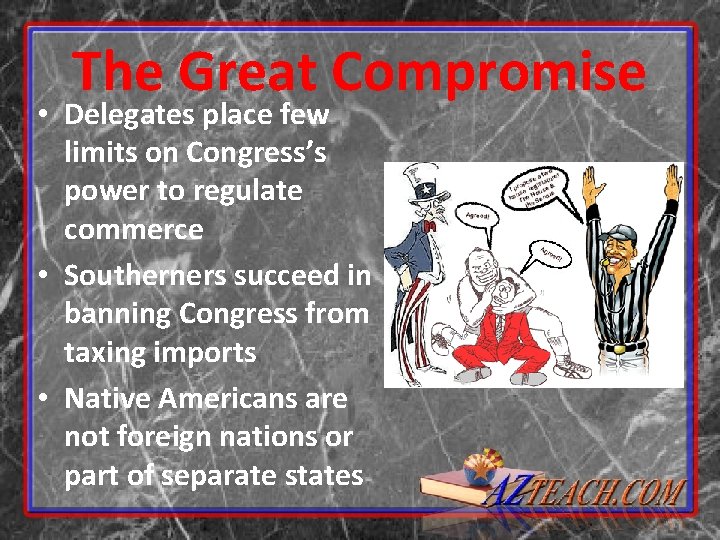
The Great Compromise • Delegates place few limits on Congress’s power to regulate commerce • Southerners succeed in banning Congress from taxing imports • Native Americans are not foreign nations or part of separate states
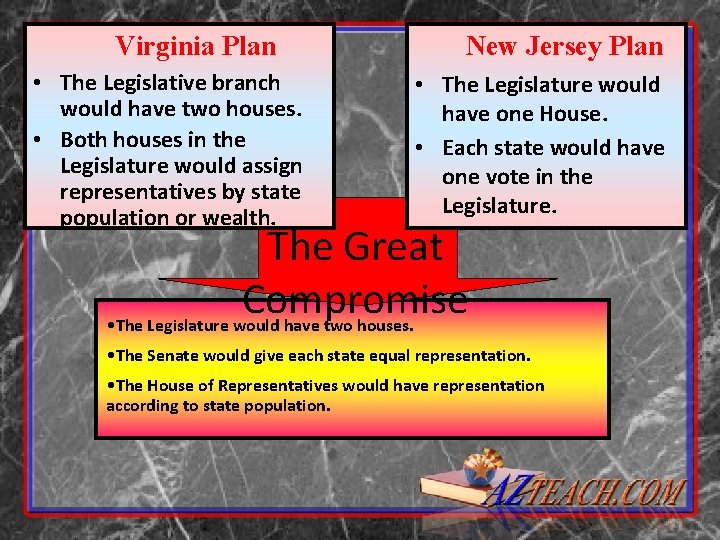
Virginia Plan • The Legislative branch would have two houses. • Both houses in the Legislature would assign representatives by state population or wealth. New Jersey Plan • The Legislature would have one House. • Each state would have one vote in the Legislature. The Great Compromise • The Legislature would have two houses. • The Senate would give each state equal representation. • The House of Representatives would have representation according to state population.
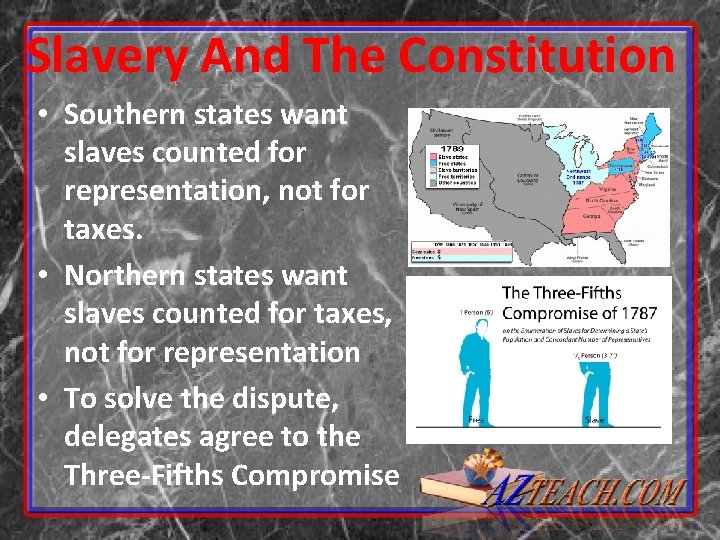
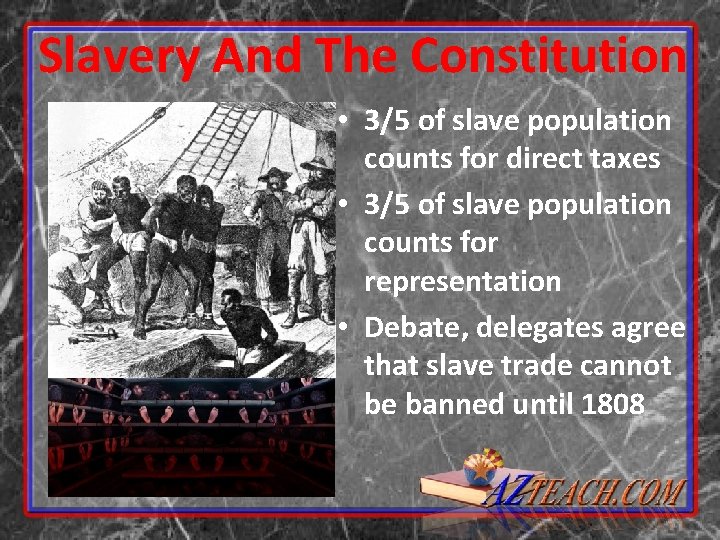
Slavery And The Constitution • Southern states want slaves counted for representation, not for taxes. • Northern states want slaves counted for taxes, not for representation • To solve the dispute, delegates agree to the Three-Fifths Compromise
Slavery And The Constitution • 3/5 of slave population counts for direct taxes • 3/5 of slave population counts for representation • Debate, delegates agree that slave trade cannot be banned until 1808
Ratification • On September 15, 1787 delegates approve the Constitution • Constitution sent to the states for ratification
FOR UNDERSTANDING
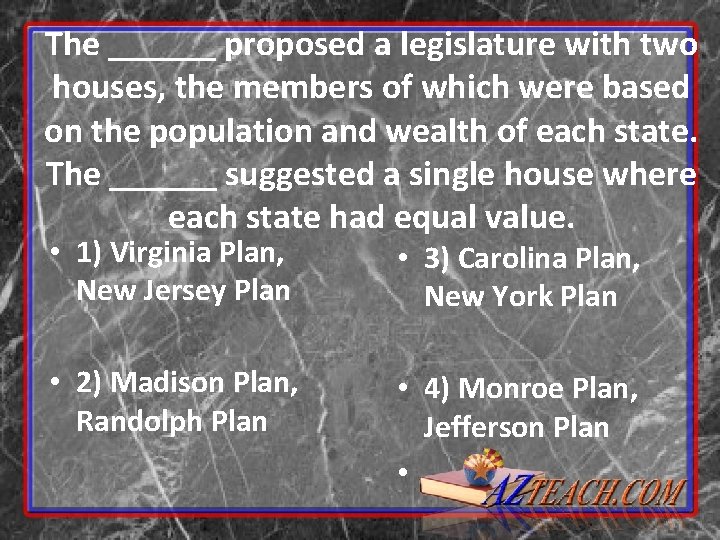
The ______ proposed a legislature with two houses, the members of which were based on the population and wealth of each state. The ______ suggested a single house where each state had equal value. • 1) Virginia Plan, New Jersey Plan • 3) Carolina Plan, New York Plan • 2) Madison Plan, Randolph Plan • 4) Monroe Plan, Jefferson Plan •
The ______ created a legislative branch with two houses, one based on the population of each state, and one that gave an equal voice to each state. • 1) Virginia Plan • 3) Great Compromise • 2) Federalist Papers • 4) New Jersey Plan
For purposes of taxation and representation in the House of Representatives, the ______ counted slaves as partial citizens. • 1) Three-Fifths Compromise • 2) Missouri Compromise • 3) Virginia Plan • 4) Articles of Confederation
Congress was granted the power to regulate, promote and tax______, make treaties, and be the sole coiner of money. • 1) slaves • 3) exports • 2) commerce • 4) incomes
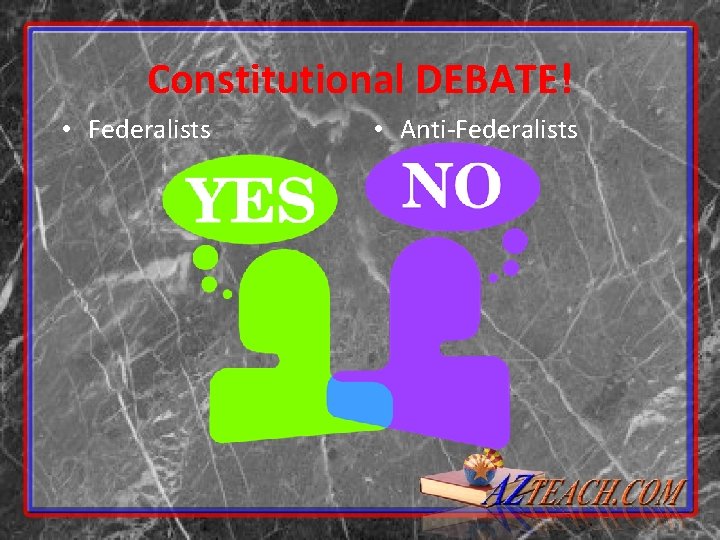
Constitutional DEBATE! • Federalists • Anti-Federalists
A Stronger Government is Created
The Preamble We the people of the United States, in order to form a more perfect union, establish justice, insure domestic tranquility, provide for the common defense, promote the general welfare, and secure the blessings of liberty to ourselves and our posterity, do ordain and establish this Constitution for the United States of America. * How has the US government accomplished each of these things?
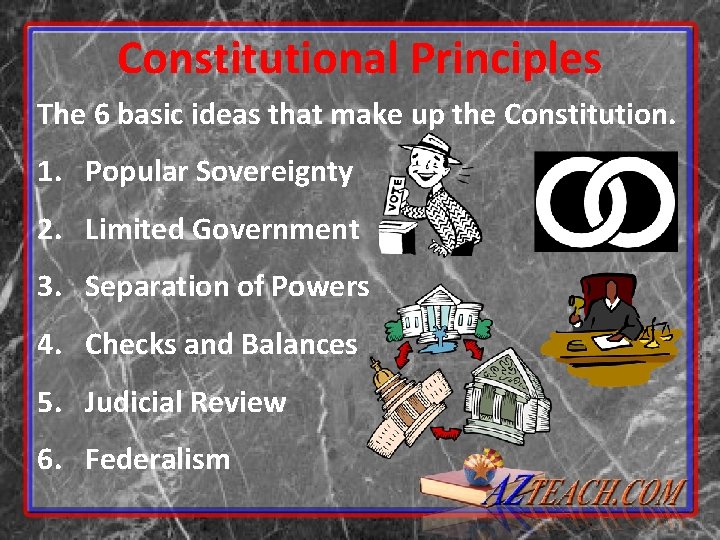
Constitutional Principles The 6 basic ideas that make up the Constitution. 1. Popular Sovereignty 2. Limited Government 3. Separation of Powers 4. Checks and Balances 5. Judicial Review 6. Federalism
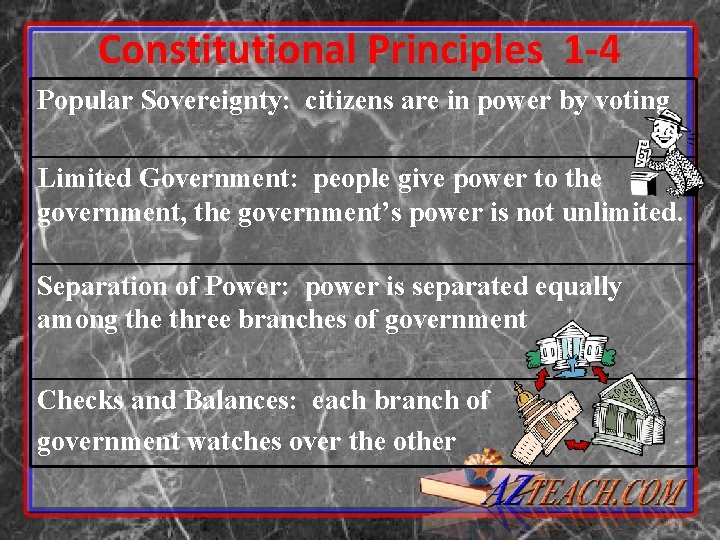
Constitutional Principles 1 -4 Popular Sovereignty: citizens are in power by voting Limited Government: people give power to the government, the government’s power is not unlimited. Separation of Power: power is separated equally among the three branches of government Checks and Balances: each branch of government watches over the other
Constitutional Principles 5 & 6 Judicial Review: The power of the Federal courts to determine if Government Action is Constitutional. The interpreter or final judge on what the Constitution says and means. Federalism: A system of government where power is divided between the national and state governments.
We can find the Constitution in our daily lives… Find an example of each principle in the current events.
Questions? ? ?