
The History of Numbers Introduction Numbers serve two
The History of Numbers
Introduction • Numbers serve two purposes – Tools for Counting and Measuring – Attempt to Understand the Unexplainable • Natural versus Learned Counting – Develop System & Method of Manipulation – Linguistics to Communicate the System

Introduction • Civilizations each developed their own system, each contributing to today’s understanding of numbers
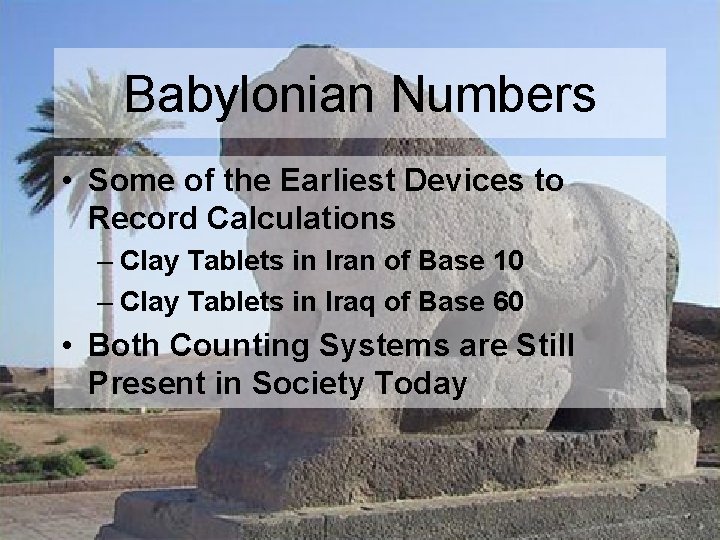
Babylonian Numbers • Some of the Earliest Devices to Record Calculations – Clay Tablets in Iran of Base 10 – Clay Tablets in Iraq of Base 60 • Both Counting Systems are Still Present in Society Today
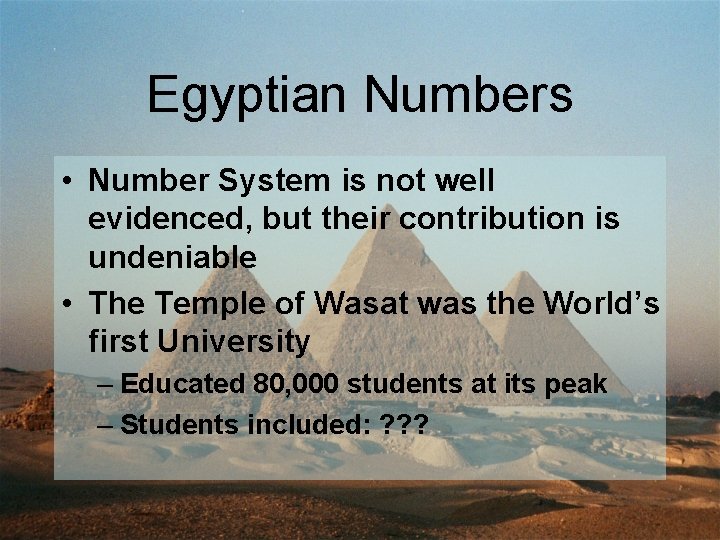
Egyptian Numbers • Number System is not well evidenced, but their contribution is undeniable • The Temple of Wasat was the World’s first University – Educated 80, 000 students at its peak – Students included: ? ? ?
Egyptian Numbers • Students included: Plato, Aristotle, Socrates, Euclid, Pythagoras, Hypocrates, Archimides, Euripides
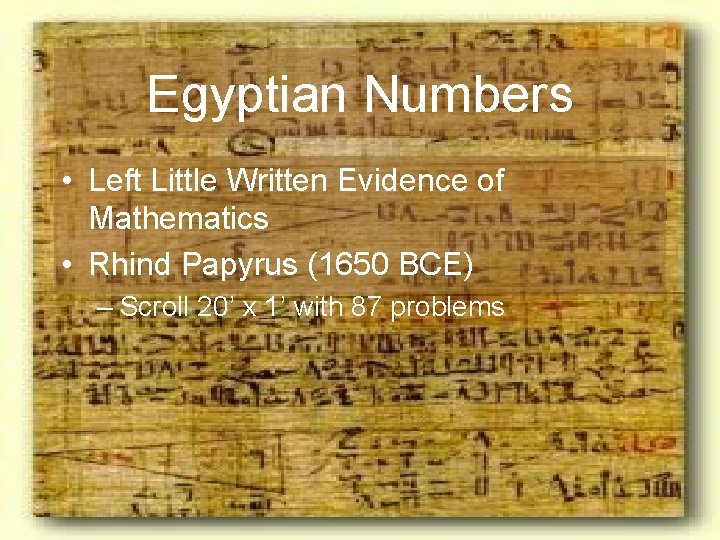
Egyptian Numbers • Left Little Written Evidence of Mathematics • Rhind Papyrus (1650 BCE) – Scroll 20’ x 1’ with 87 problems
Greek Numbers • Which is more basic: Arithmetic or Geometry? – Discrete or Continuous Universe • Reality is Mathematical in Nature • Irrational Numbers Presented a Philosophical Problem for the Greeks • Thinking Based on Words and Abstract Diagrams
Greek Numbers • By 500 BCE, they had a system based on the decimal and comprised of the 27 letters of their alphabet – First nine letters represented the digits 1 -9 – Second nine represented the tens
Greek Numbers – The last nine represented the hundreds – Special sign for numbers higher than 900 – There was no zero – Numbers were nonpositional
Roman Numbers • Roman numerals spread throughout Western Europe – Started with stick numbers (I, III, IIII) – Added six letter symbols (V, X, L, C, D, M) – Addition & Subtraction were simple, but Multiplication & Division proved Complicated – CCKCVI + DCL + MLXXX = ?
Roman Numbers • The Abacus existed to provide place value – Work vanished as it was performed, leaving no record of the process – No way to check results other than to redo the calculation
Arabic Numbers • In 830, Caliph al’Mamun founded the House of Wisdom in Baghdad – Advancement during European Dark Ages – Muslim world was reading translated works of the great Greek mathematicians
Arabic Numbers • Arabic numerals were promoted by Fibonacci, but met opposition in Europe • System had place value and zero
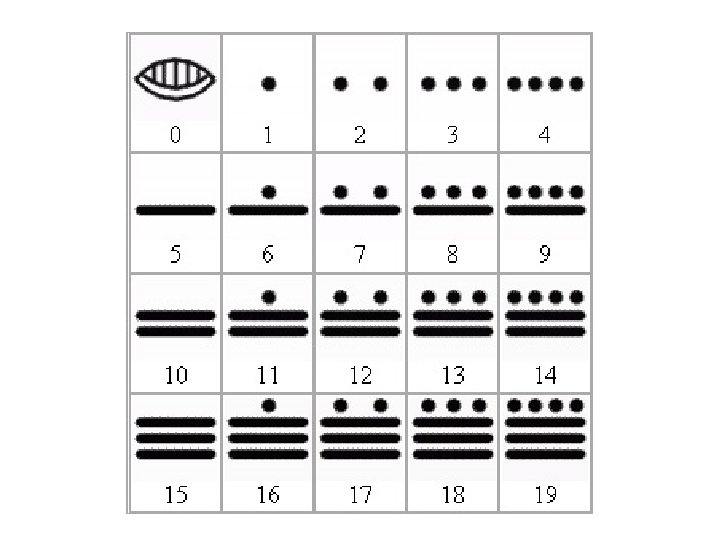
Mayan Numbers • Employed a place value system with a base twenty counting system – They used a dot to represent 1 and a horizontal line for 5 – Larger numbers were represented by stacking symbols in columns – Had a zero
- Slides: 16