
The History of IEEE and Electrotechnologies Prepared by
The History of IEEE and Electrotechnologies Prepared by the IEEE History Center 39 Union St. , New Brunswick NJ 08901 ieee-history@ieee. org
Since 1884, IEEE has been fostering technical innovation for the benefit of humanity.
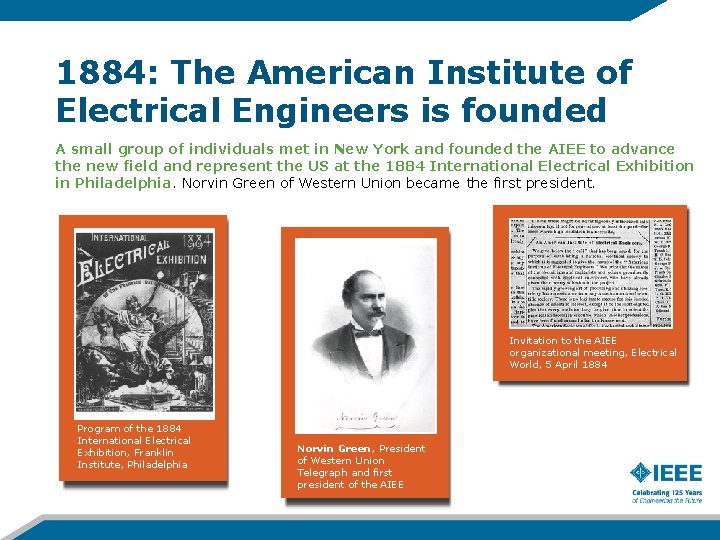
1884: The American Institute of Electrical Engineers is founded A small group of individuals met in New York and founded the AIEE to advance the new field and represent the US at the 1884 International Electrical Exhibition in Philadelphia. Norvin Green of Western Union became the first president. Invitation to the AIEE organizational meeting, Electrical World, 5 April 1884 Program of the 1884 International Electrical Exhibition, Franklin Institute, Philadelphia Norvin Green, President of Western Union Telegraph and first president of the AIEE
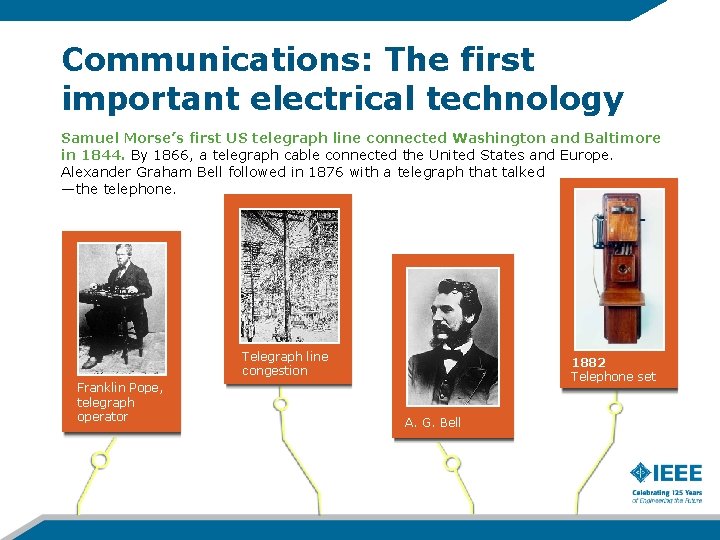
Communications: The first important electrical technology Samuel Morse’s first US telegraph line connected Washington and Baltimore in 1844. By 1866, a telegraph cable connected the United States and Europe. Alexander Graham Bell followed in 1876 with a telegraph that talked —the telephone. Telegraph line congestion Franklin Pope, telegraph operator 1882 Telephone set A. G. Bell
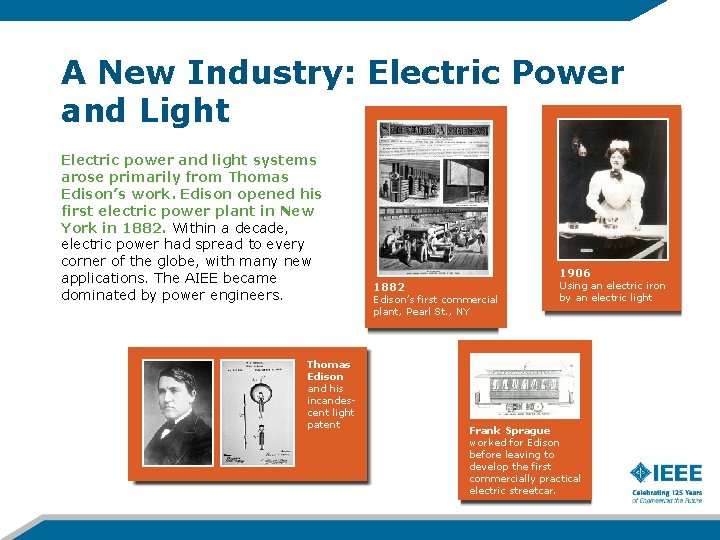
A New Industry: Electric Power and Light Electric power and light systems arose primarily from Thomas Edison’s work. Edison opened his first electric power plant in New York in 1882. Within a decade, electric power had spread to every corner of the globe, with many new applications. The AIEE became dominated by power engineers. Thomas Edison and his incandescent light patent 1882 1906 Edison’s first commercial plant, Pearl St. , NY Using an electric iron by an electric light Frank Sprague worked for Edison before leaving to develop the first commercially practical electric streetcar.
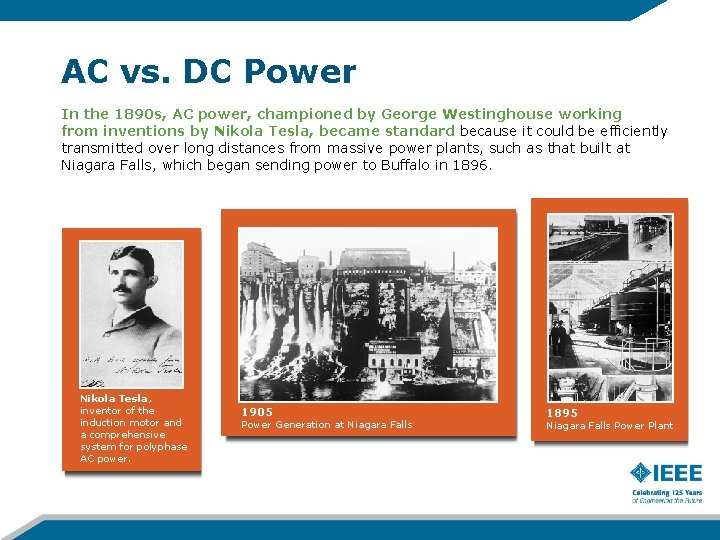
AC vs. DC Power In the 1890 s, AC power, championed by George Westinghouse working from inventions by Nikola Tesla, became standard because it could be efficiently transmitted over long distances from massive power plants, such as that built at Niagara Falls, which began sending power to Buffalo in 1896. Nikola Tesla, inventor of the induction motor and a comprehensive system for polyphase AC power. 1905 Power Generation at Niagara Falls 1895 Niagara Falls Power Plant
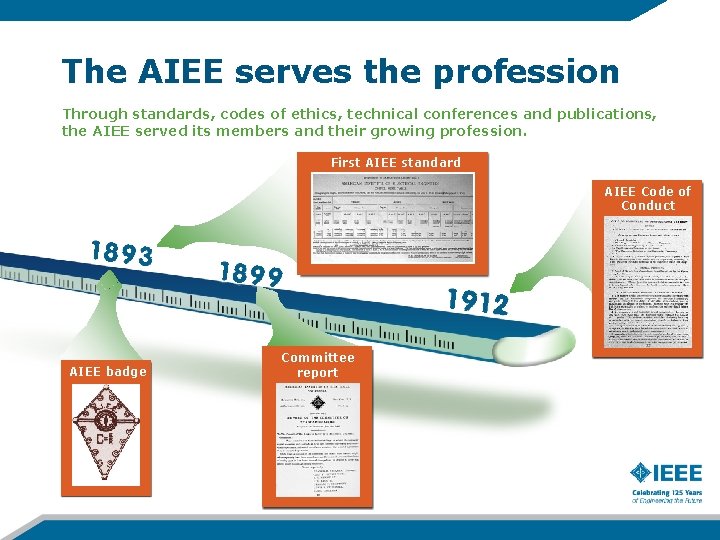
The AIEE serves the profession Through standards, codes of ethics, technical conferences and publications, the AIEE served its members and their growing profession. First AIEE standard AIEE Code of Conduct AIEE badge Committee report
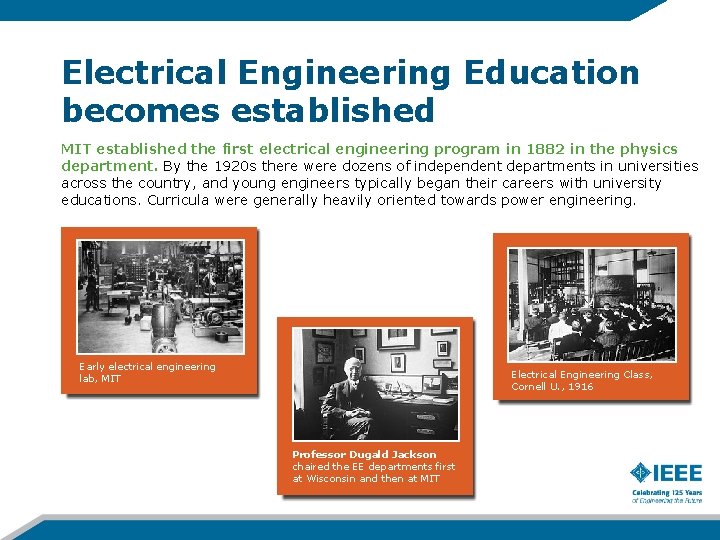
Electrical Engineering Education becomes established MIT established the first electrical engineering program in 1882 in the physics department. By the 1920 s there were dozens of independent departments in universities across the country, and young engineers typically began their careers with university educations. Curricula were generally heavily oriented towards power engineering. Early electrical engineering lab, MIT Electrical Engineering Class, Cornell U. , 1916 Professor Dugald Jackson chaired the EE departments first at Wisconsin and then at MIT
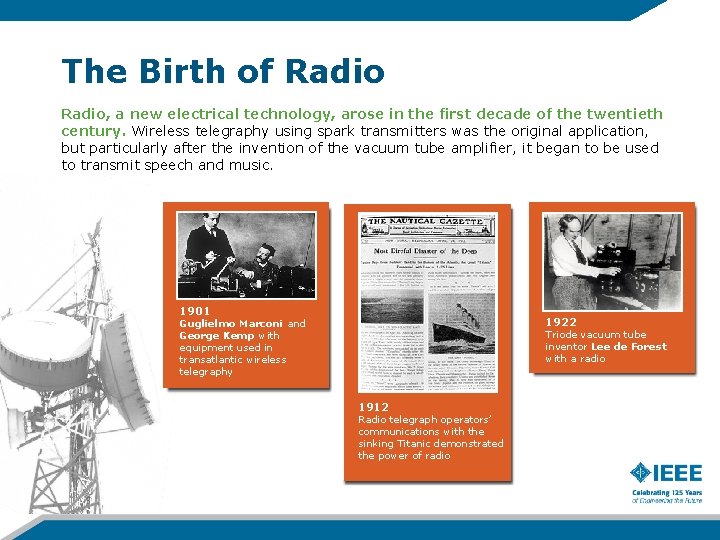
The Birth of Radio, a new electrical technology, arose in the first decade of the twentieth century. Wireless telegraphy using spark transmitters was the original application, but particularly after the invention of the vacuum tube amplifier, it began to be used to transmit speech and music. 1901 1922 Guglielmo Marconi and George Kemp with equipment used in transatlantic wireless telegraphy Triode vacuum tube inventor Lee de Forest with a radio 1912 Radio telegraph operators’ communications with the sinking Titanic demonstrated the power of radio
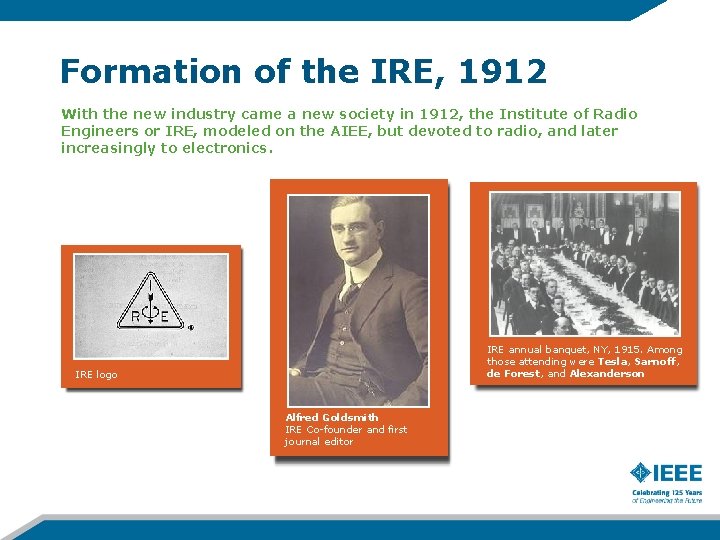
Formation of the IRE, 1912 With the new industry came a new society in 1912, the Institute of Radio Engineers or IRE, modeled on the AIEE, but devoted to radio, and later increasingly to electronics. IRE annual banquet, NY, 1915. Among those attending were Tesla, Sarnoff, de Forest, and Alexanderson IRE logo Alfred Goldsmith IRE Co-founder and first journal editor

Media Becomes Electronic In the 1920 s, Radio broadcasting swept the world. Between 1921 and 1930 the number of US households with radios grew from close to zero to almost 14 million. And a still newer technology, television, was moving from experiment to reality. IRE members led the way in these developments. Vacuum tubes, the first electronic amplifiers, made radio broadcasting and transcontinental telephony possible. 1930 s Listening to radio 1921 WJZ Studio, Newark NJ 1939 RCA President David Sarnoff opening commercial TV service, NY
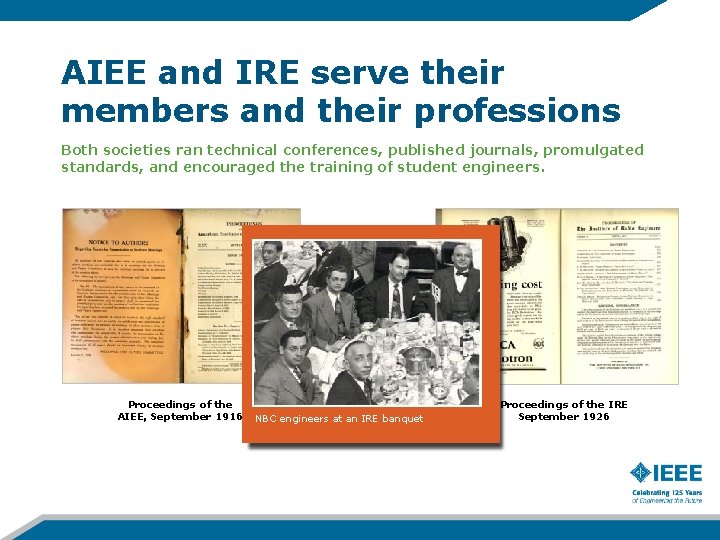
AIEE and IRE serve their members and their professions Both societies ran technical conferences, published journals, promulgated standards, and encouraged the training of student engineers. Proceedings of the AIEE, September 1916 NBC engineers at an IRE banquet Proceedings of the IRE September 1926
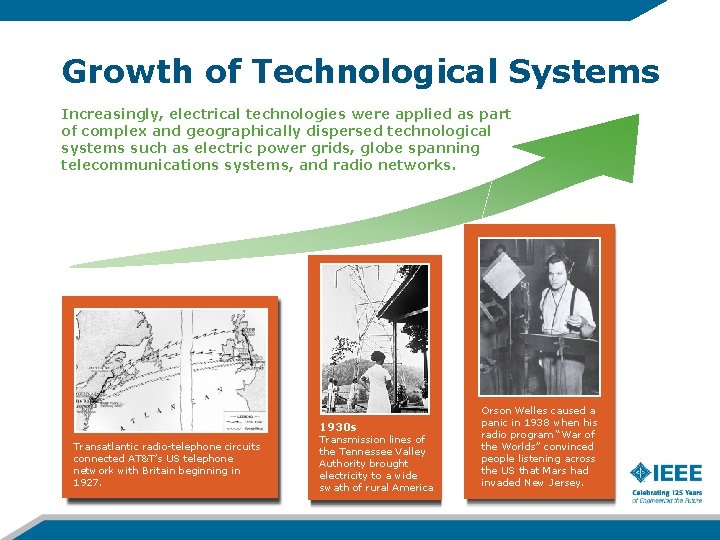
Growth of Technological Systems Increasingly, electrical technologies were applied as part of complex and geographically dispersed technological systems such as electric power grids, globe spanning telecommunications systems, and radio networks. 1930 s Transatlantic radio-telephone circuits connected AT&T’s US telephone network with Britain beginning in 1927. Transmission lines of the Tennessee Valley Authority brought electricity to a wide swath of rural America Orson Welles caused a panic in 1938 when his radio program “War of the Worlds” convinced people listening across the US that Mars had invaded New Jersey.
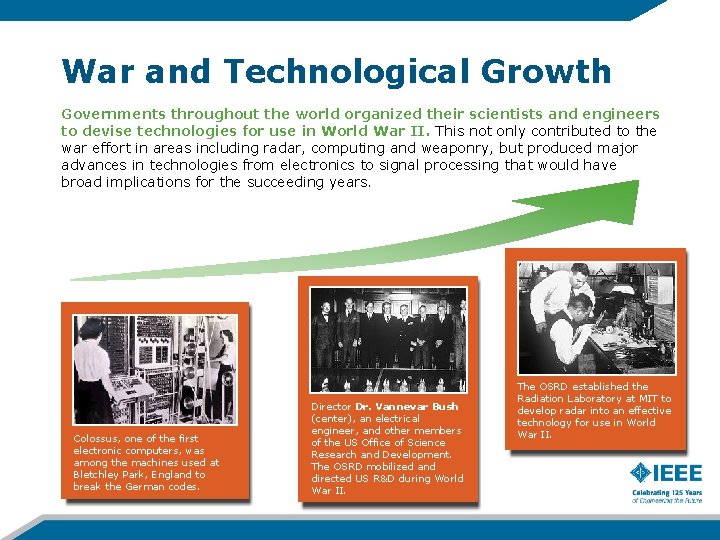
War and Technological Growth Governments throughout the world organized their scientists and engineers to devise technologies for use in World War II. This not only contributed to the war effort in areas including radar, computing and weaponry, but produced major advances in technologies from electronics to signal processing that would have broad implications for the succeeding years. Colossus, one of the first electronic computers, was among the machines used at Bletchley Park, England to break the German codes. Director Dr. Vannevar Bush (center), an electrical engineer, and other members of the US Office of Science Research and Development. The OSRD mobilized and directed US R&D during World War II. The OSRD established the Radiation Laboratory at MIT to develop radar into an effective technology for use in World War II.
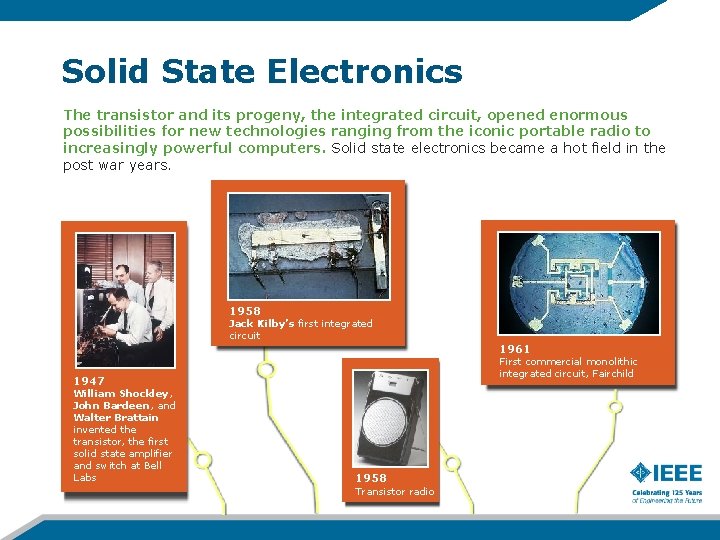
Solid State Electronics The transistor and its progeny, the integrated circuit, opened enormous possibilities for new technologies ranging from the iconic portable radio to increasingly powerful computers. Solid state electronics became a hot field in the post war years. 1958 Jack Kilby’s first integrated circuit 1961 First commercial monolithic integrated circuit, Fairchild 1947 William Shockley, John Bardeen, and Walter Brattain invented the transistor, the first solid state amplifier and switch at Bell Labs 1958 Transistor radio
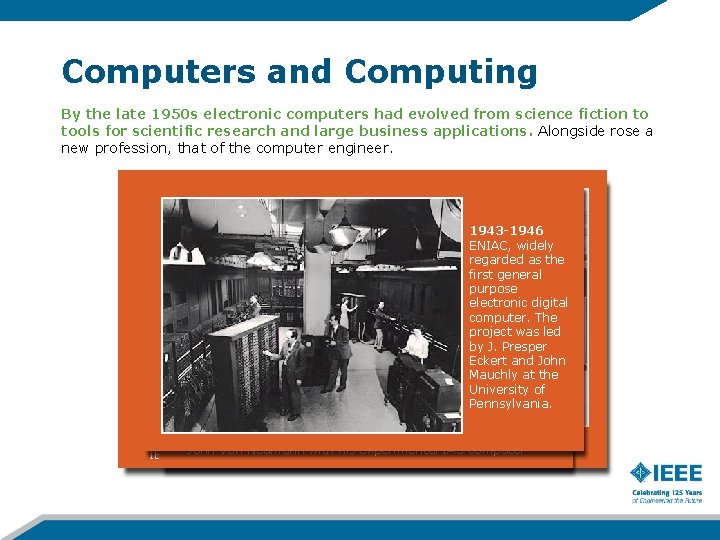
Computers and Computing By the late 1950 s electronic computers had evolved from science fiction to tools for scientific research and large business applications. Alongside rose a new profession, that of the computer engineer. 1943 -1946 ENIAC, widely regarded as the first general purpose electronic digital computer. The project was led by J. Presper Eckert and John Mauchly at the University of Pennsylvania. 1959 1952 John Von Neumann with his experimental IAS computer IBM 7090, one of the first fully transistorized computers
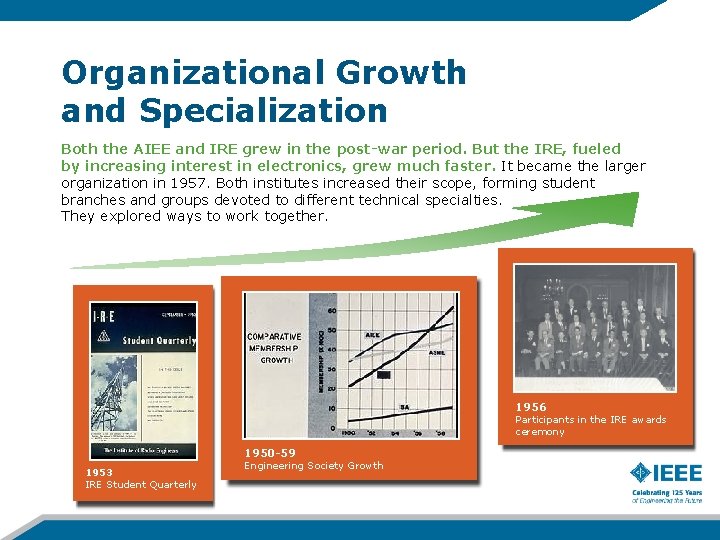
Organizational Growth and Specialization Both the AIEE and IRE grew in the post-war period. But the IRE, fueled by increasing interest in electronics, grew much faster. It became the larger organization in 1957. Both institutes increased their scope, forming student branches and groups devoted to different technical specialties. They explored ways to work together. 1956 Participants in the IRE awards ceremony 1950 -59 1953 IRE Student Quarterly Engineering Society Growth
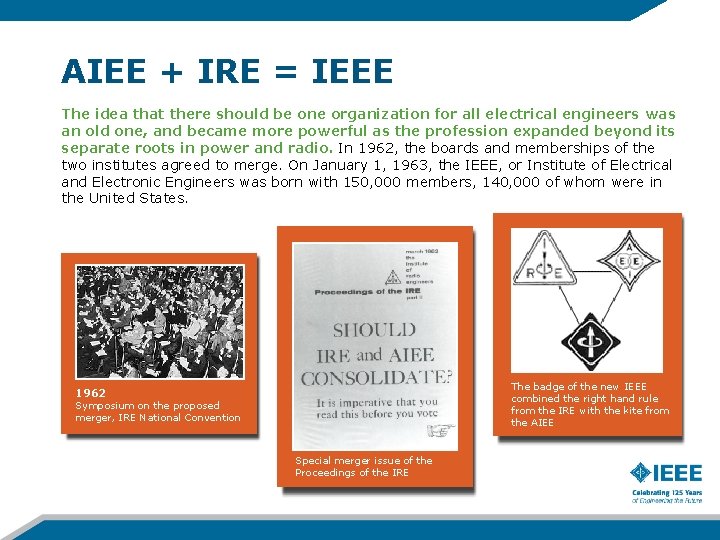
AIEE + IRE = IEEE The idea that there should be one organization for all electrical engineers was an old one, and became more powerful as the profession expanded beyond its separate roots in power and radio. In 1962, the boards and memberships of the two institutes agreed to merge. On January 1, 1963, the IEEE, or Institute of Electrical and Electronic Engineers was born with 150, 000 members, 140, 000 of whom were in the United States. The badge of the new IEEE combined the right hand rule from the IRE with the kite from the AIEE 1962 Symposium on the proposed merger, IRE National Convention Special merger issue of the Proceedings of the IRE
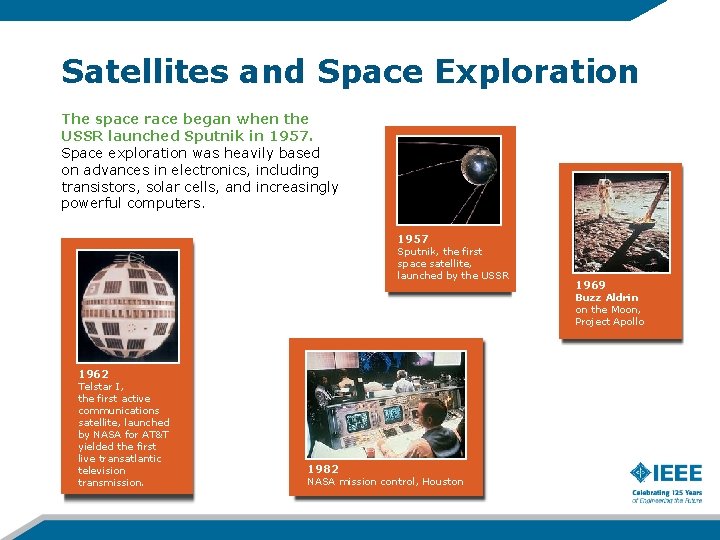
Satellites and Space Exploration The space race began when the USSR launched Sputnik in 1957. Space exploration was heavily based on advances in electronics, including transistors, solar cells, and increasingly powerful computers. 1957 Sputnik, the first space satellite, launched by the USSR 1969 Buzz Aldrin on the Moon, Project Apollo 1962 Telstar I, the first active communications satellite, launched by NASA for AT&T yielded the first live transatlantic television transmission. 1982 NASA mission control, Houston
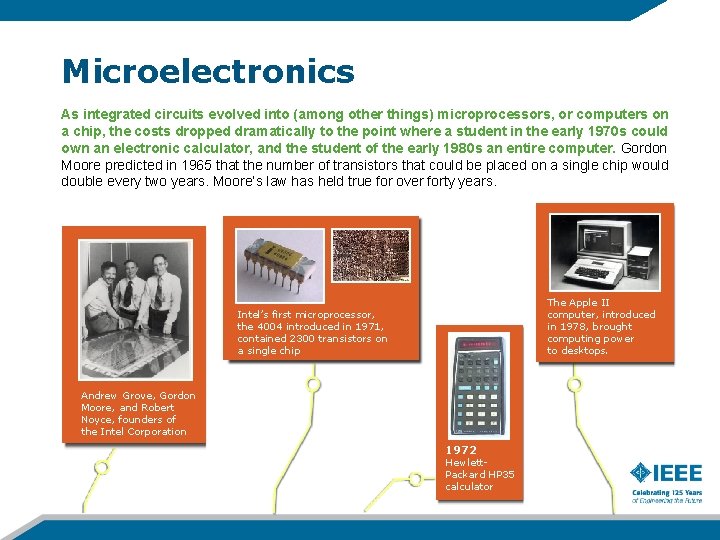
Microelectronics As integrated circuits evolved into (among other things) microprocessors, or computers on a chip, the costs dropped dramatically to the point where a student in the early 1970 s could own an electronic calculator, and the student of the early 1980 s an entire computer. Gordon Moore predicted in 1965 that the number of transistors that could be placed on a single chip would double every two years. Moore’s law has held true for over forty years. The Apple II computer, introduced in 1978, brought computing power to desktops. Intel’s first microprocessor, the 4004 introduced in 1971, contained 2300 transistors on a single chip Andrew Grove, Gordon Moore, and Robert Noyce, founders of the Intel Corporation 1972 Hewlett. Packard HP 35 calculator
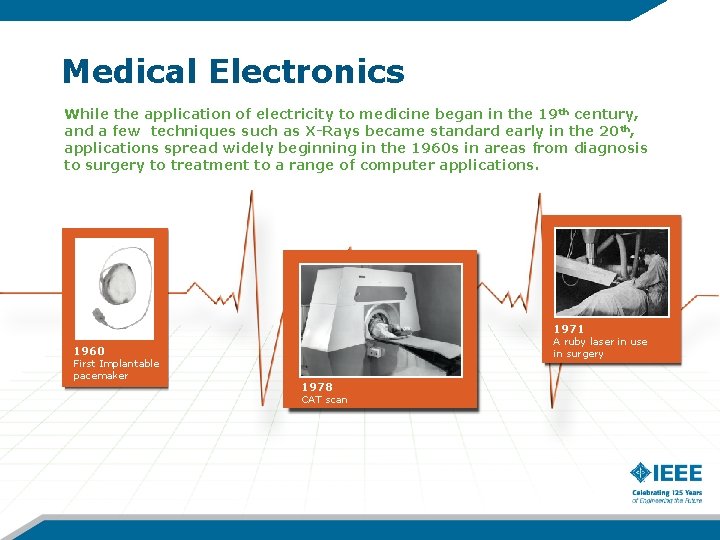
Medical Electronics While the application of electricity to medicine began in the 19 th century, and a few techniques such as X-Rays became standard early in the 20 th, applications spread widely beginning in the 1960 s in areas from diagnosis to surgery to treatment to a range of computer applications. 1971 A ruby laser in use in surgery 1960 First Implantable pacemaker 1978 CAT scan
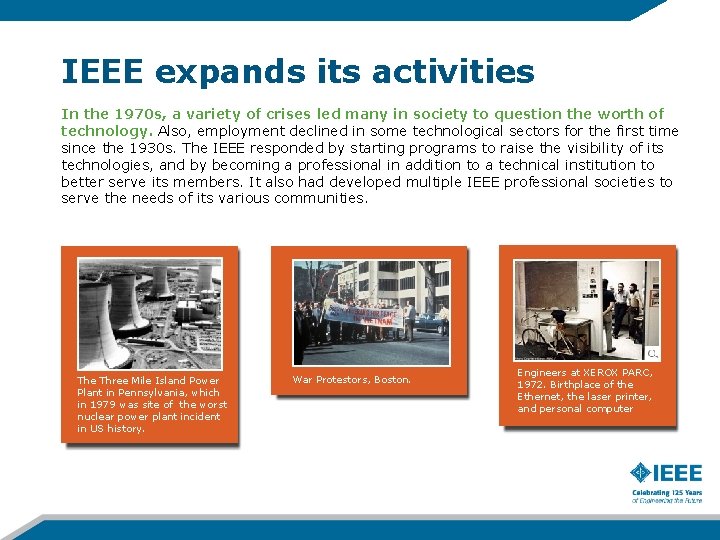
IEEE expands its activities In the 1970 s, a variety of crises led many in society to question the worth of technology. Also, employment declined in some technological sectors for the first time since the 1930 s. The IEEE responded by starting programs to raise the visibility of its technologies, and by becoming a professional in addition to a technical institution to better serve its members. It also had developed multiple IEEE professional societies to serve the needs of its various communities. The Three Mile Island Power Plant in Pennsylvania, which in 1979 was site of the worst nuclear power plant incident in US history. War Protestors, Boston. Engineers at XEROX PARC, 1972. Birthplace of the Ethernet, the laser printer, and personal computer
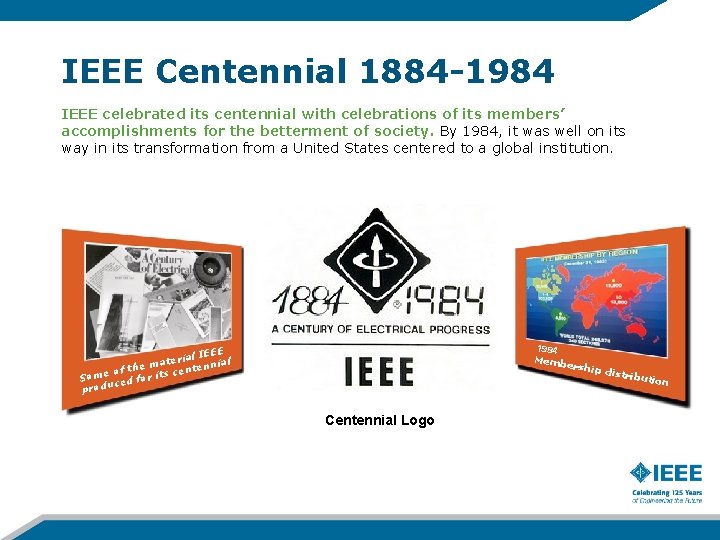
IEEE Centennial 1884 -1984 IEEE celebrated its centennial with celebrations of its members’ accomplishments for the betterment of society. By 1984, it was well on its way in its transformation from a United States centered to a global institution. 1984 Memb e EEE rial I ial e t a m nn of the cente Some ed for its c produ rship Centennial Logo distri butio n
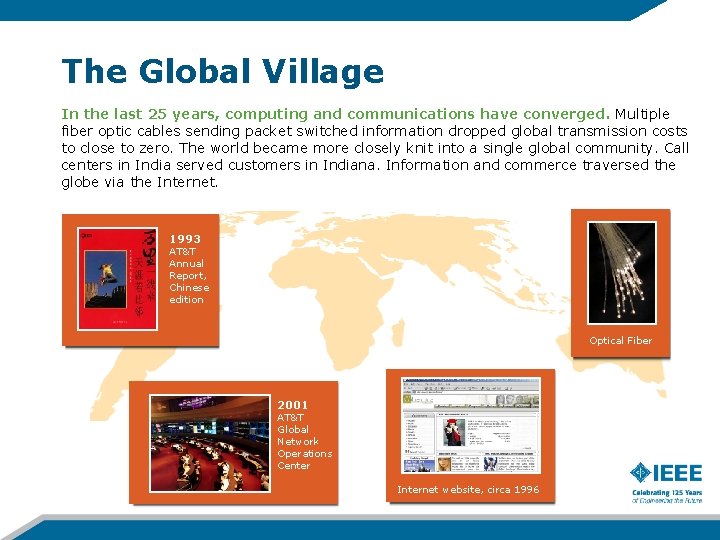
The Global Village In the last 25 years, computing and communications have converged. Multiple fiber optic cables sending packet switched information dropped global transmission costs to close to zero. The world became more closely knit into a single global community. Call centers in India served customers in Indiana. Information and commerce traversed the globe via the Internet. 1993 AT&T Annual Report, Chinese edition Optical Fiber 2001 AT&T Global Network Operations Center Internet website, circa 1996
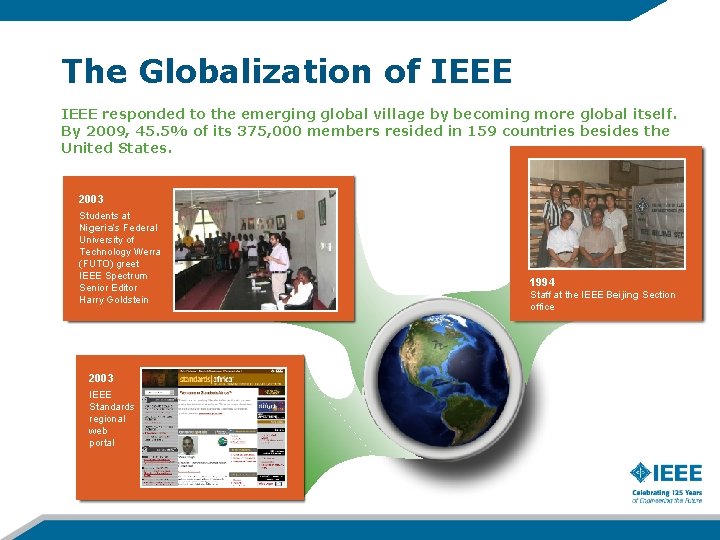
The Globalization of IEEE responded to the emerging global village by becoming more global itself. By 2009, 45. 5% of its 375, 000 members resided in 159 countries besides the United States. 2003 Students at Nigeria’s Federal University of Technology Werra (FUTO) greet IEEE Spectrum Senior Editor Harry Goldstein 2003 IEEE Standards regional web portal 1994 Staff at the IEEE Beijing Section office
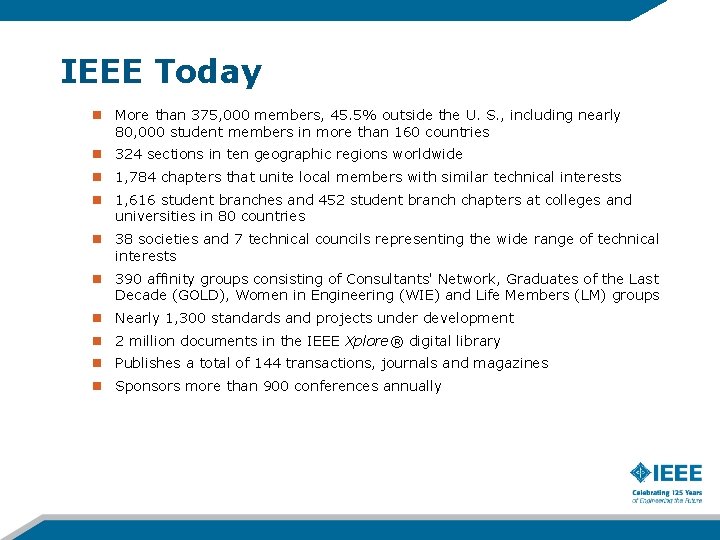
IEEE Today n More than 375, 000 members, 45. 5% outside the U. S. , including nearly 80, 000 student members in more than 160 countries n 324 sections in ten geographic regions worldwide n 1, 784 chapters that unite local members with similar technical interests n 1, 616 student branches and 452 student branch chapters at colleges and universities in 80 countries n 38 societies and 7 technical councils representing the wide range of technical interests n 390 affinity groups consisting of Consultants' Network, Graduates of the Last Decade (GOLD), Women in Engineering (WIE) and Life Members (LM) groups n Nearly 1, 300 standards and projects under development n 2 million documents in the IEEE Xplore® digital library n Publishes a total of 144 transactions, journals and magazines n Sponsors more than 900 conferences annually

For further information, or to contribute your own story, visit the IEEE Global History Network www. ieeeghn. org
- Slides: 27