
THE HISTORY OF GRAPHIC DESIGN The History of
- Slides: 23
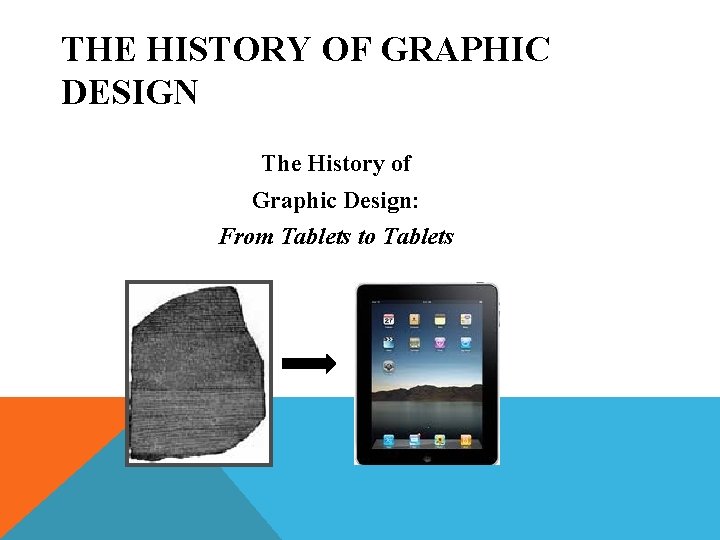
THE HISTORY OF GRAPHIC DESIGN The History of Graphic Design: From Tablets to Tablets
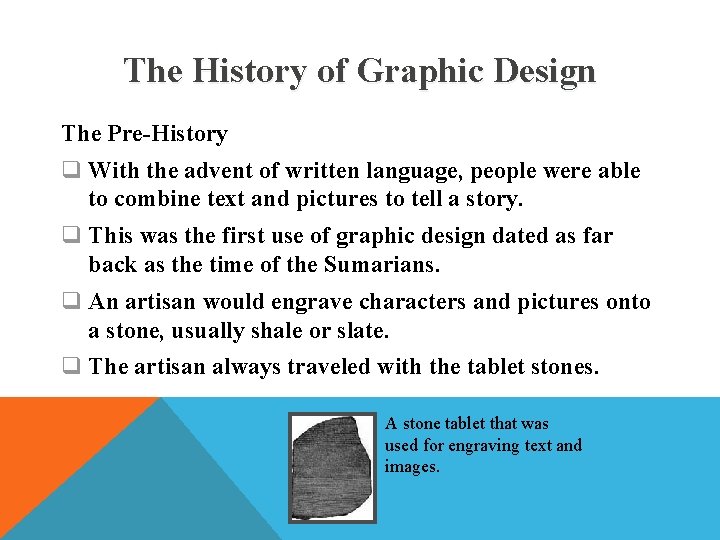
The History of Graphic Design The Pre-History q With the advent of written language, people were able to combine text and pictures to tell a story. q This was the first use of graphic design dated as far back as the time of the Sumarians. q An artisan would engrave characters and pictures onto a stone, usually shale or slate. q The artisan always traveled with the tablet stones. A stone tablet that was used for engraving text and images.
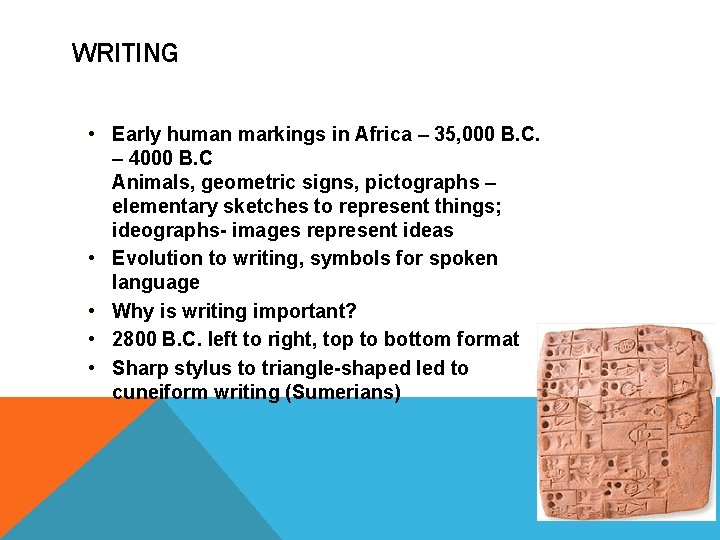
WRITING • Early human markings in Africa – 35, 000 B. C. – 4000 B. C Animals, geometric signs, pictographs – elementary sketches to represent things; ideographs- images represent ideas • Evolution to writing, symbols for spoken language • Why is writing important? • 2800 B. C. left to right, top to bottom format • Sharp stylus to triangle-shaped led to cuneiform writing (Sumerians)
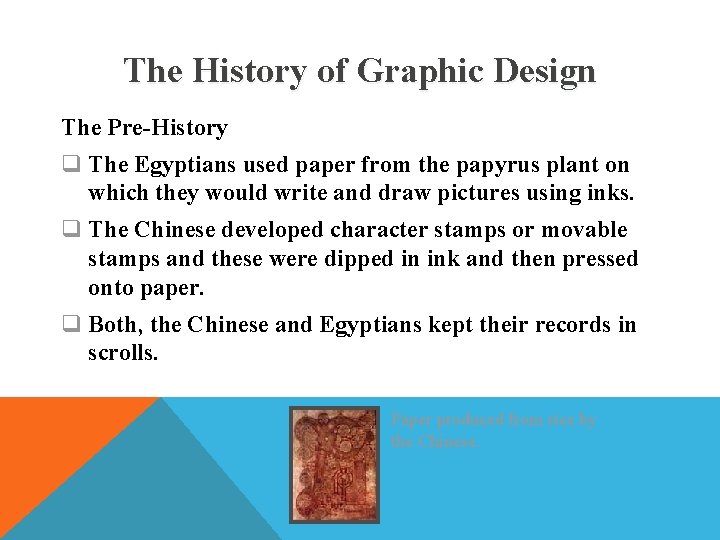
The History of Graphic Design The Pre-History q The Egyptians used paper from the papyrus plant on which they would write and draw pictures using inks. q The Chinese developed character stamps or movable stamps and these were dipped in ink and then pressed onto paper. q Both, the Chinese and Egyptians kept their records in scrolls. Paper produced from rice by the Chinese.
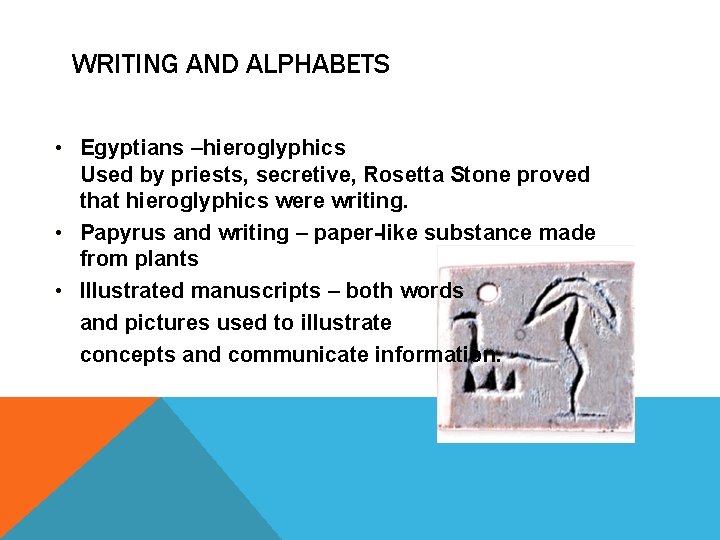
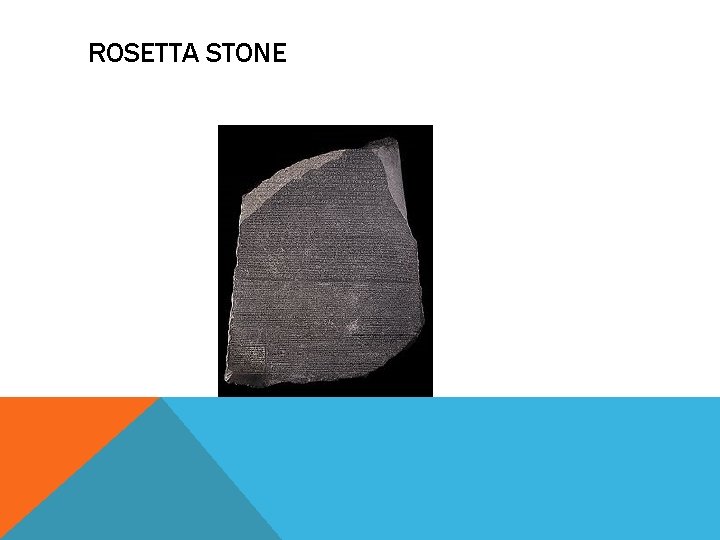
WRITING AND ALPHABETS • Egyptians –hieroglyphics Used by priests, secretive, Rosetta Stone proved that hieroglyphics were writing. • Papyrus and writing – paper-like substance made from plants • Illustrated manuscripts – both words and pictures used to illustrate concepts and communicate information.
ROSETTA STONE
WRITING AND ALPHABETS • Chinese calligraphy – 1800 B. C. • Paper 105 A. D. – natural substances wet and beaten to pulp. – Relief Printing – seals and stamps – 200 A. D. – Inked rubbings • Moveable type – first used in Asian cultures, but was not widespread due to size of alphabet • Greek alphabet 1000 B. C. • Roman or Latin Alphabet 75 B. C.
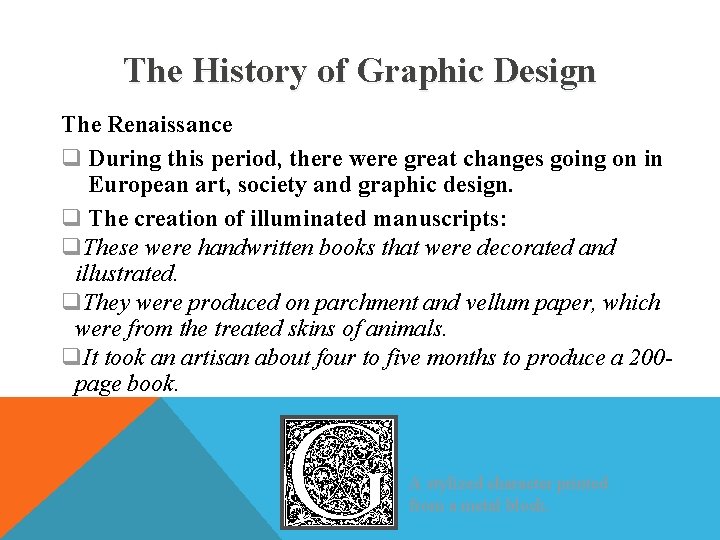
The History of Graphic Design The Renaissance q During this period, there were great changes going on in European art, society and graphic design. q The creation of illuminated manuscripts: q. These were handwritten books that were decorated and illustrated. q. They were produced on parchment and vellum paper, which were from the treated skins of animals. q. It took an artisan about four to five months to produce a 200 page book. A stylized character printed from a metal block.
The History of Graphic Design The Renaissance q The next big innovation was typography: q. Johann Gutenberg in Germany invented this method. q. It used movable type and relief printing for producing typographic print and books. q. Instead of using wooden blocks, he used metal blocks which he easily crafted since he was a goldsmith by trade. q After the advent of printed type using movable blocks and relief printing, artisans were becoming scarce.
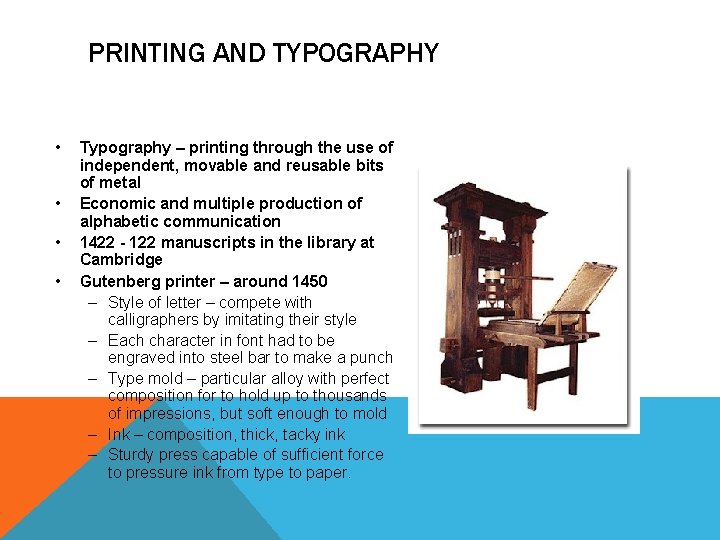
PRINTING AND TYPOGRAPHY • • Typography – printing through the use of independent, movable and reusable bits of metal Economic and multiple production of alphabetic communication 1422 - 122 manuscripts in the library at Cambridge Gutenberg printer – around 1450 – Style of letter – compete with calligraphers by imitating their style – Each character in font had to be engraved into steel bar to make a punch – Type mold – particular alloy with perfect composition for to hold up to thousands of impressions, but soft enough to mold – Ink – composition, thick, tacky ink – Sturdy press capable of sufficient force to pressure ink from type to paper.
The Early Process of Producing Books and Print q During the 1500’s and 1600’s after Gutenberg’s innovation in typography, a whole process was created using many different types of trained specialists. q The artisans that stayed in the industry became designers or engravers with special training at art academies throughout Europe. q The best engravers and designers were educated at art institutes in Italy and Spain. Sample page layouts done using the above process.
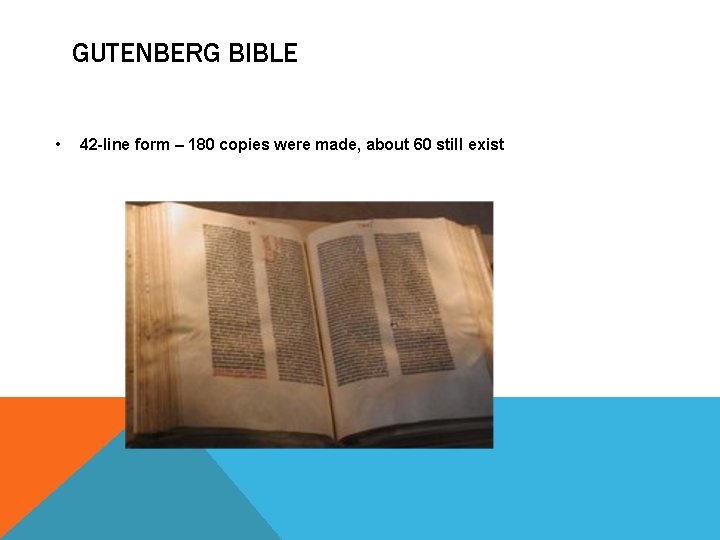
GUTENBERG BIBLE • 42 -line form – 180 copies were made, about 60 still exist
The History of Graphic Design The Early Process of Producing Books and Print q The Process: q. Parchment is prepared from scrapping animal skins. q. The typefounder pours melted lead into the type mold to case a character. q. Printers print text onto sheets of paper and when the large sheets of paper are dried, it is cut into pages. q. Designers draw their images or pictures. q. The engravers then engrave the images into wooden or metal blocks. q. The illuminator applies color and gold leaf to the manuscript. q. Then bookbinders collate the pages and apply the covers.
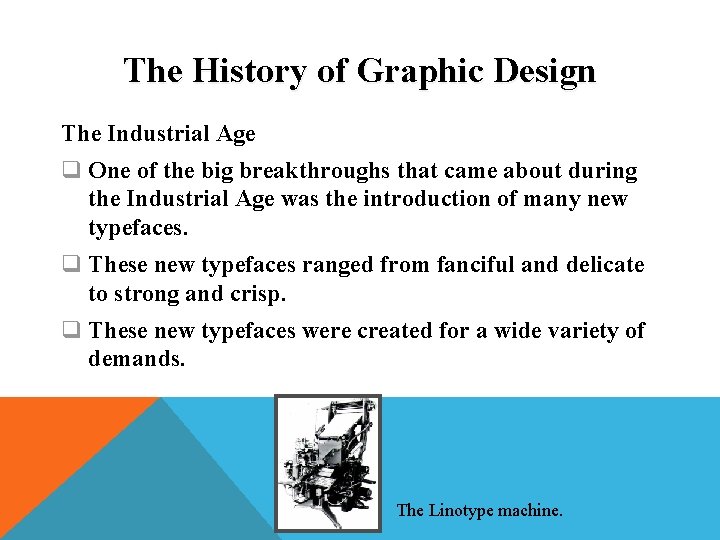
The History of Graphic Design The Industrial Age q One of the big breakthroughs that came about during the Industrial Age was the introduction of many new typefaces. q These new typefaces ranged from fanciful and delicate to strong and crisp. q These new typefaces were created for a wide variety of demands. The Linotype machine.
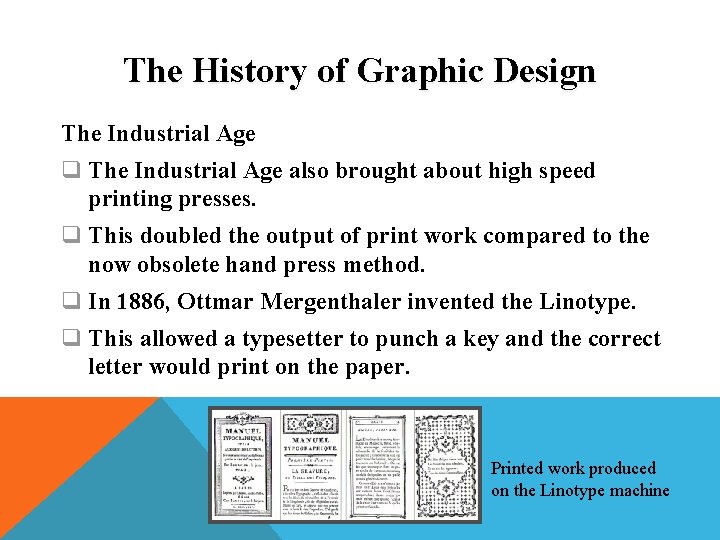
The History of Graphic Design The Industrial Age q The Industrial Age also brought about high speed printing presses. q This doubled the output of print work compared to the now obsolete hand press method. q In 1886, Ottmar Mergenthaler invented the Linotype. q This allowed a typesetter to punch a key and the correct letter would print on the paper. Printed work produced on the Linotype machine
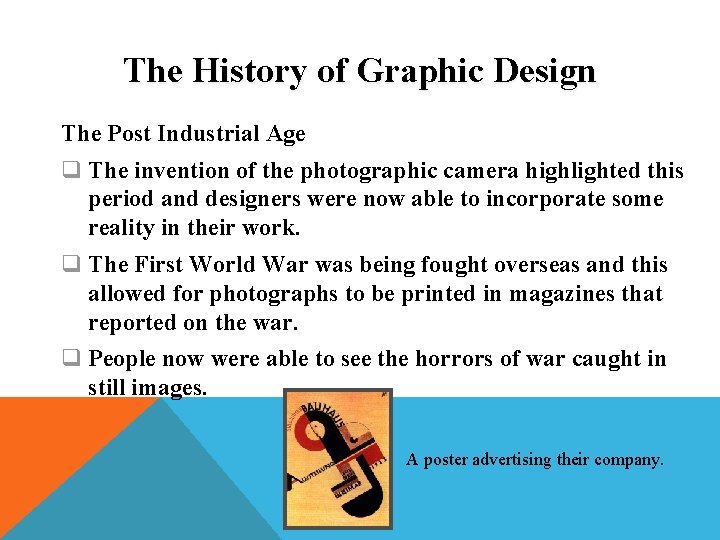
The History of Graphic Design The Post Industrial Age q The invention of the photographic camera highlighted this period and designers were now able to incorporate some reality in their work. q The First World War was being fought overseas and this allowed for photographs to be printed in magazines that reported on the war. q People now were able to see the horrors of war caught in still images. A poster advertising their company.
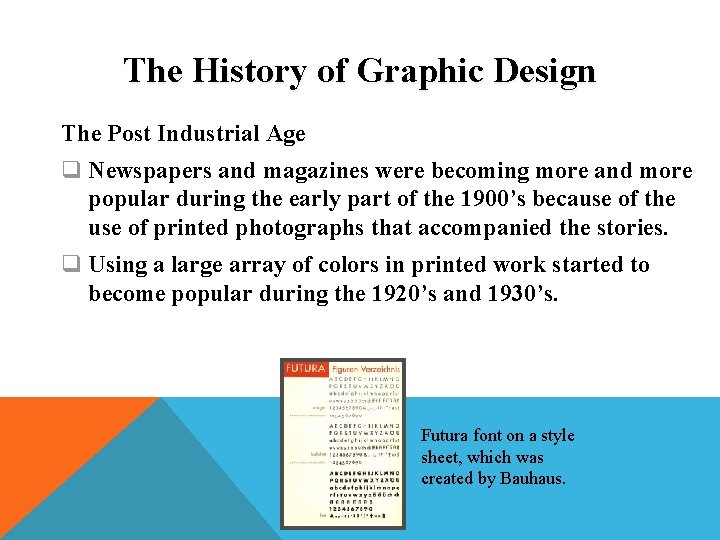
The History of Graphic Design The Post Industrial Age q Newspapers and magazines were becoming more and more popular during the early part of the 1900’s because of the use of printed photographs that accompanied the stories. q Using a large array of colors in printed work started to become popular during the 1920’s and 1930’s. Futura font on a style sheet, which was created by Bauhaus.
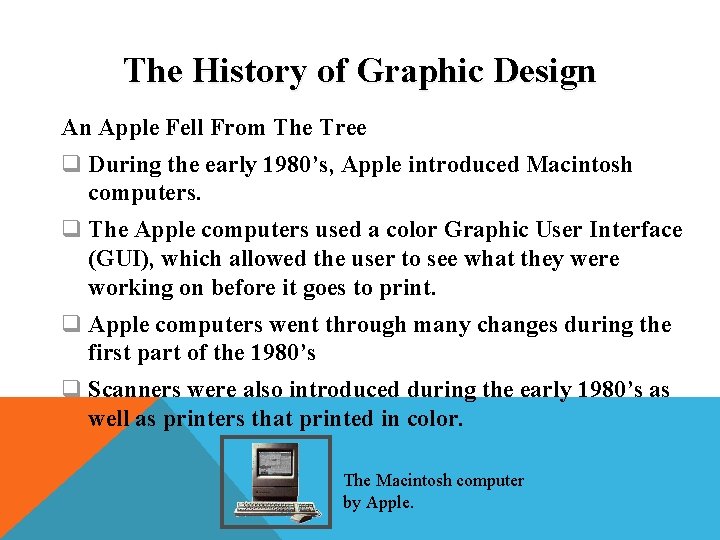
The History of Graphic Design An Apple Fell From The Tree q During the early 1980’s, Apple introduced Macintosh computers. q The Apple computers used a color Graphic User Interface (GUI), which allowed the user to see what they were working on before it goes to print. q Apple computers went through many changes during the first part of the 1980’s q Scanners were also introduced during the early 1980’s as well as printers that printed in color. The Macintosh computer by Apple.
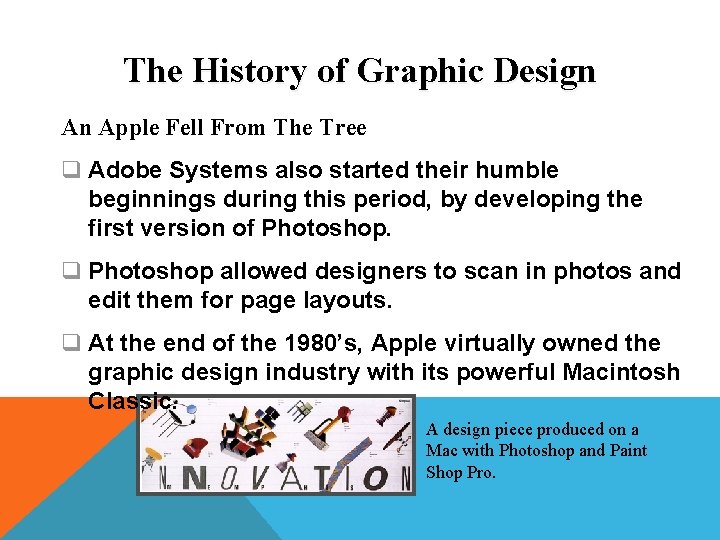
The History of Graphic Design An Apple Fell From The Tree q Adobe Systems also started their humble beginnings during this period, by developing the first version of Photoshop. q Photoshop allowed designers to scan in photos and edit them for page layouts. q At the end of the 1980’s, Apple virtually owned the graphic design industry with its powerful Macintosh Classic. A design piece produced on a Mac with Photoshop and Paint Shop Pro.
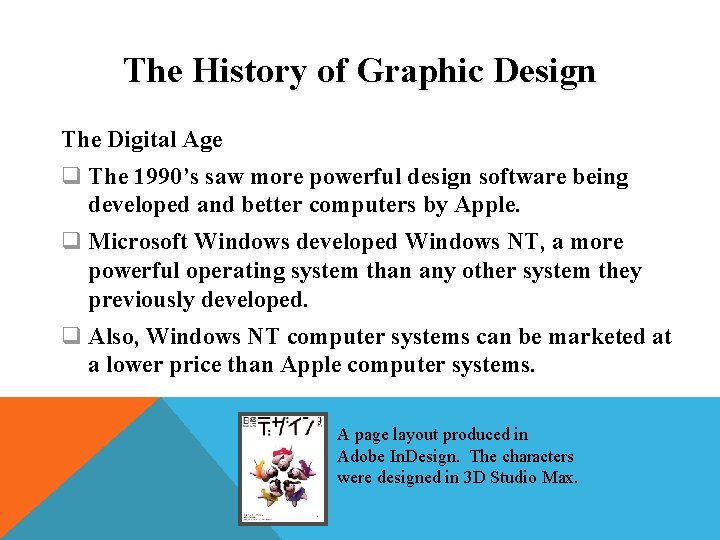
The History of Graphic Design The Digital Age q The 1990’s saw more powerful design software being developed and better computers by Apple. q Microsoft Windows developed Windows NT, a more powerful operating system than any other system they previously developed. q Also, Windows NT computer systems can be marketed at a lower price than Apple computer systems. A page layout produced in Adobe In. Design. The characters were designed in 3 D Studio Max.
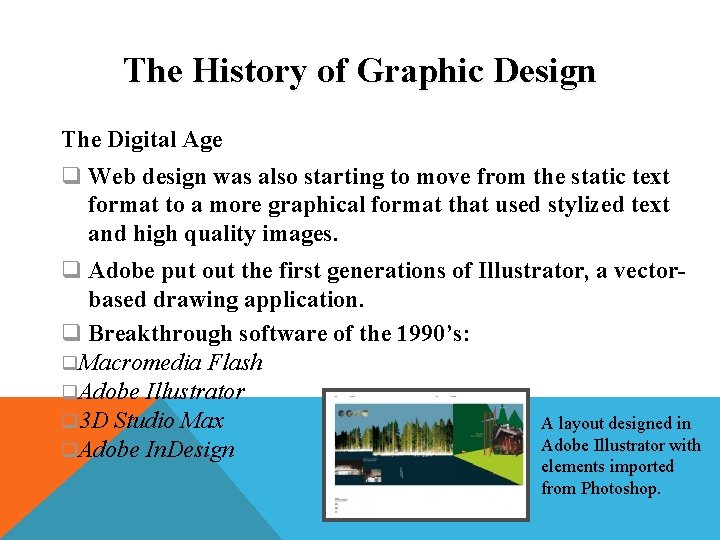
The History of Graphic Design The Digital Age q Web design was also starting to move from the static text format to a more graphical format that used stylized text and high quality images. q Adobe put out the first generations of Illustrator, a vectorbased drawing application. q Breakthrough software of the 1990’s: q. Macromedia Flash q. Adobe Illustrator q 3 D Studio Max A layout designed in Adobe Illustrator with q. Adobe In. Design elements imported from Photoshop.
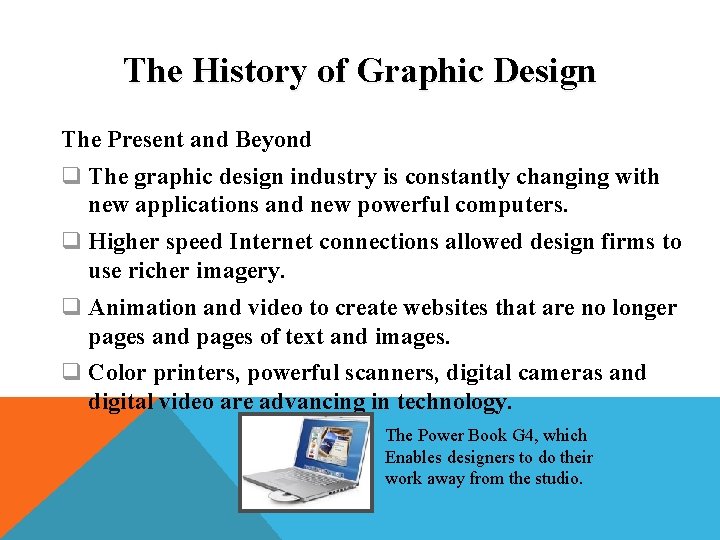
The History of Graphic Design The Present and Beyond q The graphic design industry is constantly changing with new applications and new powerful computers. q Higher speed Internet connections allowed design firms to use richer imagery. q Animation and video to create websites that are no longer pages and pages of text and images. q Color printers, powerful scanners, digital cameras and digital video are advancing in technology. The Power Book G 4, which Enables designers to do their work away from the studio.
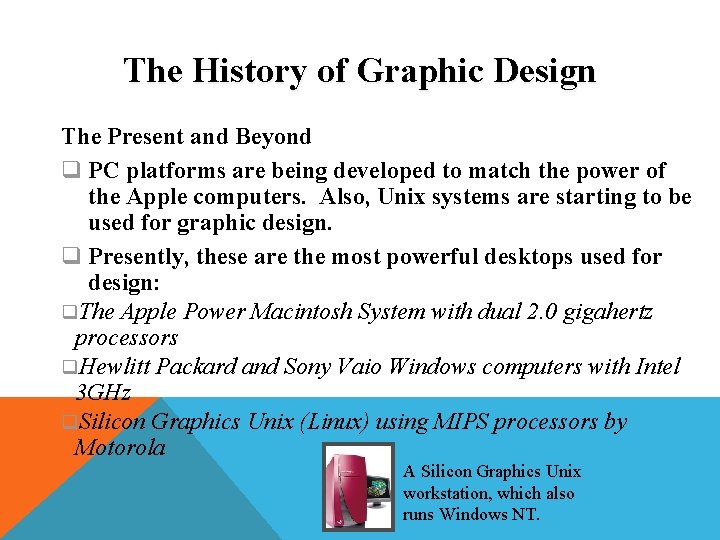
The History of Graphic Design The Present and Beyond q PC platforms are being developed to match the power of the Apple computers. Also, Unix systems are starting to be used for graphic design. q Presently, these are the most powerful desktops used for design: q. The Apple Power Macintosh System with dual 2. 0 gigahertz processors q. Hewlitt Packard and Sony Vaio Windows computers with Intel 3 GHz q. Silicon Graphics Unix (Linux) using MIPS processors by Motorola A Silicon Graphics Unix workstation, which also runs Windows NT.