
The History of English Literature 1 2 3
- Slides: 14
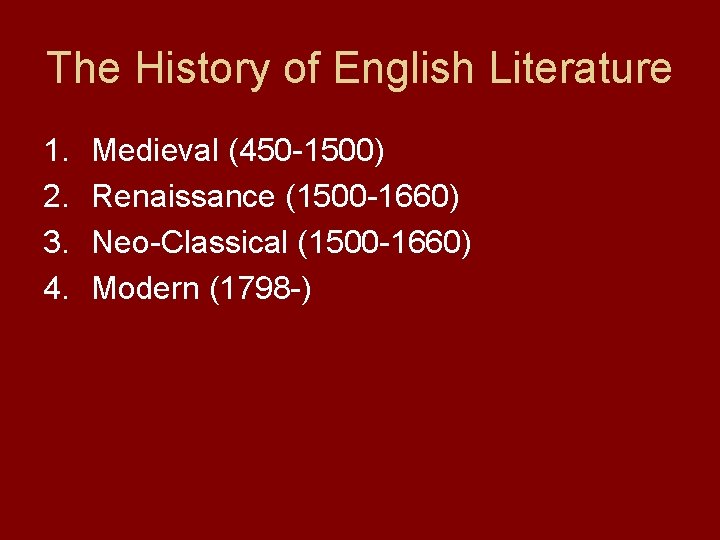
The History of English Literature 1. 2. 3. 4. Medieval (450 -1500) Renaissance (1500 -1660) Neo-Classical (1500 -1660) Modern (1798 -)
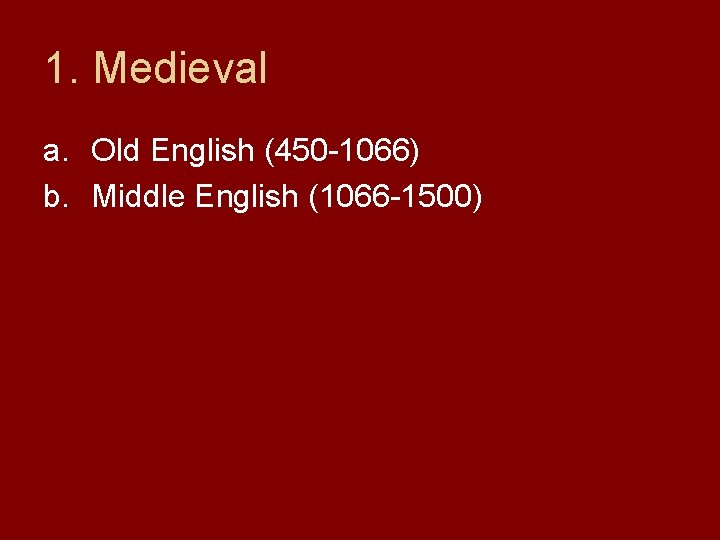
1. Medieval a. Old English (450 -1066) b. Middle English (1066 -1500)
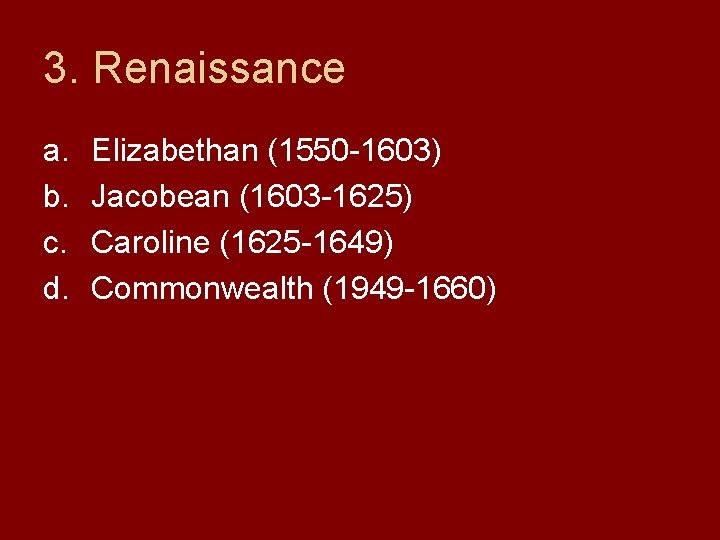
3. Renaissance a. b. c. d. Elizabethan (1550 -1603) Jacobean (1603 -1625) Caroline (1625 -1649) Commonwealth (1949 -1660)
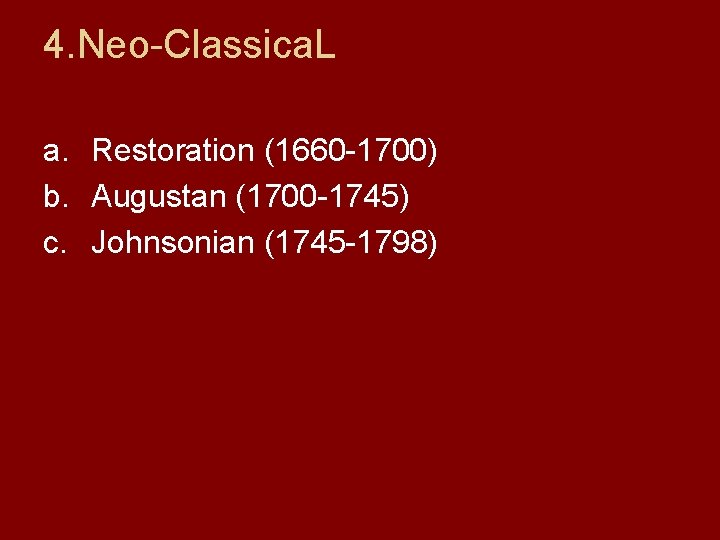
4. Neo-Classica. L a. Restoration (1660 -1700) b. Augustan (1700 -1745) c. Johnsonian (1745 -1798)
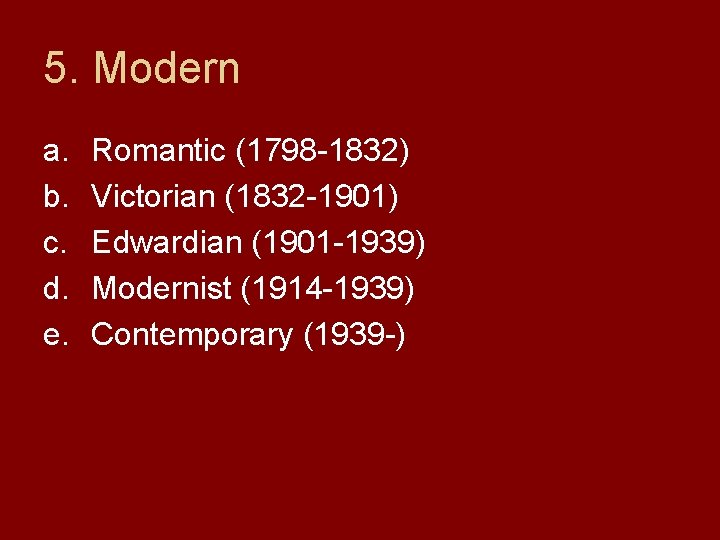
5. Modern a. b. c. d. e. Romantic (1798 -1832) Victorian (1832 -1901) Edwardian (1901 -1939) Modernist (1914 -1939) Contemporary (1939 -)
1. Renaissance a. The renaissance began in Italy and nearly 150 years passed before it made its slow progress through France and German to England. b. This is the rebirth of classical learning and humanism. c. The development of English language had reached the so-called modern English.
d. The general literary style of the renaissance was lively and richly ornamented English which made effective use of characteristics derived from Anglo-Saxon especially the flexible ordering of monosyllabic, words, heavy pattern of stress, repetitions of sound and vivid imagery. e. Drama and poetry were the main forms of Renaissance England while prose also had a certain following.
f. All literatures were influenced by medieval and classical models. g. Literatures were written by professional of the middle and lower classes, particularly in the case of drama which did not require literacy. h. Fictional situation concerned mainly with the aristocracy and concentrated on questions of noble conduct and character. h. The theme of ideal love between man and woman were celebrated. i. The fictional situation as well as the heroes and heroines were thoroughly human and realistic reflected.
2. The Neo-Classical a. It is characterized by a complete return of classical models of literary construction, style, and theme, a formalization and restraining of Renaissance exuberance and experimentation. b. Concern shifted from man as a feeling and passionate individual to a man as a social animal, from investigation of inner experience to that of outer relationship.
c. Poetry became the dominant and satire the characteristic of the period. d. The period begun in celebrating of exaggerated heroic virtues and ended with those of the middle classes and even humbler country folk. e. The phantasies of superhuman courage, love and self-sacrifice which were exemplified in heroic tragedy quickly gave way to comic exaggeration through which pretension and conduct of a middle-class and urban elite were exposed and ridiculed.
f. Poetry took the form of direct discussion or speculation on questions rather than the expression of feeling or attitudes through fictionalized situations. g. Neo-classical was an age of reason. h. One of the major concerns of this age is to fix the English language against the incorrect word usage. i. God was viewed in rational manner and in abstract concept, not personalized.
The Romantic and Modernist Periods • The romantic major feature is the concern for emotion or feelings of individual, and especially of artists. • Love between sexes is preoccupation with super natural because Christian view of love and marriage between men and women are intimately connected with those between individuals and God. • Romantic delight in a world between all kinds of supernatural agents from fairies to ghosts and demons.
• Imagination is of central to a romantic view of the universe because it is capable of transforming natural images into representation of ideal states. • Man is said to be essentially good in his natural state and merely corrupted by the evil in the world.
The Contemporary Age • As opposed to aspiration and belief which prevailed as the beginning of modern age, contemporary literature generally reflects disillusionment and disbelief. • Method of presentation became more increasingly difficult and disjointed, relying for the most part on distortions of normal sequences or conventional expectation, and place dissimilar and but related incidents or images next to one another in an effort to express the quality of inner life experience rather than mere fact or immediate outward actions of that life.