
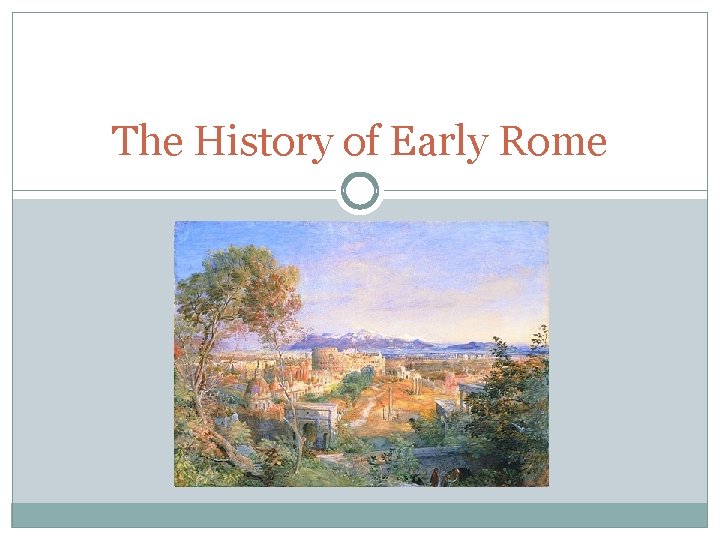
The History of Early Rome Geography of Rome






- Slides: 10
The History of Early Rome
Geography of Rome � Rome is located on the boot shaped peninsula that is modern day Italy. � Rome is located centrally in Italy. The Italian peninsula is located centrally in the Mediterranean. � The geography of Rome made it easier to unite than Greece. � Italy is less mountainous than Greece, and has the advantage of broad fertile plains in north and south.
The people of Ancient Rome � The Latin’s were the ancestors of the Romans. They migrated to Italy around 800 B. C. � The Latin’s settled on the Tiber River. They settled villages around 7 low-lying hills that would become the city of Rome. � Etruscans lived in the north of Italy and Greek Colonist lived in the South. � Etruscan Helmet. The Romans learned a great deal from the Etruscans.
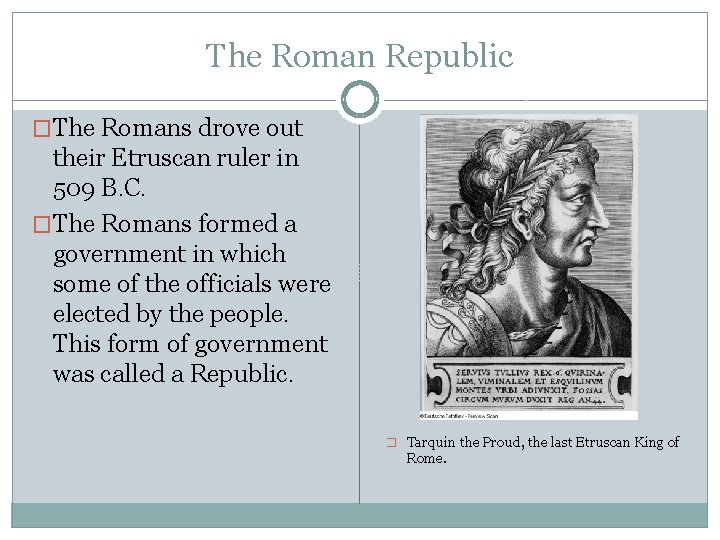
The Roman Republic �The Romans drove out their Etruscan ruler in 509 B. C. �The Romans formed a government in which some of the officials were elected by the people. This form of government was called a Republic. � Tarquin the Proud, the last Etruscan King of Rome.
Roman Republic Government � The most powerful governing body in the early republic was the senate. Its 300 members were all patricians or land holding elite. � The senate elected two consuls each year whose job was to run the business of the government and command armies. � In the event of war or crisis, the senate could elect a dictator, or ruler that had complete control over the Government. � The Roman Senate
Roman Republic Government � In the beginning, all of the government officials were patricians. � Plebeians were the farmers, merchants, artisans, and traders that made up the bulk of the population. � In 450 B. C. the laws of Rome were inscribed on twelve tablets and set up in the market place so the Plebeians could see them. � In time plebeians could elect their own officials called Tribunes, who would protect their interests.
Roman Society � The family was the basic unit of Roman society. The male, by law, was the head of the house hold. � Roman women played a larger role in society than in Greece. � Women from all classes had the opportunity to run a variety of business, from small shops to ship yards. � Most women worked at home raising their families. � Patrician Roman Woman
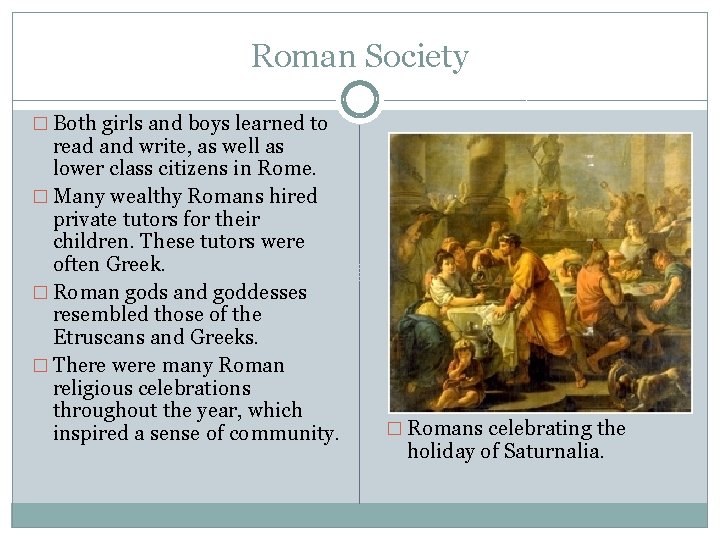
Roman Society � Both girls and boys learned to read and write, as well as lower class citizens in Rome. � Many wealthy Romans hired private tutors for their children. These tutors were often Greek. � Roman gods and goddesses resembled those of the Etruscans and Greeks. � There were many Roman religious celebrations throughout the year, which inspired a sense of community. � Romans celebrating the holiday of Saturnalia.
Expansion in Italy �By 270 B. C. Rome controlled most of the Italian Peninsula. �Rome’s success was due to its skillful diplomacy and well trained army. �The Roman Army was comprised of citizensoldiers. �The basic military unit was the Legion made up of about 5, 000 men. �Roman Legionnaire
Expansion in Italy � Roman’s usually treated their defeated enemies with justice. � Conquered peoples had to acknowledge Roman leadership, pay taxes, and supply soldiers to the Roman Army. � In return, they could keep their own customs, money and local government. � To protect their conquered lands, Rome posted soldiers throughout the land built a network of all weather roads to link distant territories. � The Roman Road, The Appian Way, linked Rome to Southern Cities in Italy.