
The History of Cosmic Expansion from Supernovae Near
- Slides: 13
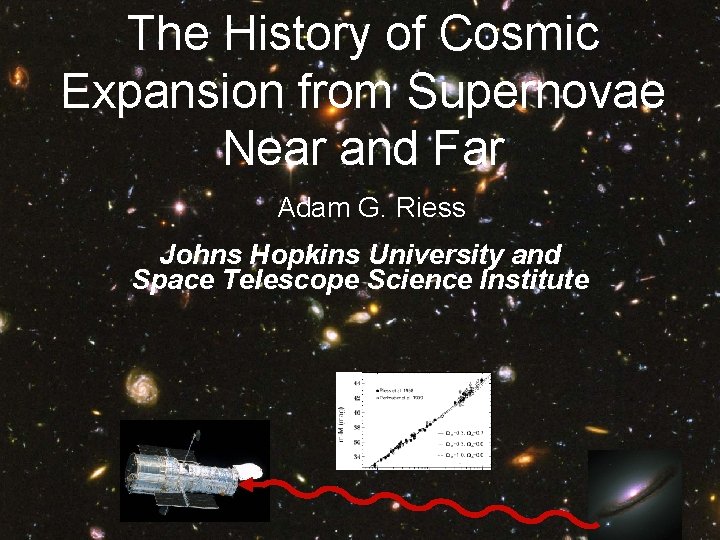
The History of Cosmic Expansion from Supernovae Near and Far Adam G. Riess Johns Hopkins University and Space Telescope Science Institute
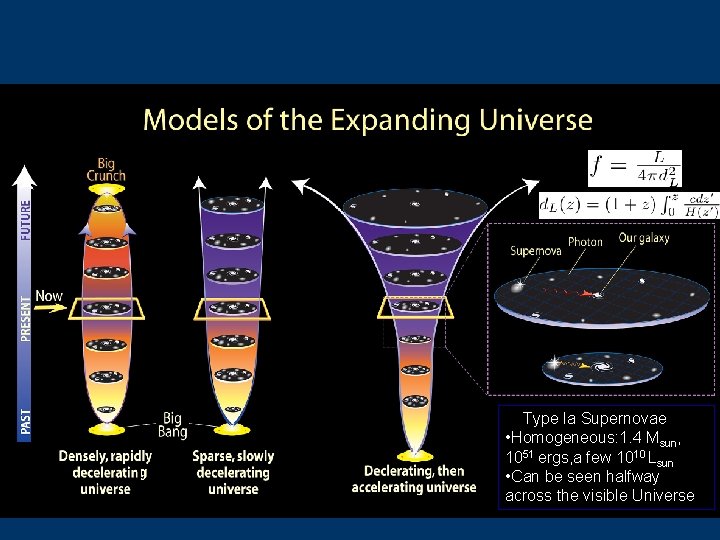
What we see Type Ia Supernovae • Homogeneous: 1. 4 Msun, 1051 ergs, a few 1010 Lsun • Can be seen halfway across the visible Universe
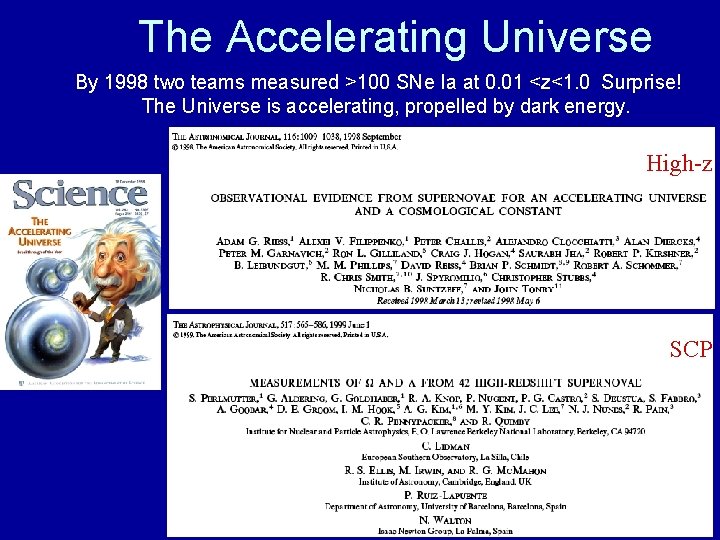
The Accelerating Universe By 1998 two teams measured >100 SNe Ia at 0. 01 <z<1. 0 Surprise! The Universe is accelerating, propelled by dark energy. High-z SCP
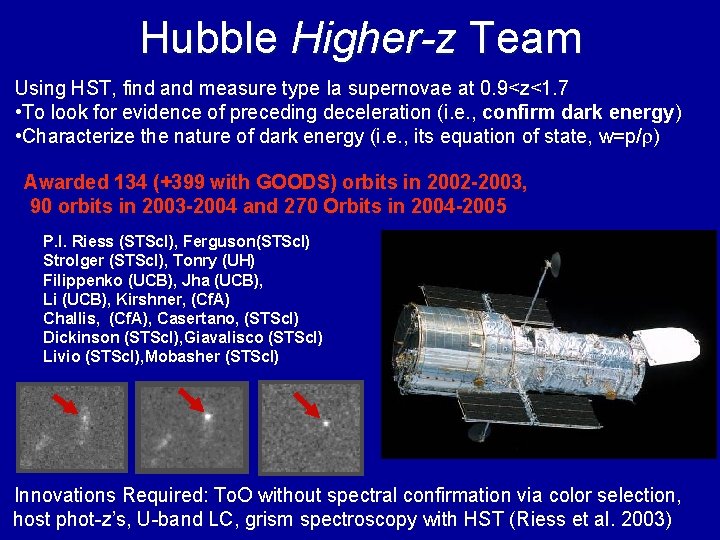
Hubble Higher-z Team Using HST, find and measure type Ia supernovae at 0. 9<z<1. 7 • To look for evidence of preceding deceleration (i. e. , confirm dark energy) • Characterize the nature of dark energy (i. e. , its equation of state, w=p/ ) Awarded 134 (+399 with GOODS) orbits in 2002 -2003, 90 orbits in 2003 -2004 and 270 Orbits in 2004 -2005 P. I. Riess (STSc. I), Ferguson(STSc. I) Strolger (STSc. I), Tonry (UH) Filippenko (UCB), Jha (UCB), Li (UCB), Kirshner, (Cf. A) Challis, (Cf. A), Casertano, (STSc. I) Dickinson (STSc. I), Giavalisco (STSc. I) Livio (STSc. I), Mobasher (STSc. I) Innovations Required: To. O without spectral confirmation via color selection, host phot-z’s, U-band LC, grism spectroscopy with HST (Riess et al. 2003)
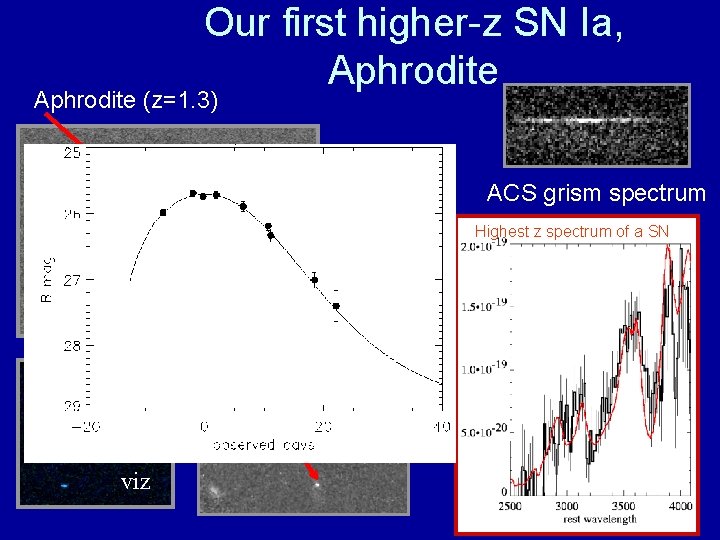
Our first higher-z SN Ia, Aphrodite (z=1. 3) ACS F 850 lp ACS grism spectrum Highest z spectrum of a SN NICMOS F 110 W viz
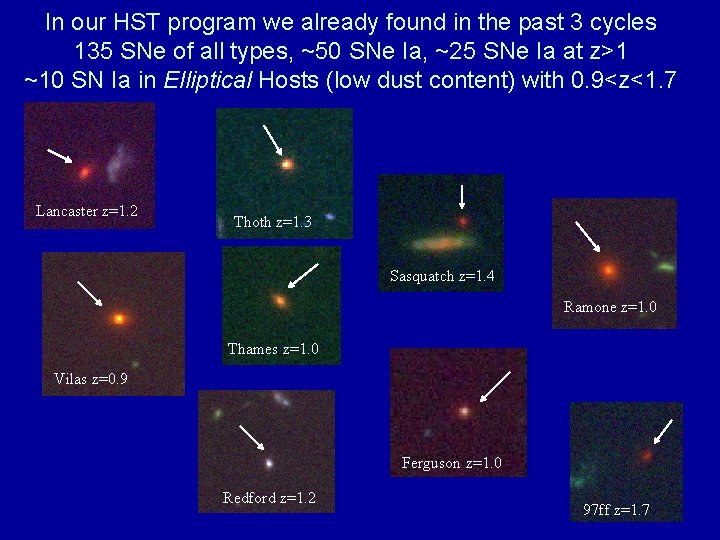
In our HST program we already found in the past 3 cycles 135 SNe of all types, ~50 SNe Ia, ~25 SNe Ia at z>1 ~10 SN Ia in Elliptical Hosts (low dust content) with 0. 9<z<1. 7 Lancaster z=1. 2 Thoth z=1. 3 Sasquatch z=1. 4 Ramone z=1. 0 Thames z=1. 0 Vilas z=0. 9 Ferguson z=1. 0 Redford z=1. 2 97 ff z=1. 7
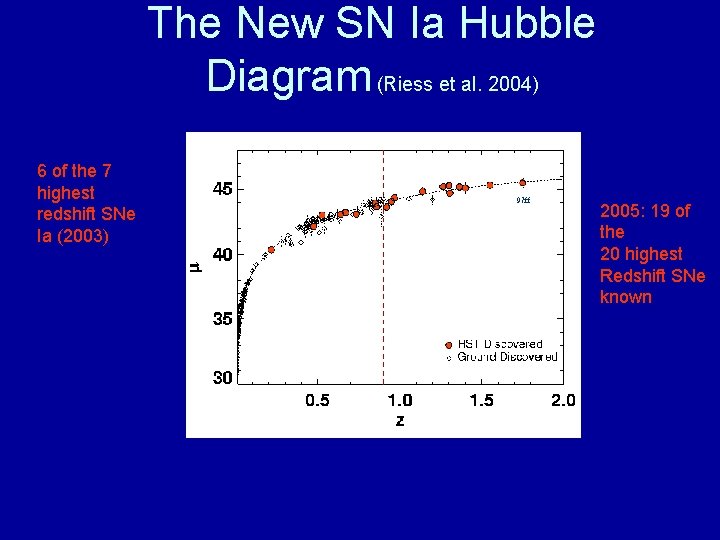
The New SN Ia Hubble Diagram (Riess et al. 2004) 6 of the 7 highest redshift SNe Ia (2003) 97 ff 2005: 19 of the 20 highest Redshift SNe known
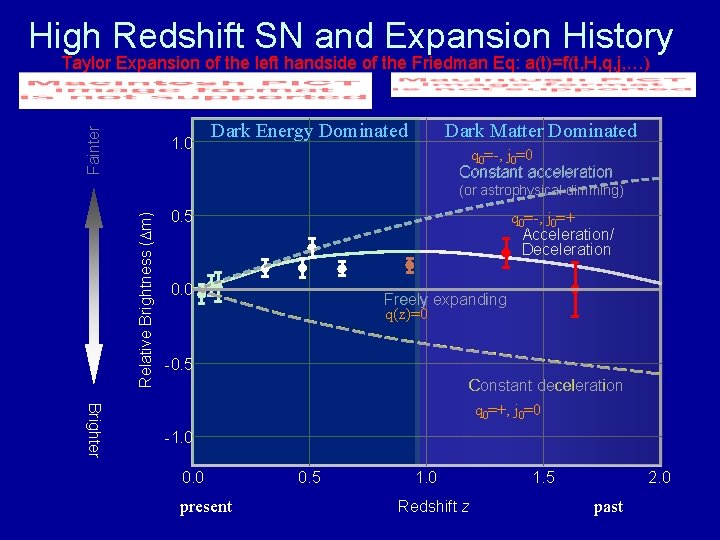
High Redshift SN and Expansion History Fainter Taylor Expansion of the left handside of the Friedman Eq: a(t)=f(t, H, q, j, …) 1. 0 Dark Energy Dominated Dark Matter Dominated q 0=-, j 0=0 Constant acceleration Relative Brightness ( m) (or astrophysical dimming) 0. 5 q 0=-, j 0=+ Acceleration/ Deceleration 0. 0 Freely expanding q(z)=0 -0. 5 Brighter Constant deceleration q 0=+, j 0=0 -1. 0 0. 0 present 0. 5 1. 0 Redshift z 1. 5 2. 0 past
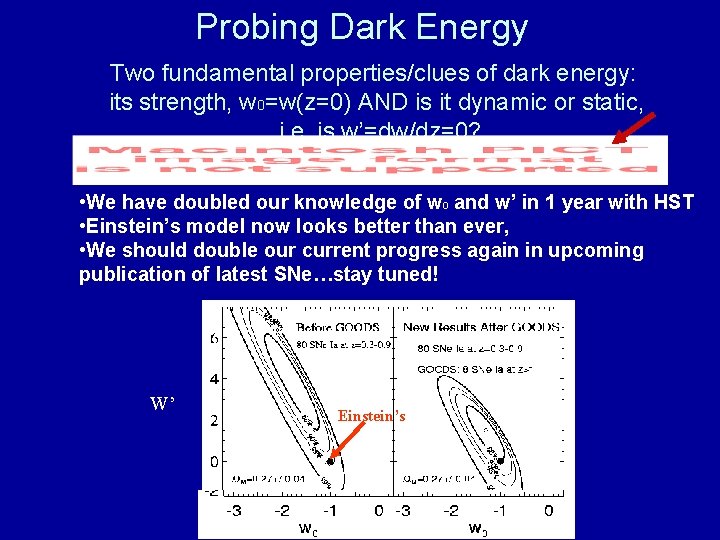
Probing Dark Energy Two fundamental properties/clues of dark energy: its strength, w 0=w(z=0) AND is it dynamic or static, i. e. is w’=dw/dz=0? • We have doubled our knowledge of w 0 and w’ in 1 year with HST • Einstein’s model now looks better than ever, • We should double our current progress again in upcoming publication of latest SNe…stay tuned! W’ Einstein’s w 0 -1
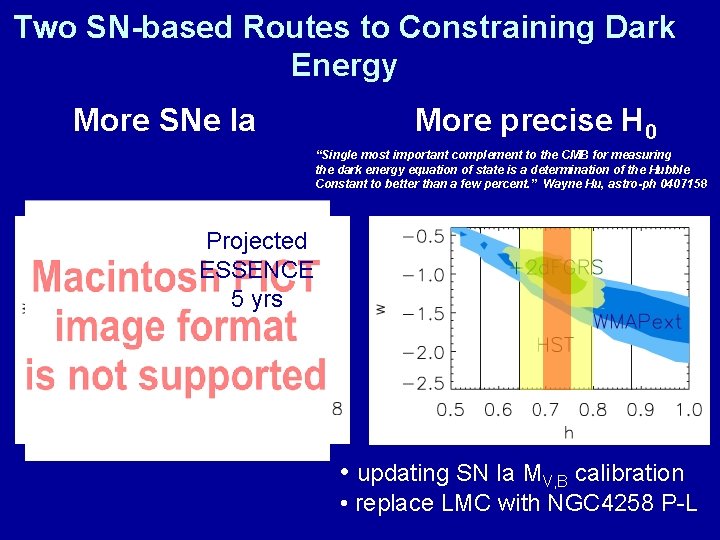
Two SN-based Routes to Constraining Dark Energy More SNe Ia More precise H 0 “Single most important complement to the CMB for measuring the dark energy equation of state is a determination of the Hubble Constant to better than a few percent. ” Wayne Hu, astro-ph 0407158 Projected ESSENCE 5 yrs • updating SN Ia MV, B calibration • replace LMC with NGC 4258 P-L
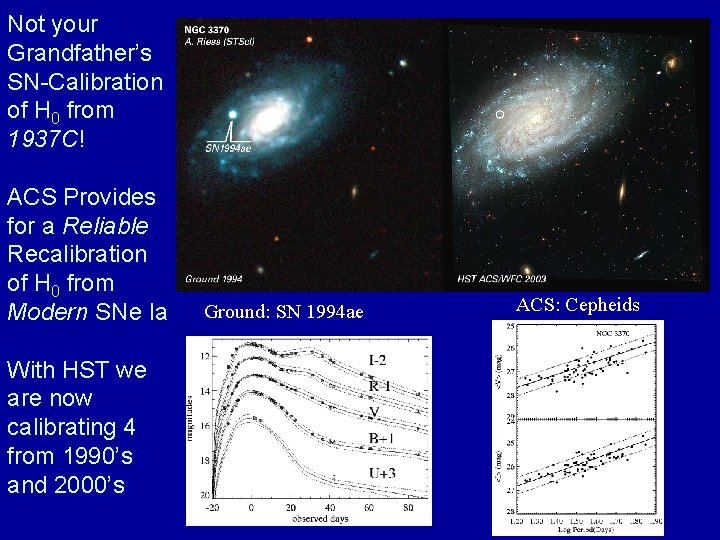
Not your Grandfather’s SN-Calibration of H 0 from 1937 C! ACS Provides for a Reliable Recalibration of H 0 from Modern SNe Ia With HST we are now calibrating 4 from 1990’s and 2000’s Ground: SN 1994 ae ACS: Cepheids
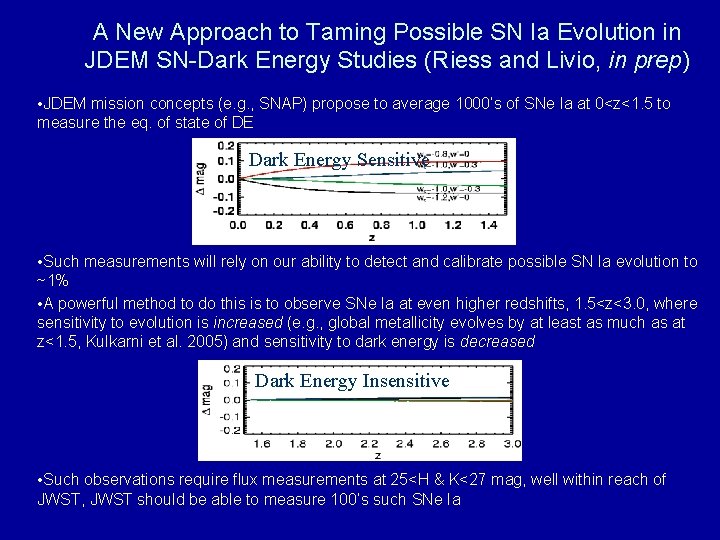
A New Approach to Taming Possible SN Ia Evolution in JDEM SN-Dark Energy Studies (Riess and Livio, in prep) • JDEM mission concepts (e. g. , SNAP) propose to average 1000’s of SNe Ia at 0<z<1. 5 to measure the eq. of state of DE Dark Energy Sensitive • Such measurements will rely on our ability to detect and calibrate possible SN Ia evolution to ~1% • A powerful method to do this is to observe SNe Ia at even higher redshifts, 1. 5<z<3. 0, where sensitivity to evolution is increased (e. g. , global metallicity evolves by at least as much as at z<1. 5, Kulkarni et al. 2005) and sensitivity to dark energy is decreased Dark Energy Insensitive • Such observations require flux measurements at 25<H & K<27 mag, well within reach of JWST, JWST should be able to measure 100’s such SNe Ia
Summary: • SNe Ia are being used to trace the history of cosmic expansion; they reveal present, cosmic acceleration and the need for dark energy • With HST we have discovered the highest redshift SNe Ia; they show a preceding epoch of decelerating expansion (as expected), confirming the reality of acceleration • With growing precision, SNe Ia at all redshifts are being used to Determine the equation of state of dark energy (value and derivative) and should, in the future, help determine the nature of Dark Energy and perhaps the fate of the Universe. • Additional studies of SNe Ia locally to improve the calibration of H 0 and at the ever higher redshifts to tame evolution are important for continued progress in Dark Energy studies