
The History of Computers The evolution of the
- Slides: 13
The History of Computers
The evolution of the computer age… RThere are 5 generations RFirst Generation (1951 -57) RSecond Generation (1958 -1963) RThird Generation (1964 -69) RFourth Generation (1970 -90) RFifth Generation (1991 -2005 & beyond
FIRST GENERATION The Vacuum Tube Age R Computers were built with vacuum tubes R The electronic tubes were made from glass and were the size of light bulbs. R In 1951 Dr. John W. Mauchly and J. Presper Eckert Jr. introduced the first commercially available electronic digital computer. The UNIVAC- built with vacuum tubes.
Continued 1 st Generation R This computer was based on their earlier ENIAC (Electronic Numerical Integrator and Computer) design completed in 1946. R 1951 -53 IBM adds computers to its business equipment products and sells over 1, 000 IBM 650 systems. R 1957 - Introduction of first high-level programming language- FORTRAN (FORmula TRANslator).
SECOND GENERATION The Transistor Age R First computers built with transistorssmall devices that transfer electronic signals across a resistor. R Transistors are much smaller, use less power, and create less heat ten vacuum tubes. R The new computers were faster, smaller, and more reliable then the first generation machines.
Continued 2 nd Generation R Introduction of the removable disk pack, providing users with fast access to stored data. R Introduction of first business application programming language-COBOL (Common Business Oriented Language) based English like phrases. R Introduced of ASCII (American Standard Code for Information Interchange). Which enables computers to exchange information.
Third Generation The Integrated Circuit Age R In 1964, computer manufactures began replacing transistors with integrated circuits. An IC is a complete electronic circuit on a small chip made of silicon (one of the most abundant elements in the earth’s crust. R These computers were more reliable and compact than computers made with transistors, and they cost less to manufacture.
Continued 3 rd Generation R Introduction of the BASIC programming language. R IBM introduced its System/360 line of compatible computers, which can all use the same programs and peripherals. R Introduction of ARPANER and the beginning of the Internet. R IBM announces it decision to offer unbundled software, priced and sold separately from the hardware.
FOURTH GENERAION The Microprocessor Age RThe Microprocessor- a specialized chip developed for computer memory and logic. RUse of a single chip to create a smaller “personal” computer revolutionized the computer industry.
Continued 4 th Generation R 1 st local area network (LAN)- Ethernetdeveloped at Xerox PARC (Palo Alto Center). R Apple computer Inc. , founded by Steve Wozniak and Steve Jobs, and Apple 1 introduced as an easy-to-use “hobbyist” computer. R Introduction of the first public information services- Compuserve and the Source.
Fifth Generation The Age of Connectivity R Connected Generation- massive effort to increase the connectivity of the computer. R The rapidly expanding Internet, World Wide Web, and intranets have created and information superhighway that has enable both computer professionals and home users to communicate with others across the globe.
Continued 5 th Generation R 1990 - Microsoft release Windows 3. 0. R 1991 - Release of the World Wide Web standards that describe the framework of linking documents on different computers. R 1995 - Microsoft releases Windows 95, a major upgrade to its Windows operating systems. R 1997 - Microsoft introduces Office 97 with major Web enhancements integrated into its applications.
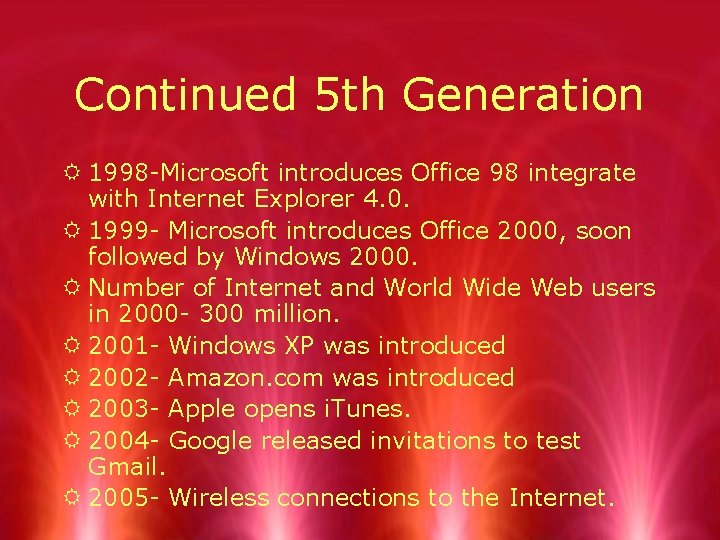
Continued 5 th Generation R 1998 -Microsoft introduces Office 98 integrate with Internet Explorer 4. 0. R 1999 - Microsoft introduces Office 2000, soon followed by Windows 2000. R Number of Internet and World Wide Web users in 2000 - 300 million. R 2001 - Windows XP was introduced R 2002 - Amazon. com was introduced R 2003 - Apple opens i. Tunes. R 2004 - Google released invitations to test Gmail. R 2005 - Wireless connections to the Internet.