
THE HISTORY OF COMPUTERS BY AARON 6 A
THE HISTORY OF COMPUTERS BY AARON 6 A
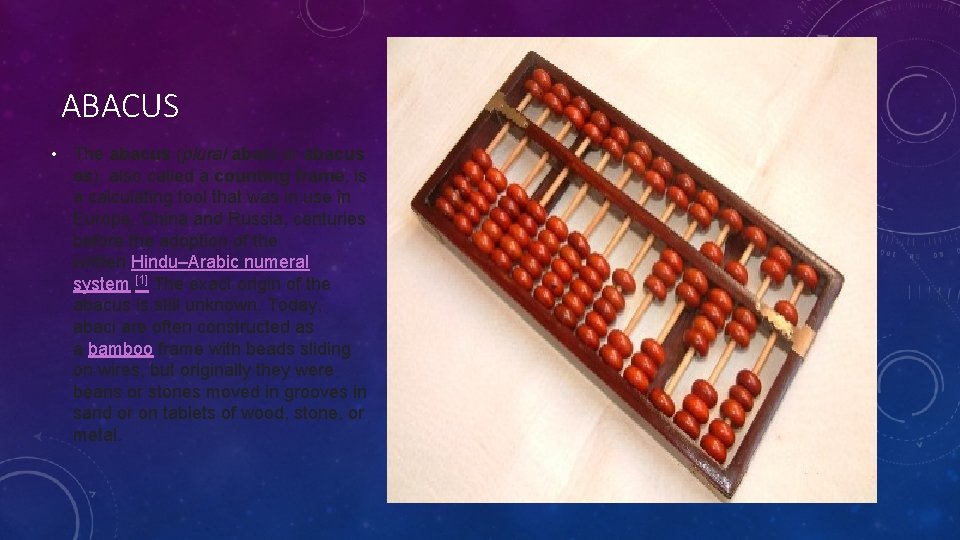
ABACUS • The abacus (plural abaci or abacus es), also called a counting frame, is a calculating tool that was in use in Europe, China and Russia, centuries before the adoption of the written Hindu–Arabic numeral system. [1] The exact origin of the abacus is still unknown. Today, abaci are often constructed as a bamboo frame with beads sliding on wires, but originally they were beans or stones moved in grooves in sand or on tablets of wood, stone, or metal.
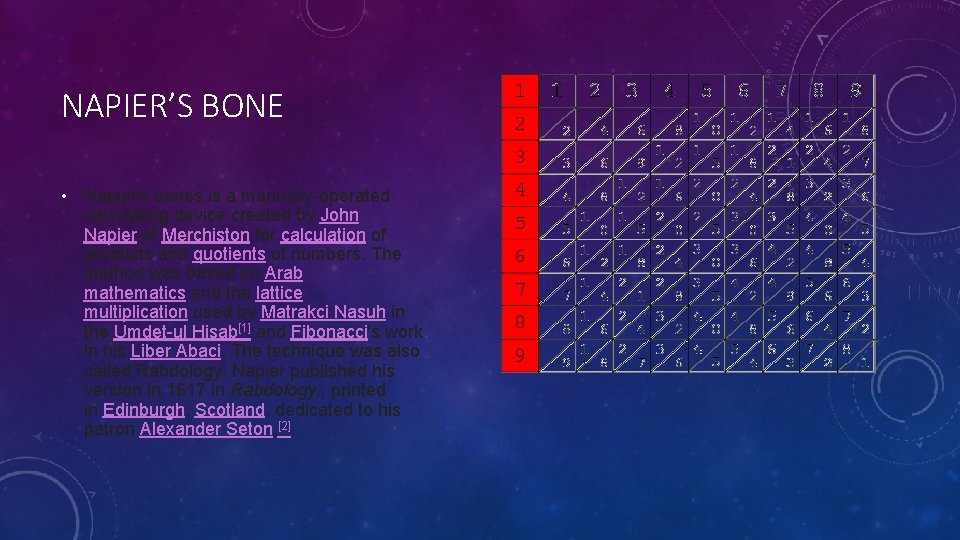
NAPIER’S BONE • Napier's bones is a manually-operated calculating device created by John Napier of Merchiston for calculation of products and quotients of numbers. The method was based on Arab mathematics and the lattice multiplication used by Matrakci Nasuh in the Umdet-ul Hisab[1] and Fibonacci's work in his Liber Abaci. The technique was also called Rabdology. Napier published his version in 1617 in Rabdology. , printed in Edinburgh, Scotland, dedicated to his patron Alexander Seton. [2]
SLIDE RULE • The slide rule, also known colloquially in the United States as a slipstick, [1][2] is a mechanical analog computer. [3][4][5][6][7] The slide rule is used primarily for multiplication and division, and also for functions such as exponents, roots, logarithms and trigonometry, but typically not for addition or subtraction. Though similar in name and appearance to a standard ruler, the slide rule is not meant to be used for measuring length or drawing straight lines. • Slide rules exist in a diverse range of styles and generally appear in a linear or circular form with a standardized set of markings (scales) essential to performing mathematical computations. Slide rules manufactured for specialized fields such as aviation or finance typically feature additional scales that aid in calculations common to those fields.
PASCALINE • Pascal's calculator (also known as the arithmetic machine or Pascaline) is a mechanical calculator invented by Blaise Pascal in the early 17 th century. Pascal was led to develop a calculator by the laborious arithmetical calculations required by his father's work as supervisor of taxes in Rouen. [2] He designed the machine to add and subtract two numbers directly and to perform multiplication and division through repeated addition or subtraction. • Pascal's calculator was especially successful in the design of its carry mechanism, which adds 1 to 9 on one dial, and when it changes from 9 to 0, carries 1 to the next dial. His innovation made each digit independent of the state of the others, which enabled multiple carries to rapidly cascade from one digit to another regardless of the machine's capacity. Pascal was also the first to shrink and adapt for his purpose a lantern gear, used in turret clocks and water wheels, which could resist the strength of any operator input with very little added friction.
PUNCH CARD • A punched card or punch card is a piece of stiff paper that can be used to contain digital information represented by the presence or absence of holes in predefined positions. The information might be data for data processing applications or, in earlier examples, used to directly control automated machinery. • Punched cards were widely used through much of the 20 th century in what became known as the data processing industry, where specialized and increasingly complex unit record machines, organized into semiautomatic data processing systems, used punched cards for data input, output, and storage. [1][2] Many early digital computers used punched cards, often prepared using keypunch machines, as the primary medium for input of both computer programs and data.

DIFFERENCE ENGINE • A difference engine is an automatic mechanical calculator designed to tabulate polynomial functions. The name derives from the method of divided differences, a way to interpolate or tabulate functions by using a small set of polynomialcoefficients. Most mathematical functions commonly used by engineers, scientists and navigators, including logarithmic and trigonometric functions, can be approximated by polynomials, so a difference engine can compute many useful tables of numbers.
ANALYTICAL ENGINE • The Analytical Engine was a proposed mechanical general-purpose computer designed by English mathematician and computer pioneer Charles Babbage. [2][3] It was first described in 1837 as the successor to Babbage's difference engine, a design for a mechanical computer. [4]The Analytical Engine incorporated an arithmetic logic unit, control flow in the form of conditional branching and loops, and integrated memory, making it the first design for a general-purpose computer that could be described in modern terms as Turing-complete. [5][6] In other words, the logical structure of the Analytical Engine was essentially the same as that which has dominated computer design in the electronic era. [3]
![ENIAC • ENIAC (/ˈiːniæk, ˈɛ-/; Electronic Numerical Integrator and Computer)[1][2] was amongst the earliest](http://slidetodoc.com/presentation_image_h2/79f2b94a96a6693a053ee13803f24471/image-9.jpg "ENIAC • ENIAC (/ˈiːniæk, ˈɛ-/; Electronic Numerical Integrator and Computer)[1][2] was amongst the earliest")
ENIAC • ENIAC (/ˈiːniæk, ˈɛ-/; Electronic Numerical Integrator and Computer)[1][2] was amongst the earliest electronic general-purpose computers made. It was Turing-complete, digital and able to solve "a large class of numerical problems" through reprogramming. [3][4] • Although ENIAC was designed and primarily used to calculate artillery firing tables for the United States Army's Ballistic Research Laboratory, [5][6] its first programs included a study of the feasibility of thermonuclear weapon. [7]
TRANSISTOR • A transistor is a semiconductor device used to amplify or switch electronic signals and electrical power. It is composed of semiconductor material usually with at least three terminals for connection to an external circuit. A voltage or current applied to one pair of the transistor's terminals controls the current through another pair of terminals. Because the controlled (output) power can be higher than the controlling (input) power, a transistor can amplify a signal. Today, some transistors are packaged individually, but many more are found embedded in integrated circuits.
UNIVAC • UNIVAC (Universal Automatic Computer) is a line of electronic digital storedprogram computers starting with the products of the Eckert–Mauchly Computer Corporation. Later the name was applied to a division of the Remington Rand company and successor organizations. • The BINAC, built by the Eckert–Mauchly Computer Corporation, was the first general-purpose computer for commercial use. The descendants of the later UNIVAC 1107 continue today as products of the Unisys company
INTERGRETED CIRCUTS • An integrated circuit or monolithic integrated circuit (also referred to as an IC, a chip, or a microchip) is a set of electronic circuits on one small flat piece (or "chip") of semiconductor material, normally silicon. The integration of large numbers of tiny transistors into a small chip results in circuits that are orders of magnitude smaller, cheaper, and faster than those constructed of discrete electronic components. The IC's mass production capability, reliability and building-block approach to circuit design has ensured the rapid adoption of standardized ICs in place of designs using discrete transistors. ICs are now used in virtually all electronic equipment and have revolutionized the world of electronics. Computers, mobile phones, and other digital home appliances are now inextricable parts of the structure of modern societies, made possible by the small size and low cost of ICs.
ARPANET • The Advanced Research Projects Agency Network (ARPANET) was an early packet switching network and the first network to implement the protocol suite TCP/IP. Both technologies became the technical foundation of the Internet. The ARPANET was initially funded by the Advanced Research Projects Agency (ARPA) of the United States Department of Defense.
AUTOMATED TELLER MACHINE • An automated teller machine (ATM) is an electronic telecommunications device that enables customers of financial institutions to perform financial transactions, such as cash withdrawals, deposits, transfer funds, or obtaining account information, at any time and without the need for direct interaction with bank staff.
MICROPROCESSOR • A microprocessor is a computer processor which incorporates the functions of a central processing unit on a single integrated circuit (IC), [1]or at most a few integrated circuits. [2] The microprocessor is a multipurpose, clock driven, register based, digital-integrated circuit which accepts binary data as input, processes it according to instructions stored in its memory, and provides results as output. Microprocessors contain both combinational logic and sequential digital logic. Microprocessors operate on numbers and symbols represented in the binary numeral system.
PC • Children being taught how to use a notebook personal computer; a desktop personal computer's CRT monitor, keyboard, and mouse are visible in the background. • An artist's depiction of a 2000 s-era personal computer of the desktop style, which includes a metal case with the computing components, a display monitor and a keyboard (mouse not shown). • A personal computer (PC) is a multi-purpose computer whose size, capabilities, and price make it feasible for individual use. PCs are intended to be operated directly by an end user, rather than by a computer expert or technician. Computer time-sharing models that were typically used with larger, more expensive minicomputer and mainframe systems, to enable them be used by many people at the same time, are not used with PCs.
GUI • The graphical user interface (GUI /ɡuːiː/), is a type of user interface that allows users to interact with electronic devices through graphical icons and visual indicators such as secondary notation, instead of text-based user interfaces, typed command labels or text navigation. GUIs were introduced in reaction to the perceived steep learning curve of command-line interfaces (CLIs), [1][2][3] which require commands to be typed on a computer keyboard.
TYPES OF COMPUTERS BY AARON
LAPTOPS • A laptop, often called a notebook computer or just notebook, is a small, portable personal computer with a "clamshell" form factor, having, typically, a thin LCD or LED computer screen mounted on the inside of the upper lid of the "clamshell" and an alphanumeric keyboard on the inside of the lower lid. The "clamshell" is opened up to use the computer. Laptops are folded shut for transportation, and thus are suitable for mobile use. [1] Its name comes from "lap", as it was deemed to be placed for use on a person's lap. Although originally there was a distinction between laptops and notebooks, the former being bigger and heavier than the latter, as of 2014, there is often no longer any difference. [2] Laptops are commonly used in a variety of settings, such as at work, in education, in playing games, Internet surfing, for personal multimedia and general home computer use.
PC • A personal computer (PC) is a multi-purpose computer whose size, capabilities, and price make it feasible for individual use. PCs are intended to be operated directly by an end user, rather than by a computer expert or technician. Computer time-sharing models that were typically used with larger, more expensive minicomputer and mainframe systems, to enable them be used by many people at the same time, are not used with PCs.
MINI COMPUTER • A minicomputer, or colloquially mini, is a class of smaller computers that was developed in the mid-1960 s[1][2] and sold for much less than mainframe[3] and mid-size computers from IBM and its direct competitors. In a 1970 survey, the New York Times suggested a consensus definition of a minicomputer as a machine costing less than US$25, 000, with an input-output device such as a teleprinter and at least four
![MINIFRAME COPUTER • Mainframe computers (colloquially referred to as "big iron"[1]) are computers used](http://slidetodoc.com/presentation_image_h2/79f2b94a96a6693a053ee13803f24471/image-22.jpg "MINIFRAME COPUTER • Mainframe computers (colloquially referred to as \"big iron\"[1]) are computers used")
MINIFRAME COPUTER • Mainframe computers (colloquially referred to as "big iron"[1]) are computers used primarily by large organizations for critical applications; bulk data processing, such as census, industry and consumer statistics, enterprise resource planning; and transaction processing. They are larger and have more processing power than some other classes of computers: minicomputers, servers, workstations, and personal computers
SUPERCOMPUTER • A supercomputer is a computer with a high level of performance compared to a generalpurpose computer. Performance of a supercomputer is measured in floating-point operations per second (FLOPS) instead of million instructions per second (MIPS). As of 2017, there are supercomputers which can perform up to nearly a hundred quadrillions of FLOPS, [3] measured in P(eta)FLOPS. [4] As of November 2017, all of the world's fastest 500 supercomputers run Linux-based operating systems. [5]Additional research is being conducted in China, United States, European Union, Taiwan and Japan to build even faster, more powerful and more technologically superior exascale supercomputers. [6]
- Slides: 23