
The History of Computer By Soham Roy 6
The History of Computer By Soham Roy 6 C
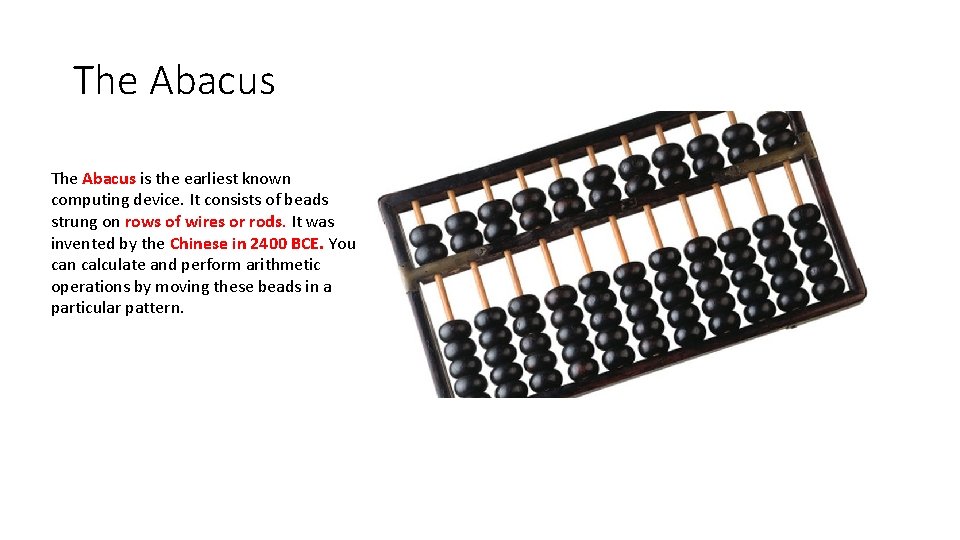
The Abacus is the earliest known computing device. It consists of beads strung on rows of wires or rods. It was invented by the Chinese in 2400 BCE. You can calculate and perform arithmetic operations by moving these beads in a particular pattern.
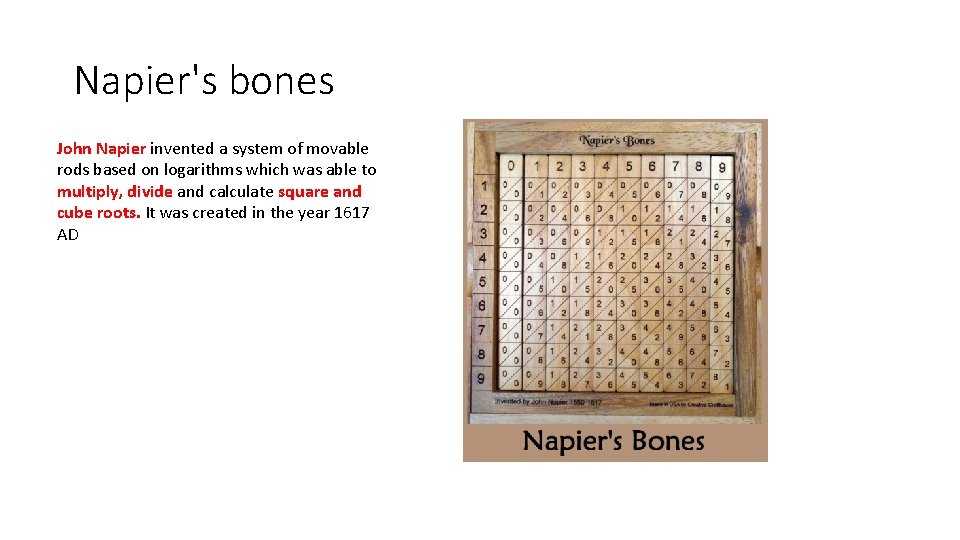
Napier's bones John Napier invented a system of movable rods based on logarithms which was able to multiply, divide and calculate square and cube roots. It was created in the year 1617 AD
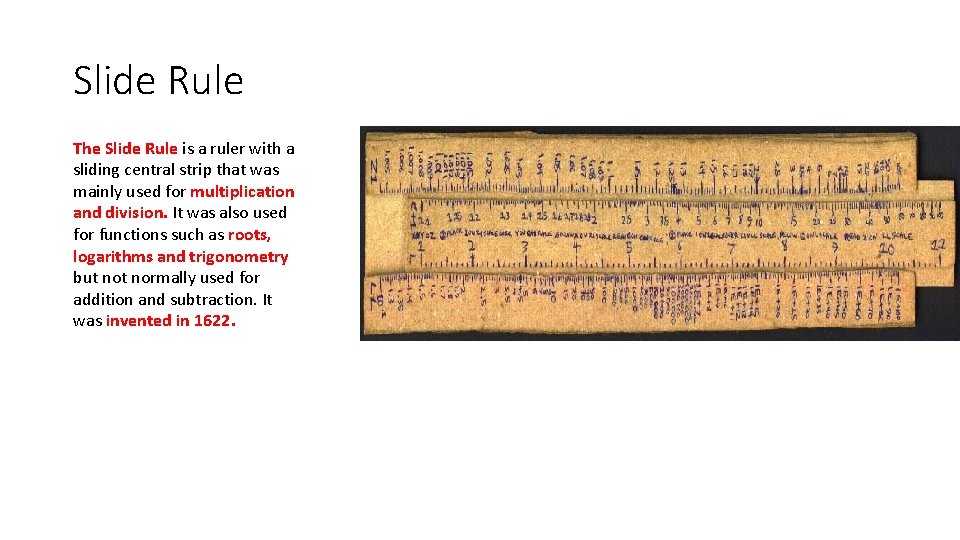
Slide Rule The Slide Rule is a ruler with a sliding central strip that was mainly used for multiplication and division. It was also used for functions such as roots, logarithms and trigonometry but normally used for addition and subtraction. It was invented in 1622.

The Pascaline Pascal's calculator (also known as the arithmetic machine or Pascaline) is a mechanical calculator invented by Blaise Pascal in the early 17 th century. Pascal was led to develop a calculator by the laborious arithmetical calculations required by his father's work as supervisor of taxes.
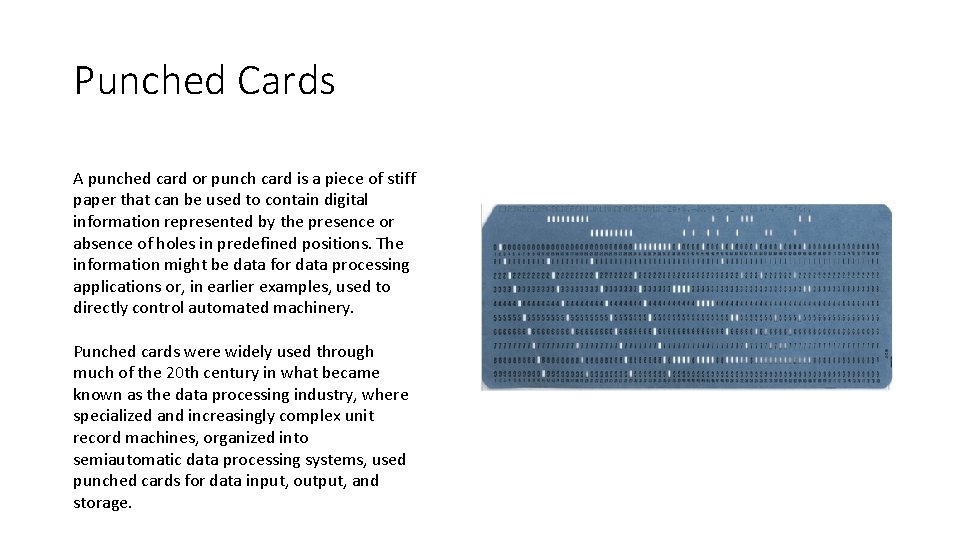
Punched Cards A punched card or punch card is a piece of stiff paper that can be used to contain digital information represented by the presence or absence of holes in predefined positions. The information might be data for data processing applications or, in earlier examples, used to directly control automated machinery. Punched cards were widely used through much of the 20 th century in what became known as the data processing industry, where specialized and increasingly complex unit record machines, organized into semiautomatic data processing systems, used punched cards for data input, output, and storage.
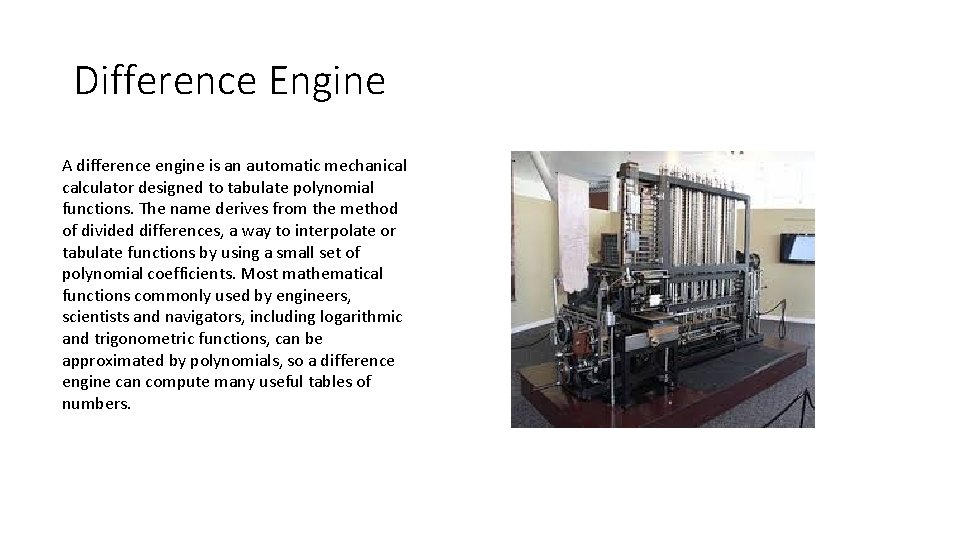
Difference Engine A difference engine is an automatic mechanical calculator designed to tabulate polynomial functions. The name derives from the method of divided differences, a way to interpolate or tabulate functions by using a small set of polynomial coefficients. Most mathematical functions commonly used by engineers, scientists and navigators, including logarithmic and trigonometric functions, can be approximated by polynomials, so a difference engine can compute many useful tables of numbers.
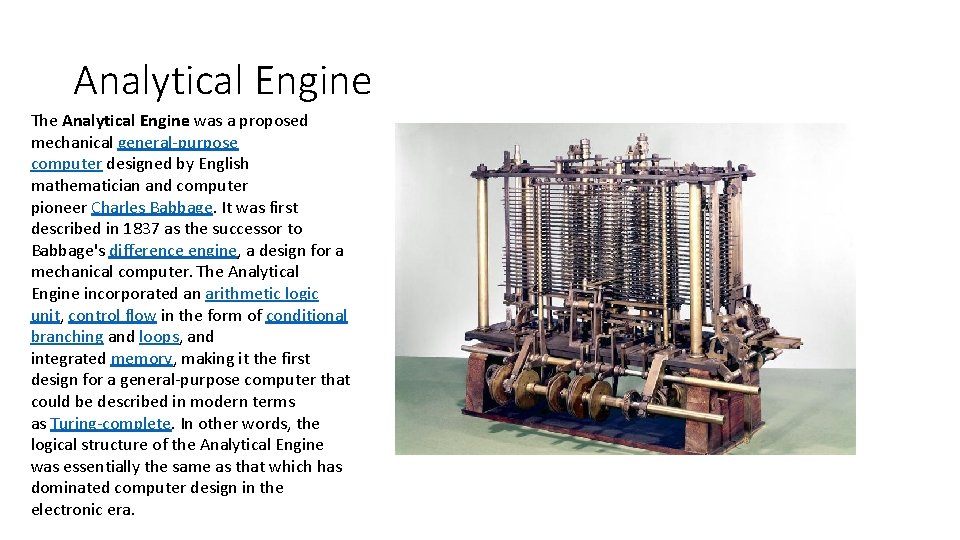
Analytical Engine The Analytical Engine was a proposed mechanical general-purpose computer designed by English mathematician and computer pioneer Charles Babbage. It was first described in 1837 as the successor to Babbage's difference engine, a design for a mechanical computer. The Analytical Engine incorporated an arithmetic logic unit, control flow in the form of conditional branching and loops, and integrated memory, making it the first design for a general-purpose computer that could be described in modern terms as Turing-complete. In other words, the logical structure of the Analytical Engine was essentially the same as that which has dominated computer design in the electronic era.

- Slides: 9