
The History of British Drama Year II4 Introduction
The History of British Drama Year II/4.
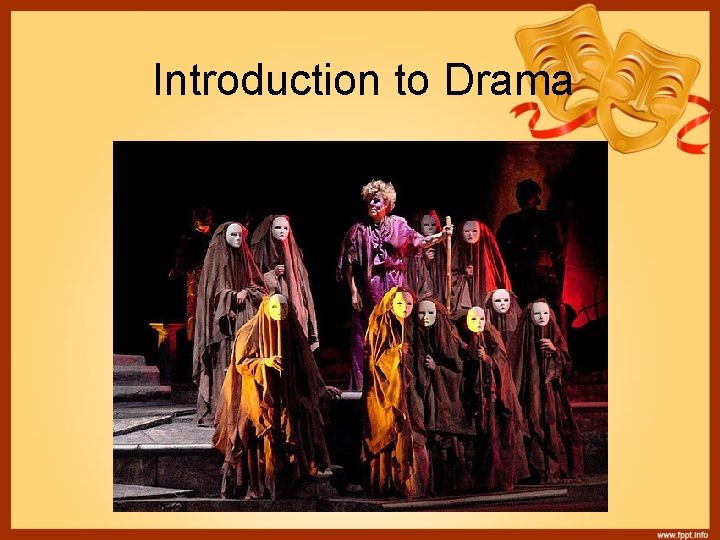
Introduction to Drama
Drama – To be, or not to be, that is the question • Drama – a literary composition involving conflict, action, crisis and atmosphere designed to be acted by players on a stage before an audience. (This definition may be applied to motion picture drama as well as to the traditional stage. ) • Drama had it’s origin in the country of Greece around 500 B. C. • Drama, as a literary genre, is an art form that is meant to be performed!
Evolution of British Drama • Plays are written for performance (if we think of them as literature only, if we see them simply as words to be read, we miss their essence. ) • It has to be performed if it is to be fully appreciated and understood. • When we read a play, we must always think of it in action. • Drama is a living art form. • Drama is about human existence but it is fiction. It is the mirror of existence, the reflection of human life so recreated as to be meaningful and significant to the audience.
Evolution of British Drama • A good play poses highly significant questions about life, but a bad play does not. • That is why drama is always social: it raises the key questions being asked within the community for which it is written. • Theatre is the art form of the play process. • It satisfies a fundamental human need because it poses the key questions of life. • One play gives a particular answer, and a second provides a different solution.
Plays are meant to be seen. However, there are justifications for reading a play • It is better to know some masterpieces by reading them than never to know them at all; • Reading allows fuller use of the imagination; • It allows one to study at leisure; • It allows for review; • It permits one to see the original intent of the author without intervention by a director;
Drama Combines aspects of all three Literary Genres (Prose, Poetry, Drama) • Literature – Drama can be fictional or factual; – Drama shares many of the common literary elements like plot, setting, characterization, and dialogue; • Poetry – Many plays are written in verse (for example, “Oedipus Rex” and “Othello”) • Drama – Its unique characteristic is that it is written to be performed;
Three Major Characteristics of Drama • 1. It has a direct, immediate impact – Advantages: • Simultaneous impressions occur; • Performance can be more expressive than a reader’s imagination; – Disadvantages: • Limited to one viewpoint—objective (dramatic) • Writers try to overcome this by using the soliloquy and the aside to accomplish what the omniscient (mindentudó) viewpoint achieves in the short story genre.
• 2. Drama effectively commands the spectator’s attention – Advantage: The playwright’s power extends beyond words alone; – Disadvantage: The materials one can use on stage are limited;
• 3. The experience of watching a play is communal – Advantage: Impact is intensified. – Disadvantages: There is a need for brevity (rövidség), swift movement of plot, and intermissions.
Drama and Shamanism • Before homo sapiens appeared, Neanderthal man acted ritual ceremonies in caves. • He sacrificed bears, arranged their bones in ceremonial order, and pierced holes in their skulls to extract and eat their brains. They believed this helps to „take over” the powers of the animal – within a dramatic act. • When homo sapiens appeared (c. 40 000 B. C. ), he created superb cave paintings, drawings, carvings, and figurines that showed he was a master symbolizer. These were made in the service of a ritual drama which attempted to control existence.
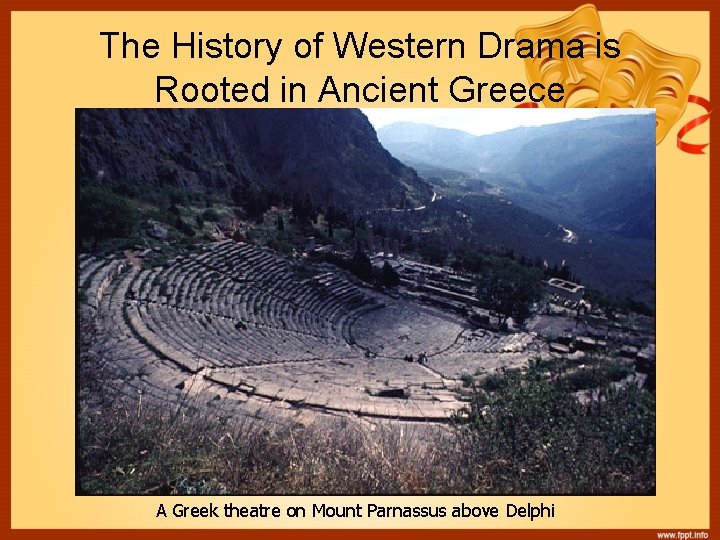
The History of Western Drama is Rooted in Ancient Greece A Greek theatre on Mount Parnassus above Delphi
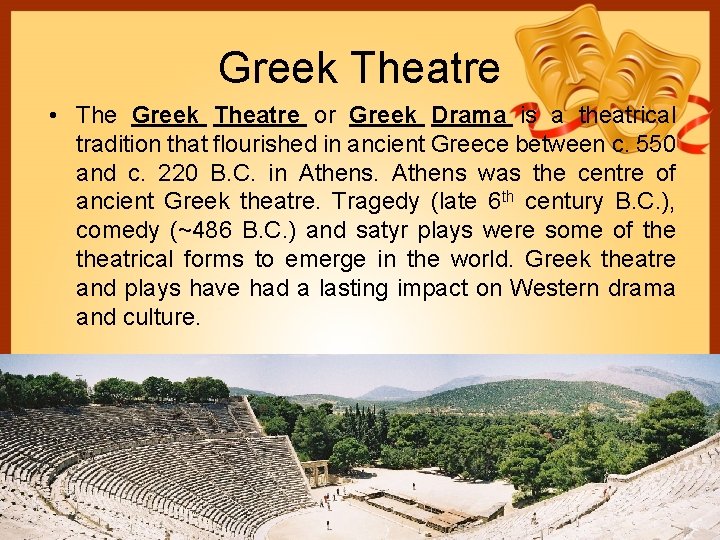
Greek Theatre • The Greek Theatre or Greek Drama is a theatrical tradition that flourished in ancient Greece between c. 550 and c. 220 B. C. in Athens was the centre of ancient Greek theatre. Tragedy (late 6 th century B. C. ), comedy (~486 B. C. ) and satyr plays were some of theatrical forms to emerge in the world. Greek theatre and plays have had a lasting impact on Western drama and culture.
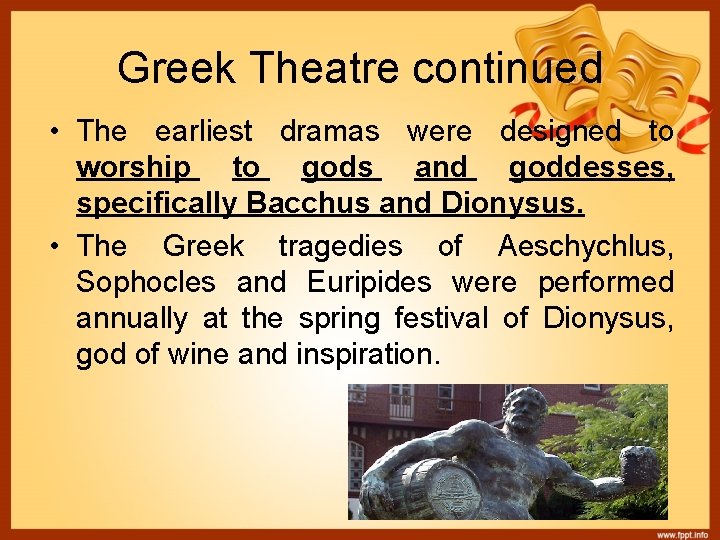
Greek Theatre continued • The earliest dramas were designed to worship to gods and goddesses, specifically Bacchus and Dionysus. • The Greek tragedies of Aeschychlus, Sophocles and Euripides were performed annually at the spring festival of Dionysus, god of wine and inspiration.
Greek Theatre • Ancient Greek theatre developed as part of religious festivals; • A “choric hymn” called the dithyramb was composed in honor of Dionysus, the god of wine and fertility; • The hymn was sung by a chorus of 50 men; • Over time, Thespis, the first actor, added dialog between one actor and the chorus.
Thespis • Added the first actor to interact with the dithyramb chorus; • Called the actor the “protagonist”; • Is said to have performed in Athens in 534 B. C. • The term “thespian”, (having to do with drama or theater) comes from his name. • When the Dionysian festivals changed to drama competitions, Thespis was the first winner.
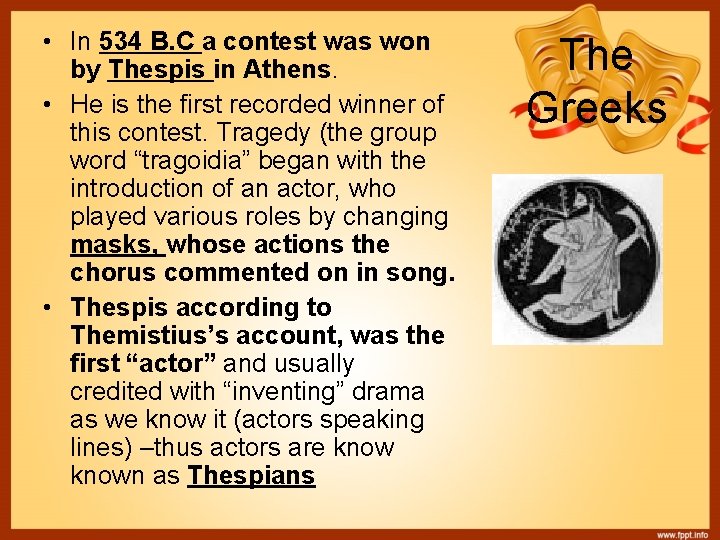
• In 534 B. C a contest was won by Thespis in Athens. • He is the first recorded winner of this contest. Tragedy (the group word “tragoidia” began with the introduction of an actor, who played various roles by changing masks, whose actions the chorus commented on in song. • Thespis according to Themistius’s account, was the first “actor” and usually credited with “inventing” drama as we know it (actors speaking lines) –thus actors are known as Thespians The Greeks
Golden Age of Greece (480 - 338 BC) l Featured 3 great tragic dramatists: l Aeschylus (525 -456 BC) l Sophocles (496 -405 BC) l Euripedes (480 -407 BC)
• Aeschylus (around 484 B. C. ) – – Changed the dithyramb into drama Added a second actor Added props and scenery Reduced the chorus from 50 to 15 • Sophocles – Added a third actor – Changed the focus from interactions between humans and the gods to interactions between humans • Euripides – Reflects modern attitudes – Writes about all real people, not just royalty – Plays have a realistic flavor
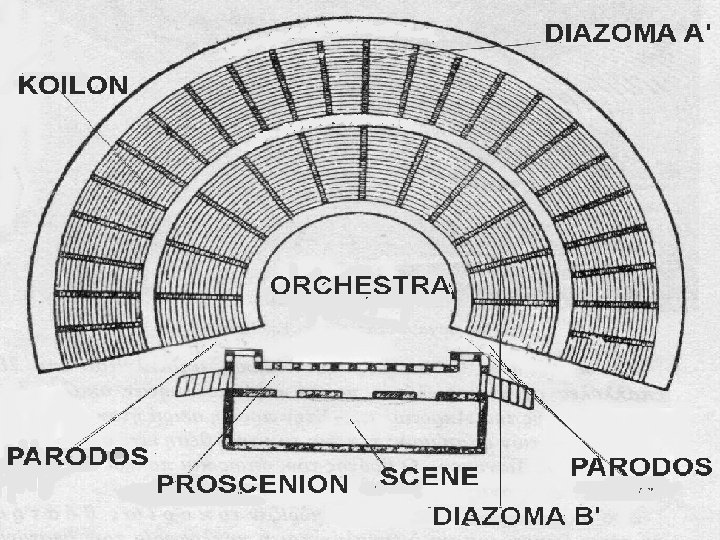
Physical Conventions of Greek Theatre • Semi-circular tiers of seats hollowed out of the hillside • Seated up to 17, 000 spectators • Orchestra – 60 ft. in diameter with altar at center – Place where the chorus performed • Performances occurred in daylight • Chorus of 15 – Sang and danced in response to the actors
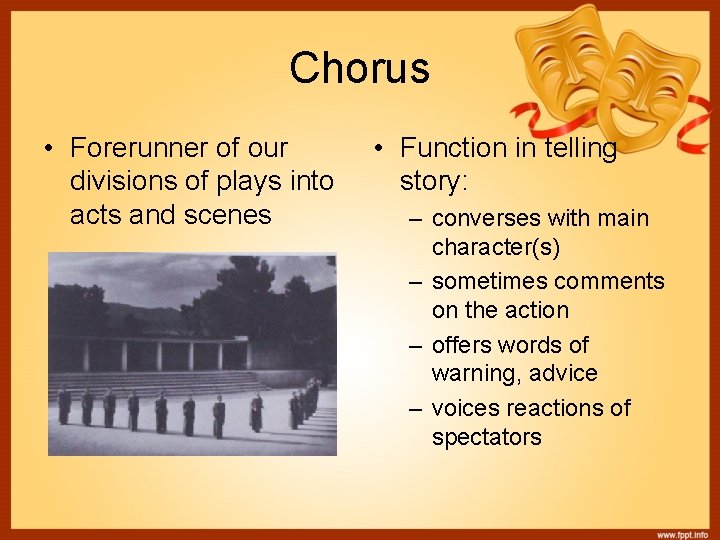
Chorus • Forerunner of our divisions of plays into acts and scenes • Function in telling story: – converses with main character(s) – sometimes comments on the action – offers words of warning, advice – voices reactions of spectators
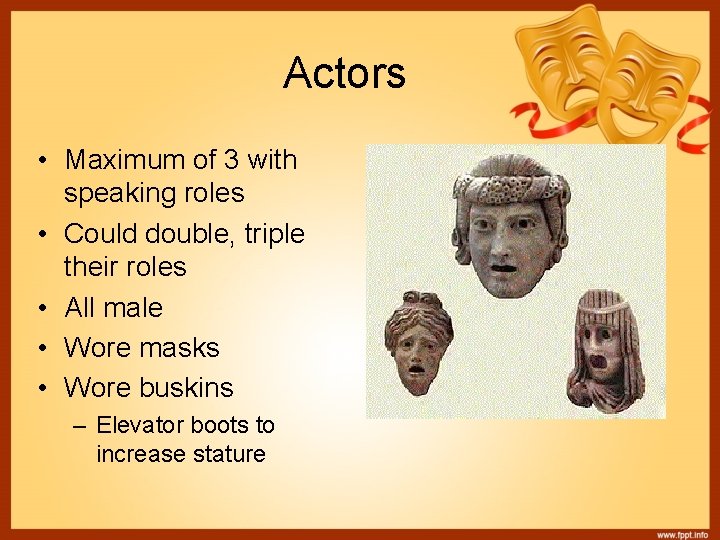
Actors • Maximum of 3 with speaking roles • Could double, triple their roles • All male • Wore masks • Wore buskins – Elevator boots to increase stature
Other Characteristics of Greek Drama: • • Some unhappy endings Few or no horrible scenes on stage Female roles played by men Simple stage props Religious in origin and spirit Romantic love not important Employed Aristotle’s classical unities
Aristotle’s Rules and Purpose for Ancient Drama • Classical Unities – Unity of time (action must occur within 24 hours) – Unity of place (action takes place in one location) – Unity of action (single plot) • Catharsis – Socially acceptable purging of emotions such as anger, fear, or grief
Two Main Types of Greek Drama with sub-genres • Tragedy – Melodrama • Comedy – Farce
Characteristics of Greek Tragedy • • Displays human greatness Emphasizes human freedom Exposes the nobility of man Presents challenges to the vision of human possibility • Adheres to Aristotle’s classical unities
Characteristics of the Tragic Hero • Overpowering (ellenállhatatlan, hatalmas) individual – Usually named in the play’s title • • Judged by moral standards Isolated Lofty (fennkölt) and noble Has a tragic flaw
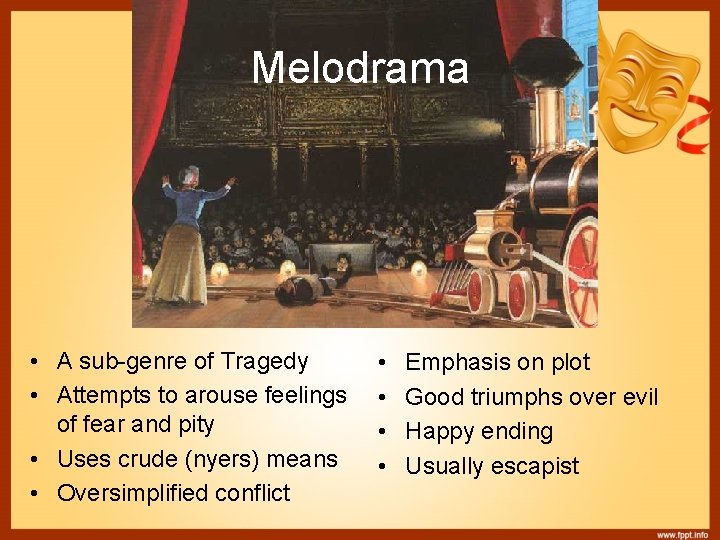
Melodrama • A sub-genre of Tragedy • Attempts to arouse feelings of fear and pity • Uses crude (nyers) means • Oversimplified conflict • • Emphasis on plot Good triumphs over evil Happy ending Usually escapist
Characteristics of Comedy • • • Emphasizes commonness of the group Protagonist tends to be a type Protagonist is judged by social standards Plots are less likely to have organic unity Usually happy ending
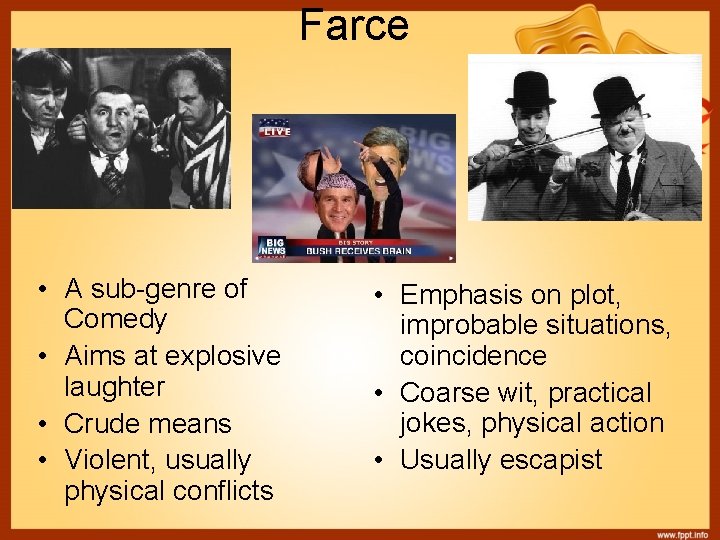
Farce • A sub-genre of Comedy • Aims at explosive laughter • Crude means • Violent, usually physical conflicts • Emphasis on plot, improbable situations, coincidence • Coarse wit, practical jokes, physical action • Usually escapist
Roman Performance in Britain • Roman soldiers arriving in Britain found hunters, herdsmen, and farmers. • These Celtic and Teutonic peoples had religious performances similar to others all over Europe: fertility processions, ritual fires on behalf of the sun to combat winter, sacrifices, sexual rites, animal worship, and so on. • The Romans brought two forms of drama: theatrical performances and their own ritual myths.
Roman Performance in Britain • The Romans built theatres and amphitheatres. • The best preserved theater is at Verulamium (St. Albans). • Amphitheatres suitable for chariot races and large spectacles have been found; they influenced the production of later medieval Cycles. • Rome, like other early cultures, had a world peopled by gods. • Roman religion centred around family or clan gods, with other gods for gates, boundaries, or specific problems.
Roman Performance in Britain • On this basis was built the state religion with a calendar full of ritual festivals. • These festivals were the appropriate occasions for drama because they promoted fertility, and each was surrounded by magic and taboos. • Toward the end of the 4 th century A. D. , the Roman legions went home, and by 410 Rome was sacked. • From c. 350 the Anglo-Saxons from northeast Europe had plundered the south and east coast of England; • About 450 they began to settle along the great rivers and conquered most of England.
Roman Performance in Britain • They met with a pagan culture much like their own in its rituals. • Celtic Christians in Ireland Wales were isolated. • It was not until c. 590 that St. Columba began his progress of conversion, while in 597 St. Augustine began to Christianize the country.
Decline of Drama • Drama went into a period of decline around A. D. 400 (Roman Empire) • Due to the Power of Christians • Acting has been deemed at times to be unchristian, idolatrous (bálványimádó) and depraved or, worse, boring. • Actors themselves have frequently been seen to be one of the humbler classes, and only towards the end of the 19 th century did their status start to improve.
Ancient Ritual in Britain • Despite the work of the early Church, Britain remained fundamentally heathen (pogány) with three types of performance: • 1. rites, like those of the ancient shamans, to increase the fertility of game (wild animals); • 2. rituals, like those of the ancient Near East, to make the crops grow; • 3. and presentations by mimes who travelled the country poking fun at all forms of power. • Much of modern folklore derives from those days.
• Fertility semidramas and the mimes continued through the Middle Ages, although the Catholic Church thundered against them • However, it was from the Church itself that a genuine form of drama flowered: from the liturgy during the festivals of Easter and Christmas.
Revival of Drama • A. D. 900 -1500 • Medieval Drama, when it emerged hundreds of years later, was a new creation rather than a rebirth. • The drama of earlier times having almost no influence on it. • The reason for this creation came from a quarter that had traditionally opposed any form of theatre: The Christian church

Dramatic Terminology Literary Terms
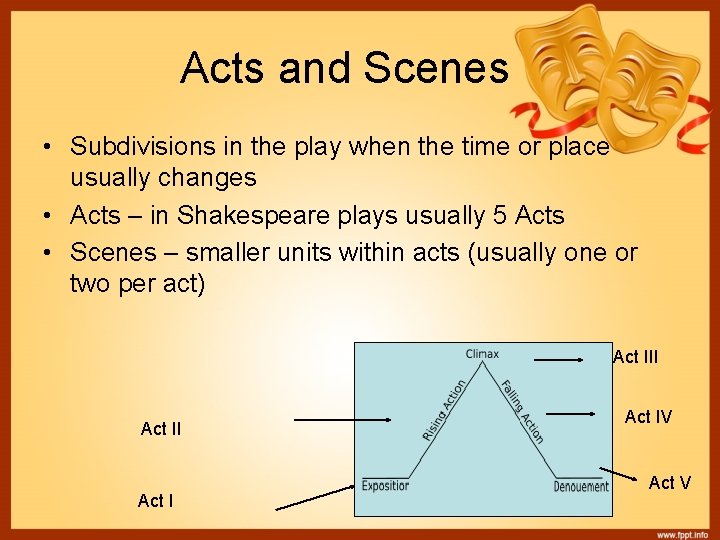
Acts and Scenes • Subdivisions in the play when the time or place usually changes • Acts – in Shakespeare plays usually 5 Acts • Scenes – smaller units within acts (usually one or two per act) Act III Act IV Act V
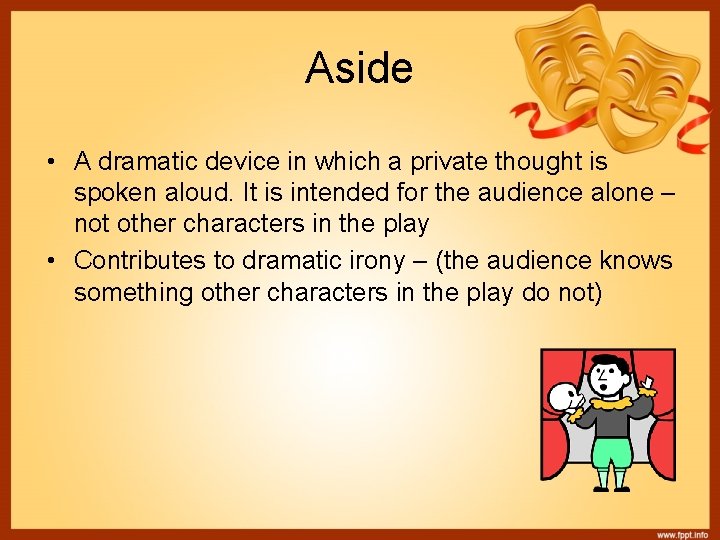
Aside • A dramatic device in which a private thought is spoken aloud. It is intended for the audience alone – not other characters in the play • Contributes to dramatic irony – (the audience knows something other characters in the play do not)
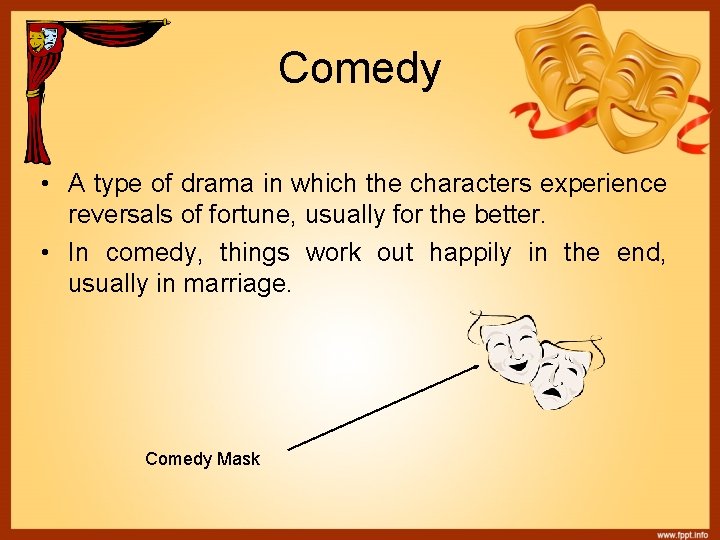
Comedy • A type of drama in which the characters experience reversals of fortune, usually for the better. • In comedy, things work out happily in the end, usually in marriage. Comedy Mask
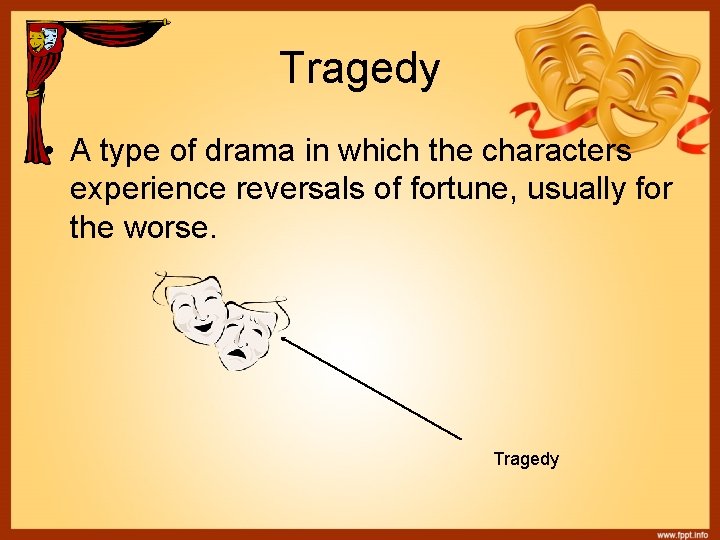
Tragedy • A type of drama in which the characters experience reversals of fortune, usually for the worse. Tragedy
Dialogue • Conversations among characters
Drama • One of the three main types of literature; it tells a story through the words and actions of a character.
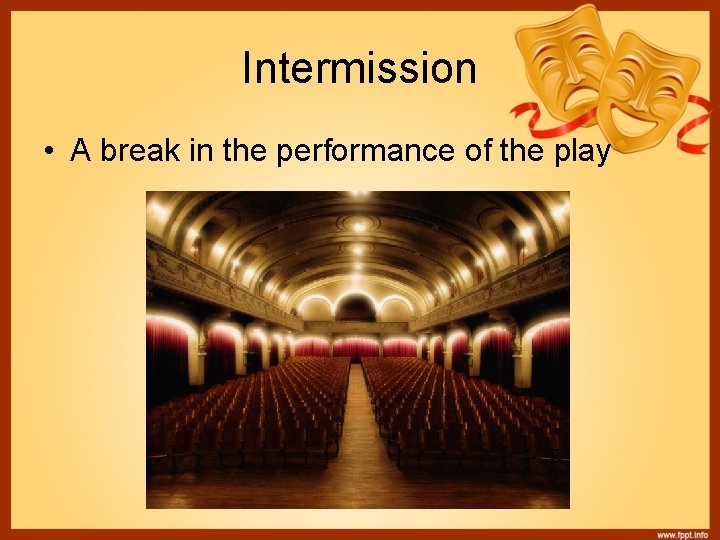
Intermission • A break in the performance of the play
Monologue • A speech delivered by one person
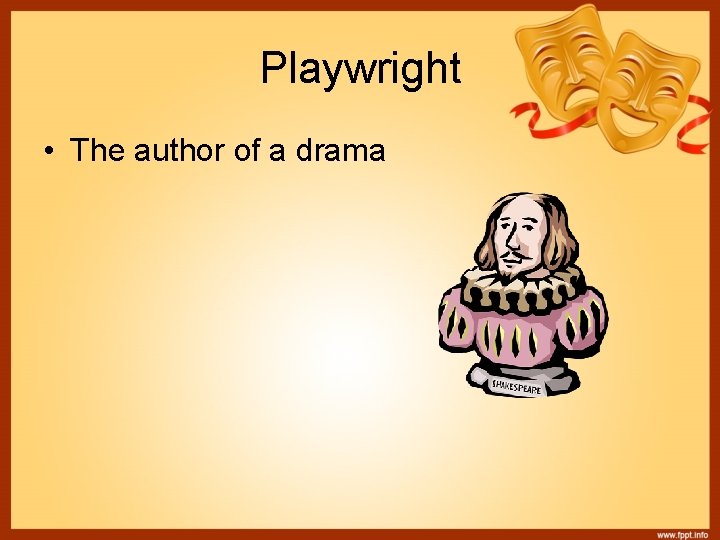
Playwright • The author of a drama
Props • Articles or objects that appear on stage during a play
Script • The written version of the play
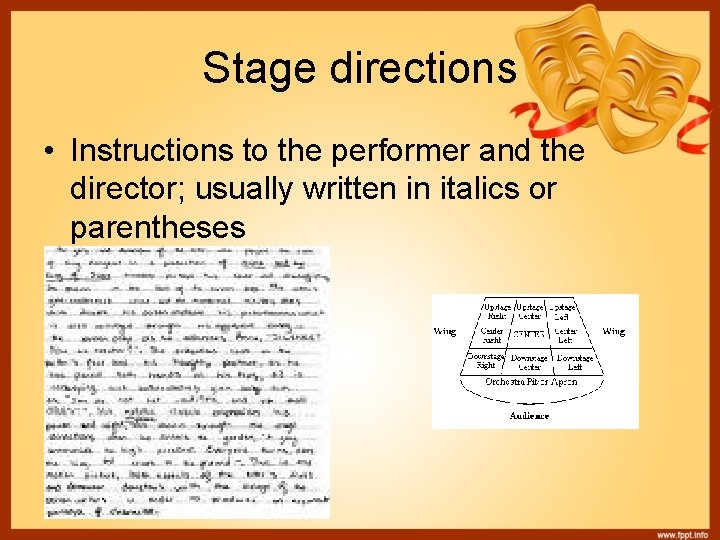
Stage directions • Instructions to the performer and the director; usually written in italics or parentheses
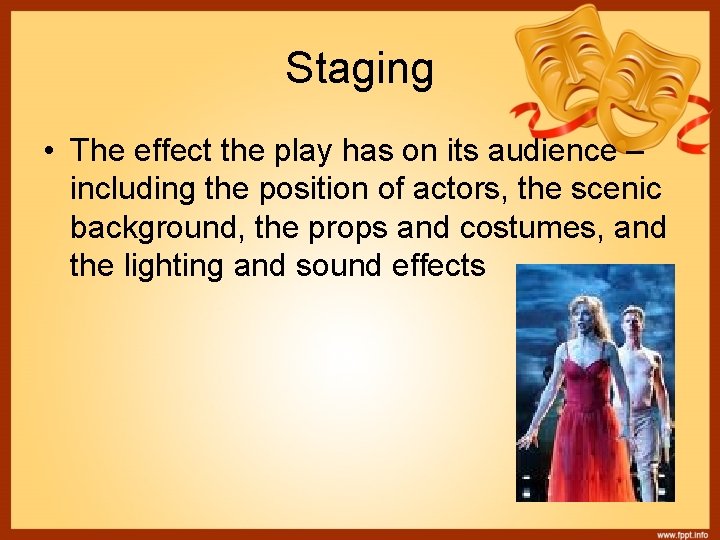
Staging • The effect the play has on its audience – including the position of actors, the scenic background, the props and costumes, and the lighting and sound effects
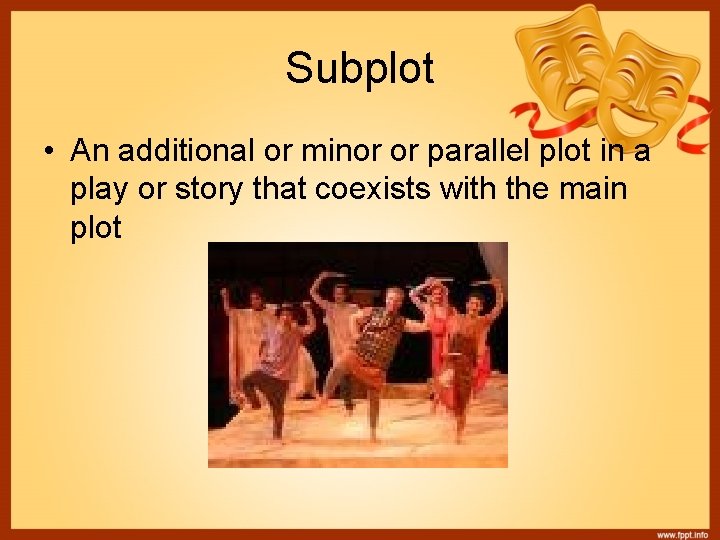
Subplot • An additional or minor or parallel plot in a play or story that coexists with the main plot
Thespians • Actors and actresses
- Slides: 55