
The History of Black History Month Including Psychologys
The History of Black History Month Including Psychology’s Contribution to the Public Interest Mr. van Over/2018
Part 1 The Origins of the National Month
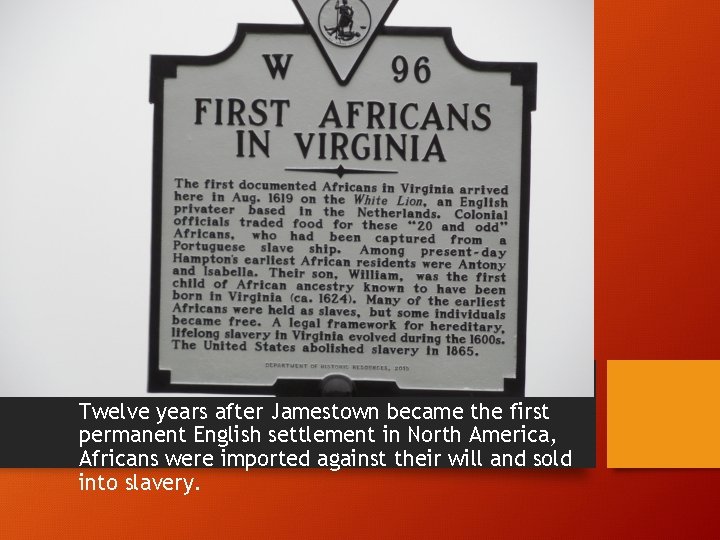
Twelve years after Jamestown became the first permanent English settlement in North America, Africans were imported against their will and sold into slavery.
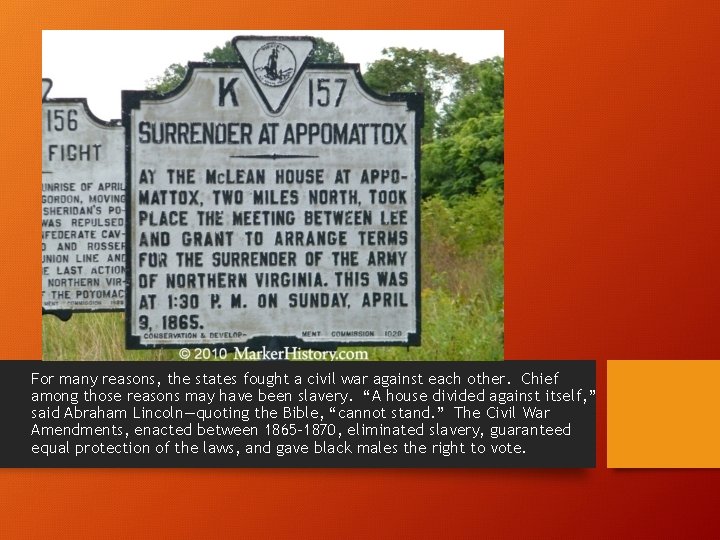
For many reasons, the states fought a civil war against each other. Chief among those reasons may have been slavery. “A house divided against itself, ” said Abraham Lincoln—quoting the Bible, “cannot stand. ” The Civil War Amendments, enacted between 1865 -1870, eliminated slavery, guaranteed equal protection of the laws, and gave black males the right to vote.
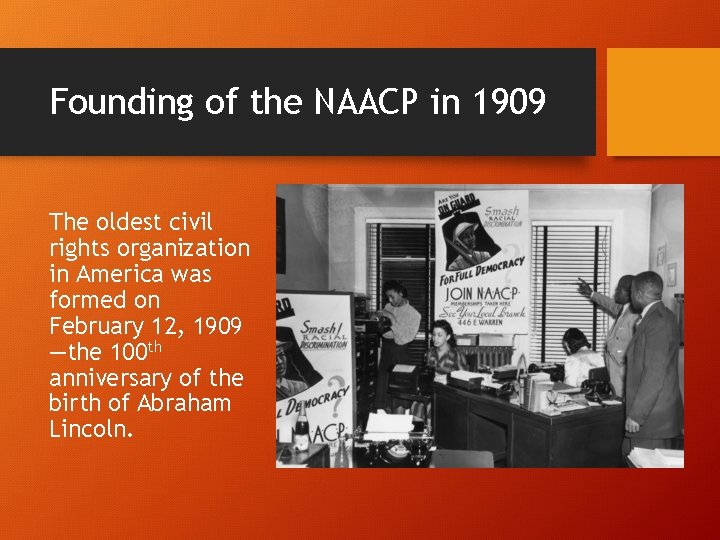
Founding of the NAACP in 1909 The oldest civil rights organization in America was formed on February 12, 1909 —the 100 th anniversary of the birth of Abraham Lincoln.

Carter G. Woodson founds Negro History Week
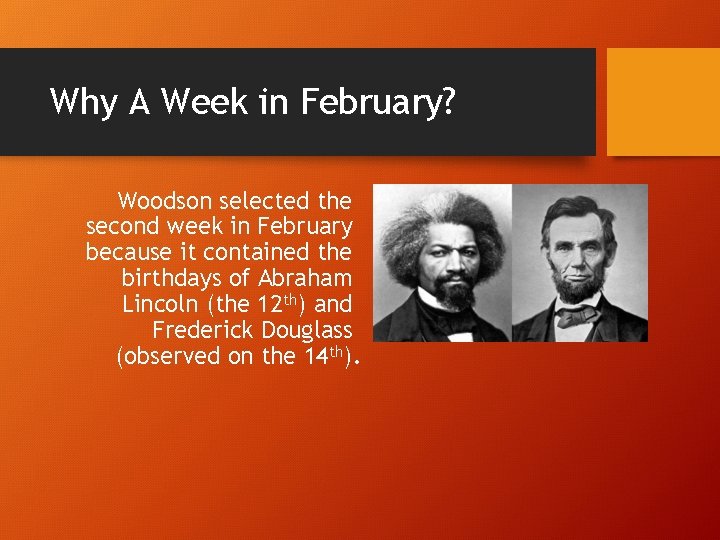
Why A Week in February? Woodson selected the second week in February because it contained the birthdays of Abraham Lincoln (the 12 th) and Frederick Douglass (observed on the 14 th).
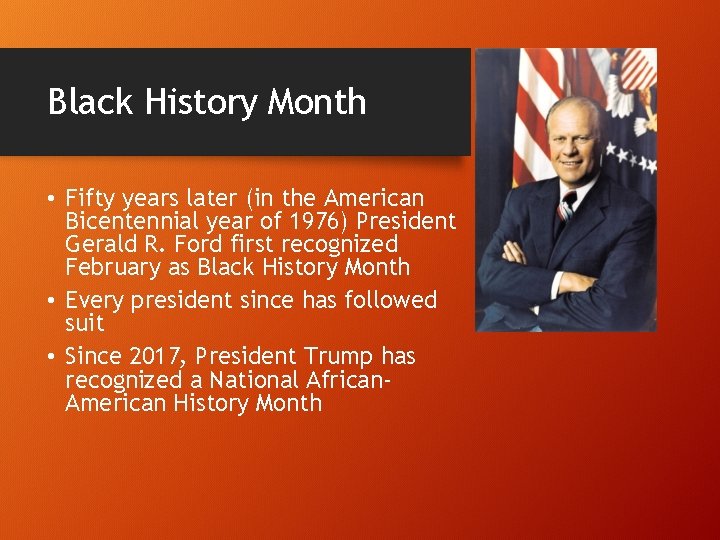
Black History Month • Fifty years later (in the American Bicentennial year of 1976) President Gerald R. Ford first recognized February as Black History Month • Every president since has followed suit • Since 2017, President Trump has recognized a National African. American History Month

Part 2 The Separate But Equal Doctrine
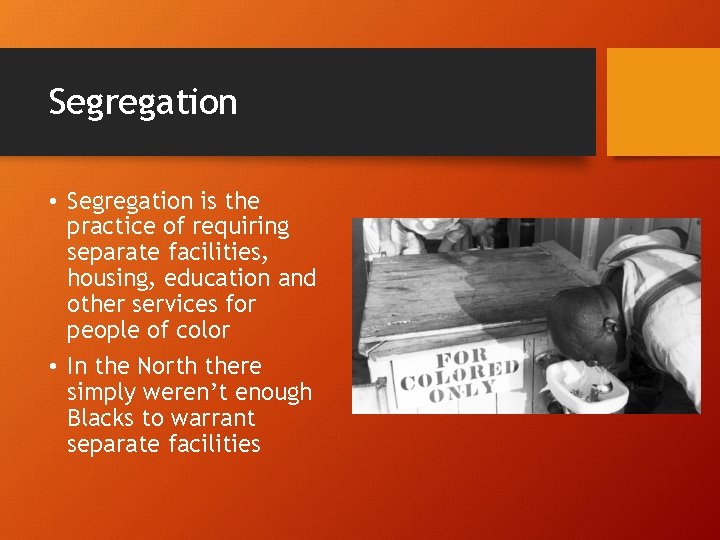
Segregation • Segregation is the practice of requiring separate facilities, housing, education and other services for people of color • In the North there simply weren’t enough Blacks to warrant separate facilities
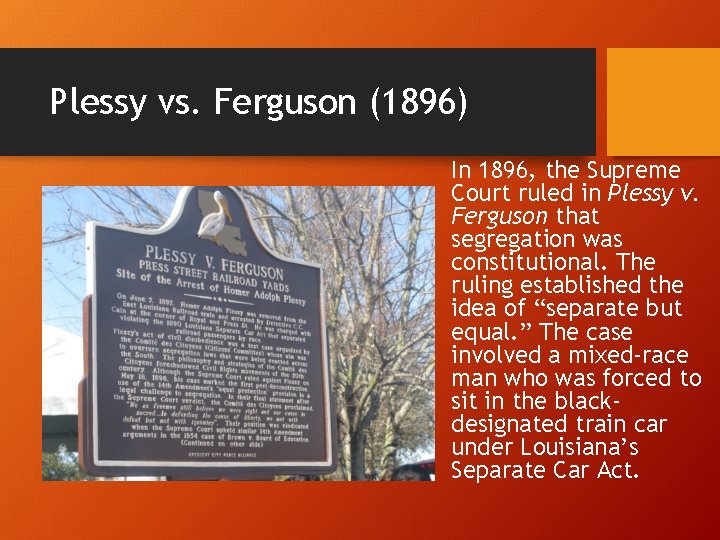
Plessy vs. Ferguson (1896) In 1896, the Supreme Court ruled in Plessy v. Ferguson that segregation was constitutional. The ruling established the idea of “separate but equal. ” The case involved a mixed-race man who was forced to sit in the blackdesignated train car under Louisiana’s Separate Car Act.
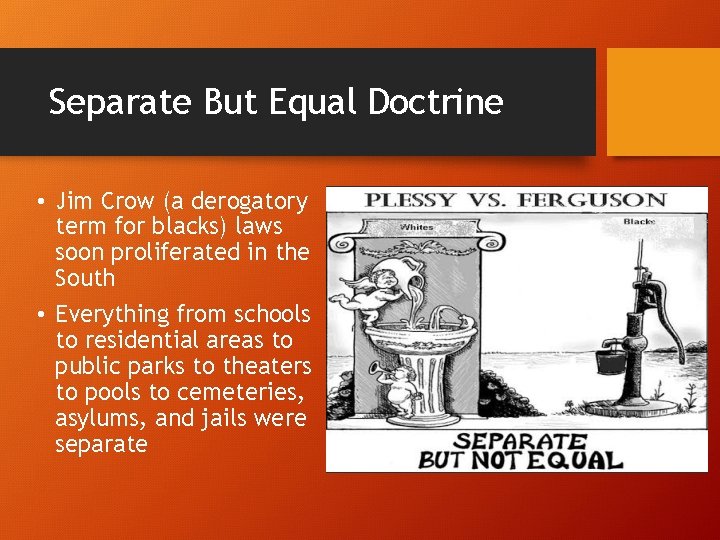
Separate But Equal Doctrine • Jim Crow (a derogatory term for blacks) laws soon proliferated in the South • Everything from schools to residential areas to public parks to theaters to pools to cemeteries, asylums, and jails were separate
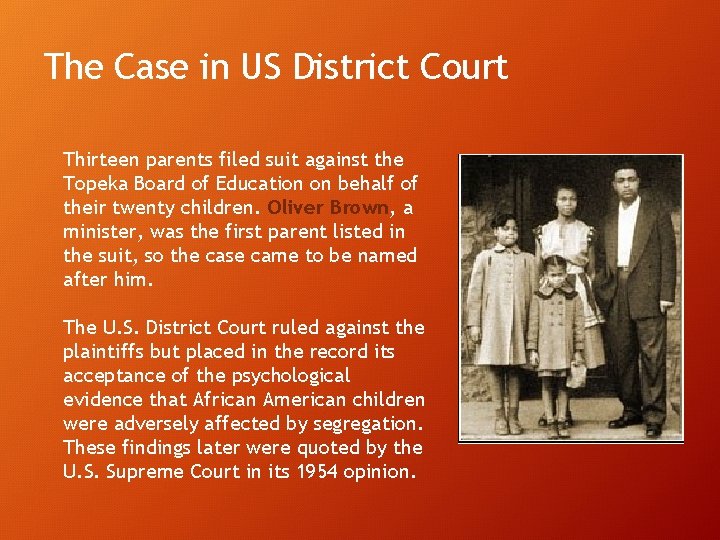
The Case in US District Court Thirteen parents filed suit against the Topeka Board of Education on behalf of their twenty children. Oliver Brown, a minister, was the first parent listed in the suit, so the case came to be named after him. The U. S. District Court ruled against the plaintiffs but placed in the record its acceptance of the psychological evidence that African American children were adversely affected by segregation. These findings later were quoted by the U. S. Supreme Court in its 1954 opinion.

Part 3 The Clark Doll Study Psychology’s Contribution to Society and the Public Interest
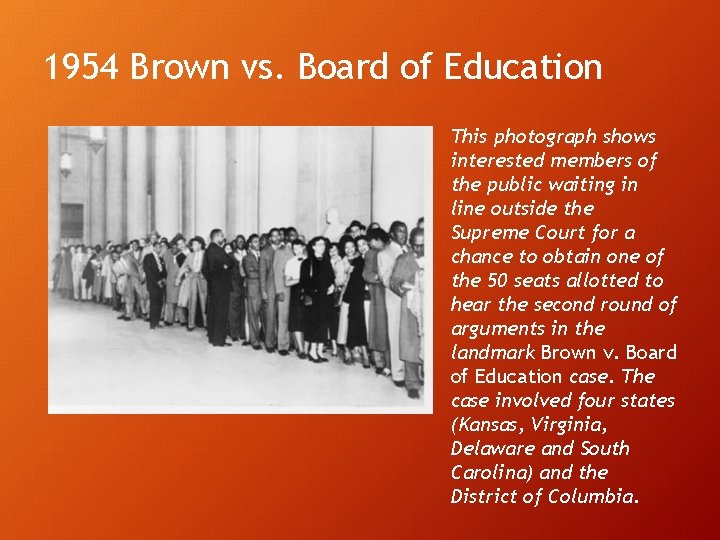
1954 Brown vs. Board of Education This photograph shows interested members of the public waiting in line outside the Supreme Court for a chance to obtain one of the 50 seats allotted to hear the second round of arguments in the landmark Brown v. Board of Education case. The case involved four states (Kansas, Virginia, Delaware and South Carolina) and the District of Columbia.
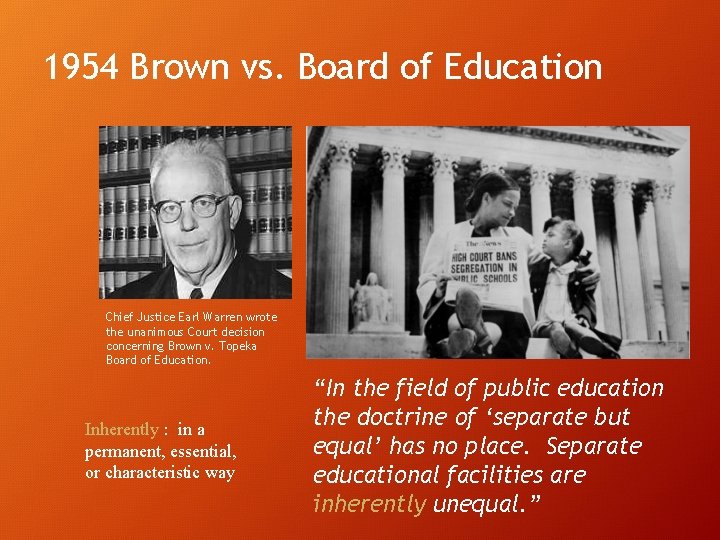
1954 Brown vs. Board of Education Chief Justice Earl Warren wrote the unanimous Court decision concerning Brown v. Topeka Board of Education. Inherently : in a permanent, essential, or characteristic way “In the field of public education the doctrine of ‘separate but equal’ has no place. Separate educational facilities are inherently unequal. ”
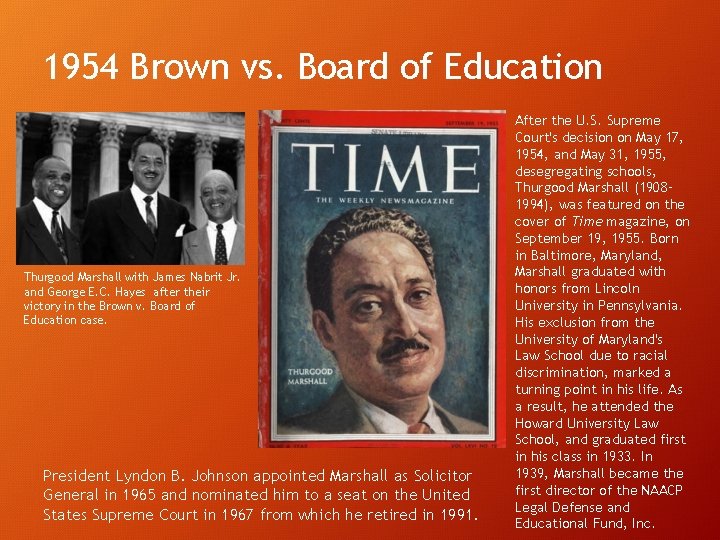
1954 Brown vs. Board of Education Thurgood Marshall with James Nabrit Jr. and George E. C. Hayes after their victory in the Brown v. Board of Education case. President Lyndon B. Johnson appointed Marshall as Solicitor General in 1965 and nominated him to a seat on the United States Supreme Court in 1967 from which he retired in 1991. After the U. S. Supreme Court's decision on May 17, 1954, and May 31, 1955, desegregating schools, Thurgood Marshall (1908– 1994), was featured on the cover of Time magazine, on September 19, 1955. Born in Baltimore, Maryland, Marshall graduated with honors from Lincoln University in Pennsylvania. His exclusion from the University of Maryland's Law School due to racial discrimination, marked a turning point in his life. As a result, he attended the Howard University Law School, and graduated first in his class in 1933. In 1939, Marshall became the first director of the NAACP Legal Defense and Educational Fund, Inc.

Kenneth Bancroft Clark 1914 -2005 Mamie Phipps Clark 1917 -1983 • 1914 -2005, U. S. psychologist • Best known for the Doll study • Relationship between skin color and self-esteem in children • Cited by SCOTUS in its landmark decision Brown vs. BOE Topeka • Kenneth was the first black elected President of the American Psychological Association (1970)
- Slides: 18