
The history of Animation Principles The persistence of

- Slides: 16
The history of Animation
Principles The persistence of vision- The perception of an object by the eyes and brain continues for a small fraction of a second after the view is blocked or the object is removed. Stop frame- This is the animation technique that makes an object appear to be moving on its own. The object is moved in small movements each photo. Its like watching a puppet show were the puppet has no strings or a puppeteer. Frame rate- Is the amount of imagines (pictures) shown per second (Also known as frames per second). 24 frames per second is what animators use.
The forms of animation • Stop motion- this is where a physical object is moved slightly in each picture taken and played back at 24 frames per second to give the impression of movement. • Cel animation- Cel is short for celluloid which is a transparent sheet where objects are drawn on and then a picture is taken the cel is removed and replaced with another slightly different drawing to give the impression of movement.
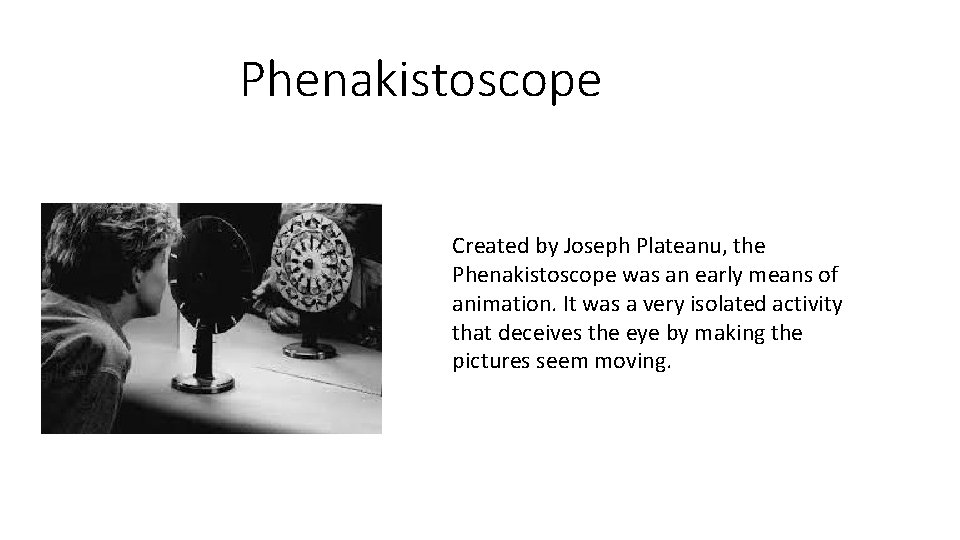
Phenakistoscope Created by Joseph Plateanu, the Phenakistoscope was an early means of animation. It was a very isolated activity that deceives the eye by making the pictures seem moving.
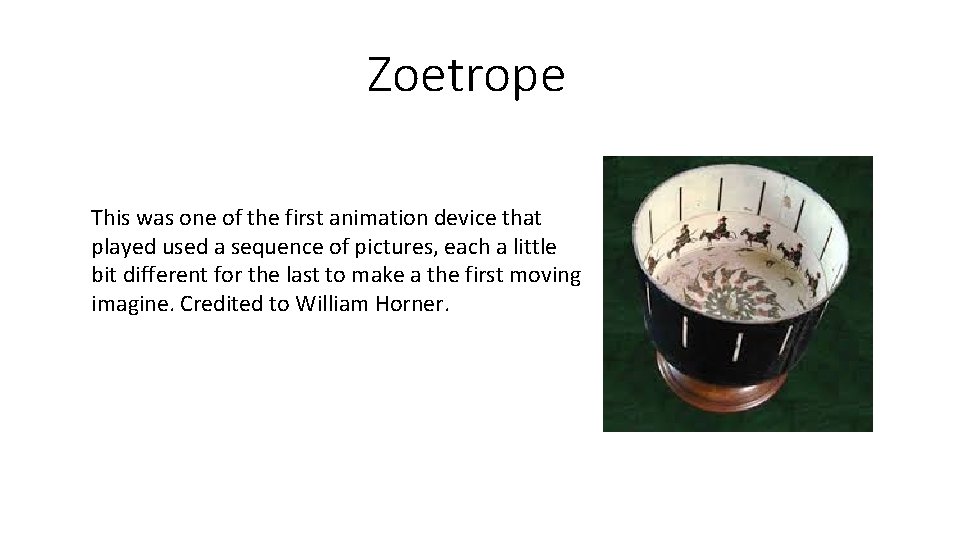
Zoetrope This was one of the first animation device that played used a sequence of pictures, each a little bit different for the last to make a the first moving imagine. Credited to William Horner.
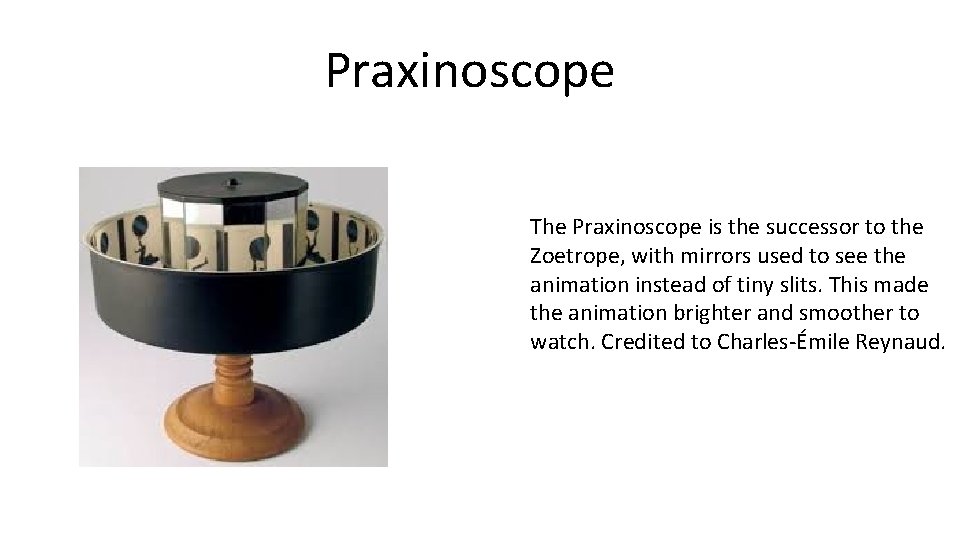
Praxinoscope The Praxinoscope is the successor to the Zoetrope, with mirrors used to see the animation instead of tiny slits. This made the animation brighter and smoother to watch. Credited to Charles-Émile Reynaud.
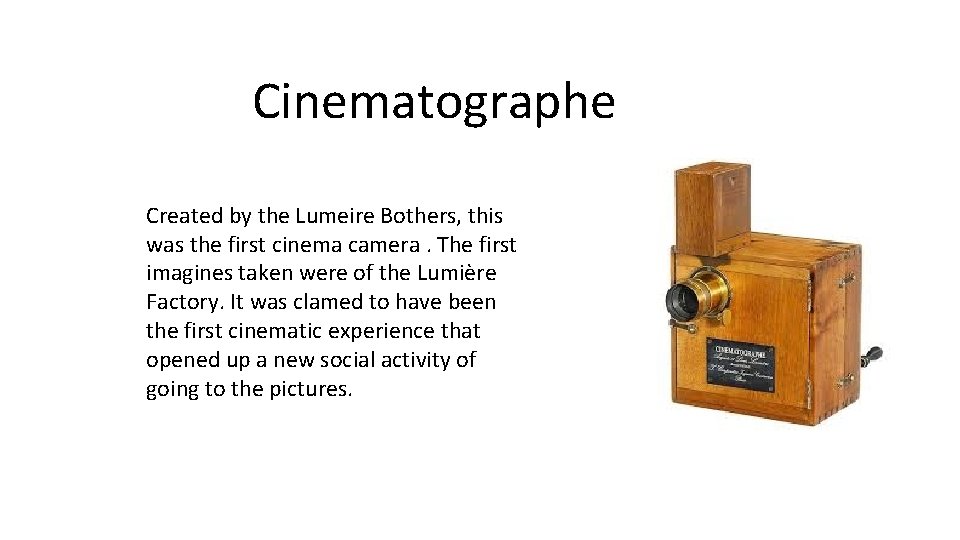
Cinematographe Created by the Lumeire Bothers, this was the first cinema camera. The first imagines taken were of the Lumière Factory. It was clamed to have been the first cinematic experience that opened up a new social activity of going to the pictures.
Horse in motion This was a bet that when a horse moves it becomes air born. It was taken by photographer Eadweard Muybridge and proved scientifically that a horse does become air born when it runs. This laid the groundwork for the development of motion pictures.
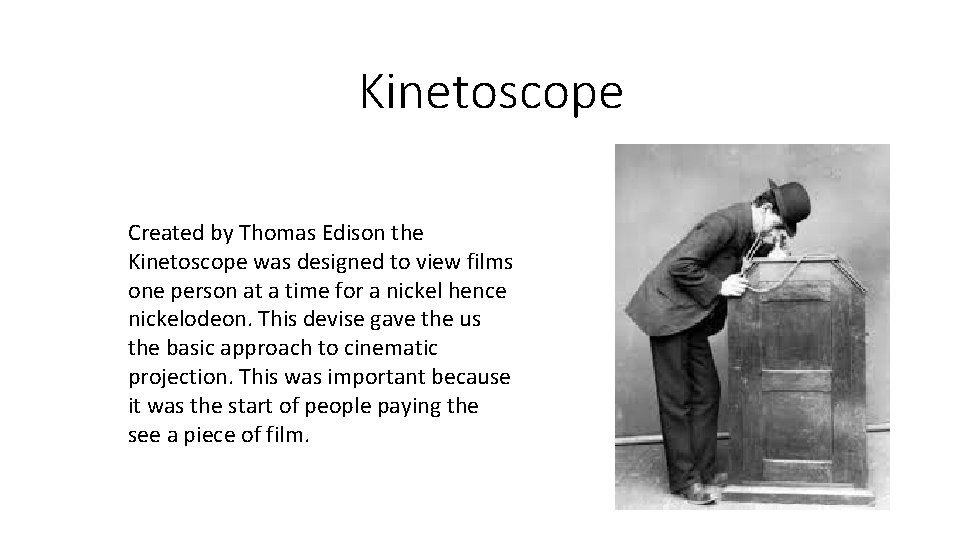
Kinetoscope Created by Thomas Edison the Kinetoscope was designed to view films one person at a time for a nickel hence nickelodeon. This devise gave the us the basic approach to cinematic projection. This was important because it was the start of people paying the see a piece of film.
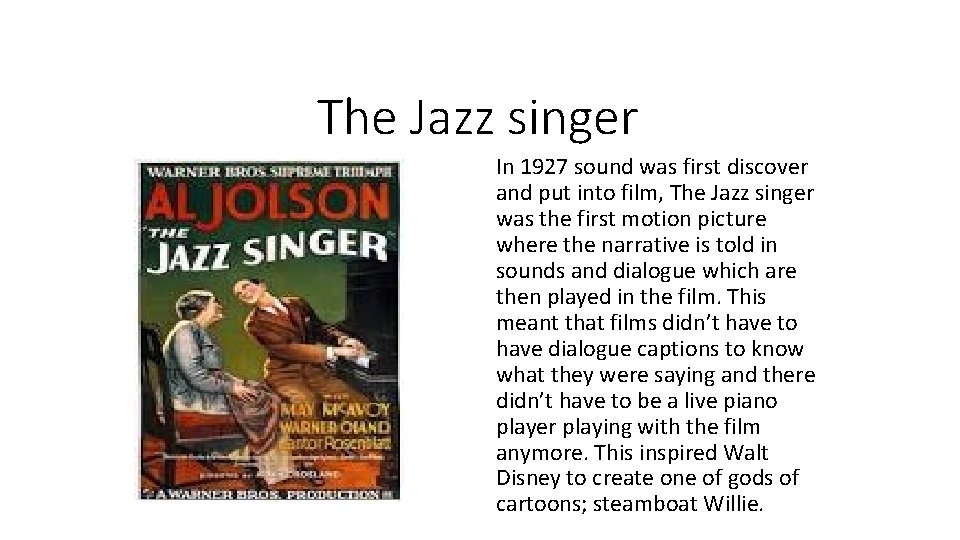
The Jazz singer In 1927 sound was first discover and put into film, The Jazz singer was the first motion picture where the narrative is told in sounds and dialogue which are then played in the film. This meant that films didn’t have to have dialogue captions to know what they were saying and there didn’t have to be a live piano player playing with the film anymore. This inspired Walt Disney to create one of gods of cartoons; steamboat Willie.
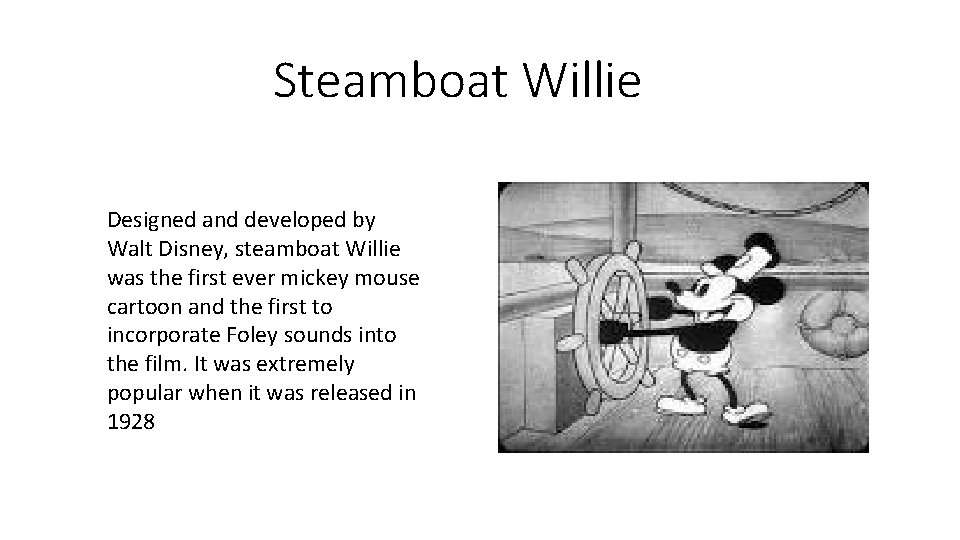
Steamboat Willie Designed and developed by Walt Disney, steamboat Willie was the first ever mickey mouse cartoon and the first to incorporate Foley sounds into the film. It was extremely popular when it was released in 1928
Stop motion developers • George Pal- Puppetoons: Most known for the use of replacement animation. This is when a model has a range of different heads and/or limbs for each frame it moves or changes faecal expression. • Willis o Brien- The lost world: The models used in this animation use exquisite. The models had metal armatures and an inflating system which gave the impression of breathing, this was covered up by a rubber exterior. • Ray Harryhausen- Jason and the Argonauts: The animation in this iconic film was really something special. The scene almost everyone knows is the fight with the skeletons. Live action mix with animation at its finessed, it was done by layering cels, putting the animation cel over the live action. • The brothers Quay- Street of crocodiles know for using organic and inorganic materials to make their creations. A very creative and still used in animations today. i. e. Luxo Jr. by Pixar. • Tim Burton- The nightmare before charismas: He used animatronics to move his models. This made it easier and certain to get smooth movement.
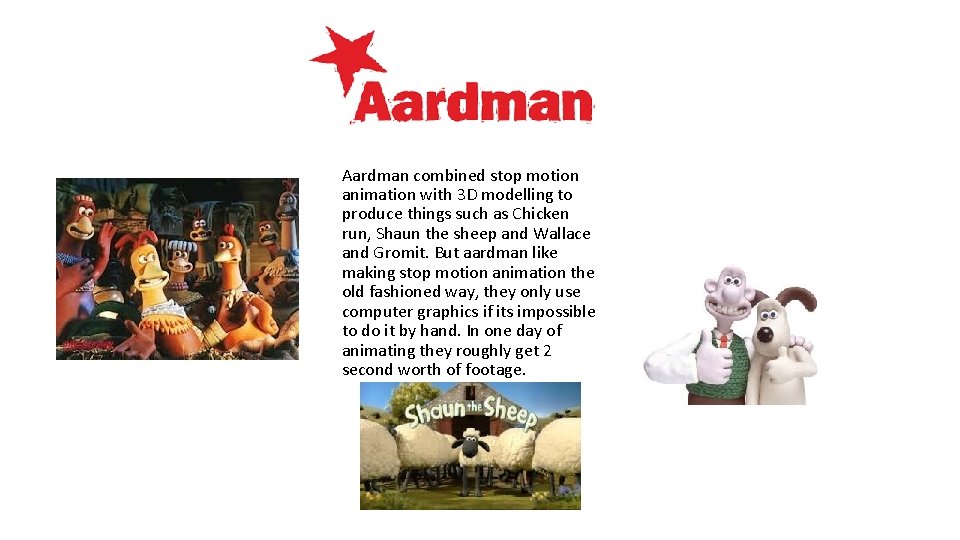
Aardman combined stop motion animation with 3 D modelling to produce things such as Chicken run, Shaun the sheep and Wallace and Gromit. But aardman like making stop motion animation the old fashioned way, they only use computer graphics if its impossible to do it by hand. In one day of animating they roughly get 2 second worth of footage.
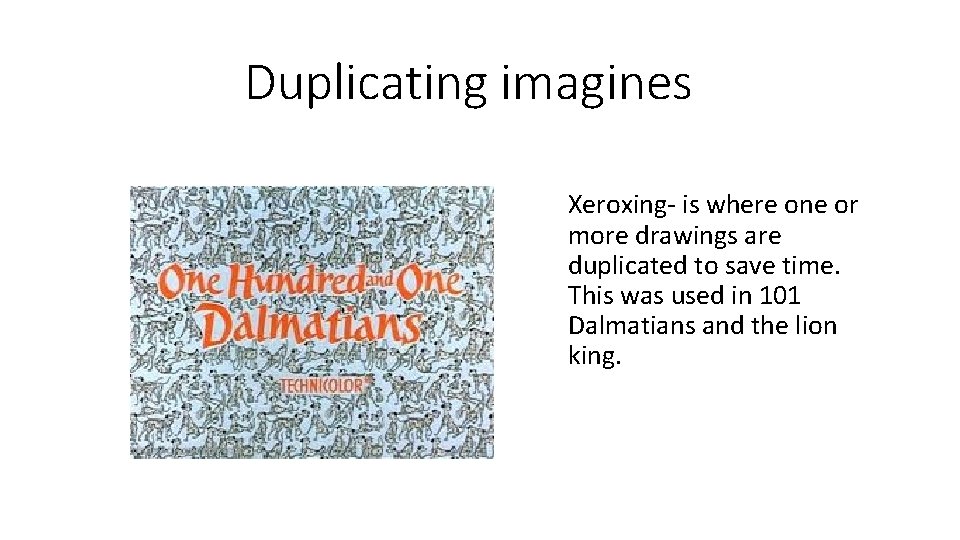
Duplicating imagines Xeroxing- is where one or more drawings are duplicated to save time. This was used in 101 Dalmatians and the lion king.
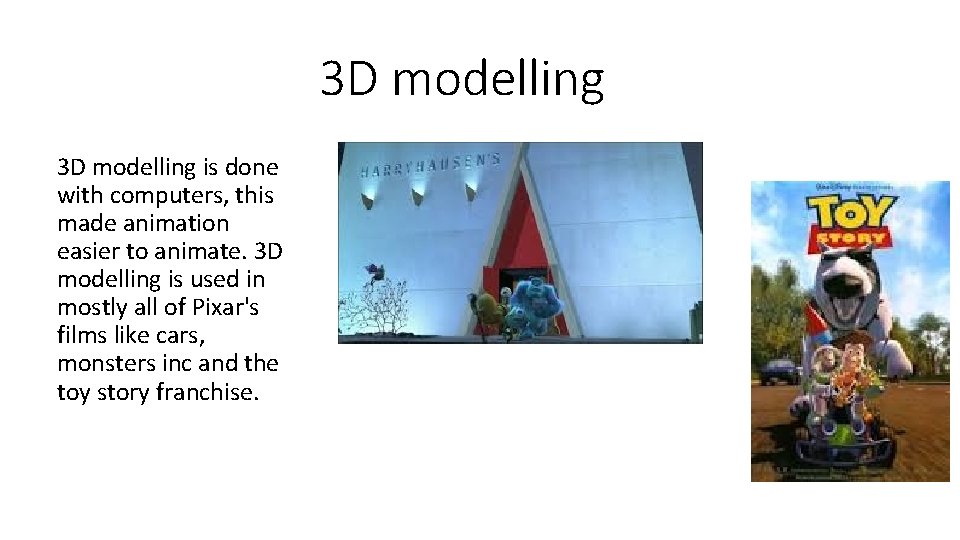
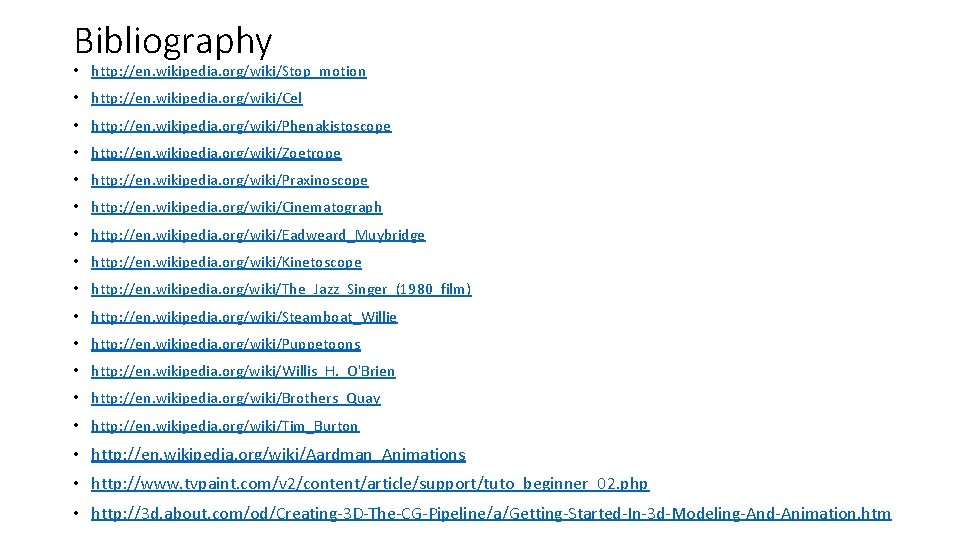
3 D modelling is done with computers, this made animation easier to animate. 3 D modelling is used in mostly all of Pixar's films like cars, monsters inc and the toy story franchise.
Bibliography • http: //en. wikipedia. org/wiki/Stop_motion • http: //en. wikipedia. org/wiki/Cel • http: //en. wikipedia. org/wiki/Phenakistoscope • http: //en. wikipedia. org/wiki/Zoetrope • http: //en. wikipedia. org/wiki/Praxinoscope • http: //en. wikipedia. org/wiki/Cinematograph • http: //en. wikipedia. org/wiki/Eadweard_Muybridge • http: //en. wikipedia. org/wiki/Kinetoscope • http: //en. wikipedia. org/wiki/The_Jazz_Singer_(1980_film) • http: //en. wikipedia. org/wiki/Steamboat_Willie • http: //en. wikipedia. org/wiki/Puppetoons • http: //en. wikipedia. org/wiki/Willis_H. _O'Brien • http: //en. wikipedia. org/wiki/Brothers_Quay • http: //en. wikipedia. org/wiki/Tim_Burton • http: //en. wikipedia. org/wiki/Aardman_Animations • http: //www. tvpaint. com/v 2/content/article/support/tuto_beginner_02. php • http: //3 d. about. com/od/Creating-3 D-The-CG-Pipeline/a/Getting-Started-In-3 d-Modeling-And-Animation. htm