
The History and Evolution of Healthcare Information Systems
- Slides: 20
The History and Evolution of Healthcare Information Systems Health Information Technology For Nursing Curriculum Northern Virginia Community College 2014
LEARNING OBJECTIVES • Describe the history and evolution of healthcare information systems (HCIS) from the 1960 s to the present. • Identify major advances in health information technology (HIT) and significant federal initiatives that influenced the adoption of healthcare information systems. • Discuss the supporting roles of computers, “smart” technology, the internet and the World Wide Web as they apply to healthcare.
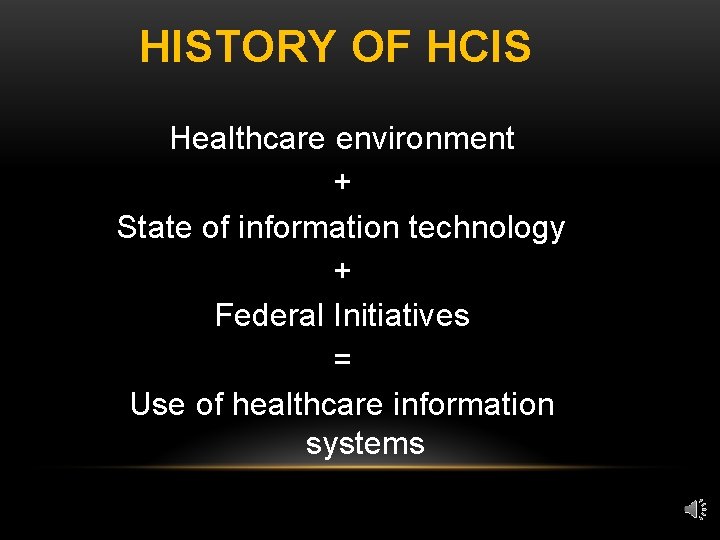
HISTORY OF HCIS Healthcare environment + State of information technology + Federal Initiatives = Use of healthcare information systems
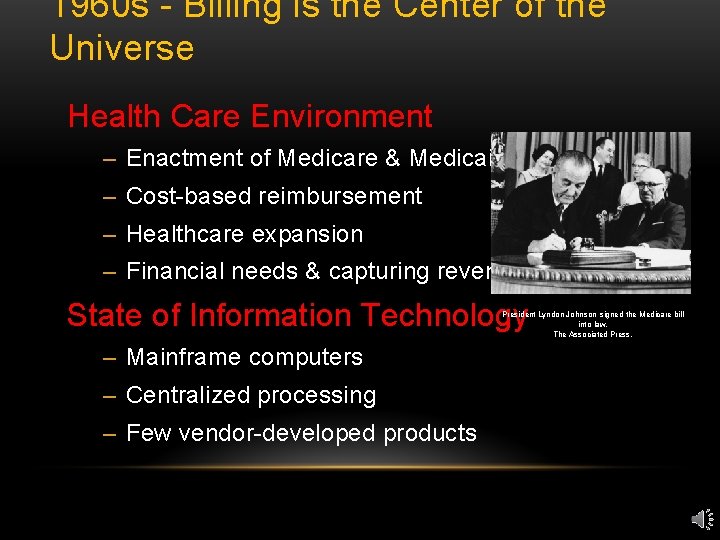
1960 s - Billing is the Center of the Universe Health Care Environment – Enactment of Medicare & Medicaid – Cost-based reimbursement – Healthcare expansion – Financial needs & capturing revenues State of Information Technology President Lyndon Johnson signed the Medicare bill into law. The Associated Press. – Mainframe computers – Centralized processing – Few vendor-developed products
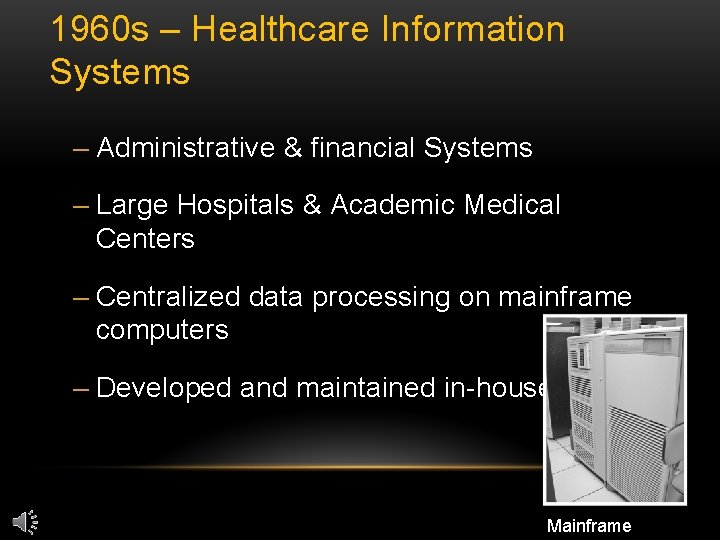
1960 s – Healthcare Information Systems – Administrative & financial Systems – Large Hospitals & Academic Medical Centers – Centralized data processing on mainframe computers – Developed and maintained in-house Mainframe
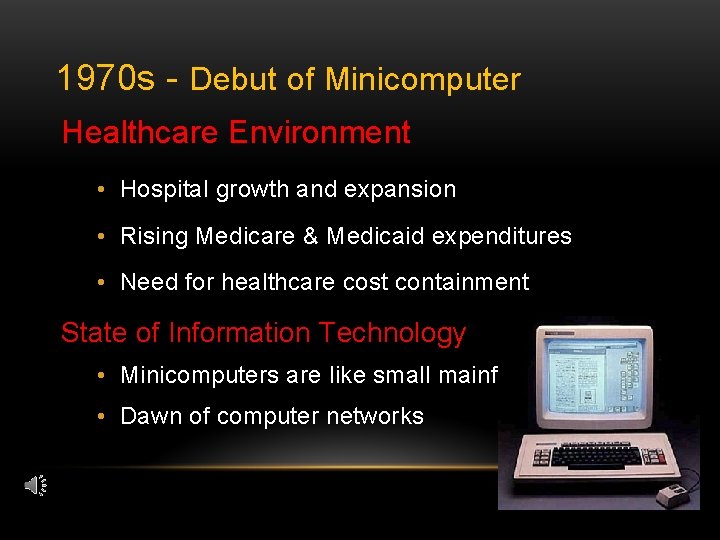
1970 s - Debut of Minicomputer Healthcare Environment • Hospital growth and expansion • Rising Medicare & Medicaid expenditures • Need for healthcare cost containment State of Information Technology • Minicomputers are like small mainframes • Dawn of computer networks
1970 s – Healthcare Information Systems – Turnkey systems available through vendor community – Increased interest in clinical applications – Information systems used to reduce costs – Shared systems still used
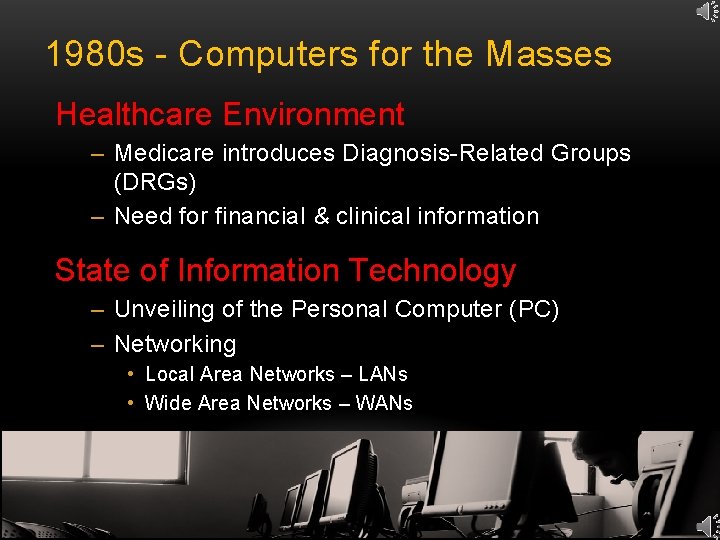
1980 s - Computers for the Masses Healthcare Environment – Medicare introduces Diagnosis-Related Groups (DRGs) – Need for financial & clinical information State of Information Technology – Unveiling of the Personal Computer (PC) – Networking • Local Area Networks – LANs • Wide Area Networks – WANs
1980 s – Healthcare Information Systems – Increased use of PCs – Decentralized data processing – Physician practices introduce billing systems – Expansion of clinical information systems in hospitals
1990 s - Advent of the World Wide Web Healthcare Environment • Growth of managed care & integrated delivery systems • Institute of Medicine (IOM) calls for “computer-based patient” rec State of Information Technology • Cost of hardware drops • Proliferation of the Internet • Unveiling of the World Wide Web • “Off-the-shelf” software
1990 s – Healthcare Information Systems – Health care organizations take advantage of Internet – Vendor community explodes – Wide range of HCIS products/services available – Growing implementation of clinical applications – Lack of adoption of Electronic Medical Record (EMR)
2000 s – A Call for Healthcare Reform Healthcare Environment • IOM reports on patient safety and medical errors • Spiraling healthcare costs • Economic upheaval and growing number of uninsured • The American Recovery and Reinvestment Act of 2009 • HITECH Act of 2009 • Office of the National Coordinator for HIT (ONC)
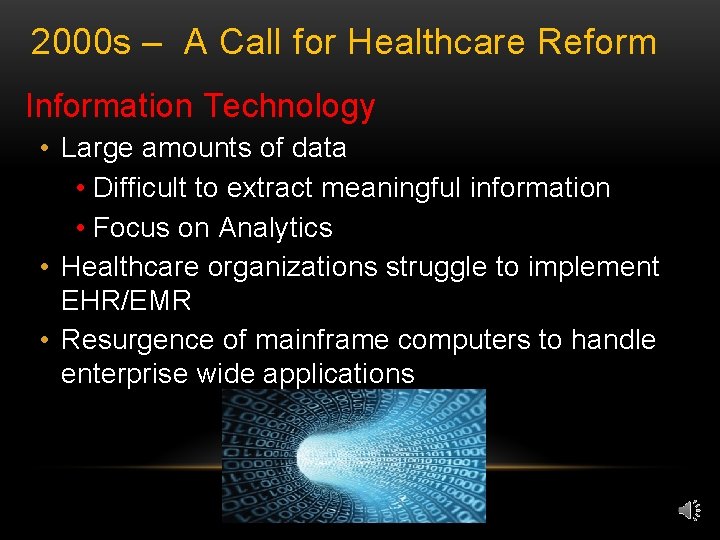
2000 s – A Call for Healthcare Reform Information Technology • Large amounts of data • Difficult to extract meaningful information • Focus on Analytics • Healthcare organizations struggle to implement EHR/EMR • Resurgence of mainframe computers to handle enterprise wide applications
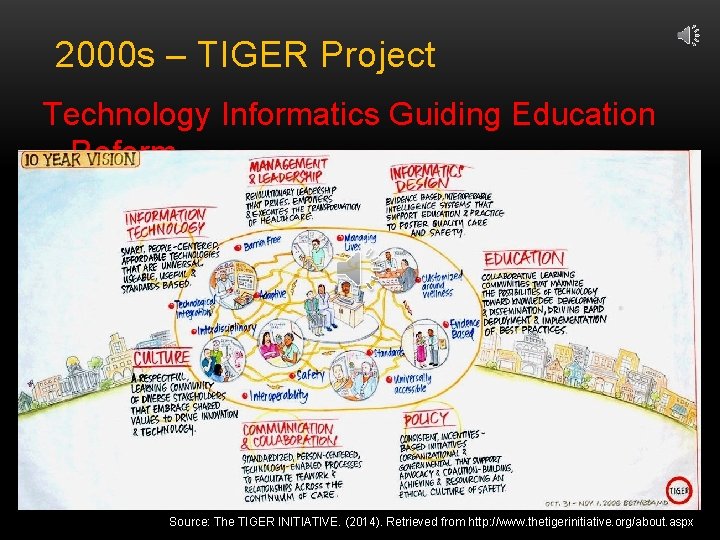
2000 s – TIGER Project Technology Informatics Guiding Education Reform Source: The TIGER INITIATIVE. (2014). Retrieved from http: //www. thetigerinitiative. org/about. aspx
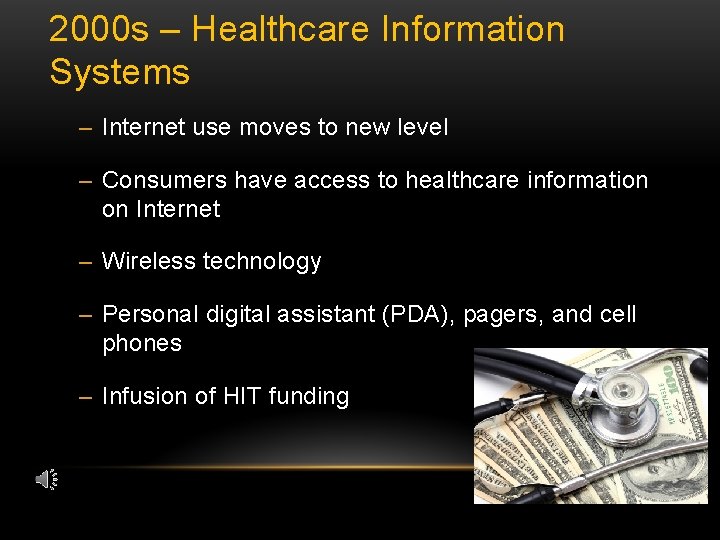
2000 s – Healthcare Information Systems – Internet use moves to new level – Consumers have access to healthcare information on Internet – Wireless technology – Personal digital assistant (PDA), pagers, and cell phones – Infusion of HIT funding
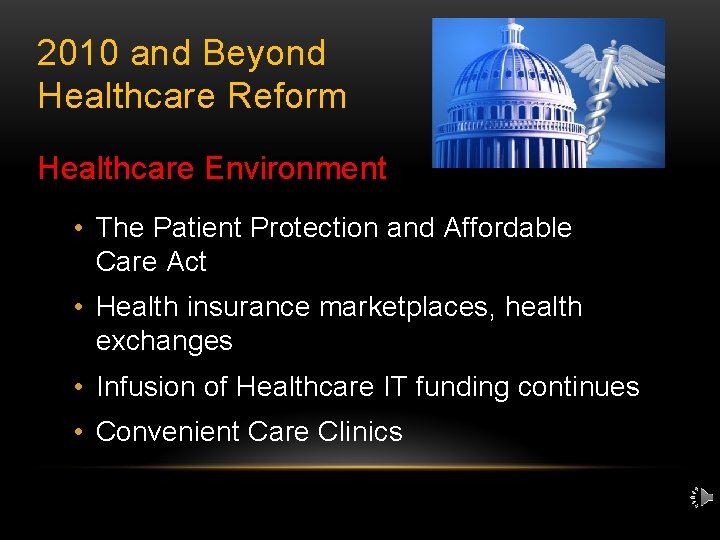
2010 and Beyond Healthcare Reform Healthcare Environment • The Patient Protection and Affordable Care Act • Health insurance marketplaces, health exchanges • Infusion of Healthcare IT funding continues • Convenient Care Clinics
2010 and Beyond Healthcare Reform Information Technology • Cloud computing • Applications, Storage, Infrastructure • “Smart” Devices • Phones, Cars, Appliances…
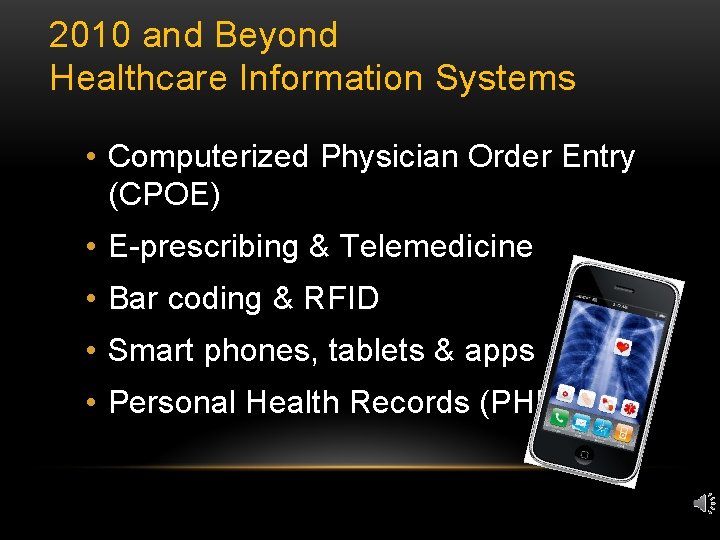
2010 and Beyond Healthcare Information Systems • Computerized Physician Order Entry (CPOE) • E-prescribing & Telemedicine • Bar coding & RFID • Smart phones, tablets & apps • Personal Health Records (PHR)
References • Ball, M. J. , & Hannah, K. J. (2011). Nursing informatics: Where technology and caring meet (4 th ed. ). London: Springer. • Department of Health and Human Services. (2001). Medicare hospital prospective payment system: How DRG rates are calculated and updated. Retrieved from https: //oig. hhs. gov/oei/reports/oei-09 -00 -00200. pdf • Hebda, T. L. , & Czar, P. (2012). Handbook of informatics for nurses & healthcare professionals (5 edition. ). Boston: Prentice Hall. • Institute of Medicine. (2001). Crossing the Quality Chasm: A New Health System for the 21 st Century. Washington, D. C. : National Academy Press. • Kohn, L. T. , Corrigan, J. , & Donaldson, M. S. (2000). To err is human: Building a safer health system. Washington, D. C: National Academy Press. • Poterba, J. M. (1998). Tax policy and the economy (Vol. 12). Cambridge MA: MIT Press. Retrieved from http: //www. nber. org/chapters/c 10911. pdf • Saba, V. , & Mc. Cormick, K. (2005). Essentials of nursing informatics (4 ed. ). New York: Mc. Graw-Hill Professional. • Waegeman, P. (2003). EHR vs. CPR vs. EMR. Health Informatics Online, 1– 4. Retrieved from http: //www. providersedge. com/ehdocs/ehr_articles/EHR_vs_CPR_vs_EMR. pdf. • http: //www. hhs. gov/ • www. healthit. gov
This work is licensed under a Creative Commons Attribution 4. 0 International License. Exceptions: 1) Materials identified as copyrighted or derived from another source. 2) Materials extracted from the Office of the National Coordinator (ONC) Health Information Technology Workforce Curriculum, which carries a more limited CC-BY SA license. Led by Bellevue College, the Health e. Workforce Consortium was formed to elevate Health Information Technology workforce development locally and nationally and provide career paths into this promising field for veterans and others. The nine-college consortium includes Bellevue College, Bellingham Technical College, Clark College, Clover Park Technical College, Northern Virginia Community College, Pierce College, Renton Technical College, Spokane Community College, and Whatcom Community College. The Health Information and Management Systems Society (HIMSS) is also a primary partner. This workforce solution is 100% funded by an $11. 7 m grant awarded by the U. S. Department of Labor's Employment and Training Administration. The solution was created by the grantee and does not necessarily reflect the official position of the U. S. Department of Labor. The Department of Labor makes no guarantees, warranties, or assurances of any kind, express or implied, with respect to such information, including any information on linked sites and including, but not limited to, accuracy of the information or its completeness, timeliness, usefulness, adequacy, continued availability or ownership.