
The Historicist Approach to Literature An approach to
- Slides: 12
The Historicist Approach to Literature An approach to the study of literature that highlights the importance of historical contexts in shaping the meaning of texts. For example, historicism acknowledges how texts engage with historical events as well as with other texts; it also acknowledges that readers often interpret texts in ways that confirm their own experiences and ideas.
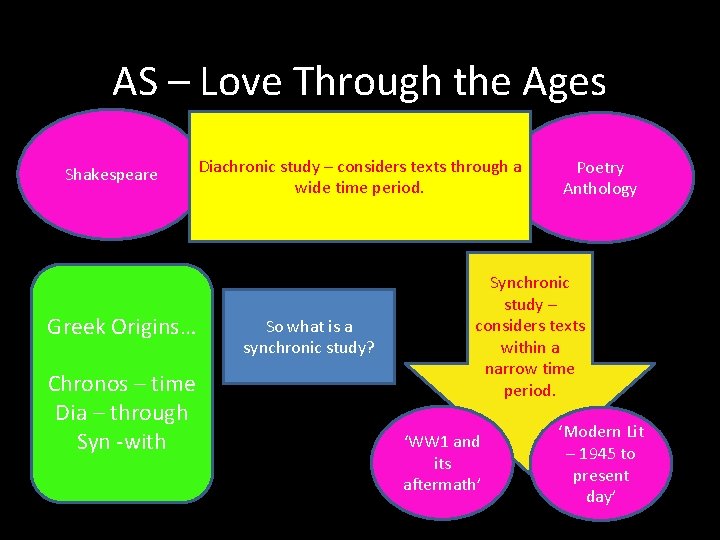
AS – Love Through the Ages Shakespeare Greek Origins… Chronos – time Dia – through Syn -with Diachronic study – considers texts through a wide time period. So what is a synchronic study? Poetry Anthology Synchronic study – considers texts within a narrow time period. ‘WW 1 and its aftermath’ ‘Modern Lit – 1945 to present day’
Subtext…? N E V O W How does this link the Historicist approach? What is underlying/going on beneath Text from the Latin textus Meaning. . ? So that next word we need to think about is…? _ _ _ TEXT CONTEXT Which assessment objectives? What goes with the text, how it connects to wider ideas, events and circumstances that shape its meaning.
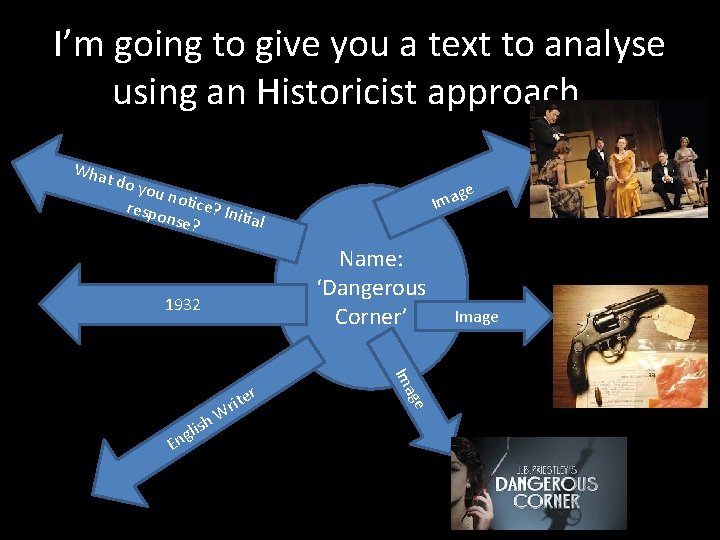
I’m going to give you a text to analyse using an Historicist approach… Wha t do y ou no respo tice? Ini tial nse? Name: ‘Dangerous Corner’ 1932 age ite r W Im r lish g En ge a Im Image
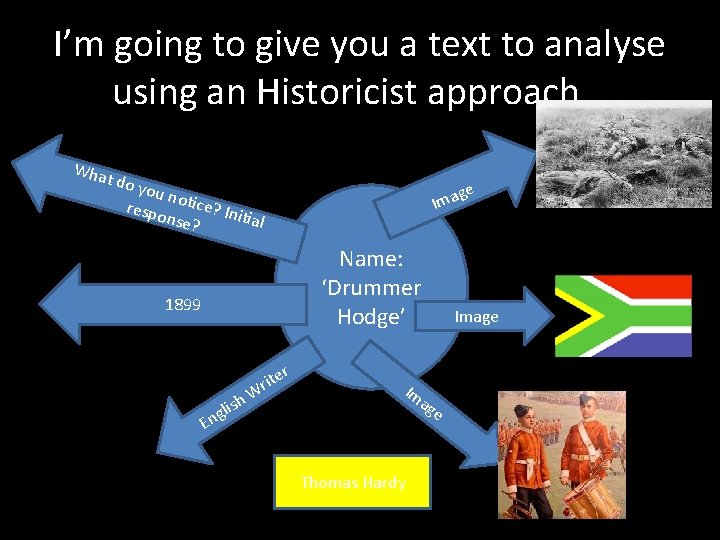
I’m going to give you a text to analyse using an Historicist approach… Wha t do y ou no respo tice? Ini tial nse? ge a Im Name: ‘Drummer Hodge’ 1899 r g En lish ite r W Im ag e Thomas Hardy Image
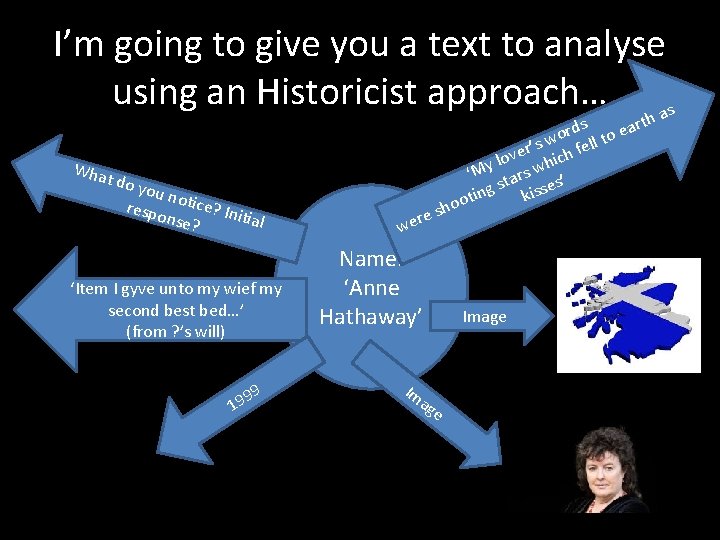
I’m going to give you a text to analyse using an Historicist approach… as Wha t do y ou no respo tice? Ini tial nse? ‘Item I gyve unto my wief my second best bed…’ (from ? ’s will) 99 19 rth s a d r e wo ell to s ’ r ve hich f o l ‘My tars w ’ g s kisses n i t oo h s e wer Name: ‘Anne Hathaway’ Im ag e Image
The History of English Literature is not just a chronological account of works written in the English Language. It is a record of the relationship between a writer and those who precede him or her; it is a record of the relationship between different ages; it records the rise, the growth and the decline of styles and movements; it is a record of the influence of individual writers upon their age, and vice versa. To understand a work of literature, we must understand the personal and wider forces which shaped it – i. e. the context and time it was written in.
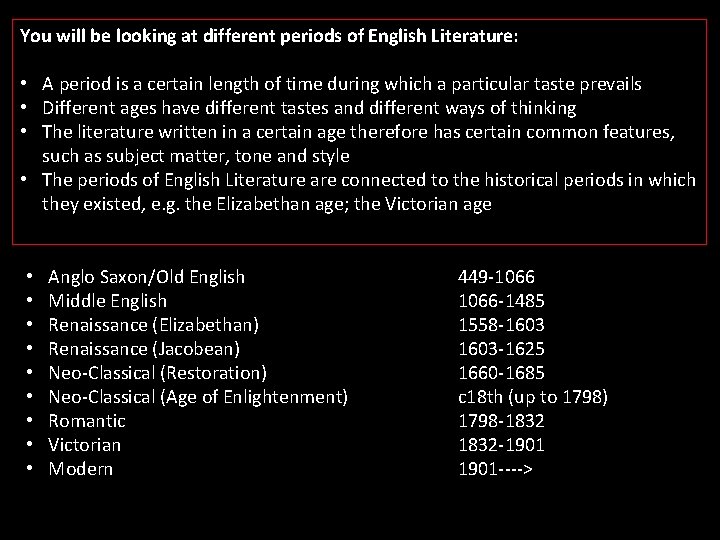
You will be looking at different periods of English Literature: • A period is a certain length of time during which a particular taste prevails • Different ages have different tastes and different ways of thinking • The literature written in a certain age therefore has certain common features, such as subject matter, tone and style • The periods of English Literature are connected to the historical periods in which they existed, e. g. the Elizabethan age; the Victorian age • • • Anglo Saxon/Old English Middle English Renaissance (Elizabethan) Renaissance (Jacobean) Neo-Classical (Restoration) Neo-Classical (Age of Enlightenment) Romantic Victorian Modern 449 -1066 -1485 1558 -1603 -1625 1660 -1685 c 18 th (up to 1798) 1798 -1832 -1901 ---->
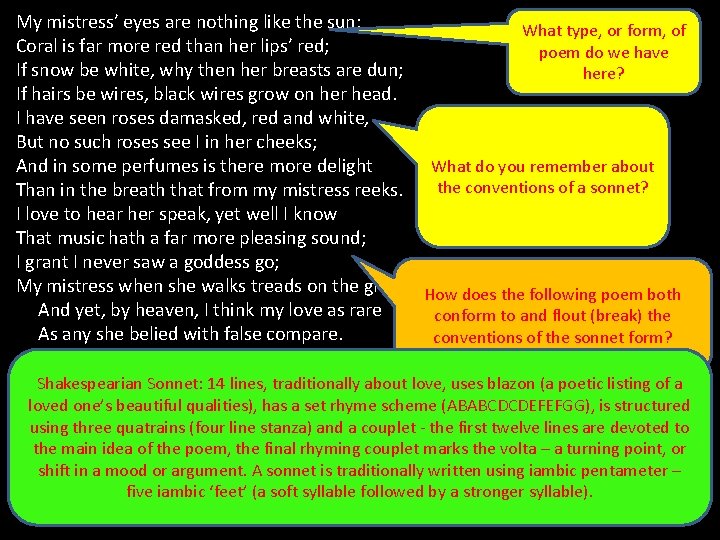
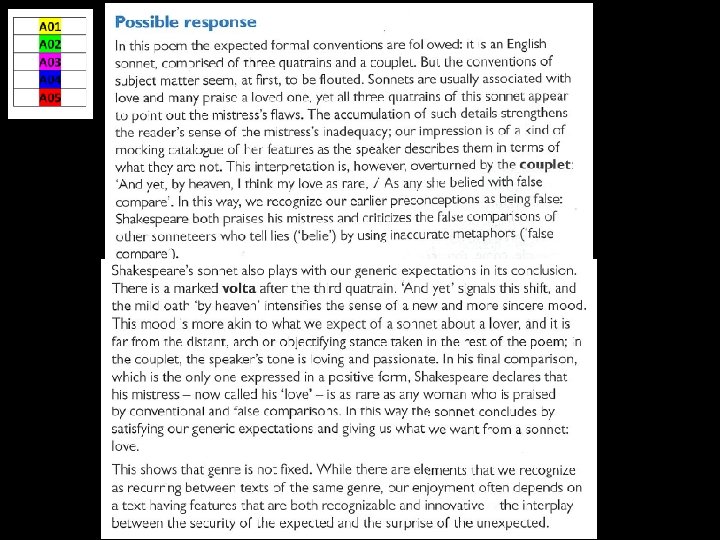
My mistress’ eyes are nothing like the sun; What type, or form, of Coral is far more red than her lips’ red; poem do we have If snow be white, why then her breasts are dun; here? If hairs be wires, black wires grow on her head. I have seen roses damasked, red and white, But no such roses see I in her cheeks; What do you remember about And in some perfumes is there more delight the conventions of a sonnet? Than in the breath that from my mistress reeks. I love to hear her speak, yet well I know That music hath a far more pleasing sound; I grant I never saw a goddess go; My mistress when she walks treads on the ground. How does the following poem both And yet, by heaven, I think my love as rare conform to and flout (break) the As any she belied with false compare. conventions of the sonnet form? Shakespearian Sonnet: 14 lines, traditionally about love, uses blazon (a poetic listing of a loved one’s beautiful qualities), has a set rhyme scheme (ABABCDCDEFEFGG), is structured using three quatrains (four line stanza) and a couplet - the first twelve lines are devoted to the main idea of the poem, the final rhyming couplet marks the volta – a turning point, or shift in a mood or argument. A sonnet is traditionally written using iambic pentameter – five iambic ‘feet’ (a soft syllable followed by a stronger syllable).
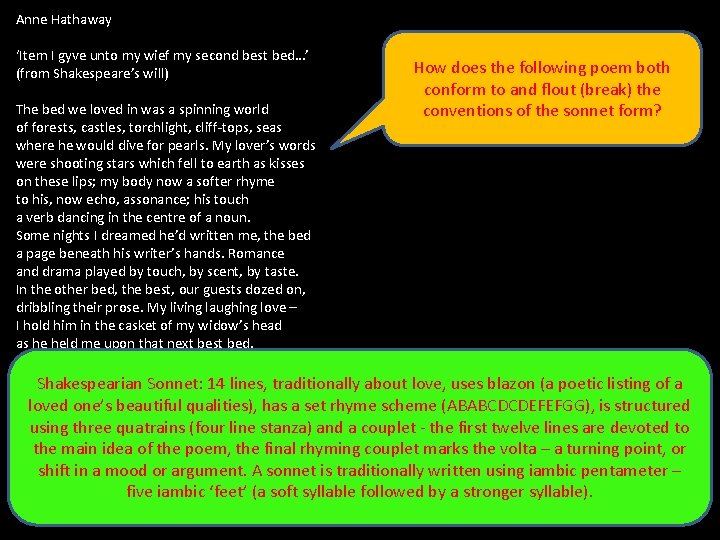
Anne Hathaway ‘Item I gyve unto my wief my second best bed…’ (from Shakespeare’s will) The bed we loved in was a spinning world of forests, castles, torchlight, cliff-tops, seas where he would dive for pearls. My lover’s words were shooting stars which fell to earth as kisses on these lips; my body now a softer rhyme to his, now echo, assonance; his touch a verb dancing in the centre of a noun. Some nights I dreamed he’d written me, the bed a page beneath his writer’s hands. Romance and drama played by touch, by scent, by taste. In the other bed, the best, our guests dozed on, dribbling their prose. My living laughing love – I hold him in the casket of my widow’s head as he held me upon that next best bed. How does the following poem both conform to and flout (break) the conventions of the sonnet form? Shakespearian Sonnet: 14 lines, traditionally about love, uses blazon (a poetic listing of a loved one’s beautiful qualities), has a set rhyme scheme (ABABCDCDEFEFGG), is structured using three quatrains (four line stanza) and a couplet - the first twelve lines are devoted to the main idea of the poem, the final rhyming couplet marks the volta – a turning point, or shift in a mood or argument. A sonnet is traditionally written using iambic pentameter – five iambic ‘feet’ (a soft syllable followed by a stronger syllable).
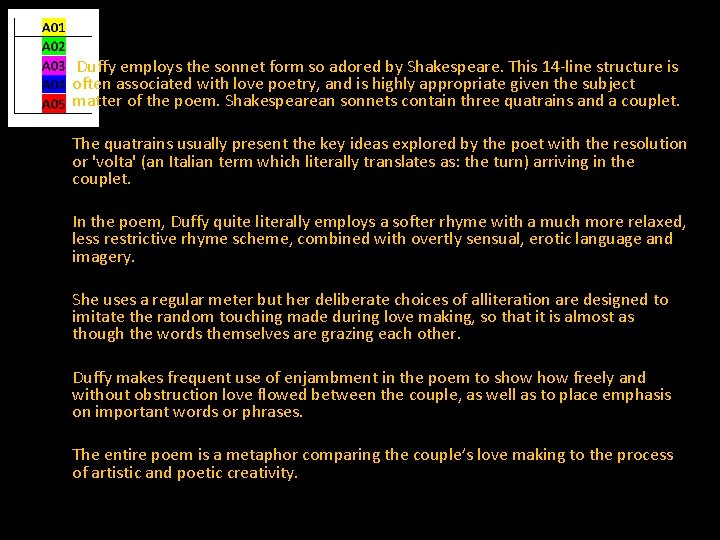
Duffy employs the sonnet form so adored by Shakespeare. This 14 -line structure is often associated with love poetry, and is highly appropriate given the subject matter of the poem. Shakespearean sonnets contain three quatrains and a couplet. The quatrains usually present the key ideas explored by the poet with the resolution or 'volta' (an Italian term which literally translates as: the turn) arriving in the couplet. In the poem, Duffy quite literally employs a softer rhyme with a much more relaxed, less restrictive rhyme scheme, combined with overtly sensual, erotic language and imagery. She uses a regular meter but her deliberate choices of alliteration are designed to imitate the random touching made during love making, so that it is almost as though the words themselves are grazing each other. Duffy makes frequent use of enjambment in the poem to show freely and without obstruction love flowed between the couple, as well as to place emphasis on important words or phrases. The entire poem is a metaphor comparing the couple’s love making to the process of artistic and poetic creativity.