
THE HISTORICAL PROCESS MIGRATION THE INDIGENOUS PEOPLE AND

- Slides: 26
THE HISTORICAL PROCESS MIGRATION THE INDIGENOUS PEOPLE AND THEIR PERSPECTIVES
THE HISTORICAL PROCESS When we speak of the Historical Process, we speak of the following themes: • MIGRATION • OPPRESSION • RESISTANCE
MIGRATION • Migration is the movement of people, from one place, region or country to another with the intention of making permanent settlement in a new location. • Throughout the history of the Caribbean, many groups of people have moved into, within and out of the region. • These groups have left their cultural and social impact on the history of the Caribbean.
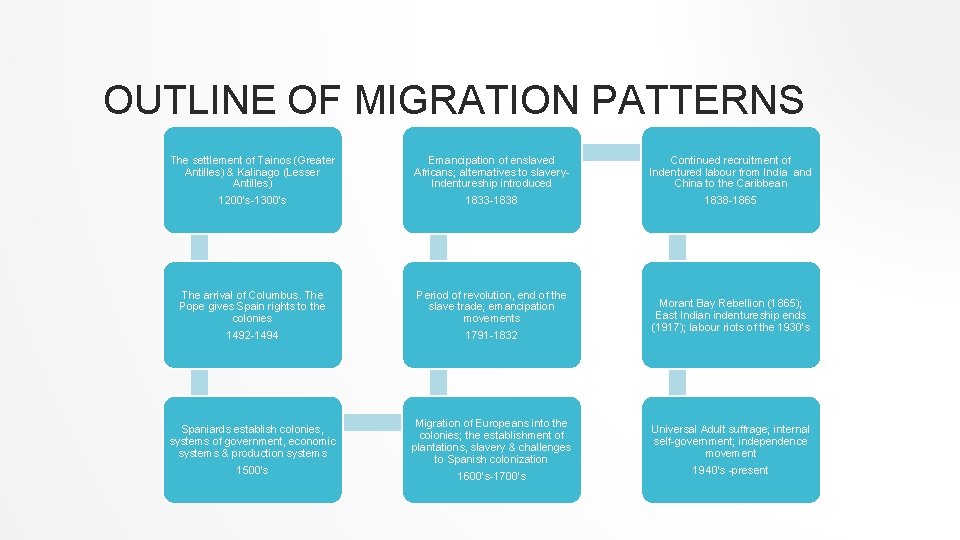
OUTLINE OF MIGRATION PATTERNS The settlement of Tainos (Greater Antilles) & Kalinago (Lesser Antilles) Emancipation of enslaved Africans; alternatives to slavery. Indentureship introduced Continued recruitment of Indentured labour from India and China to the Caribbean 1200’s-1300’s 1833 -1838 -1865 The arrival of Columbus. The Pope gives Spain rights to the colonies Period of revolution, end of the slave trade; emancipation movements 1492 -1494 1791 -1832 Spaniards establish colonies, systems of government, economic systems & production systems 1500’s Migration of Europeans into the colonies; the establishment of plantations, slavery & challenges to Spanish colonization 1600’s-1700’s Morant Bay Rebellion (1865); East Indian indentureship ends (1917); labour riots of the 1930’s Universal Adult suffrage; internal self-government; independence movement 1940’s -present
MAJOR ETHNIC GROUPS Amerindians Europeans Africans Other Europeans East Indians Chinese Syrians, Lebanese, Jews
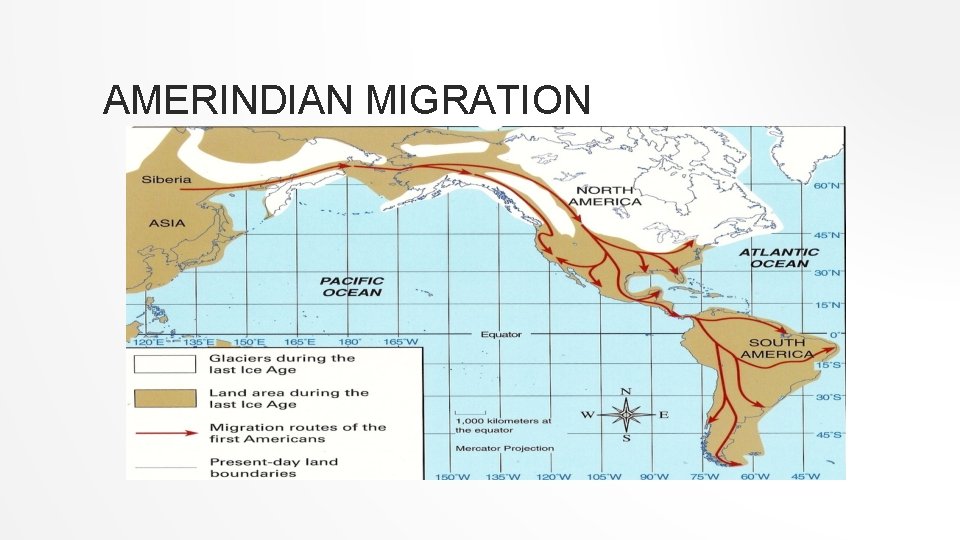
AMERINDIAN MIGRATION
THE AMERINDIAN MIGRATION • It is generally believed that the migration of the Amerindians took place in waves. In this video we will see that the first wave came from north-east Asia and migrated along the seacoast of the Bering Strait into the Americas. The second wave came thousands of years later as the ice melted and created a pathway on the mainland. It is believed that these were two distinctive groups and were probably from different parts of Asia. • https: //www. youtube. com/watch? v=E_k 9 u. E 6 vrb 8
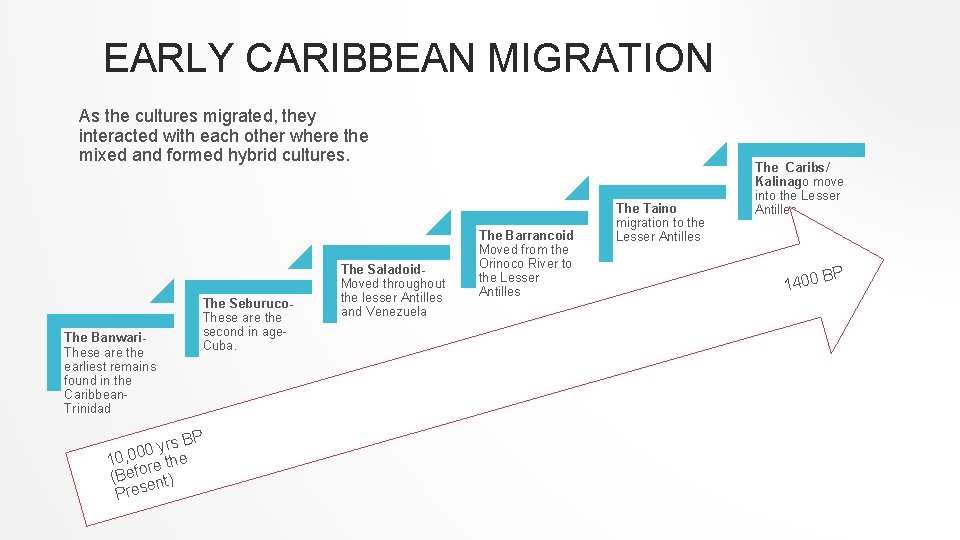
EARLY CARIBBEAN MIGRATION • In the Caribbean region, archaeologist have found some of the earliest remains of Archaic people in both Trinidad and Cuba. It is believed that these early inhabitants entered the Caribbean through Central and South America and maybe even Florida. • It is also believed that some of the earliest people lived in the Greater Antilles and the Lesser Antilles at least 5000 years before the migration of other groups into the region. • These groups were different from each other and had their distinctive styles of pottery, ornamentation, beliefs, diets etc. • This supports the claims, as seen in video, that the Amerindians migrated in waves, thousands of years apart from each other.
EARLY CARIBBEAN MIGRATION As the cultures migrated, they interacted with each other where the mixed and formed hybrid cultures. The Banwari. These are the earliest remains found in the Caribbean. Trinidad The Seburuco. These are the second in age. Cuba. s BP r y 0 0 10, 0 re the (Befo nt) e Pres The Saladoid. Moved throughout the lesser Antilles and Venezuela The Barrancoid Moved from the Orinoco River to the Lesser Antilles The Taino migration to the Lesser Antilles The Caribs/ Kalinago move into the Lesser Antilles P B 1400
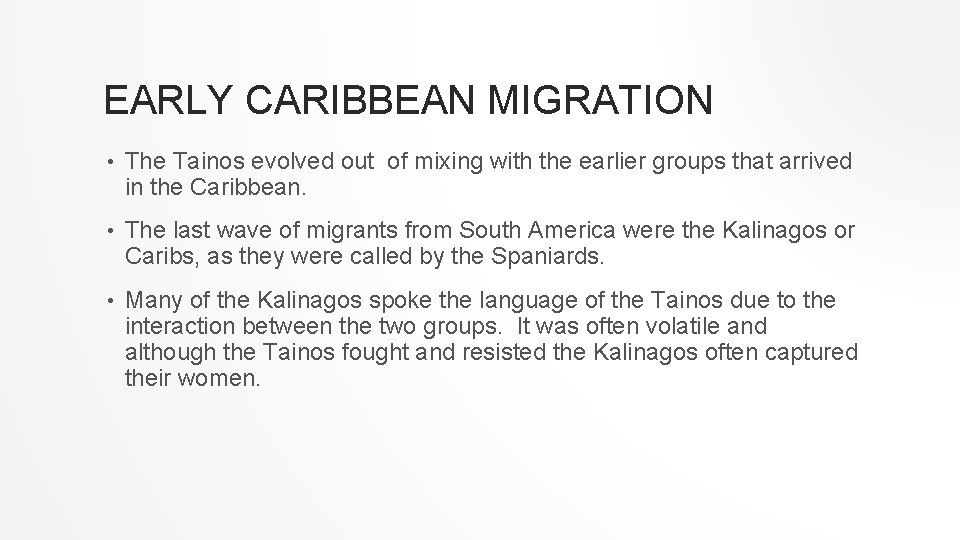
EARLY CARIBBEAN MIGRATION • The Tainos evolved out of mixing with the earlier groups that arrived in the Caribbean. • The last wave of migrants from South America were the Kalinagos or Caribs, as they were called by the Spaniards. • Many of the Kalinagos spoke the language of the Tainos due to the interaction between the two groups. It was often volatile and although the Tainos fought and resisted the Kalinagos often captured their women.
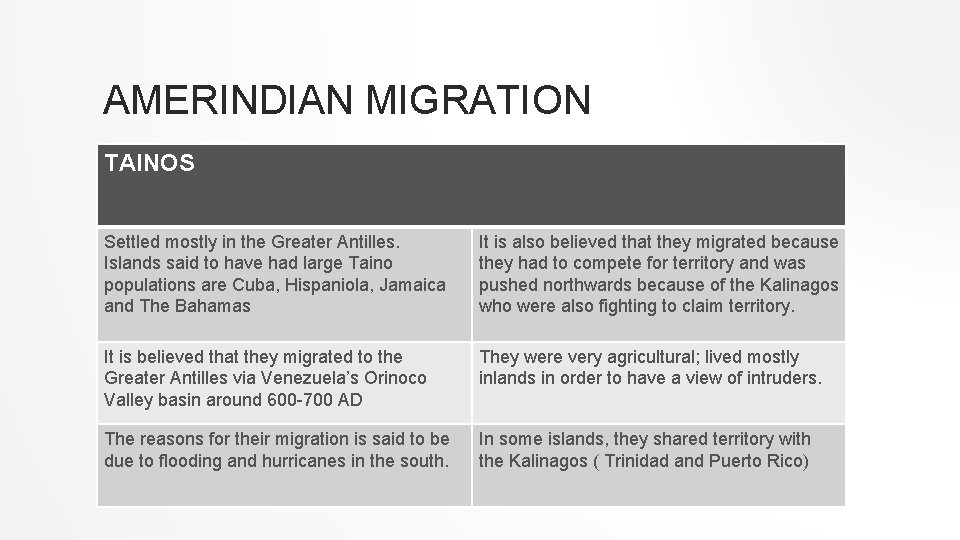
AMERINDIAN MIGRATION TAINOS Settled mostly in the Greater Antilles. Islands said to have had large Taino populations are Cuba, Hispaniola, Jamaica and The Bahamas It is also believed that they migrated because they had to compete for territory and was pushed northwards because of the Kalinagos who were also fighting to claim territory. It is believed that they migrated to the Greater Antilles via Venezuela’s Orinoco Valley basin around 600 -700 AD They were very agricultural; lived mostly inlands in order to have a view of intruders. The reasons for their migration is said to be due to flooding and hurricanes in the south. In some islands, they shared territory with the Kalinagos ( Trinidad and Puerto Rico)
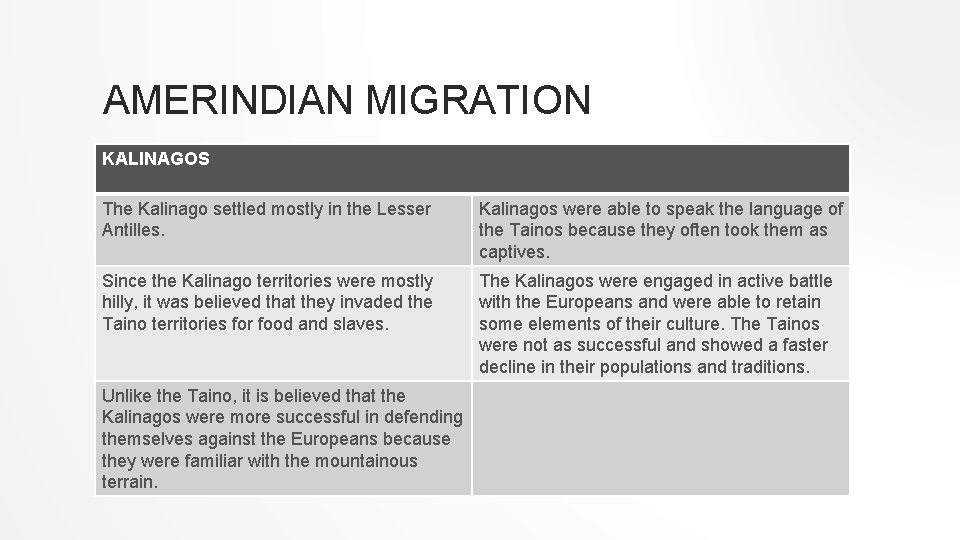
AMERINDIAN MIGRATION KALINAGOS The Kalinago settled mostly in the Lesser Antilles. Kalinagos were able to speak the language of the Tainos because they often took them as captives. Since the Kalinago territories were mostly hilly, it was believed that they invaded the Taino territories for food and slaves. The Kalinagos were engaged in active battle with the Europeans and were able to retain some elements of their culture. The Tainos were not as successful and showed a faster decline in their populations and traditions. Unlike the Taino, it is believed that the Kalinagos were more successful in defending themselves against the Europeans because they were familiar with the mountainous terrain.
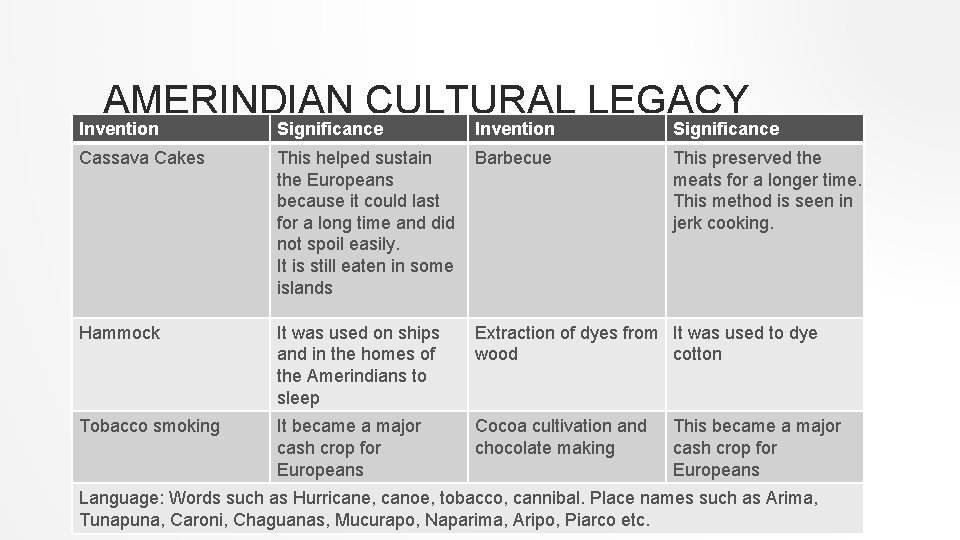
AMERINDIAN CULTURAL LEGACY Invention Significance Cassava Cakes This helped sustain the Europeans because it could last for a long time and did not spoil easily. It is still eaten in some islands Barbecue This preserved the meats for a longer time. This method is seen in jerk cooking. Hammock It was used on ships and in the homes of the Amerindians to sleep Extraction of dyes from It was used to dye wood cotton Tobacco smoking It became a major cash crop for Europeans Cocoa cultivation and chocolate making This became a major cash crop for Europeans Language: Words such as Hurricane, canoe, tobacco, cannibal. Place names such as Arima, Tunapuna, Caroni, Chaguanas, Mucurapo, Naparima, Aripo, Piarco etc.
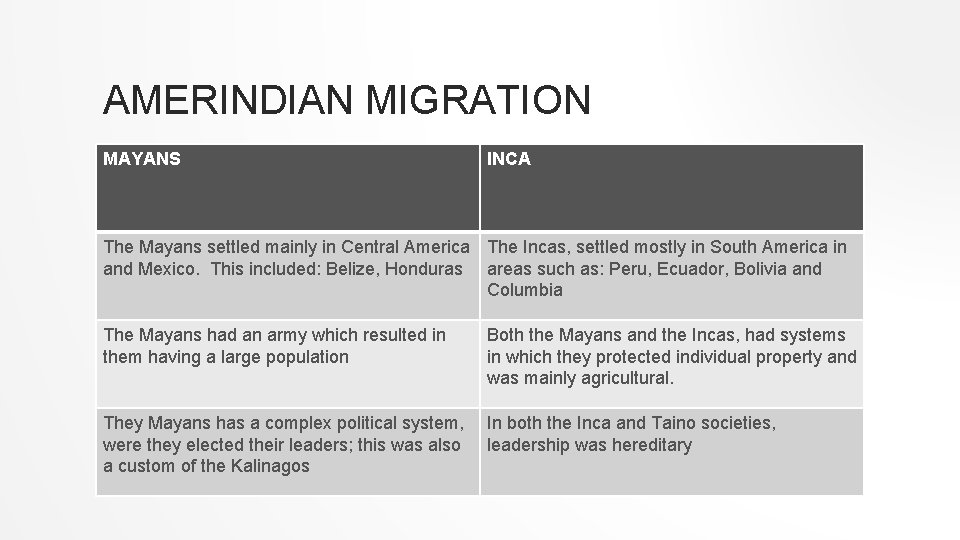
AMERINDIAN MIGRATION MAYANS INCA The Mayans settled mainly in Central America The Incas, settled mostly in South America in and Mexico. This included: Belize, Honduras areas such as: Peru, Ecuador, Bolivia and Columbia The Mayans had an army which resulted in them having a large population Both the Mayans and the Incas, had systems in which they protected individual property and was mainly agricultural. They Mayans has a complex political system, were they elected their leaders; this was also a custom of the Kalinagos In both the Inca and Taino societies, leadership was hereditary
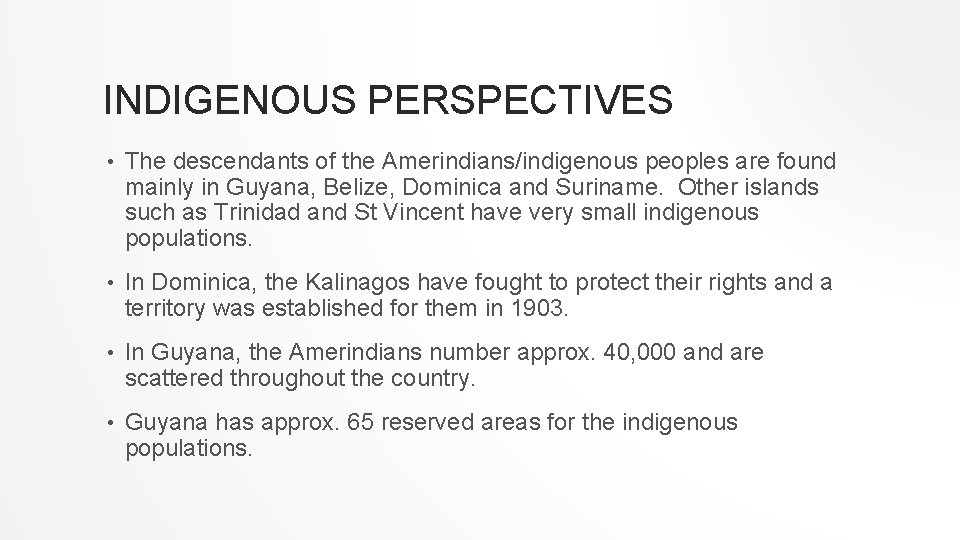
INDIGENOUS PERSPECTIVES • The descendants of the Amerindians/indigenous peoples are found mainly in Guyana, Belize, Dominica and Suriname. Other islands such as Trinidad and St Vincent have very small indigenous populations. • In Dominica, the Kalinagos have fought to protect their rights and a territory was established for them in 1903. • In Guyana, the Amerindians number approx. 40, 000 and are scattered throughout the country. • Guyana has approx. 65 reserved areas for the indigenous populations.
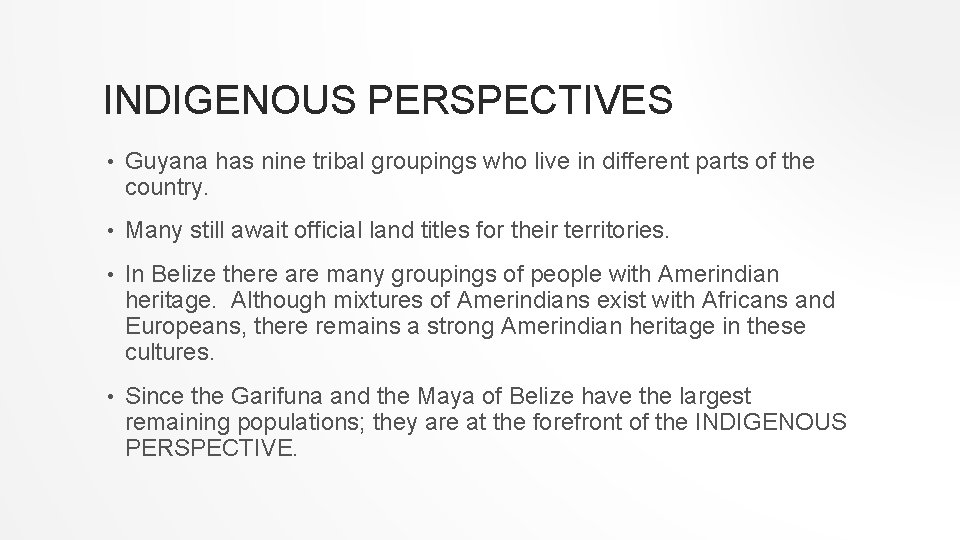
INDIGENOUS PERSPECTIVES • Guyana has nine tribal groupings who live in different parts of the country. • Many still await official land titles for their territories. • In Belize there are many groupings of people with Amerindian heritage. Although mixtures of Amerindians exist with Africans and Europeans, there remains a strong Amerindian heritage in these cultures. • Since the Garifuna and the Maya of Belize have the largest remaining populations; they are at the forefront of the INDIGENOUS PERSPECTIVE.
INDIGENOUS PERSPECTIVES- ISSUES • They believe that the narrative that the indigenous population is extinct, or that they are small surviving population that is not pure is a myth put forward by the Europeans. • They believe that this myth justified the actions of European capitalists to move into their ancestral territory and establish industries such as mining and timber. • Those of mixed Amerindian heritage were discriminated against and were made to diminish their Amerindian heritage.
INDIGENOUS PERSPECTIVES-ISSUES • The current statistics on the current Amerindian population are flawed because many Amerindians do not claim their heritage because of stereotypes: lazy dirty, backward etc. • History texts have portrayed Amerindians as submissive and passive except for the Kalinagos who were warlike and cannibals. This too provided the Europeans with the justification to kill and enslave these populations. • The historical accounts of Amerindian resistance are omitted from textbooks. The accounts of Dutch and Amerindian collaborations to oust the Spanish are not talk about.
INDIGENOUS PERSPECTIVES-ISSUES • The indigenous peoples of the Caribbean tend to be most marginalized since they are overlooked socially, politically and economically. In Guyana, for example, they refer to themselves as Afro-Guyanese, Indo-Guyanese but do not readily include the Amerindian. • Due to the strong Amerindian alignment with their culture, they are not seen as true Guyanese. • Most Amerindians live in poverty and lack many amenities. • They often have few opportunities to pursue secondary education since they marry early and have large families.
INDIGENOUS PERSPECTIVES-ISSUES • There is often a high drop-out rate amongst the indigenous population, this further limits their prospects for accumulating wealth and perpetuates the perception that they are not responsible with money. • It is in light of all these highlighted issues that we have activism within the indigenous communities. Thus, when we think of the indigenous perspective, we must also think about activism. They have formed pressure groups in various communities in order to bring about social and political change in the areas mentioned.
INDIGENOUS PERSPECTIVES- LAND RIGHTS-ACTIVISM • Indigenous peoples have been forced to defend their territories or fight for the rights to their ancestral lands. They have had to face political opposition and in some cases they have had to submit to the national laws e. g. Dominica • They have had to defend their territories from capitalists and governments wanting to exploit their resources. In Guyana they formed the Touchau’s Amerindian Council e. g. Guyana • They have had to fight to get the legal claims to their lands e. g. Guyana. • The Guyanese were forced to recognize the inequalities against the indigenous people before the UN in 2006.
INDIGENOUS PERSPECTIVESACTIVISM • The continued discrimination, marginalization and disrespect shown to the indigenous communities have resulted in more Amerindians becoming organized. • They have developed many pressure groups to highlight the problems faced by the population. Some groups include: The Amerindian Peoples Association (APA); The Rainforest Foundation; The Amerindian Legal Services Centre • The have petitioned the international community to recognize their struggle for recognition, equity in job opportunities and respect for their spiritual heritage and land rights.
THE TAINO HTTPS: //WWW. YOUTUBE. COM/WATCH? V=DMKPORC 6 PUW • See link above
INDIGENOUS PERSPECTIVE: ACTIVISM HTTPS: //WWW. YOUTUBE. COM/WATCH? V=KI 89 FHQVRF 0 • See Link Above
ARTICLES ON ACTIVISM IN THE CARIBBEAN • https: //www. culturalsurvival. org/publications/cultural-survivalquarterly/caribs-dominica-land-rights-and-ethnic-consciousness • https: //www. stabroeknews. com/2018/10/17/opinion/letters/twentyyears-on-akawaio-and-arecuna-peoples-still-fighting-for-land-rightsin-upper-mazaruni/print/