
THE HIPPIES NOW WHERE BLACK CRASS UK ANARCHOPUNK
THE HIPPIES NOW WHERE BLACK CRASS & UK ANARCHO-PUNK

CRASS Centered around the work of the band Crass, anarcho-punk asserted a belief in the politics and practice of punk ‘as it was always supposed to have been’ – autonomous, subversive and free from commercial corruption. Embracing the politics of anarchism, anti-militarism and pacifism, Crass worked to popularize the notion of a consciously revolutionary punk rock culture.
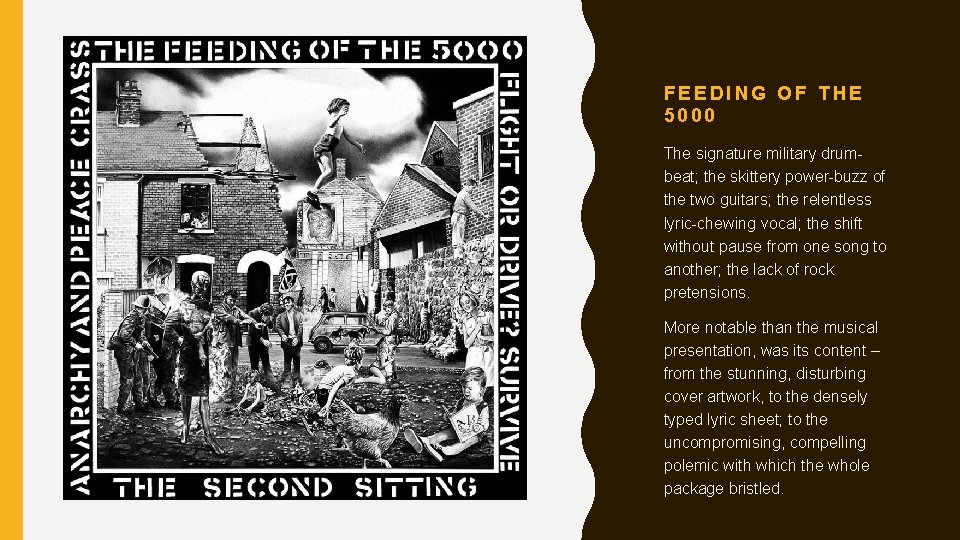
FEEDING OF THE 5000 The signature military drumbeat; the skittery power-buzz of the two guitars; the relentless lyric-chewing vocal; the shift without pause from one song to another; the lack of rock pretensions. More notable than the musical presentation, was its content – from the stunning, disturbing cover artwork, to the densely typed lyric sheet; to the uncompromising, compelling polemic with which the whole package bristled.
PUNK IS DEAD Yes that's right, punk is dead, It's just another cheap product for the consumers head. Bubblegum rock on plastic transistors, Schoolboy sedition backed by big time promoters. CBS promote the Clash, But it ain't for revolution, it's just for cash. Punk became a fashion just like hippy used to be And it ain't got a thing to do with you or me. Movements are systems and systems kill. Movements are expressions of the public will. Punk became a movement cos we all felt lost, But the leaders sold out and now we all pay the cost […]
DIFFERENT KIND OF PUNK • Crass’s reconciliation of punk and hippy cultures • A reclamation of what were seen as common principles — a rejection of crushing social conformity; of miserable wage-labour; of war and militarism; and a celebration of freedom, both collective and individual.
AUTONOMY • Anarcho-punk reclaimed the notion of punk autonomy – rejecting all approaches from the pop industry, establishing in their place the movement’s own record labels and distribution networks; working directly and collaboratively, without agents or intermediaries, to set up tours, produce publications and record music. Remarkably, none of the bands whose reputation gave them a national, and indeed international, profile broke this self-imposed embargo to “sell-out” to the majors.
TRULY DIY: RETHINKING WHAT A ‘BAND’ DOES • All aspects of the group’s work, from its appearance on stage, the packaging of its records. to the band’s relationship to its ‘fans’ were subject to a political critique which, it is claimed, tried to subvert usual rock’n’roll conventions, to reclaim what were seen as the essentials of ‘punk’. • Messages of anarchy, peace and love were now delivered in anguished howls, over distorted guitar riffs and thundering drum beats, by bands who sought to honour the principles of ‘do-ityourself (DIY) punk’ in every aspect of their work – records were stamped with the instruction to ‘pay no more than’ the breakeven price fixed by the band; concert tickets were sold for the barest minimum; all of the affectations and decadence of the rockstar lifestyle were shunned; and genuine efforts made to minimize the gap between performer and audience. • A defining feature of anarcho-punk was the refusal to co-operate with the established music industry on all levels.
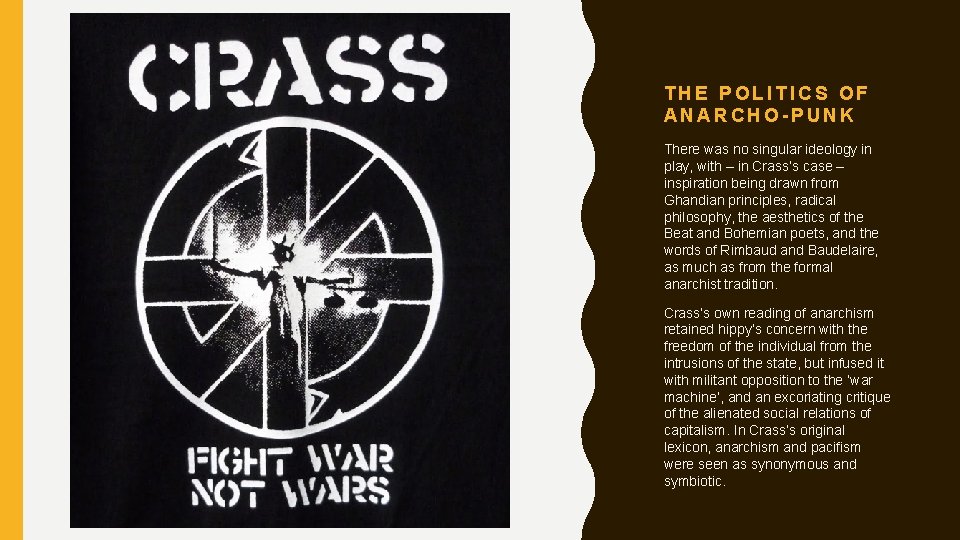
THE POLITICS OF ANARCHO-PUNK There was no singular ideology in play, with – in Crass’s case – inspiration being drawn from Ghandian principles, radical philosophy, the aesthetics of the Beat and Bohemian poets, and the words of Rimbaud and Baudelaire, as much as from the formal anarchist tradition. Crass’s own reading of anarchism retained hippy’s concern with the freedom of the individual from the intrusions of the state, but infused it with militant opposition to the ‘war machine’, and an excoriating critique of the alienated social relations of capitalism. In Crass’s original lexicon, anarchism and pacifism were seen as synonymous and symbiotic.
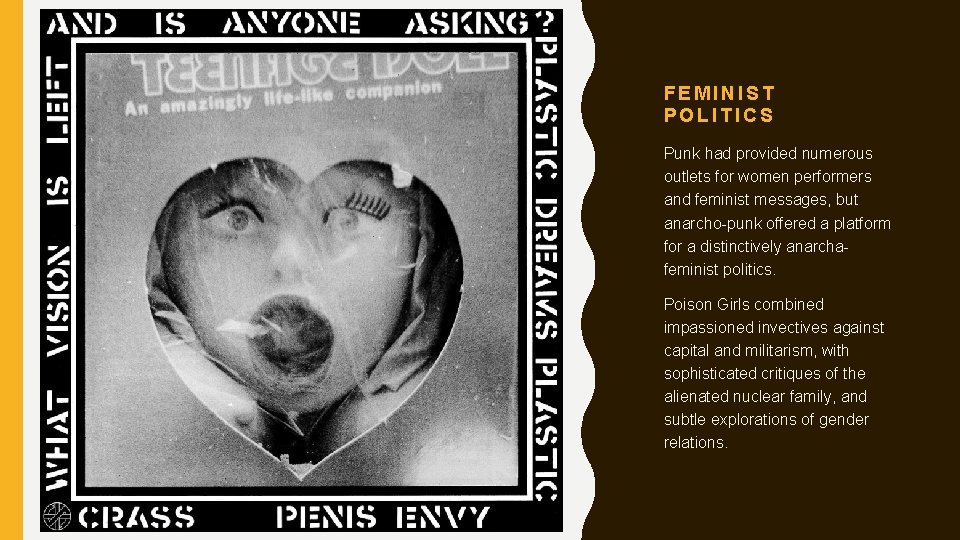
FEMINIST POLITICS Punk had provided numerous outlets for women performers and feminist messages, but anarcho-punk offered a platform for a distinctively anarchafeminist politics. Poison Girls combined impassioned invectives against capital and militarism, with sophisticated critiques of the alienated nuclear family, and subtle explorations of gender relations.
COMPLICATING/COMPLICATED POLITICS • The complications of Crass’s own political position, and by extension that of anarchopunk, were acute. Explored in the extended essays of Crass’s 1982 book, A Series of Shock Slogans and Mindless Token Tantrums, the politics of anarcho-punk emerge as an interplay between nonviolence, counter-culturalism, spartan anti-consumerism and the exploration of personal liberty that might provide the supportive context for a relentless struggle against the forces of capital and the war state. • Criticized by some anarchist opponents as a confusion of revolutionary perspectives with the ‘politics of lifestyle’, anarcho-punk was premised on the adoption of radical practices in the personal lives of its adherents – co-operative and communal living, notfor-profit publishing and artistry, squatting, re-appropriation – that could together help generalize the culture of disobedience and direct action.
POLITICS CONTINUED • By 1984, as many anarcho-punk benefits were concerned with raising money and support for striking miners as for anti-nuclear causes, and the peace movement’s conflict with the nuclear state was itself seen as developing an increasingly revolutionary logic. Committed anarchopunks ran with the hunt saboteurs, whilst denouncing the military and economic imperialism of the USA; they organized public fasts against world hunger, while they prepared clandestine spray-paint attacks on army recruitment offices. What kept the movement connected was the shared subculture of gigs, records and fanzines, not the diktats of any central organizing committee, or ultimately the pronouncements of Crass. Anarcho-punk’s politics remained a moving target. • For critics and supporters alike, even as the movement’s manifestos evolved, they remained frustratingly imprecise. It was a politics that left the movement noticeably separated from both the anti-militarist and anarchist traditions that it initially hoped to fuse. • Of necessity, much of anarcho-punk’s political identity was defined in oppositional terms.
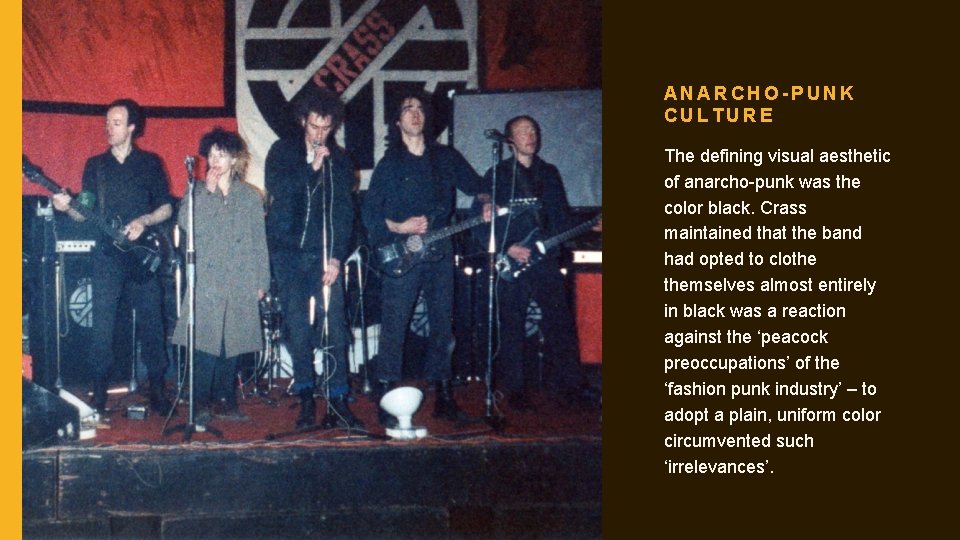
ANARCHO-PUNK CULTURE The defining visual aesthetic of anarcho-punk was the color black. Crass maintained that the band had opted to clothe themselves almost entirely in black was a reaction against the ‘peacock preoccupations’ of the ‘fashion punk industry’ – to adopt a plain, uniform color circumvented such ‘irrelevances’.
CULTURE CONTINUED • Although the similarity of appearance sometimes offered anonymity in the cut and thrust of a lively street march, police forces quickly recognized the hallmark of the new anarchist contingent, and responded accordingly. • Critics mused on the apparent irony of ‘uniform anarchists’ urging the freedom of all from imposed rules (while Crass countered that this was both a trivial observation and a misrepresentation). And yet the dress sense of anarcho-punks – however unmissable it remained – was actually one of the least significant aspects of the movement’s culture. • Far more important was the sub cultural expectation of co-operation and self-activity.

SKIP TO PAGE 10
- Slides: 14