
The Himalayan Tradition of Yoga Meditation Night Birds
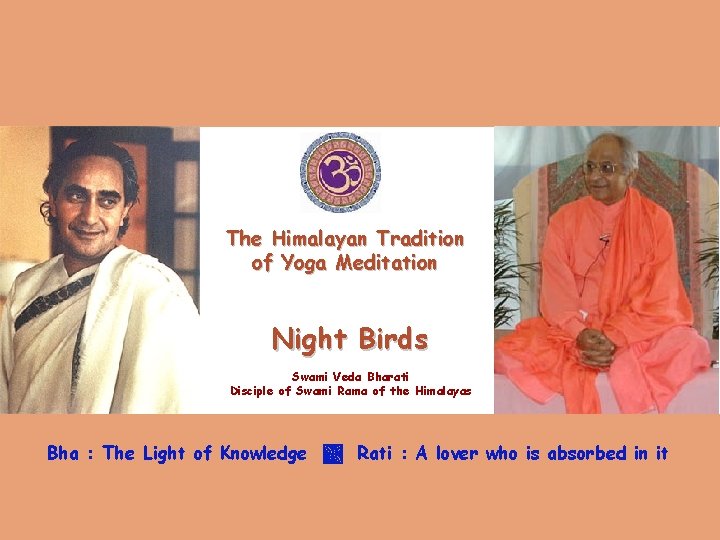
The Himalayan Tradition of Yoga Meditation Night Birds Swami Veda Bharati Disciple of Swami Rama of the Himalayas Bha : The Light of Knowledge Rati : A lover who is absorbed in it
The Himalayan Tradition of Yoga Meditation – Chief Component 1. Purification of thoughts and emotions : Practice purifications v Yamas m Non-violence m Truthfulness m Non-stealing m Abstinence from sexual indulgence m Non-possessiveness v Niyamas m Purity m Contentment m Practices for perfection of body, mind and senses m Study for knowledge of the self m Surrender to ultimate reality v Brahma-viharas m Friendliness towards the happy m Compassion for the unhappy m Delight in virtuous m Indifference towards the wicked ……. . Cont/d Swami Rama presented this tradition in its scientific format
The Himalayan Tradition of Yoga Meditation – Chief Component 1. Purification of thoughts and emotions : Practice purifications v Antidotes to disturbing thoughts : Prati-paksha-bhavana m Ward off thoughts opposed to yama, niyama and brahma-viharas v Conquest of Vikshepas : Disturbances m Sickness m Mental laziness m Doubt m Lack of enthusiasm m Sloth m Craving for sense pleasure m False perception m Despair m Unsteadiness in the concentration and Ó Accompaniments ¶ Grief ¶ Despondency ¶ Trembling of body ¶ Irregular breathing
The Himalayan Tradition of Yoga Meditation – Chief Component 2. Mindfulness : Practice smrty-upa-sthana v A deep self observation, in all states of body, breath and the mind 3. Breath Awareness : 1 st step in the Practice of Meditation v Diaphragmatic breathing m Slow m Smooth m Without jerks m Without break in between breaths Breath awareness branches of to ¶ Nadi-shodhana ¶ Pratyahara ¶ Kundalini breathing ¶ Sa-garbha pranayama The first meditative tradition
The Himalayan Tradition of Yoga Meditation – Chief Component 4. Japa : Understanding of sound vibrations v Nine major stages of mantra practice m With the awareness of the breath flow m While performing daily tasks m Listening to one’s mantra in the mind / anhata chakra m With sumeru breathing m Merging the mantra into the dot of the bija of a given chakra, then observing it emerge from there again m Merging the mantra into the mind‘s chamber of silence and then observing it emerge again from the silence m Merging the mantra into the interior sound in the Cave of the bees, bhramara guha, again experiencing its re-emergence m Using the mantra in the mental worship in the interior temples, manasa-puja m Contemplating the meaning of mantra and unifying that with ¶ Manana ¶ Internal dialogue m Using the mantra as bhakti experience Most comprehensive, integral and all-inclusive
The Himalayan Tradition of Yoga Meditation – Chief Component 5. Shavasana : Enter one’s own subtle body. v May be used to m m m Replace sleep Heal oneself learn, discover, plan and solve Master the art of dying Enter Samadhi 6. Dharana : Concentrations, Pra-vrttis v Various methods of concentration m On various focal points in physical body m At the chakra points m In the tattvas m As listed in Vijnana-bhairava (100 ways) and Malini-vijayottara-tantra (1300 ways). Even if not practised know the ins and outs Given birth to major meditative traditions of the world
The Himalayan Tradition of Yoga Meditation – Chief Component 7. Dhyana : Meditation proper v Begins at the level of manomaya kosha. Enter kosha through m Refining art of japa m Subtler steps in breath awareness m Concentrations m Initiations m Guru may pull the disciple’s mind to a higher degree 8. A qualified Preceptor v Fulfill following requirements m Knowledge of major yoga text m Have practiced and initiated into major paths of yoga m Be able to see the association between the Himalayan tradition and other paths m Be able to study the personality type of a student to designate ¶ Complementary path (bhakti, jnana etc) ¶ Mantra or chakra concentration ¶ Progressive appropriate practices m Have certain degree of transmission power Does not require adherence to belief system
The Himalayan Tradition of Yoga Meditation – Chief Component 9. Transmission v Tradition has been passed on experientially in an unbroken chain of master disciple relationships m Transfer shakti to those being taught m Create common mind-field m Induce meditative state by mere presence and voice Unbroken lineage
The Himalayan Tradition of Yoga Meditation – Chief Component May you receive the grace of the Himalayan Lineage
- Slides: 9