
The Highly Capable Program in the ISD August
The Highly Capable Program in the ISD August, 2017
State Law Requires: • All school districts MUST identify and serve their “most highly capable students” • Services MUST be available for identified students from Kindergarten through 12 th grade • Highly Capable services are considered “basic education” for identified students While state law requires us to provide services, more importantly, it is our moral responsibility to educate all kinds of minds.
Who are the Highly Capable?
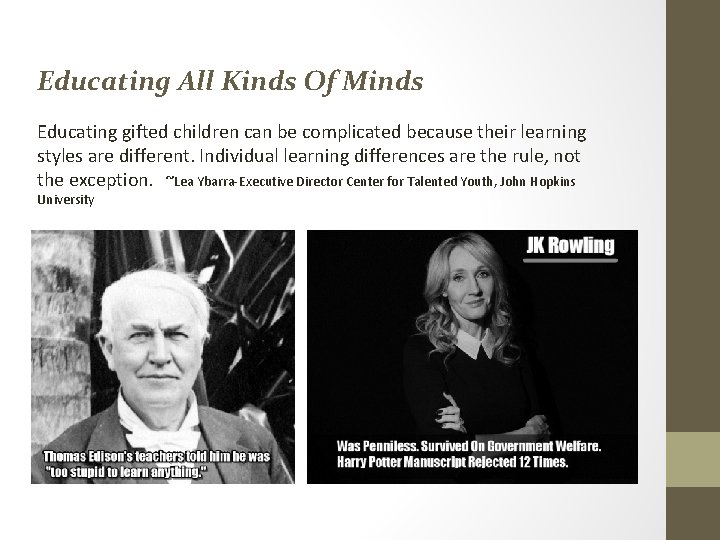
Educating All Kinds Of Minds Educating gifted children can be complicated because their learning styles are different. Individual learning differences are the rule, not the exception. ~Lea Ybarra‐Executive Director Center for Talented Youth, John Hopkins University
Who are these students? • State definition says that these students “may possess, but are not limited to, these learning characteristics: • Capacity to learn with unusual depth of understanding, to retain what has been learned, and to transfer learning to new situations; • Capacity and willingness to deal with increasing levels of abstraction and complexity earlier than their chronological peers; • Creative ability to make unusual connections among ideas and concepts; • Ability to learn quickly in their area(s) of intellectual strength; and • Capacity for intense concentration and/or focus.
Common Social/Emotional Characteristics • Asynchronous • Developing “out‐of‐sync”, high cognitive development not matched with physical or emotional development • This asynchrony can be in academic areas as well as between social emotional level and cognitive level • Introversion • Significantly higher percent of highly capable students can be considered introverts than the general population • Perfectionism • “Gifted underachievers are often, but not always, perfectionists. They view themselves as either “A” students or failures. ” –Sylvia Rimm • Executive Function (difficulty with organization) • Absent-minded professor

A High Achiever vs. A Gifted Learner from “The Gifted and Talented Child” by Janice Szabos, Maryland Council for Gifted & Talented, Inc. A High Achiever Knows the answers Is Interested Is attentive Has good ideas Works hard Commits time and effort to learning Answers questions Absorbs information Copies and responds accurately Is a top student Needs 6 to 8 repetitions for mastery Understands ideas Grasps meaning Completes assignments Is a technician Is a good memorizer Is receptive Listens with interest Prefers sequential presentation of information Is pleased with his or her own learning A Gifted Learner Asks the questions Is highly curious Is intellectually engaged Has original ideas Performs with ease May need less time to excel Responds with detail and unique perspectives Manipulates information Creates new and original products Is beyond his or her age peers Needs 1 to 2 repetitions for mastery Constructs abstractions Draws inferences Initiates projects Is an innovator Is insightful; makes connections Is intense Shows strong feelings, opinions, perspectives Thrives on complexity Is highly self‐critical
How are the Most Highly Capable Students Identified?
How Do We Determine our Most Highly Capable Students? • Each school district determines who their “most highly capable students” are: • Top 3‐ 7% of ISD students • Multiple measures must be used • District determines score “cut off” (based on ISD peers and “local norms”) • Each school district determines appropriate services to offer identified students • Services should be based on student need (identified area of strength) AND • Available resources of the district
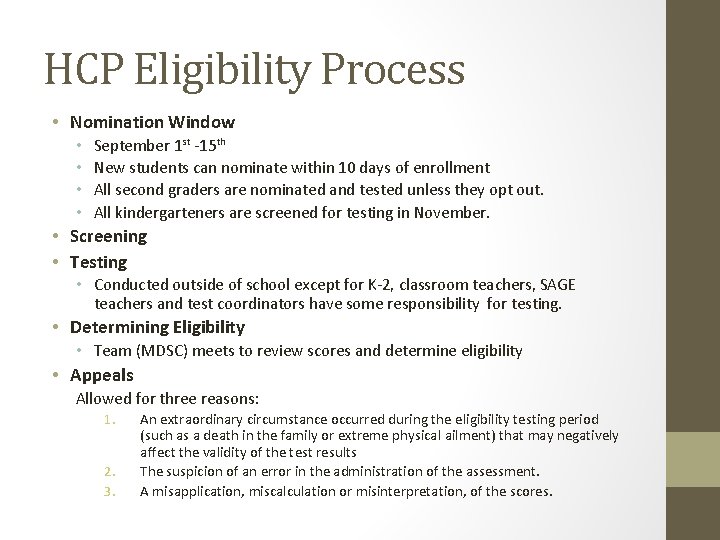
HCP Eligibility Process • Nomination Window • • September 1 st ‐ 15 th New students can nominate within 10 days of enrollment All second graders are nominated and tested unless they opt out. All kindergarteners are screened for testing in November. • Screening • Testing • Conducted outside of school except for K‐ 2, classroom teachers, SAGE teachers and test coordinators have some responsibility for testing. • Determining Eligibility • Team (MDSC) meets to review scores and determine eligibility • Appeals Allowed for three reasons: 1. 2. 3. An extraordinary circumstance occurred during the eligibility testing period (such as a death in the family or extreme physical ailment) that may negatively affect the validity of the test results The suspicion of an error in the administration of the assessment. A misapplication, miscalculation or misinterpretation, of the scores.
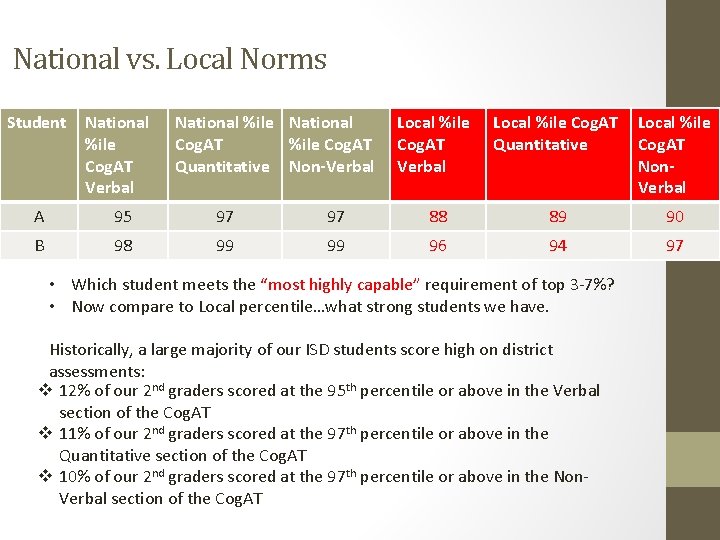
National vs. Local Norms Student National %ile Cog. AT Verbal National %ile National Cog. AT %ile Cog. AT Quantitative Non-Verbal Local %ile Cog. AT Quantitative Local %ile Cog. AT Non. Verbal A 95 97 97 88 89 90 B 98 99 99 96 94 97 • Which student meets the “most highly capable” requirement of top 3‐ 7%? • Now compare to Local percentile…what strong students we have. Historically, a large majority of our ISD students score high on district assessments: v 12% of our 2 nd graders scored at the 95 th percentile or above in the Verbal section of the Cog. AT v 11% of our 2 nd graders scored at the 97 th percentile or above in the Quantitative section of the Cog. AT v 10% of our 2 nd graders scored at the 97 th percentile or above in the Non‐ Verbal section of the Cog. AT
How are the Highly Capable Students Served?

Program Service Delivery Options ISD Highly Capable Program • • Differentiation in the general education classroom Pull-Out Self-Contained Acceleration Challenge Courses Mentorships/Internships Social/Emotional Support
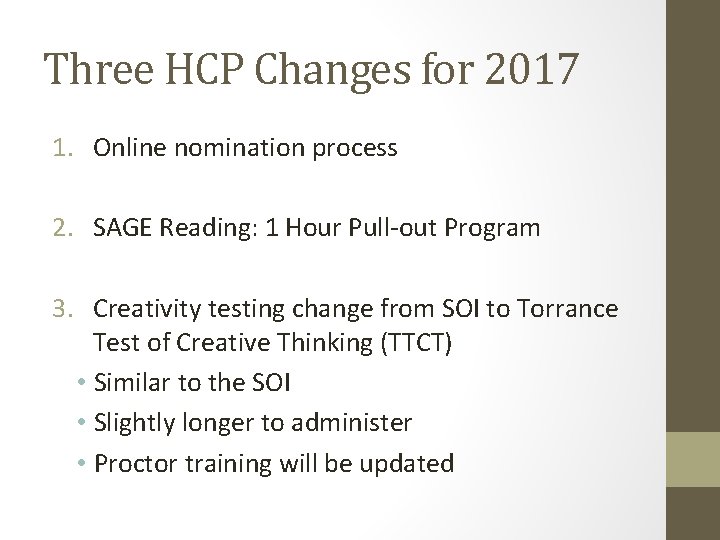
Three HCP Changes for 2017 1. Online nomination process 2. SAGE Reading: 1 Hour Pull‐out Program 3. Creativity testing change from SOI to Torrance Test of Creative Thinking (TTCT) • Similar to the SOI • Slightly longer to administer • Proctor training will be updated
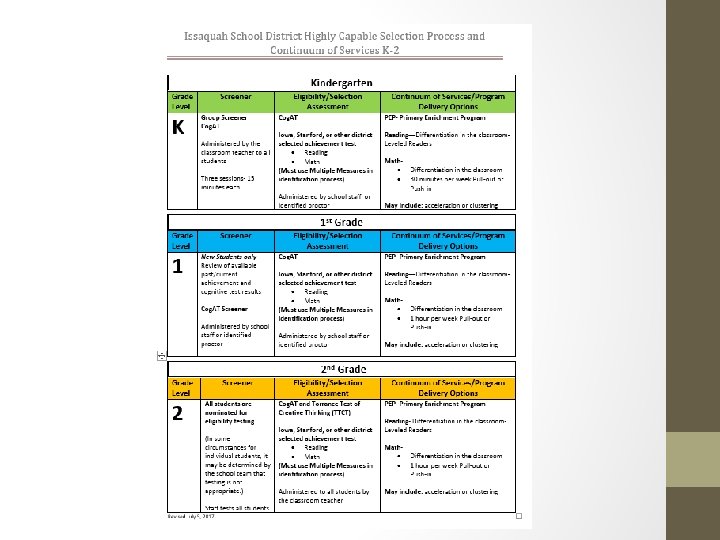
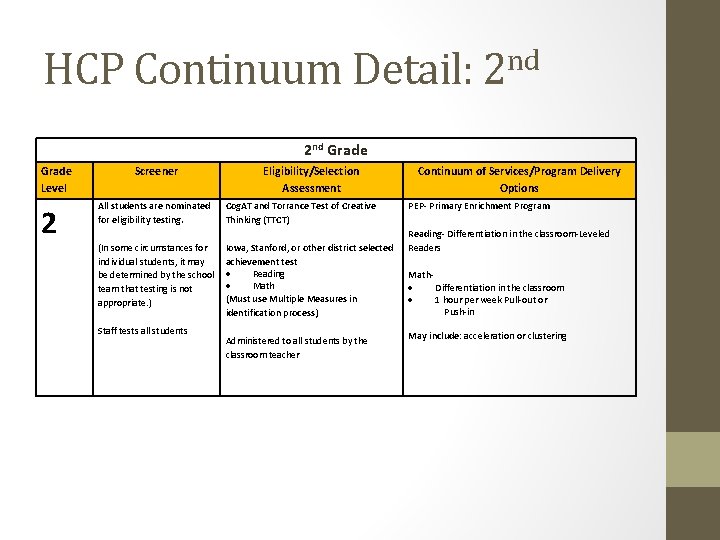
HCP Continuum Detail: 2 nd Grade Level 2 Screener Eligibility/Selection Assessment All students are nominated for eligibility testing. Cog. AT and Torrance Test of Creative Thinking (TTCT) (In some circumstances for individual students, it may be determined by the school team that testing is not appropriate. ) Iowa, Stanford, or other district selected achievement test Reading Math (Must use Multiple Measures in identification process) Staff tests all students Administered to all students by the classroom teacher Continuum of Services/Program Delivery Options PEP- Primary Enrichment Program Reading- Differentiation in the classroom‐Leveled Readers Math- Differentiation in the classroom 1 hour per week Pull‐out or Push‐in May include: acceleration or clustering
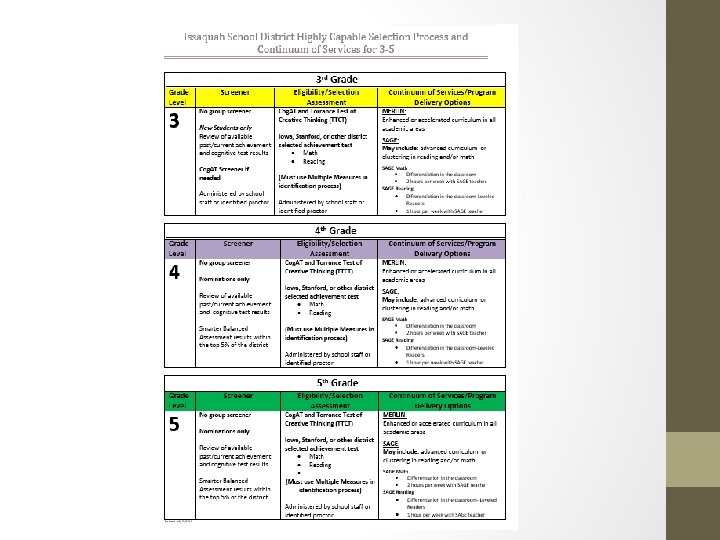
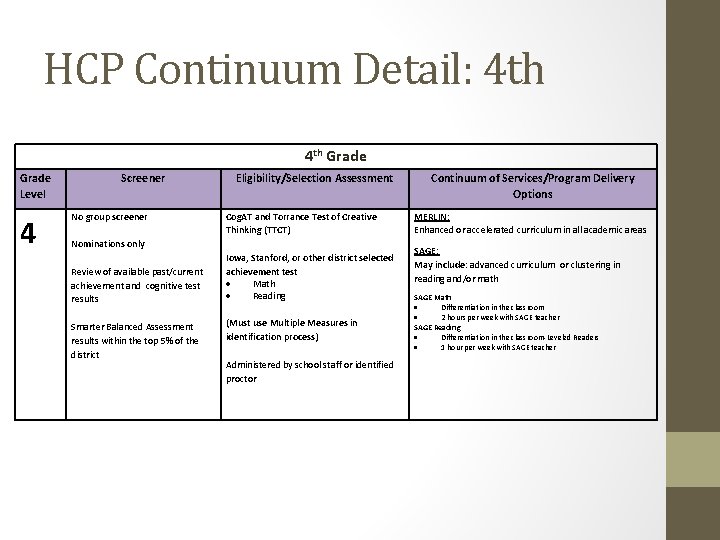
HCP Continuum Detail: 4 th Grade Level 4 Screener No group screener Eligibility/Selection Assessment Cog. AT and Torrance Test of Creative Thinking (TTCT) Nominations only Review of available past/current achievement and cognitive test results Smarter Balanced Assessment results within the top 5% of the district Iowa, Stanford, or other district selected achievement test Math Reading (Must use Multiple Measures in identification process) Administered by school staff or identified proctor Continuum of Services/Program Delivery Options MERLIN: Enhanced or accelerated curriculum in all academic areas SAGE: May include: advanced curriculum or clustering in reading and/or math SAGE Math Differentiation in the classroom 2 hours per week with SAGE teacher SAGE Reading Differentiation in the classroom‐Leveled Readers 1 hour per week with SAGE teacher
SAGE Programing • SAGE Math • Differentiation in the classroom • Two hours per week pull‐out • SAGE Reading • Differentiation in the classroom‐Leveled Readers • One hour per week pull‐out Highly Capable Students are highly capable (gifted) all the time not just when in the pull out. Their needs should be met in all aspects of their education.
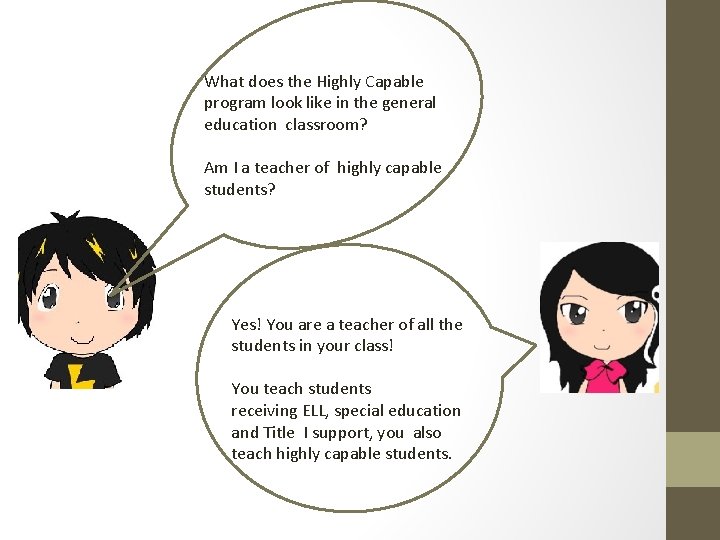
What does the Highly Capable program look like in the general education classroom? Am I a teacher of highly capable students? Yes! You are a teacher of all the students in your class! You teach students receiving ELL, special education and Title I support, you also teach highly capable students.
Smooth Sailing with SAGE (How to avoid rough water) • Communicate and work closely with your SAGE teacher • Recognize (celebrate and enjoy) the unique needs of your highly capable students • Work with your SAGE teacher and other colleagues to differentiate • Recognize that you are a teacher of highly capable students in your general ed. class. Just as you are a teacher of students with special needs in your general ed. class. • Recognize that you are the students’ primary and most important teacher for all subjects. Remember, they are gifted all day not just when in the pull out. • Communicate effectively and listen to parents of HCP students.
Differentiation
Differentiation for SAGE Reading: Responsibilities of Classroom Teacher: • Use leveled readers and regularly conduct guided reading groups for the highly capable students • Use additional challenging reading material confer regularly with SAGE readers • Ask higher level questions • Consult with the SAGE teacher to provide differentiation ideas for SAGE readers • Using SAGE teacher as a resource and a consultant • Use of SAGE teacher as the “Case Manager” of the SAGE reading and SAGE Math students includes goal setting • Teach all students to their greatest potential and to show growth
Differentiation for SAGE Math Responsibilities of Classroom Teacher: • Use Eureka Math to meet the highly capable students’ needs in math • Conduct guided math groups • Provide extension menus • Provide deeper level problem solving • Incorporate student accountability • Use SAGE teacher as a resource and a consultant • Use of SAGE teacher as the “Case Manager” of the SAGE reading and SAGE Math students includes goal setting • Teach all students to their greatest potential and to show growth
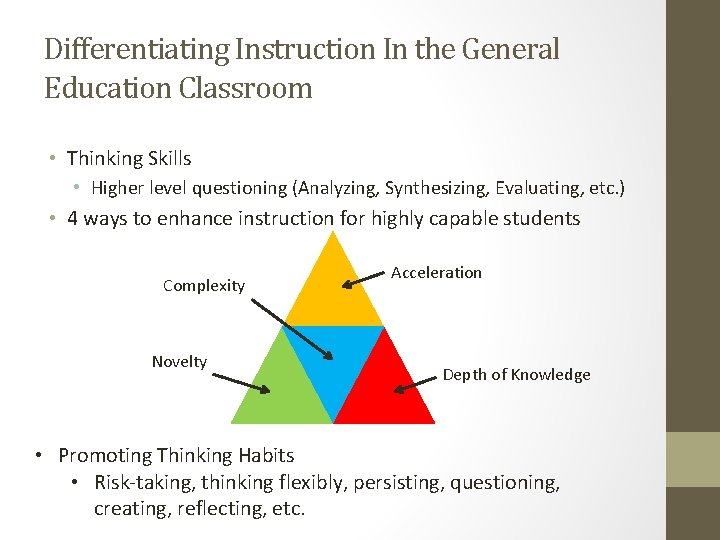
Differentiating Instruction In the General Education Classroom • Thinking Skills • Higher level questioning (Analyzing, Synthesizing, Evaluating, etc. ) • 4 ways to enhance instruction for highly capable students Complexity Novelty Acceleration Depth of Knowledge • Promoting Thinking Habits • Risk‐taking, thinking flexibly, persisting, questioning, creating, reflecting, etc.
Acceleration • Within the classroom through pacing and/or compacting • HCP students learn more quickly than their peers so a quicker pace can be appropriate • However, sometimes HCP students may need to slow down the pace because they are interested in going deeper in subject knowledge • Pre‐tests are useful, fewer practice items once mastery is achieved • Important to determine the appropriate level challenge.
Depth • Teaching to a higher “degree of difficulty” • Calling on more skills to be used by student • Calling on more refined skills to be used by student (than peers) • Student applies skills and understanding at a higher plane of sophistication (than peers) • Learn and use the language of the discipline • Recognize details • Note patterns • Identify rules • Study ethical considerations • Develop unanswered questions
Complexity • Process and products should be: More complex More abstract More open‐ended More multifaceted Students should work with more complex/abstract problems than their peers • Students need less teacher‐imposed structure for products • Able to make greater leaps of insight and more transfer than their peers • May cross disciplines and include different perspectives, points of view, and change over time. • • •
Novelty • Thrive with new learning and applications • NOT more of the same materials or problems • NOT additional work to keep students busy • NOT teaching higher thinking skills in isolation to subject • It IS providing students with new and unique problems that require application of skills and understanding • It IS using higher thinking skills WITHIN the subject being taught
Supported Risk-Taking • Highly capable students often excel in the regular classroom and become accustomed to little challenge (and ALWAYS knowing the correct answer) • They succeed without “normal” encounters with failure • When presented with a high‐challenge task the student may feel threatened and may therefore NOT try hard • The supportive teacher understands this dynamic and invites, cajoles and insists on the risk…but in a way that supports success • Eventually the highly capable student will learn the importance of risk and challenge and rise to the occasion
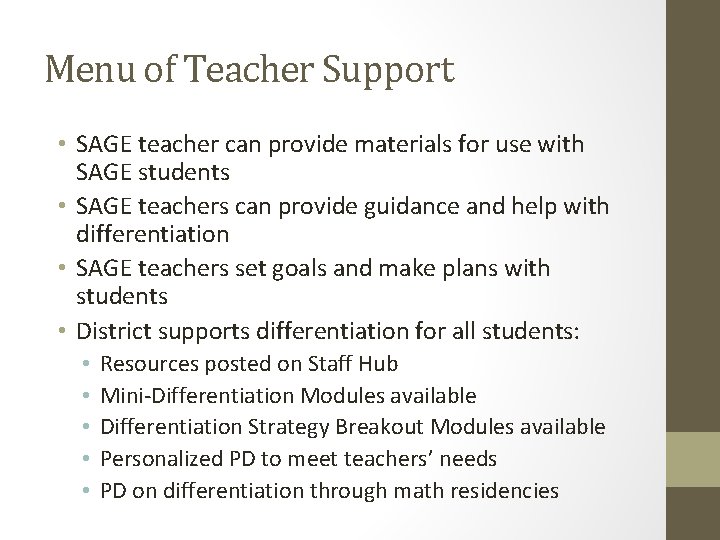
Menu of Teacher Support • SAGE teacher can provide materials for use with SAGE students • SAGE teachers can provide guidance and help with differentiation • SAGE teachers set goals and make plans with students • District supports differentiation for all students: • • • Resources posted on Staff Hub Mini‐Differentiation Modules available Differentiation Strategy Breakout Modules available Personalized PD to meet teachers’ needs PD on differentiation through math residencies

Need more support or have questions? Please contact: Susan Mundell Director of Elementary Special Programs 425‐ 837‐ 7129 mundells@issaquah. wednet. edu
- Slides: 32