
The Higher Learning Commission Criteria for Accreditation and
- Slides: 1
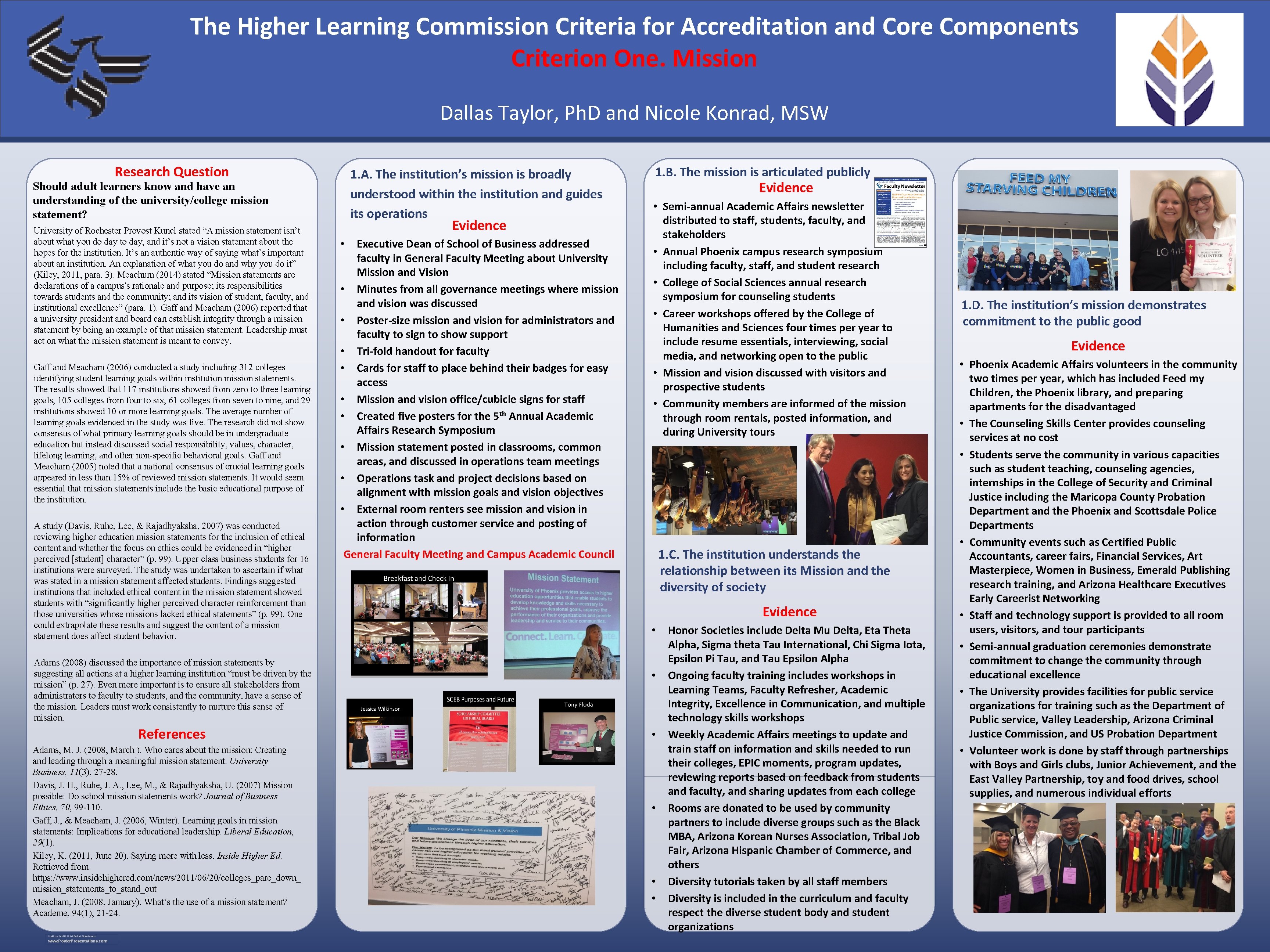
The Higher Learning Commission Criteria for Accreditation and Core Components Criterion One. Mission Dallas Taylor, Ph. D and Nicole Konrad, MSW Research Question 1. A. The institution’s mission is broadly understood within the institution and guides its operations Should adult learners know and have an understanding of the university/college mission statement? University of Rochester Provost Kuncl stated “A mission statement isn’t about what you do day to day, and it’s not a vision statement about the hopes for the institution. It’s an authentic way of saying what’s important about an institution. An explanation of what you do and why you do it” (Kiley, 2011, para. 3). Meachum (2014) stated “Mission statements are declarations of a campus's rationale and purpose; its responsibilities towards students and the community; and its vision of student, faculty, and institutional excellence” (para. 1). Gaff and Meacham (2006) reported that a university president and board can establish integrity through a mission statement by being an example of that mission statement. Leadership must act on what the mission statement is meant to convey. Gaff and Meacham (2006) conducted a study including 312 colleges identifying student learning goals within institution mission statements. The results showed that 117 institutions showed from zero to three learning goals, 105 colleges from four to six, 61 colleges from seven to nine, and 29 institutions showed 10 or more learning goals. The average number of learning goals evidenced in the study was five. The research did not show consensus of what primary learning goals should be in undergraduate education but instead discussed social responsibility, values, character, lifelong learning, and other non-specific behavioral goals. Gaff and Meacham (2005) noted that a national consensus of crucial learning goals appeared in less than 15% of reviewed mission statements. It would seem essential that mission statements include the basic educational purpose of the institution. A study (Davis, Ruhe, Lee, & Rajadhyaksha, 2007) was conducted reviewing higher education mission statements for the inclusion of ethical content and whether the focus on ethics could be evidenced in “higher perceived [student] character” (p. 99). Upper class business students for 16 institutions were surveyed. The study was undertaken to ascertain if what was stated in a mission statement affected students. Findings suggested institutions that included ethical content in the mission statement showed students with “significantly higher perceived character reinforcement than those universities whose missions lacked ethical statements” (p. 99). One could extrapolate these results and suggest the content of a mission statement does affect student behavior. Adams (2008) discussed the importance of mission statements by suggesting all actions at a higher learning institution “must be driven by the mission” (p. 27). Even more important is to ensure all stakeholders from administrators to faculty to students, and the community, have a sense of the mission. Leaders must work consistently to nurture this sense of mission. References Adams, M. J. (2008, March ). Who cares about the mission: Creating and leading through a meaningful mission statement. University Business, 11(3), 27 -28. Davis, J. H. , Ruhe, J. A. , Lee, M. , & Rajadhyaksha, U. (2007) Mission possible: Do school mission statements work? Journal of Business Ethics, 70, 99 -110. Gaff, J. , & Meacham, J. (2006, Winter). Learning goals in mission statements: Implications for educational leadership. Liberal Education, 29(1). Kiley, K. (2011, June 20). Saying more with less. Inside Higher Ed. Retrieved from https: //www. insidehighered. com/news/2011/06/20/colleges_pare_down_ mission_statements_to_stand_out Meacham, J. (2008, January). What’s the use of a mission statement? Academe, 94(1), 21 -24. RESEARCH POSTER PRESENTATION DESIGN © 2012 www. Poster. Presentations. com Evidence Executive Dean of School of Business addressed faculty in General Faculty Meeting about University Mission and Vision • Minutes from all governance meetings where mission and vision was discussed • Poster-size mission and vision for administrators and faculty to sign to show support • Tri-fold handout for faculty • Cards for staff to place behind their badges for easy access • Mission and vision office/cubicle signs for staff • Created five posters for the 5 th Annual Academic Affairs Research Symposium • Mission statement posted in classrooms, common areas, and discussed in operations team meetings • Operations task and project decisions based on alignment with mission goals and vision objectives • External room renters see mission and vision in action through customer service and posting of information General Faculty Meeting and Campus Academic Council • 1. B. The mission is articulated publicly Evidence • Semi-annual Academic Affairs newsletter distributed to staff, students, faculty, and stakeholders • Annual Phoenix campus research symposium including faculty, staff, and student research • College of Social Sciences annual research symposium for counseling students • Career workshops offered by the College of Humanities and Sciences four times per year to include resume essentials, interviewing, social media, and networking open to the public • Mission and vision discussed with visitors and prospective students • Community members are informed of the mission through room rentals, posted information, and during University tours 1. C. The institution understands the relationship between its Mission and the diversity of society Evidence • • • Honor Societies include Delta Mu Delta, Eta Theta Alpha, Sigma theta Tau International, Chi Sigma Iota, Epsilon Pi Tau, and Tau Epsilon Alpha Ongoing faculty training includes workshops in Learning Teams, Faculty Refresher, Academic Integrity, Excellence in Communication, and multiple technology skills workshops Weekly Academic Affairs meetings to update and train staff on information and skills needed to run their colleges, EPIC moments, program updates, reviewing reports based on feedback from students and faculty, and sharing updates from each college Rooms are donated to be used by community partners to include diverse groups such as the Black MBA, Arizona Korean Nurses Association, Tribal Job Fair, Arizona Hispanic Chamber of Commerce, and others Diversity tutorials taken by all staff members Diversity is included in the curriculum and faculty respect the diverse student body and student organizations 1. D. The institution’s mission demonstrates commitment to the public good Evidence • Phoenix Academic Affairs volunteers in the community two times per year, which has included Feed my Children, the Phoenix library, and preparing apartments for the disadvantaged • The Counseling Skills Center provides counseling services at no cost • Students serve the community in various capacities such as student teaching, counseling agencies, internships in the College of Security and Criminal Justice including the Maricopa County Probation Department and the Phoenix and Scottsdale Police Departments • Community events such as Certified Public Accountants, career fairs, Financial Services, Art Masterpiece, Women in Business, Emerald Publishing research training, and Arizona Healthcare Executives Early Careerist Networking • Staff and technology support is provided to all room users, visitors, and tour participants • Semi-annual graduation ceremonies demonstrate commitment to change the community through educational excellence • The University provides facilities for public service organizations for training such as the Department of Public service, Valley Leadership, Arizona Criminal Justice Commission, and US Probation Department • Volunteer work is done by staff through partnerships with Boys and Girls clubs, Junior Achievement, and the East Valley Partnership, toy and food drives, school supplies, and numerous individual efforts