
The High Way Transportation System and Risk Management
- Slides: 15
The High Way Transportation System and Risk Management Traffic Laws
Objectives: l l l Name three Parts of the highway transportation system Explain how, and by whom, the highway transportation system is regulated Describe five ways you can reduce driving risk within the highway transportation system
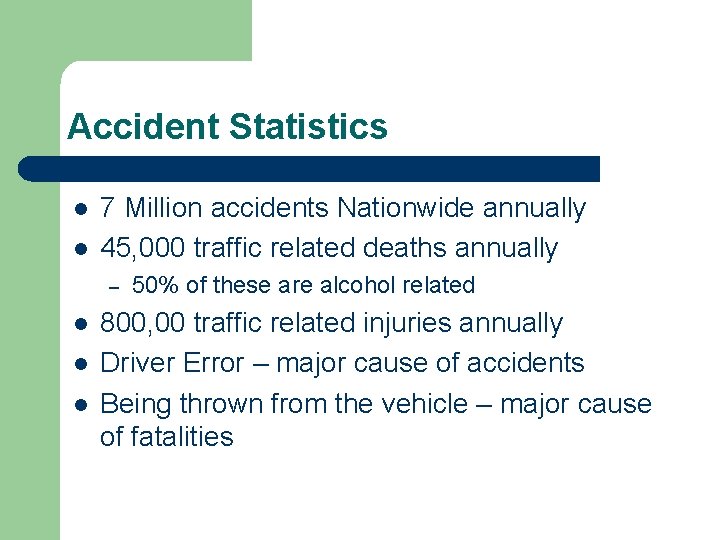
Accident Statistics l l 7 Million accidents Nationwide annually 45, 000 traffic related deaths annually – l l l 50% of these are alcohol related 800, 00 traffic related injuries annually Driver Error – major cause of accidents Being thrown from the vehicle – major cause of fatalities
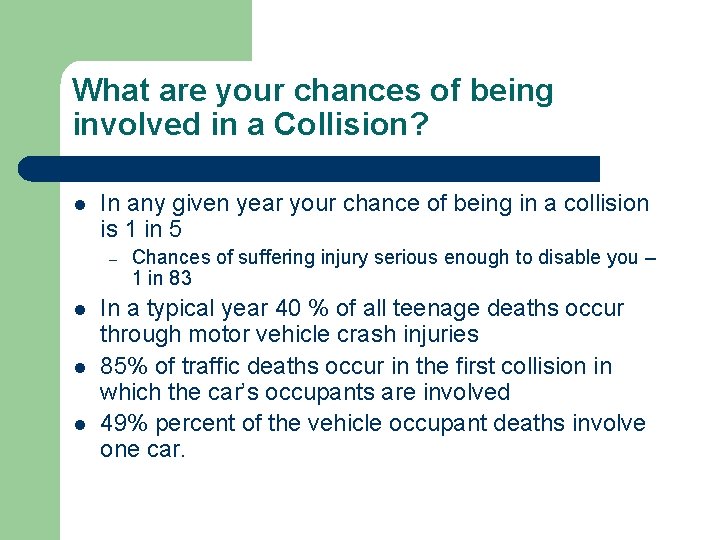
What are your chances of being involved in a Collision? l In any given year your chance of being in a collision is 1 in 5 – l l l Chances of suffering injury serious enough to disable you – 1 in 83 In a typical year 40 % of all teenage deaths occur through motor vehicle crash injuries 85% of traffic deaths occur in the first collision in which the car’s occupants are involved 49% percent of the vehicle occupant deaths involve one car.
Highway Transportation System l The highway transportation system (HTS) is made up of; – – – l Cars Trucks Streets Highways Drivers Cyclists and pedestrians Purpose of the HTS is to enable people and goods to move from place to place as safely as possible
How is the HTS regulated? l l Federal state and local governments work together to regulate the HTS Example: Federal law establishes maximum speed limit law however it is up to the individual states to enforce that law.
Federal and State Requirements l The National Traffic and Motor Vehicle Safety Act – Requires car makers to build certain safety features l l Seat belts Air bags Shatterproof windows The National Highway Safety Act – Established specific guidelines for state motor vehicle safety programs. l l – Vehicle registration/inspection Driver licensing Traffic laws/courts Highway construction/maintenance Each state is responsible for following and enforcing the guidelines
Reducing Driving risks l l l Vehicle Maintenance Anticipate the actions of others Use of Safety Restraints Drive only when you are in sound Physical and mental condition Make a conscience effort to develop your driving skills
Vehicle Maintenance l The better the condition of your care the more control you will have when driving – – – Brakes properly working Tired properly inflated Clean windows
Anticipate the actions of others l l Drive Defensively Attempt to identify cues to behavior to predict how other drivers will act or react
Use of Safety Restraints Being thrown from the vehicle – major cause of fatalities l Two types of restraints – Passive – work by design l l l – Active – Work when activated l l l Airbags Side Door Beams Collapsible Dashboard Door Locks Seat belts Reason for seatbelts – – Safer in care/Away from the Dashboard Driving Position Law in Kentucky Reduces Fatigue- reinforces proper posture
Drive only when you are in sound Physical and mental condition l l l Be alert Clear Headed Concentrate on Driving rather than other issues.
Make a conscience effort to develop your driving skills l Actively work to improve your driving habits and abilities
Managing Visibility, Time, and Space -Crucial elements in safe and responsible driving. l Visibility – l Time – – l What you can see from behind the wheel and well you can see it. Ability to judge your speed and the speed of others. Also refers to how long it will take your car or another vehicle to stop. Space – – Wise drivers keep a margin of space between their cars and other vehicles. Room to maneuver in dangerous situations
Review l l l Name three(3) parts of the HTS Explain how and by whom the HTS is regulated What is the – – l l National Traffic and Safety Act? National Highway Safety Act? Describe five ways you can reduce driving risks Name three crucial elements in safe and responsible driving