
The High Middle Ages 1000 1300 Timeline for











- Slides: 61
The High Middle Ages 1000 -1300
Timeline for High Middle Ages & First Four Crusades • • 1075 -1090: Dictates of the Pope 1095: Council of Clermont 1096 -1099: First Crusade 1140 s: Gratian produces his Decretum 1147 -1149: Second Crusade 1164: Constitutions of Clarendon 1189 -1193: Third Crusade 1198 -1203: Fourth Crusade
What concept is central to our understanding of the High or Central Middle Ages? A. Medieval Fusion B. Expansion C. Decay D. Rebirth
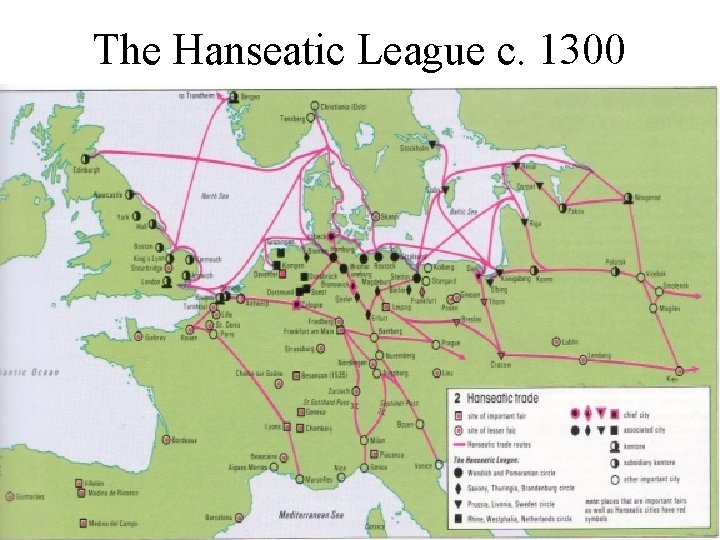
The Hanseatic League c. 1300
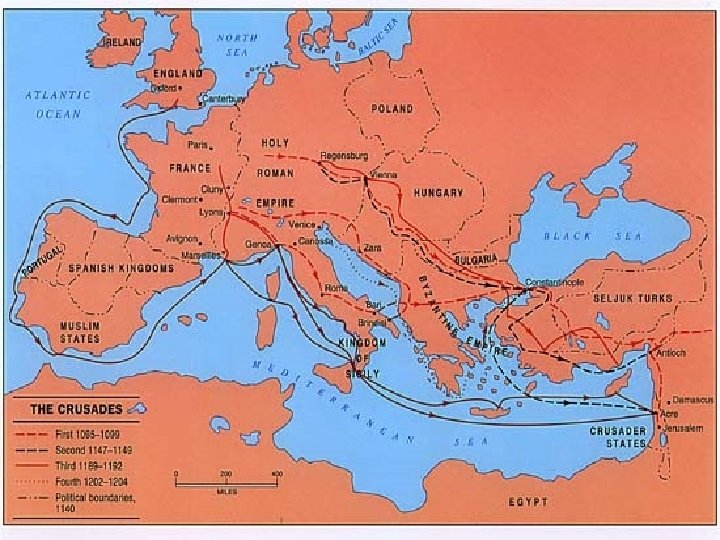
Crusader States during the twelfth century
What was the most important cultural influence of the crusades on Europe? A. They increased the interaction with Muslim culture B. They increased the power & prestige of the papacy C. They stimulated competition between the Church and secular rulers across Europe D. They helped to divert violence away from Europe
Discuss Crusades
Templars and Hospitallers Christian Soldiers of the High Middle Ages
Crusader States during the twelfth century
Bernard of Clairvaux • Cistercian leader during much of the movement’s first century • Considered by many contemporaries the holiest man in Europe • Preached the Second Crusade, 1147 -9
The defeat of Christians at the Horns of Hattin sent shock waves across Europe 1187
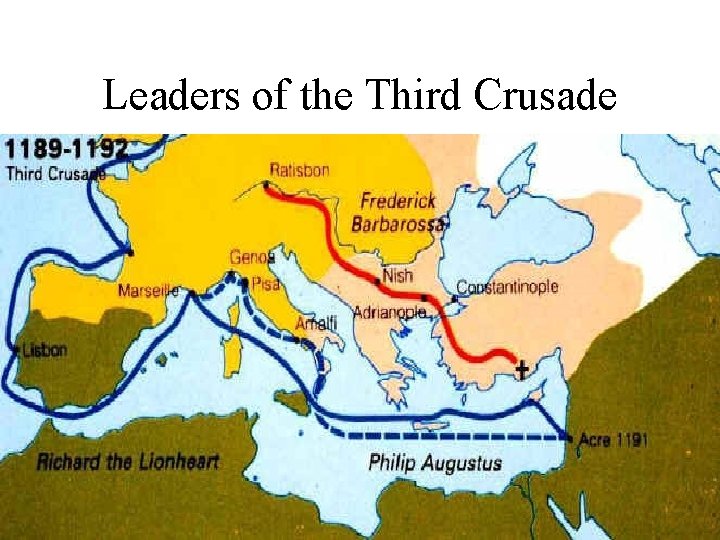
Leaders of the Third Crusade
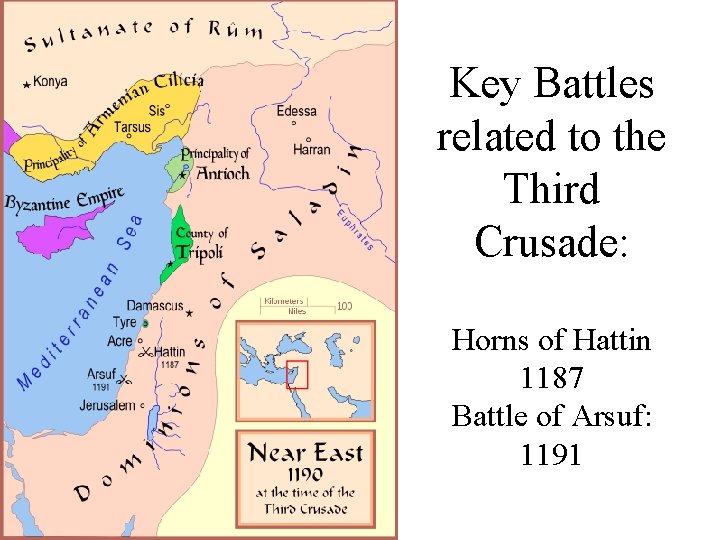
Key Battles related to the Third Crusade: Horns of Hattin 1187 Battle of Arsuf: 1191
Richard Lionheart & Truce with Saladin 1191
Fourth Crusade’s Planned Course
The Venetian Mercantile Empire
Innocent III 1161 -1216 r. 1198 -1216
How did the crusades influence the power of the Church? A. The popes became the most powerful rulers in Europe by about 1200. B. The crusades stimulated religious devotion which encouraged pious bequests to the Church. C. Individuals across Europe sought positions in the expanding Church hierarchy. D. Positions in the Church became increasingly valuable and individuals often paid for those positions (simony).
What was the most likely consequence of the growing power of the papacy? A. Secular rulers gave up their rights to control their states. B. Popes were very careful to avoid overstepping the boundary between Church and state. C. Popes and kings increasingly vied for power. D. All of the above E. None of the above
Medieval Universities
Gratian’s Decretum c. 1140 Foundation for Systematic Canon Law of Church Courts
Innovations in Medieval Theology
Romanesque Architecture dominant in new construction in the West until c. 1140
French Gothic at St. Chapelle
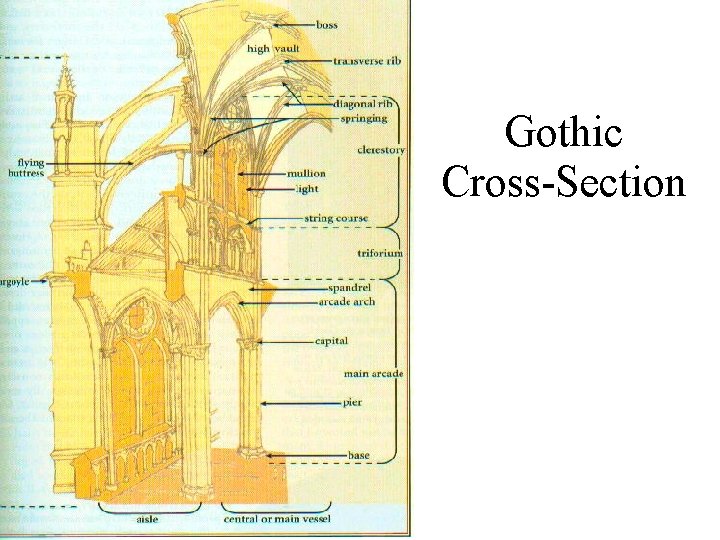
Gothic Cross-Section
St. Francis
Henry II of England: 1154 -1189 Creator of English Common Law
Constitutions of Clarendon, 1164 1. If a controversy concerning advowson and presentation of churches arise between laymen, or between laymen and clerks, or between clerks, it shall be treated of and terminated in the court of the lord king. 2. Churches of the fee of the lord king cannot, unto all time, be given without his assent and concession. 3. Clerks charged and accused of anything, being summoned by the Justice of the king, shall come into his court, about to respond there for what it seems to the king's court that he should respond there; and in the ecclesiastical court for what it seems he should respond there; so that the Justice of the king shall send to the court of the holy church to see in what manner the affair will there be carried on. And if the clerk shall be convicted, or shall confess, the church ought not to protect him further.
4. It is not lawful for archbishops, and persons of the kingdom to go out of the kingdom without the permission of the lord king. And if it please the king and they go out, they shall give assurance that neither in going, nor in making a stay, nor in returning, will they seek the hurt or harm of king or kingdom. 5. The excommunicated shall not give a pledge as a permanency, nor take an oath, but only a pledge and surety of presenting themselves before the tribunal of the church, that they may be absolved. 16. The sons of rustics may not be ordained without the consent of the lord on whose land they are known to have been born.
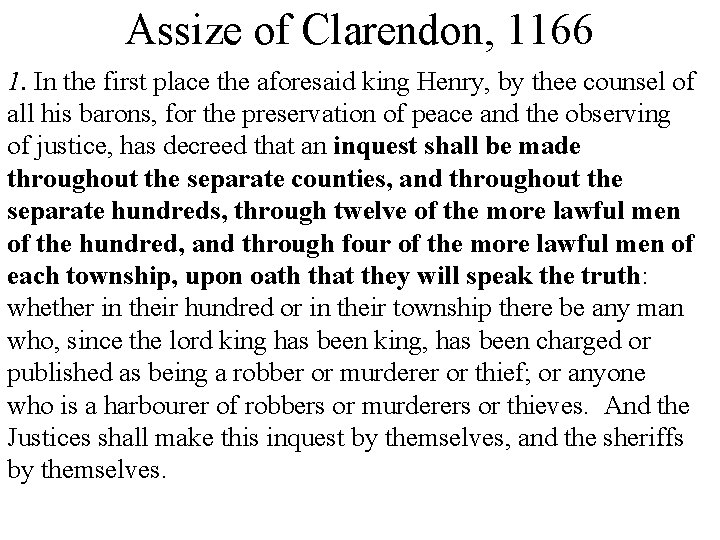
Assize of Clarendon, 1166 1. In the first place the aforesaid king Henry, by thee counsel of all his barons, for the preservation of peace and the observing of justice, has decreed that an inquest shall be made throughout the separate counties, and throughout the separate hundreds, through twelve of the more lawful men of the hundred, and through four of the more lawful men of each township, upon oath that they will speak the truth: whether in their hundred or in their township there be any man who, since the lord king has been king, has been charged or published as being a robber or murderer or thief; or anyone who is a harbourer of robbers or murderers or thieves. And the Justices shall make this inquest by themselves, and the sheriffs by themselves.
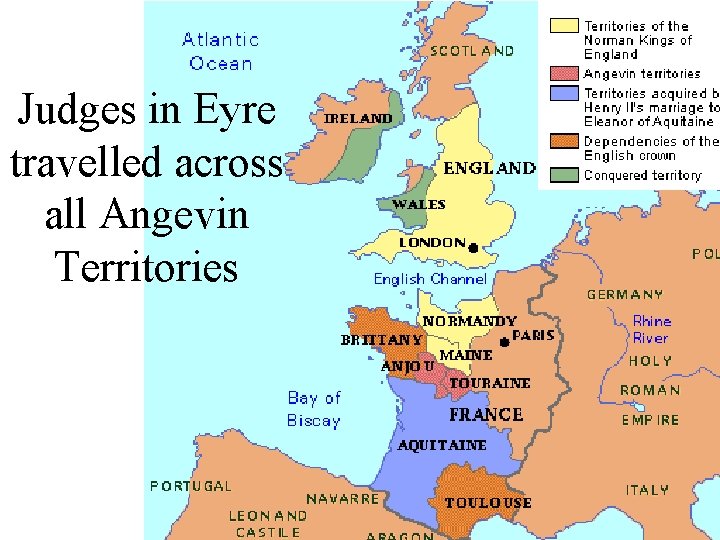
Judges in Eyre travelled across all Angevin Territories
Writ from early 12 th century
Juries of presentment were quite different from these dudes
Common Law Judges were bound to follow legal precedent
The Emergence of the Gentry
Literacy and Religion c. 1300
The Divine Comedy: Learned Vernacular
Birth of Venus 1480 s - Botticelli
Which figures are central to the Hunt reading for today? A. Thomas Aquinas and Joachim of Fiore B. Henry II and Eleanor of Aquitaine C. Peter Abelard & Heloise D. St. Bernard and St. Francis
Where did Gothic Architecture first develop? A. Near Rome B. Near Paris C. Near London D. Near Prague E. Near Leiden
Why did the First Crusade contribute mightily to the growing power of the papacy?
Overview • Competition between the Emperor and the Pope – the investiture conflict – the law school at Bologna • Intellectual development – cathedral schools & universities – scholasticism • Art & architecture • Increasing literacy, especially in government • However, increasing rigidity: dogma
The Investiture Conflict, 1075 -1122 • Argument between the Holy Roman Emperor and the Pope over who is ultimately in control of Church hierarchy • The name comes from the ceremony that “invests” a bishop with his office; in other words the pope and the emperor initially argued over who was ultimately in control of appointments to ecclesiastical offices • But the conflict spread to the larger issue of who was the ultimate political and religious leader of Europe and at least in the early phases of this conflict which would continue for two centuries, the popes came out on top • In the quest for the assertion of authority, the conflict generated a revival of intellectual development, particularly in the field of law
The Decretum Gratiani c. 1140 • Gratian’s Decretum is also known as the Concordance of Discordant Canons • Published around 1140, this document revolutionized jurisprudence in Western Europe by organizing Church law in a systematic fashion • In the quest to establish papal authority, Gratian found the Justinian Code, which was a sixth century legal code published by the Emperor Justinian c. 535 • Gratian applied the hierarchical and organizing principals employed by Byzantine scholars on Roman laws to systematically arrange hundreds of Church laws, known as canons
Intellectual Development • The Investiture Conflict had a broad ranging effect on educational practices throughout Europe • The Law School at Bologna was only one of several universities that began to appear in Europe during the 12 th century • These universities pioneered the development of scholasticism which was a new method of learning and argumentation • During the 12 th century the university of Paris became the most advanced center for theological studies in Europe • By the 13 th century scholars at Oxford were performing experiments in optics; they were clearly influenced by the Islamic scientific tradition
Scholasticism • Early pioneers: Anselm of Canterbury (1034 -1109) and Peter Abelard in Paris (1079 -1142) • An attempt to reconcile contradictory authorities through questions and answers • Developed in the wake of investiture controversy between papacy and Holy Roman Emperor • Drew on a hierarchy of disparate intellectual traditions – – Scripture Christian theologians and Church fathers ancient Greeks Islamic & Jewish scholars • Increasingly dry and rigid after 1300
Universities • Law – Bologna in late 11 th century – Gratian’s Decretum • Medicine – Salerno by 12 th century – fusion of ancient, Byzantine, and Muslim medicine • Theology/Philosophy – – the mother discipline Paris founded in 1100 s, Oxford in 1200 s Aquinas: reconciliation of reason and faith scholastic methodology
The Spread of Literacy • Prior to the High Middle Ages, literacy was often confined to monasteries • Distrust of writing was widespread prior to 1200 as forgeries were common • Proliferation of literate professions: scribes, clerks, lawyers, accountants, professors, scholars, notaries • More documents produced throughout society – merchant letters – royal degrees – charters granting rights • Increased familiarity of of common people with written documents but literacy remains rudimentary throughout society
Proliferation of Literature • Throughout the High Middle Ages, Latin was the dominant language of educated writers • Although vernacular writing was common for entertainment prior to 1300, vernacular writing became increasingly common in intellectual works after 1300 – Dante was one of the pioneers; his De vulgari eloquentia (c. 1290) provided a catalyst for European intellectual development in the vernacular • As Europe became wealthier and more educated, the thirst for literature increased and vernacular writing, such as Dante’s Comedy, became increasingly popular
Architecture • The prevalence of Romanesque style prior to 1140 – no ribs in vault – round arches – tendency toward darkness – more austere in northern Europe • Development of Gothic style (1140) – vault rib – pointed arch – allows larger windows: more light – occasional flying buttresses
What was the focus of the Constitutions of Clarendon? A. The relationship between Church and State B. The establishment of the Common Law C. The adoption of the Justinian Code D. I do not know E. Whatever