
The High Flux Isotope Reactor HFIR Pressurized 470
- Slides: 6
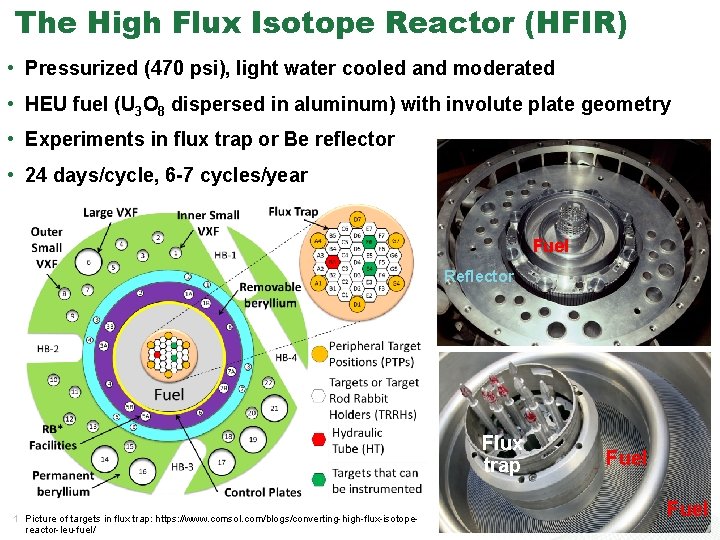
The High Flux Isotope Reactor (HFIR) • Pressurized (470 psi), light water cooled and moderated • HEU fuel (U 3 O 8 dispersed in aluminum) with involute plate geometry • Experiments in flux trap or Be reflector • 24 days/cycle, 6 -7 cycles/year Fuel Reflector Flux trap 1 Picture of targets in flux trap: https: //www. comsol. com/blogs/converting-high-flux-isotopereactor-leu-fuel/ Fuel
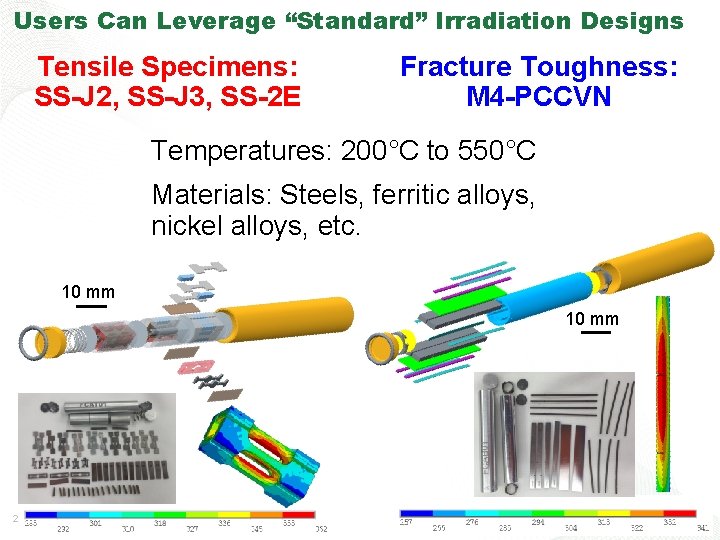
Users Can Leverage “Standard” Irradiation Designs Tensile Specimens: SS-J 2, SS-J 3, SS-2 E Fracture Toughness: M 4 -PCCVN Temperatures: 200°C to 550°C Materials: Steels, ferritic alloys, nickel alloys, etc. 10 mm 2
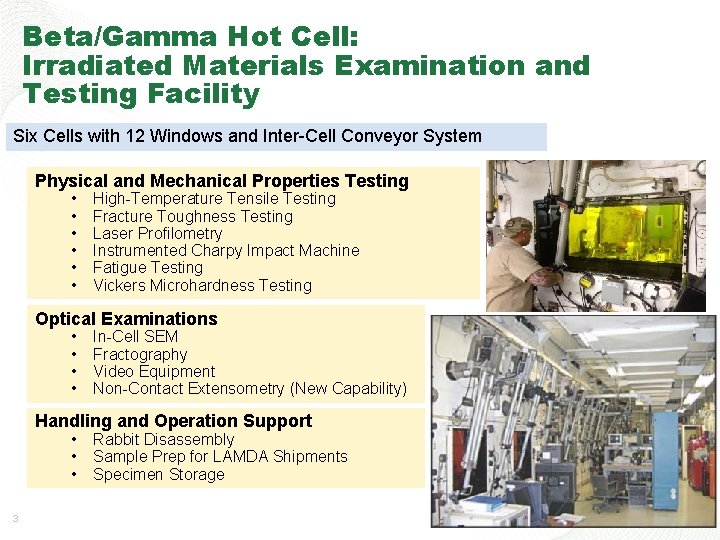
Beta/Gamma Hot Cell: Irradiated Materials Examination and Testing Facility Six Cells with 12 Windows and Inter-Cell Conveyor System Physical and Mechanical Properties Testing • • • High-Temperature Tensile Testing Fracture Toughness Testing Laser Profilometry Instrumented Charpy Impact Machine Fatigue Testing Vickers Microhardness Testing Optical Examinations • • In-Cell SEM Fractography Video Equipment Non-Contact Extensometry (New Capability) Handling and Operation Support • • • 3 Rabbit Disassembly Sample Prep for LAMDA Shipments Specimen Storage
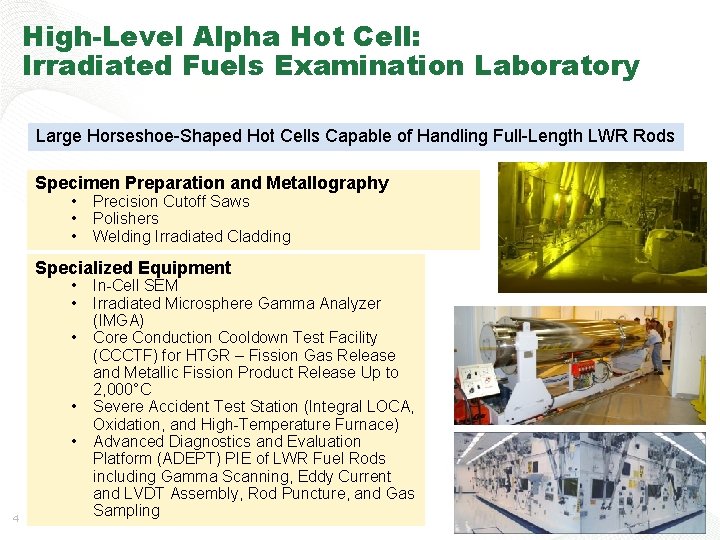
High-Level Alpha Hot Cell: Irradiated Fuels Examination Laboratory Large Horseshoe-Shaped Hot Cells Capable of Handling Full-Length LWR Rods Specimen Preparation and Metallography • • • Precision Cutoff Saws Polishers Welding Irradiated Cladding Specialized Equipment • • • 4 In-Cell SEM Irradiated Microsphere Gamma Analyzer (IMGA) Core Conduction Cooldown Test Facility (CCCTF) for HTGR – Fission Gas Release and Metallic Fission Product Release Up to 2, 000°C Severe Accident Test Station (Integral LOCA, Oxidation, and High-Temperature Furnace) Advanced Diagnostics and Evaluation Platform (ADEPT) PIE of LWR Fuel Rods including Gamma Scanning, Eddy Current and LVDT Assembly, Rod Puncture, and Gas Sampling
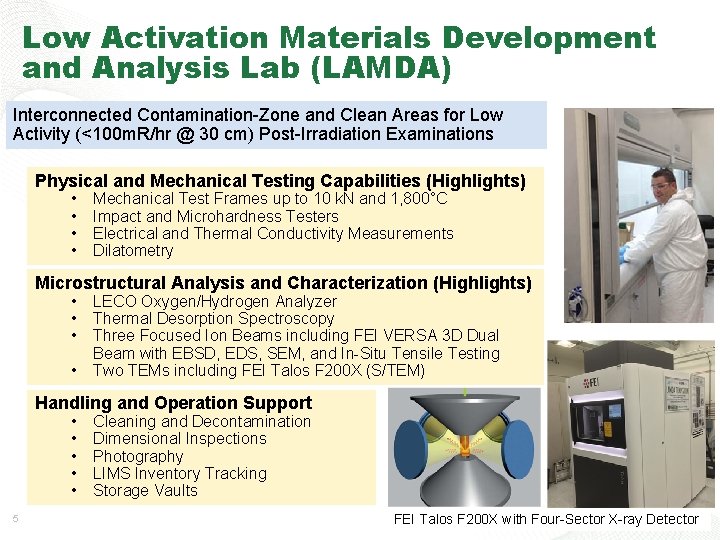
Low Activation Materials Development and Analysis Lab (LAMDA) Interconnected Contamination-Zone and Clean Areas for Low Activity (<100 m. R/hr @ 30 cm) Post-Irradiation Examinations Physical and Mechanical Testing Capabilities (Highlights) • • Mechanical Test Frames up to 10 k. N and 1, 800°C Impact and Microhardness Testers Electrical and Thermal Conductivity Measurements Dilatometry Microstructural Analysis and Characterization (Highlights) • • LECO Oxygen/Hydrogen Analyzer Thermal Desorption Spectroscopy Three Focused Ion Beams including FEI VERSA 3 D Dual Beam with EBSD, EDS, SEM, and In-Situ Tensile Testing Two TEMs including FEI Talos F 200 X (S/TEM) Handling and Operation Support • • • 5 Cleaning and Decontamination Dimensional Inspections Photography LIMS Inventory Tracking Storage Vaults FEI Talos F 200 X with Four-Sector X-ray Detector
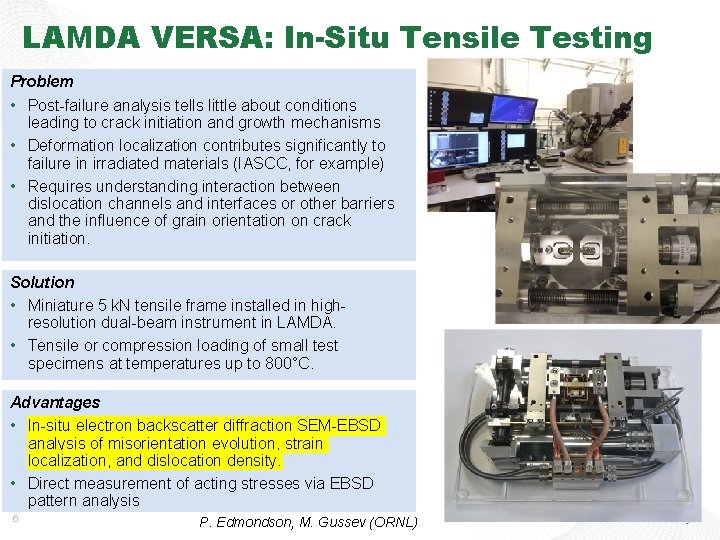
LAMDA VERSA: In-Situ Tensile Testing Problem • Post-failure analysis tells little about conditions leading to crack initiation and growth mechanisms • Deformation localization contributes significantly to failure in irradiated materials (IASCC, for example) • Requires understanding interaction between dislocation channels and interfaces or other barriers and the influence of grain orientation on crack initiation. Solution • Miniature 5 k. N tensile frame installed in highresolution dual-beam instrument in LAMDA. • Tensile or compression loading of small test specimens at temperatures up to 800°C. Advantages • In-situ electron backscatter diffraction SEM-EBSD analysis of misorientation evolution, strain localization, and dislocation density. • Direct measurement of acting stresses via EBSD pattern analysis 6 P. Edmondson, M. Gussev (ORNL)