
The Higgs Particle CERN Academic Training Lecture III



- Slides: 62
The Higgs Particle CERN Academic Training Lecture III Properties, Implications and Prospects Marumi Kado Laboratoire de l’Accélérateur Linéaire (LAL) And CERN
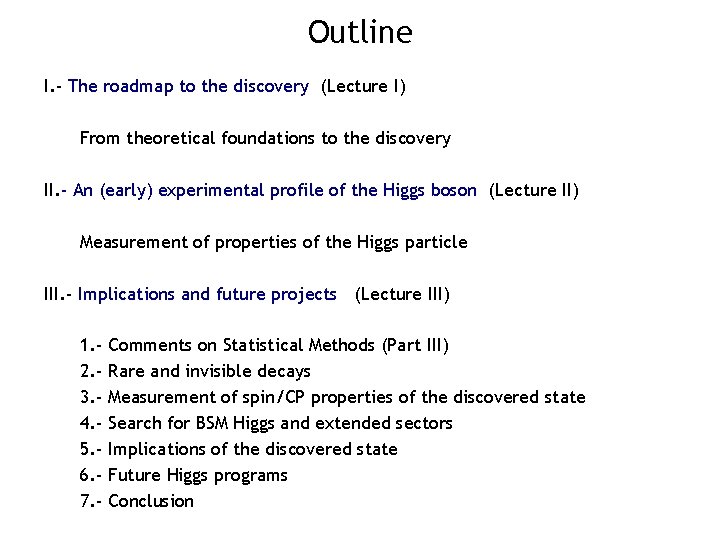
Outline I. - The roadmap to the discovery (Lecture I) From theoretical foundations to the discovery II. - An (early) experimental profile of the Higgs boson (Lecture II) Measurement of properties of the Higgs particle III. - Implications and future projects (Lecture III) 1. 2. 3. 4. 5. 6. 7. - Comments on Statistical Methods (Part III) Rare and invisible decays Measurement of spin/CP properties of the discovered state Search for BSM Higgs and extended sectors Implications of the discovered state Future Higgs programs Conclusion
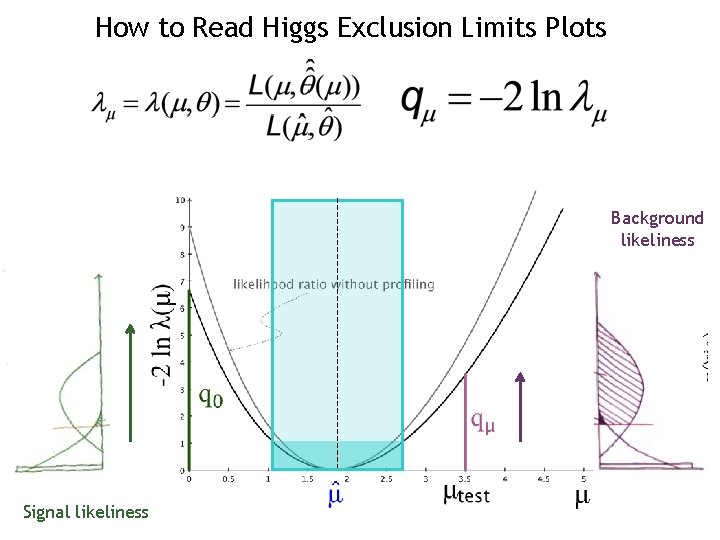
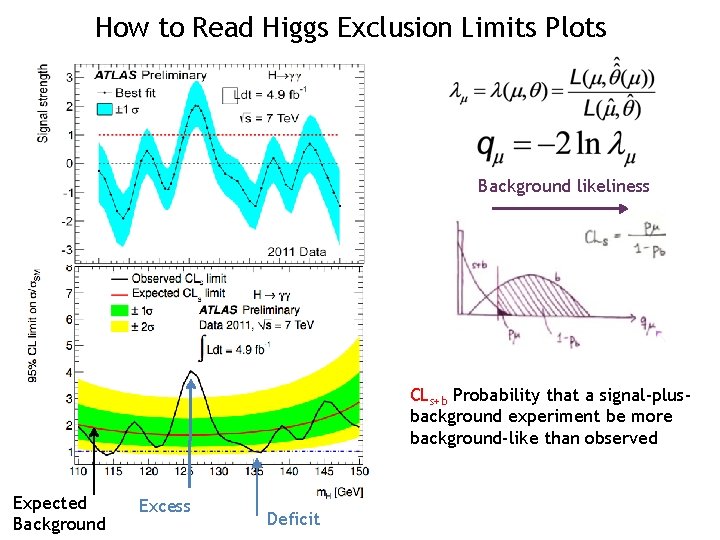
How to Read Higgs Exclusion Limits Plots Background likeliness Signal likeliness
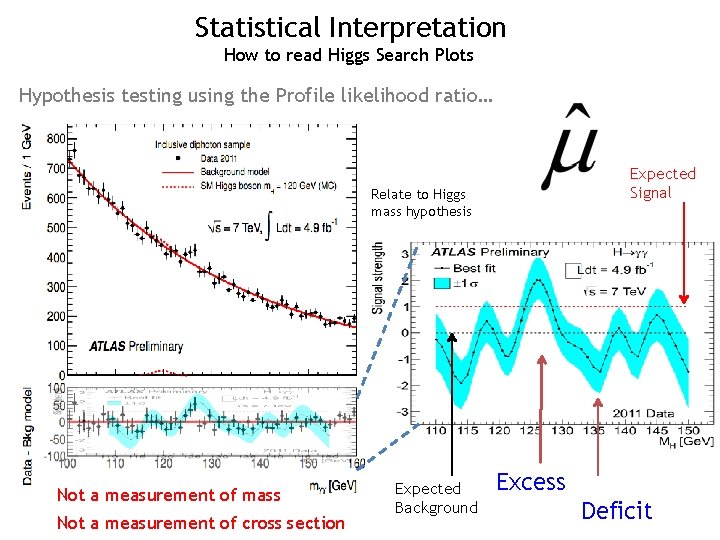
Statistical Interpretation How to read Higgs Search Plots Hypothesis testing using the Profile likelihood ratio… Expected Signal Relate to Higgs mass hypothesis Not a measurement of mass Not a measurement of cross section Expected Background Excess Deficit
How to Read Higgs Exclusion Limits Plots Background likeliness CLs+b Probability that a signal-plusbackground experiment be more background-like than observed Expected Background Excess Deficit
The Higgs Natural Width Problem At LHC no direct access to the Higgs total cross section (unlike e+e- collider from recoil mass spectrum) – Total width (4 Me. V) too tiny to be meaningfully measured experimentally from lineshape – New observed state can decay invisibly. Direct search possible at LHC – New observed state can decay to a priori visible decay products but not distinguishable from background. In this case no experimental handle The total width cannot be measured without further assumptions on the couplings of the visible states.
Invisible and rare decays
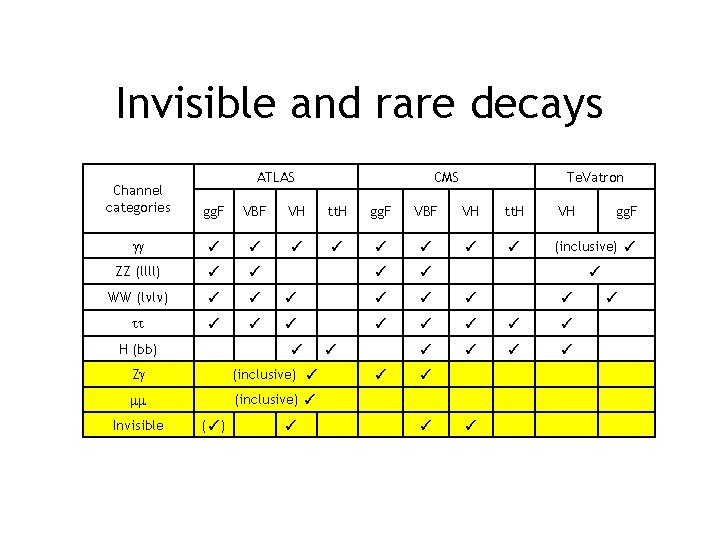
Invisible and rare decays ATLAS CMS Te. Vatron Channel categories gg. F VBF VH tt. H VH ✓ ✓ ✓ ✓ (inclusive) ✓ ZZ (llll) ✓ ✓ WW (lnln) ✓ ✓ ✓ ✓ ✓ H (bb) ✓ Z (inclusive) ✓ mm (inclusive) ✓ Invisible (✓) ✓ ✓ ✓ gg. F ✓ ✓ ✓
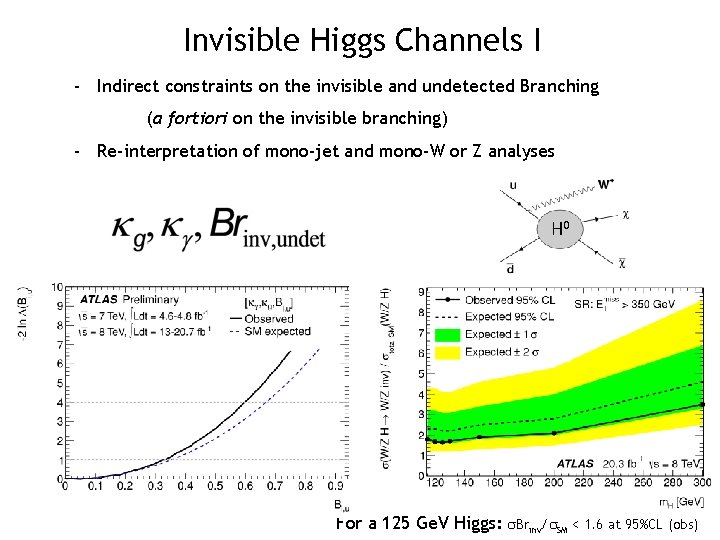
Invisible Higgs Channels I - Indirect constraints on the invisible and undetected Branching (a fortiori on the invisible branching) - Re-interpretation of mono-jet and mono-W or Z analyses H 0 For a 125 Ge. V Higgs: s. Brinv/s. SM < 1. 6 at 95%CL (obs)
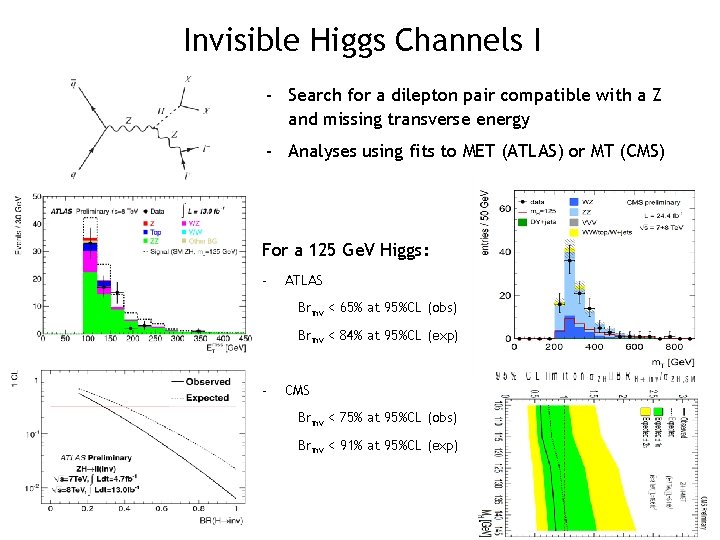
Invisible Higgs Channels I - Search for a dilepton pair compatible with a Z and missing transverse energy - Analyses using fits to MET (ATLAS) or MT (CMS) For a 125 Ge. V Higgs: - ATLAS Brinv < 65% at 95%CL (obs) Brinv < 84% at 95%CL (exp) - CMS Brinv < 75% at 95%CL (obs) Brinv < 91% at 95%CL (exp)
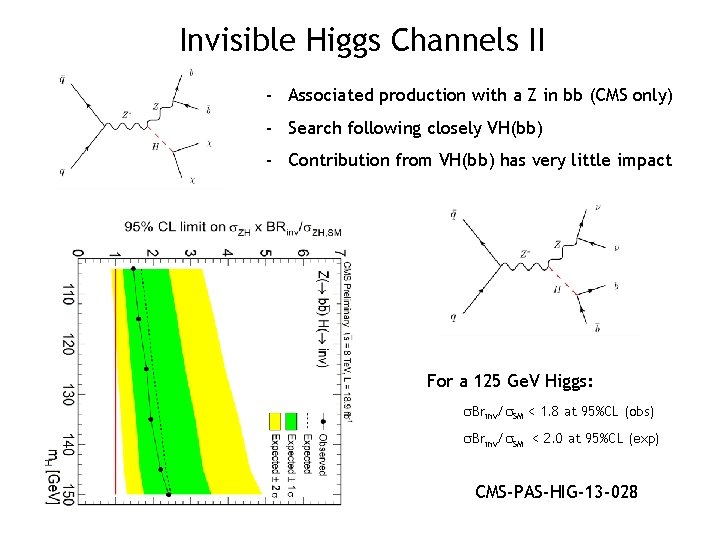
Invisible Higgs Channels II - Associated production with a Z in bb (CMS only) - Search following closely VH(bb) - Contribution from VH(bb) has very little impact For a 125 Ge. V Higgs: s. Brinv/s. SM < 1. 8 at 95%CL (obs) s. Brinv/s. SM < 2. 0 at 95%CL (exp) CMS-PAS-HIG-13 -028
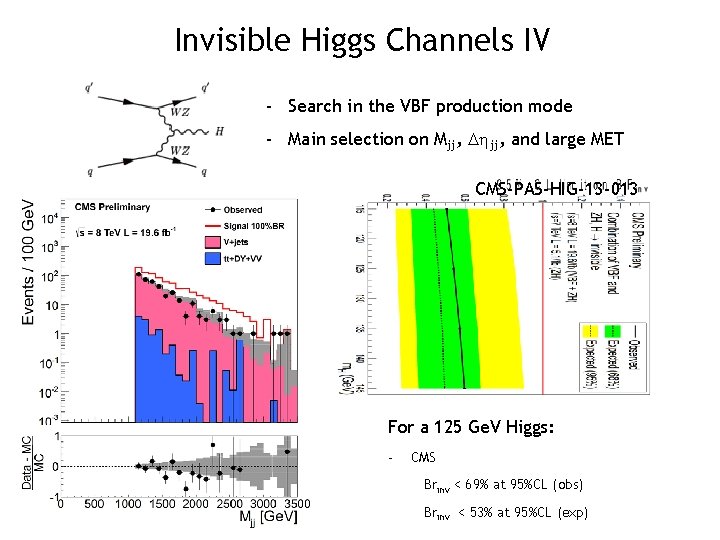
Invisible Higgs Channels IV - Search in the VBF production mode - Main selection on Mjj, Dhjj, and large MET CMS-PAS-HIG-13 -013 For a 125 Ge. V Higgs: - CMS Brinv < 69% at 95%CL (obs) Brinv < 53% at 95%CL (exp)
Higgs width determination - Direct measurement will only be possible at muon collider… what can be done at the LHC? - Direct measurement at LHC from the Higgs lineshape in diphoton and 4 l will be limited by systematics and in particular the modeling of the resolution systematic uncertainties (See CMS result) - Direct measurement through decay length in the 4 l channel has also very limited sensitivity. - Very indirect estimates through coupling fit (with various assumptions) - New trends in trying to constrain the Higgs width (still indirect, but little to no assumptions): - Width through mass differences - Width through precise high mass VV cross section measurements
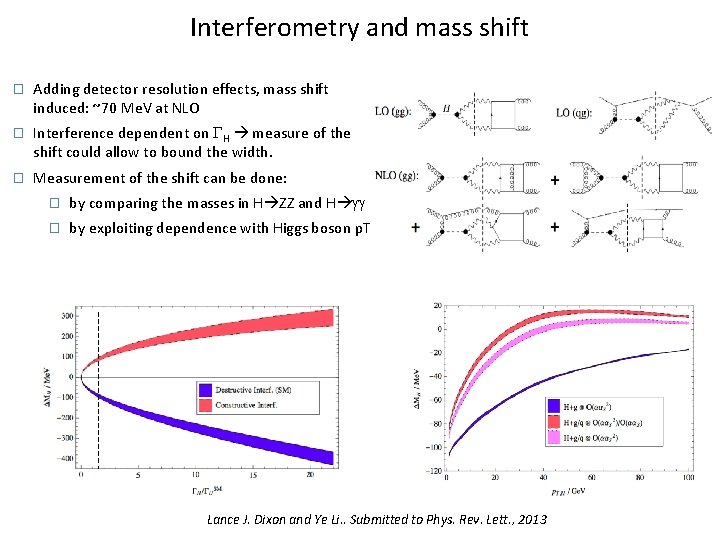
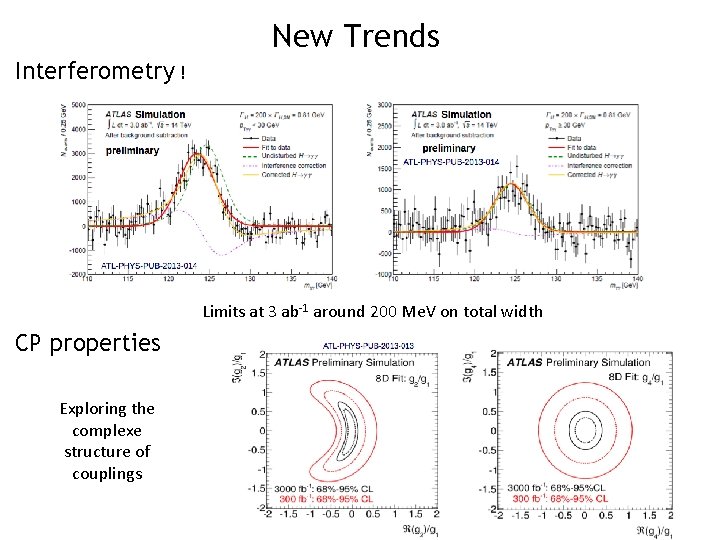
Interferometry and mass shift � Adding detector resolution effects, mass shift induced: ~70 Me. V at NLO � Interference dependent on GH measure of the shift could allow to bound the width. � Measurement of the shift can be done: � by comparing the masses in H ZZ and H � by exploiting dependence with Higgs boson p. T Lance J. Dixon and Ye Li. . Submitted to Phys. Rev. Lett. , 2013
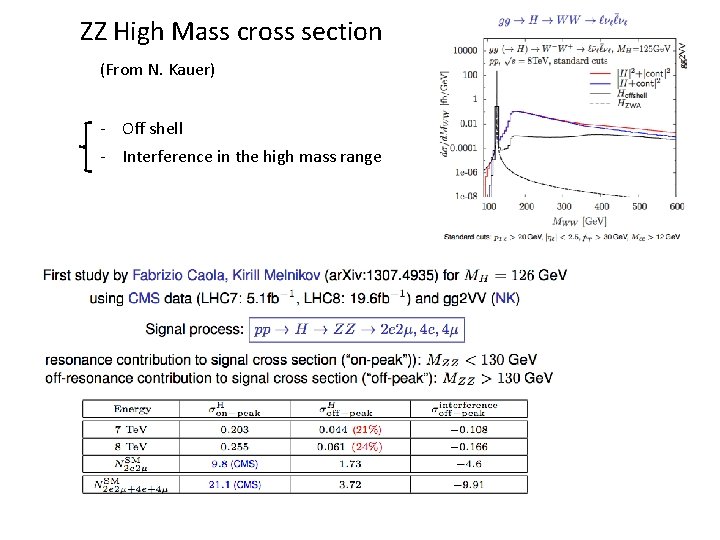
ZZ High Mass cross section (From N. Kauer) - Off shell - Interference in the high mass range
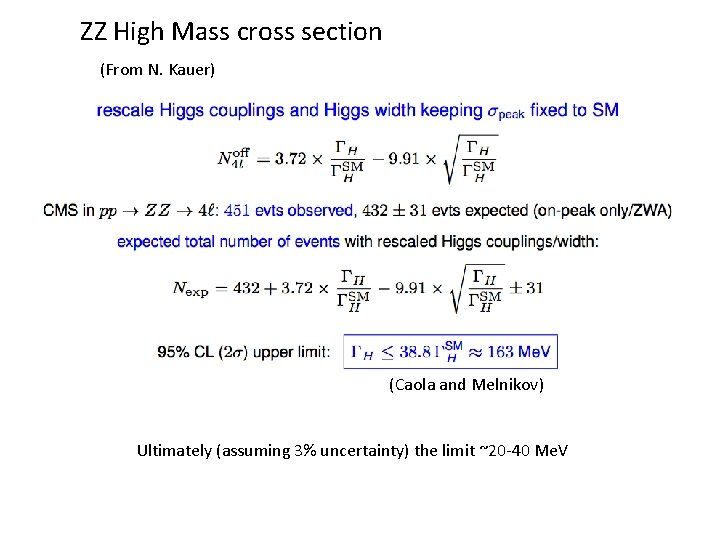
ZZ High Mass cross section (From N. Kauer) (Caola and Melnikov) Ultimately (assuming 3% uncertainty) the limit ~20 -40 Me. V
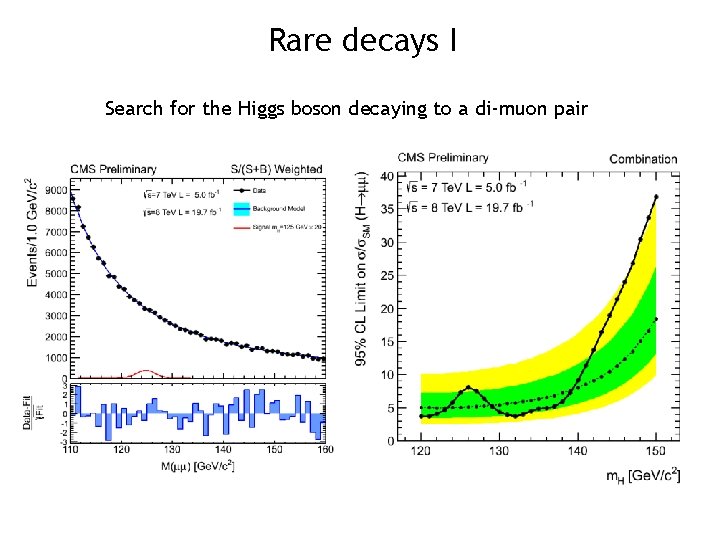
Rare decays I Search for the Higgs boson decaying to a di-muon pair
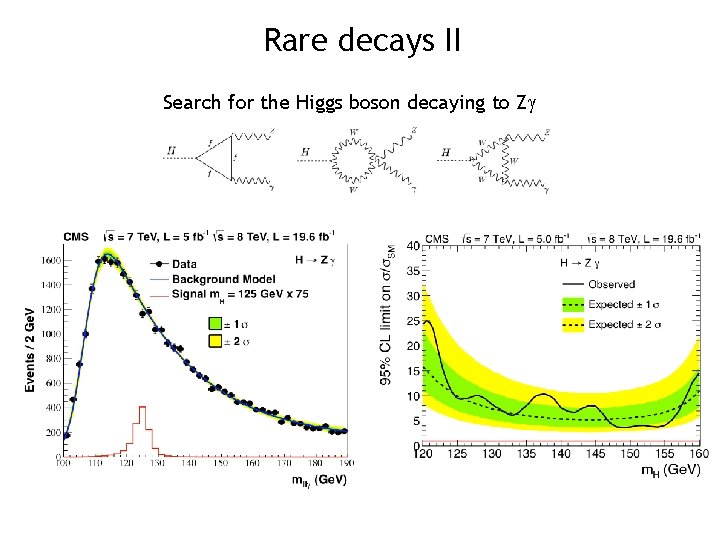
Rare decays II Search for the Higgs boson decaying to Z
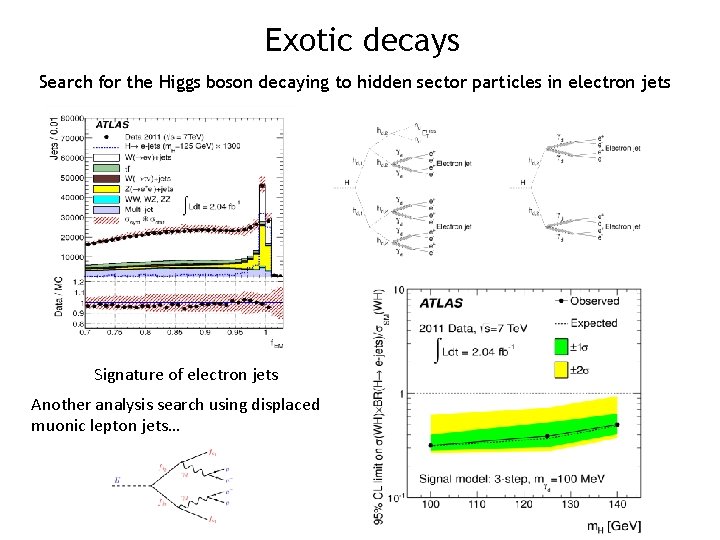
Exotic decays Search for the Higgs boson decaying to hidden sector particles in electron jets Signature of electron jets Another analysis search using displaced muonic lepton jets…
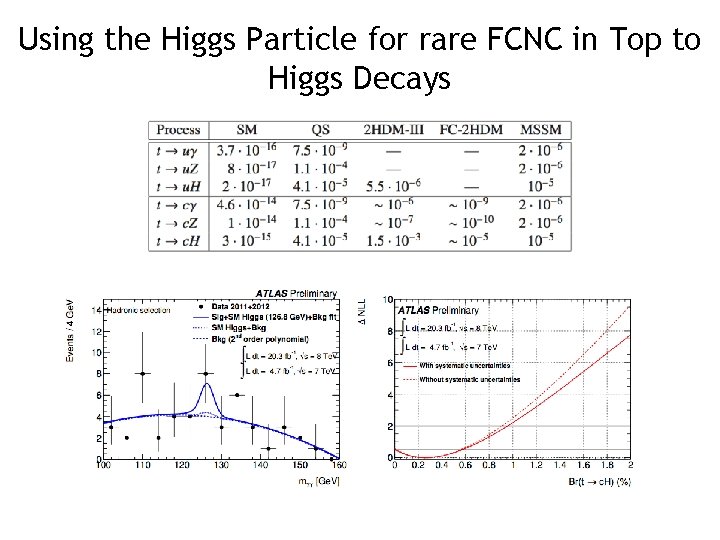
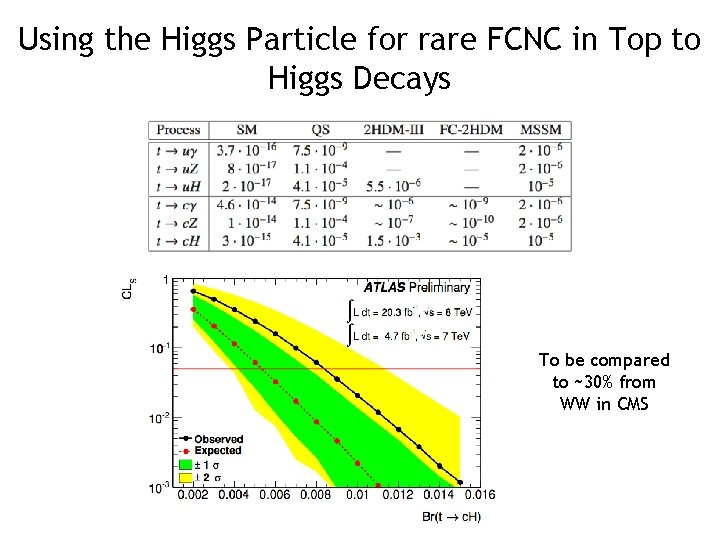
Using the Higgs Particle for rare FCNC in Top to Higgs Decays
Using the Higgs Particle for rare FCNC in Top to Higgs Decays To be compared to ~30% from WW in CMS
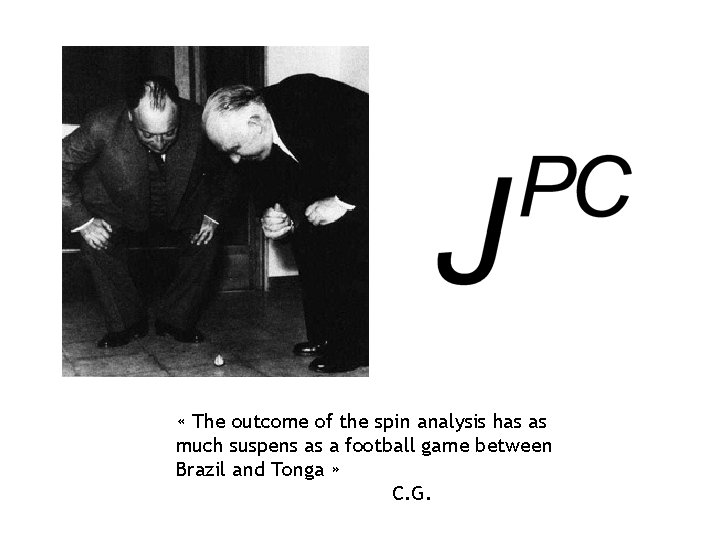
« The outcome of the spin analysis has as much suspens as a football game between Brazil and Tonga » C. G.
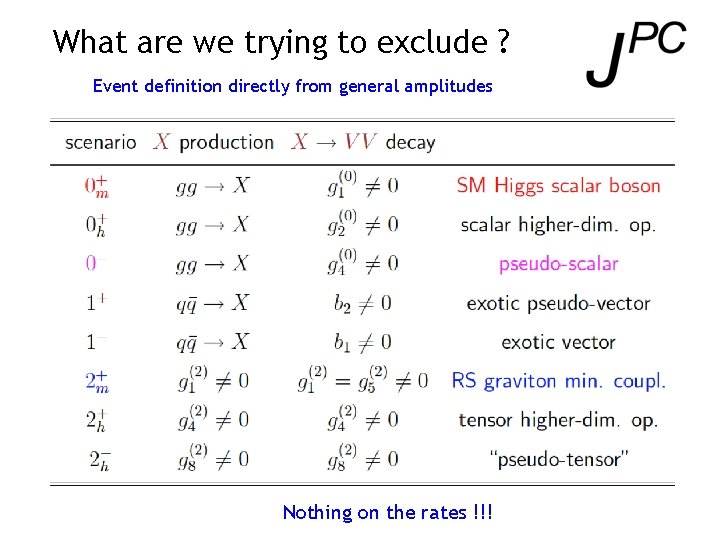
Main Quantum Numbers A large number of options to probe the spin directly from angular (or threshold behavior) distributions. - From the associated production modes (VH, VBF or gg. F+jets) - From the production angle cos q* distribution - From the decay angles and the spin correlation when applicable The philosophy of the approach : - Measure compatibility with the 0+ hypothesis - Try to exclude alternative hypotheses simulated using an effective Lagrangian including higher order couplings.
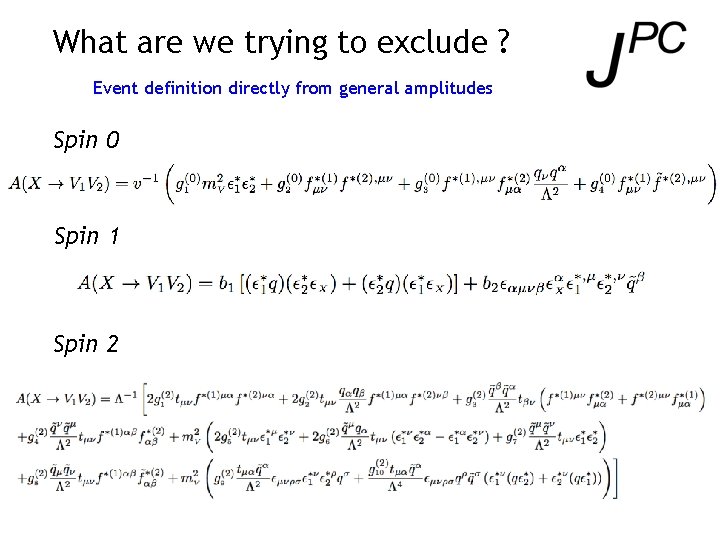
What are we trying to exclude ? Event definition directly from general amplitudes Spin 0 Spin 1 Spin 2
What are we trying to exclude ? Event definition directly from general amplitudes Nothing on the rates !!!
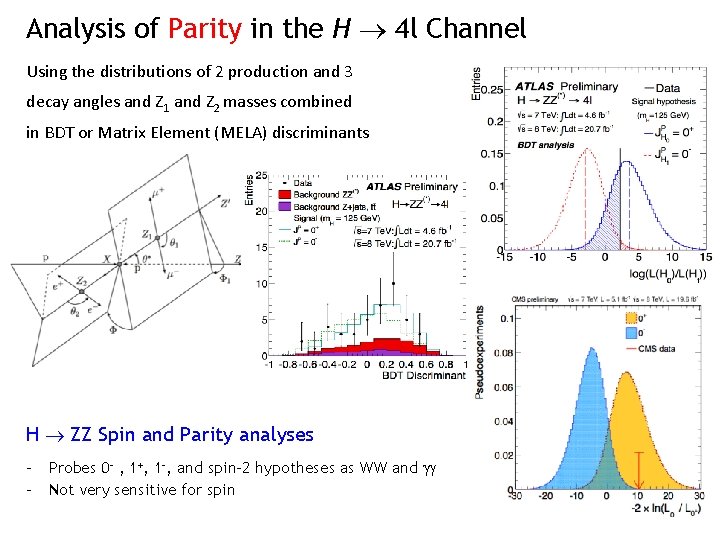
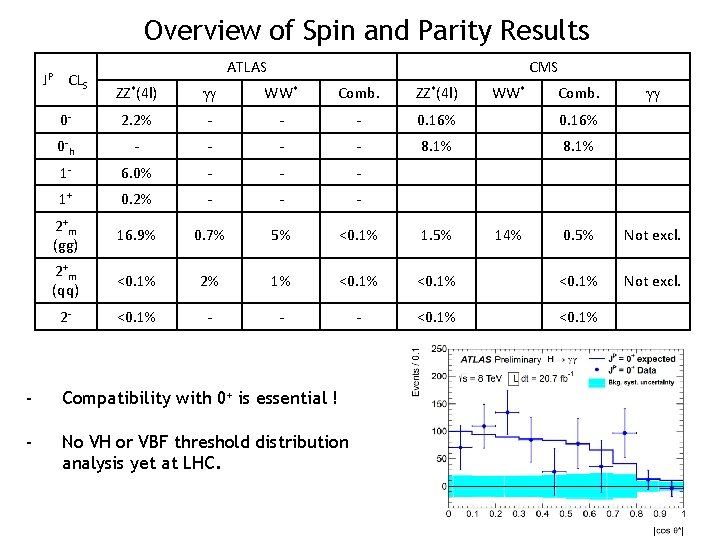
Analysis of Parity in the H 4 l Channel Using the distributions of 2 production and 3 decay angles and Z 1 and Z 2 masses combined in BDT or Matrix Element (MELA) discriminants H ZZ Spin and Parity analyses - Probes 0 - , 1+, 1 -, and spin-2 hypotheses as WW and - Not very sensitive for spin
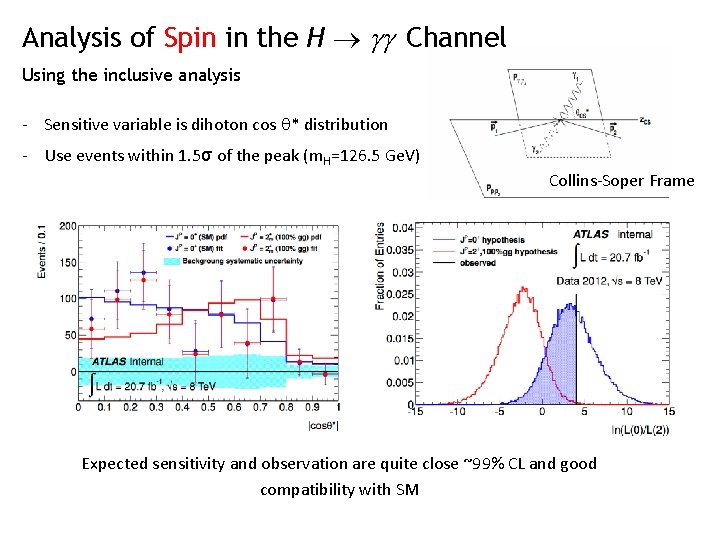
Analysis of Spin in the H gg Channel Using the inclusive analysis - Sensitive variable is dihoton cos q* distribution - Use events within 1. 5σ of the peak (m. H=126. 5 Ge. V) Collins-Soper Frame 1. 4σ Expected sensitivity and observation are quite close ~99% CL and good compatibility with SM
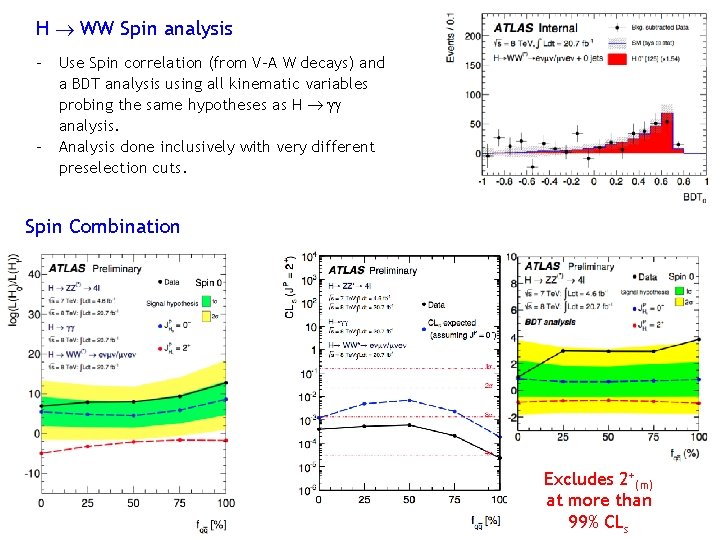
H WW Spin analysis - Use Spin correlation (from V-A W decays) and a BDT analysis using all kinematic variables probing the same hypotheses as H analysis. - Analysis done inclusively with very different preselection cuts. Spin Combination Excludes 2+(m) at more than 99% CLs
Overview of Spin and Parity Results JP CLS ATLAS CMS ZZ*(4 l) WW* Comb. ZZ*(4 l) 0 - 2. 2% - - - 0. 16% 0 - h - - 8. 1% 1 - 6. 0% - - - 1+ 0. 2% - - - 2+m (gg) 16. 9% 0. 7% 5% <0. 1% 1. 5% 2+m (qq) <0. 1% 2% 1% <0. 1% 2 - <0. 1% - - Compatibility with 0+ is essential ! - No VH or VBF threshold distribution analysis yet at LHC. WW* 14% Comb. 0. 5% Not excl. <0. 1%
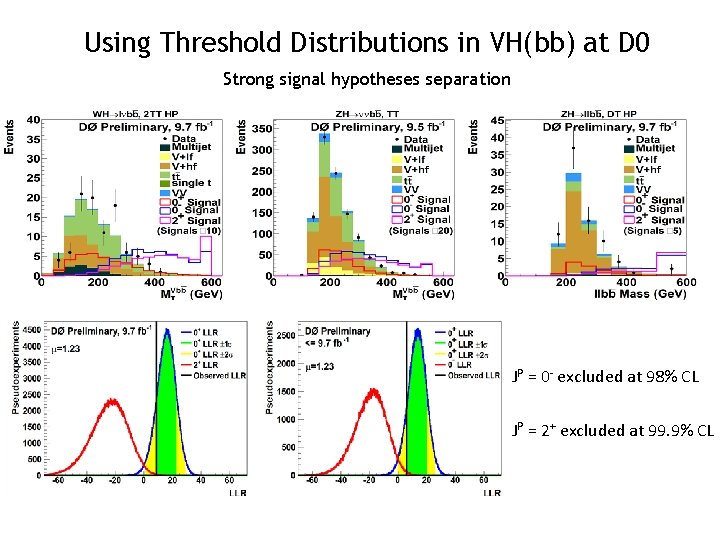
Using Threshold Distributions in VH(bb) at D 0 Strong signal hypotheses separation JP = 0 - excluded at 98% CL JP = 2+ excluded at 99. 9% CL
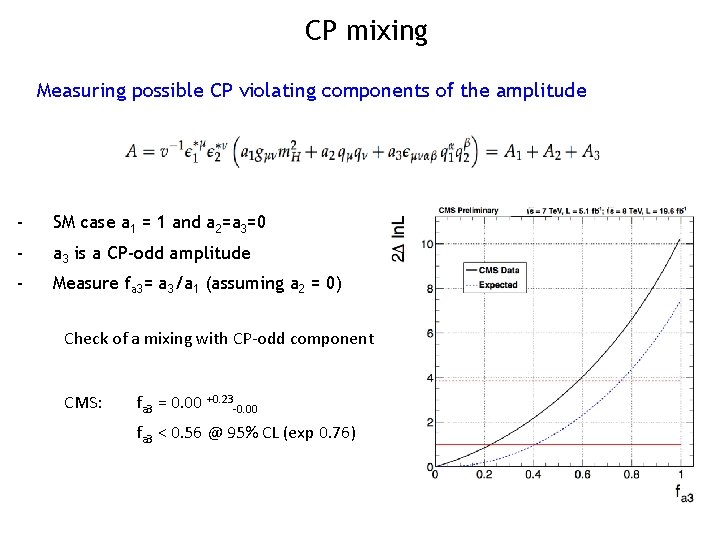
CP mixing Measuring possible CP violating components of the amplitude - SM case a 1 = 1 and a 2=a 3=0 - a 3 is a CP-odd amplitude - Measure fa 3= a 3/a 1 (assuming a 2 = 0) Check of a mixing with CP-odd component CMS: fa 3 = 0. 00 +0. 23 -0. 00 fa 3 < 0. 56 @ 95% CL (exp 0. 76)
Extending… The Higgs sector - Not governed by gauge symmetry - Bears the Flavor Hierarchy problem (responsible for most free parameters of the Standard Model) - …and there is more !
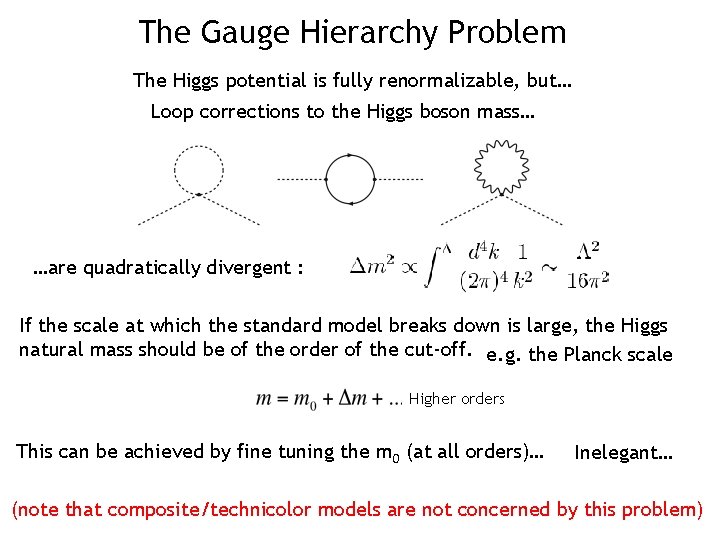
The Gauge Hierarchy Problem The Higgs potential is fully renormalizable, but… Loop corrections to the Higgs boson mass… …are quadratically divergent : If the scale at which the standard model breaks down is large, the Higgs natural mass should be of the order of the cut-off. e. g. the Planck scale Higher orders This can be achieved by fine tuning the m 0 (at all orders)… Inelegant… (note that composite/technicolor models are not concerned by this problem)
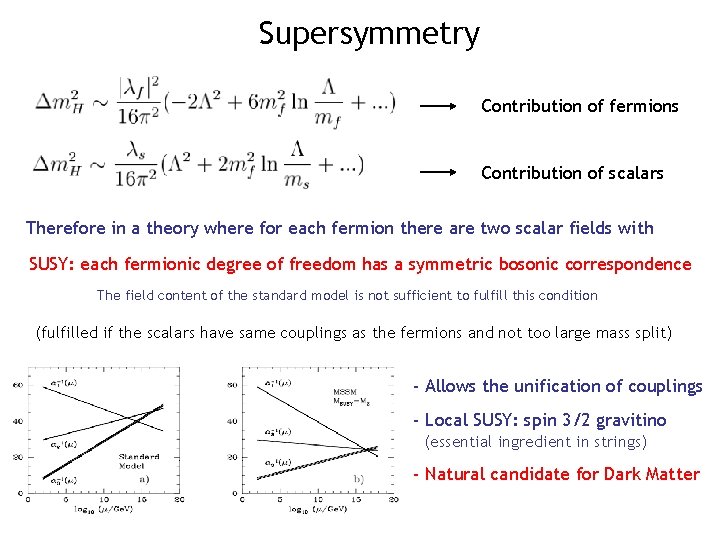
Supersymmetry Contribution of fermions Contribution of scalars Therefore in a theory where for each fermion there are two scalar fields with SUSY: each fermionic degree of freedom has a symmetric bosonic correspondence The field content of the standard model is not sufficient to fulfill this condition (fulfilled if the scalars have same couplings as the fermions and not too large mass split) - Allows the unification of couplings - Local SUSY: spin 3/2 gravitino (essential ingredient in strings) - Natural candidate for Dark Matter
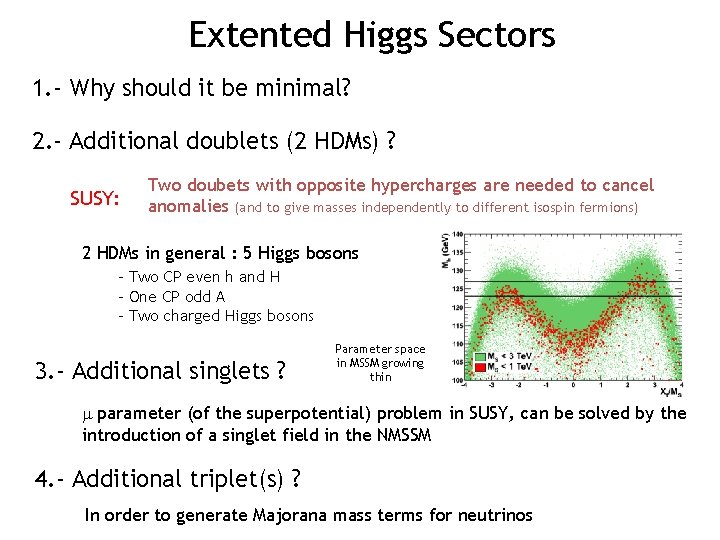
Extented Higgs Sectors 1. - Why should it be minimal? 2. - Additional doublets (2 HDMs) ? SUSY: Two doubets with opposite hypercharges are needed to cancel anomalies (and to give masses independently to different isospin fermions) 2 HDMs in general : 5 Higgs bosons - Two CP even h and H - One CP odd A - Two charged Higgs bosons 3. - Additional singlets ? Parameter space in MSSM growing thin m parameter (of the superpotential) problem in SUSY, can be solved by the introduction of a singlet field in the NMSSM 4. - Additional triplet(s) ? In order to generate Majorana mass terms for neutrinos
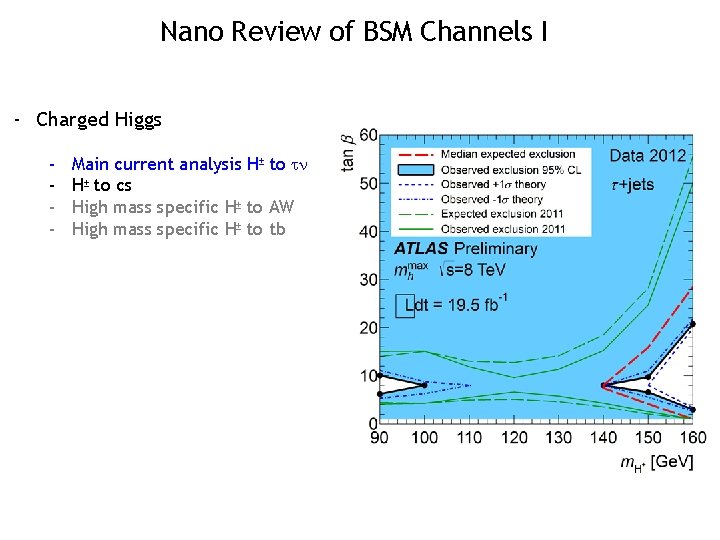
Nano Review of BSM Channels I - Charged Higgs - Main current analysis H± to n H± to cs High mass specific H± to AW High mass specific H± to tb
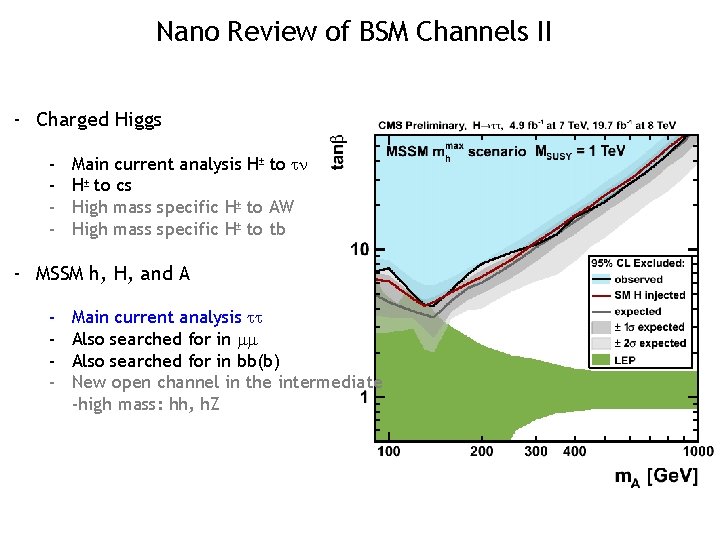
Nano Review of BSM Channels II - Charged Higgs - Main current analysis H± to n H± to cs High mass specific H± to AW High mass specific H± to tb - MSSM h, H, and A - Main current analysis Also searched for in mm Also searched for in bb(b) New open channel in the intermediate -high mass: hh, h. Z
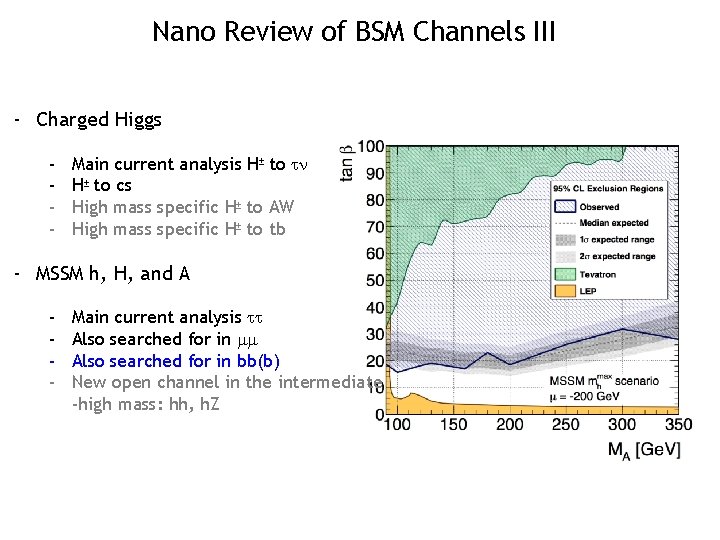
Nano Review of BSM Channels III - Charged Higgs - Main current analysis H± to n H± to cs High mass specific H± to AW High mass specific H± to tb - MSSM h, H, and A - Main current analysis Also searched for in mm Also searched for in bb(b) New open channel in the intermediate -high mass: hh, h. Z
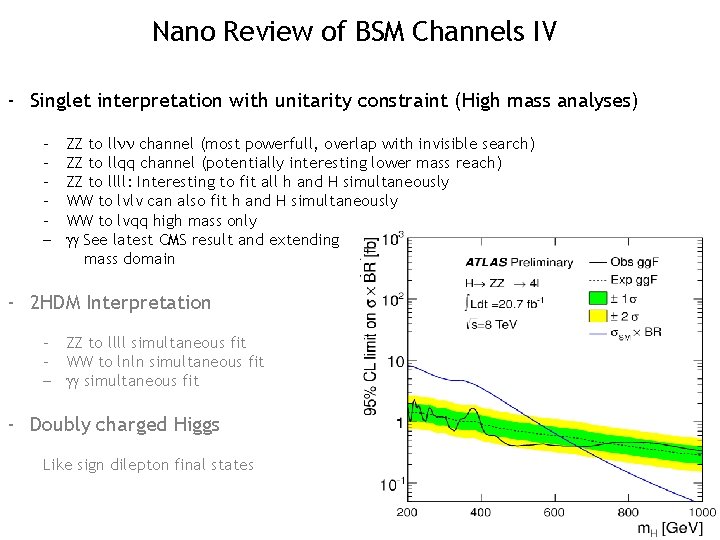
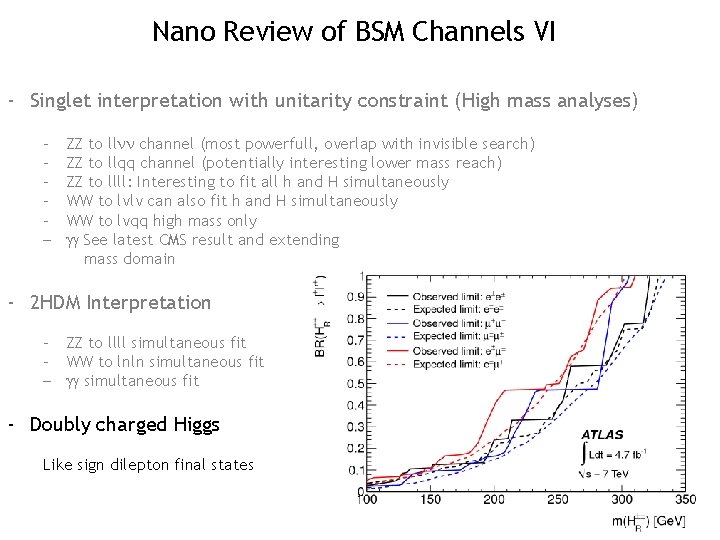
Nano Review of BSM Channels IV - Singlet interpretation with unitarity constraint (High mass analyses) - ZZ to llnn channel (most powerfull, overlap with invisible search) ZZ to llqq channel (potentially interesting lower mass reach) ZZ to llll: Interesting to fit all h and H simultaneously WW to lvlv can also fit h and H simultaneously WW to lvqq high mass only See latest CMS result and extending mass domain - 2 HDM Interpretation - ZZ to llll simultaneous fit - WW to lnln simultaneous fit - Doubly charged Higgs Like sign dilepton final states
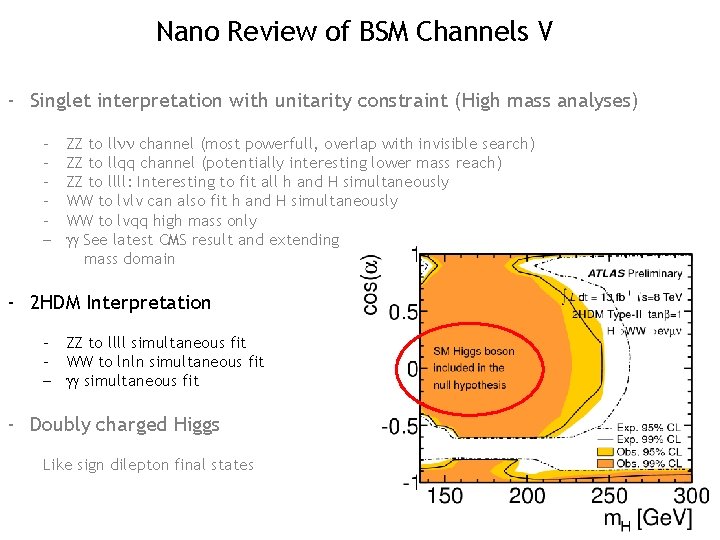
Nano Review of BSM Channels V - Singlet interpretation with unitarity constraint (High mass analyses) - ZZ to llnn channel (most powerfull, overlap with invisible search) ZZ to llqq channel (potentially interesting lower mass reach) ZZ to llll: Interesting to fit all h and H simultaneously WW to lvlv can also fit h and H simultaneously WW to lvqq high mass only See latest CMS result and extending mass domain - 2 HDM Interpretation - ZZ to llll simultaneous fit - WW to lnln simultaneous fit - Doubly charged Higgs Like sign dilepton final states
Nano Review of BSM Channels VI - Singlet interpretation with unitarity constraint (High mass analyses) - ZZ to llnn channel (most powerfull, overlap with invisible search) ZZ to llqq channel (potentially interesting lower mass reach) ZZ to llll: Interesting to fit all h and H simultaneously WW to lvlv can also fit h and H simultaneously WW to lvqq high mass only See latest CMS result and extending mass domain - 2 HDM Interpretation - ZZ to llll simultaneous fit - WW to lnln simultaneous fit - Doubly charged Higgs Like sign dilepton final states
Future projects
The Higgs particle and LHC future prospects High Luminosity scenarios of 300 fb-1 and 3 ab-1
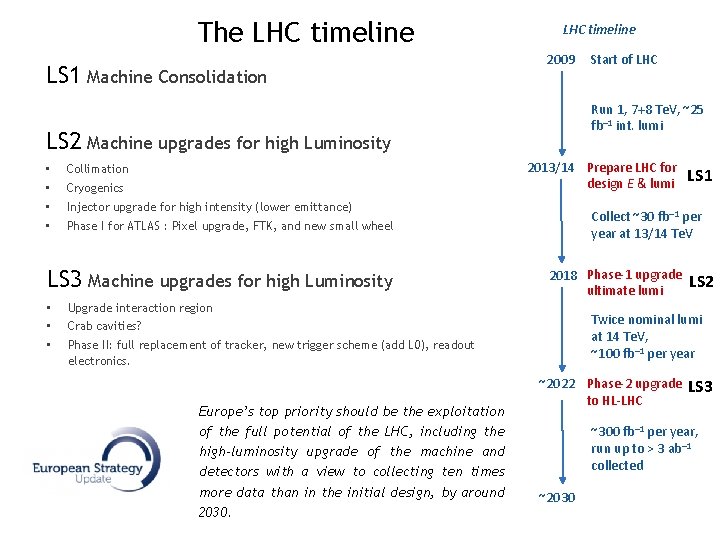
The LHC timeline LS 1 Machine Consolidation LHC timeline 2009 Start of LHC Run 1, 7+8 Te. V, ~25 fb-1 int. lumi LS 2 Machine upgrades for high Luminosity 2013/14 Prepare LHC for design E & lumi • Collimation • Cryogenics • Injector upgrade for high intensity (lower emittance) • Phase I for ATLAS : Pixel upgrade, FTK, and new small wheel LS 3 Machine upgrades for high Luminosity • Upgrade interaction region • Crab cavities? • Phase II: full replacement of tracker, new trigger scheme (add L 0), readout electronics. Europe’s top priority should be the exploitation of the full potential of the LHC, including the high-luminosity upgrade of the machine and detectors with a view to collecting ten times more data than in the initial design, by around 2030. LS 1 Collect ~30 fb-1 per year at 13/14 Te. V 2018 Phase-1 upgrade ultimate lumi LS 2 Twice nominal lumi at 14 Te. V, ~100 fb-1 per year ~2022 Phase-2 upgrade to HL-LHC LS 3 ~300 fb-1 per year, run up to > 3 ab-1 collected ~2030
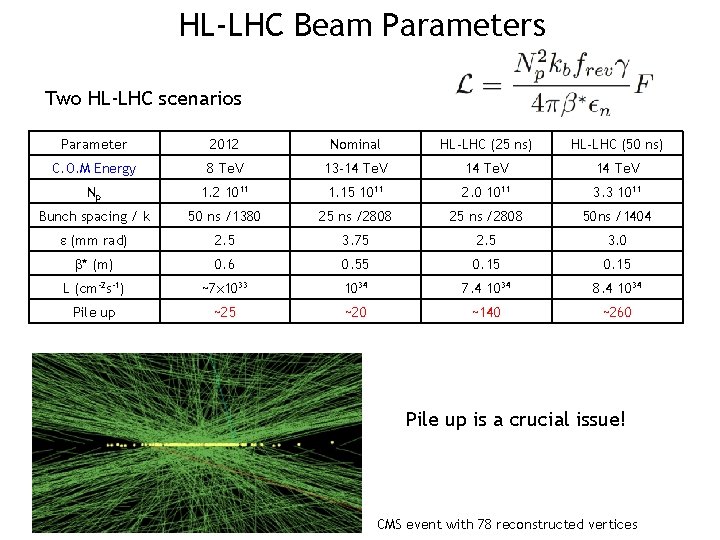
HL-LHC Beam Parameters Two HL-LHC scenarios Parameter 2012 Nominal HL-LHC (25 ns) HL-LHC (50 ns) Event taken at random C. O. M Energy 8 Te. V 13 -14 Te. V Np 1. 2 1011 1. 15 1011 2. 0 1011 3. 3 1011 Bunch spacing / k 50 ns /1380 25 ns /2808 50 ns /1404 e (mm rad) 2. 5 3. 75 2. 5 3. 0 b* (m) 0. 6 0. 55 0. 15 L (cm-2 s-1) ~7 x 1033 1034 7. 4 1034 8. 4 1034 Pile up ~25 ~20 ~140 ~260 (filled) bunch crossings 14 Te. V Pile up is a crucial issue! CMS event with 78 reconstructed vertices
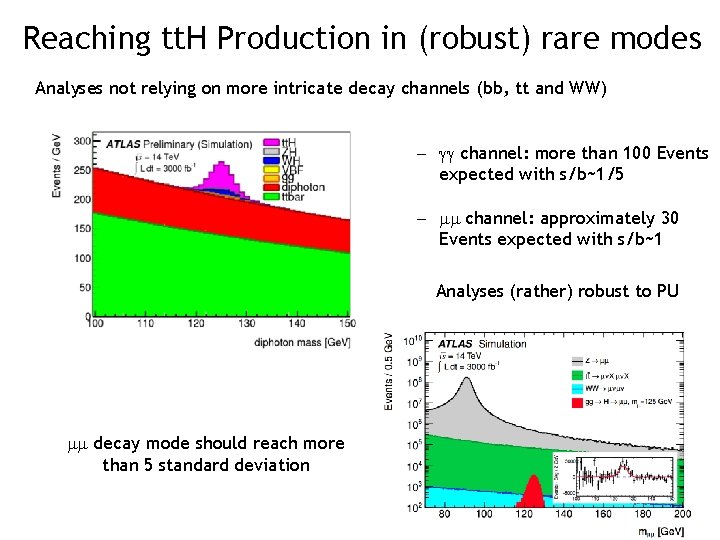
Reaching tt. H Production in (robust) rare modes Analyses not relying on more intricate decay channels (bb, tt and WW) - channel: more than 100 Events expected with s/b~1/5 - mm channel: approximately 30 Events expected with s/b~1 Analyses (rather) robust to PU mm decay mode should reach more than 5 standard deviation
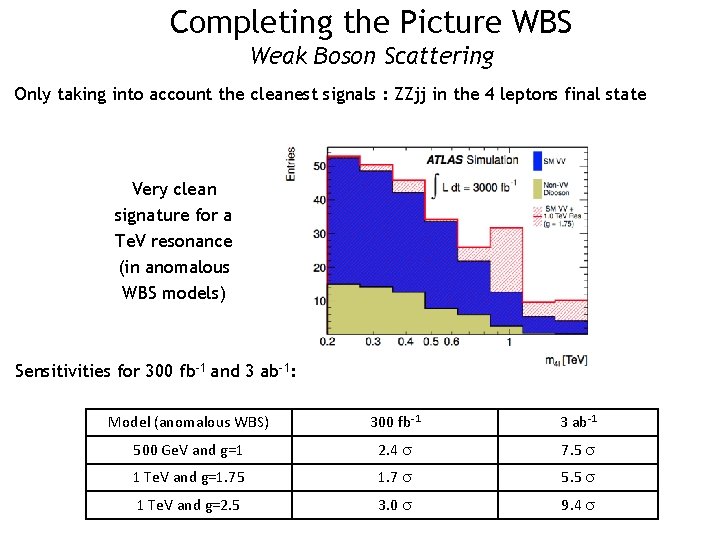
Completing the Picture WBS Weak Boson Scattering Only taking into account the cleanest signals : ZZjj in the 4 leptons final state Very clean signature for a Te. V resonance (in anomalous WBS models) Sensitivities for 300 fb-1 and 3 ab-1: Model (anomalous WBS) 300 fb-1 3 ab-1 500 Ge. V and g=1 2. 4 s 7. 5 s 1 Te. V and g=1. 75 1. 7 s 5. 5 s 1 Te. V and g=2. 5 3. 0 s 9. 4 s
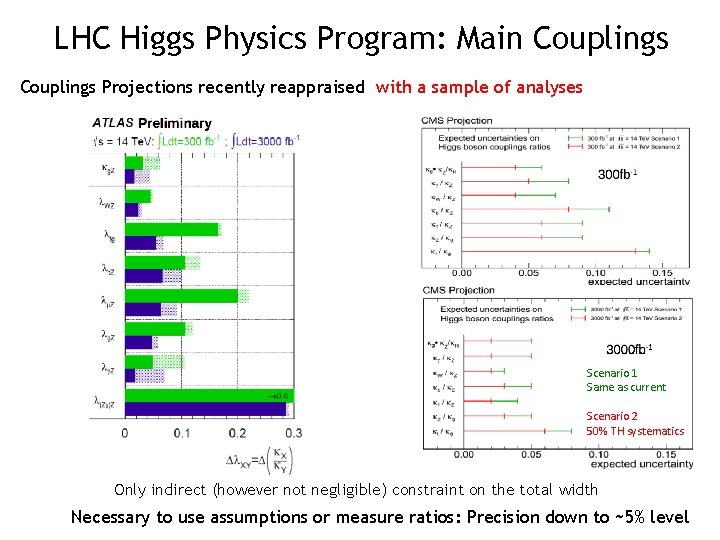
LHC Higgs Physics Program: Main Couplings Projections recently reappraised with a sample of analyses Scenario 1 Same as current Scenario 2 50% TH systematics Only indirect (however not negligible) constraint on the total width Necessary to use assumptions or measure ratios: Precision down to ~5% level
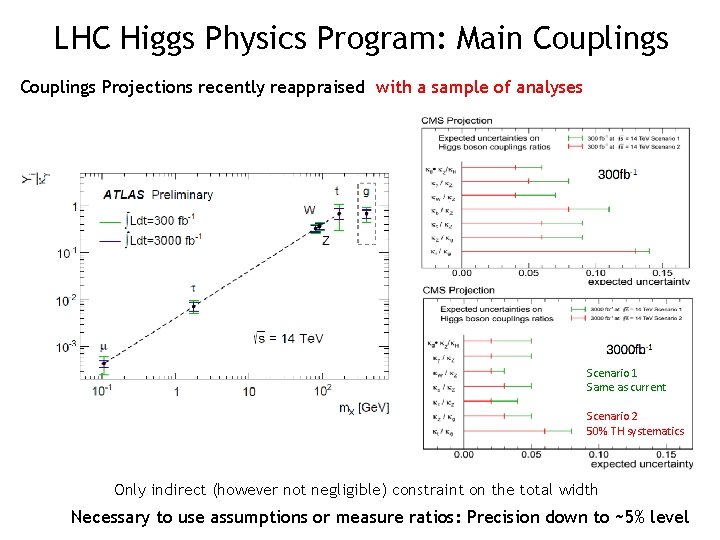
LHC Higgs Physics Program: Main Couplings Projections recently reappraised with a sample of analyses Scenario 1 Same as current Scenario 2 50% TH systematics Only indirect (however not negligible) constraint on the total width Necessary to use assumptions or measure ratios: Precision down to ~5% level
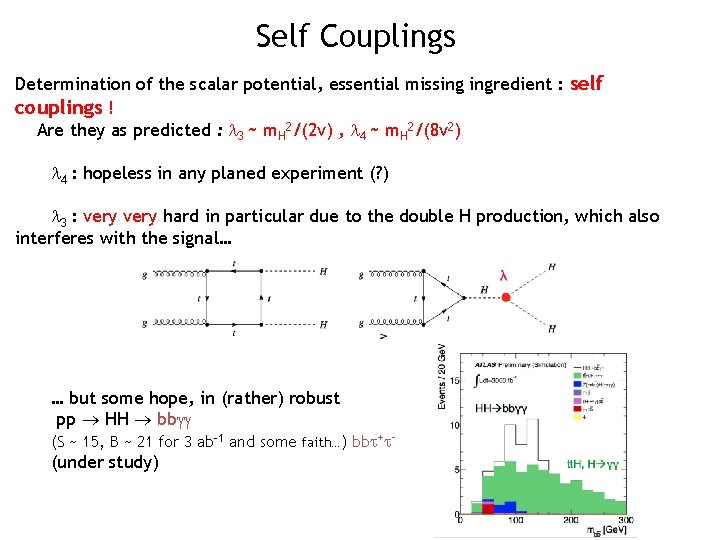
Self Couplings Determination of the scalar potential, essential missing ingredient : self couplings ! Are they as predicted : 3 ~ m. H 2/(2 v) , 4 ~ m. H 2/(8 v 2) 4 : hopeless in any planed experiment (? ) 3 : very hard in particular due to the double H production, which also interferes with the signal… … but some hope, in (rather) robust pp HH bb (S ~ 15, B ~ 21 for 3 ab-1 and some faith…) bb + - (under study)
New Trends Interferometry ! Limits at 3 ab-1 around 200 Me. V on total width CP properties Exploring the complexe structure of couplings
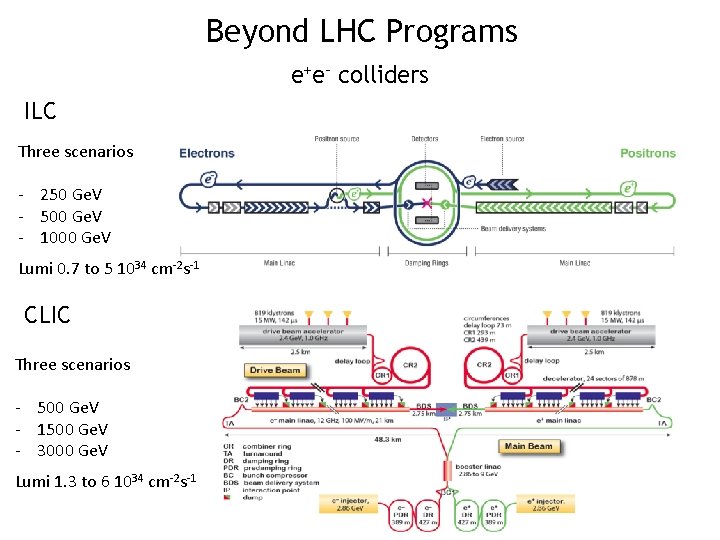
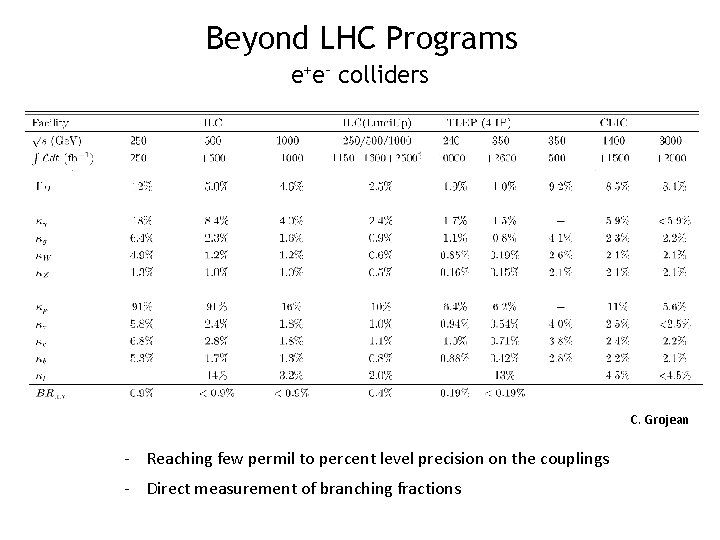
Beyond LHC Programs e+e- colliders ILC Three scenarios - 250 Ge. V - 500 Ge. V - 1000 Ge. V Lumi 0. 7 to 5 1034 cm-2 s-1 CLIC Three scenarios - 500 Ge. V - 1500 Ge. V - 3000 Ge. V Lumi 1. 3 to 6 1034 cm-2 s-1
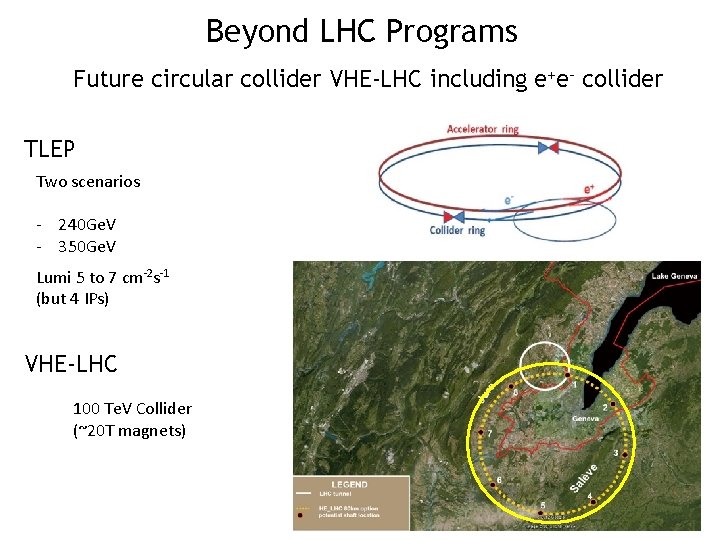
Beyond LHC Programs Future circular collider VHE-LHC including e+e- collider TLEP Two scenarios - 240 Ge. V - 350 Ge. V Lumi 5 to 7 cm-2 s-1 (but 4 IPs) VHE-LHC 100 Te. V Collider (~20 T magnets)
Beyond LHC Programs e+e- colliders C. Grojean - Reaching few permil to percent level precision on the couplings - Direct measurement of branching fractions
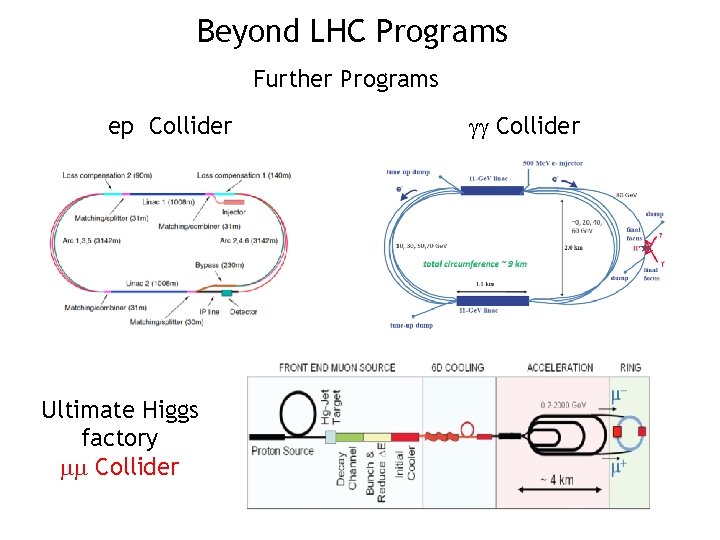
Beyond LHC Programs Further Programs ep Collider Ultimate Higgs factory mm Collider
Conclusions and Outlook
Three Years of LHC at the Energy Frontier Two fundamental observations - The discovery of the 126 Ge. V (Standard Model-like) Higgs boson: The main missing key piece of the Standard Model! - Nothing else!
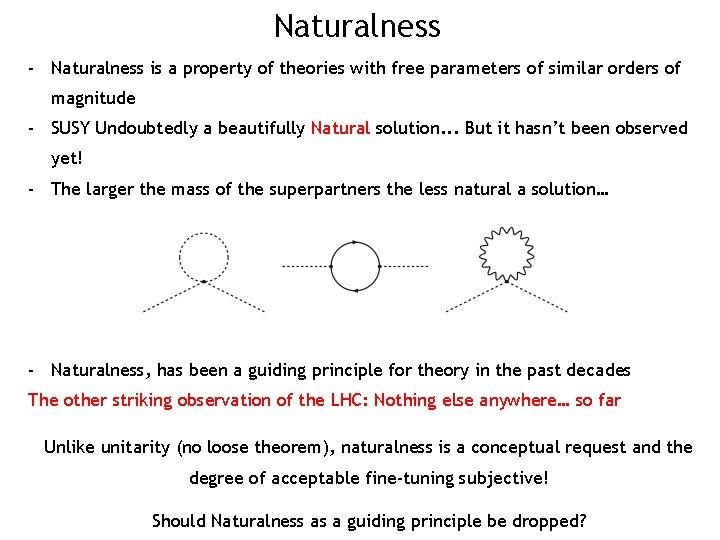
Naturalness - Naturalness is a property of theories with free parameters of similar orders of magnitude - SUSY Undoubtedly a beautifully Natural solution. . . But it hasn’t been observed yet! - The larger the mass of the superpartners the less natural a solution… - Naturalness, has been a guiding principle for theory in the past decades The other striking observation of the LHC: Nothing else anywhere… so far Unlike unitarity (no loose theorem), naturalness is a conceptual request and the degree of acceptable fine-tuning subjective! Should Naturalness as a guiding principle be dropped?
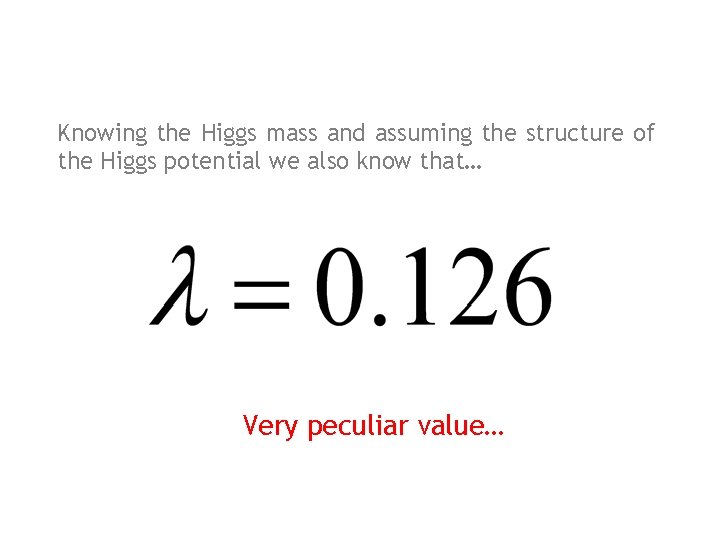
Knowing the Higgs mass and assuming the structure of the Higgs potential we also know that… Very peculiar value…
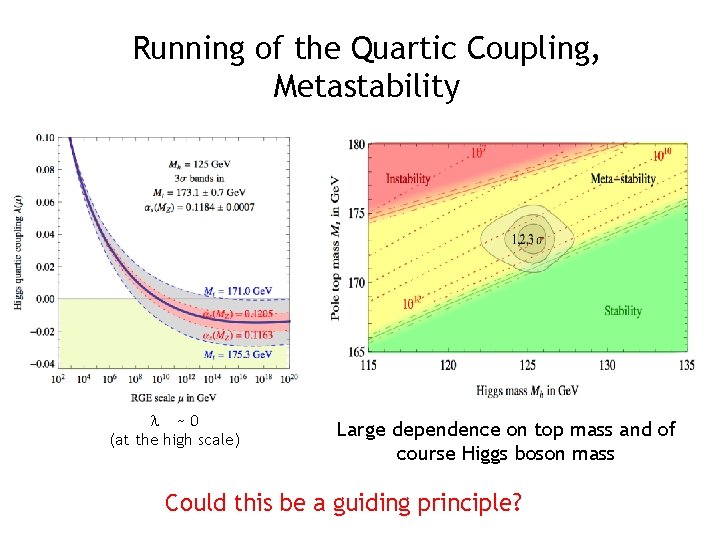
Running of the Quartic Coupling, Metastability ~0 (at the high scale) Large dependence on top mass and of course Higgs boson mass Could this be a guiding principle?
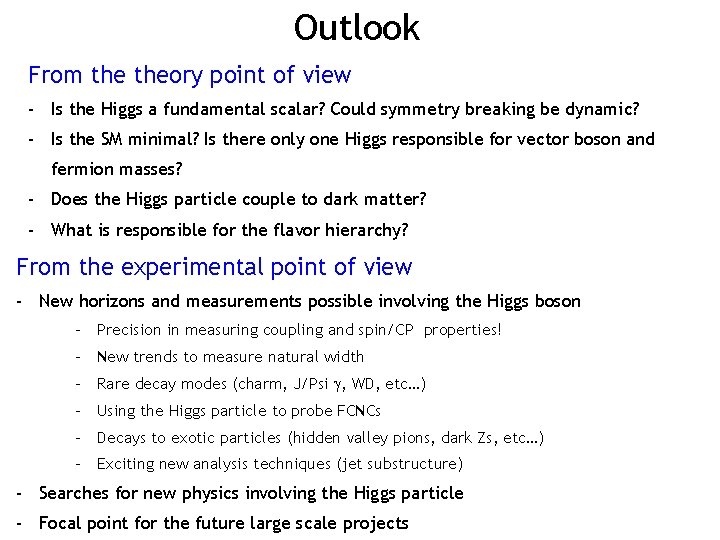
Outlook From theory point of view - Is the Higgs a fundamental scalar? Could symmetry breaking be dynamic? - Is the SM minimal? Is there only one Higgs responsible for vector boson and fermion masses? - Does the Higgs particle couple to dark matter? - What is responsible for the flavor hierarchy? From the experimental point of view - New horizons and measurements possible involving the Higgs boson - Precision in measuring coupling and spin/CP properties! - New trends to measure natural width - Rare decay modes (charm, J/Psi , WD, etc…) - Using the Higgs particle to probe FCNCs - Decays to exotic particles (hidden valley pions, dark Zs, etc…) - Exciting new analysis techniques (jet substructure) - Searches for new physics involving the Higgs particle - Focal point for the future large scale projects
Thank You !