
The Higgs Boson Observation probably Not just another
The Higgs Boson Observation (probably) Not just another fundamental particle… Matthew Jones Purdue University 27 -July-2012 July 27, 2012 Purdue Quark. Net Summer Workshop 1
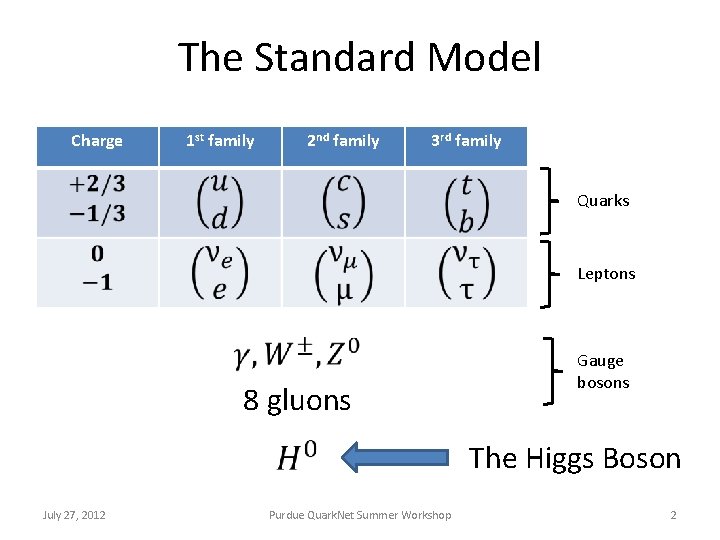
The Standard Model Charge 1 st family 2 nd family 3 rd family Quarks Leptons 8 gluons July 27, 2012 Purdue Quark. Net Summer Workshop Gauge bosons The Higgs Boson 2
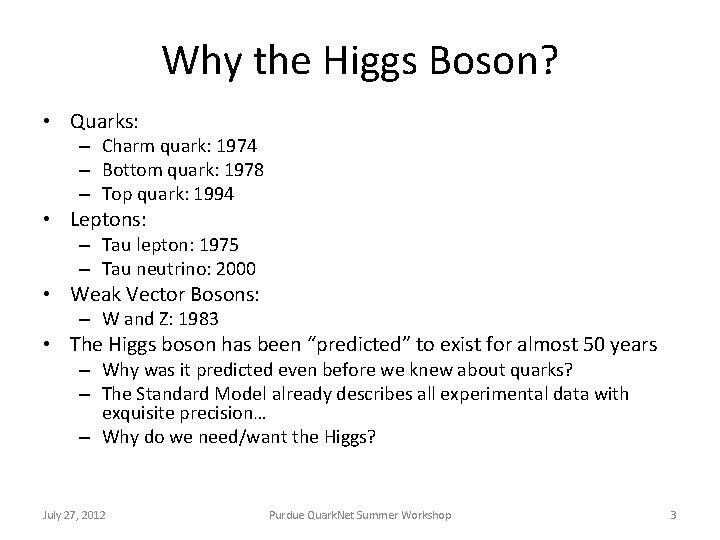
Why the Higgs Boson? • Quarks: – Charm quark: 1974 – Bottom quark: 1978 – Top quark: 1994 • Leptons: – Tau lepton: 1975 – Tau neutrino: 2000 • Weak Vector Bosons: – W and Z: 1983 • The Higgs boson has been “predicted” to exist for almost 50 years – Why was it predicted even before we knew about quarks? – The Standard Model already describes all experimental data with exquisite precision… – Why do we need/want the Higgs? July 27, 2012 Purdue Quark. Net Summer Workshop 3
Quantum Field Theory in 30 Minutes Over the years, our description of the most fundamental laws of Nature has evolved… July 27, 2012 Purdue Quark. Net Summer Workshop 4
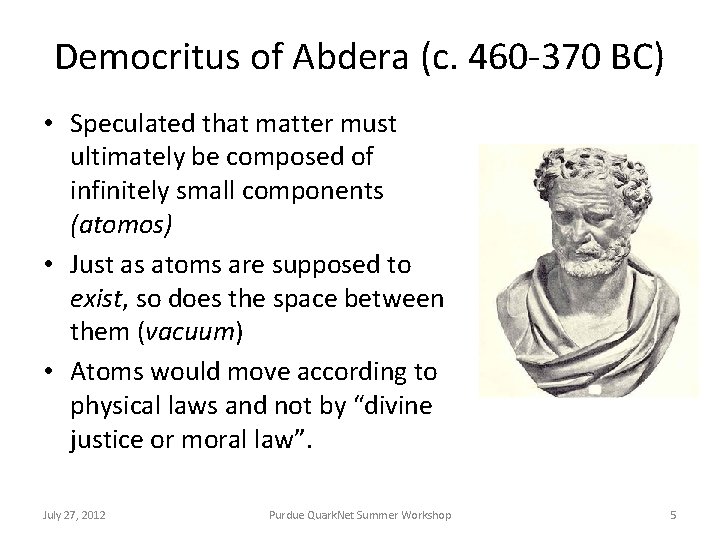
Democritus of Abdera (c. 460 -370 BC) • Speculated that matter must ultimately be composed of infinitely small components (atomos) • Just as atoms are supposed to exist, so does the space between them (vacuum) • Atoms would move according to physical laws and not by “divine justice or moral law”. July 27, 2012 Purdue Quark. Net Summer Workshop 5

Classical Mechanics Special relativity modifies the form of these equations but the idea is the same. July 27, 2012 Purdue Quark. Net Summer Workshop 6
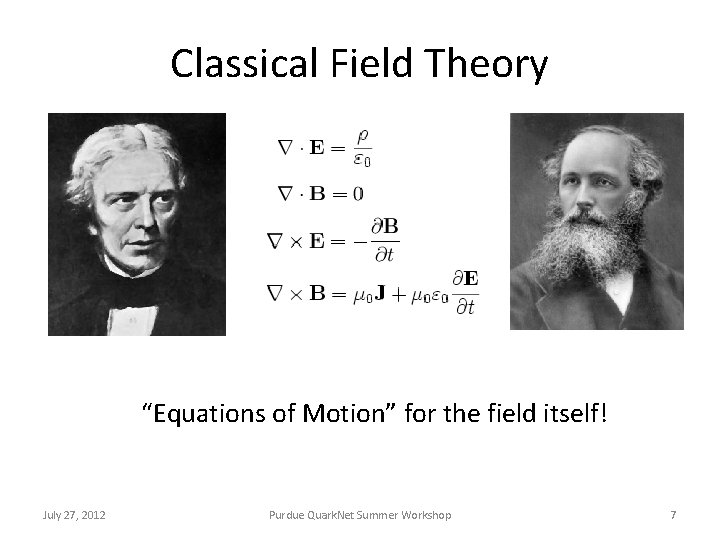
Classical Field Theory “Equations of Motion” for the field itself! July 27, 2012 Purdue Quark. Net Summer Workshop 7
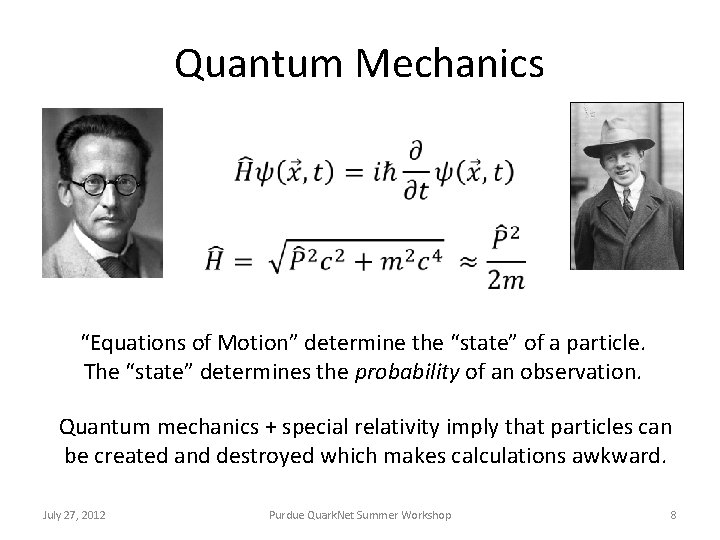
Quantum Mechanics “Equations of Motion” determine the “state” of a particle. The “state” determines the probability of an observation. Quantum mechanics + special relativity imply that particles can be created and destroyed which makes calculations awkward. July 27, 2012 Purdue Quark. Net Summer Workshop 8
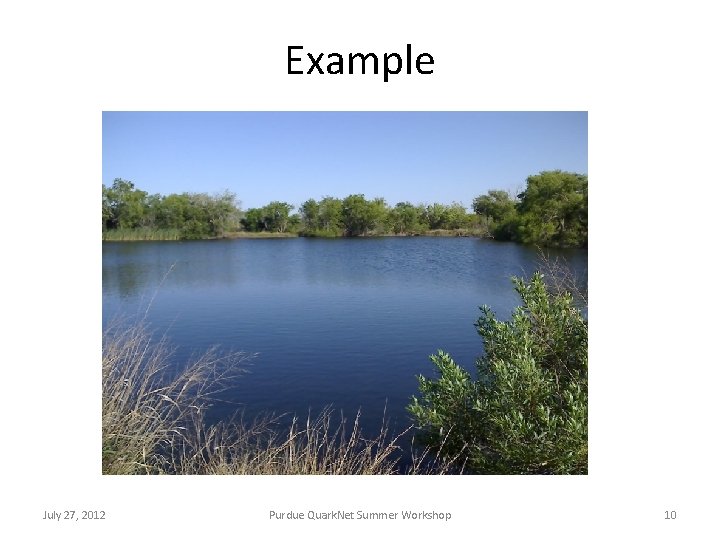
Quantum Field Theory • The particle is not fundamental – the field is: – The photon is a quantum excitation of the electromagnetic field – An electron could be a quantum excitation of the “electron field” • We need equations of motion that tell us what the field is doing at each point in space – Even if there is no electron, there is still an electron field… – One, two, or more electrons are just different ways to excite the field. July 27, 2012 Purdue Quark. Net Summer Workshop 9
Example July 27, 2012 Purdue Quark. Net Summer Workshop 10
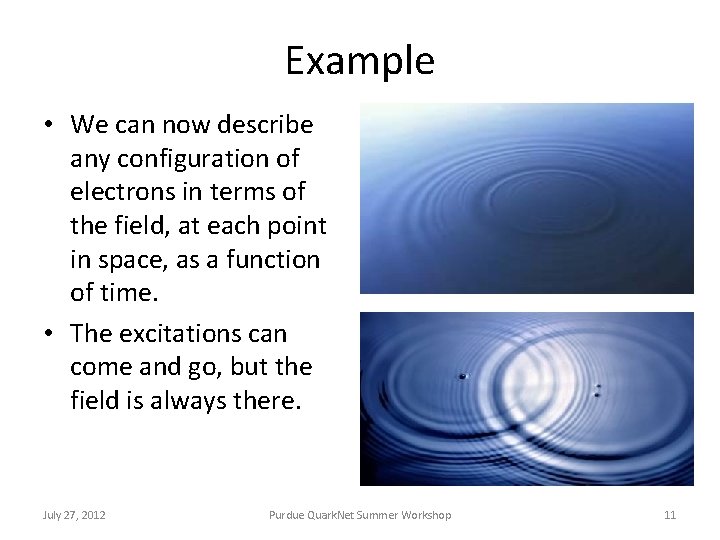
Example • We can now describe any configuration of electrons in terms of the field, at each point in space, as a function of time. • The excitations can come and go, but the field is always there. July 27, 2012 Purdue Quark. Net Summer Workshop 11
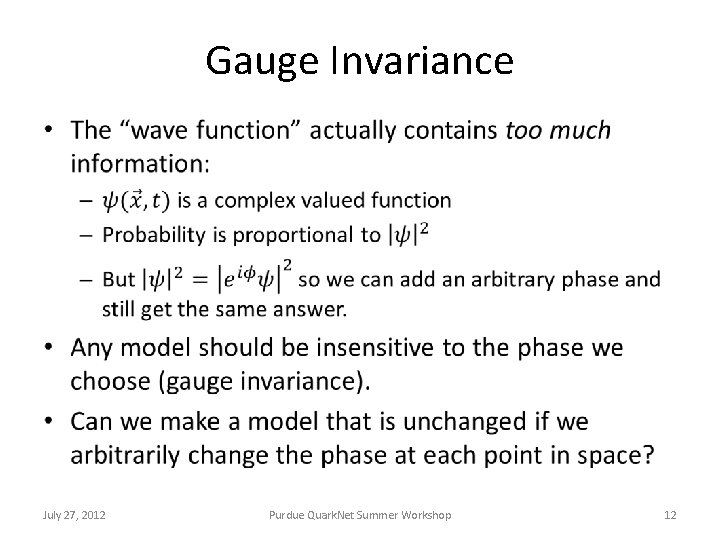
Gauge Invariance • July 27, 2012 Purdue Quark. Net Summer Workshop 12
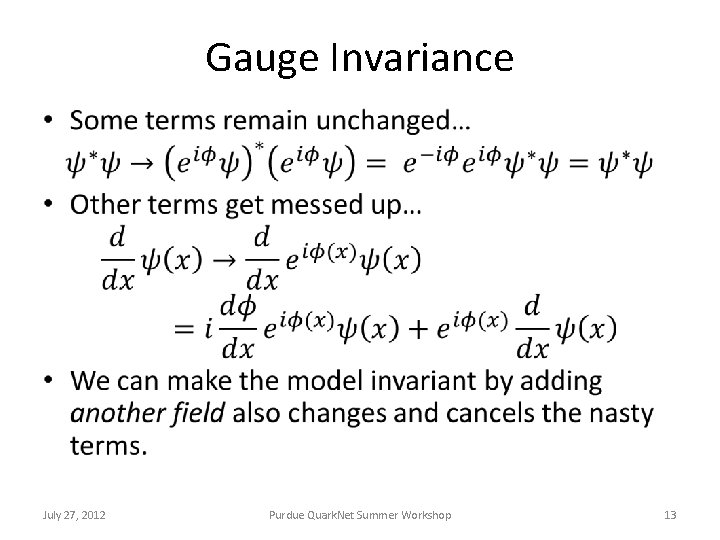
Gauge Invariance • July 27, 2012 Purdue Quark. Net Summer Workshop 13
Gauge Invariance • The extra field has to be spin-1 for this to work – We call it a “gauge boson” – It also has to be massless. • Its interaction with an electron field is completely constrained except for an unknown constant – But we can measure it in an experiment • It has all the properties of the electromagnetic field. – The constant is the charge of an electron • This is Quantum Electrodynamics: – the relativistic quantum field theory of electrons, positrons and photons. July 27, 2012 Purdue Quark. Net Summer Workshop 14
Quantum Chromodynamics • Quarks carry one of three “color charges” – But we can’t observe them directly… the hadrons are colorless combinations of quarks. • We can define how to label the colors differently at each point in space. • To keep the model unchanged we have to add new particles: – – We need to add 8 of them We call them “gluons” They must have spin-1 They must be massless • As far as we can tell, they are… • This seems to be a perfect description of the strong force July 27, 2012 Purdue Quark. Net Summer Workshop 15
Weak Interactions • QED and QCD work so well that we use these ideas to describe other “symmetries”… • As far as the weak interaction is concerned, the up and down quarks are the same. – We can tell them apart by means of their electric charge, but the weak force doesn’t care about electric charge. • Same with the electron and the electron neutrino – We can tell them apart because they have different mass and charge, but the weak interaction doesn’t care. July 27, 2012 Purdue Quark. Net Summer Workshop 16
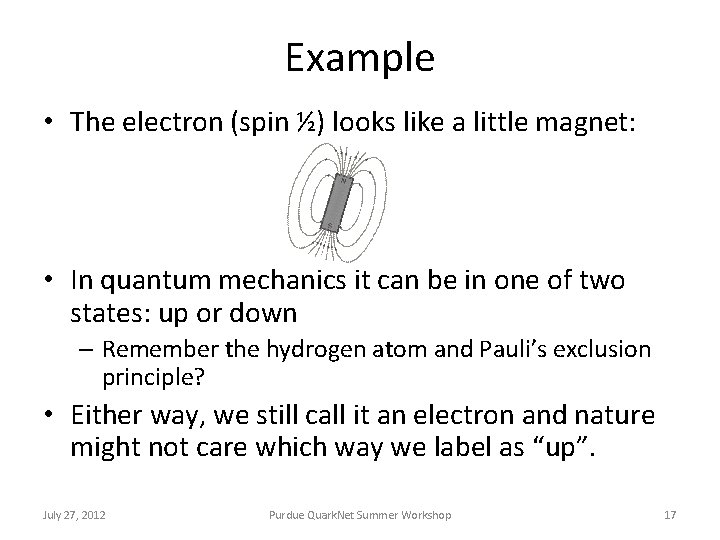
Example • The electron (spin ½) looks like a little magnet: • In quantum mechanics it can be in one of two states: up or down – Remember the hydrogen atom and Pauli’s exclusion principle? • Either way, we still call it an electron and nature might not care which way we label as “up”. July 27, 2012 Purdue Quark. Net Summer Workshop 17
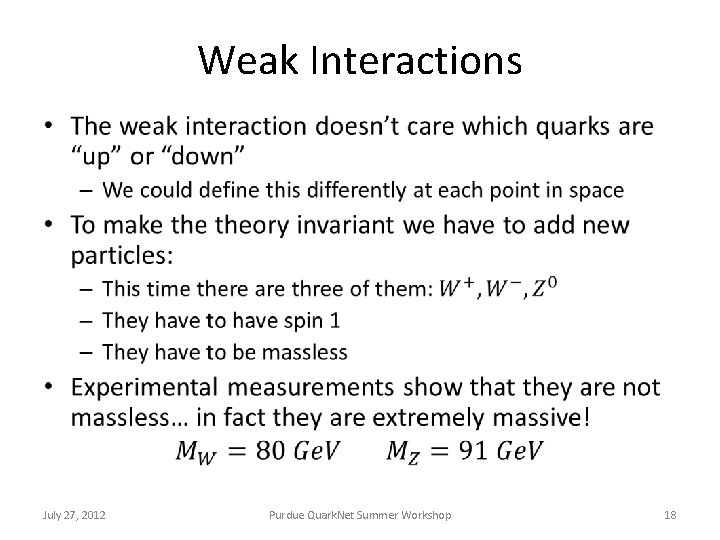
Weak Interactions • July 27, 2012 Purdue Quark. Net Summer Workshop 18
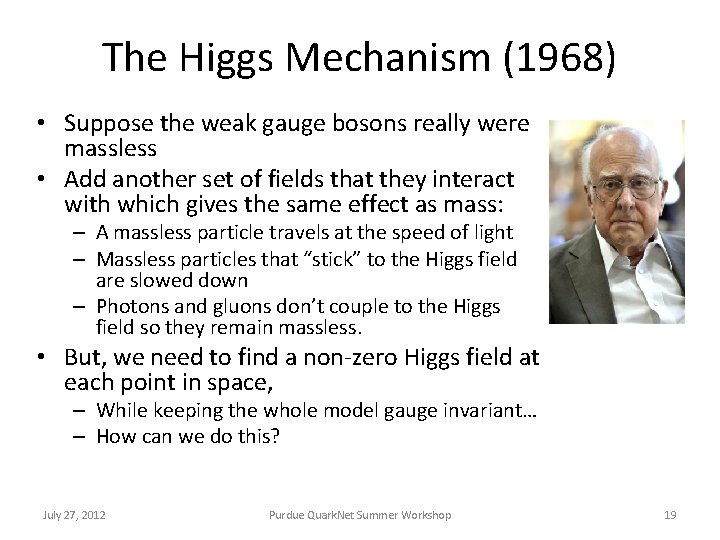
The Higgs Mechanism (1968) • Suppose the weak gauge bosons really were massless • Add another set of fields that they interact with which gives the same effect as mass: – A massless particle travels at the speed of light – Massless particles that “stick” to the Higgs field are slowed down – Photons and gluons don’t couple to the Higgs field so they remain massless. • But, we need to find a non-zero Higgs field at each point in space, – While keeping the whole model gauge invariant… – How can we do this? July 27, 2012 Purdue Quark. Net Summer Workshop 19
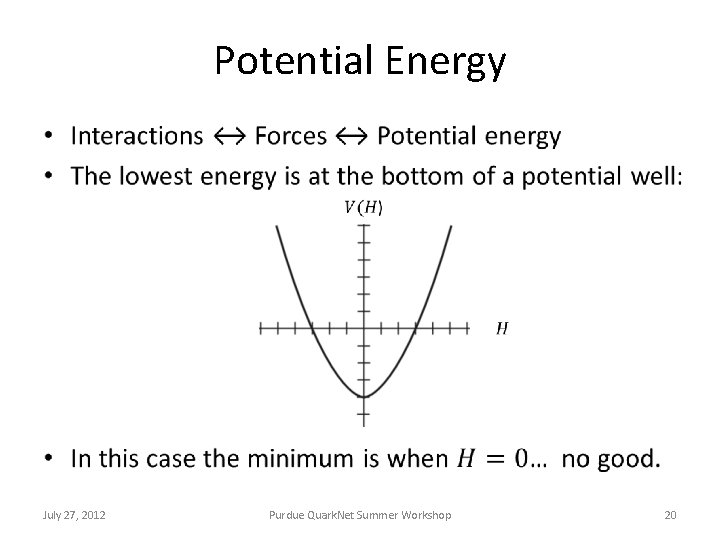
Potential Energy • July 27, 2012 Purdue Quark. Net Summer Workshop 20
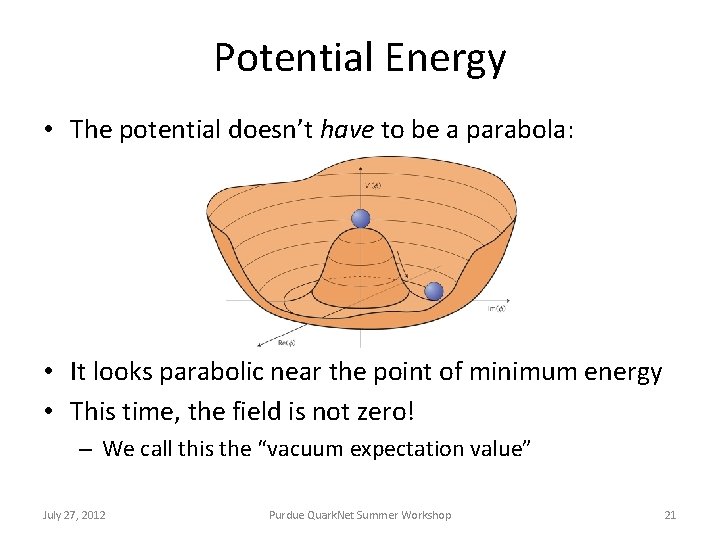
Potential Energy • The potential doesn’t have to be a parabola: • It looks parabolic near the point of minimum energy • This time, the field is not zero! – We call this the “vacuum expectation value” July 27, 2012 Purdue Quark. Net Summer Workshop 21
The Standard Model • • Start with massless quarks and leptons Group them into up-down pairs Add massless gauge bosons Add a Higgs field – Give it a potential energy with a non-zero vacuum expectation value • Voila! – Massive quarks and leptons – Massive gauge bosons July 27, 2012 Purdue Quark. Net Summer Workshop 22
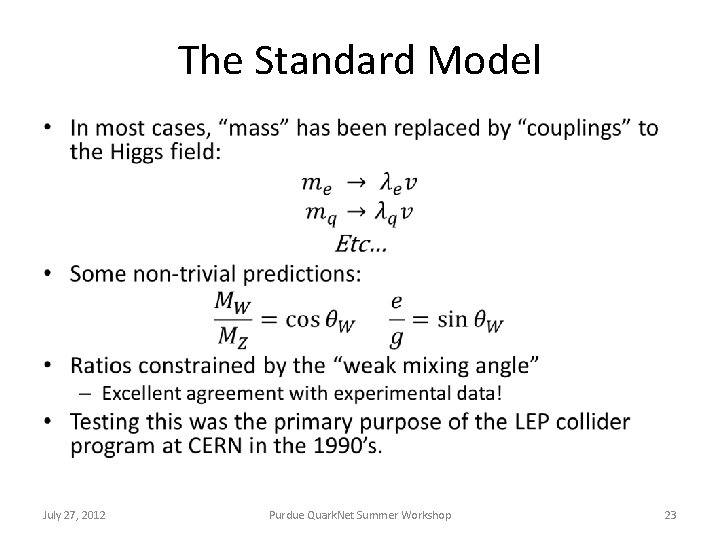
The Standard Model • July 27, 2012 Purdue Quark. Net Summer Workshop 23
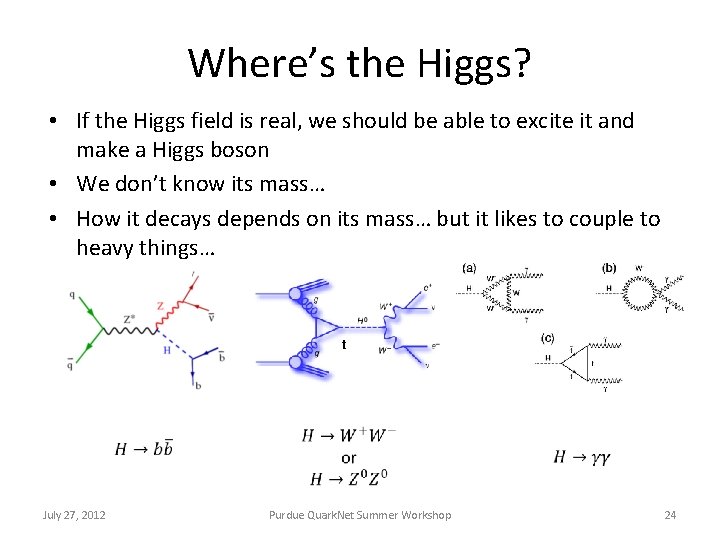
Where’s the Higgs? • If the Higgs field is real, we should be able to excite it and make a Higgs boson • We don’t know its mass… • How it decays depends on its mass… but it likes to couple to heavy things… t July 27, 2012 Purdue Quark. Net Summer Workshop 24
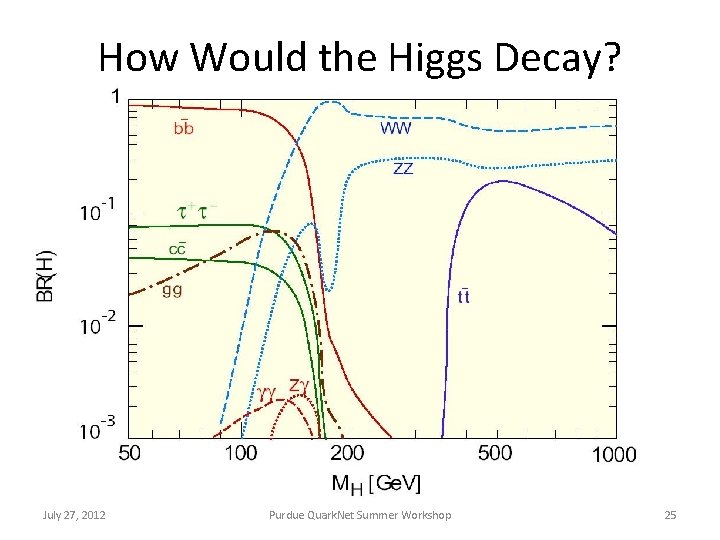
How Would the Higgs Decay? July 27, 2012 Purdue Quark. Net Summer Workshop 25
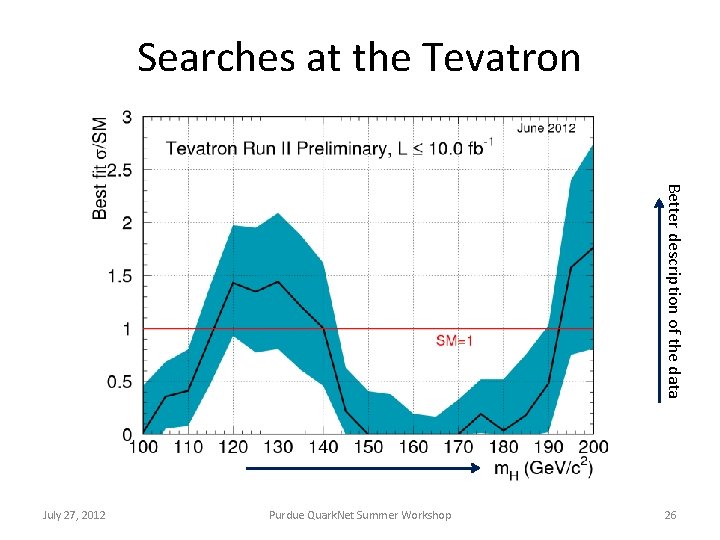
Searches at the Tevatron Better description of the data July 27, 2012 Purdue Quark. Net Summer Workshop 26
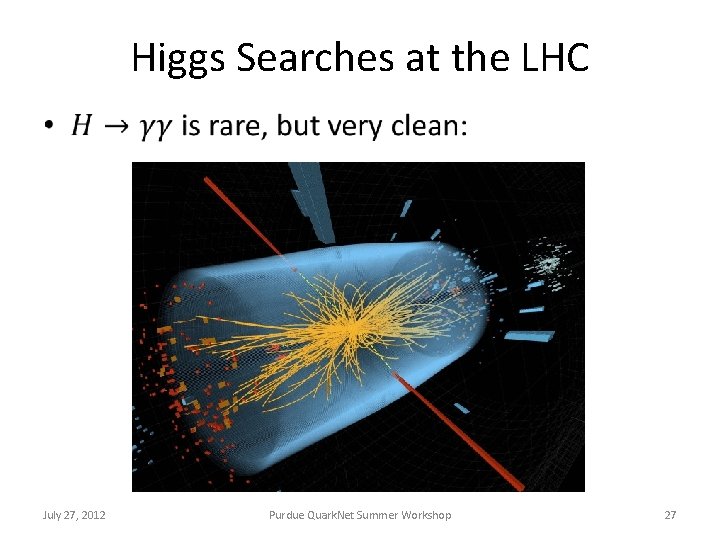
Higgs Searches at the LHC • July 27, 2012 Purdue Quark. Net Summer Workshop 27
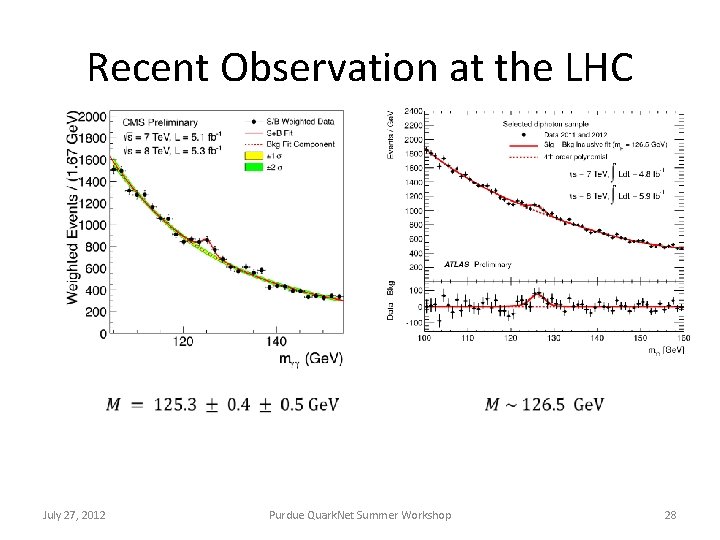
Recent Observation at the LHC July 27, 2012 Purdue Quark. Net Summer Workshop 28
Is it the Higgs? • How to check? – Is its coupling strength proportional to mass? – Is it spin zero? – Does it decay in all the ways we expect? • Still some open questions: – The Higgs couples to itself… what keeps the Higgs mass from getting too big? – Neutrinos do have mass… – Still no good ideas for quantizing gravity or explaining dark matter – As usual, we can solve these problems by adding new particles to theory. • So far we see no evidence for any of them. July 27, 2012 Purdue Quark. Net Summer Workshop 29
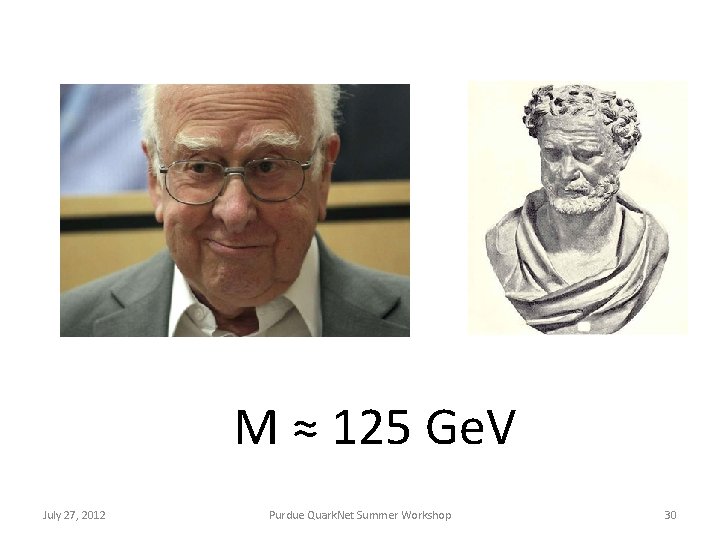
M ≈ 125 Ge. V July 27, 2012 Purdue Quark. Net Summer Workshop 30
- Slides: 30