
The Hidden Traps in Decision Making By Jodi
The Hidden Traps in Decision Making By Jodi Demerly MGT 366 F
Topics of Discussion • The Anchoring Trap • The Status-Quo Trap • The Sunk Cost Trap • The Confirming-Evidence Trap • The Framing Trap • The Estimating and Forecasting Trap • The overconfidence trap • The prudence trap • The recallability trap

The Anchoring Trap Basing decisions on the past: • Events • Trends Ways to avoid: • Use different perspectives • Be open minded • Be sure to have your own thought on a problem to avoid being anchored by others ideas
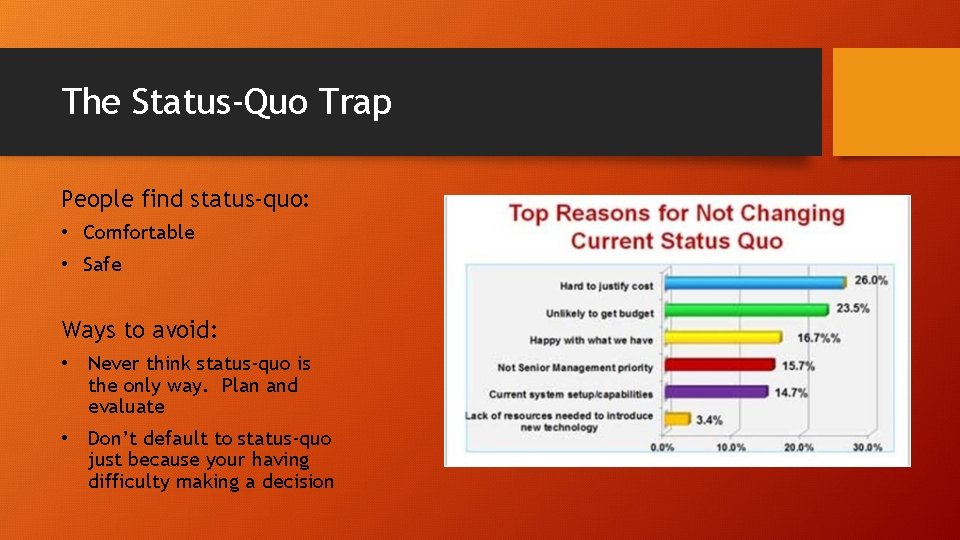
The Status-Quo Trap People find status-quo: • Comfortable • Safe Ways to avoid: • Never think status-quo is the only way. Plan and evaluate • Don’t default to status-quo just because your having difficulty making a decision
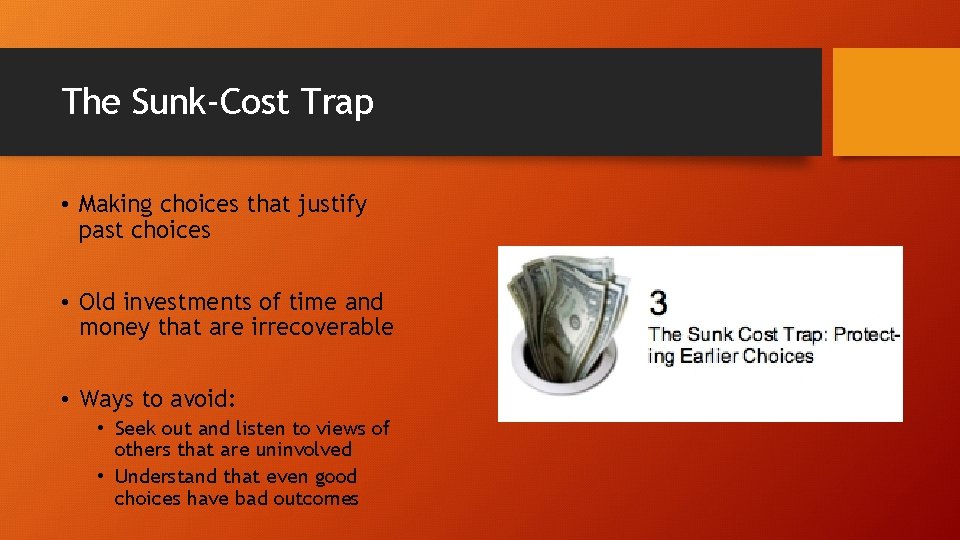
The Sunk-Cost Trap • Making choices that justify past choices • Old investments of time and money that are irrecoverable • Ways to avoid: • Seek out and listen to views of others that are uninvolved • Understand that even good choices have bad outcomes
The Confirming-Evidence Trap • Seeking information that supports an existing thought, while avoiding information that contradicts it • People tend to decide what they want to do before actually thinking about it • Naturally people are more inclined to things they like then things they don’t like • Ways to avoid: • Examine all the evidence, avoid just confirming without proof • Have a “no” man or someone to play devils advocate • Know your motive. Are you looking for confirming evidence?

The Framing Trap • The first step in making a decision is to frame the question • Pay careful attention of how the question is framed because it can profoundly influence the choice you make. • The same question worded differently can generate different responses • A poorly framed question can undermine the best considered decision • Ways to avoid: • Do not just accept the initial frame, look at it in different ways • When making a decision have different framed questions to look at and compare. That way you can observe the different thought patterns that occur

The Estimating and Forecasting Trap • Estimates and forecasting about uncertain events • The overconfidence trap • Accuracy errors that can lead to errors in judgment, leading to bad decisions • Narrow range of thinking • The prudence trap • On the safe side • To much or too little can be dangerous • The recallability trap • Predictions about future events based on memory • Over influenced from dramatic events
References • Hammond, J. R. , & Smith, D. K. (2005). The Discipline of teams. Boston: Harvard Business Review. #R 0507 P
- Slides: 9