
The Helsinki Water Convention History main provisions and
- Slides: 40
The Helsinki Water Convention: History, main provisions and lessons learned Sonja Koeppel Water Convention secretariat 27 February 2017 Twitte r Faceboo k You. Tub e UNEC E
Outline § History of the Helsinki Water Convention and lessons learned of the negotiations process Break for discussion and questions § Structure and main provisions § Institutional structure and current activities § Lessons learned Break for discussion and questions § SDG indicator 6. 5. 2 and its monitoring and reporting exercise 2
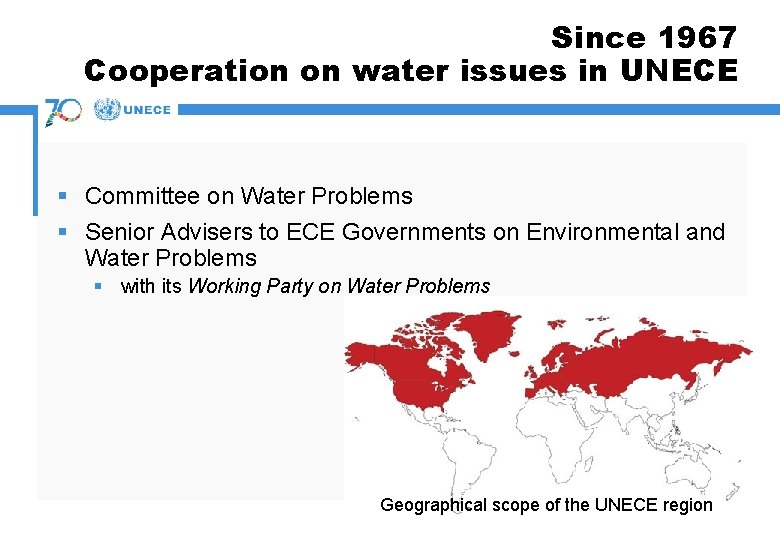
Since 1967 Cooperation on water issues in UNECE § Committee on Water Problems § Senior Advisers to ECE Governments on Environmental and Water Problems § with its Working Party on Water Problems Geographical scope of the UNECE region 3
Major achievements by 1989 § ECE Principles on Cooperation in the field of Transboundary Waters § ECE Declaration of Policy on Prevention and Control of Water Pollution, including Transboundary Pollution § ECE Charter on Ground-Water management § Code of Conduct on Accidental Pollution of Transboundary Inland Waters 4
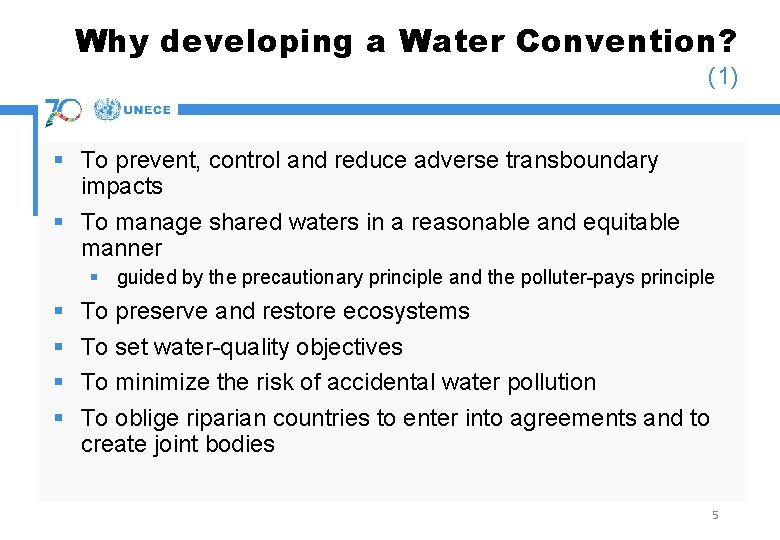
Why developing a Water Convention? (1) § To prevent, control and reduce adverse transboundary impacts § To manage shared waters in a reasonable and equitable manner § guided by the precautionary principle and the polluter-pays principle § § To preserve and restore ecosystems To set water-quality objectives To minimize the risk of accidental water pollution To oblige riparian countries to enter into agreements and to create joint bodies 5
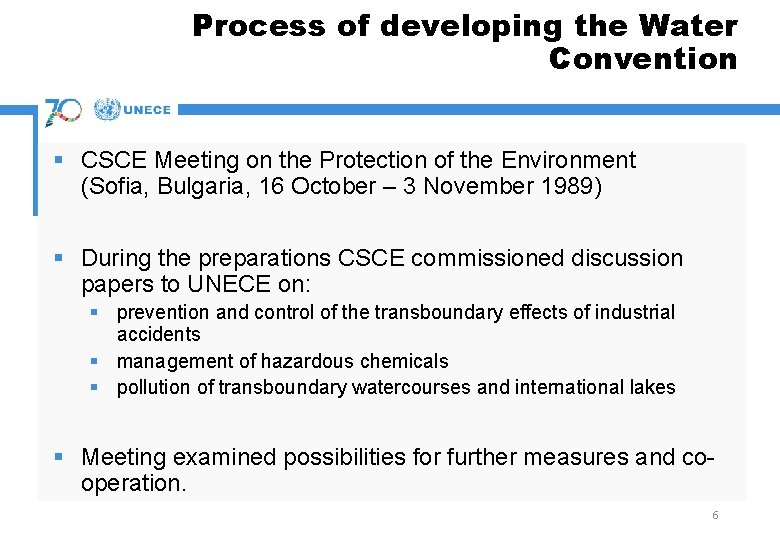
Process of developing the Water Convention § CSCE Meeting on the Protection of the Environment (Sofia, Bulgaria, 16 October – 3 November 1989) § During the preparations CSCE commissioned discussion papers to UNECE on: § prevention and control of the transboundary effects of industrial accidents § management of hazardous chemicals § pollution of transboundary watercourses and international lakes § Meeting examined possibilities for further measures and cooperation. 6
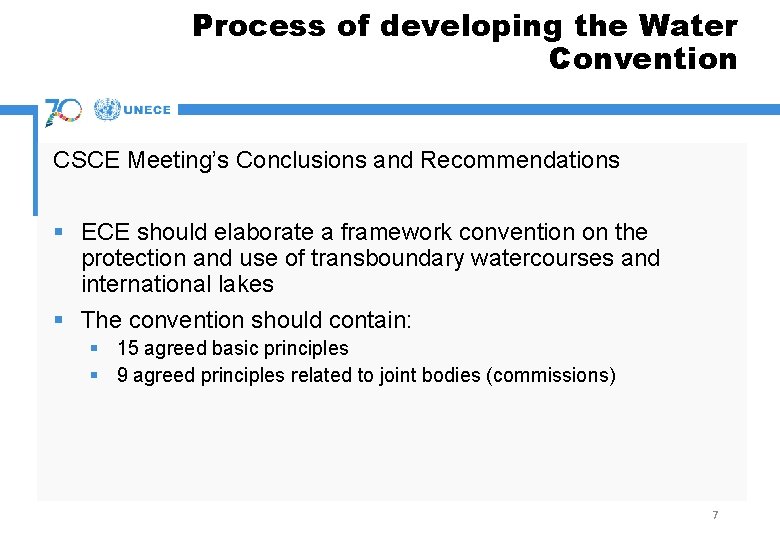
Process of developing the Water Convention CSCE Meeting’s Conclusions and Recommendations § ECE should elaborate a framework convention on the protection and use of transboundary watercourses and international lakes § The convention should contain: § 15 agreed basic principles § 9 agreed principles related to joint bodies (commissions) 7
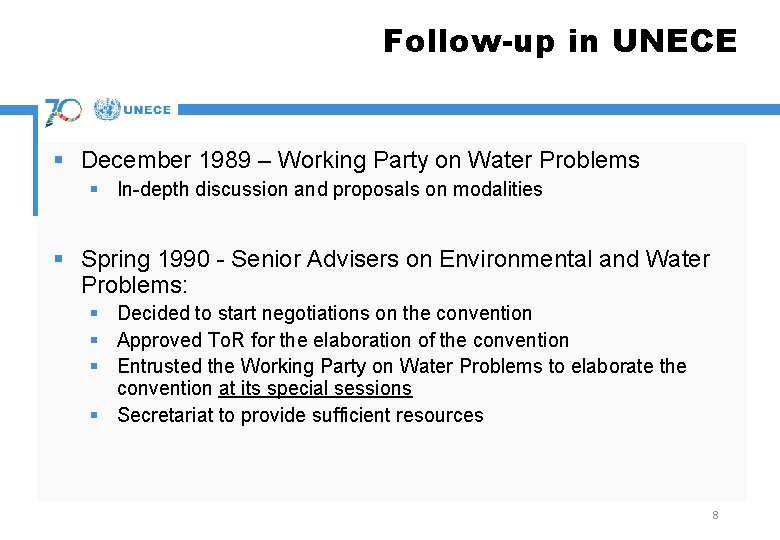
Follow-up in UNECE § December 1989 – Working Party on Water Problems § In-depth discussion and proposals on modalities § Spring 1990 - Senior Advisers on Environmental and Water Problems: § Decided to start negotiations on the convention § Approved To. R for the elaboration of the convention § Entrusted the Working Party on Water Problems to elaborate the convention at its special sessions § Secretariat to provide sufficient resources 8
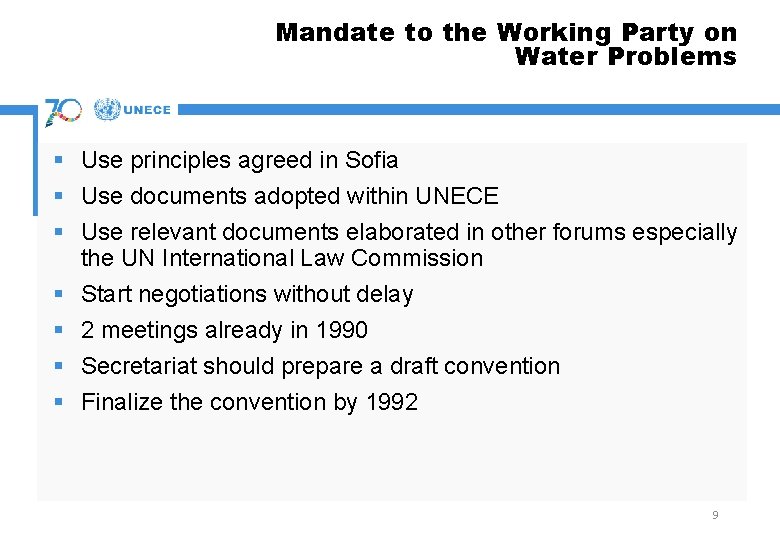
Mandate to the Working Party on Water Problems § Use principles agreed in Sofia § Use documents adopted within UNECE § Use relevant documents elaborated in other forums especially the UN International Law Commission § Start negotiations without delay § 2 meetings already in 1990 § Secretariat should prepare a draft convention § Finalize the convention by 1992 9
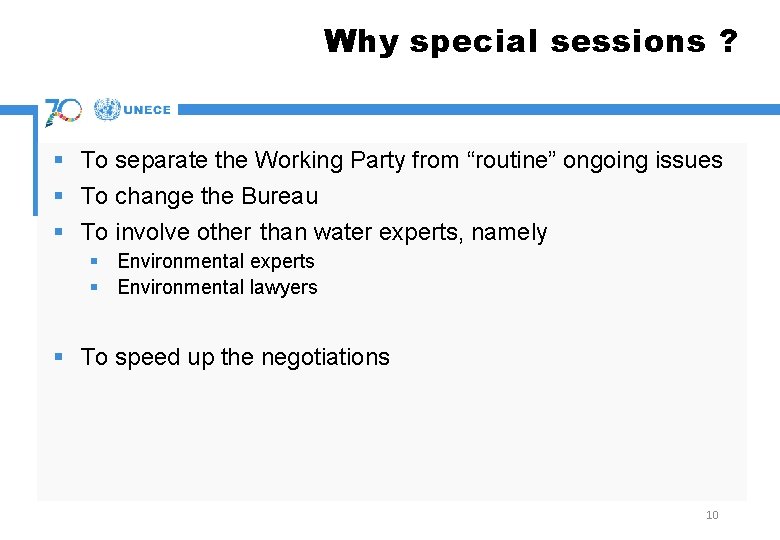
Why special sessions ? § To separate the Working Party from “routine” ongoing issues § To change the Bureau § To involve other than water experts, namely § Environmental experts § Environmental lawyers § To speed up the negotiations 10
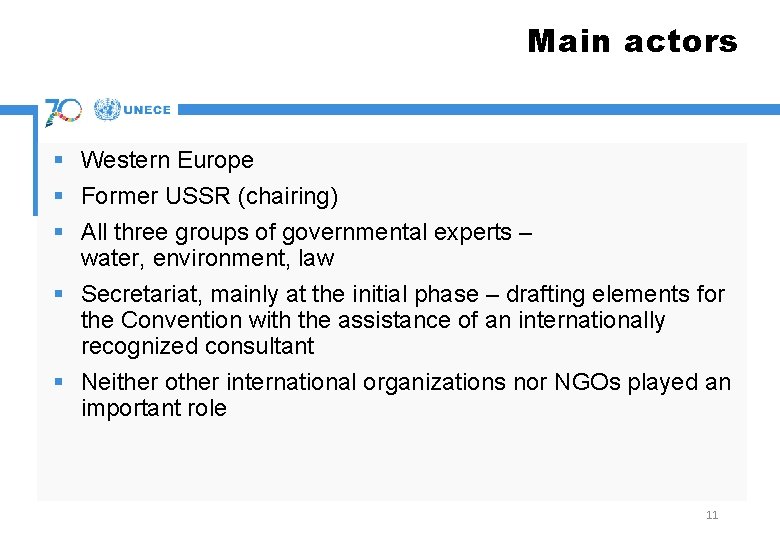
Main actors § Western Europe § Former USSR (chairing) § All three groups of governmental experts – water, environment, law § Secretariat, mainly at the initial phase – drafting elements for the Convention with the assistance of an internationally recognized consultant § Neither other international organizations nor NGOs played an important role 11
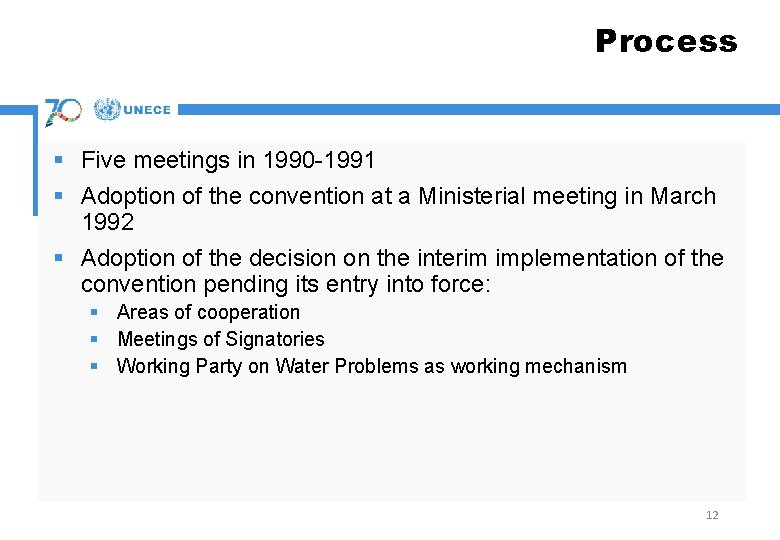
Process § Five meetings in 1990 -1991 § Adoption of the convention at a Ministerial meeting in March 1992 § Adoption of the decision on the interim implementation of the convention pending its entry into force: § Areas of cooperation § Meetings of Signatories § Working Party on Water Problems as working mechanism 12
The Helsinki Water Convention today § Signed in Helsinki in 1992 § Entered into force in 1996 § 2003 Amendments to allow accession to all UN Member States § Since 2016 opened to accession to all UN Member States § 41 Parties 13
Lessons learned § § § Usefulness of a solid record of cooperation in the region Importance to base negotiations on existing documents, strategies The secretariat should be a widely recognized actor on the issue Strong political message to start negotiations The negotiating mechanisms should be designed in sufficient detail A deadline set by a parent body to implement the task helps Expertise in delegations and in the secretariat Effective and unbiased Bureau, good chair Flexibility and firmness Importance to involve all relevant actors, especially countries Participating countries’ commitment from the earliest 14
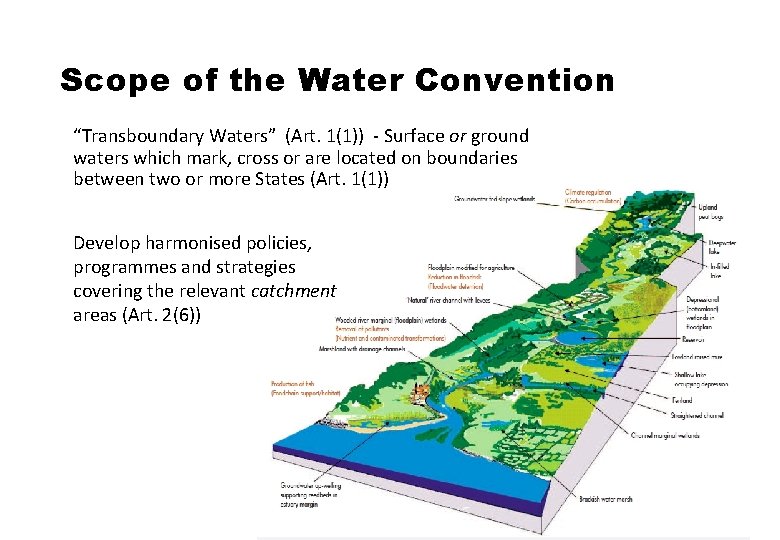
Scope of the Water Convention “Transboundary Waters” (Art. 1(1)) - Surface or ground waters which mark, cross or are located on boundaries between two or more States (Art. 1(1)) Develop harmonised policies, programmes and strategies covering the relevant catchment areas (Art. 2(6))
Water Convention: Main objectives and principles Objective: to protect and ensure the quantity, quality and sustainable use of transboundary water resources by facilitating cooperation The Convention is based on three main pillars: • Principle of prevention (no harm) • Principle of reasonable and equitable utilization • Principle of cooperation • Sustainability of resources is the overarching objective
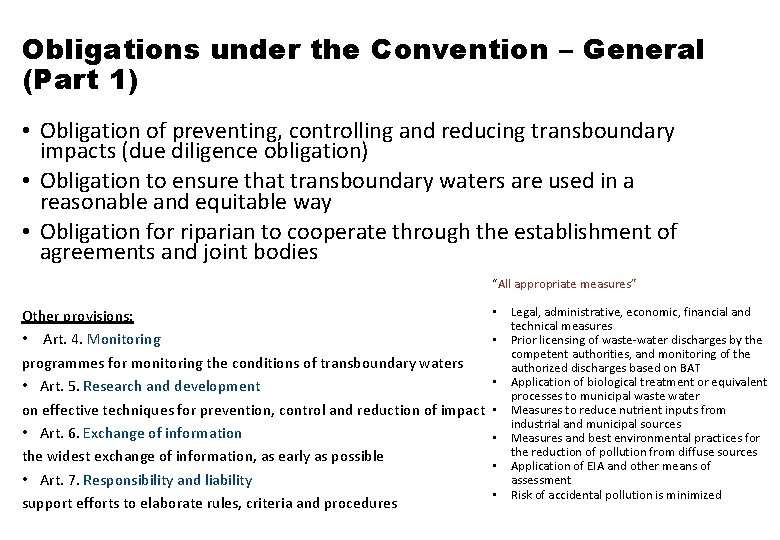
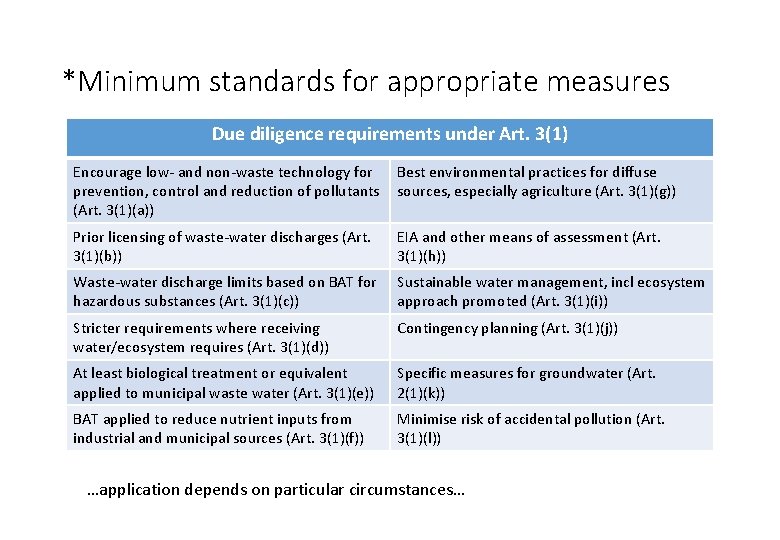
Obligations under the Convention – General (Part 1) • Obligation of preventing, controlling and reducing transboundary impacts (due diligence obligation) • Obligation to ensure that transboundary waters are used in a reasonable and equitable way • Obligation for riparian to cooperate through the establishment of agreements and joint bodies “All appropriate measures” Other provisions: • Art. 4. Monitoring programmes for monitoring the conditions of transboundary waters • Art. 5. Research and development on effective techniques for prevention, control and reduction of impact • Art. 6. Exchange of information the widest exchange of information, as early as possible • Art. 7. Responsibility and liability support efforts to elaborate rules, criteria and procedures • • Legal, administrative, economic, financial and technical measures Prior licensing of waste-water discharges by the competent authorities, and monitoring of the authorized discharges based on BAT Application of biological treatment or equivalent processes to municipal waste water Measures to reduce nutrient inputs from industrial and municipal sources Measures and best environmental practices for the reduction of pollution from diffuse sources Application of EIA and other means of assessment Risk of accidental pollution is minimized
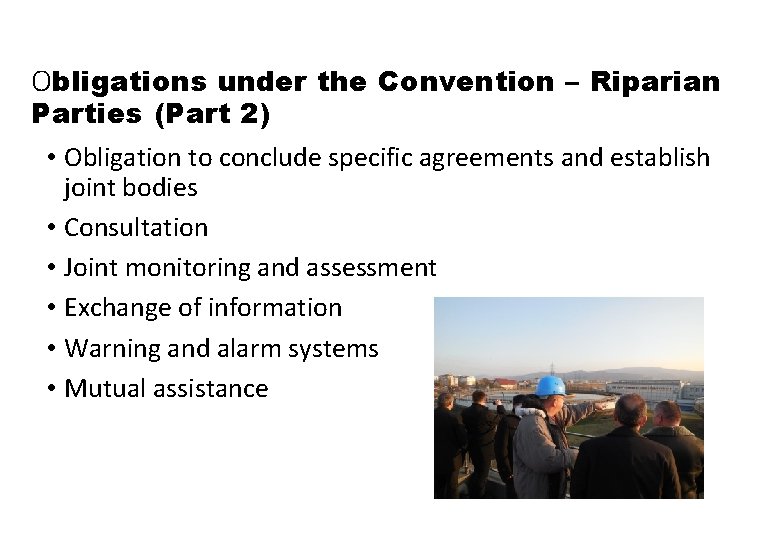
Obligations under the Convention – Riparian Parties (Part 2) • Obligation to conclude specific agreements and establish joint bodies • Consultation • Joint monitoring and assessment • Exchange of information • Warning and alarm systems • Mutual assistance
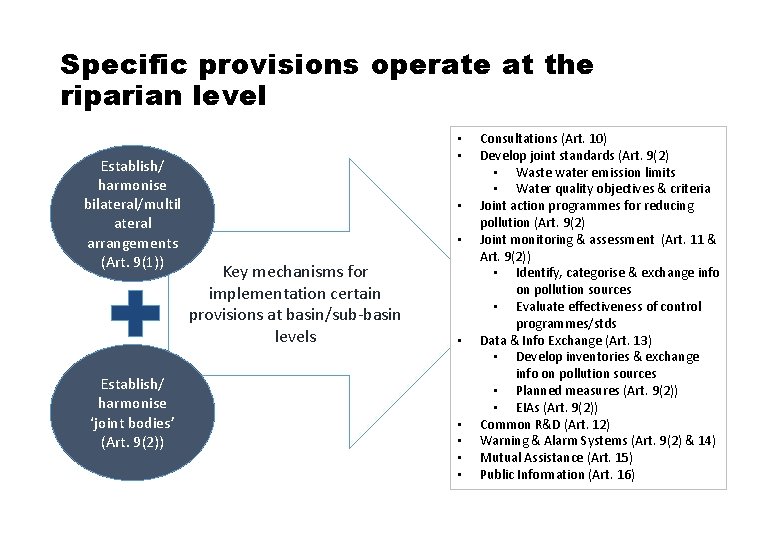
Specific provisions operate at the riparian level Establish/ harmonise bilateral/multil ateral arrangements (Art. 9(1)) Establish/ harmonise ‘joint bodies’ (Art. 9(2)) • • Key mechanisms for implementation certain provisions at basin/sub-basin levels • • • Consultations (Art. 10) Develop joint standards (Art. 9(2) • Waste water emission limits • Water quality objectives & criteria Joint action programmes for reducing pollution (Art. 9(2) Joint monitoring & assessment (Art. 11 & Art. 9(2)) • Identify, categorise & exchange info on pollution sources • Evaluate effectiveness of control programmes/stds Data & Info Exchange (Art. 13) • Develop inventories & exchange info on pollution sources • Planned measures (Art. 9(2)) • EIAs (Art. 9(2)) Common R&D (Art. 12) Warning & Alarm Systems (Art. 9(2) & 14) Mutual Assistance (Art. 15) Public Information (Art. 16)
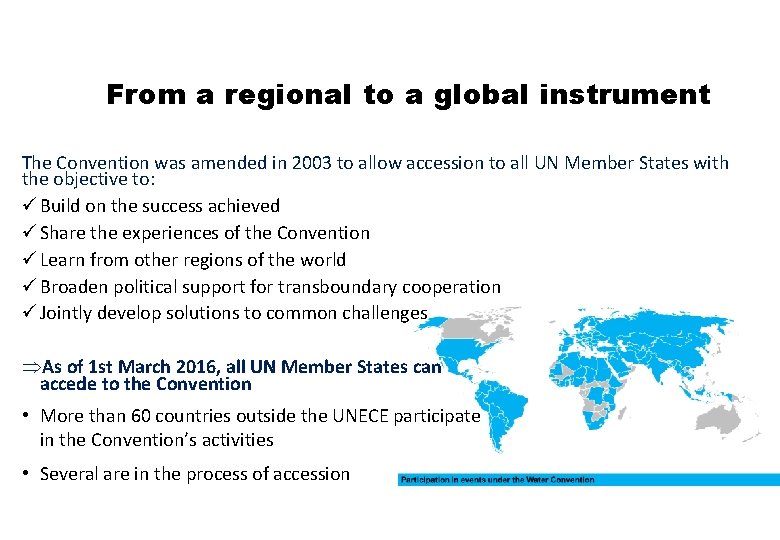
From a regional to a global instrument The Convention was amended in 2003 to allow accession to all UN Member States with the objective to: ü Build on the success achieved ü Share the experiences of the Convention ü Learn from other regions of the world ü Broaden political support for transboundary cooperation ü Jointly develop solutions to common challenges ÞAs of 1 st March 2016, all UN Member States can accede to the Convention • More than 60 countries outside the UNECE participate in the Convention’s activities • Several are in the process of accession
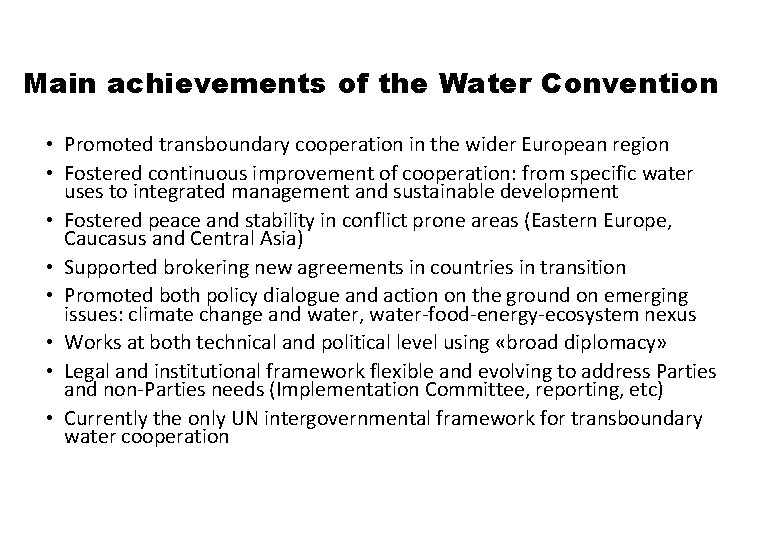
Main achievements of the Water Convention • Promoted transboundary cooperation in the wider European region • Fostered continuous improvement of cooperation: from specific water uses to integrated management and sustainable development • Fostered peace and stability in conflict prone areas (Eastern Europe, Caucasus and Central Asia) • Supported brokering new agreements in countries in transition • Promoted both policy dialogue and action on the ground on emerging issues: climate change and water, water-food-energy-ecosystem nexus • Works at both technical and political level using «broad diplomacy» • Legal and institutional framework flexible and evolving to address Parties and non-Parties needs (Implementation Committee, reporting, etc) • Currently the only UN intergovernmental framework for transboundary water cooperation
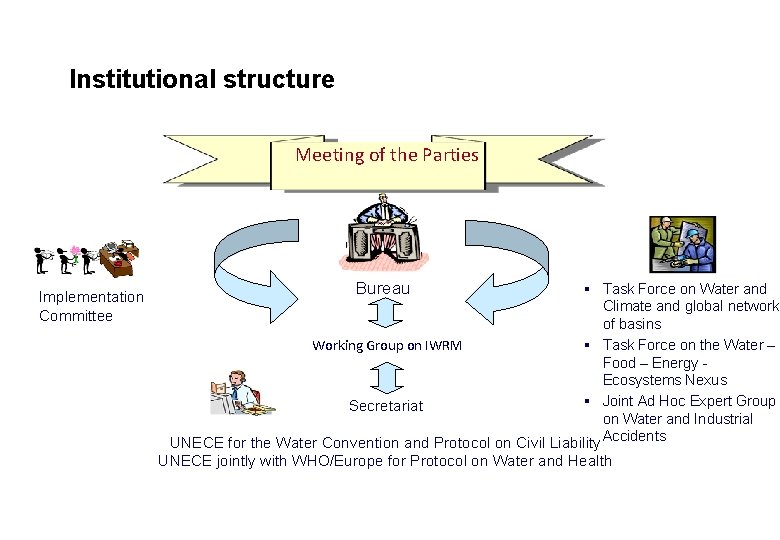
Institutional structure Meeting of the Parties Implementation Committee Bureau § Task Force on Water and Climate and global network of basins Working Group on IWRM § Task Force on the Water – Food – Energy Ecosystems Nexus § Joint Ad Hoc Expert Group Secretariat on Water and Industrial UNECE for the Water Convention and Protocol on Civil Liability Accidents UNECE jointly with WHO/Europe for Protocol on Water and Health
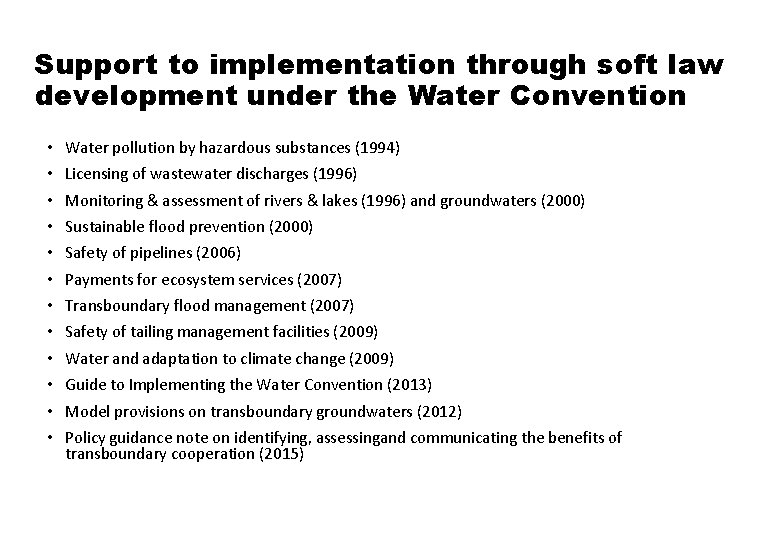
Support to implementation through soft law development under the Water Convention • Water pollution by hazardous substances (1994) • Licensing of wastewater discharges (1996) • Monitoring & assessment of rivers & lakes (1996) and groundwaters (2000) • Sustainable flood prevention (2000) • Safety of pipelines (2006) • Payments for ecosystem services (2007) • Transboundary flood management (2007) • Safety of tailing management facilities (2009) • Water and adaptation to climate change (2009) • Guide to Implementing the Water Convention (2013) • Model provisions on transboundary groundwaters (2012) • Policy guidance note on identifying, assessingand communicating the benefits of transboundary cooperation (2015)
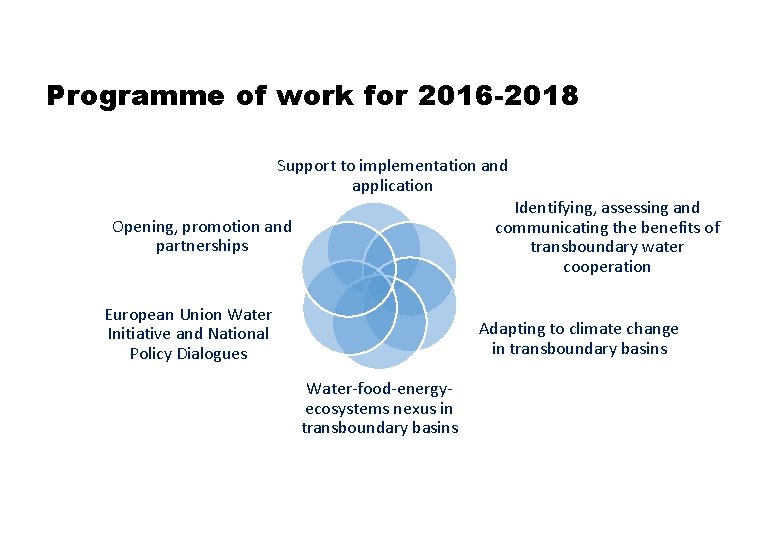
Programme of work for 2016 -2018 Support to implementation and application Identifying, assessing and communicating the benefits of transboundary water cooperation Opening, promotion and partnerships European Union Water Initiative and National Policy Dialogues Adapting to climate change in transboundary basins Water-food-energyecosystems nexus in transboundary basins
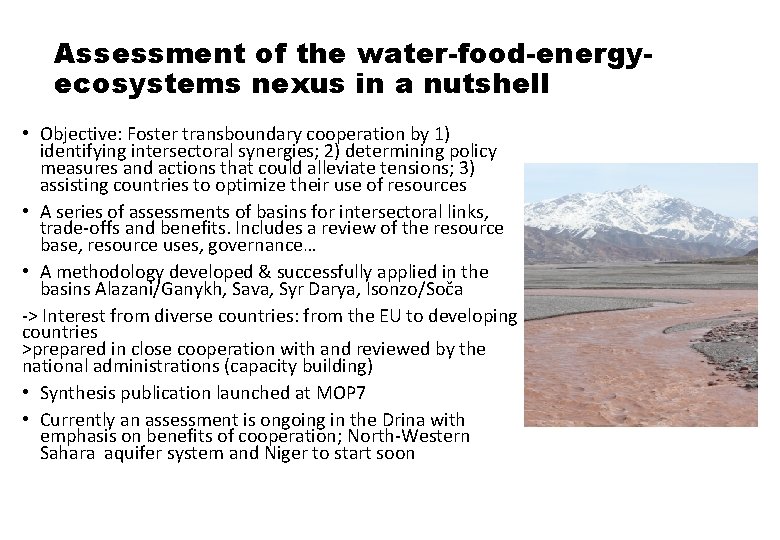
Assessment of the water-food-energyecosystems nexus in a nutshell • Objective: Foster transboundary cooperation by 1) identifying intersectoral synergies; 2) determining policy measures and actions that could alleviate tensions; 3) assisting countries to optimize their use of resources • A series of assessments of basins for intersectoral links, trade-offs and benefits. Includes a review of the resource base, resource uses, governance… • A methodology developed & successfully applied in the basins Alazani/Ganykh, Sava, Syr Darya, Isonzo/Soča -> Interest from diverse countries: from the EU to developing countries >prepared in close cooperation with and reviewed by the national administrations (capacity building) • Synthesis publication launched at MOP 7 • Currently an assessment is ongoing in the Drina with emphasis on benefits of cooperation; North-Western Sahara aquifer system and Niger to start soon
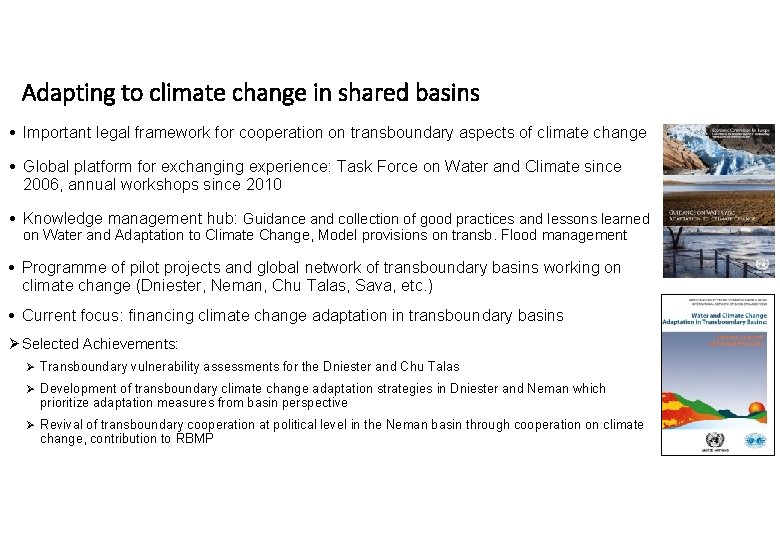
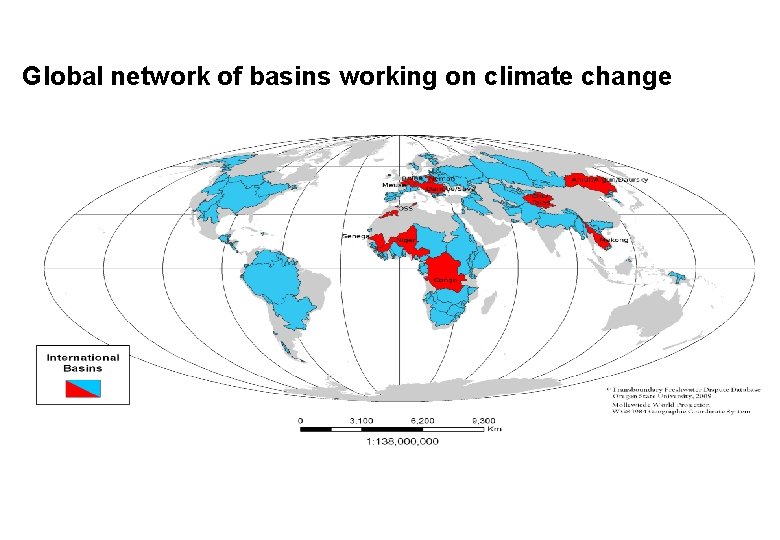
Adapting to climate change in shared basins • Important legal framework for cooperation on transboundary aspects of climate change • Global platform for exchanging experience: Task Force on Water and Climate since 2006, annual workshops since 2010 • Knowledge management hub: Guidance and collection of good practices and lessons learned on Water and Adaptation to Climate Change, Model provisions on transb. Flood management • Programme of pilot projects and global network of transboundary basins working on climate change (Dniester, Neman, Chu Talas, Sava, etc. ) • Current focus: financing climate change adaptation in transboundary basins Ø Selected Achievements: Ø Transboundary vulnerability assessments for the Dniester and Chu Talas Ø Development of transboundary climate change adaptation strategies in Dniester and Neman which prioritize adaptation measures from basin perspective Ø Revival of transboundary cooperation at political level in the Neman basin through cooperation on climate change, contribution to RBMP
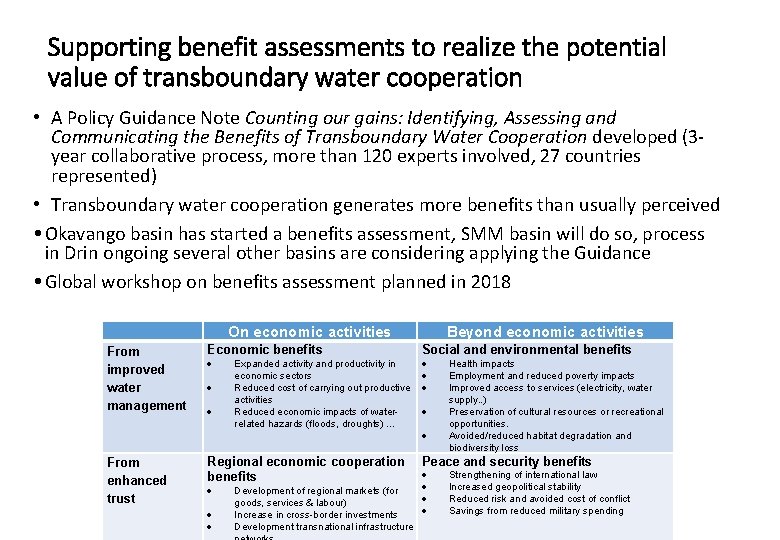
Supporting benefit assessments to realize the potential value of transboundary water cooperation • A Policy Guidance Note Counting our gains: Identifying, Assessing and Communicating the Benefits of Transboundary Water Cooperation developed (3 year collaborative process, more than 120 experts involved, 27 countries represented) • Transboundary water cooperation generates more benefits than usually perceived • Okavango basin has started a benefits assessment, SMM basin will do so, process in Drin ongoing several other basins are considering applying the Guidance • Global workshop on benefits assessment planned in 2018 On economic activities From improved water management From enhanced trust Economic benefits Expanded activity and productivity in economic sectors Reduced cost of carrying out productive activities Reduced economic impacts of waterrelated hazards (floods, droughts) … Regional economic cooperation benefits Development of regional markets (for goods, services & labour) Increase in cross-border investments Development transnational infrastructure Beyond economic activities Social and environmental benefits Health impacts Employment and reduced poverty impacts Improved access to services (electricity, water supply. . ) Preservation of cultural resources or recreational opportunities. Avoided/reduced habitat degradation and biodiversity loss Peace and security benefits Strengthening of international law Increased geopolitical stability Reduced risk and avoided cost of conflict Savings from reduced military spending
Global network of basins on climate changeon adaptation Global network ofworking basins working climate change
Opening, promotion and partnerships Promoting the Convention, its products and achievements, and transboundary water cooperation in general, and supporting its global opening by: ü Raising awareness and developing capacity on the Convention in non-parties, including by involving them in activities under the Convention; ü Promoting exchange of experience with other regions of the world; ü Ensuring synergies with other multilateral legal instruments on water; ü Supporting countries in their efforts to accede to the Convention through national and regional events, legal advice etc. . E. g. workshop in Chad end of March 2017
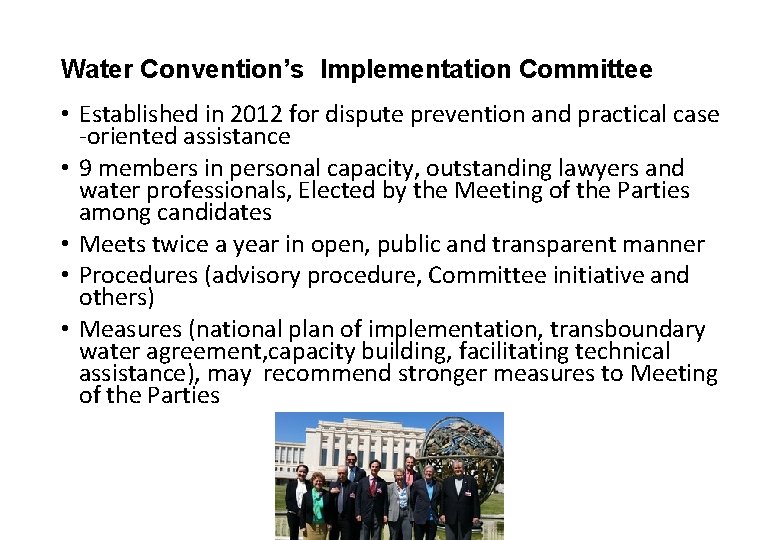
Water Convention’s Implementation Committee • Established in 2012 for dispute prevention and practical case -oriented assistance • 9 members in personal capacity, outstanding lawyers and water professionals, Elected by the Meeting of the Parties among candidates • Meets twice a year in open, public and transparent manner • Procedures (advisory procedure, Committee initiative and others) • Measures (national plan of implementation, transboundary water agreement, capacity building, facilitating technical assistance), may recommend stronger measures to Meeting of the Parties
Lessons learned from 20 years of implementing the Convention • Strong legal and institutional frameworks => legitimacy of efforts • Start with cooperation at technical level • Implement practical measures • Focus on issues of common interest and constructive dialogue • Involve third parties… but also build ownership • Patience to build trust • Be ready to not have ideal results
Why is the Water Convention relevant for Africa? • Sound legal framework coupled with action to support implementation and implementation committee • Catalyst for cooperation, balanced approach for both upstream and downstream countries • Several African countries already participated in the Convention’s activities, some showed some interest - the Convention can support such requests • You are invited to use the various guidance documents, participate in pilots etc. • Cooperation with partners such as ECA, CEEAC, IGAD, ANBO, and many others • Continuously evolves and address emerging issues with conflict potential ( such as dam safety) • BUT: It is up to each country to decide • You are invited to participate in upcoming meetings: • Working Group on IWRM, with a special session on progress in transboundary cooperation: 4 -6 July 2017, Geneva • Global workshop on water allocation: 16 -17 October 2017 • Global workshop on managing water scarcity in December 2017
Thank you for your attention! More information including guidelines, publications and information on activities under the Convention can be found at: http: //unece. org/env/water Sonja. Koeppel@unece. org Water. convention@unece. org
What is SDG indicator 6. 5. 2? • Target 6. 5: By 2030, implement integrated water resources management at all levels, including through transboundary cooperation as appropriate. • Indicator 6. 5. 2: Proportion of transboundary basin area with an operational arrangement for water cooperation. • Complements indicator 6. 5. 1 which measures the advancement of Integrated Water Resources Management (IWRM) • Custodian agencies: UNECE and UNESCO
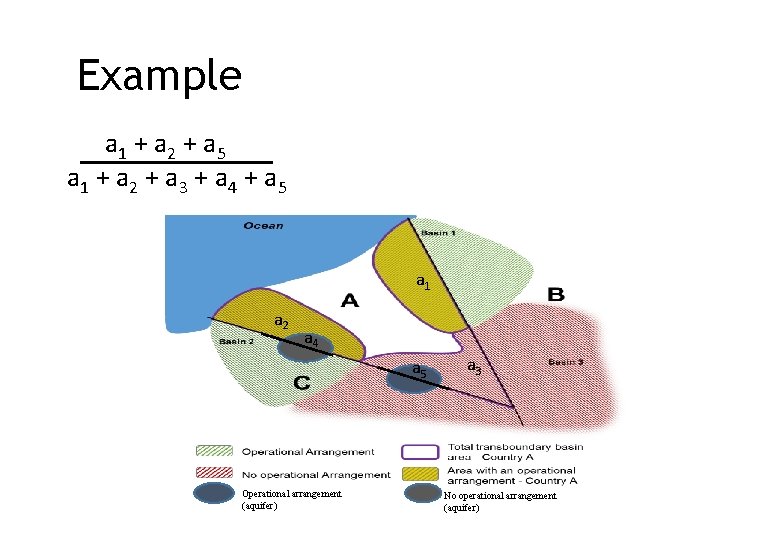
How is 6. 5. 2 calculated? 1 - calculate the surface area of each transboundary basin (for aquifer = aquifer extent) and the total sum within a country. 2 - verify which transboundary basins are covered by a cooperation arrangement. 3 - check which of the existing arrangements are operational: • Existence of a joint body, joint mechanism, commission (e. g. a river basin organization) for transboundary cooperation • Regular formal communications between riparian countries (e. g. regular meetings) • Existence of joint or coordinated water management plan(s), or of joint objectives • Regular exchange of data and information between riparians. 4 - calculate the share of transboundary basins covered by operational arrangements of the total sum of transboundary basin area.
Example a 1 + a 2 + a 5 a 1 + a 2 + a 3 + a 4 + a 5 a 1 a 2 a 4 a 5 Operational arrangement (aquifer) a 3 No operational arrangement (aquifer)
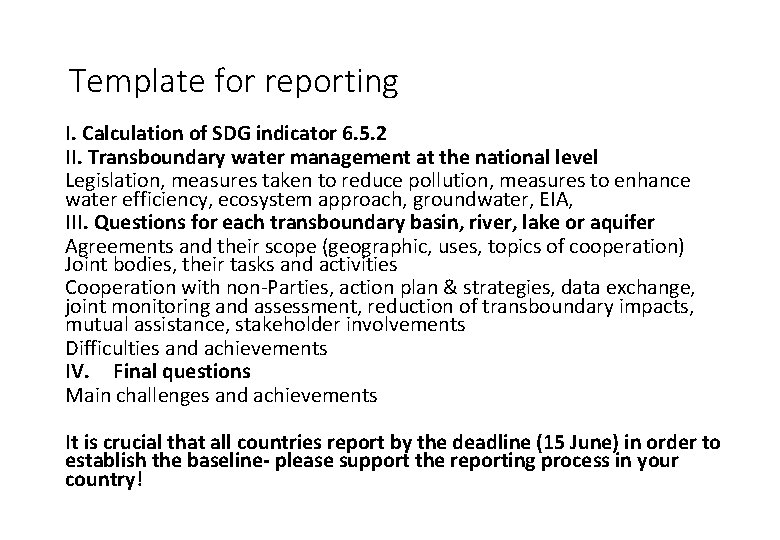
Template for reporting I. Calculation of SDG indicator 6. 5. 2 II. Transboundary water management at the national level Legislation, measures taken to reduce pollution, measures to enhance water efficiency, ecosystem approach, groundwater, EIA, III. Questions for each transboundary basin, river, lake or aquifer Agreements and their scope (geographic, uses, topics of cooperation) Joint bodies, their tasks and activities Cooperation with non-Parties, action plan & strategies, data exchange, joint monitoring and assessment, reduction of transboundary impacts, mutual assistance, stakeholder involvements Difficulties and achievements IV. Final questions Main challenges and achievements It is crucial that all countries report by the deadline (15 June) in order to establish the baseline- please support the reporting process in your country!
Thank you for your attention! More information including guidelines, publications and information on activities under the Convention can be found at: http: //unece. org/env/water or water. convention@unece. org Sonja Koeppel Helsinki Water Convention UNECE Date 27. 02. 2017, Addis Ababa, Ethiopia Twitte r Faceboo You. Tub UNEC E
*Minimum standards for appropriate measures Due diligence requirements under Art. 3(1) Encourage low- and non-waste technology for prevention, control and reduction of pollutants (Art. 3(1)(a)) Best environmental practices for diffuse sources, especially agriculture (Art. 3(1)(g)) Prior licensing of waste-water discharges (Art. 3(1)(b)) EIA and other means of assessment (Art. 3(1)(h)) Waste-water discharge limits based on BAT for hazardous substances (Art. 3(1)(c)) Sustainable water management, incl ecosystem approach promoted (Art. 3(1)(i)) Stricter requirements where receiving water/ecosystem requires (Art. 3(1)(d)) Contingency planning (Art. 3(1)(j)) At least biological treatment or equivalent applied to municipal waste water (Art. 3(1)(e)) Specific measures for groundwater (Art. 2(1)(k)) BAT applied to reduce nutrient inputs from industrial and municipal sources (Art. 3(1)(f)) Minimise risk of accidental pollution (Art. 3(1)(l)) …application depends on particular circumstances…
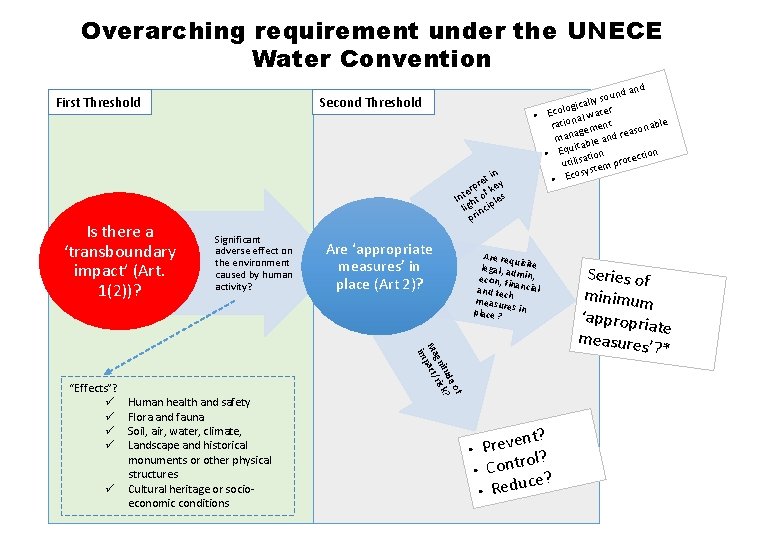
Overarching requirement under the UNECE Water Convention First Threshold Is there a ‘transboundary impact’ (Art. 1(2))? ü in ret ey p er f k Int ht o ples lig inci pr Significant adverse effect on the environment caused by human activity? Human health and safety Flora and fauna Soil, air, water, climate, Landscape and historical monuments or other physical structures Cultural heritage or socioeconomic conditions Are ‘appropriate measures’ in place (Art 2)? Are req u legal, ad isite econ, fin min, and tec ancial h measur es in place? of de itu k? gn /ris Ma pact im “Effects”? ü ü Second Threshold d nd an u o s cally ologi water c E • nal ratio ement able ason g e a r n a d m le an uitab n q E n • ectio atio utilis tem prot osys • Ec ent? • Prev l? ro • Cont e? c • Redu Series of minimum ‘appropri ate measures ’? *