
The Helical Luttinger Liquid and the Edge of
- Slides: 11
The Helical Luttinger Liquid and the Edge of Quantum Spin Hall Systems Congjun Wu Kavli Institute for Theoretical Physics, UCSB B. Andrei Bernevig, and Shou-Cheng Zhang Physics Department, Stanford University Ref: C. Wu, B. A. Bernevig, and S. C. Zhang, Phys. Rev. Lett. 96, 106401 (2006). March Meeting, 03/15/2006, 3: 42 pm. 1
Introduction • Spin Hall effect (SHE): Use electric field to generate transverse spin current in spin-orbit (SO) coupling systems. S. Murakami et al. , Science 301 (2003); J. Sinova et al. PRL 92, 126603 (2004). Y. Kato et al. , PRL 93, 176001 (2004); J. Wunderlich et al. PRL 94, 47204 (2005). • Quantum SHE systems: bulk is gapped; no charge current. • Gapless edge modes support spin transport. F. D. M. Haldane, PRL 61, 2015 (1988); Kane et al. , cond-mat/0411737, Phys. Rev. Lett. 95, 146802 (2005); B. A. Bernevig et al. , cond-mat/0504147, to appear in PRL; X. L Qi et al. , condmat/0505308; L. Sheng et al. , PRL 95, 136602 (2005); D. N. Sheng et al, cond-mat/0603054. • Stability of the gapless edge modes against impurity, disorder under strong interactions. C. Wu, B. A. Bernevig, and S. C. Zhang, cond-mat/0508273, to appear in Phys. Rev. Lett; C. Xu and J. Moore, PRB, 45322 (2006). 2
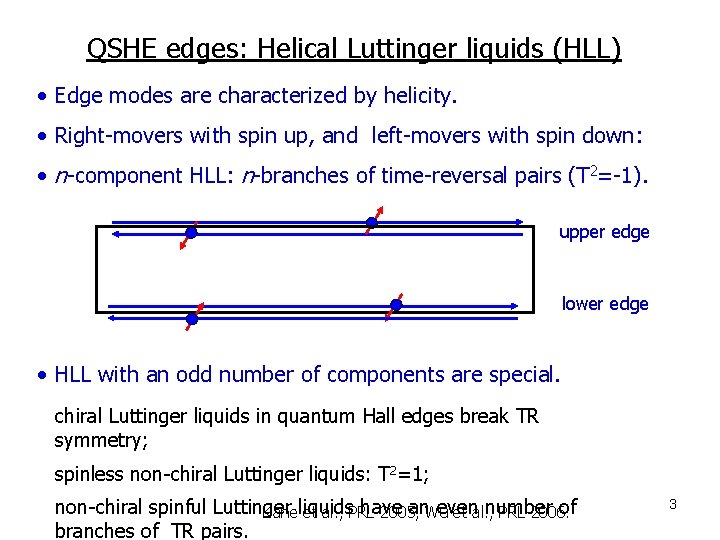
QSHE edges: Helical Luttinger liquids (HLL) • Edge modes are characterized by helicity. • Right-movers with spin up, and left-movers with spin down: • n-component HLL: n-branches of time-reversal pairs (T 2=-1). upper edge lower edge • HLL with an odd number of components are special. chiral Luttinger liquids in quantum Hall edges break TR symmetry; spinless non-chiral Luttinger liquids: T 2=1; non-chiral spinful Luttinger have an. Wu even number of Kaneliquids et al. , PRL 2005, et al. , PRL 2006. branches of TR pairs. 3
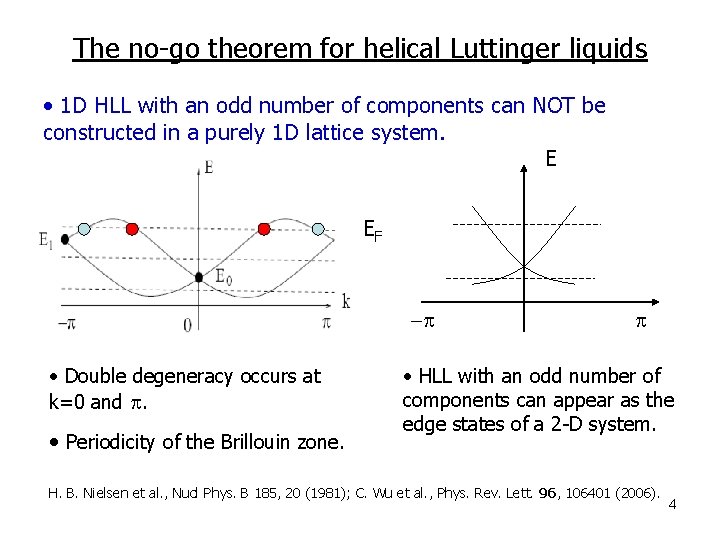
The no-go theorem for helical Luttinger liquids • 1 D HLL with an odd number of components can NOT be constructed in a purely 1 D lattice system. E EF -p • Double degeneracy occurs at k=0 and p. • Periodicity of the Brillouin zone. p • HLL with an odd number of components can appear as the edge states of a 2 -D system. H. B. Nielsen et al. , Nucl Phys. B 185, 20 (1981); C. Wu et al. , Phys. Rev. Lett. 96, 106401 (2006). 4
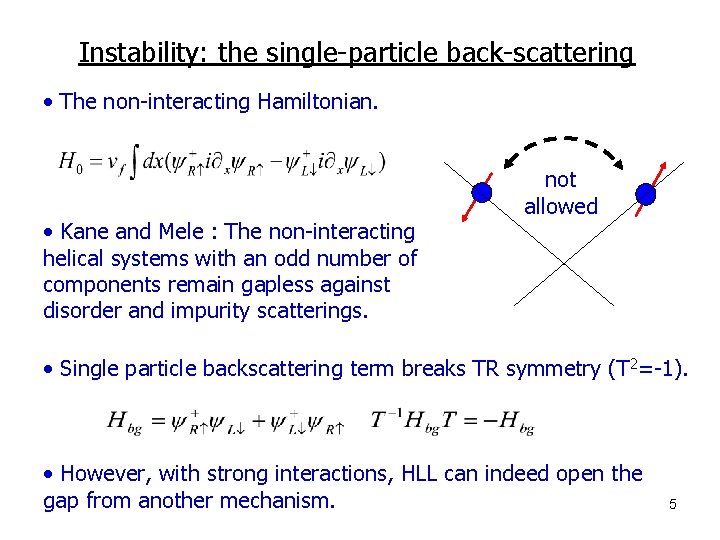
Instability: the single-particle back-scattering • The non-interacting Hamiltonian. • Kane and Mele : The non-interacting helical systems with an odd number of components remain gapless against disorder and impurity scatterings. not allowed • Single particle backscattering term breaks TR symmetry (T 2=-1). • However, with strong interactions, HLL can indeed open the gap from another mechanism. 5
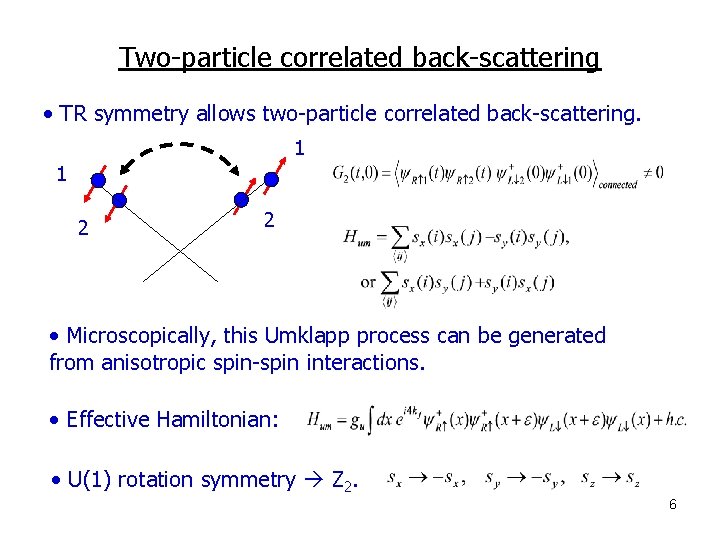
Two-particle correlated back-scattering • TR symmetry allows two-particle correlated back-scattering. 1 1 2 2 • Microscopically, this Umklapp process can be generated from anisotropic spin-spin interactions. • Effective Hamiltonian: • U(1) rotation symmetry Z 2. 6
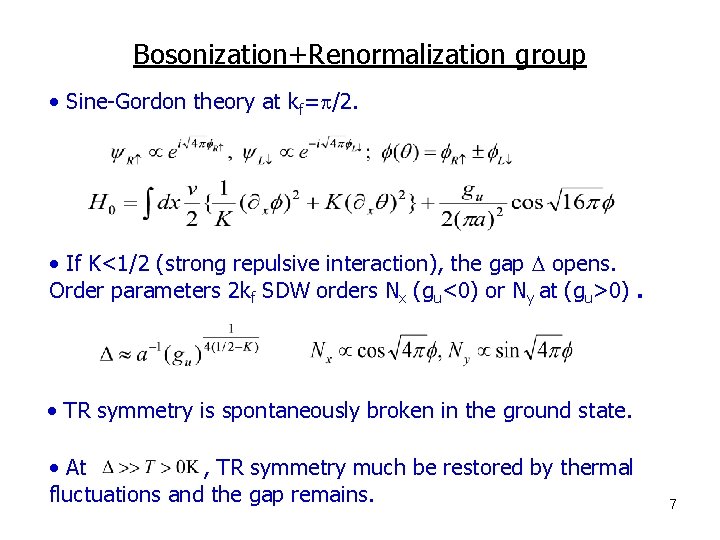
Bosonization+Renormalization group • Sine-Gordon theory at kf=p/2. • If K<1/2 (strong repulsive interaction), the gap D opens. Order parameters 2 kf SDW orders Nx (gu<0) or Ny at (gu>0). • TR symmetry is spontaneously broken in the ground state. • At , TR symmetry much be restored by thermal fluctuations and the gap remains. 7
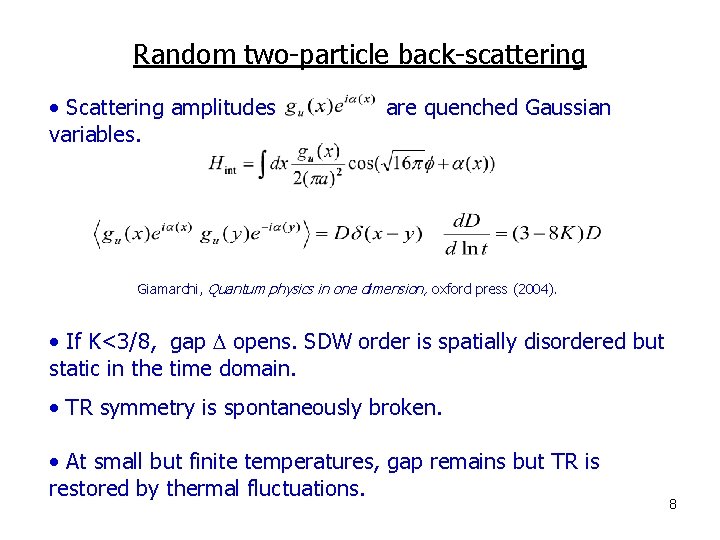
Random two-particle back-scattering • Scattering amplitudes variables. are quenched Gaussian Giamarchi, Quantum physics in one dimension, oxford press (2004). • If K<3/8, gap D opens. SDW order is spatially disordered but static in the time domain. • TR symmetry is spontaneously broken. • At small but finite temperatures, gap remains but TR is restored by thermal fluctuations. 8
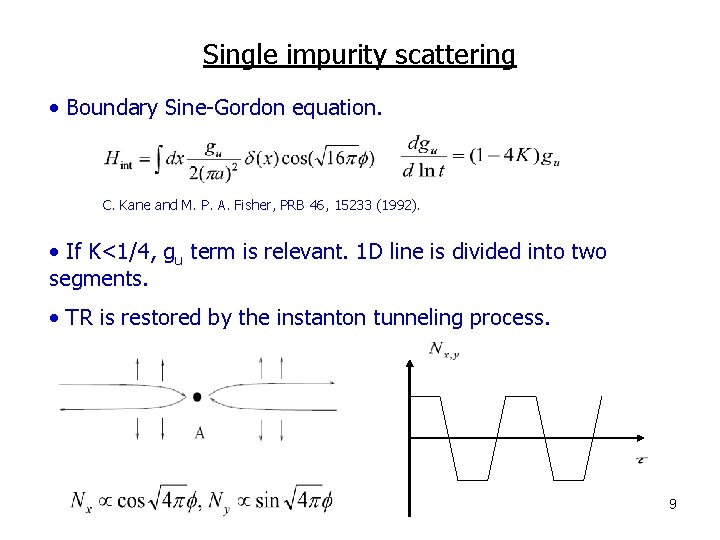
Single impurity scattering • Boundary Sine-Gordon equation. C. Kane and M. P. A. Fisher, PRB 46, 15233 (1992). • If K<1/4, gu term is relevant. 1 D line is divided into two segments. • TR is restored by the instanton tunneling process. 9
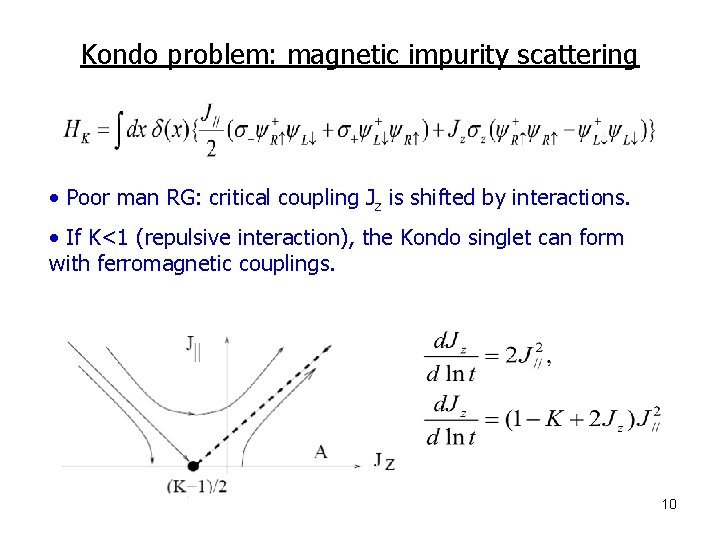
Kondo problem: magnetic impurity scattering • Poor man RG: critical coupling Jz is shifted by interactions. • If K<1 (repulsive interaction), the Kondo singlet can form with ferromagnetic couplings. 10
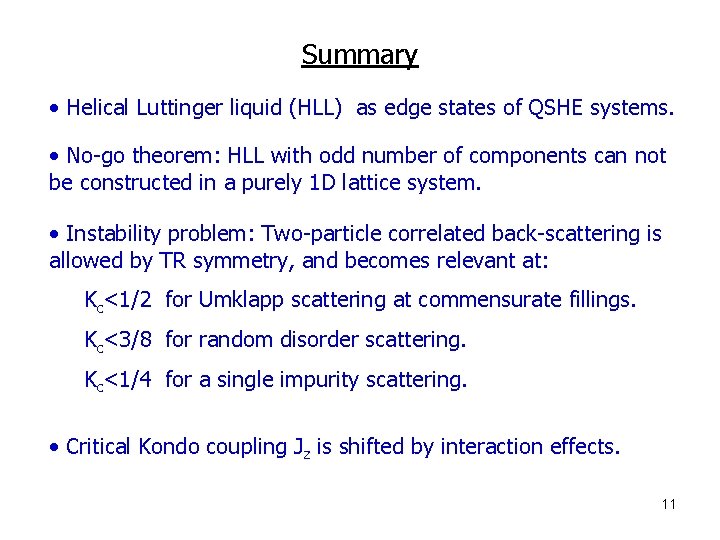
Summary • Helical Luttinger liquid (HLL) as edge states of QSHE systems. • No-go theorem: HLL with odd number of components can not be constructed in a purely 1 D lattice system. • Instability problem: Two-particle correlated back-scattering is allowed by TR symmetry, and becomes relevant at: Kc<1/2 for Umklapp scattering at commensurate fillings. Kc<3/8 for random disorder scattering. Kc<1/4 for a single impurity scattering. • Critical Kondo coupling Jz is shifted by interaction effects. 11