
The Height and Span Juxtaposition Unit 4 Bivariate
The Height and Span Juxtaposition Unit 4 – Bivariate Data 2/12/2022 Algebra 1 Institute 1

Another TED Talk Hans Rosling 2/12/2022 Algebra 1 Institute 2
Bivariate Data • Association between two variables • Positive: an increase in one variable generally produces an increase in the other. • Example: association between a student's grades and the number of hours per week that student spends studying • Negative: an increase in one variable generally produces a decrease in the other. • Example: association between the number of doctors in a country and the percentage of the population that dies before adulthood is generally a negative one. 2/12/2022 Algebra 1 Institute 3
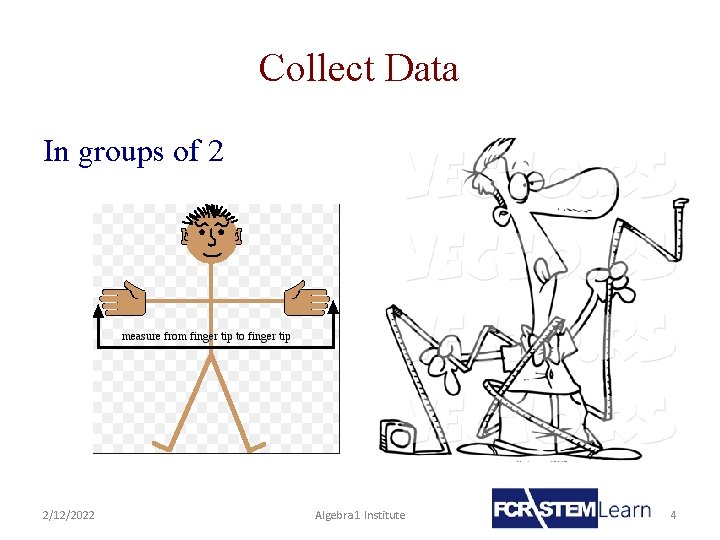
Collect Data In groups of 2 2/12/2022 Algebra 1 Institute 4
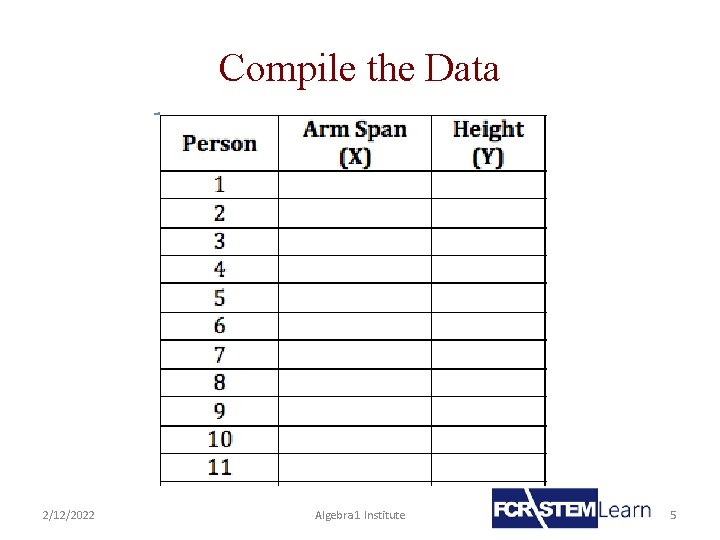
Compile the Data 2/12/2022 Algebra 1 Institute 5
Scatterplot in Geo. Gebra • Enter the Arm Span information in Column A and the Height in Column B. • Highlight the cells in Column A and B that contain the information. • Click on the tool “Two Variable Regression Analysis” • On the pop-up window, click “Analyze” • A Scatterplot will be produced 2/12/2022 Algebra 1 Institute 6
Association? Does an increase in arm span generally lead to an increase in height? How strong is the association (correlation)? 2/12/2022 Algebra 1 Institute 7
Find the Means a. Is your arm span and height above the average of these 40 adults? b. How many of the 40 people have above-average arm spans? c. How many of the 40 people have above-average heights? d. It is possible to divide the 40 people into four categories: a. b. c. d. 2/12/2022 Above-average arm span and above-average height; Above-average arm span and below-average height; Below-average arm span and above-average height; and Below-average arm span and below-average height. Algebra 1 Institute 8
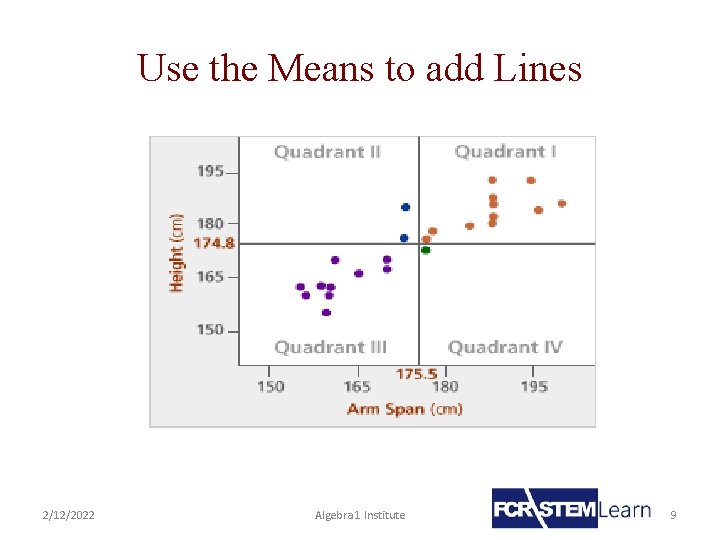
Use the Means to add Lines 2/12/2022 Algebra 1 Institute 9
How Many People in each Quadrant? a. Do most people with below-average arm spans also have below-average heights? b. Do most people with above-average arm spans also have above-average heights? c. What do these answers suggest? 2/12/2022 Algebra 1 Institute 10
Height – Arm Span a. How many of the 40 people have heights that are greater than their arm spans? b. How many of the 40 people have heights that are less than their arm spans? c. How many of the 40 people have heights that are equal to their arm spans? d. Which six people are the closest to being square without being perfectly square? e. Which five are the farthest from being square? 2/12/2022 Algebra 1 Institute 11
Draw Line y = x in Scatterplot a. b. c. d. What do the points above the line represent? What do the points on the line represent? What do the points below the line represent? Why is it helpful to draw the line height = arm span? How does this line help us analyze differences? 2/12/2022 Algebra 1 Institute 12
Draw More Lines Which one is a better fit? • Y=x+1 • Y=x– 1 • Any other? 2/12/2022 Algebra 1 Institute 13
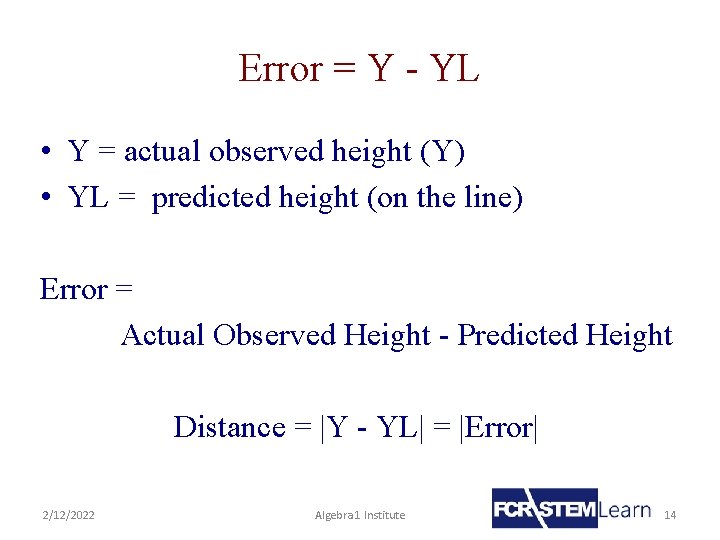
Error = Y - YL • Y = actual observed height (Y) • YL = predicted height (on the line) Error = Actual Observed Height - Predicted Height Distance = |Y - YL| = |Error| 2/12/2022 Algebra 1 Institute 14
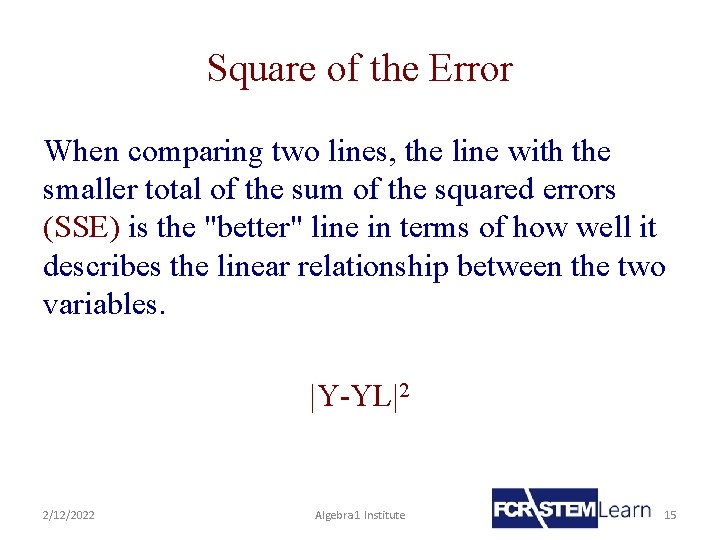
Square of the Error When comparing two lines, the line with the smaller total of the sum of the squared errors (SSE) is the "better" line in terms of how well it describes the linear relationship between the two variables. |Y-YL|2 2/12/2022 Algebra 1 Institute 15
For our Data • Judging on the basis of the SSE, which is the best line? Which is the worst? • What other ways could we change the line equation in an attempt to further reduce the SSE? • Is it possible to reduce the SSE to 0? Why or why not? 2/12/2022 Algebra 1 Institute 16
- Slides: 16