
The Heart vs The Brain Emotions Mission Control
The Heart vs The Brain Emotions
Mission Control for Emotions • Many authors have written about heartbreak, and many movie characters have died of a broken heart. • Directors add long pauses in between scary scenes to quicken viewers’ heartrates. • Commercials play slow music behind sad images hoping you will have a change of heart and donate to their cause. • When your sibling steals your clothes you feel your chest tighten and your heart beat faster as you grow angry. • But is your heart really in charge of all these emotions?
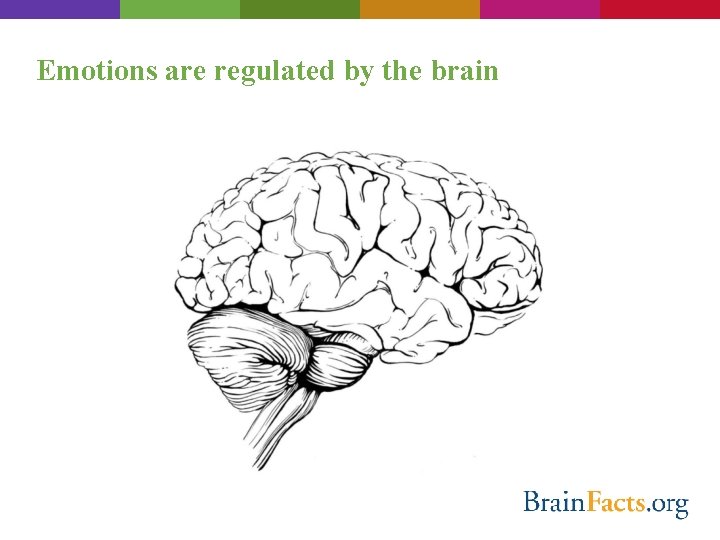
Emotions are regulated by the brain
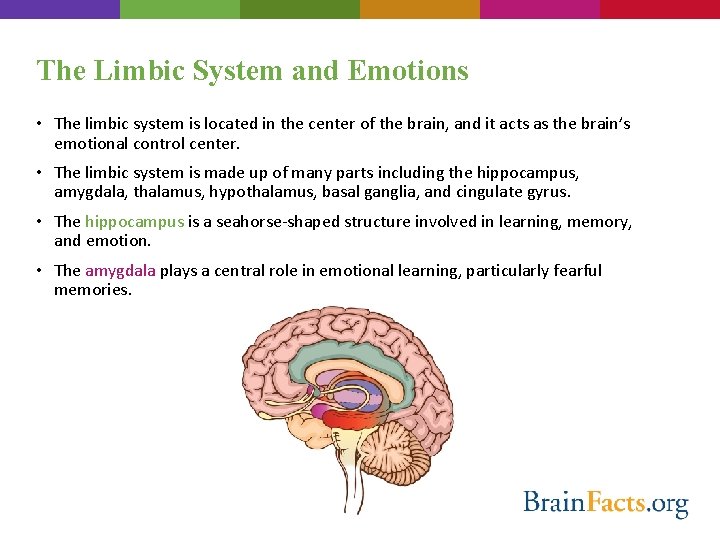
The Limbic System and Emotions • The limbic system is located in the center of the brain, and it acts as the brain’s emotional control center. • The limbic system is made up of many parts including the hippocampus, amygdala, thalamus, hypothalamus, basal ganglia, and cingulate gyrus. • The hippocampus is a seahorse-shaped structure involved in learning, memory, and emotion. • The amygdala plays a central role in emotional learning, particularly fearful memories.
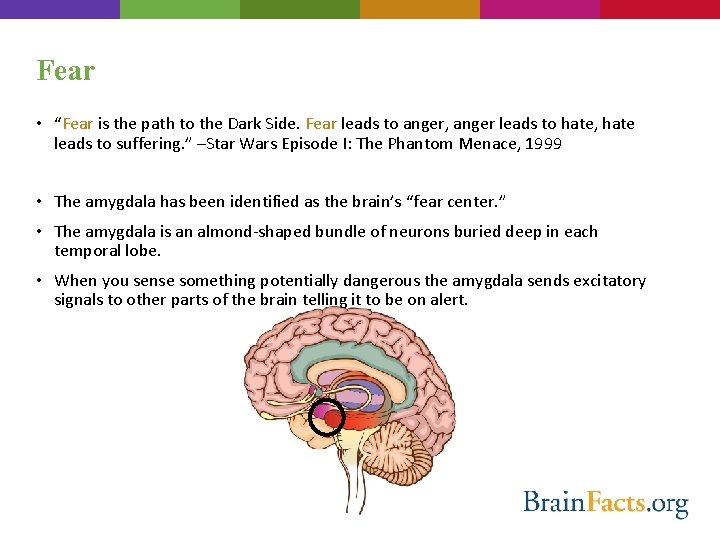
Fear • “Fear is the path to the Dark Side. Fear leads to anger, anger leads to hate, hate leads to suffering. ” –Star Wars Episode I: The Phantom Menace, 1999 • The amygdala has been identified as the brain’s “fear center. ” • The amygdala is an almond-shaped bundle of neurons buried deep in each temporal lobe. • When you sense something potentially dangerous the amygdala sends excitatory signals to other parts of the brain telling it to be on alert.

Aggression • “Aggression is different from anger. Anger is an emotion; aggression is a behavior. ” – Growing Into Soul • Low levels of the chemical serotonin, particularly in the prefrontal cortex, play a large role in aggressive behavior. • Mice demonstrate aggression by physically dominating other mice repeatedly. • Being the recipient of an aggressive social encounter can cause changes in the brain that lead to depression and anxiety. • Animal research shows that aggressors may suffer from many of these same effects.
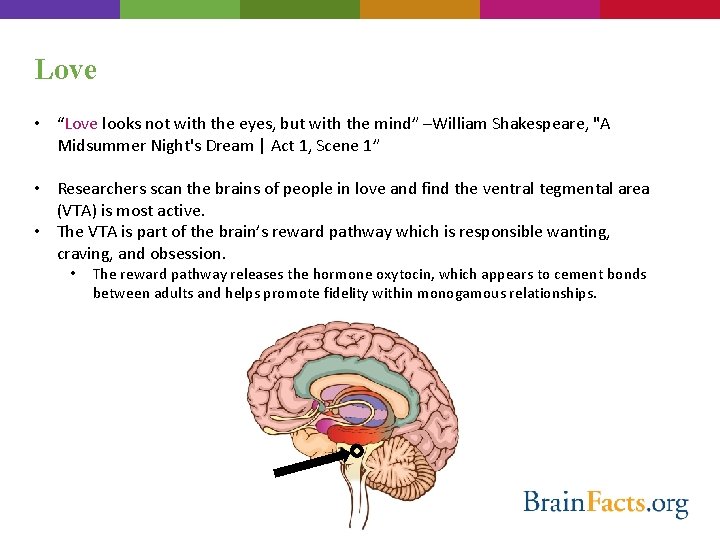
Love • “Love looks not with the eyes, but with the mind” –William Shakespeare, "A Midsummer Night's Dream | Act 1, Scene 1” • Researchers scan the brains of people in love and find the ventral tegmental area (VTA) is most active. • The VTA is part of the brain’s reward pathway which is responsible wanting, craving, and obsession. • The reward pathway releases the hormone oxytocin, which appears to cement bonds between adults and helps promote fidelity within monogamous relationships.
Activity • Using your notes, fill in the blank brain worksheet. • First, label the amygdala, the prefrontal cortex, and the Ventral Tegmental Area (VTA). • Next, label what emotion each area of the brain regulates. • Finally, list three examples of each emotion on the lines provided. • Examples: • Fear: Hearing a loud noise when you’re home alone • Aggression: Road rage
Follow Brain. Facts. org @Brain_Facts_org https: //www. facebook. com/Brain. Facts. Org
- Slides: 10