
The Heart Outcomes Prevention Evaluation HOPE 3 Trial
- Slides: 39
The Heart Outcomes Prevention Evaluation (HOPE) – 3 Trial Eva Lonn, Jackie Bosch, Salim Yusuf For the HOPE-3 Investigators Population Health Research Institute, Mc. Master University and Hamilton Health Sciences, Hamilton, Canada
Disclosures • Eva Lonn – Institutional Research Grants/ Contracts: Astra Zeneca, CIHR, Amgen, Bayer, GSK, Merck Shering, Eli Lilly, Sanofi – Consulting/ Lectures fees: Amgen, Cadila Pharmaceuticals, Novartis, Sanofi, Servier • Jackie Bosch – Institutional Research Grants/ Contracts: Astra Zeneca, CIHR, Cadila Pharmaceuticals, Bayer, Boehringer-Ingelheim, Novartis – Consulting Fees: Bristol-Myers Squibb • Salim Yusuf – Institutional Research Grants/ Contarcts: Astra Zeneca, CIHR, Cadila Pharmaceuticals, Bayer, Boehringer-Ingelheim, Bristol. Myers Squibb, Novartis – Consulting/Lecture fees and Travel Expenses: Bayer
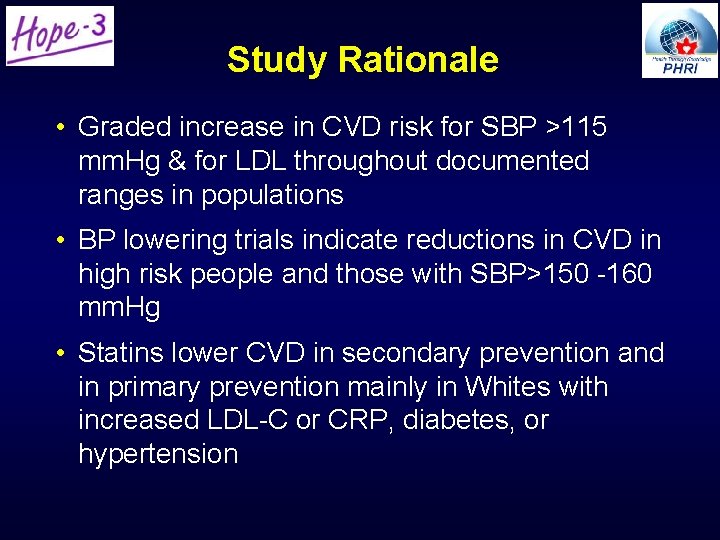
Study Rationale • Graded increase in CVD risk for SBP >115 mm. Hg & for LDL throughout documented ranges in populations • BP lowering trials indicate reductions in CVD in high risk people and those with SBP>150 -160 mm. Hg • Statins lower CVD in secondary prevention and in primary prevention mainly in Whites with increased LDL-C or CRP, diabetes, or hypertension
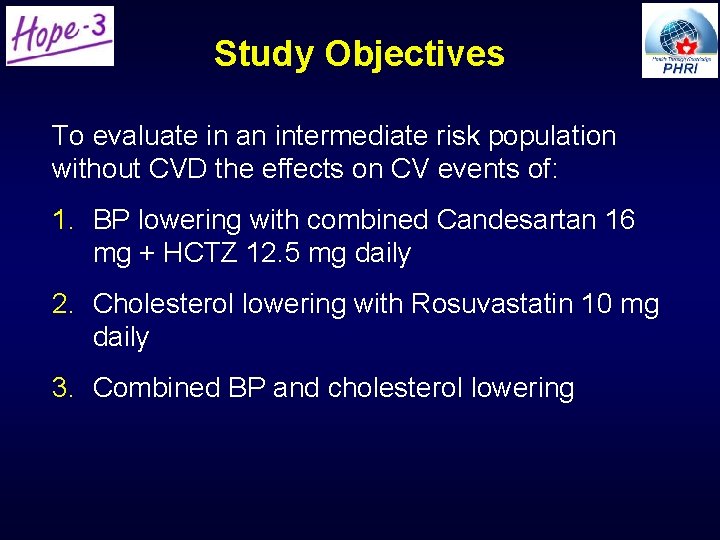
Study Objectives To evaluate in an intermediate risk population without CVD the effects on CV events of: 1. BP lowering with combined Candesartan 16 mg + HCTZ 12. 5 mg daily 2. Cholesterol lowering with Rosuvastatin 10 mg daily 3. Combined BP and cholesterol lowering
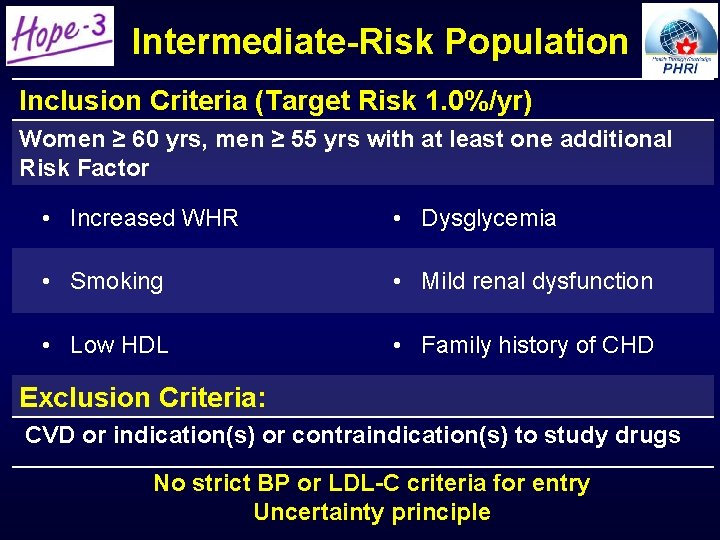
Intermediate-Risk Population Inclusion Criteria (Target Risk 1. 0%/yr) Women ≥ 60 yrs, men ≥ 55 yrs with at least one additional Risk Factor • Increased WHR • Dysglycemia • Smoking • Mild renal dysfunction • Low HDL • Family history of CHD Exclusion Criteria: CVD or indication(s) or contraindication(s) to study drugs No strict BP or LDL-C criteria for entry Uncertainty principle
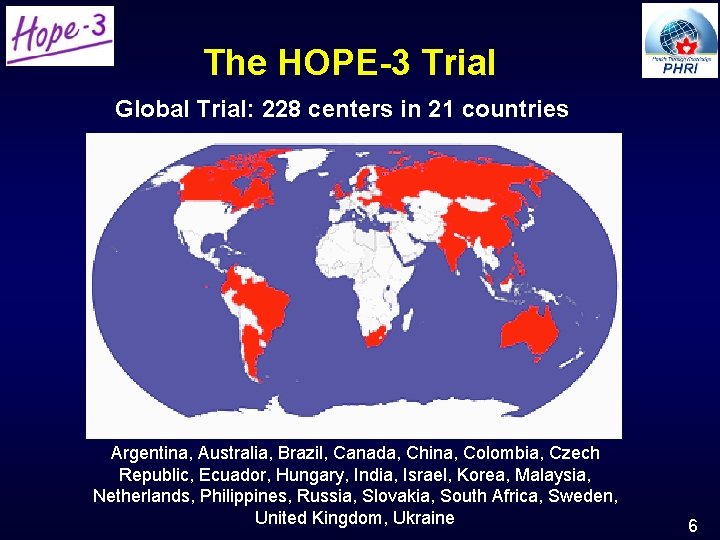
The HOPE-3 Trial Global Trial: 228 centers in 21 countries Argentina, Australia, Brazil, Canada, China, Colombia, Czech Republic, Ecuador, Hungary, India, Israel, Korea, Malaysia, Netherlands, Philippines, Russia, Slovakia, South Africa, Sweden, United Kingdom, Ukraine 6
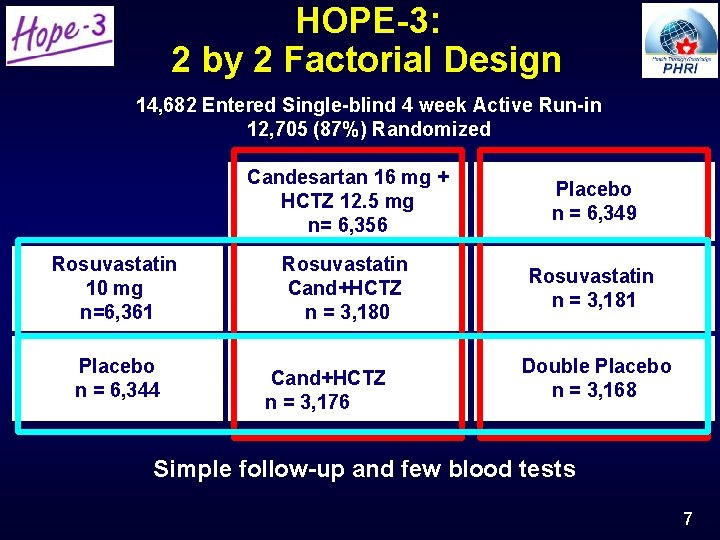
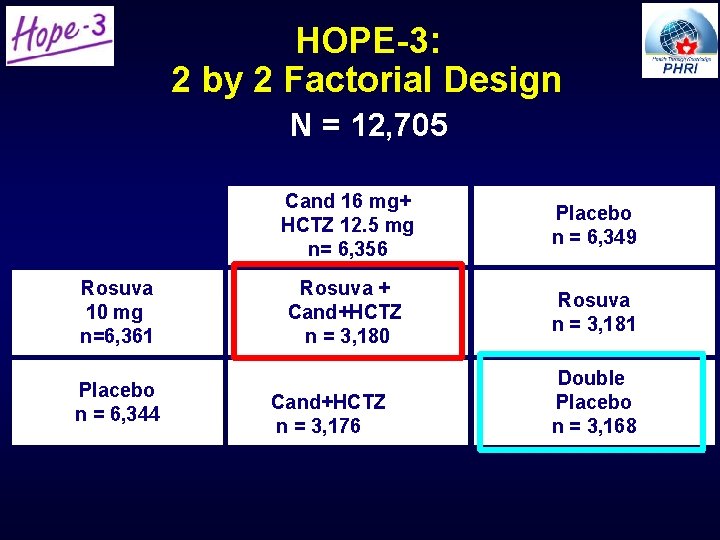
HOPE-3: 2 by 2 Factorial Design 14, 682 Entered Single-blind 4 week Active Run-in 12, 705 (87%) Randomized Rosuvastatin 10 mg n=6, 361 Placebo n = 6, 344 Candesartan 16 mg + HCTZ 12. 5 mg n= 6, 356 Placebo n = 6, 349 Rosuvastatin Cand+HCTZ n = 3, 180 Rosuvastatin n = 3, 181 Cand+HCTZ n = 3, 176 Double Placebo n = 3, 168 Simple follow-up and few blood tests 7
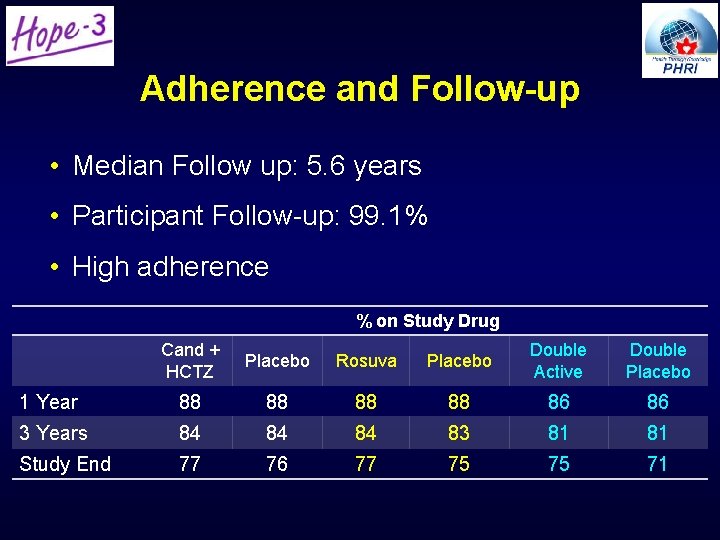
Adherence and Follow-up • Median Follow up: 5. 6 years • Participant Follow-up: 99. 1% • High adherence % on Study Drug Cand + HCTZ Placebo Rosuva Placebo Double Active Double Placebo 1 Year 88 88 86 86 3 Years 84 84 84 83 81 81 Study End 77 76 77 75 75 71
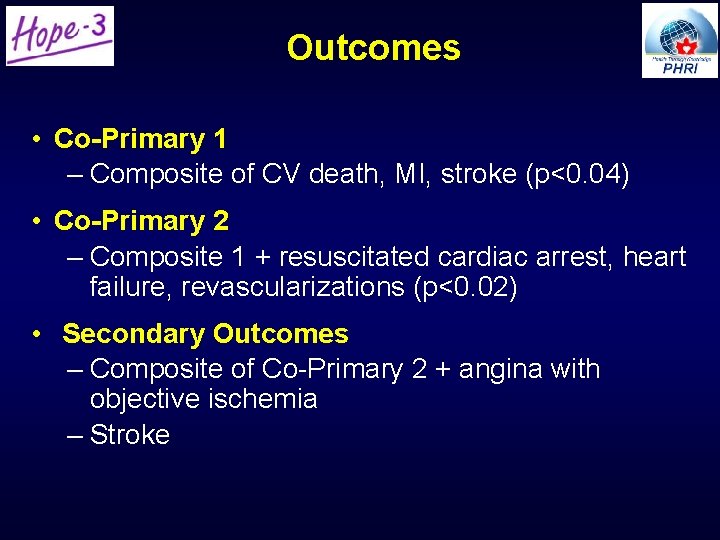
Outcomes • Co-Primary 1 – Composite of CV death, MI, stroke (p<0. 04) • Co-Primary 2 – Composite 1 + resuscitated cardiac arrest, heart failure, revascularizations (p<0. 02) • Secondary Outcomes – Composite of Co-Primary 2 + angina with objective ischemia – Stroke
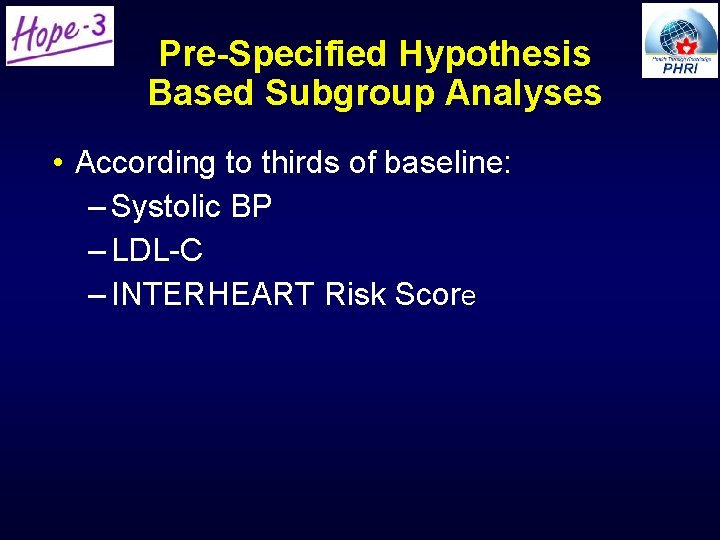
Pre-Specified Hypothesis Based Subgroup Analyses • According to thirds of baseline: – Systolic BP – LDL-C – INTERHEART Risk Score
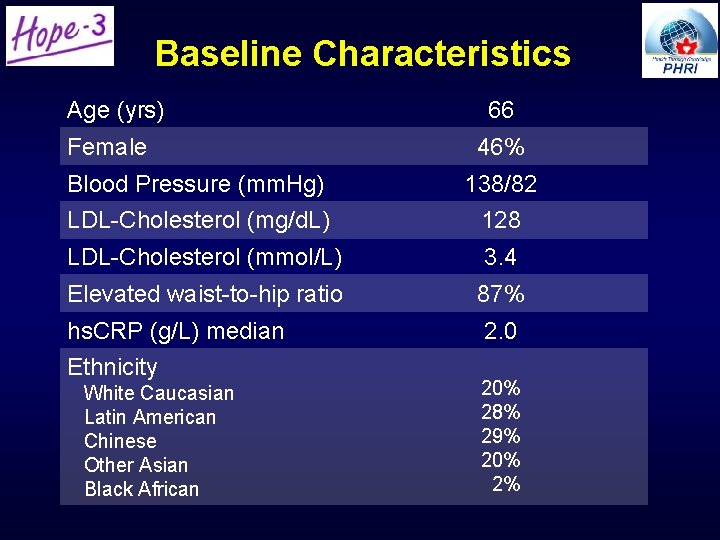
Baseline Characteristics Age (yrs) Female 66 46% Blood Pressure (mm. Hg) 138/82 LDL-Cholesterol (mg/d. L) 128 LDL-Cholesterol (mmol/L) 3. 4 Elevated waist-to-hip ratio 87% hs. CRP (g/L) median Ethnicity White Caucasian Latin American Chinese Other Asian Black African 2. 0 20% 28% 29% 20% 2%
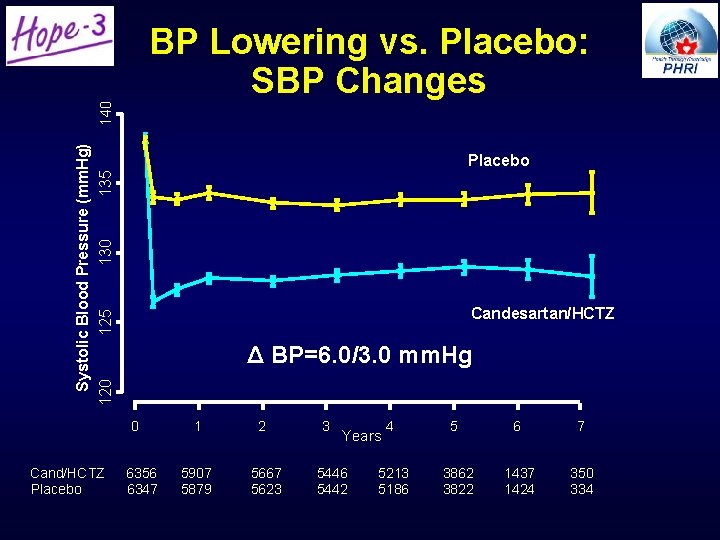
Systolic Blood Pressure (mm. Hg) 130 125 135 140 BP Lowering vs. Placebo: SBP Changes Placebo Candesartan/HCTZ Δ BP=6. 0/3. 0 mm. Hg 0 Cand/HCTZ Placebo 6356 6347 1 2 5907 5879 5667 5623 3 Years 5446 5442 4 5213 5186 5 3862 3822 6 7 1437 1424 350 334
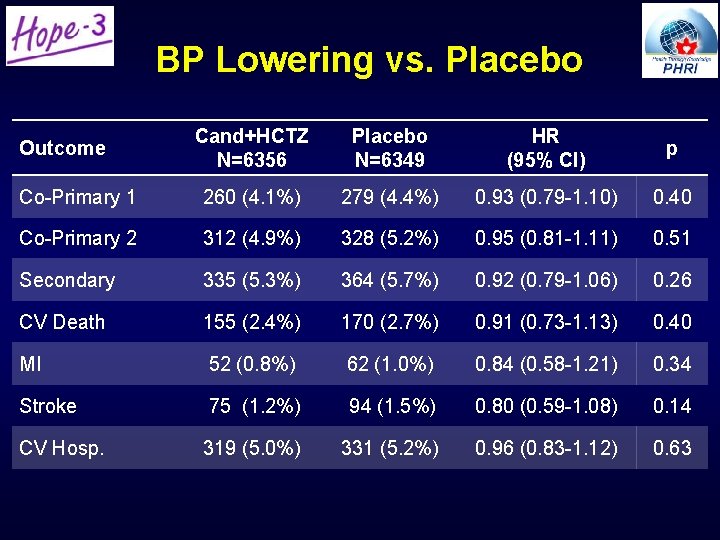
BP Lowering vs. Placebo Cand+HCTZ N=6356 Placebo N=6349 HR (95% CI) p Co-Primary 1 260 (4. 1%) 279 (4. 4%) 0. 93 (0. 79 -1. 10) 0. 40 Co-Primary 2 312 (4. 9%) 328 (5. 2%) 0. 95 (0. 81 -1. 11) 0. 51 Secondary 335 (5. 3%) 364 (5. 7%) 0. 92 (0. 79 -1. 06) 0. 26 CV Death 155 (2. 4%) 170 (2. 7%) 0. 91 (0. 73 -1. 13) 0. 40 MI 52 (0. 8%) 62 (1. 0%) 0. 84 (0. 58 -1. 21) 0. 34 Stroke 75 (1. 2%) 94 (1. 5%) 0. 80 (0. 59 -1. 08) 0. 14 CV Hosp. 319 (5. 0%) 331 (5. 2%) 0. 96 (0. 83 -1. 12) 0. 63 Outcome
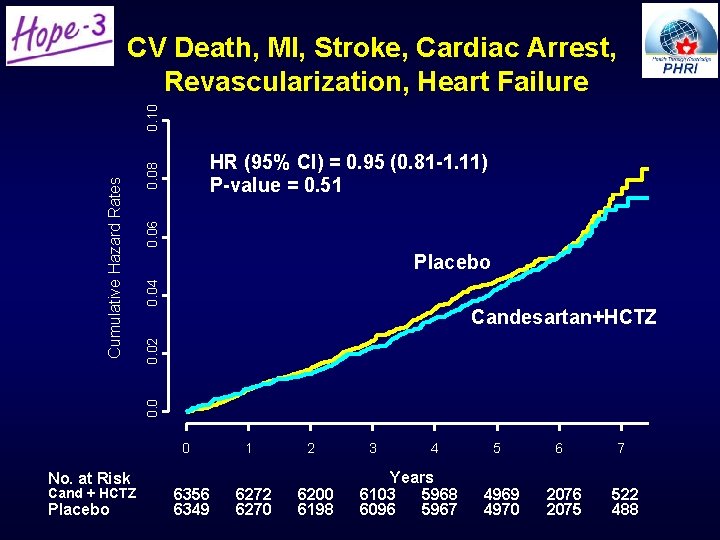
0. 06 0. 08 HR (95% CI) = 0. 95 (0. 81 -1. 11) P-value = 0. 51 0. 04 Placebo 0. 02 Candesartan+HCTZ 0. 0 Cumulative Hazard Rates 0. 10 CV Death, MI, Stroke, Cardiac Arrest, Revascularization, Heart Failure No. at Risk Cand + HCTZ Placebo 0 1 2 6356 6349 6272 6270 6200 6198 3 4 Years 6103 5968 6096 5967 5 4969 4970 6 2076 2075 7 522 488
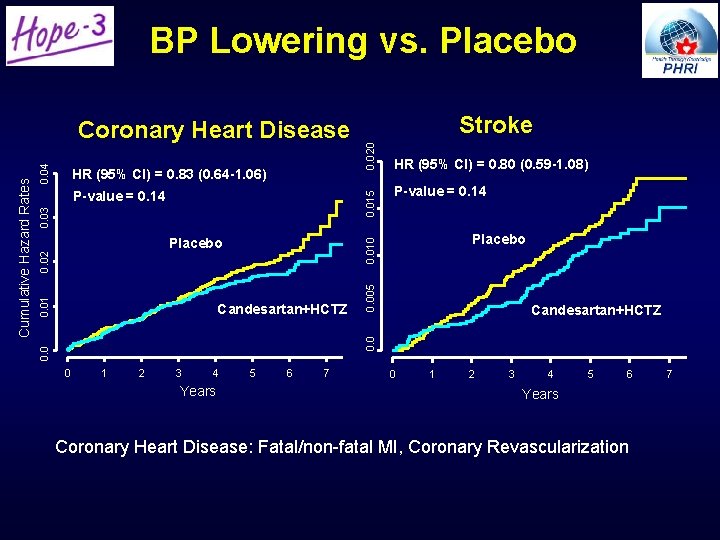
BP Lowering vs. Placebo 0. 020 HR (95% CI) = 0. 80 (0. 59 -1. 08) P-value = 0. 14 0. 03 0. 015 P-value = 0. 14 Stroke 0. 02 0. 01 Placebo 0. 010 Placebo Candesartan+HCTZ 0. 005 0. 04 HR (95% CI) = 0. 83 (0. 64 -1. 06) 0. 0 Cumulative Hazard Rates Coronary Heart Disease 4 5 6 7 0 1 2 3 Years 0 1 2 3 4 Years 5 6 7 Coronary Heart Disease: Fatal/non-fatal MI, Coronary Revascularization
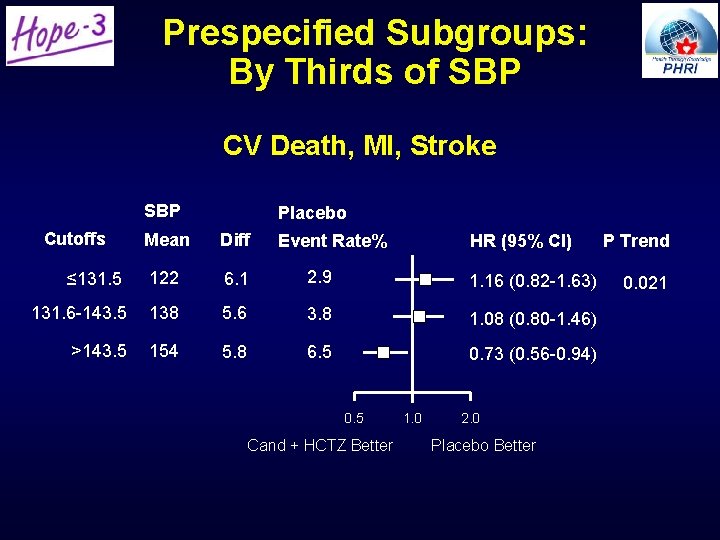
Prespecified Subgroups: By Thirds of SBP CV Death, MI, Stroke SBP Cutoffs Mean Placebo Diff Event Rate% HR (95% CI) ≤ 131. 5 122 6. 1 2. 9 1. 16 (0. 82 -1. 63) 131. 6 -143. 5 138 5. 6 3. 8 1. 08 (0. 80 -1. 46) >143. 5 154 5. 8 6. 5 0. 73 (0. 56 -0. 94) 0. 5 Cand + HCTZ Better 1. 0 2. 0 Placebo Better P Trend 0. 021
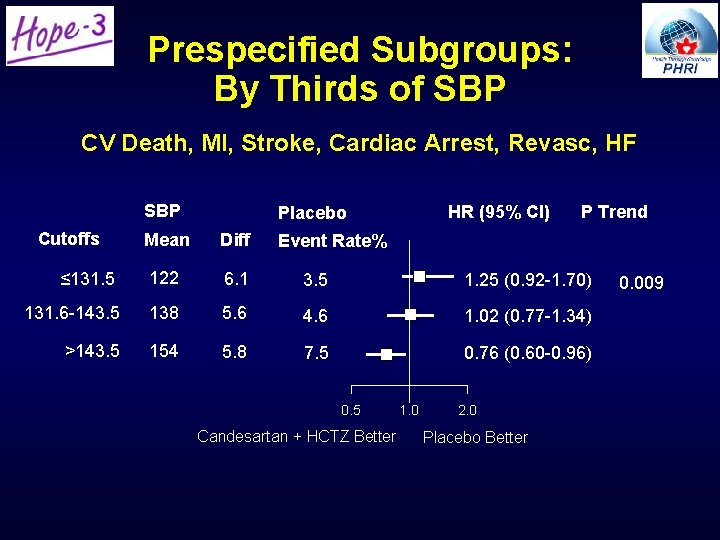
Prespecified Subgroups: By Thirds of SBP CV Death, MI, Stroke, Cardiac Arrest, Revasc, HF SBP Cutoffs Mean HR (95% CI) Placebo Diff P Trend Event Rate% ≤ 131. 5 122 6. 1 3. 5 1. 25 (0. 92 -1. 70) 131. 6 -143. 5 138 5. 6 4. 6 1. 02 (0. 77 -1. 34) >143. 5 154 5. 8 7. 5 0. 76 (0. 60 -0. 96) 0. 5 Candesartan + HCTZ Better 1. 0 2. 0 Placebo Better 0. 009
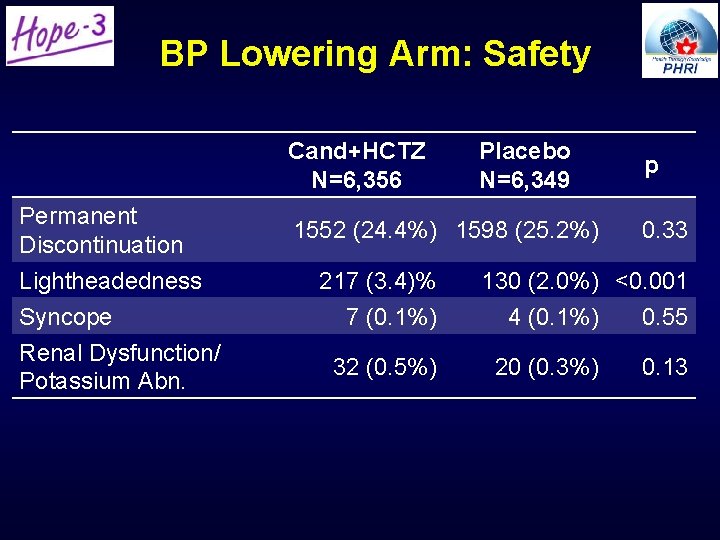
BP Lowering Arm: Safety Cand+HCTZ N=6, 356 Permanent Discontinuation Lightheadedness Syncope Renal Dysfunction/ Potassium Abn. Placebo N=6, 349 1552 (24. 4%) 1598 (25. 2%) 217 (3. 4)% 7 (0. 1%) 32 (0. 5%) p 0. 33 130 (2. 0%) <0. 001 4 (0. 1%) 0. 55 20 (0. 3%) 0. 13
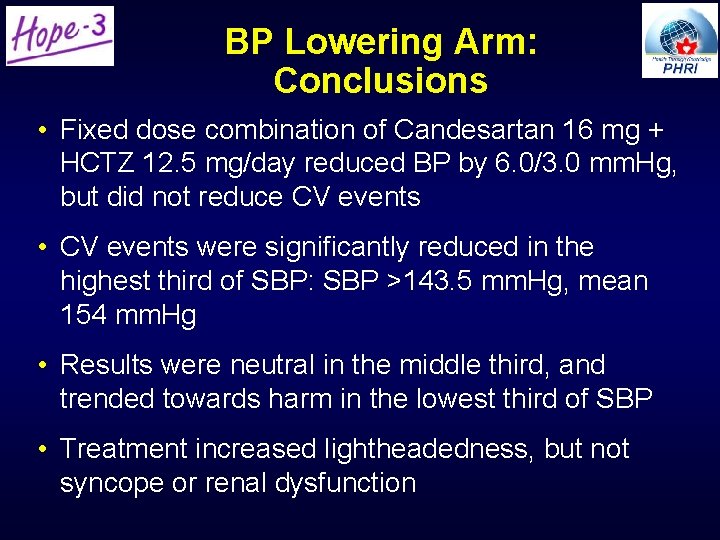
BP Lowering Arm: Conclusions • Fixed dose combination of Candesartan 16 mg + HCTZ 12. 5 mg/day reduced BP by 6. 0/3. 0 mm. Hg, but did not reduce CV events • CV events were significantly reduced in the highest third of SBP: SBP >143. 5 mm. Hg, mean 154 mm. Hg • Results were neutral in the middle third, and trended towards harm in the lowest third of SBP • Treatment increased lightheadedness, but not syncope or renal dysfunction
Cholesterol Lowering Arm Results J. Bosch
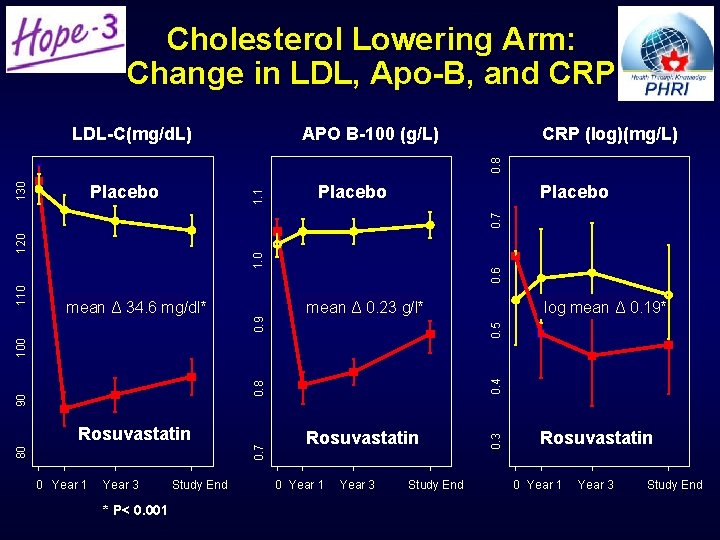
Cholesterol Lowering Arm: Change in LDL, Apo-B, and CRP APO B-100 (g/L) CRP (log)(mg/L) 0. 8 LDL-C(mg/d. L) Placebo 0. 6 1. 0 0. 4 0. 8 90 80 0. 7 Rosuvastatin 0 Year 1 Year 3 * P< 0. 001 Study End log mean Δ 0. 19* 0. 5 mean Δ 0. 23 g/l* Rosuvastatin 0 Year 1 Year 3 Study End 0. 3 0. 9 mean Δ 34. 6 mg/dl* 100 110 120 0. 7 1. 1 130 Placebo Rosuvastatin 0 Year 1 Year 3 Study End
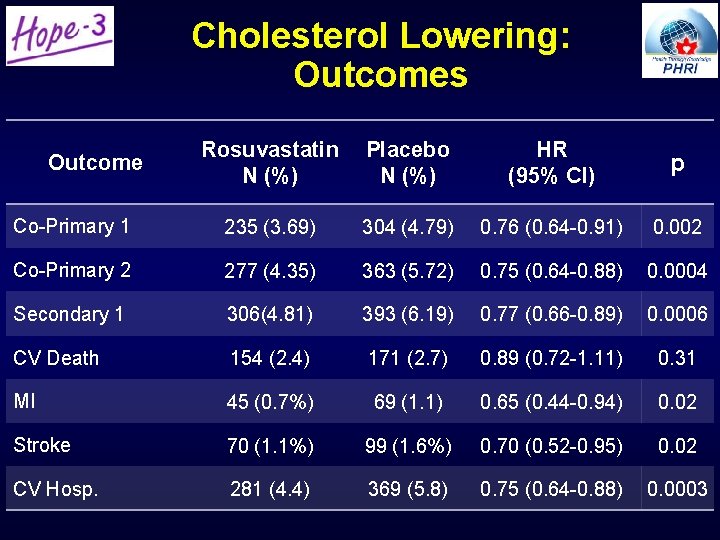
Cholesterol Lowering: Outcomes Rosuvastatin N (%) Placebo N (%) HR (95% CI) p Co-Primary 1 235 (3. 69) 304 (4. 79) 0. 76 (0. 64 -0. 91) 0. 002 Co-Primary 2 277 (4. 35) 363 (5. 72) 0. 75 (0. 64 -0. 88) 0. 0004 Secondary 1 306(4. 81) 393 (6. 19) 0. 77 (0. 66 -0. 89) 0. 0006 CV Death 154 (2. 4) 171 (2. 7) 0. 89 (0. 72 -1. 11) 0. 31 MI 45 (0. 7%) 69 (1. 1) 0. 65 (0. 44 -0. 94) 0. 02 Stroke 70 (1. 1%) 99 (1. 6%) 0. 70 (0. 52 -0. 95) 0. 02 CV Hosp. 281 (4. 4) 369 (5. 8) 0. 75 (0. 64 -0. 88) 0. 0003 Outcome
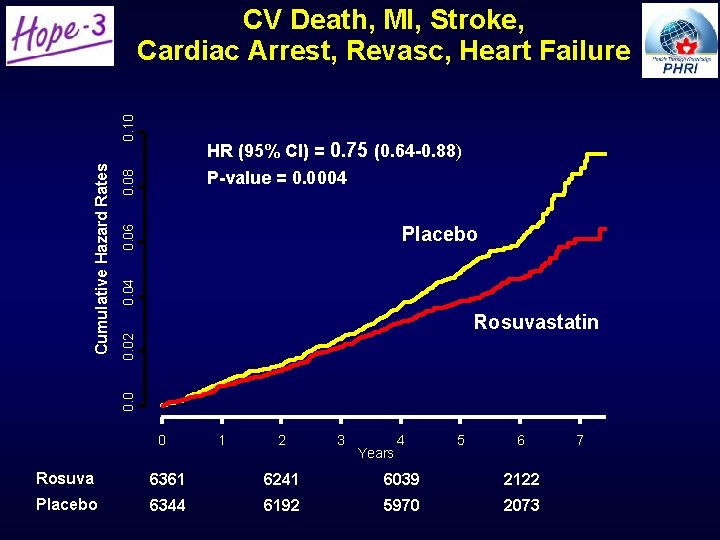
0. 08 HR (95% CI) = 0. 75 (0. 64 -0. 88) P-value = 0. 0004 0. 06 Placebo 0. 02 Rosuvastatin 0. 0 Cumulative Hazard Rates 0. 10 CV Death, MI, Stroke, Cardiac Arrest, Revasc, Heart Failure 0 1 2 3 Years 4 5 6 Rosuva 6361 6241 6039 2122 Placebo 6344 6192 5970 2073 7
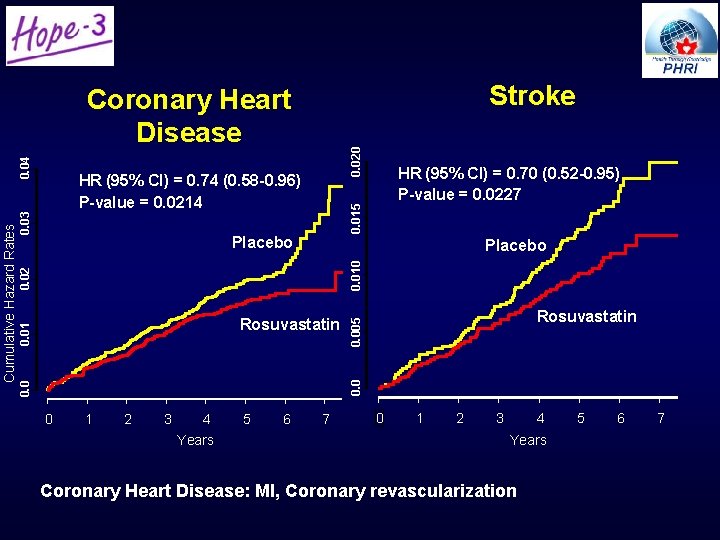
Stroke 0. 020 HR (95% CI) = 0. 70 (0. 52 -0. 95) P-value = 0. 0227 0. 015 0. 03 HR (95% CI) = 0. 74 (0. 58 -0. 96) P-value = 0. 0214 Placebo Rosuvastatin 0. 01 Rosuvastatin 0. 005 0. 02 0. 010 Placebo 0. 0 Cumulative Hazard Rates 0. 04 Coronary Heart Disease 0 1 2 3 4 Years 5 6 7 0 1 2 3 4 Years Coronary Heart Disease: MI, Coronary revascularization 5 6 7
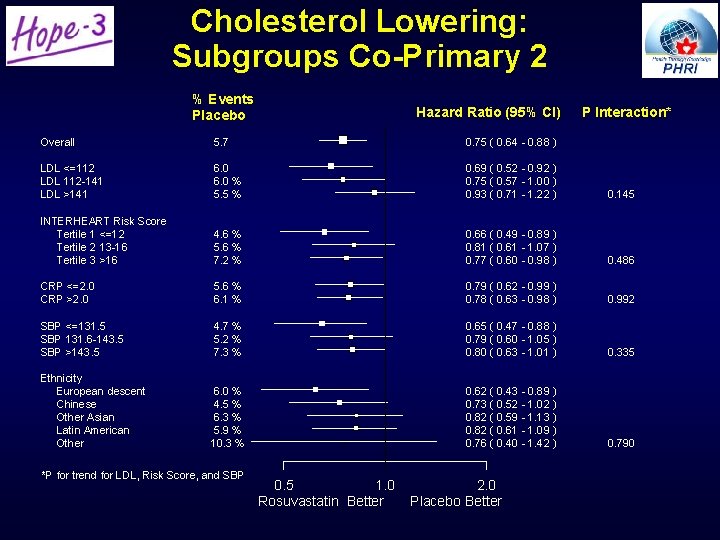
Cholesterol Lowering: Subgroups Co-Primary 2 % Events Placebo Hazard Ratio (95% CI) P Interaction* Overall 5. 7 0. 75 ( 0. 64 - 0. 88 ) LDL <=112 LDL 112 -141 LDL >141 6. 0 % 5. 5 % 0. 69 ( 0. 52 - 0. 92 ) 0. 75 ( 0. 57 - 1. 00 ) 0. 93 ( 0. 71 - 1. 22 ) 0. 145 INTERHEART Risk Score Tertile 1 <=12 Tertile 2 13 -16 Tertile 3 >16 4. 6 % 5. 6 % 7. 2 % 0. 66 ( 0. 49 - 0. 89 ) 0. 81 ( 0. 61 - 1. 07 ) 0. 77 ( 0. 60 - 0. 98 ) 0. 486 CRP <=2. 0 CRP >2. 0 5. 6 % 6. 1 % 0. 79 ( 0. 62 - 0. 99 ) 0. 78 ( 0. 63 - 0. 98 ) 0. 992 SBP <=131. 5 SBP 131. 6 -143. 5 SBP >143. 5 4. 7 % 5. 2 % 7. 3 % 0. 65 ( 0. 47 - 0. 88 ) 0. 79 ( 0. 60 - 1. 05 ) 0. 80 ( 0. 63 - 1. 01 ) 0. 335 Ethnicity European descent Chinese Other Asian Latin American Other 6. 0 % 4. 5 % 6. 3 % 5. 9 % 10. 3 % 0. 62 ( 0. 43 - 0. 89 ) 0. 73 ( 0. 52 - 1. 02 ) 0. 82 ( 0. 59 - 1. 13 ) 0. 82 ( 0. 61 - 1. 09 ) 0. 76 ( 0. 40 - 1. 42 ) 0. 790 *P for trend for LDL, Risk Score, and SBP 0. 5 1. 0 Rosuvastatin Better 2. 0 Placebo Better
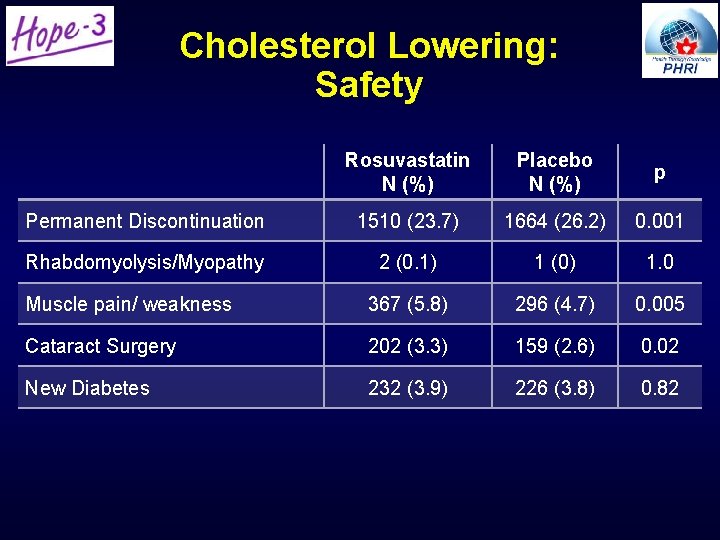
Cholesterol Lowering: Safety Rosuvastatin N (%) Placebo N (%) p Permanent Discontinuation 1510 (23. 7) 1664 (26. 2) 0. 001 Rhabdomyolysis/Myopathy 2 (0. 1) 1 (0) 1. 0 Muscle pain/ weakness 367 (5. 8) 296 (4. 7) 0. 005 Cataract Surgery 202 (3. 3) 159 (2. 6) 0. 02 New Diabetes 232 (3. 9) 226 (3. 8) 0. 82
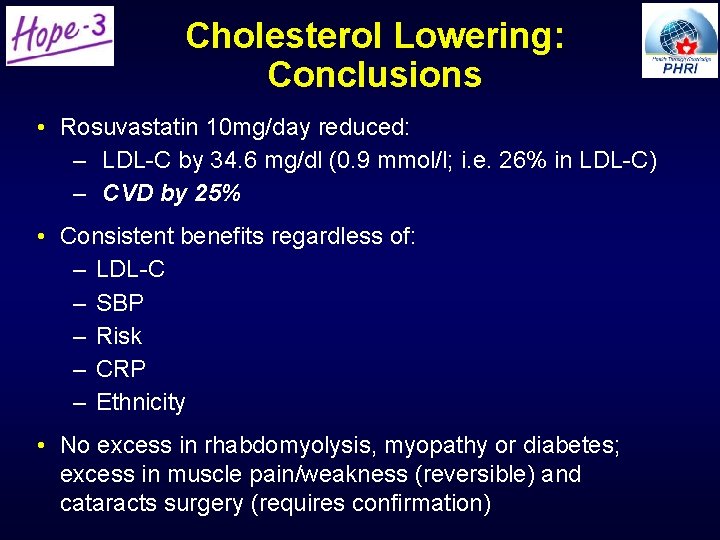
Cholesterol Lowering: Conclusions • Rosuvastatin 10 mg/day reduced: – LDL-C by 34. 6 mg/dl (0. 9 mmol/l; i. e. 26% in LDL-C) – CVD by 25% • Consistent benefits regardless of: – LDL-C – SBP – Risk – CRP – Ethnicity • No excess in rhabdomyolysis, myopathy or diabetes; excess in muscle pain/weakness (reversible) and cataracts surgery (requires confirmation)
Combined BP & Cholesterol Lowering vs Double Placebo Salim Yusuf
HOPE-3: 2 by 2 Factorial Design N = 12, 705 Rosuva 10 mg n=6, 361 Placebo n = 6, 344 Cand 16 mg+ HCTZ 12. 5 mg n= 6, 356 Placebo n = 6, 349 Rosuva + Cand+HCTZ n = 3, 180 Rosuva n = 3, 181 Cand+HCTZ n = 3, 176 Double Placebo n = 3, 168
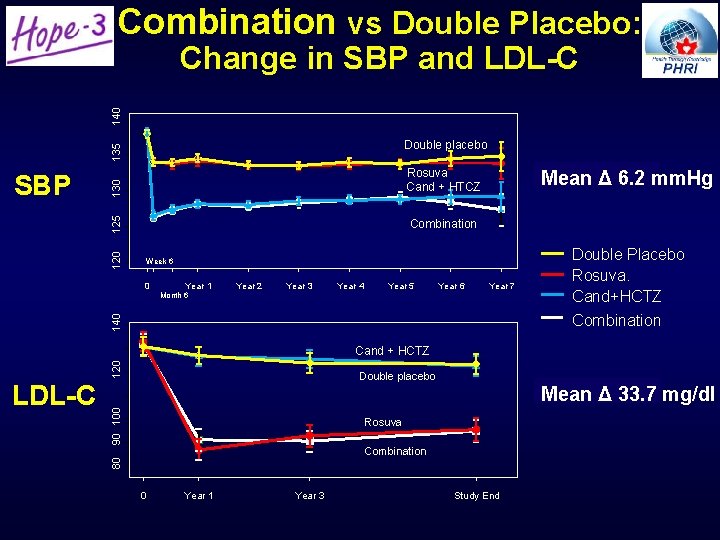
Combination vs Double Placebo: 140 Change in SBP and LDL-C 130 Combination 120 SBP Rosuva Cand + HTCZ 125 135 Double placebo Mean Δ 6. 2 mm. Hg Week 6 0 Year 1 Year 2 Year 3 Year 4 Year 5 Year 6 Year 7 140 Month 6 Double Placebo Rosuva. Cand+HCTZ Combination 120 Cand + HCTZ 90 100 Mean Δ 33. 7 mg/dl Rosuva Combination 80 LDL-C Double placebo 0 Year 1 Year 3 Study End
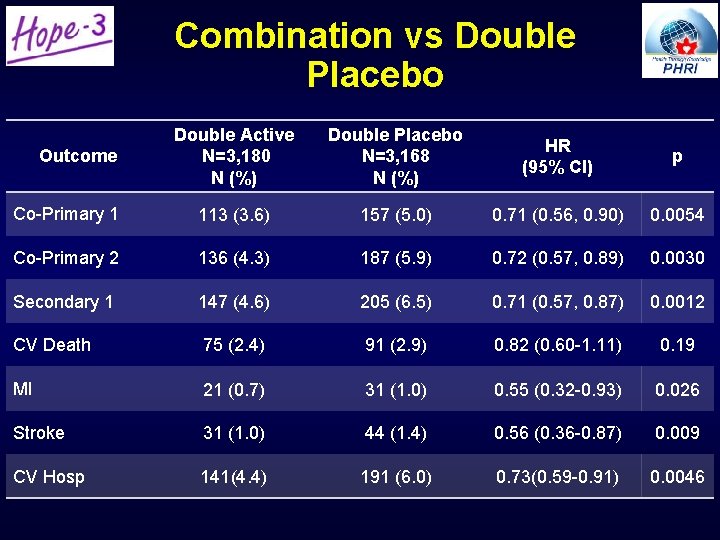
Combination vs Double Placebo Double Active N=3, 180 N (%) Double Placebo N=3, 168 N (%) HR (95% CI) p Co-Primary 1 113 (3. 6) 157 (5. 0) 0. 71 (0. 56, 0. 90) 0. 0054 Co-Primary 2 136 (4. 3) 187 (5. 9) 0. 72 (0. 57, 0. 89) 0. 0030 Secondary 1 147 (4. 6) 205 (6. 5) 0. 71 (0. 57, 0. 87) 0. 0012 CV Death 75 (2. 4) 91 (2. 9) 0. 82 (0. 60 -1. 11) 0. 19 MI 21 (0. 7) 31 (1. 0) 0. 55 (0. 32 -0. 93) 0. 026 Stroke 31 (1. 0) 44 (1. 4) 0. 56 (0. 36 -0. 87) 0. 009 CV Hosp 141(4. 4) 191 (6. 0) 0. 73(0. 59 -0. 91) 0. 0046 Outcome
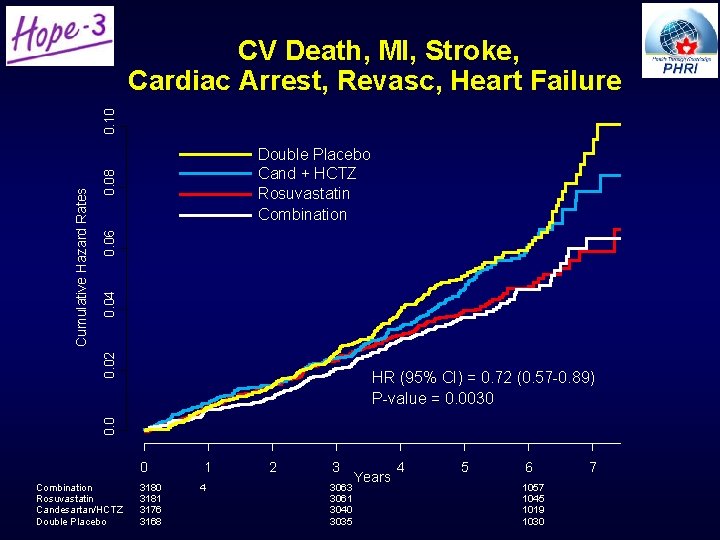
0. 04 0. 06 0. 08 Double Placebo Cand + HCTZ Rosuvastatin Combination 0. 02 Cumulative Hazard Rates 0. 10 CV Death, MI, Stroke, Cardiac Arrest, Revasc, Heart Failure 0. 0 HR (95% CI) = 0. 72 (0. 57 -0. 89) P-value = 0. 0030 0 Combination Rosuvastatin Candesartan/HCTZ Double Placebo 3180 3181 3176 3168 1 4 2 3 Years 3063 3061 3040 3035 4 5 6 1057 1045 1019 1030 7
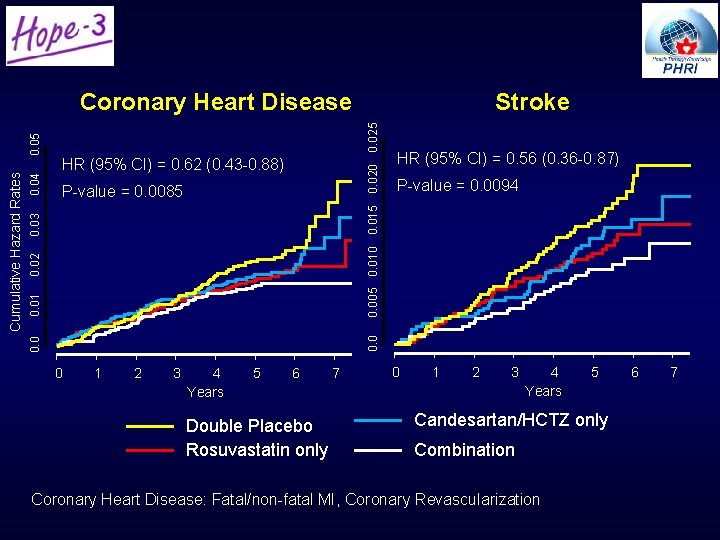
Stroke 0. 005 0. 010 0. 015 0. 020 0. 025 P-value = 0. 0085 HR (95% CI) = 0. 56 (0. 36 -0. 87) P-value = 0. 0094 0. 01 0. 02 0. 03 0. 04 HR (95% CI) = 0. 62 (0. 43 -0. 88) 0. 0 Cumulative Hazard Rates 0. 05 Coronary Heart Disease 0 1 2 3 4 Years 5 6 Double Placebo Rosuvastatin only 7 0 1 2 3 4 Years 5 6 Candesartan/HCTZ only Combination Coronary Heart Disease: Fatal/non-fatal MI, Coronary Revascularization 7
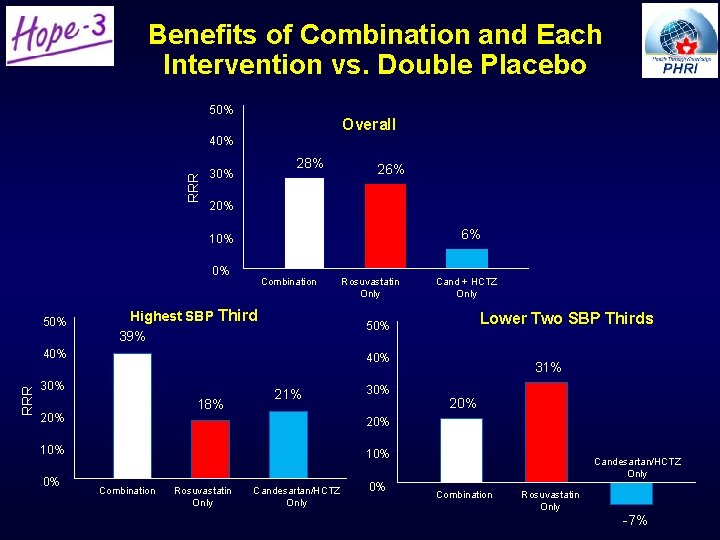
Benefits of Combination and Each Intervention vs. Double Placebo 50% Overall RRR 40% 28% 30% 26% 20% 6% 10% 0% 50% Combination Highest SBP Third 39% RRR Cand + HCTZ Only Lower Two SBP Thirds 50% 40% 30% 18% 20% 21% 30% 31% 20% 10% 0% Rosuvastatin Only 10% Combination Rosuvastatin Only Candesartan/HCTZ Only 0% Candesartan/HCTZ Only Combination Rosuvastatin Only -7%
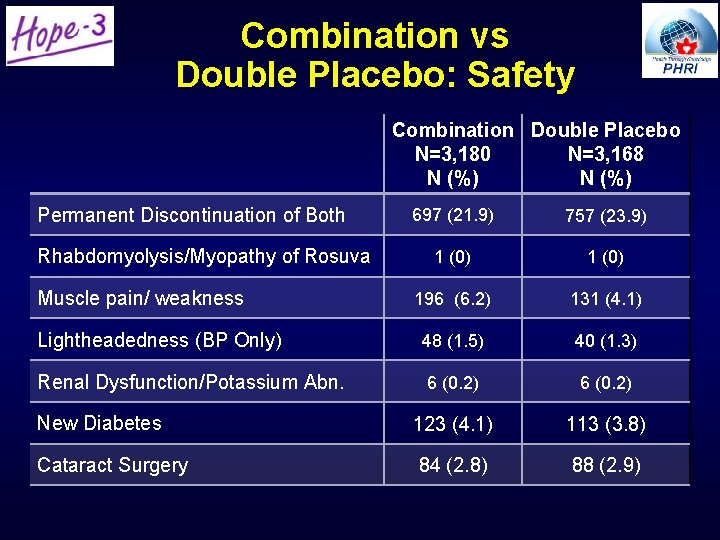
Combination vs Double Placebo: Safety Combination Double Placebo N=3, 180 N=3, 168 N (%) Permanent Discontinuation of Both 697 (21. 9) 757 (23. 9) 1 (0) 196 (6. 2) 131 (4. 1) Lightheadedness (BP Only) 48 (1. 5) 40 (1. 3) Renal Dysfunction/Potassium Abn. 6 (0. 2) New Diabetes 123 (4. 1) 113 (3. 8) Cataract Surgery 84 (2. 8) 88 (2. 9) Rhabdomyolysis/Myopathy of Rosuva Muscle pain/ weakness
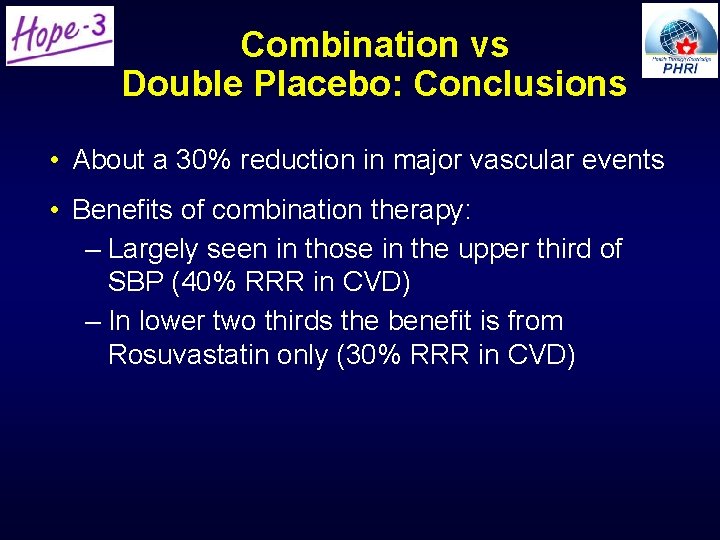
Combination vs Double Placebo: Conclusions • About a 30% reduction in major vascular events • Benefits of combination therapy: – Largely seen in those in the upper third of SBP (40% RRR in CVD) – In lower two thirds the benefit is from Rosuvastatin only (30% RRR in CVD)
Clinical Implications • Statins beneficial in all participants • BP lowering benefits only those with elevated BP • Combination therapy: – In hypertensives, leads to a 40% risk reduction (benefits from both BP lowering and statin) – In others, 30% RRR from statin alone • Pragmatic strategy without: – Lipid or BP criteria – Dose titration – Frequent monitoring HOPE-3 strategy is simple, effective, safe and low cost, and is globally applicable
HOPE-3 Results Published today in the NEJM: • Lonn E, Bosch J, Lopez-Jaramillo P, et al. , for the HOPE-3 Investigators. Blood pressure lowering in intermediate risk people without vascular disease. NEJM 2016. • Yusuf, S. , Bosch, J. , Dagenais, G. , et al. for the HOPE-3 Investigators. Rosuvastatin in intermediate-risk people without cardiovascular disease. NEJM 2016. • Yusuf, S. , Lonn, E. , Pais, P. et al. for the HOPE-3 Investigators. Blood pressure and cholesterol lowering in people without cardiovascular disease. NEJM 2016.
Acknowledgements • We would like to thank: – The Steering Committee – The Data and Safety Monitoring Committee – The Investigators and Study Coordinators for all their efforts We are very appreciative of the efforts made by all participants!!