
The Hazard Analysis Critical Control Point HACCP Introduction
- Slides: 14
The Hazard Analysis Critical Control Point HACCP
Introduction n a food safety program developed nearly 30 years ago for astronauts and is applying it to seafood and juice. It focuses on preventing hazards that could cause food-borne illnesses by applying sciencebased controls, from raw material to finished products. Safety of the food supply is key to consumer confidence.
What is HACCP? ? n n A systematic approach to the identification, evaluation, and control of food safety hazards. system is based on assessing the natural hazards or risks in a particular product or process and designing a system to control them.
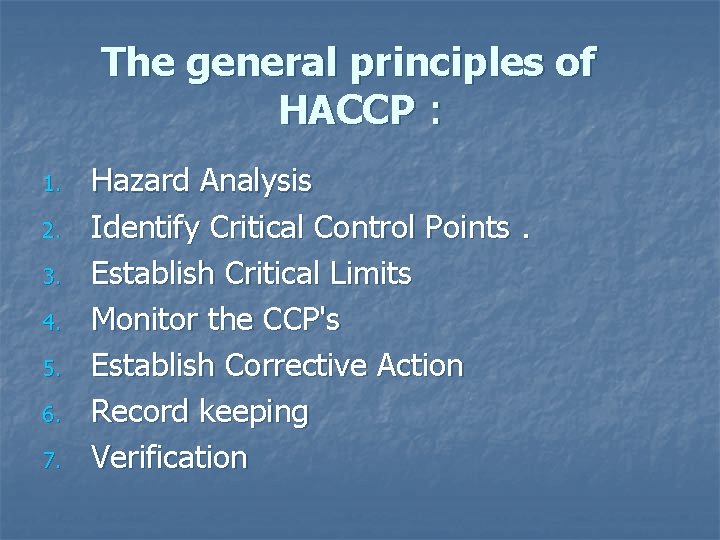
The general principles of HACCP : 1. 2. 3. 4. 5. 6. 7. Hazard Analysis Identify Critical Control Points. Establish Critical Limits Monitor the CCP's Establish Corrective Action Record keeping Verification
Hazard Analysis n n Hazards : biological, chemical, and physical which are conditions cause a health risk to the consumer. In order to conduct the hazard analysis a flow diagram of the complete process is important.
Identify critical control points n CCP’S are the points in a food's production (from its raw state To consumption) at which the potential hazard can be controlled or eliminated.
Establish Critical Limits Establish preventive measures with critical limits for each control point. n
Monitor the CCP's n Monitoring : is a planned sequence of measurements or observations to ensure the product or process is in control.
Establish Corrective Action n Establish corrective actions ( for the product or process) when monitoring shows that a critical limit has loss of control.
Record keeping n The HACCP system requires the preparation and maintenance of a written HACCP plan together with other documentation. This must include all records generated during the monitoring of each CCP and notations of corrective actions taken.
Verification n n Verification : is the activities that determine the validity of the HACCP plan and that the system is operating according to the plan. Verification activities are carried out by individuals within a company, experts team, and regulatory agencies
The HACCP Plan n The HACCP Plan is the written document which is based upon the principles of HACCP and which delineates the procedures to be followed.
Developing a HACCP Plan n n The format of HACCP plans will vary depending on the product and process. In the development of a HACCP plan, five preliminary tasks need to be accomplished before the application of the HACCP principles to a specific product and process.
: The five preliminary tasks are n n n Assemble the HACCP Team Describe the Food and its Distribution Describe the Intended Use and Consumers of the Food Develop a Flow Diagram Which Describes the Process Verify the Flow Diagram