
The Hawaii Space Flight Laboratory Western Regional Space
The Hawaii Space Flight Laboratory Western Regional Space Grant Meeting Oklahoma City, OK 29 September, 2007

Hawaii Space Flight Lab n Collaborative program between the University of Hawaii’s School of Ocean and Earth Science and Technology (SOEST) and College of Engineering (Co. E). n Connections through the Hawaii Space Grant Consortium since 2001. ¡ Co. E provides small satellite engineering experience n National Electrical Engineering Undergraduate Students from the year 2003 and 2005. n Engineering faculty specializing in nano- and micro-sat design. ¡ SOEST provides instrumentation design and science applications n Faculty with instrument building experience. n Faculty investigators on many NASA missions. ¡ HSGC provides NASA support n Network of 52 space grant consortia located in each State as well as District of Columbia and Puerto Rico. n Grant funds for undergraduate and graduate fellowships. n Connections to NASA Centers and NASA HQ through Office of Education.

The mission of HSFL is to: n n promote innovative engineering and science research for terrestrial and planetary space missions develop, launch, and operate small spacecraft from the Hawaiian Islands to accelerate the validation of new space technologies provide workforce training in all aspects of unmanned space missions promote synergistic collaborations between educational, governmental, and corporate institutions interested in space exploration

University Organization UH System Kauai Community College UH Manoa School of Ocean and Earth Science and Technology (SOEST) College of Engineering (Co. E) Hawaii Space Flight Laboratory (HSFL) Hawaii Space Grant Consortium (HSGC) Windward Community College

HSFL Organization Management Director: Co-Director: Missions Manager: Admin Lead: Contracts: Spacecraft Instrument Manager: T. Sorensen Systems Lead: B. Wolfe Avionics Lead: Jason Akagi Lead: K. Horton Systems: H. Garbeil Integration & Testing Project-French, G. Facility-K. Kurokawa Support: TBD Luke Flynn Wayne Shiroma Lloyd French Judy Rubano Lenny Gouveia Launch Vehicle Launch Support LV Lead: L. Flynn LS Lead: T. Williams LV Technical Monitors: J. Liller, T. Maultsby Ground Station Operations & Data O&D Lead: TBD LS Technical Monitor: S. Burley Lead: T. Nielsen Support: TBD O&D Assist: H. Garbeil Systems Orbits C&DH Software Structure ACS B. Wolfe Justin Akagi M. Jah - Oceanit Jason Akagi S. Stolper H. Garbeil L. Yoneshige TBD Thermal Power Telecom Payload –IHMS Payload -UV/Vis/IR M. Kobayashi E. Miller W. Shiroma NASA Ames/JPL K. Horton H. Garbeil
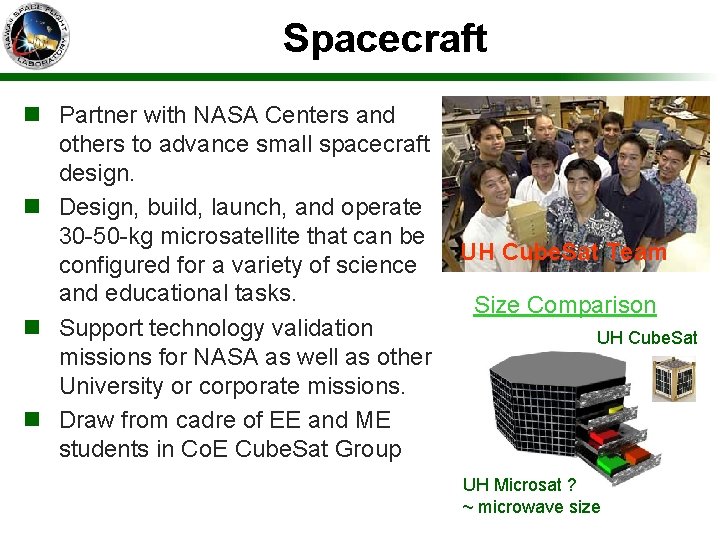
Spacecraft n Partner with NASA Centers and others to advance small spacecraft design. n Design, build, launch, and operate 30 -50 -kg microsatellite that can be configured for a variety of science and educational tasks. n Support technology validation missions for NASA as well as other University or corporate missions. n Draw from cadre of EE and ME students in Co. E Cube. Sat Group UH Cube. Sat Team Size Comparison UH Cube. Sat UH Microsat ? ~ microwave size

Integration and Test n College of Engineering donates available clean room space n Vice Chancellor for Research and SOEST Dean allocate funds for clean room equipment. n Clean rooms in UH/POST will be used to assemble satellites. ¡ ¡ Systems integration Thermo-vac testing Vibration testing Electronics testing for launch vehicle component integration

Ground Station n UH/HSFL maintains receiving stations that will be moved to roof of POST in 2007. n Ground station provides command control broadcast as well as data downlink capabilities. n Mission Ops Center on POST 5 th floor under development with UH support. n Back-up provided by PMRF
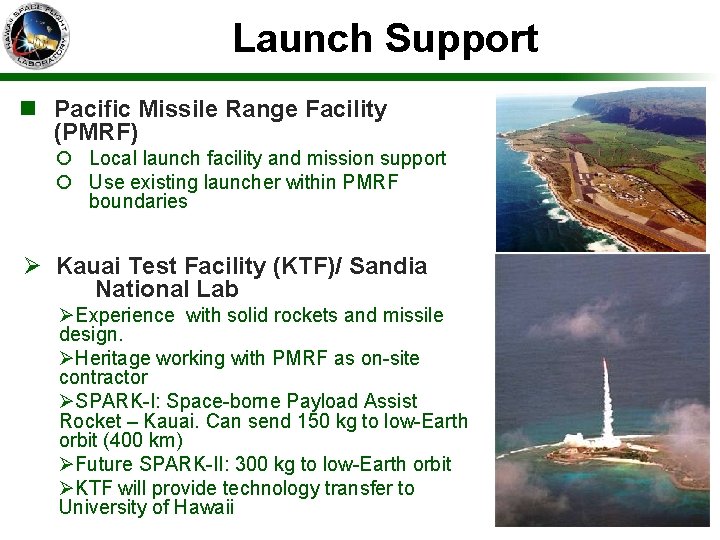
Launch Support n Pacific Missile Range Facility (PMRF) ¡ Local launch facility and mission support ¡ Use existing launcher within PMRF boundaries Ø Kauai Test Facility (KTF)/ Sandia National Lab ØExperience with solid rockets and missile design. ØHeritage working with PMRF as on-site contractor ØSPARK-I: Space-borne Payload Assist Rocket – Kauai. Can send 150 kg to low-Earth orbit (400 km) ØFuture SPARK-II: 300 kg to low-Earth orbit ØKTF will provide technology transfer to University of Hawaii
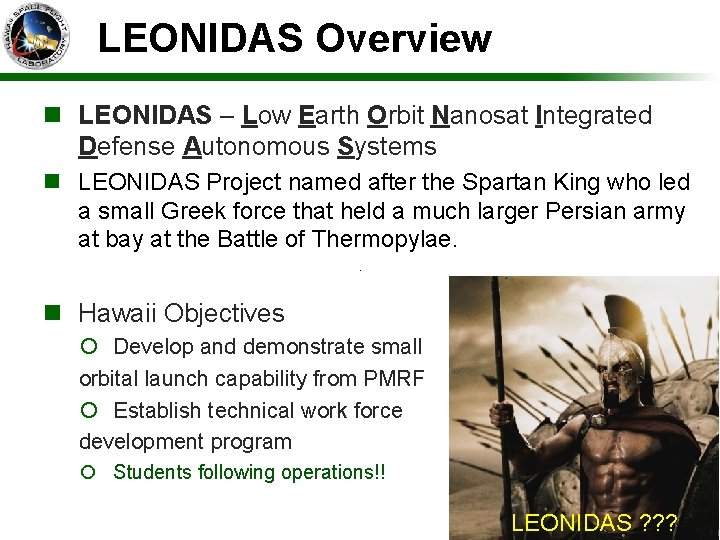
LEONIDAS Overview n LEONIDAS – Low Earth Orbit Nanosat Integrated Defense Autonomous Systems n LEONIDAS Project named after the Spartan King who led a small Greek force that held a much larger Persian army at bay at the Battle of Thermopylae. n Hawaii Objectives ¡ Develop and demonstrate small orbital launch capability from PMRF ¡ Establish technical work force development program ¡ Students following operations!! LEONIDAS ? ? ?
LEONIDAS-1 Mission Scenario LEONIDAS Mission #1 is designated as Science and Technology for the University (STU) #1. LEONIDAS #1 ¡Mission Objectives: Remote Sensing and Spacecraft Health Monitoring ¡Mission Duration: 1 – 1. 5 years ¡Orbit: 400 km ¡Payload Mass: ~140 -150 kg n Rideshare Satellite - 50 kg n UH satellite – 50 kg n PAD (Payload Adapter and Deployer) ~ 30 kg n Cube. Sats – 2 P-PODS – up to 6 cubes LEONIDAS ? ?
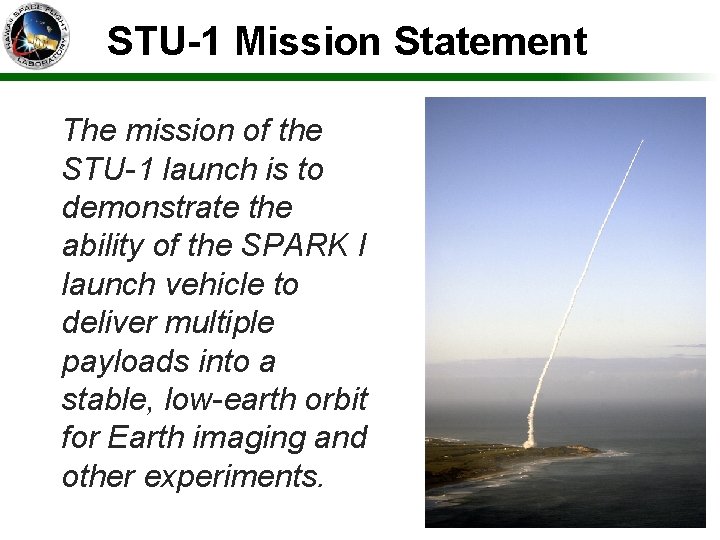
STU-1 Mission Statement The mission of the STU-1 launch is to demonstrate the ability of the SPARK I launch vehicle to deliver multiple payloads into a stable, low-earth orbit for Earth imaging and other experiments.
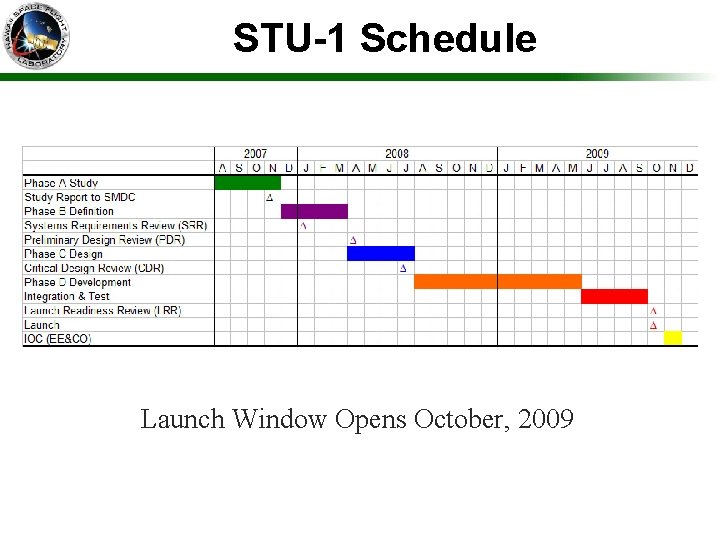
STU-1 Schedule Launch Window Opens October, 2009
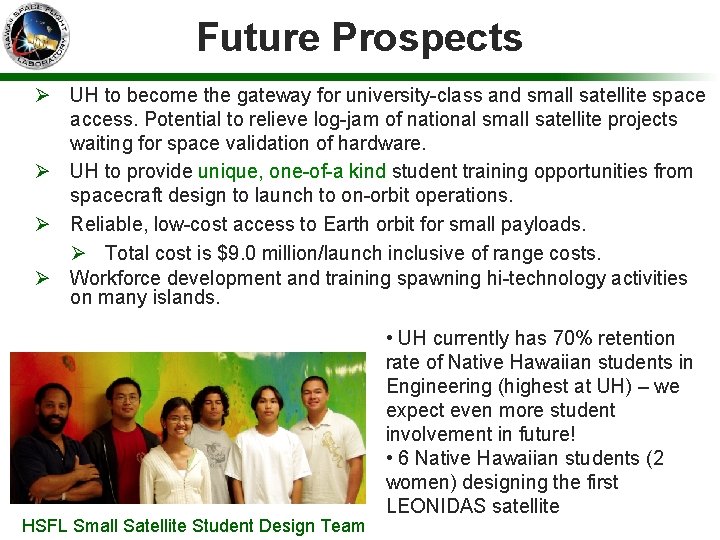
Future Prospects Ø UH to become the gateway for university-class and small satellite space access. Potential to relieve log-jam of national small satellite projects waiting for space validation of hardware. Ø UH to provide unique, one-of-a kind student training opportunities from spacecraft design to launch to on-orbit operations. Ø Reliable, low-cost access to Earth orbit for small payloads. Ø Total cost is $9. 0 million/launch inclusive of range costs. Ø Workforce development and training spawning hi-technology activities on many islands. HSFL Small Satellite Student Design Team • UH currently has 70% retention rate of Native Hawaiian students in Engineering (highest at UH) – we expect even more student involvement in future! • 6 Native Hawaiian students (2 women) designing the first LEONIDAS satellite
Benefits to State n State Economic Infrastructure ¡ 2 -6 planned launch activities beginning in 2011 will require infrastructure support network for satellite and rocket components ¡ At least 60 new technical jobs related to aerospace n n n 6 new HSFL-related program management teams at PMRF consisting of 3 people 3 launch crews of 15 technicians each ? ? More positions for telemetry and range support n Windward Community College ¡ Offers Associate Degree in Aerospace serving as a pipeline to HSFL programs. ¡ Aerospace Lab will serve as outreach and educational component of HSFL. Dr. Joseph Ciotti will lead effort. ¡ Upgrades to Windward CC Aerospace Lab will serve as “virtual” Mission Control Center for the HSFL. n Kauai Community College ¡ Training program established through Kauai CC n High paying, high technology jobs for State residents
- Slides: 15