
THE HASH TRICK A REVIEW Hash Trick Insights



![Bloom filters • An implementation – Allocate M bits, bit[0]…, bit[1 -M] – Pick](https://slidetodoc.com/presentation_image_h2/a562f3b366f64e2bd2502e0850f0e79e/image-14.jpg "Bloom filters • An implementation – Allocate M bits, bit[0]…, bit[1 -M] – Pick")

![Bloom filters • An implementation – Allocate M bits, bit[0]…, bit[1 -M] – Pick](https://slidetodoc.com/presentation_image_h2/a562f3b366f64e2bd2502e0850f0e79e/image-24.jpg "Bloom filters • An implementation – Allocate M bits, bit[0]…, bit[1 -M] – Pick")
![from: Minos Garofalakis CM Sketch Guarantees n [Cormode, Muthukrishnan’ 04] CM sketch guarantees approximation](https://slidetodoc.com/presentation_image_h2/a562f3b366f64e2bd2502e0850f0e79e/image-28.jpg "from: Minos Garofalakis CM Sketch Guarantees n [Cormode, Muthukrishnan’ 04] CM sketch guarantees approximation")
![from: Minos Garofalakis CM Sketch Guarantees [Cormode, Muthukrishnan’ 04] CM sketch guarantees approximation error](https://slidetodoc.com/presentation_image_h2/a562f3b366f64e2bd2502e0850f0e79e/image-29.jpg "from: Minos Garofalakis CM Sketch Guarantees [Cormode, Muthukrishnan’ 04] CM sketch guarantees approximation error")


- Slides: 48
THE HASH TRICK: A REVIEW
Hash Trick - Insights • Save memory: don’t store hash keys • Allow collisions – even though it distorts your data some • Let the learner (downstream) take up the slack
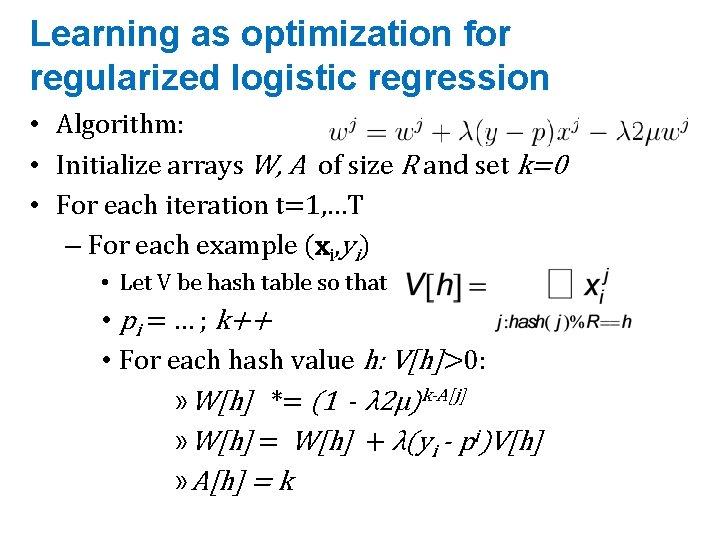
Learning as optimization for regularized logistic regression • Algorithm: • Initialize arrays W, A of size R and set k=0 • For each iteration t=1, …T – For each example (xi, yi) • Let V be hash table so that • pi = … ; k++ • For each hash value h: V[h]>0: » W[h] *= (1 - λ 2μ)k-A[j] » W[h] = W[h] + λ(yi - pi)V[h] » A[h] = k
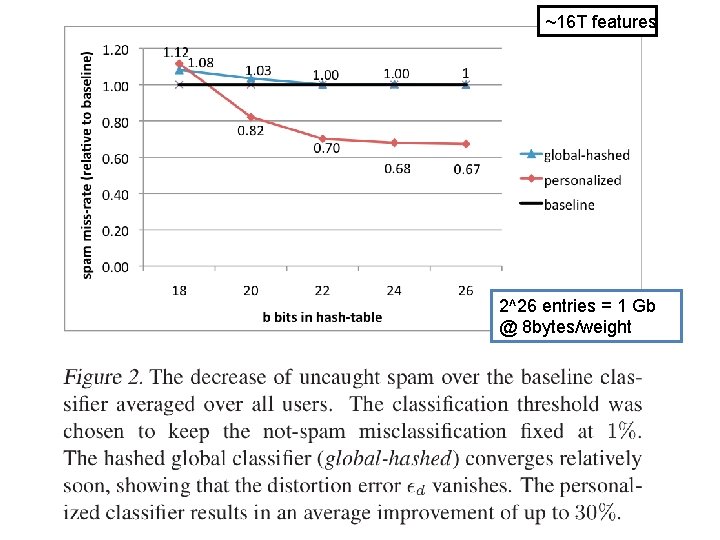
~16 T features An example 2^26 entries = 1 Gb @ 8 bytes/weight
Results
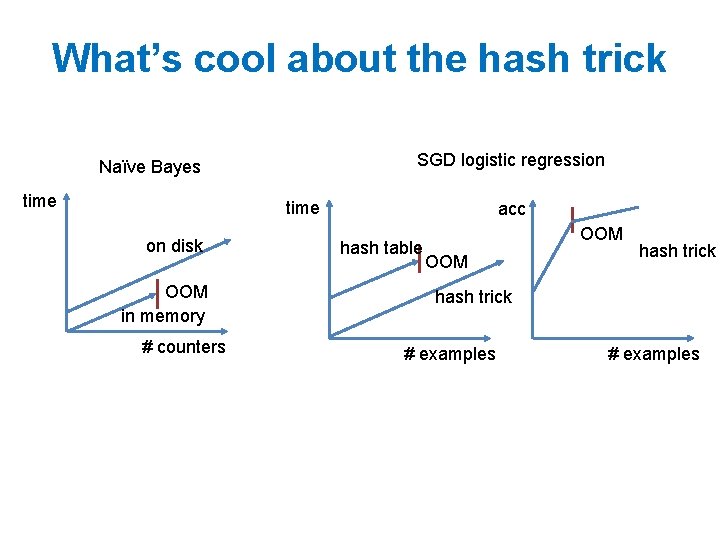
What’s cool about the hash trick SGD logistic regression Naïve Bayes time on disk OOM in memory # counters acc hash table OOM hash trick # examples
MOTIVATING BLOOM FILTERS: VARIANT OF THE HASH TRICK
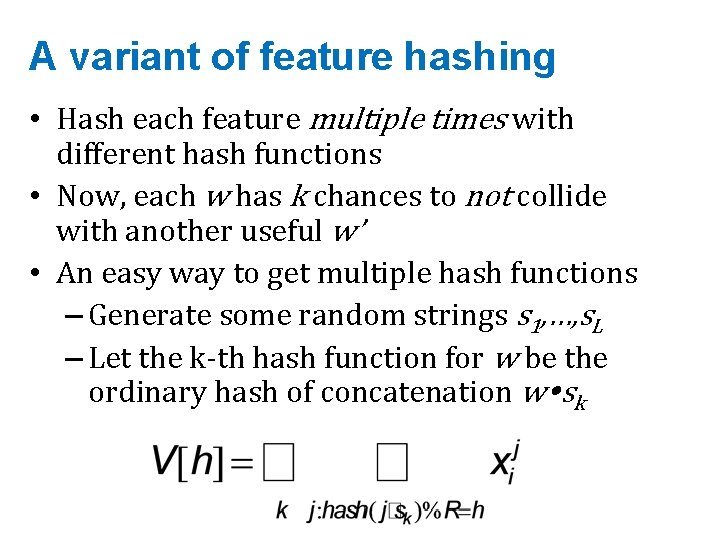
A variant of feature hashing • Hash each feature multiple times with different hash functions • Now, each w has k chances to not collide with another useful w’ • An easy way to get multiple hash functions – Generate some random strings s 1, …, s. L – Let the k-th hash function for w be the ordinary hash of concatenation w sk
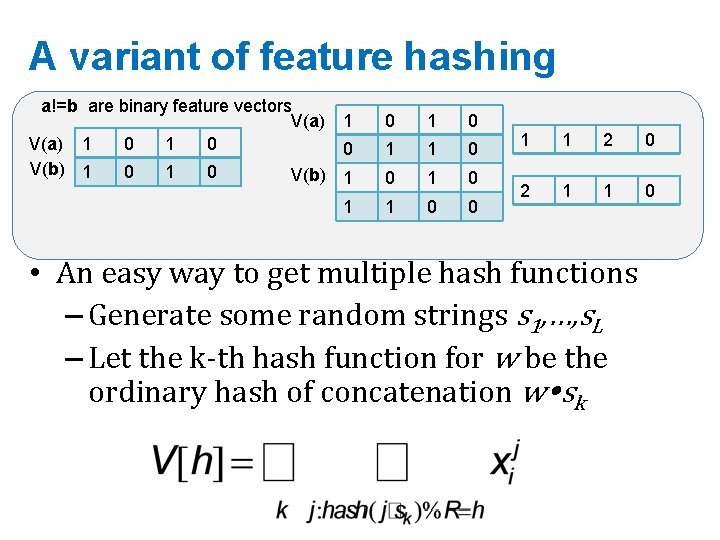
A variant of feature hashing a!=b are binary feature vectors V(a) 1 0 V(b) 1 0 1 times 0 • Hash each feature multiple with 1 1 2 0 1 1 0 different hash functions 0 1 0 2 1 1 0 • Now, each w has k chances to not collide 1 1 0 0 with another useful w’ • An easy way to get multiple hash functions – Generate some random strings s 1, …, s. L – Let the k-th hash function for w be the ordinary hash of concatenation w sk
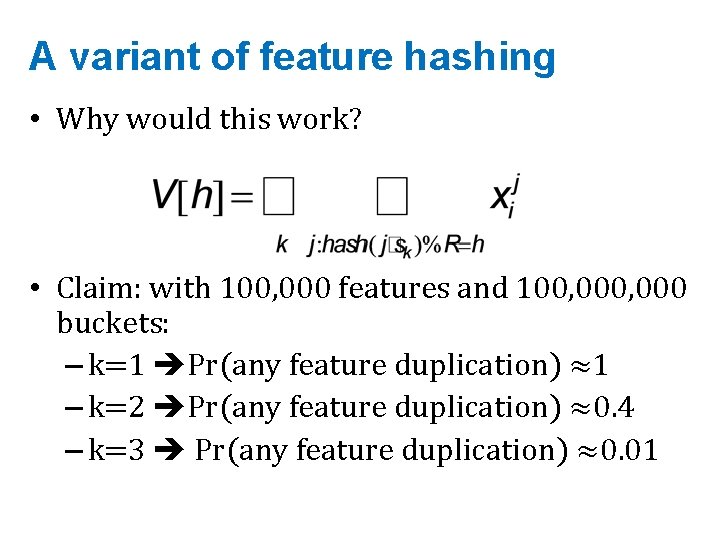
A variant of feature hashing • Why would this work? • Claim: with 100, 000 features and 100, 000 buckets: – k=1 Pr(any feature duplication) ≈1 – k=2 Pr(any feature duplication) ≈0. 4 – k=3 Pr(any feature duplication) ≈0. 01
Hash Trick - Insights • Save memory: don’t store hash keys • Allow collisions – even though it distorts your data some • Let the learner (downstream) take up the slack • Bloom filters are another famous trick that exploits these insights….
BLOOM FILTERS
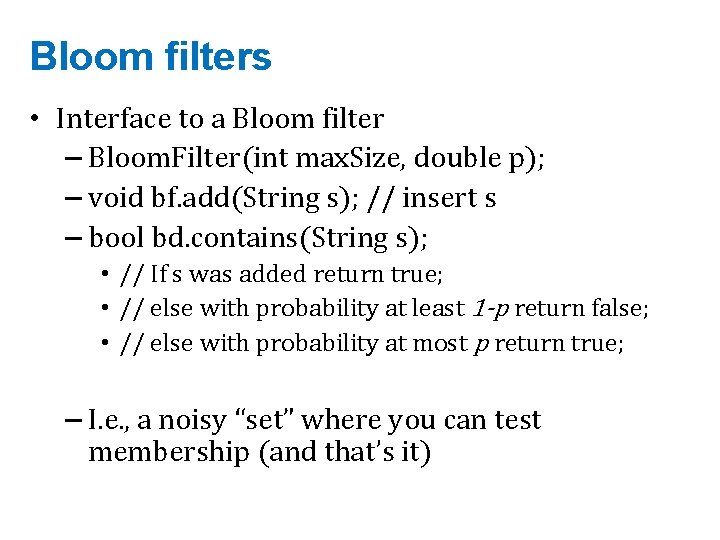
Bloom filters • Interface to a Bloom filter – Bloom. Filter(int max. Size, double p); – void bf. add(String s); // insert s – bool bd. contains(String s); • // If s was added return true; • // else with probability at least 1 -p return false; • // else with probability at most p return true; – I. e. , a noisy “set” where you can test membership (and that’s it)
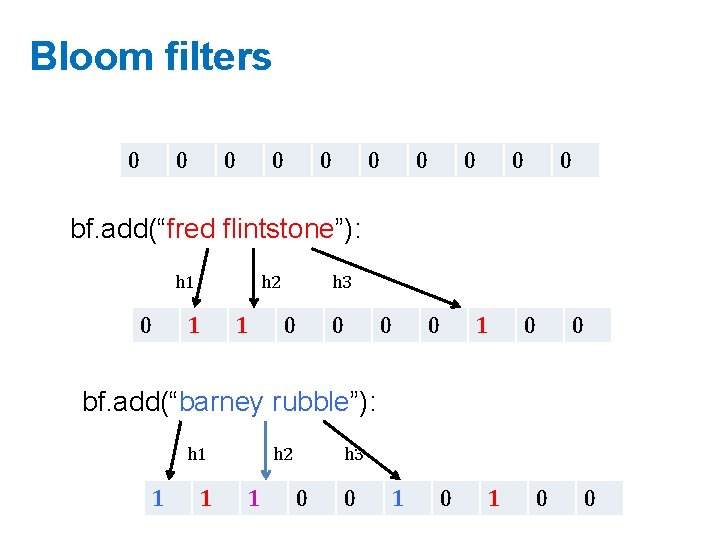
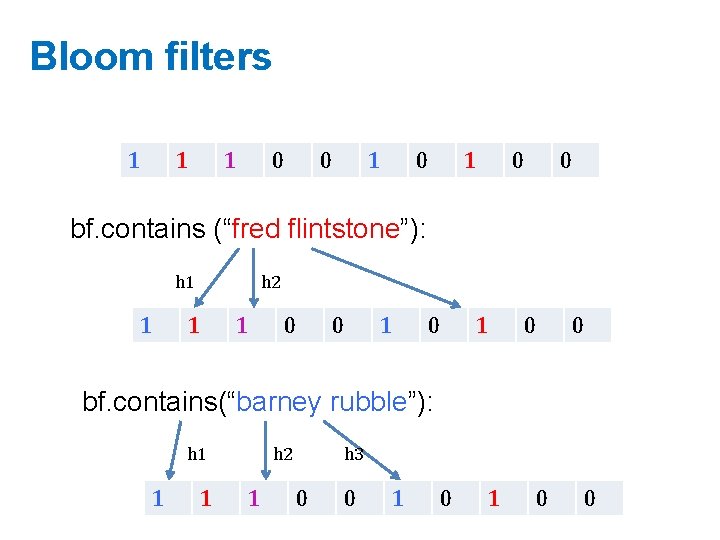
Bloom filters • An implementation – Allocate M bits, bit[0]…, bit[1 -M] – Pick K hash functions hash(1, 2), hash(2, s), …. • E. g: hash(i, s) = hash(s+ random. String[i]) – To add string s: • For i=1 to k, set bit[hash(i, s)] = 1 – To check contains(s): • For i=1 to k, test bit[hash(i, s)] • Return “true” if they’re all set; otherwise, return “false” – We’ll discuss how to set M and K soon, but for now: • Let M = 1. 5*max. Size // less than two bits per item! • Let K = 2*log(1/p) // about right with this M
Bloom filters 0 0 0 0 0 bf. add(“fred flintstone”): h 1 0 h 2 1 1 h 3 0 0 1 0 0 bf. add(“barney rubble”): h 1 1 1 h 2 1 h 3 0 0 1 0 0
Bloom filters 1 1 1 0 0 bf. contains (“fred flintstone”): h 1 1 h 2 1 1 0 0 bf. contains(“barney rubble”): h 1 1 1 h 2 1 h 3 0 0 1 0 0
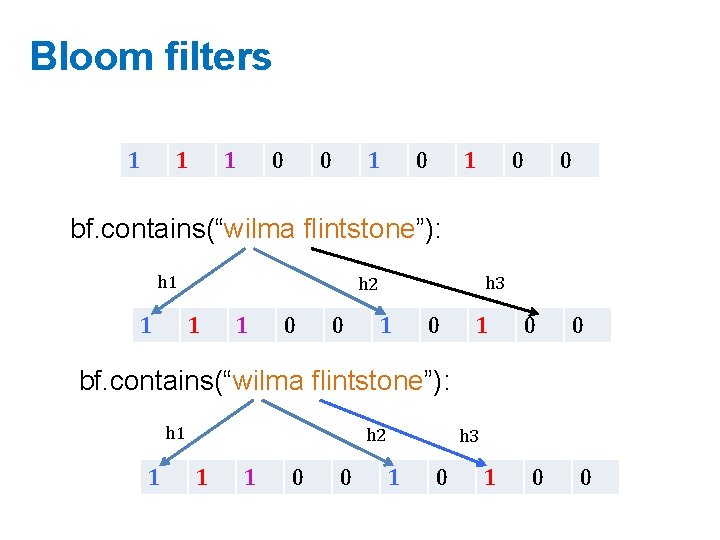
Bloom filters 1 1 1 0 0 bf. contains(“wilma flintstone”): h 1 1 h 3 h 2 1 1 0 0 bf. contains(“wilma flintstone”): h 1 1 h 2 1 1 0 0 h 3 1 0 0
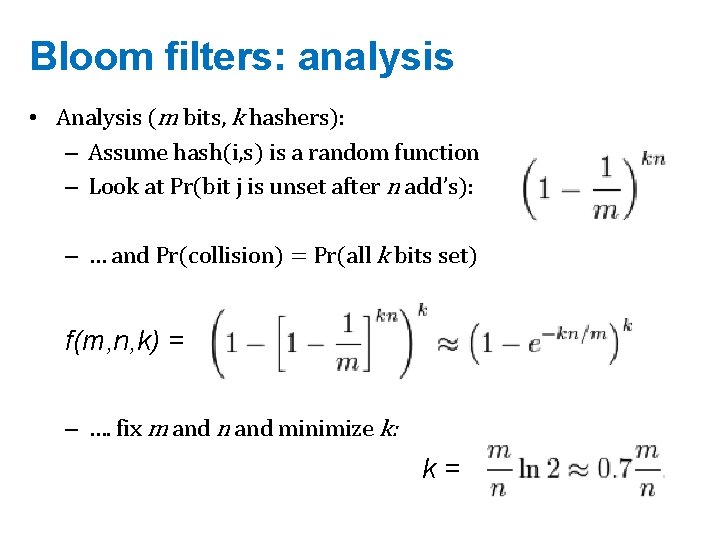
Bloom filters: analysis • Analysis (m bits, k hashers): – Assume hash(i, s) is a random function – Look at Pr(bit j is unset after n add’s): – … and Pr(collision) = Pr(all k bits set) f(m, n, k) = – …. fix m and n and minimize k: k=
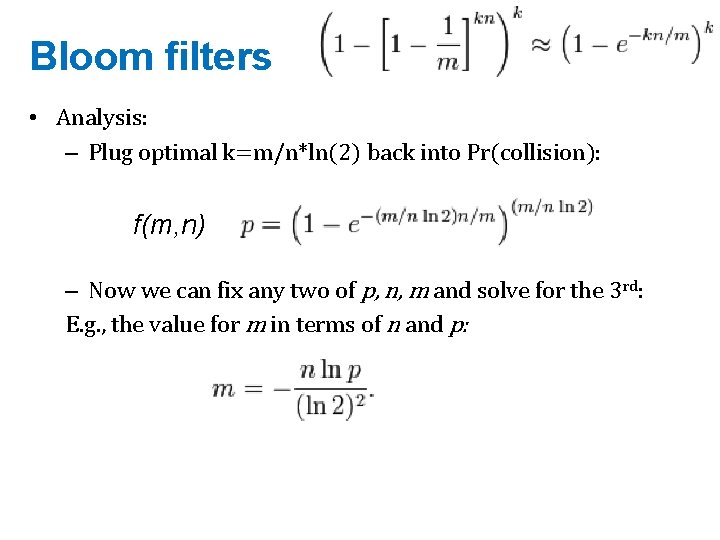
Bloom filters • Analysis: – Plug optimal k=m/n*ln(2) back into Pr(collision): f(m, n) = – Now we can fix any two of p, n, m and solve for the 3 rd: E. g. , the value for m in terms of n and p:
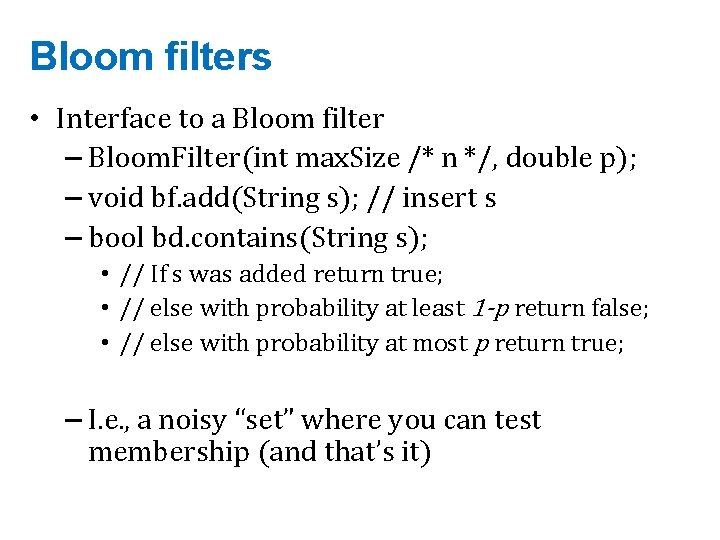
Bloom filters • Interface to a Bloom filter – Bloom. Filter(int max. Size /* n */, double p); – void bf. add(String s); // insert s – bool bd. contains(String s); • // If s was added return true; • // else with probability at least 1 -p return false; • // else with probability at most p return true; – I. e. , a noisy “set” where you can test membership (and that’s it)
Bloom filters: demo
THE COUNT-MIN SKETCH
A variant of feature hashing • Hash each feature multiple times with different hash functions • Now, each w has k chances to not collide with another useful w’ • Get multiple hash functions as in Bloom filters • Part Bloom filter, part hash kernel – but predates either, called “count-min sketch” -- Cormode and Muthukrishnan
Bloom filters • An implementation – Allocate M bits, bit[0]…, bit[1 -M] – Pick K hash functions hash(1, 2), hash(2, s), …. • E. g: hash(i, s) = hash(s+ random. String[i]) – To add string s: • For i=1 to k, set bit[hash(i, s)] = 1 – To check contains(s): • For i=1 to k, test bit[hash(i, s)] • Return “true” if they’re all set; otherwise, return “false” – We’ll discuss how to set M and K soon, but for now: • Let M = 1. 5*max. Size // less than two bits per item! • Let K = 2*log(1/p) // about right with this M
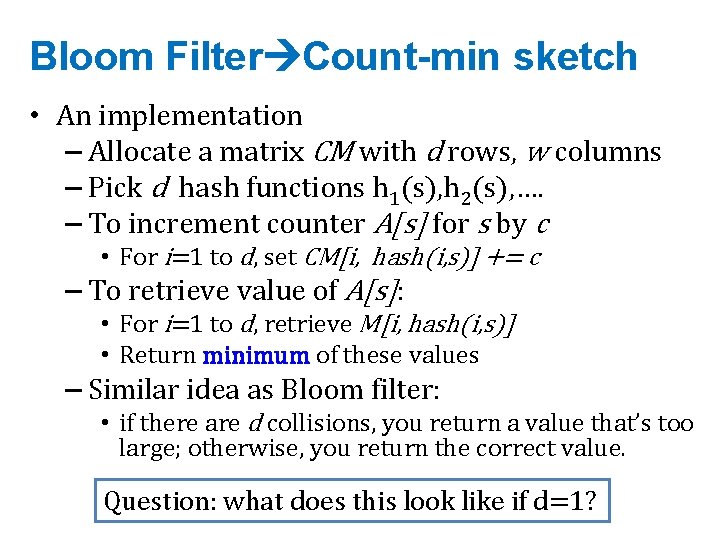
Bloom Filter Count-min sketch • An implementation – Allocate a matrix CM with d rows, w columns – Pick d hash functions h 1(s), h 2(s), …. – To increment counter A[s] for s by c • For i=1 to d, set CM[i, hash(i, s)] += c – To retrieve value of A[s]: • For i=1 to d, retrieve M[i, hash(i, s)] • Return minimum of these values – Similar idea as Bloom filter: • if there are d collisions, you return a value that’s too large; otherwise, you return the correct value. Question: what does this look like if d=1?
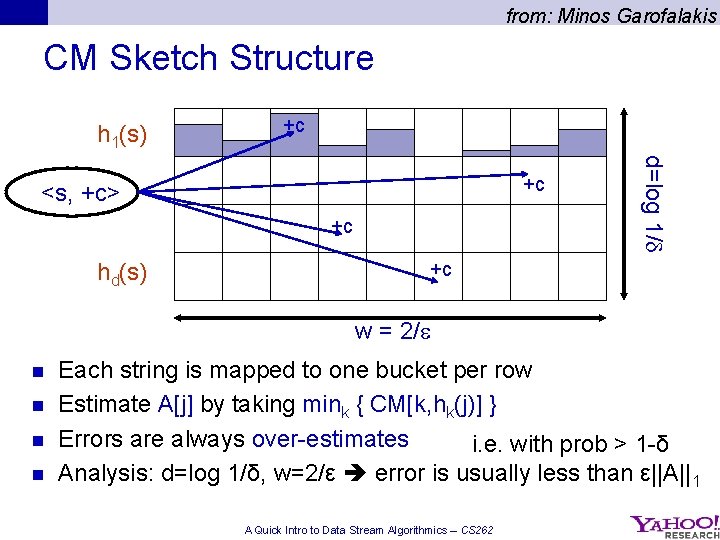
from: Minos Garofalakis CM Sketch Structure h 1(s) +c +c hd(s) d=log 1/ +c <s, +c> +c w = 2/ n n Each string is mapped to one bucket per row Estimate A[j] by taking mink { CM[k, hk(j)] } Errors are always over-estimates i. e. with prob > 1 -δ Analysis: d=log 1/δ, w=2/ε error is usually less than ε||A||1 A Quick Intro to Data Stream Algorithmics – CS 262
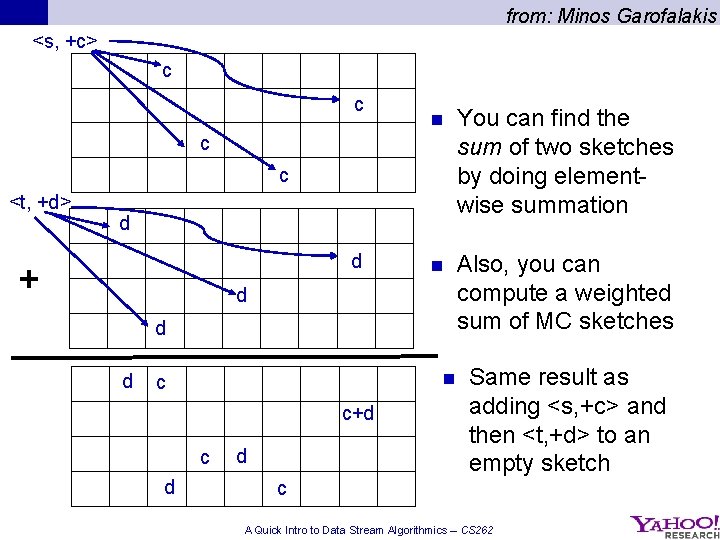
from: Minos Garofalakis <s, +c> c c n You can find the sum of two sketches by doing elementwise summation n Also, you can compute a weighted sum of MC sketches c c <t, +d> d d + d d d n c c+d c d d Same result as adding <s, +c> and then <t, +d> to an empty sketch c A Quick Intro to Data Stream Algorithmics – CS 262
from: Minos Garofalakis CM Sketch Guarantees n [Cormode, Muthukrishnan’ 04] CM sketch guarantees approximation error on point queries less than ||A||1 in space O(1/ log 1/ ) – Probability of more error is less than 1 - n This is sometimes enough: Estimating a multinomial: if A[s] = Pr(s|…) then ||A||1 = 1 – Multiclassification: if Ax[s] = Pr(x in class s) then ||Ax||1 is probably small, since most x’s will be in only a few classes – 28 A Quick Intro to Data Stream Algorithmics – CS 262
from: Minos Garofalakis CM Sketch Guarantees [Cormode, Muthukrishnan’ 04] CM sketch guarantees approximation error on point queries less than ||A||1 in space O(1/ log 1/ ) n CM sketches are also accurate for skewed values---i. e. , only a few entries s with large A[s] n A Quick Intro to Data Stream Algorithmics – CS 262
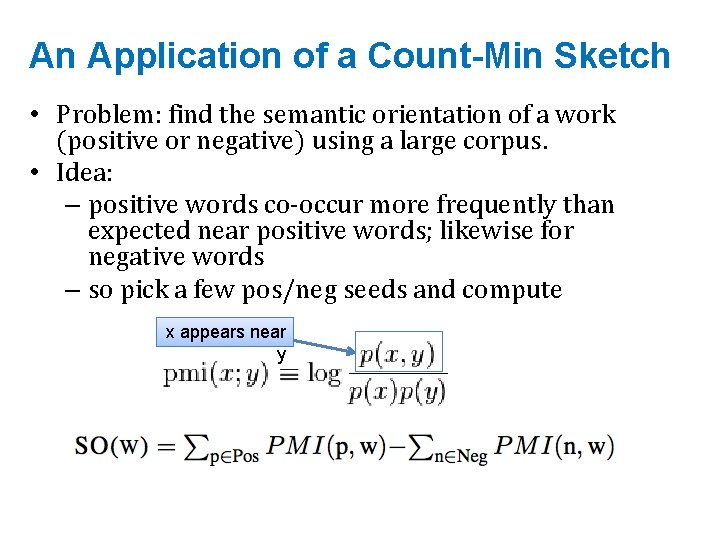
An Application of a Count-Min Sketch • Problem: find the semantic orientation of a work (positive or negative) using a large corpus. • Idea: – positive words co-occur more frequently than expected near positive words; likewise for negative words – so pick a few pos/neg seeds and compute x appears near y
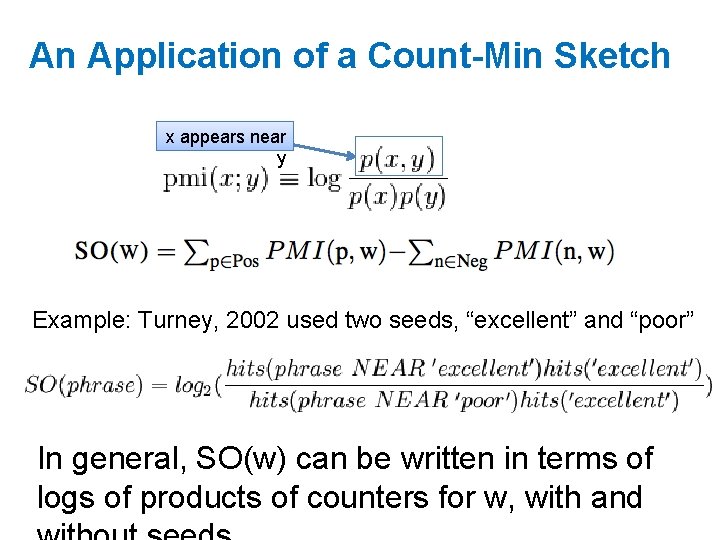
An Application of a Count-Min Sketch x appears near y Example: Turney, 2002 used two seeds, “excellent” and “poor” In general, SO(w) can be written in terms of logs of products of counters for w, with and
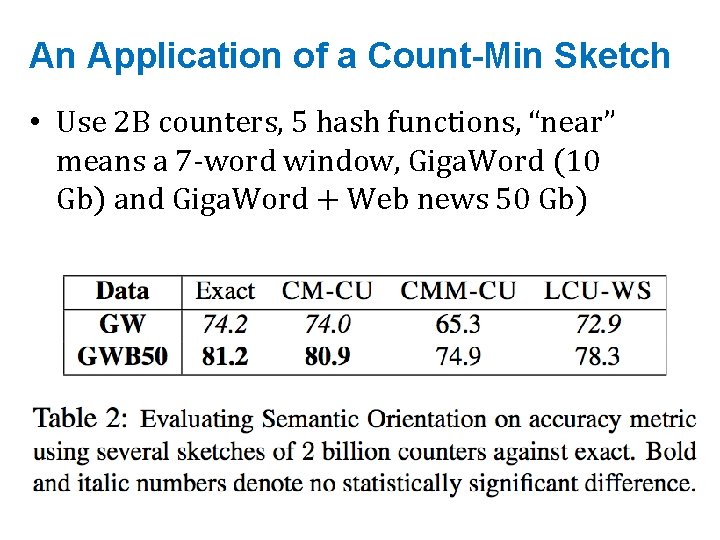
An Application of a Count-Min Sketch • Use 2 B counters, 5 hash functions, “near” means a 7 -word window, Giga. Word (10 Gb) and Giga. Word + Web news 50 Gb)
Simpler analysis
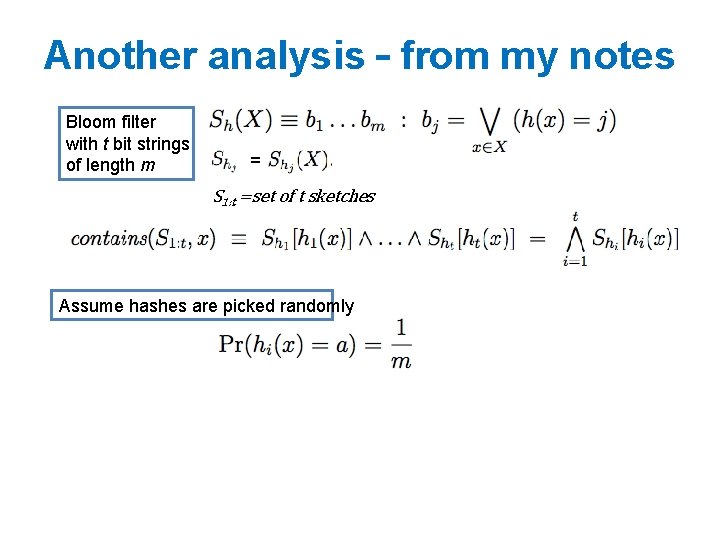
Another analysis – from my notes Bloom filter with t bit strings of length m = S 1: t =set of t sketches Assume hashes are picked randomly
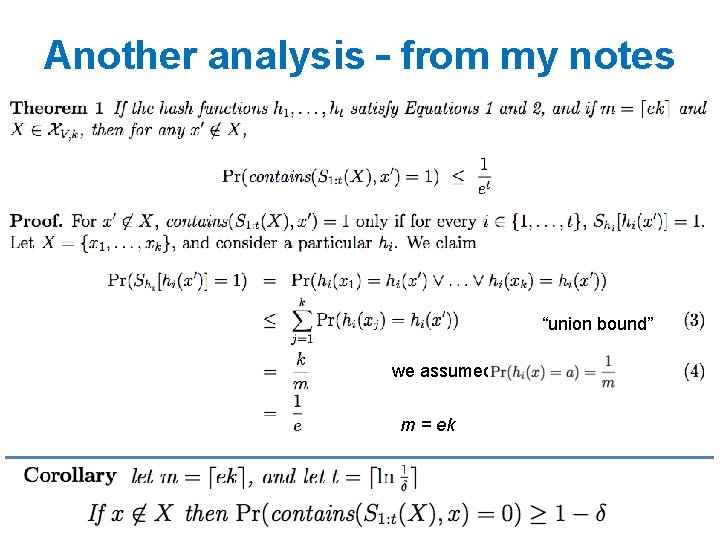
Another analysis – from my notes “union bound” we assumed m = ek
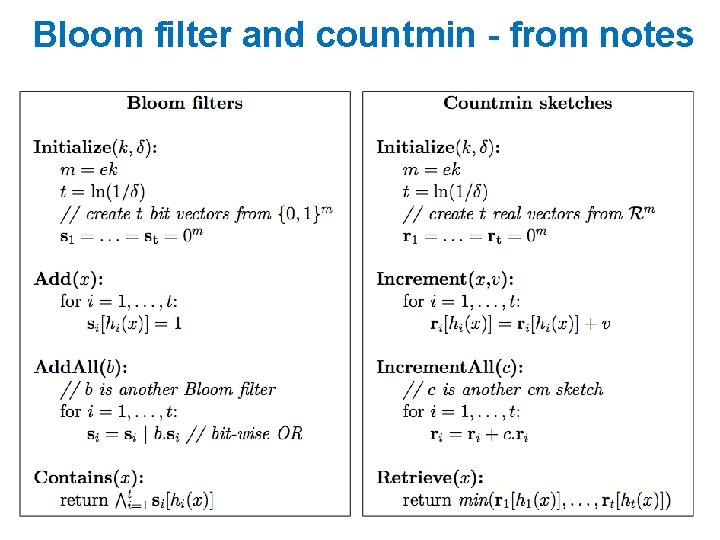
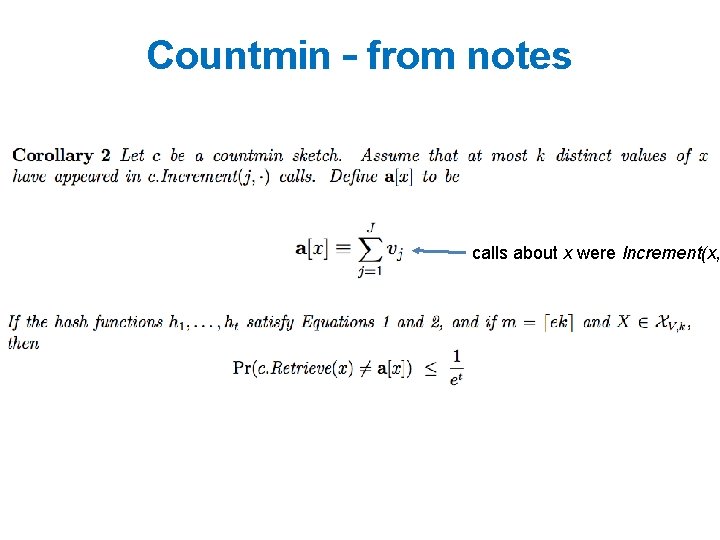
Bloom filter and countmin - from notes
Countmin – from notes calls about x were Increment(x,
Deep Learning and Sketches 38
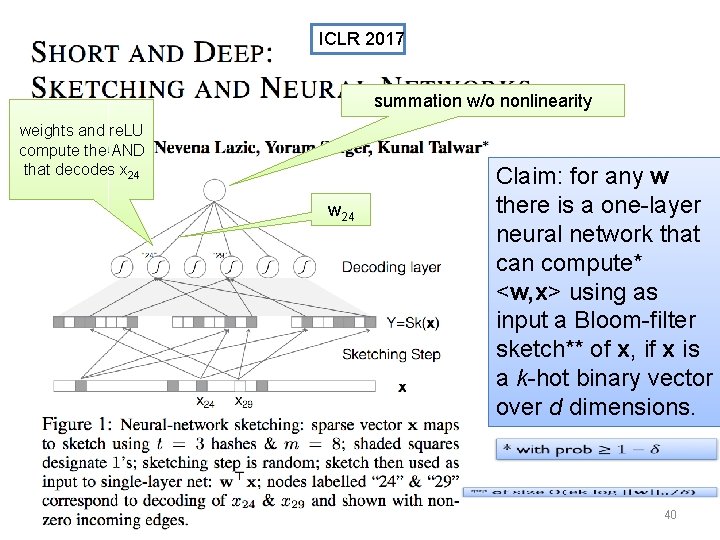
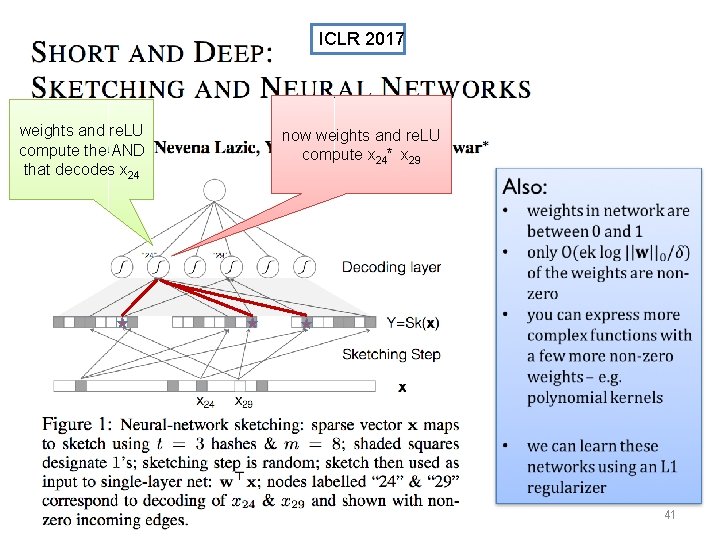
ICLR 2017 39
ICLR 2017 summation w/o nonlinearity weights and re. LU compute the AND that decodes x 24 w 24 Claim: for any w there is a one-layer neural network that can compute* <w, x> using as input a Bloom-filter sketch** of x, if x is a k-hot binary vector over d dimensions. 40
ICLR 2017 weights and re. LU compute the AND that decodes x 24 now weights and re. LU compute x 24* x 29 41
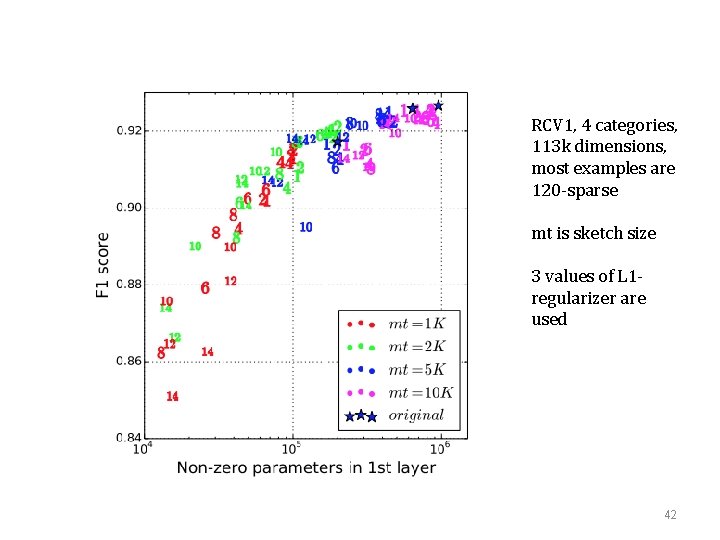
RCV 1, 4 categories, 113 k dimensions, most examples are 120 -sparse mt is sketch size 3 values of L 1 regularizer are used 42
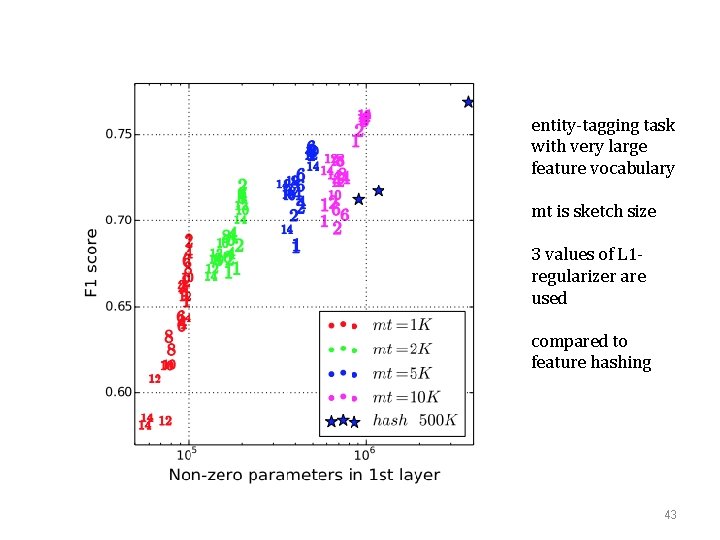
entity-tagging task with very large feature vocabulary mt is sketch size 3 values of L 1 regularizer are used compared to feature hashing 43
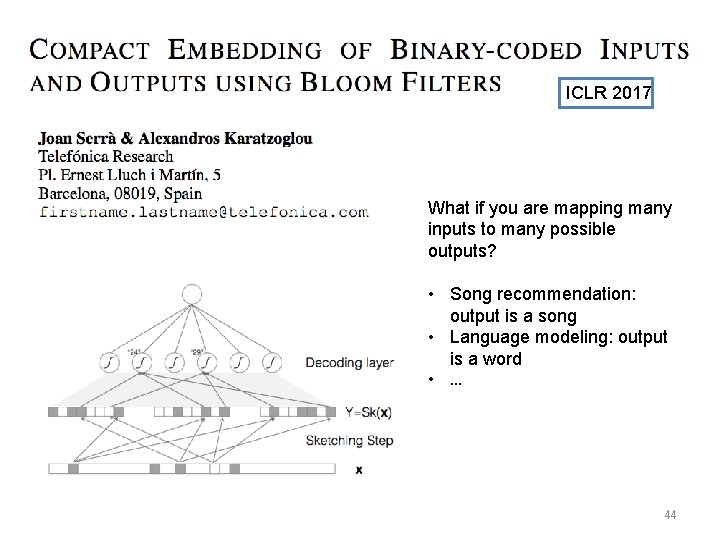
ICLR 2017 What if you are mapping many inputs to many possible outputs? • Song recommendation: output is a song • Language modeling: output is a word • … 44
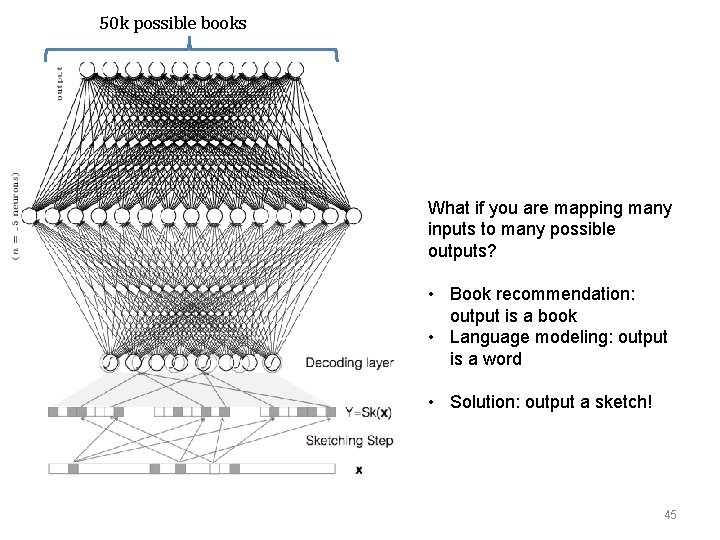
50 k possible books What if you are mapping many inputs to many possible outputs? • Book recommendation: output is a book • Language modeling: output is a word • Solution: output a sketch! 45
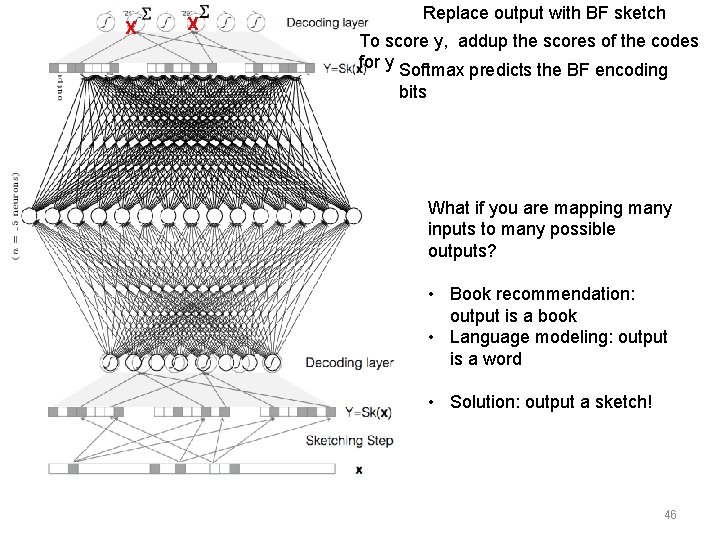
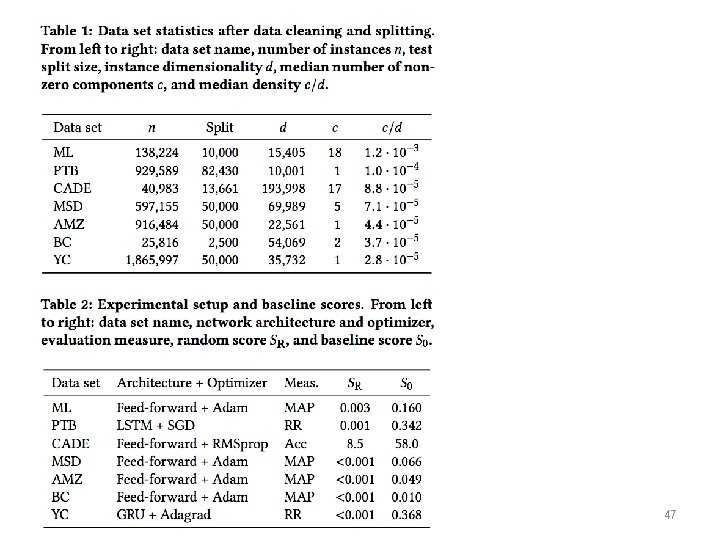
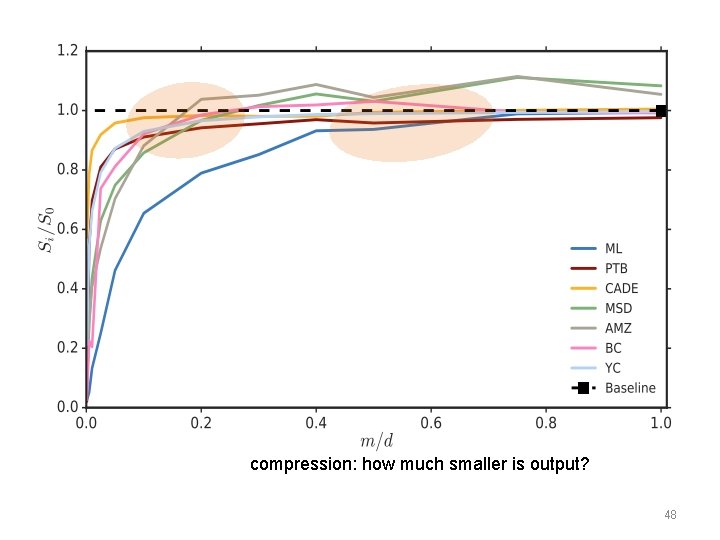
X X Replace output with BF sketch To score y, addup the scores of the codes for y Softmax predicts the BF encoding bits What if you are mapping many inputs to many possible outputs? • Book recommendation: output is a book • Language modeling: output is a word • Solution: output a sketch! 46
47
compression: how much smaller is output? 48