
The Harness Workbench Unified and Adaptive Access to
The Harness Workbench: Unified and Adaptive Access to Diverse HPC Platforms Presented by Christian Engelmann Network and Cluster Computing Group Computer Science and Mathematics Division Oak Ridge National Laboratory
Existing Scientific Application Development and Deployment Issues · The diversity of HPC platforms and associated software complexity often pose challenges that lead to slow or hampered scientific discovery · Application scientists expend considerable time and effort dealing with development, deployment, and runtime interfacing activities · Additionally, the short HPC system deployment and upgrade interval requires frequent redeployment of scientific application to different system software stacks 2
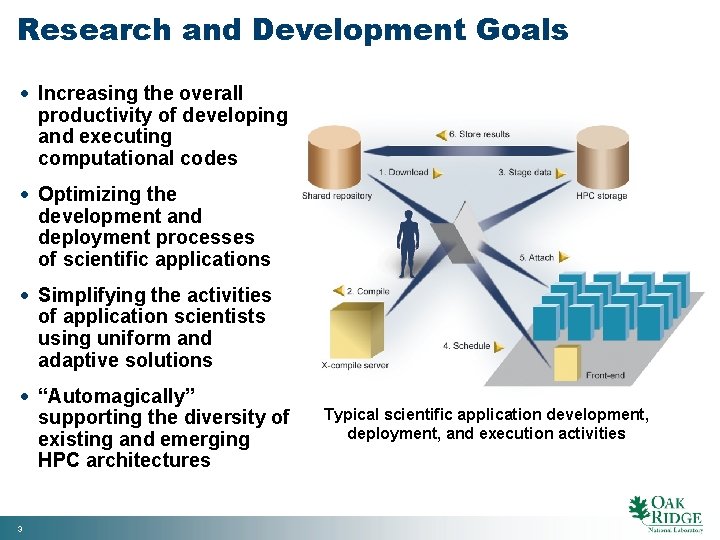
Research and Development Goals · Increasing the overall productivity of developing and executing computational codes · Optimizing the development and deployment processes of scientific applications · Simplifying the activities of application scientists using uniform and adaptive solutions · “Automagically” supporting the diversity of existing and emerging HPC architectures 3 Typical scientific application development, deployment, and execution activities

Harness Workbench Core Components · Virtualized command toolkit - Unified development, deployment, and execution - Common view across diverse HPC platforms - User-space installation and virtual environments · Next-generation runtime environment - Flexible, adaptive, lightweight framework - Management of runtime tasks - Support for diverse HPC platforms 4
Harness Workbench Core Technologies · Automatic adaptation using pluggable modules - Virtualized command toolkit plug-ins - Runtime environment plug-ins · Development environment and toolkit interfaces - Easy-to-use interfaces for scientific application development, deployment, and execution 5
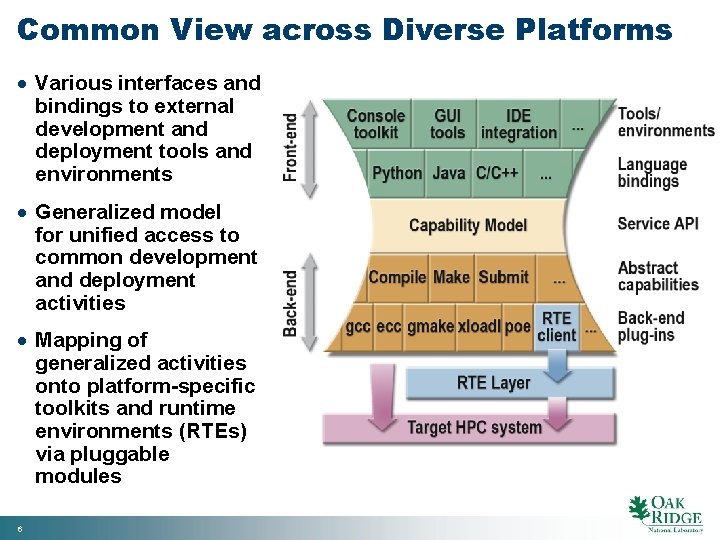
Common View across Diverse Platforms · Various interfaces and bindings to external development and deployment tools and environments · Generalized model for unified access to common development and deployment activities · Mapping of generalized activities onto platform-specific toolkits and runtime environments (RTEs) via pluggable modules 6

Virtualized Command Toolkit · Unifying abstraction over heterogeneous HPC resources · Command line and GUI tools · Translation into finetuned invocations of native toolkits · Behavior encapsulated in (vendor-provided) modules · Configurable by system administrators · Tunable by end-users 7
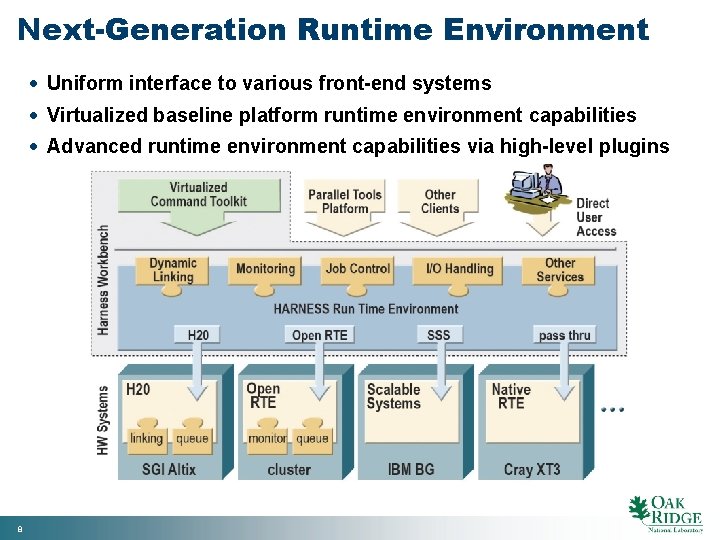
Next-Generation Runtime Environment · Uniform interface to various front-end systems · Virtualized baseline platform runtime environment capabilities · Advanced runtime environment capabilities via high-level plugins 8
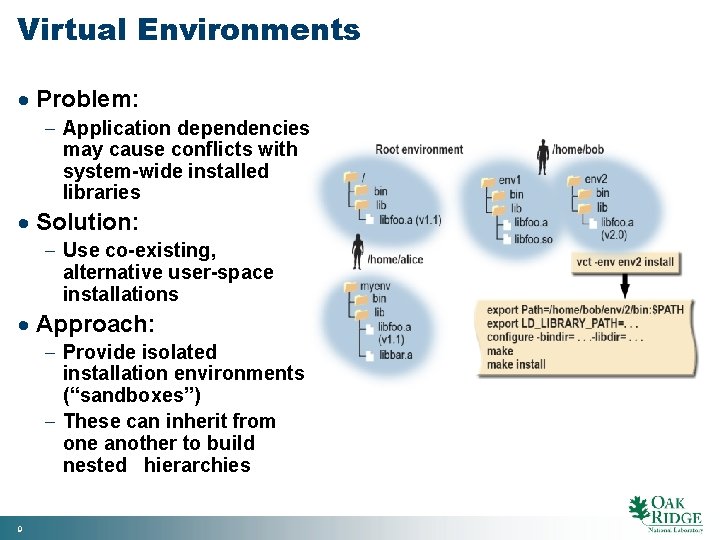
Virtual Environments · Problem: - Application dependencies may cause conflicts with system-wide installed libraries · Solution: - Use co-existing, alternative user-space installations · Approach: - Provide isolated installation environments (“sandboxes”) - These can inherit from one another to build nested hierarchies 9

The Harness Workbench: Unified and Adaptive Access to Diverse HPC Platforms 10
Contacts Christian Engelmann Network and Cluster Computing Group Computer Science and Mathematics Division (865) 576 -5491 englemannc@ornl. gov Al Geist Oak Ridge National Laboratory (865) 574 -31534 gst@ornl. gov Jack Dongarra University of Tennessee (865) 974 -8295 Vaidy Sunderam Emory University (404) 727 -5926 11 Engleman_Harness_0611
- Slides: 11