
THE HAMBURG SHIP MODEL BASIN Setting the Standard
THE HAMBURG SHIP MODEL BASIN Setting the Standard in Ship Optimisation Ice actions on offshore wind turbine foundations – mitigating ice loads and ice-induced vibrations Dipl. -Ing. Gesa Ziemer Project Manager Hamburgische Schiffbau-Versuchsanstalt Gmb. H (HSVA) Wind. Europe Summit 2016, Hamburg, 28. 09. 2016 CFD CAD Office Resistance & Propulsion Seakeeping, Manoeuvring & Offshore Propellers & Cavitation Arctic Technology www. hsva. de
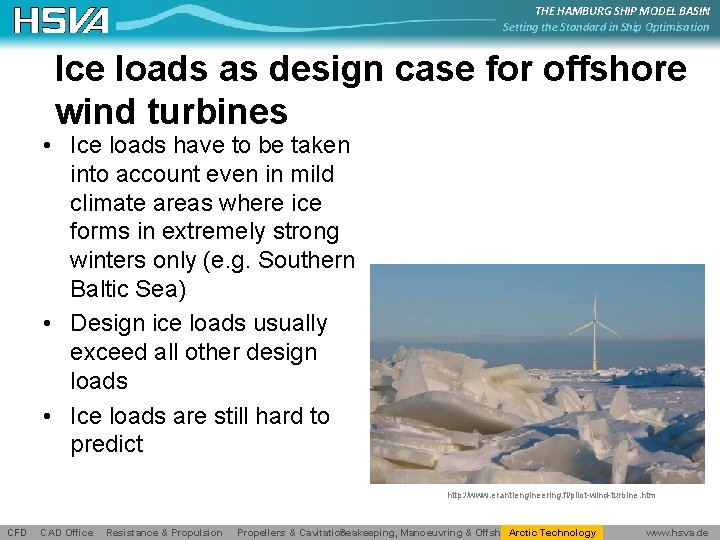
THE HAMBURG SHIP MODEL BASIN Setting the Standard in Ship Optimisation Ice loads as design case for offshore wind turbines • Ice loads have to be taken into account even in mild climate areas where ice forms in extremely strong winters only (e. g. Southern Baltic Sea) • Design ice loads usually exceed all other design loads • Ice loads are still hard to predict http: //www. erantiengineering. fi/pilot-wind-turbine. htm CFD CAD Office Resistance & Propulsion Seakeeping, Manoeuvring & Offshore Propellers & Cavitation Arctic Technology www. hsva. de
THE HAMBURG SHIP MODEL BASIN Setting the Standard in Ship Optimisation Prediction of ice loads • Design formulas (analytical / (semi-)empirical) Usually very conservative. Hardly applicable for complex geometries. Often calibrated for cold climate (e. g. Northern Baltic Sea) • Numerical methods Not yet fully reliable. Calculations need calibration, which requires full scale measurements -> not available for OWT in ice • Model tests Expensive, suffer from scale effects. Combination of numerical and physical modelling can improve understanding of ice loads on OWT and lead to more realistic design formulas CFD CAD Office Resistance & Propulsion Seakeeping, Manoeuvring & Offshore Propellers & Cavitation Arctic Technology www. hsva. de
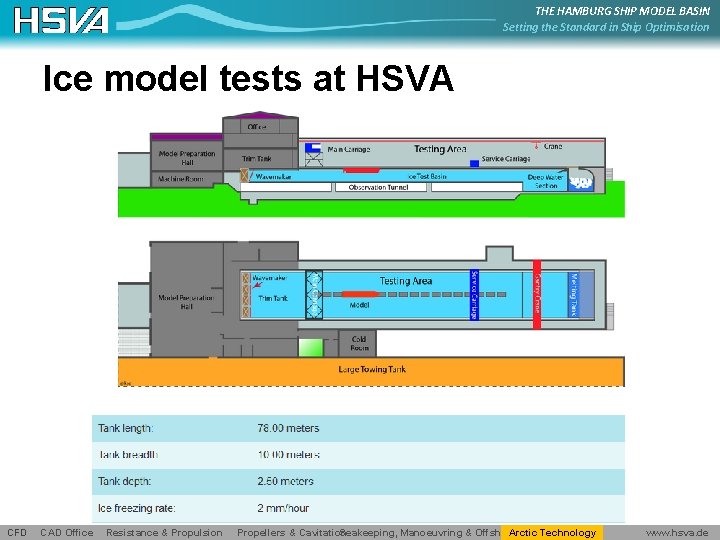
THE HAMBURG SHIP MODEL BASIN Setting the Standard in Ship Optimisation Ice model tests at HSVA CFD CAD Office Resistance & Propulsion Seakeeping, Manoeuvring & Offshore Propellers & Cavitation Arctic Technology www. hsva. de
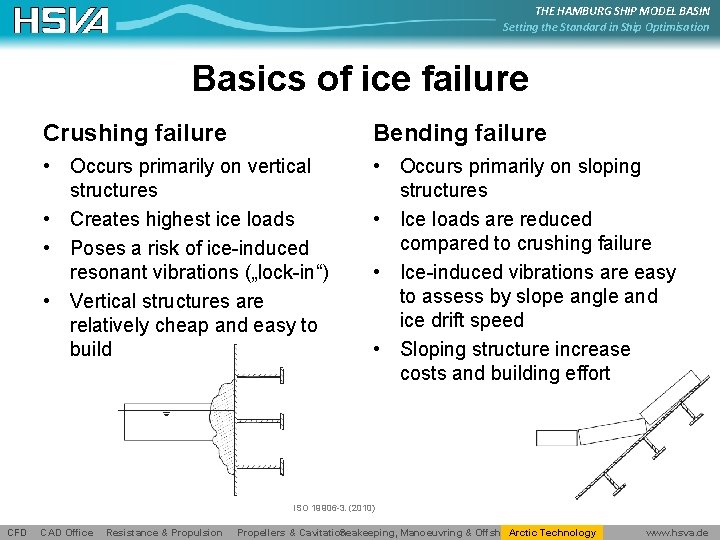
THE HAMBURG SHIP MODEL BASIN Setting the Standard in Ship Optimisation Basics of ice failure Crushing failure Bending failure • Occurs primarily on vertical structures • Creates highest ice loads • Poses a risk of ice-induced resonant vibrations („lock-in“) • Vertical structures are relatively cheap and easy to build • Occurs primarily on sloping structures • Ice loads are reduced compared to crushing failure • Ice-induced vibrations are easy to assess by slope angle and ice drift speed • Sloping structure increase costs and building effort ISO 19906 -3. (2010) CFD CAD Office Resistance & Propulsion Seakeeping, Manoeuvring & Offshore Propellers & Cavitation Arctic Technology www. hsva. de
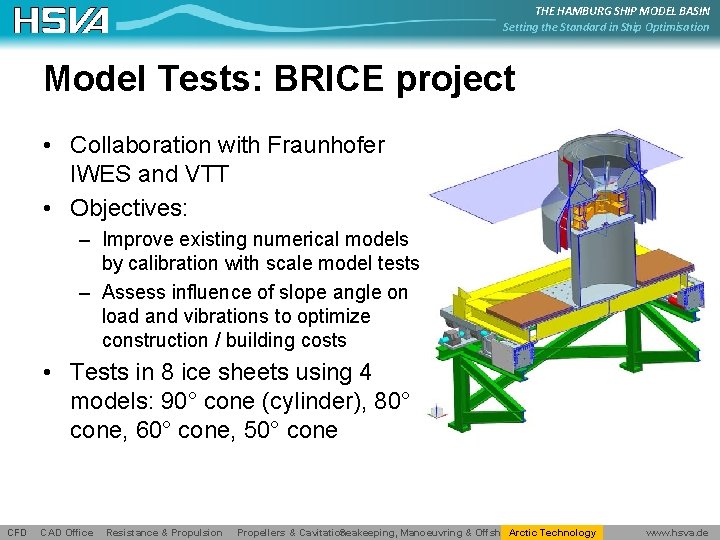
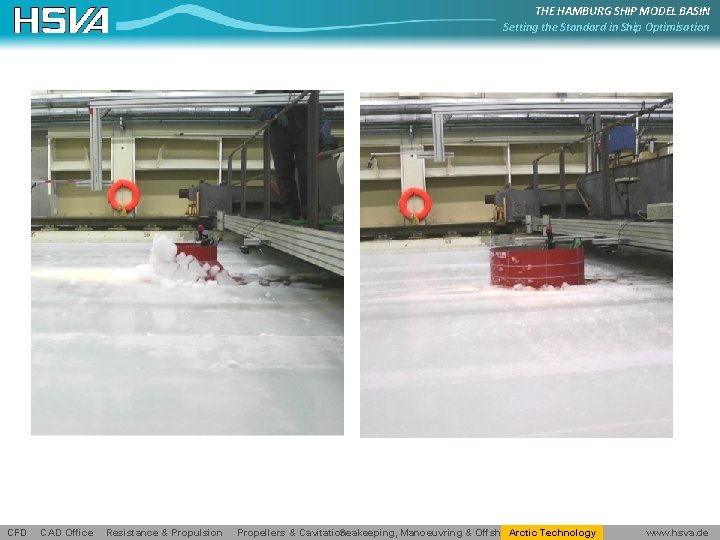
THE HAMBURG SHIP MODEL BASIN Setting the Standard in Ship Optimisation Model Tests: BRICE project • Collaboration with Fraunhofer IWES and VTT • Objectives: – Improve existing numerical models by calibration with scale model tests – Assess influence of slope angle on load and vibrations to optimize construction / building costs • Tests in 8 ice sheets using 4 models: 90° cone (cylinder), 80° cone, 60° cone, 50° cone CFD CAD Office Resistance & Propulsion Seakeeping, Manoeuvring & Offshore Propellers & Cavitation Arctic Technology www. hsva. de
THE HAMBURG SHIP MODEL BASIN Setting the Standard in Ship Optimisation CFD CAD Office Resistance & Propulsion Seakeeping, Manoeuvring & Offshore Propellers & Cavitation Arctic Technology www. hsva. de
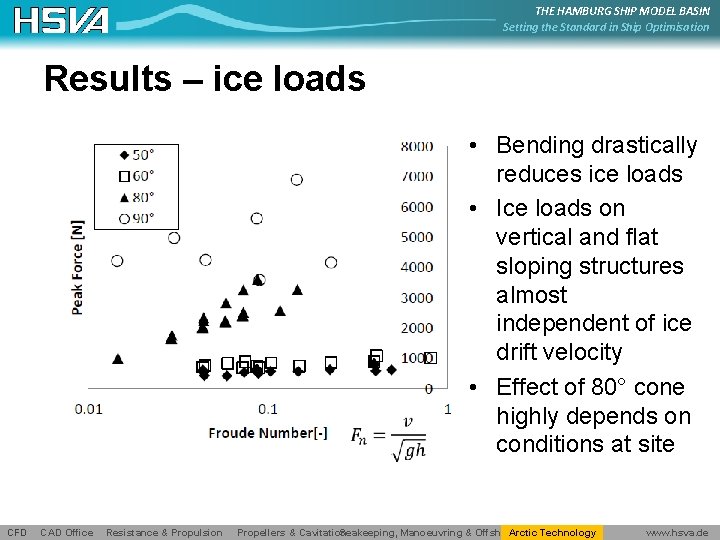
THE HAMBURG SHIP MODEL BASIN Setting the Standard in Ship Optimisation Results – ice loads • Bending drastically reduces ice loads • Ice loads on vertical and flat sloping structures almost independent of ice drift velocity • Effect of 80° cone highly depends on conditions at site CFD CAD Office Resistance & Propulsion Seakeeping, Manoeuvring & Offshore Propellers & Cavitation Arctic Technology www. hsva. de
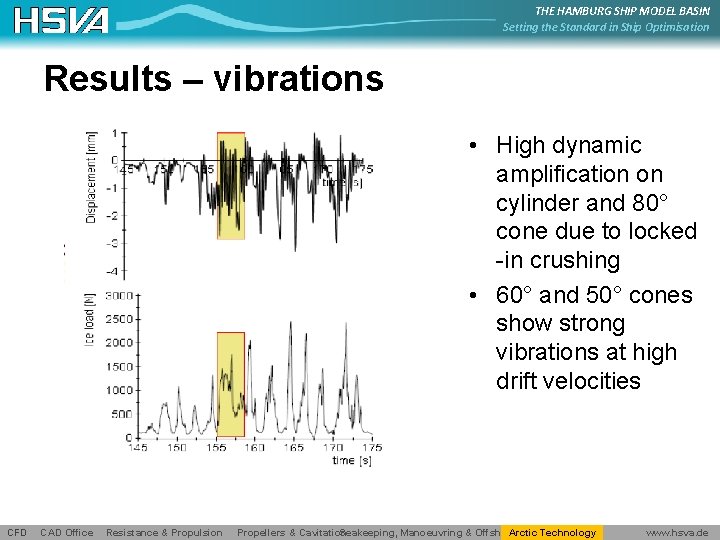
THE HAMBURG SHIP MODEL BASIN Setting the Standard in Ship Optimisation Results – vibrations • High dynamic amplification on cylinder and 80° cone due to locked -in crushing • 60° and 50° cones show strong vibrations at high drift velocities CFD CAD Office Resistance & Propulsion Seakeeping, Manoeuvring & Offshore Propellers & Cavitation Arctic Technology www. hsva. de
THE HAMBURG SHIP MODEL BASIN Setting the Standard in Ship Optimisation Summary • Ice loads are critical for design of OWT. Realistic and not over-conservative prediction of ice loads and vibrations is inevitable for cost-efficient design • Model tests are suitable to support design calculations and numerical methods • Sloping structures are recommended and often used for OWT in ice. Most reasonable slope angles depend on the site of OWT CFD CAD Office Resistance & Propulsion Seakeeping, Manoeuvring & Offshore Propellers & Cavitation Arctic Technology www. hsva. de
THE HAMBURG SHIP MODEL BASIN Setting the Standard in Ship Optimisation Thank you. CFD CAD Office Resistance & Propulsion Seakeeping, Manoeuvring & Offshore Propellers & Cavitation Arctic Technology www. hsva. de
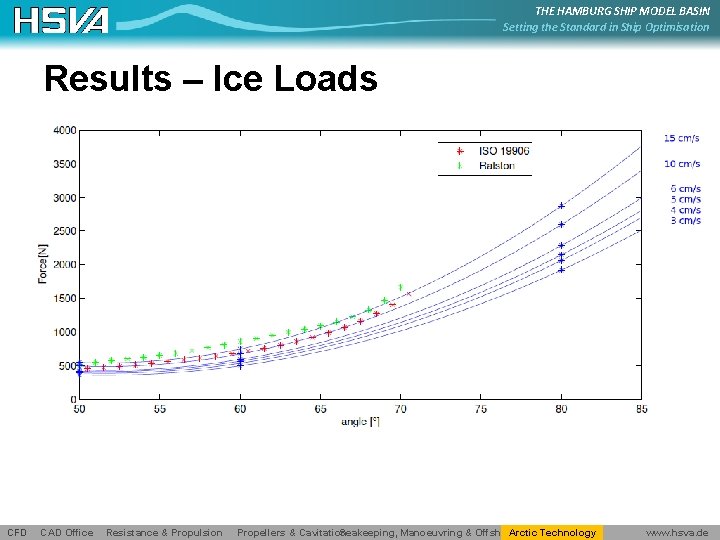
THE HAMBURG SHIP MODEL BASIN Setting the Standard in Ship Optimisation Results – Ice Loads CFD CAD Office Resistance & Propulsion Seakeeping, Manoeuvring & Offshore Propellers & Cavitation Arctic Technology www. hsva. de
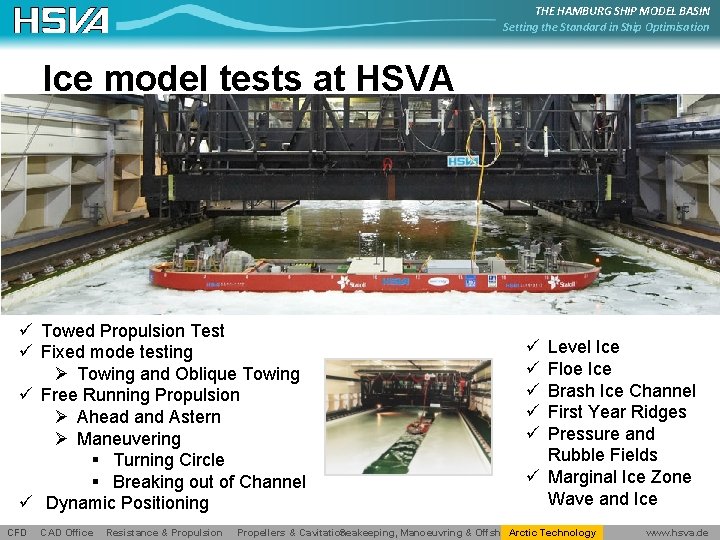
THE HAMBURG SHIP MODEL BASIN Setting the Standard in Ship Optimisation Ice model tests at HSVA ü Towed Propulsion Test ü Fixed mode testing Ø Towing and Oblique Towing ü Free Running Propulsion Ø Ahead and Astern Ø Maneuvering § Turning Circle § Breaking out of Channel ü Dynamic Positioning CFD CAD Office Resistance & Propulsion ü ü ü Level Ice Floe Ice Brash Ice Channel First Year Ridges Pressure and Rubble Fields ü Marginal Ice Zone Wave and Ice Seakeeping, Manoeuvring & Offshore Propellers & Cavitation Arctic Technology www. hsva. de
- Slides: 13