
The Halogens Group 17 Pure elements consist of
- Slides: 6
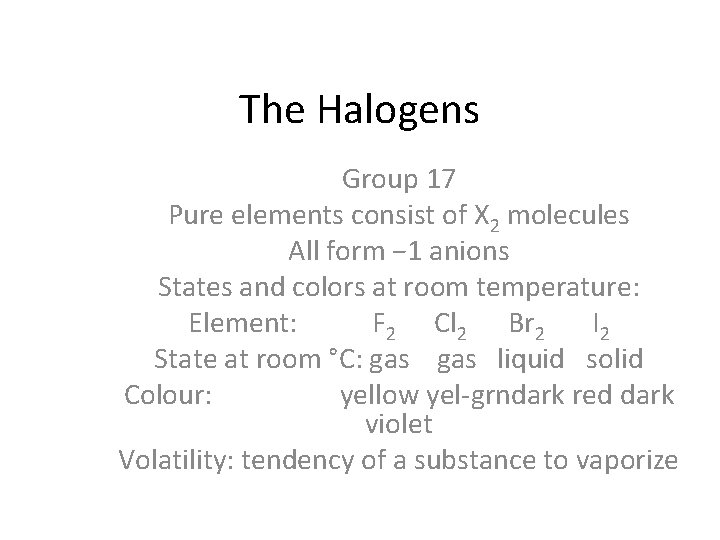
The Halogens Group 17 Pure elements consist of X 2 molecules All form − 1 anions States and colors at room temperature: Element: F 2 Cl 2 Br 2 I 2 State at room °C: gas liquid solid Colour: yellow yel-grndark red dark violet Volatility: tendency of a substance to vaporize
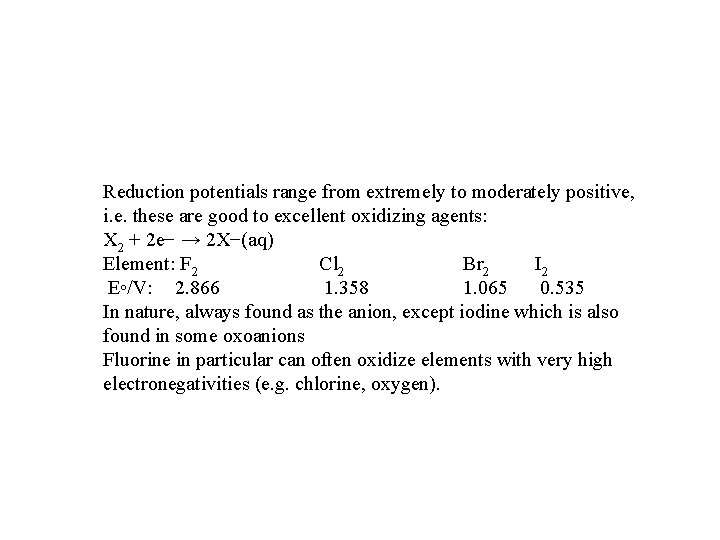
Reduction potentials range from extremely to moderately positive, i. e. these are good to excellent oxidizing agents: X 2 + 2 e− → 2 X−(aq) Element: F 2 Cl 2 Br 2 I 2 E◦/V: 2. 866 1. 358 1. 065 0. 535 In nature, always found as the anion, except iodine which is also found in some oxoanions Fluorine in particular can often oxidize elements with very high electronegativities (e. g. chlorine, oxygen).
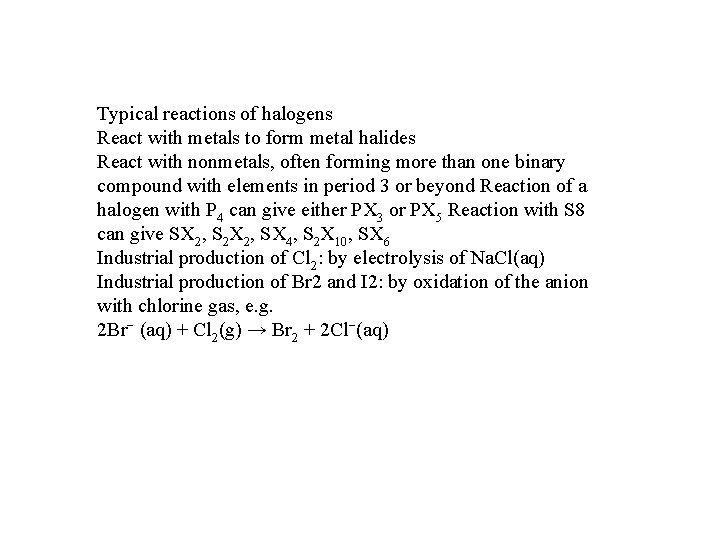
Typical reactions of halogens React with metals to form metal halides React with nonmetals, often forming more than one binary compound with elements in period 3 or beyond Reaction of a halogen with P 4 can give either PX 3 or PX 5 Reaction with S 8 can give SX 2, S 2 X 2, SX 4, S 2 X 10, SX 6 Industrial production of Cl 2: by electrolysis of Na. Cl(aq) Industrial production of Br 2 and I 2: by oxidation of the anion with chlorine gas, e. g. 2 Br− (aq) + Cl 2(g) → Br 2 + 2 Cl−(aq)
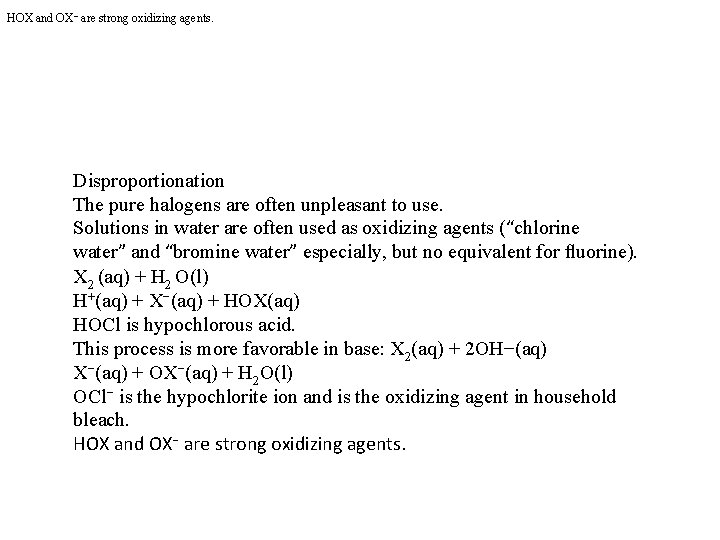
HOX and OX− are strong oxidizing agents. Disproportionation The pure halogens are often unpleasant to use. Solutions in water are often used as oxidizing agents (“chlorine water” and “bromine water” especially, but no equivalent for fluorine). X 2 (aq) + H 2 O(l) H+(aq) + X−(aq) + HOX(aq) HOCl is hypochlorous acid. This process is more favorable in base: X 2(aq) + 2 OH−(aq) X−(aq) + OX−(aq) + H 2 O(l) OCl− is the hypochlorite ion and is the oxidizing agent in household bleach. HOX and OX− are strong oxidizing agents.
Oxidation states Recall that the formal charge assumes perfect covalency (sharing of electrons). Oxidation states can be thought of as a counterpart of formal charge which assumes that all bonding is ionic, i. e. “shared” electrons belong to the more electronegative element.
Recall that the formal charge assumes perfect covalency (sharing of electrons). Oxidation states can be thought of as a counterpart of formal charge which assumes that all bonding is ionic, i. e. “shared” electrons belong to the more electronegative element. Rules for assigning oxidation states 1 The sum of the oxidation states in a molecule is equal to the charge. 2 In a bond between two identical atoms, the electrons are equally shared. 3 In any other bond, we “give” all the shared electrons to the more electronegative atom. oxidation state = valence electrons of neutral atom − electrons in ionized structure