
The HADES experiment GSI Motivation Detector description Performance
![MDC module x/X 0 5 10 -4 Cell characteristic 6 ] m [m](https://slidetodoc.com/presentation_image_h2/c856581811c54890d8e5db2a305da41e/image-11.jpg "MDC module x/X 0 5 10 -4 Cell characteristic 6 ] m [m")
![TOF-hadron identification Pr counts p [Me. V/c] eli m y Mass [Me. V/c 2]](https://slidetodoc.com/presentation_image_h2/c856581811c54890d8e5db2a305da41e/image-15.jpg "TOF-hadron identification Pr counts p [Me. V/c] eli m y Mass [Me. V/c 2]")
- Slides: 29
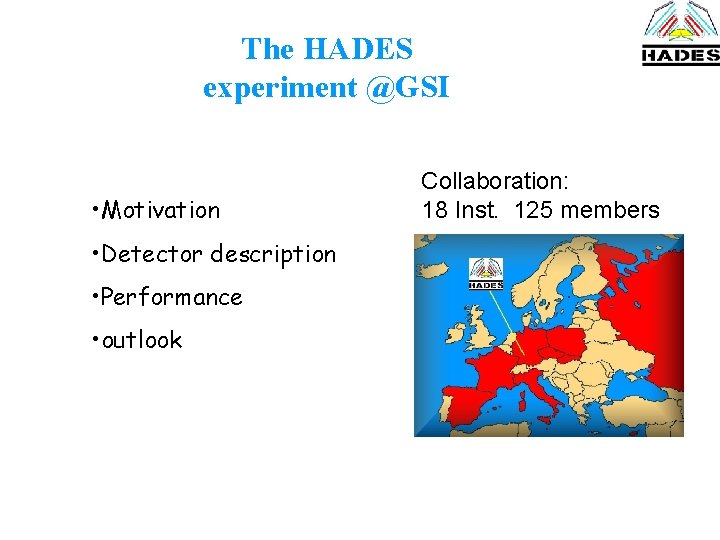
The HADES experiment @GSI • Motivation • Detector description • Performance • outlook Collaboration: 18 Inst. 125 members
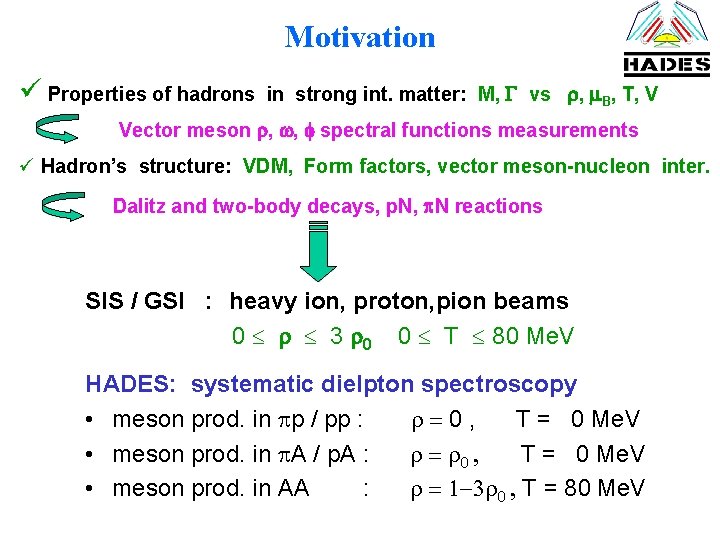
Motivation ü Properties of hadrons in strong int. matter: M, G vs , B, T, V Vector meson , , spectral functions measurements ü Hadron’s structure: VDM, Form factors, vector meson-nucleon inter. Dalitz and two-body decays, p. N, N reactions SIS / GSI : heavy ion, proton, pion beams 0 3 0 0 T 80 Me. V HADES: systematic dielpton spectroscopy • meson prod. in p / pp : =0, T = 0 Me. V • meson prod. in A / p. A : = 0 , T = 0 Me. V • meson prod. in AA : = 1 -3 0 , T = 80 Me. V
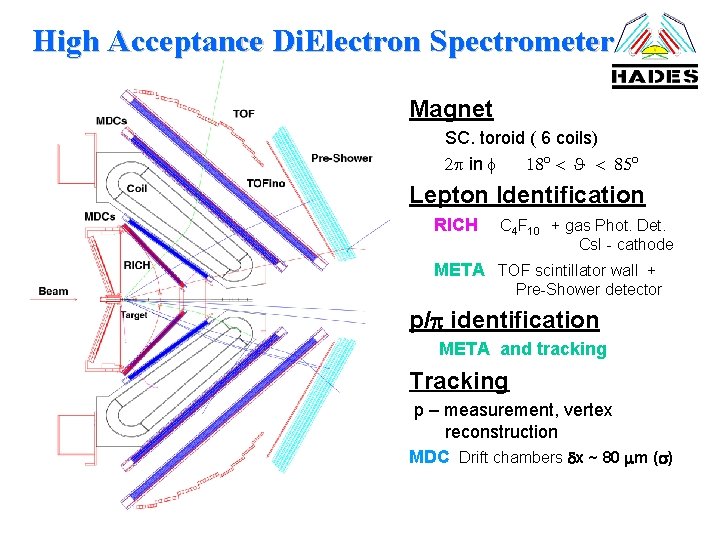
High Acceptance Di. Electron Spectrometer Magnet SC. toroid ( 6 coils) 2 in f 18 o < J < 85 o Lepton Identification RICH C 4 F 10 + gas Phot. Det. Cs. I - cathode META TOF scintillator wall + Pre-Shower detector p/ identification META and tracking Tracking p – measurement, vertex reconstruction MDC Drift chambers x ~ 80 m (s)
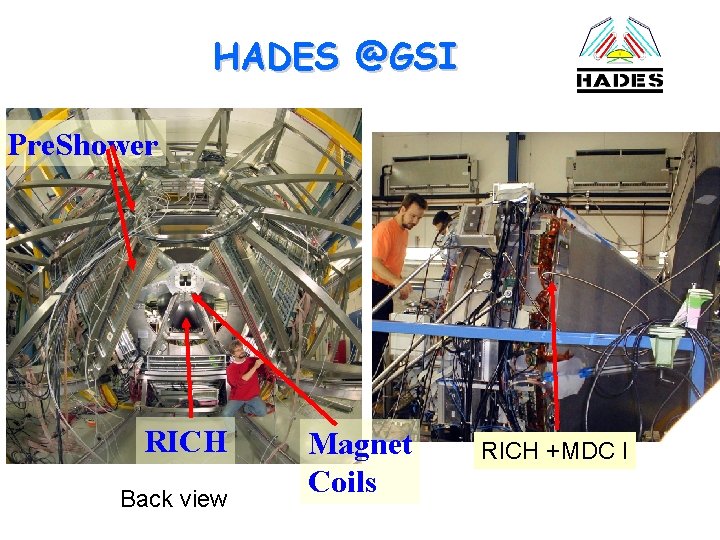
HADES @GSI Pre. Shower RICH Back view Magnet Coils RICH +MDC I
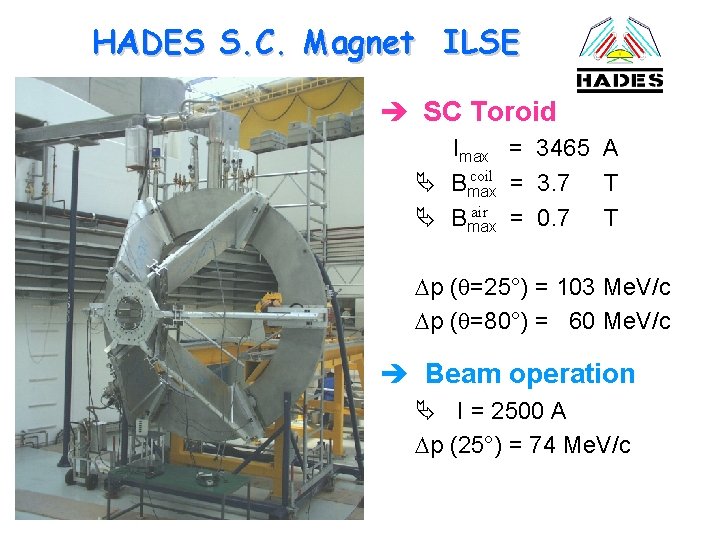
HADES S. C. Magnet ILSE è SC Toroid Imax = 3465 A coil Ä Bmax = 3. 7 T air Ä Bmax = 0. 7 T p (q=25°) = 103 Me. V/c p (q=80°) = 60 Me. V/c è Beam operation Ä I = 2500 A p (25°) = 74 Me. V/c
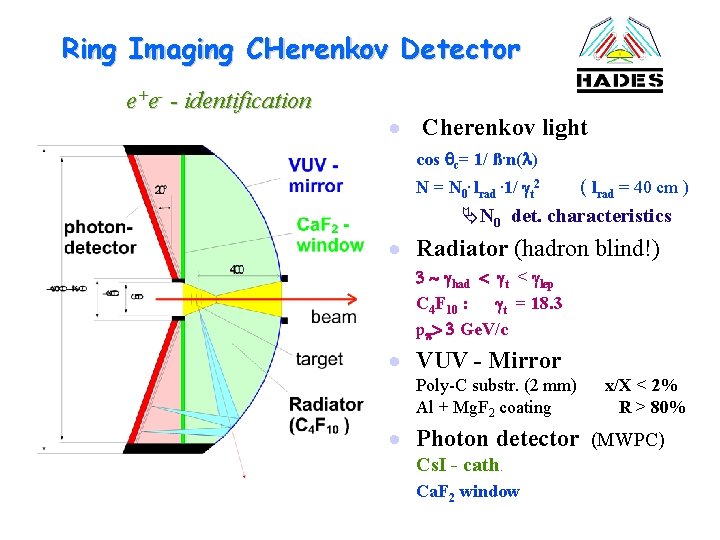
Ring Imaging CHerenkov Detector e+e- - identification · Cherenkov light cos qc= 1/ ß. n(l) N = N 0. lrad. 1/ gt 2 ( lrad = 40 cm ) ÄN 0 det. characteristics · Radiator (hadron blind!) 3 ~ ghad < gt < glep C 4 F 10 : gt = 18. 3 p > 3 Ge. V/c · VUV - Mirror Poly-C substr. (2 mm) Al + Mg. F 2 coating x/X < 2% R > 80% · Photon detector (MWPC) Cs. I - cath. Ca. F 2 window
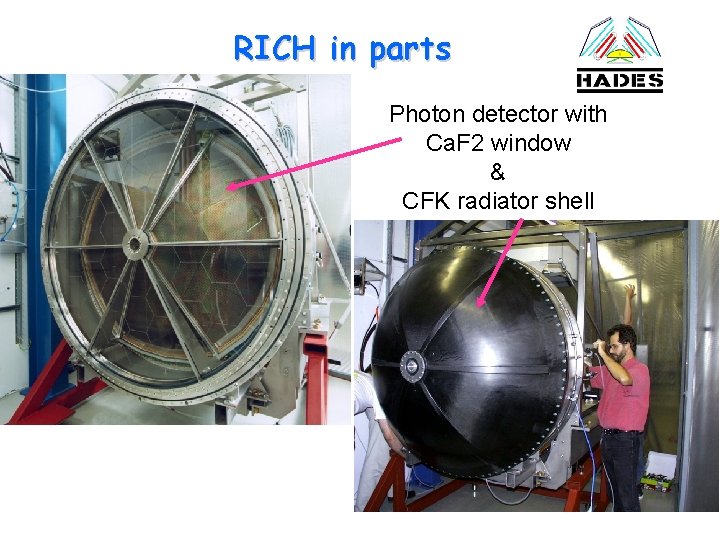
RICH in parts Photon detector with Ca. F 2 window & CFK radiator shell
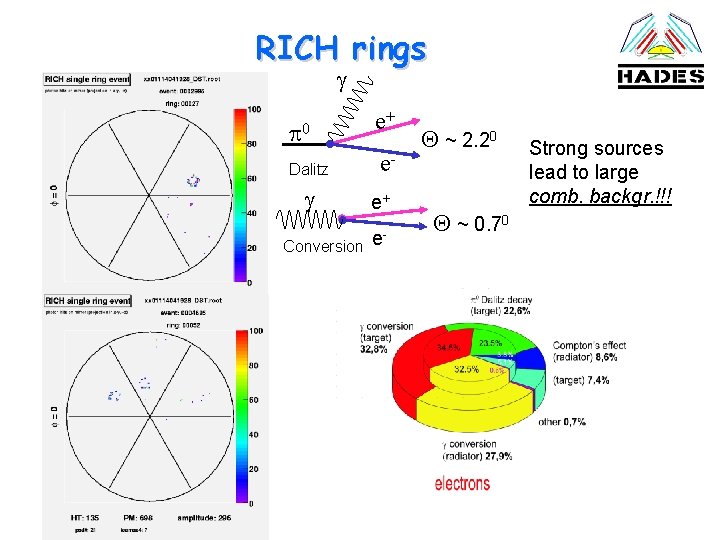
RICH rings g 0 Dalitz g Conversion e+ e- Q ~ 2. 20 Q ~ 0. 70 Strong sources lead to large comb. backgr. !!!
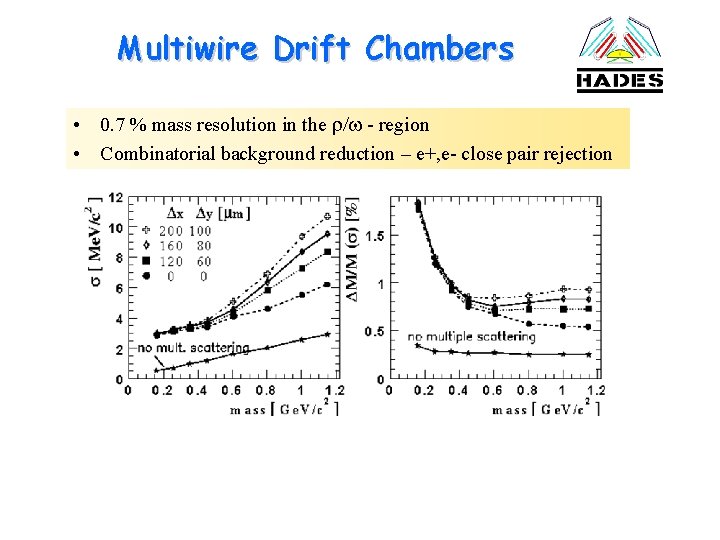
Multiwire Drift Chambers • 0. 7 % mass resolution in the / - region • Combinatorial background reduction – e+, e- close pair rejection
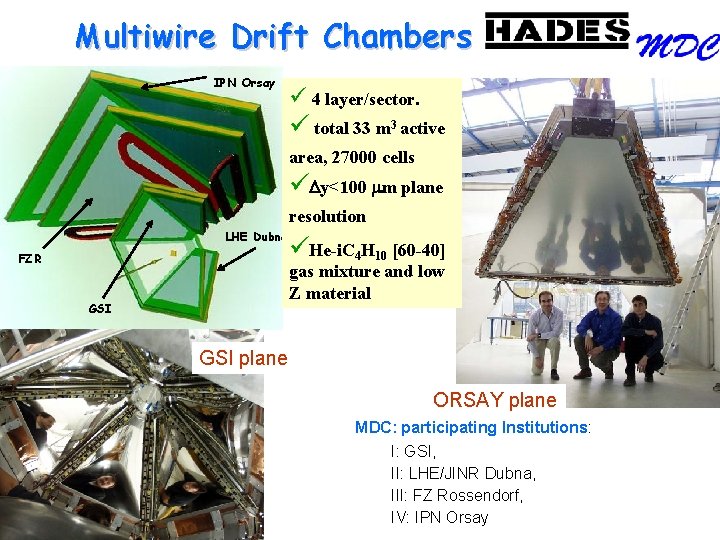
Multiwire Drift Chambers IPN Orsay ü 4 layer/sector. ü total 33 m 3 active area, 27000 cells ü y<100 m plane resolution LHE Dubna FZR üHe-i. C 4 H 10 [60 -40] gas mixture and low Z material GSI plane ORSAY plane MDC: participating Institutions: I: GSI, II: LHE/JINR Dubna, III: FZ Rossendorf, IV: IPN Orsay
MDC module x/X 0 5 10 -4 Cell characteristic 6 ] m [m
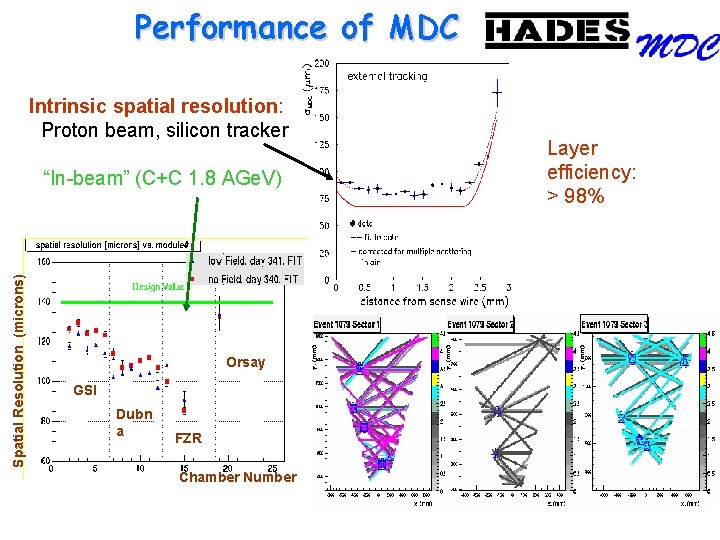
Performance of MDC Intrinsic spatial resolution: Proton beam, silicon tracker Spatial Resolution (microns) “In-beam” (C+C 1. 8 AGe. V) Orsay GSI Dubn a FZR Chamber Number Layer efficiency: > 98%
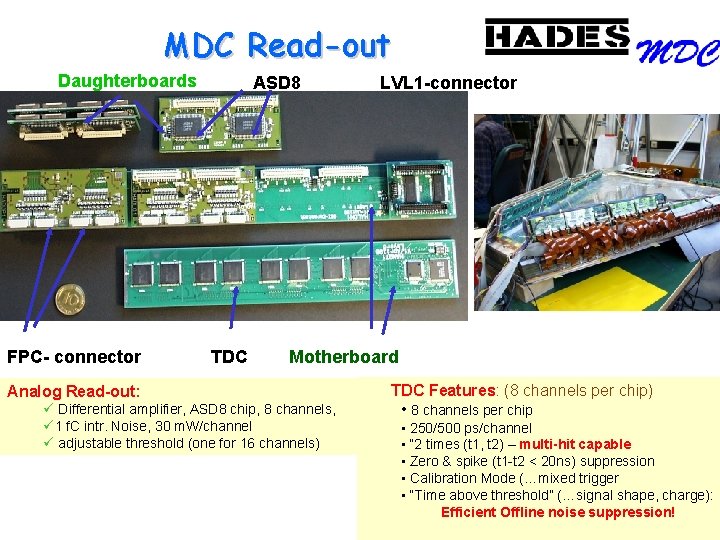
MDC Read-out Daughterboards FPC- connector ASD 8 TDC LVL 1 -connector Motherboard Analog Read-out: ü Differential amplifier, ASD 8 chip, 8 channels, ü 1 f. C intr. Noise, 30 m. W/channel ü adjustable threshold (one for 16 channels) TDC Features: (8 channels per chip) • 8 channels per chip • 250/500 ps/channel • “ 2 times (t 1, t 2) – multi-hit capable • Zero & spike (t 1 -t 2 < 20 ns) suppression • Calibration Mode (…mixed trigger • “Time above threshold” (…signal shape, charge): Efficient Offline noise suppression!
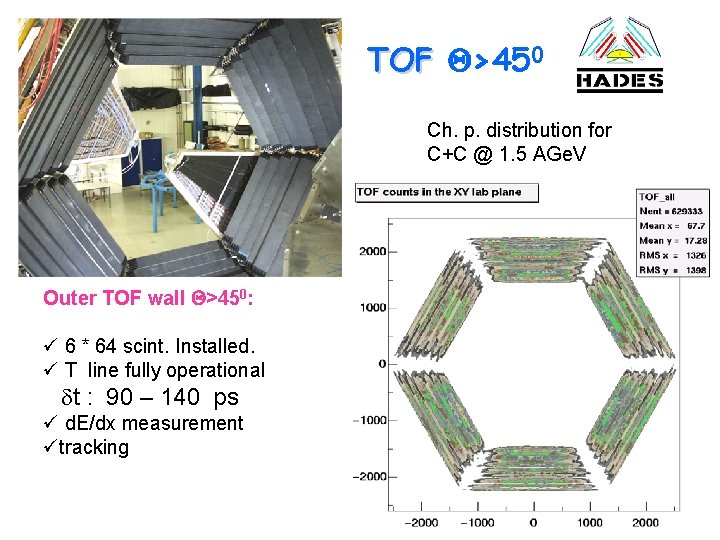
TOF >450 Ch. p. distribution for C+C @ 1. 5 AGe. V Outer TOF wall >450: ü 6 * 64 scint. Installed. ü T line fully operational t : 90 – 140 ps ü d. E/dx measurement ütracking J. Friese, TU München
TOF-hadron identification Pr counts p [Me. V/c] eli m y Mass [Me. V/c 2] Deuteron peak: deuterons counts Tof [ns] b in ar m 0 = 1890 Me. V sm = 551 Me. V protons Energy loss [Me. V] Mass [Me. V/c 2]
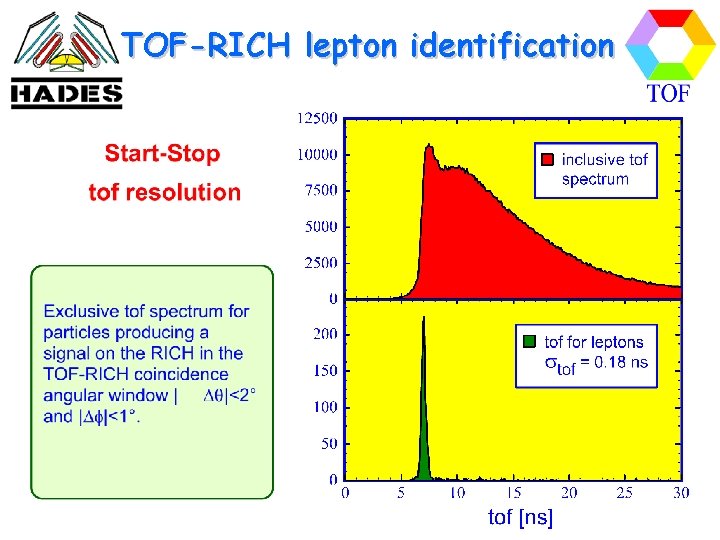
TOF-RICH lepton identification
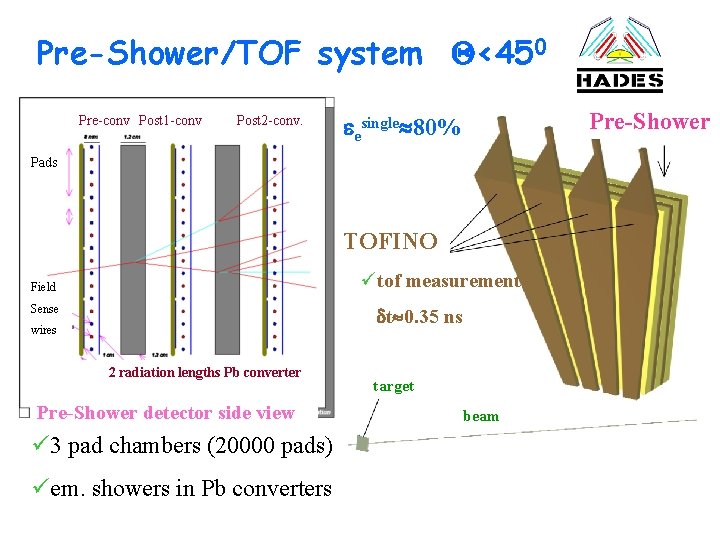
Pre-Shower/TOF system <450 Pre-conv Post 1 -conv Post 2 -conv. Pre-Shower esingle 80% Pads TOFINO ütof measurement Field Sense t 0. 35 ns wires 2 radiation lengths Pb converter Pre-Shower detector side view ü 3 pad chambers (20000 pads) üem. showers in Pb converters target beam
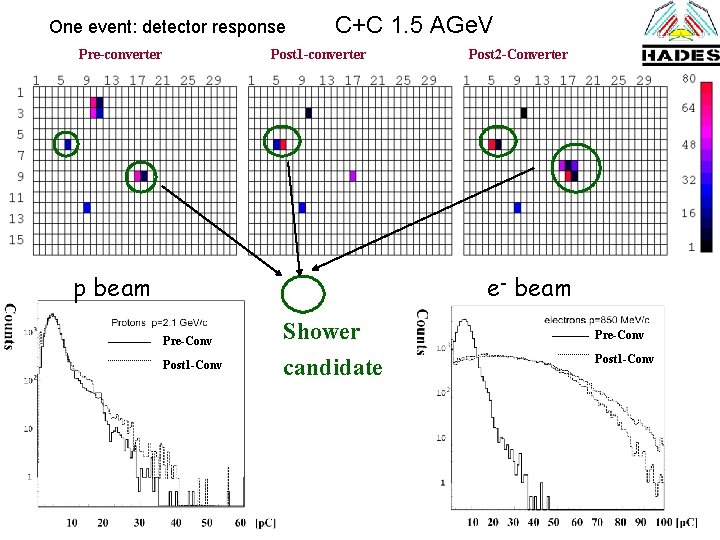
One event: detector response Pre-converter C+C 1. 5 AGe. V Post 1 -converter p beam Post 2 -Converter e- beam Pre-Conv Post 1 -Conv Shower candidate Pre-Conv Post 1 -Conv
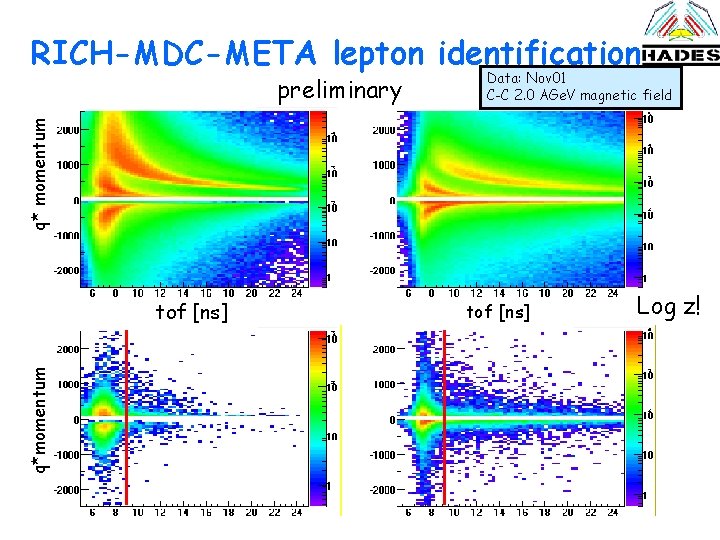
RICH-MDC-META lepton identification q* momentum preliminary Data: Nov 01 C-C 2. 0 AGe. V magnetic field q*momentum tof [ns] Log z!
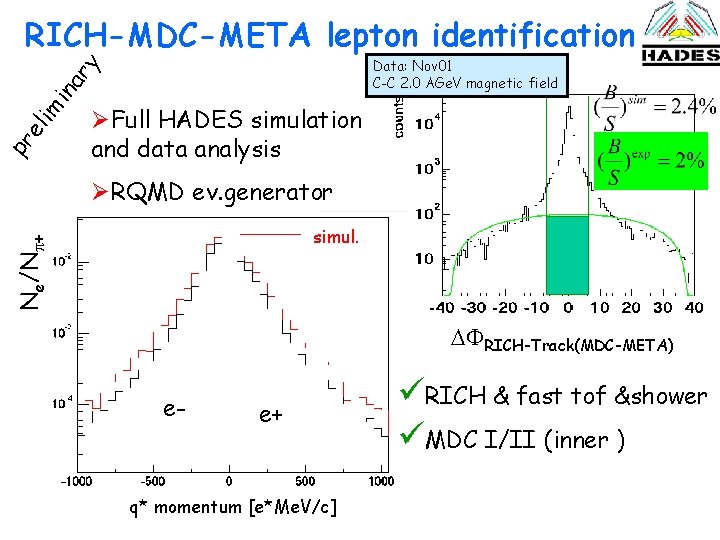
RICH-MDC-META lepton identification pr el im in ar y Data: Nov 01 C-C 2. 0 AGe. V magnetic field ØFull HADES simulation and data analysis ØRQMD ev. generator Ne/N + simul. RICH-Track(MDC-META) e- e+ q* momentum [e*Me. V/c] üRICH & fast tof &shower üMDC I/II (inner )
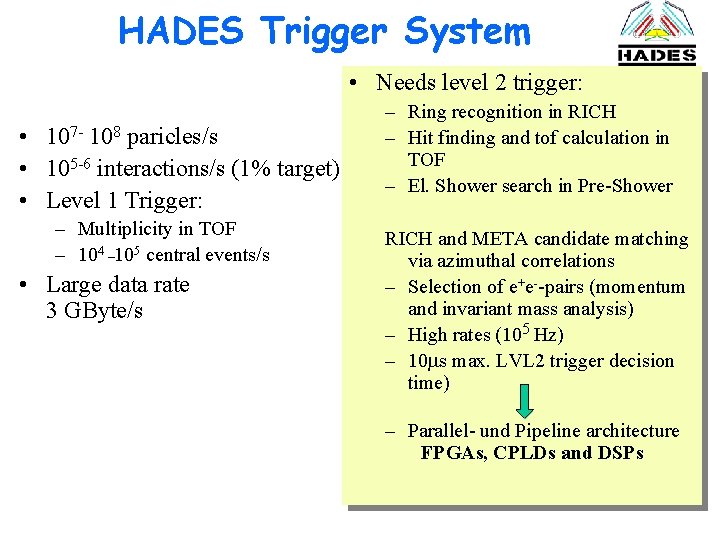
HADES Trigger System • Needs level 2 trigger: • 107 - 108 paricles/s • 105 -6 interactions/s (1% target) • Level 1 Trigger: – Multiplicity in TOF – 104 _105 central events/s • Large data rate 3 GByte/s – Ring recognition in RICH – Hit finding and tof calculation in TOF – El. Shower search in Pre-Shower RICH and META candidate matching via azimuthal correlations – Selection of e+e--pairs (momentum and invariant mass analysis) – High rates (105 Hz) – 10 ms max. LVL 2 trigger decision time) – Parallel- und Pipeline architecture FPGAs, CPLDs and DSPs
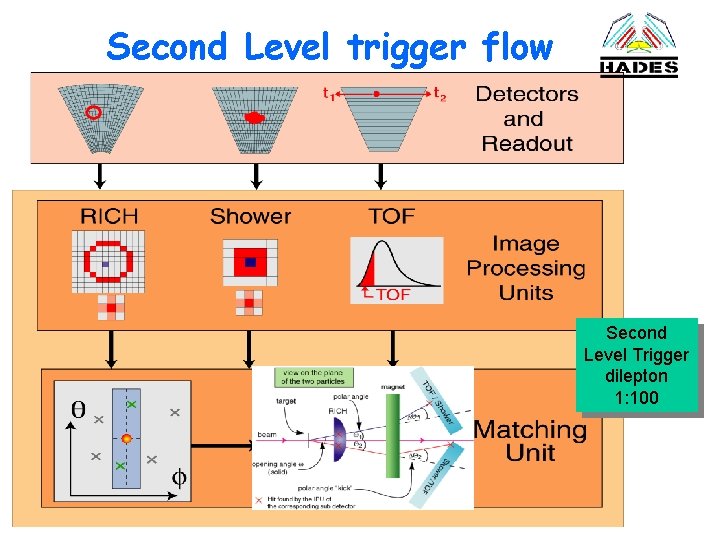
Second Level trigger flow Second Level Trigger dilepton 1: 100
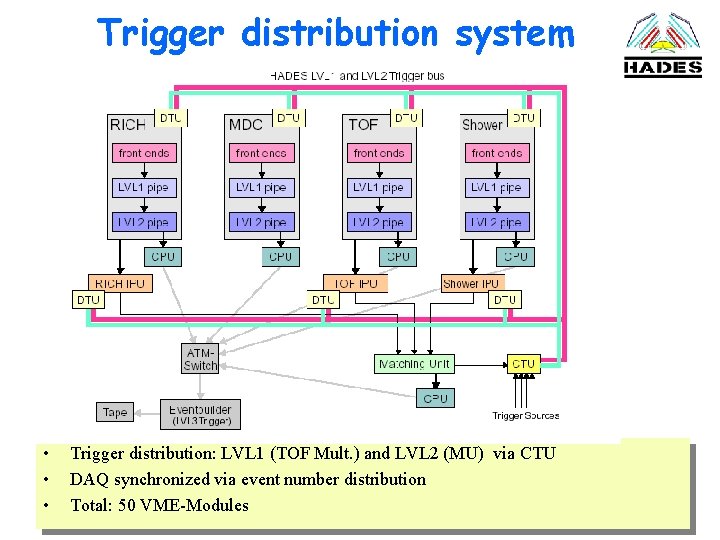
Trigger distribution system • • • Trigger distribution: LVL 1 (TOF Mult. ) and LVL 2 (MU) via CTU DAQ synchronized via event number distribution Total: 50 VME-Modules
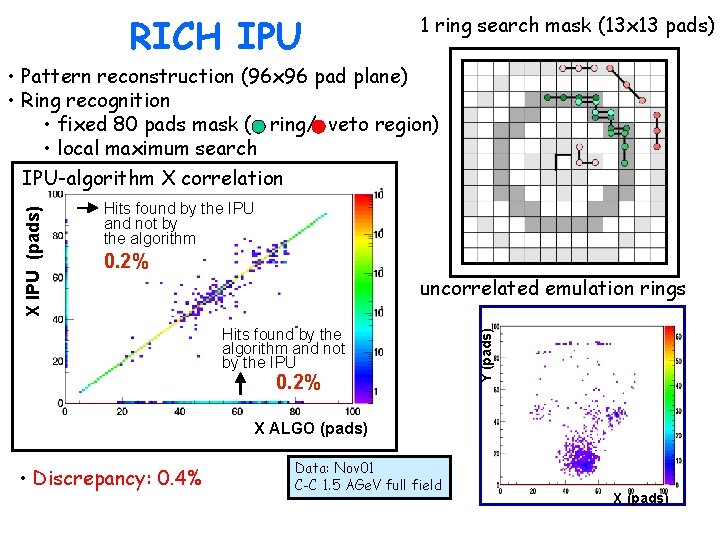
RICH IPU 1 ring search mask (13 x 13 pads) Hits found by the IPU and not by the algorithm 0. 2% uncorrelated emulation rings Hits found by the algorithm and not by the IPU 0. 2% Y (pads) X IPU (pads) • Pattern reconstruction (96 x 96 pad plane) • Ring recognition • fixed 80 pads mask ( ring/ veto region) • local maximum search IPU-algorithm X correlation X ALGO (pads) • Discrepancy: 0. 4% Data: Nov 01 C-C 1. 5 AGe. V full field X (pads)
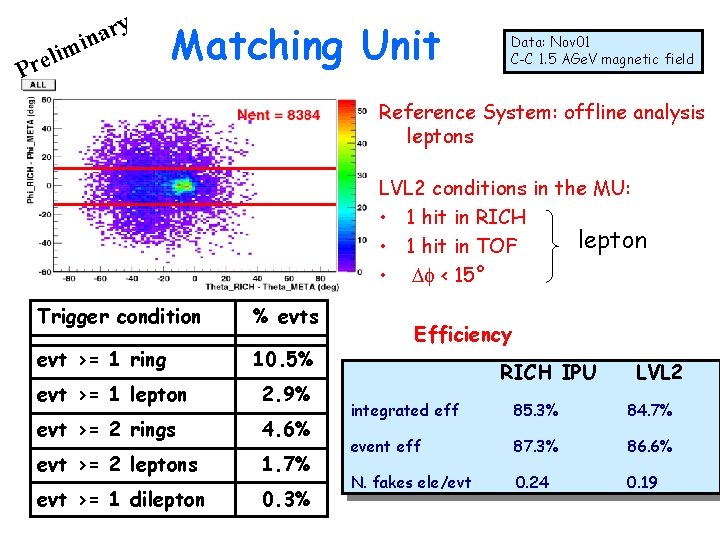
ry a n mi li e r P Matching Unit Data: Nov 01 C-C 1. 5 AGe. V magnetic field Reference System: offline analysis leptons LVL 2 conditions in the MU: • 1 hit in RICH lepton • 1 hit in TOF • f < 15° Trigger condition % evts evt >= 1 ring 10. 5% evt >= 1 lepton 2. 9% evt >= 2 rings 4. 6% evt >= 2 leptons 1. 7% evt >= 1 dilepton 0. 3% Efficiency RICH IPU LVL 2 integrated eff 85. 3% 84. 7% event eff 87. 3% 86. 6% N. fakes ele/evt 0. 24 0. 19
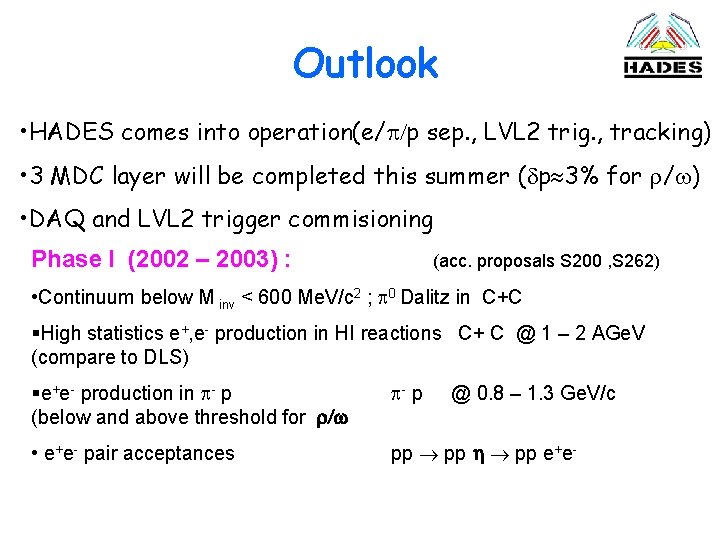
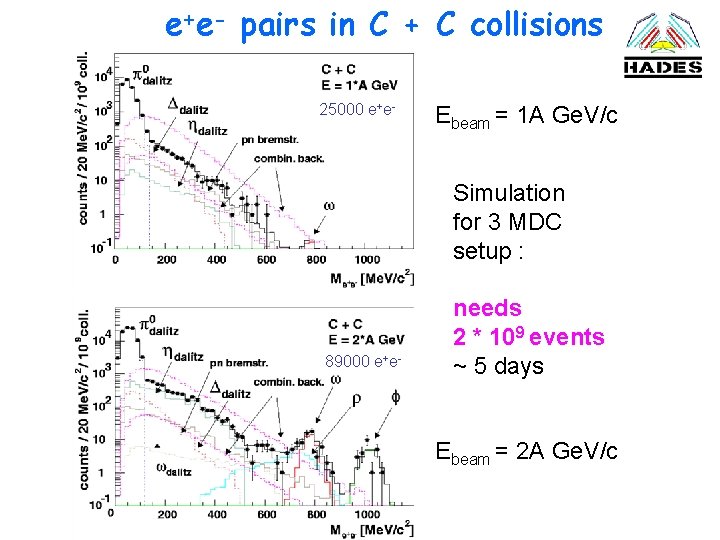
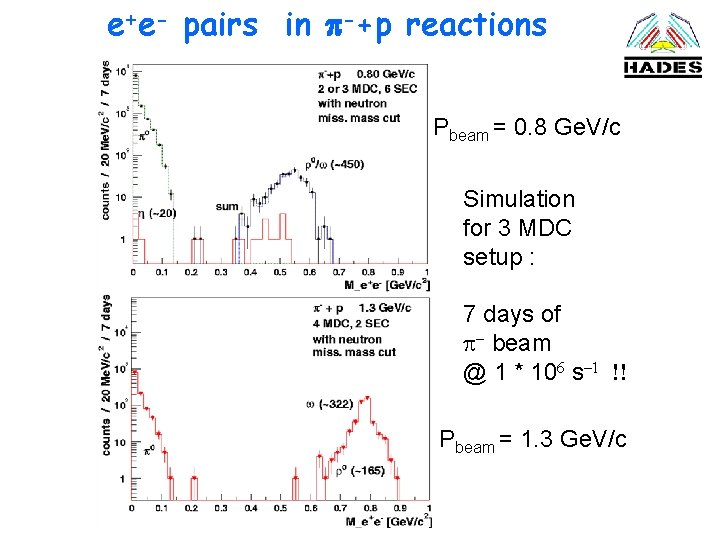
Outlook • HADES comes into operation(e/ /p sep. , LVL 2 trig. , tracking) • 3 MDC layer will be completed this summer ( p 3% for / ) • DAQ and LVL 2 trigger commisioning Phase I (2002 – 2003) : (acc. proposals S 200 , S 262) • Continuum below M inv < 600 Me. V/c 2 ; 0 Dalitz in C+C §High statistics e+, e- production in HI reactions C+ C @ 1 – 2 AGe. V (compare to DLS) §e+e- production in - p (below and above threshold for / - p • e+e- pair acceptances pp h pp e+e- @ 0. 8 – 1. 3 Ge. V/c
e+e- pairs in C + C collisions 25000 e+e- Ebeam = 1 A Ge. V/c Simulation for 3 MDC setup : 89000 e+e- needs 2 * 109 events ~ 5 days Ebeam = 2 A Ge. V/c
e+e- pairs in -+p reactions Pbeam = 0. 8 Ge. V/c Simulation for 3 MDC setup : 7 days of - beam @ 1 * 106 s-1 !! Pbeam = 1. 3 Ge. V/c
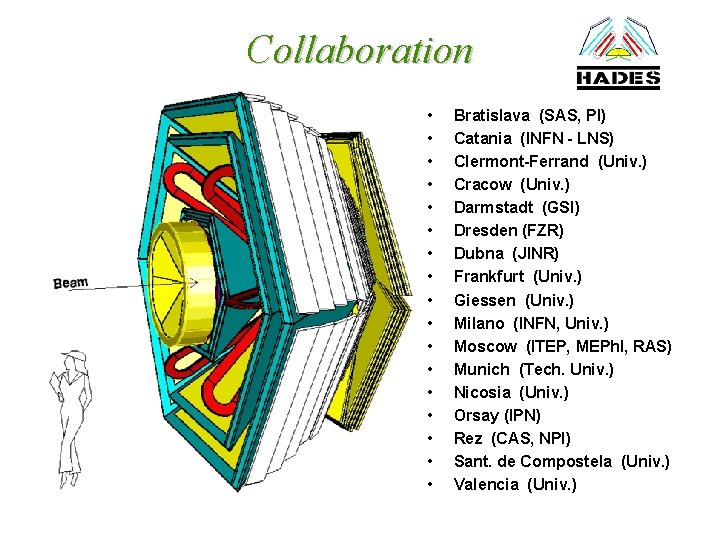
Collaboration • • • • • Bratislava (SAS, PI) Catania (INFN - LNS) Clermont-Ferrand (Univ. ) Cracow (Univ. ) Darmstadt (GSI) Dresden (FZR) Dubna (JINR) Frankfurt (Univ. ) Giessen (Univ. ) Milano (INFN, Univ. ) Moscow (ITEP, MEPh. I, RAS) Munich (Tech. Univ. ) Nicosia (Univ. ) Orsay (IPN) Rez (CAS, NPI) Sant. de Compostela (Univ. ) Valencia (Univ. )