
The Habitable Zone The habitable zone in a
The Habitable Zone The habitable zone in a solar system is the range of locations around the parent star where life based on liquid water could exist!

HZ dependent upon: • mass and age of parent star • planet’s mass, atmosphere and distance from its parent star
What is a Habitable Planet? A habitable planet is: • Not too big • Not too small • Not too hot or too cold • … and it has beer! 3
Why is the Earth Habitable? • Solid surface - useful for concentrating chemicals & reactions • Not located in a “bad” neighborhood - low supernova rate, no nearby gamma ray bursters or “death rays” • Sun had plenty of heavy elements to make terrestrial planets from (not Pop II star) • Relatively low major impact rate - major “killers” only every 100 Myr - planet-sterilizers less frequent • Large Moon stabilizes rotation axis to prevent some huge changes in climate • Location, location!
1970’s — Michael Hart Re-posed Fermi’s Question: “Where IS Everyone? ” • Are the conditions for life common or rare? • How does one decide the issue? • What is necessary for a terrestrial planet to have suitable conditions for the emergence of life as we understand it? • Hart decided to model why it is that the Earth is currently capable of sustaining life!
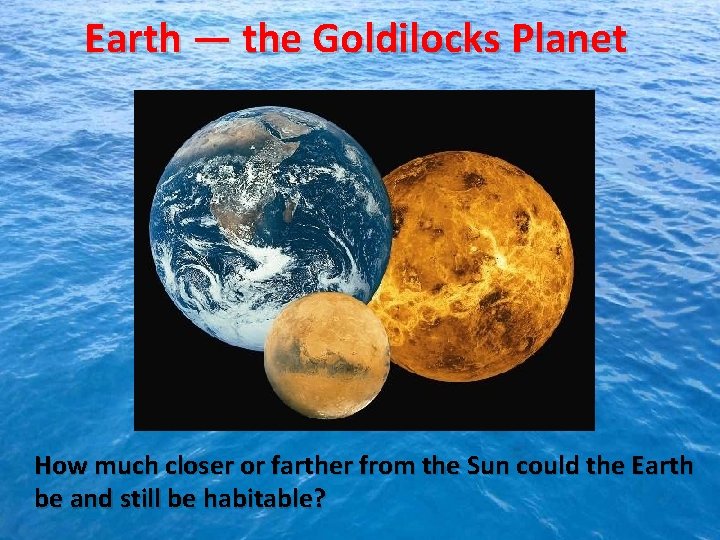
Earth — the Goldilocks Planet How much closer or farther from the Sun could the Earth be and still be habitable?
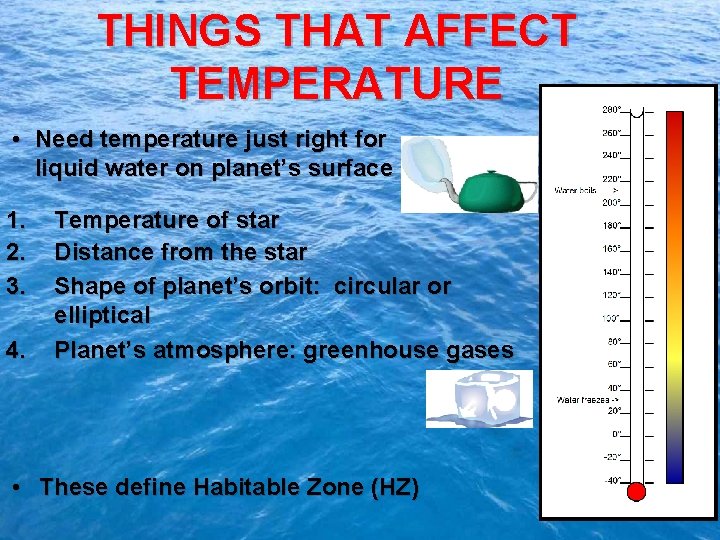
THINGS THAT AFFECT TEMPERATURE • Need temperature just right for liquid water on planet’s surface 1. 2. 3. 4. Temperature of star Distance from the star Shape of planet’s orbit: circular or elliptical Planet’s atmosphere: greenhouse gases • These define Habitable Zone (HZ)
Question Perhaps the most critical factor that affects the temperature of any planet is ____. A. where the planet is located in the Milky Way B. whether or not it has a store of fossil fuel C. whether or not it rotates clock-wise or counter clock-wise D. how far the planet is from its parent Sun E. whether or not its inhabitants drive oversized SUV’s
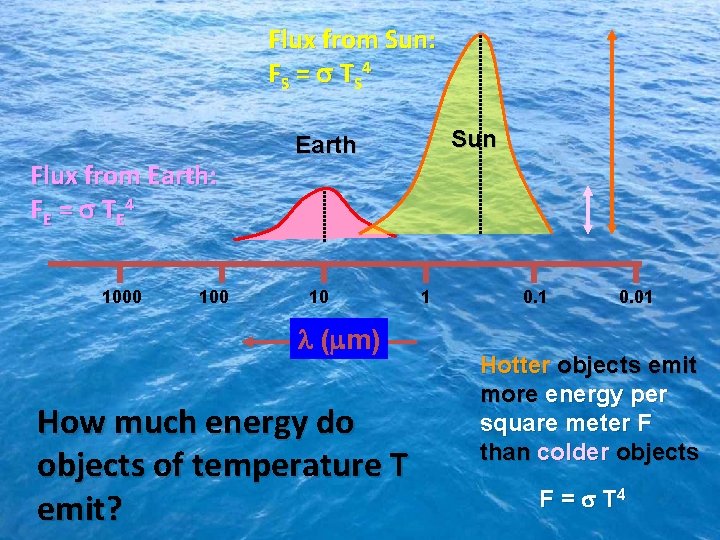
Flux from Sun: F S = TS 4 Flux from Earth: F E = TE 4 1000 100 Sun Earth 10 ( m) How much energy do objects of temperature T emit? 1 0. 01 Hotter objects emit more energy per square meter F than colder objects F = T 4
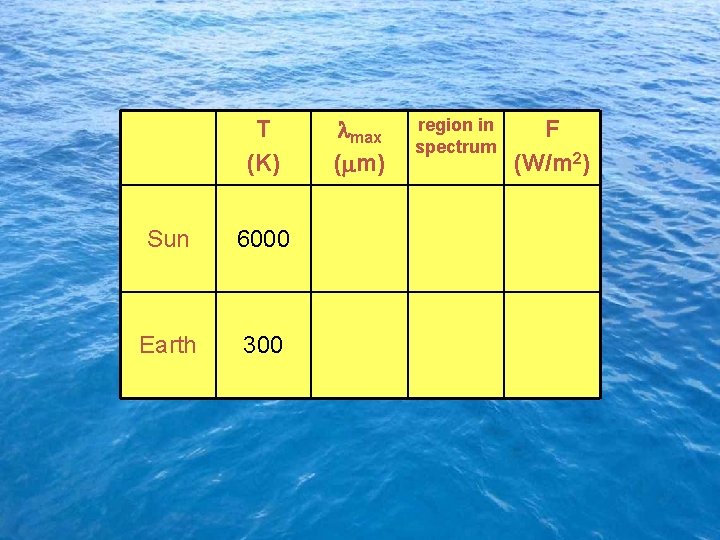
T (K) Sun 6000 Earth 300 max ( m) region in spectrum F (W/m 2)
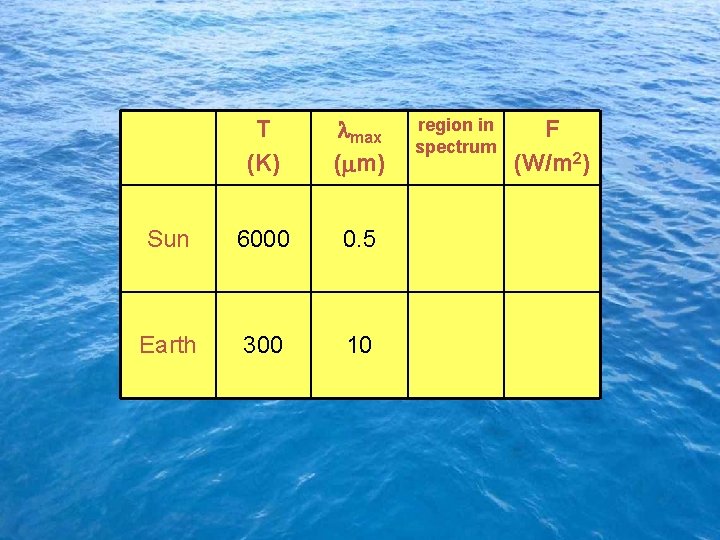
T (K) max ( m) Sun 6000 0. 5 Earth 300 10 region in spectrum F (W/m 2)
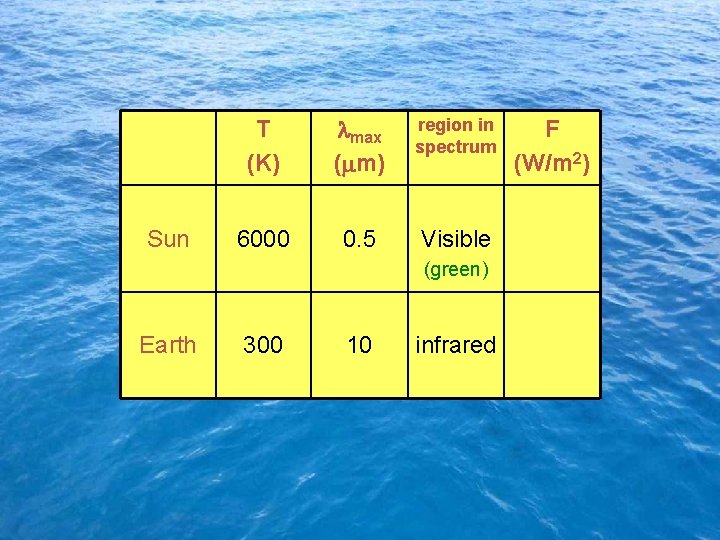
Sun T (K) max ( m) region in spectrum 6000 0. 5 Visible (green) Earth 300 10 infrared F (W/m 2)
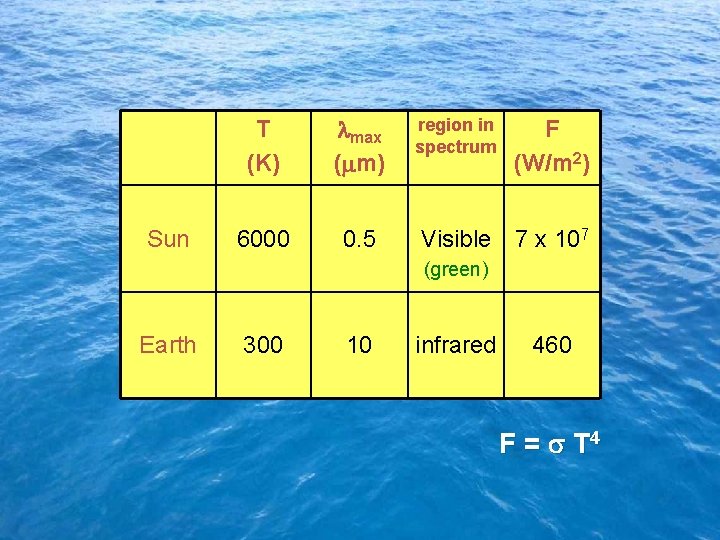
Sun T (K) max ( m) 6000 0. 5 region in spectrum F (W/m 2) Visible 7 x 10⁷ (green) Earth 300 10 infrared 460 F = T 4
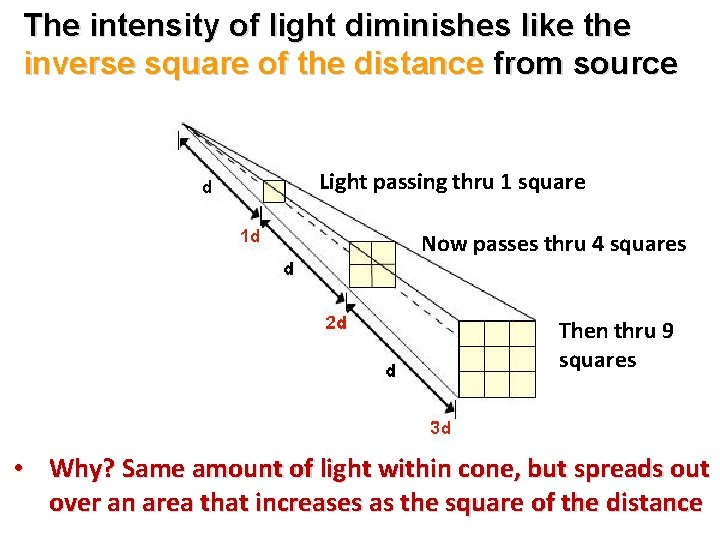
The intensity of light diminishes like the inverse square of the distance from source Light passing thru 1 square Now passes thru 4 squares Then thru 9 squares • Why? Same amount of light within cone, but spreads out over an area that increases as the square of the distance
Light Intensity on Terrestrial Planets • Mercury’s average distance from Sun is 0. 39 AU Average intensity 1/(0. 39)2 = 6. 6 x Earth’s • Venus’ average distance from Sun is 0. 72 AU Average intensity 1/(0. 72)2= 1. 93 x Earth’s • Mars’ average distance from Sun is 1. 52 AU Average intensity 1/(1. 52)2 = 0. 43 x Earth’s • But how does this translate into temperature?
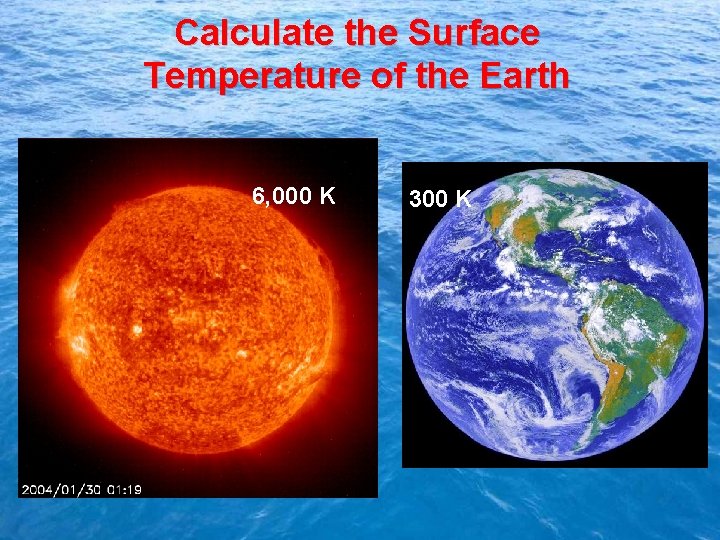
Calculate the Surface Temperature of the Earth 6, 000 K 300 K
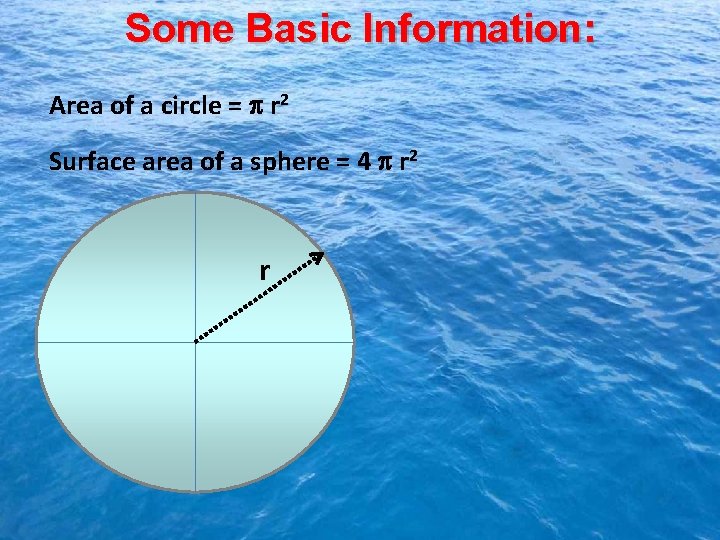
Some Basic Information: Area of a circle = r 2 Surface area of a sphere = 4 r 2 r
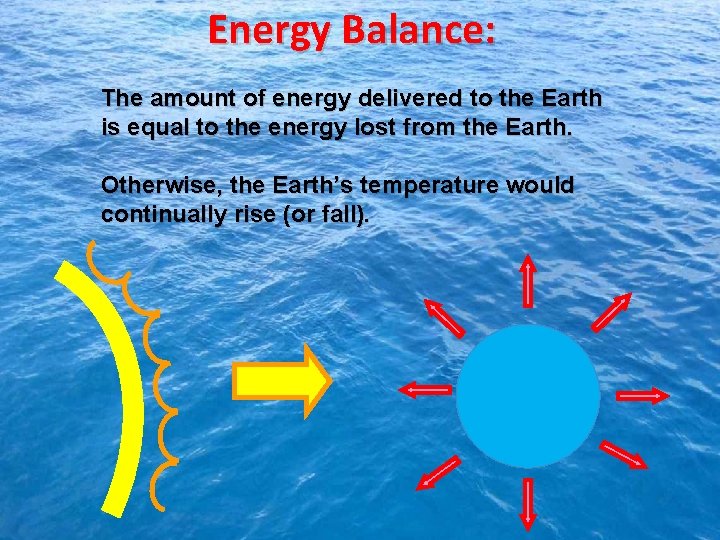
Energy Balance: The amount of energy delivered to the Earth is equal to the energy lost from the Earth. Otherwise, the Earth’s temperature would continually rise (or fall).
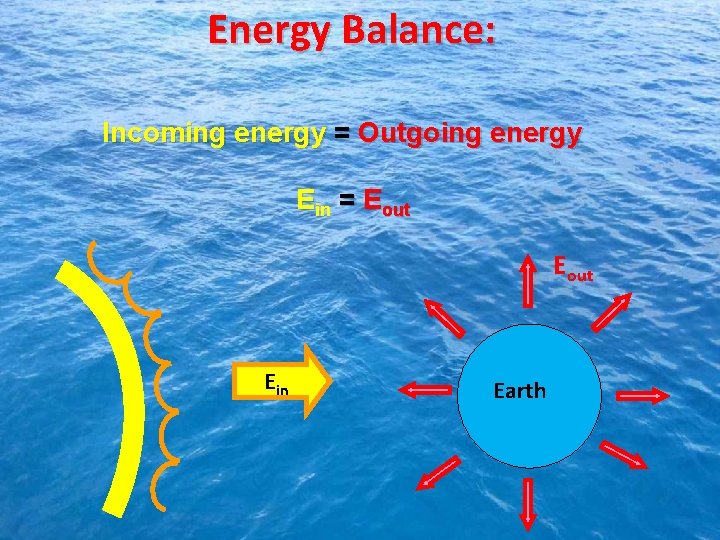
Energy Balance: Incoming energy = Outgoing energy Ein = Eout Ein Earth
How Much Solar Energy Reaches Earth?
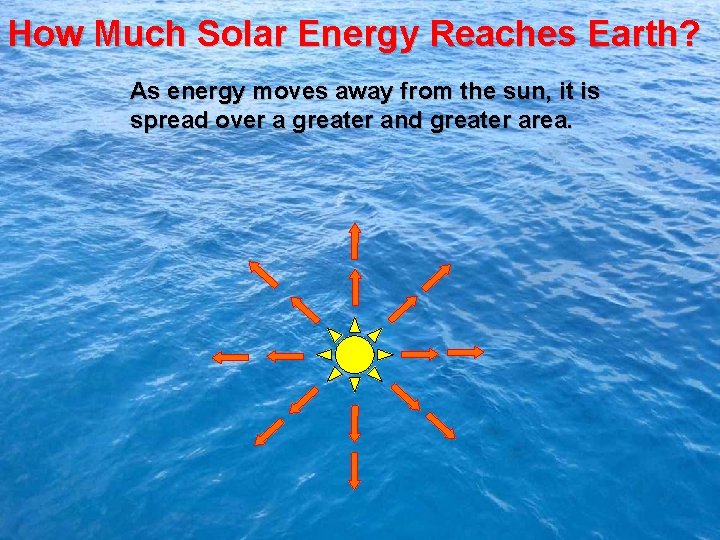
How Much Solar Energy Reaches Earth? As energy moves away from the sun, it is spread over a greater and greater area.
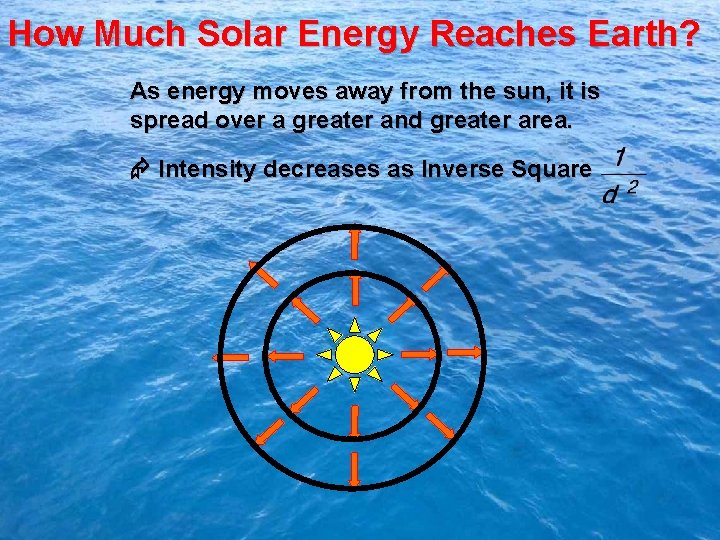
How Much Solar Energy Reaches Earth? As energy moves away from the sun, it is spread over a greater and greater area. Intensity decreases as Inverse Square
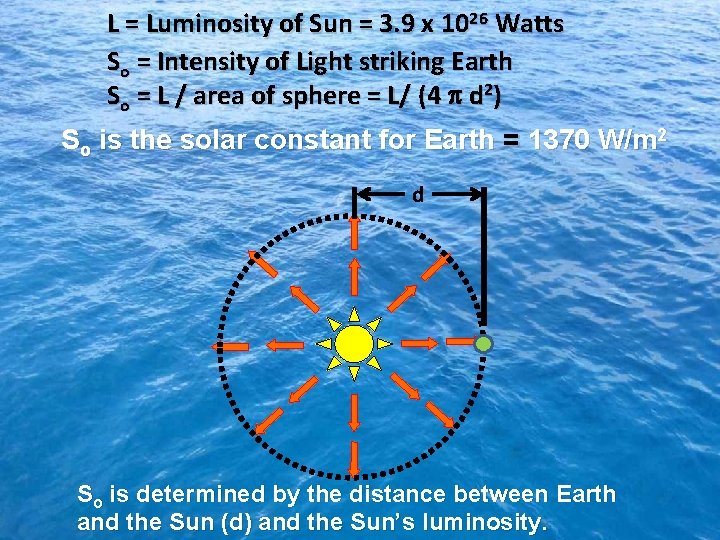
L = Luminosity of Sun = 3. 9 x 1026 Watts So = Intensity of Light striking Earth So = L / area of sphere = L/ (4 d 2) So is the solar constant for Earth = 1370 W/m 2 d So is determined by the distance between Earth and the Sun (d) and the Sun’s luminosity.
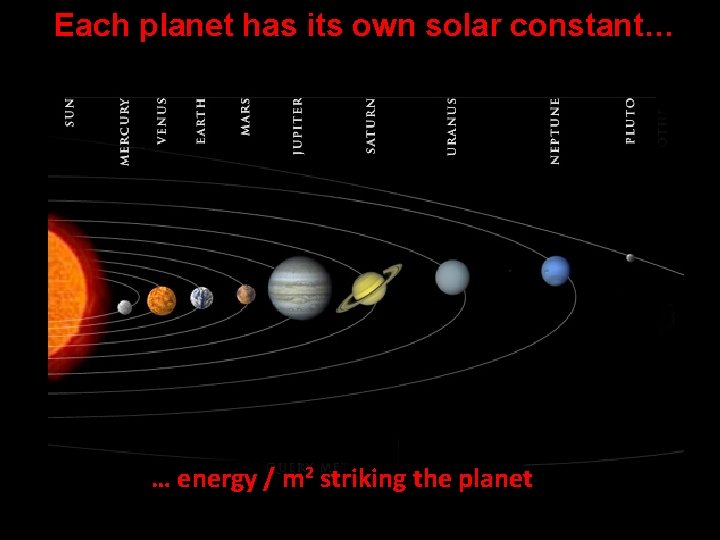
Each planet has its own solar constant… … energy / m 2 striking the planet
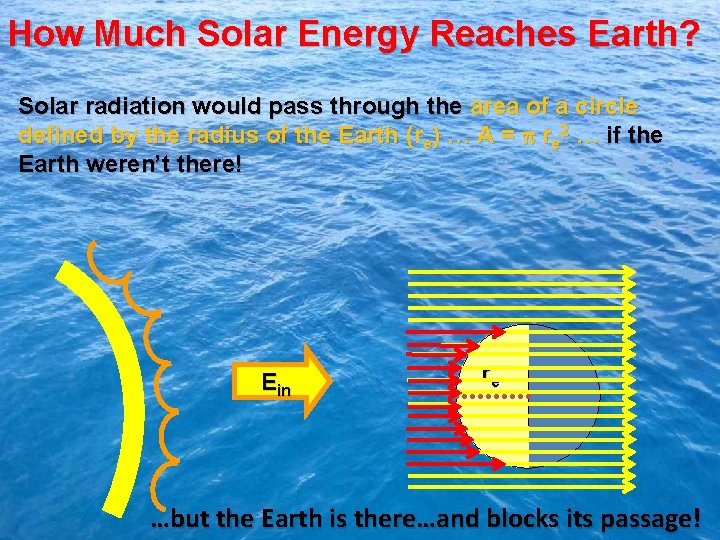
How Much Solar Energy Reaches Earth? Solar radiation would pass through the area of a circle defined by the radius of the Earth (re) … A = re 2 … if the Earth weren’t there! Ein re …but the Earth is there…and blocks its passage!
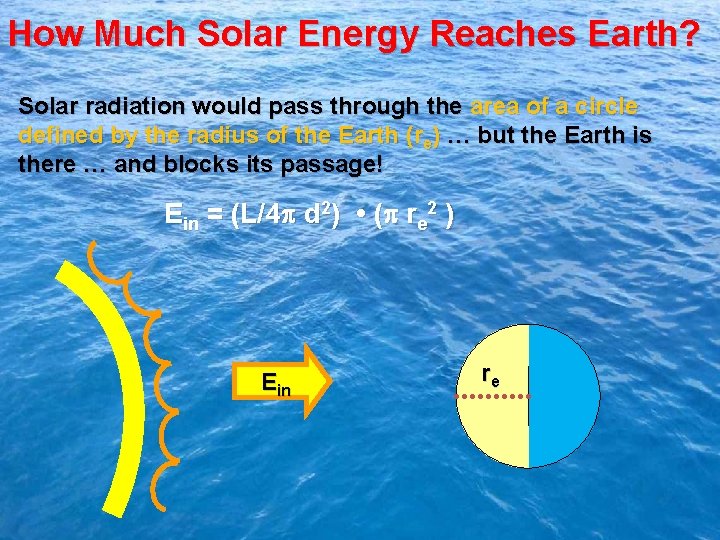
How Much Solar Energy Reaches Earth? Solar radiation would pass through the area of a circle defined by the radius of the Earth (re) … but the Earth is there … and blocks its passage! Ein = (L/4 d 2) • ( re 2 ) Ein re
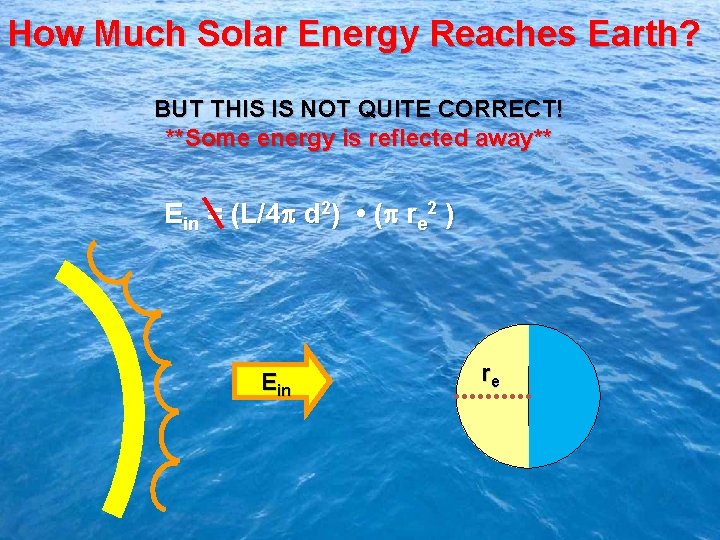
How Much Solar Energy Reaches Earth? BUT THIS IS NOT QUITE CORRECT! **Some energy is reflected away** Ein = (L/4 d 2) • ( re 2 ) Ein re
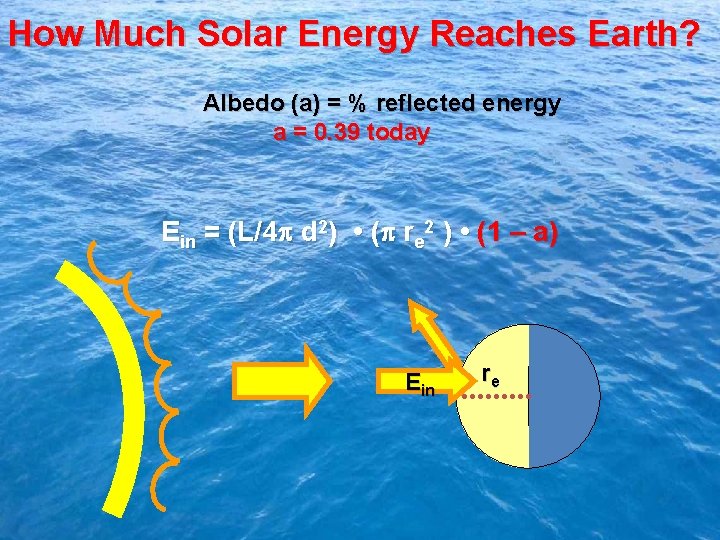
How Much Solar Energy Reaches Earth? Albedo (a) = % reflected energy a = 0. 39 today Ein = (L/4 d 2) • ( re 2 ) • (1 – a) Ein re
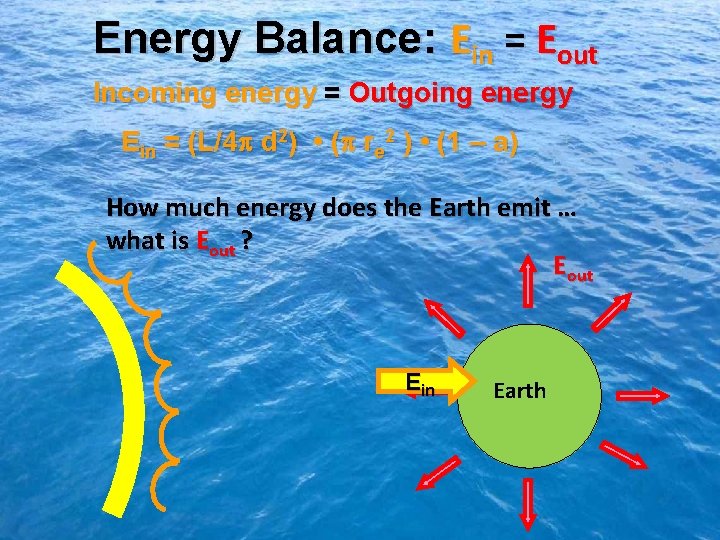
Energy Balance: Ein = Eout Incoming energy = Outgoing energy Ein = (L/4 d 2) • ( re 2 ) • (1 – a) How much energy does the Earth emit … what is Eout ? Eout Ein Earth
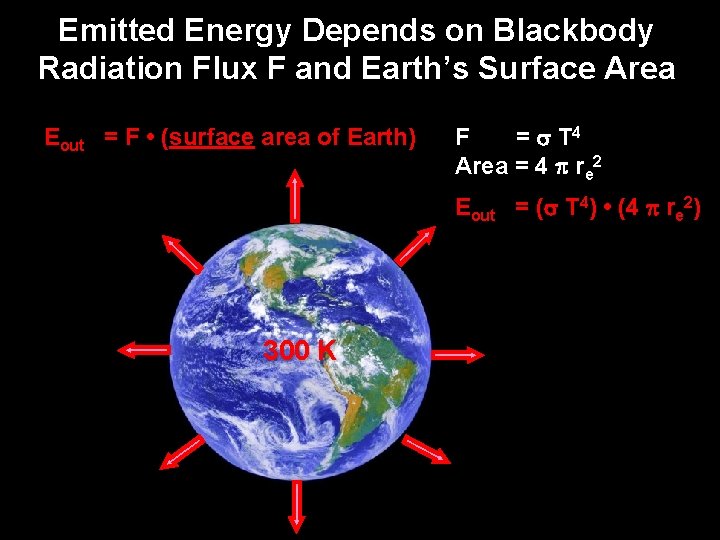
Emitted Energy Depends on Blackbody Radiation Flux F and Earth’s Surface Area Eout = F • (surface area of Earth) F = T 4 Area = 4 re 2 Eout = ( T 4) • (4 re 2) 300 K
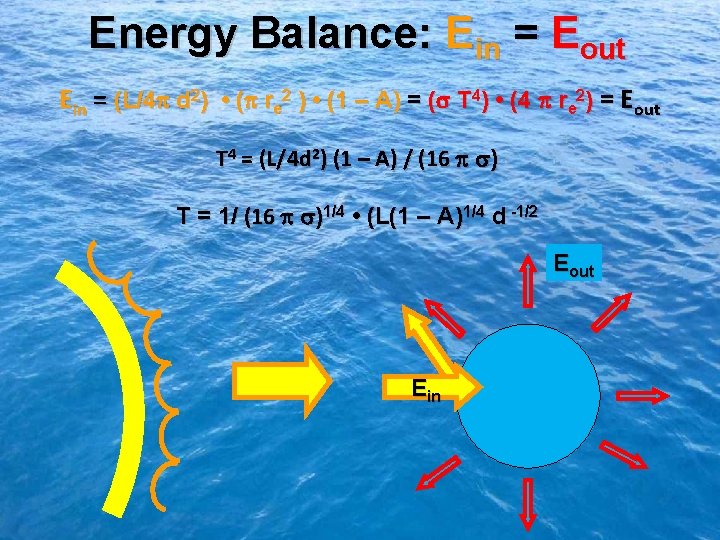
Energy Balance: Ein = Eout Ein = (L/4 d 2) • ( re 2 ) • (1 – A) = ( T 4) • (4 re 2) = Eout T 4 = (L/4 d 2) (1 – A) / (16 ) T = 1/ (16 )1/4 • (L(1 – A)1/4 d -1/2 Eout Ein
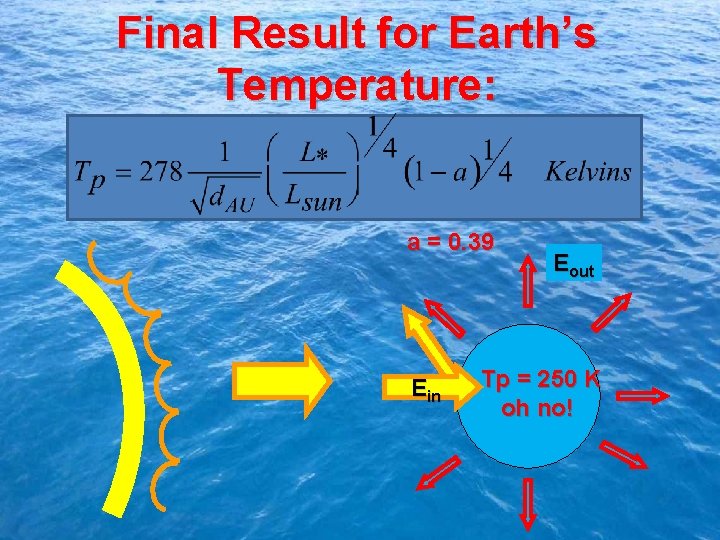
Final Result for Earth’s Temperature: a = 0. 39 Ein Eout Tp = 250 K oh no!
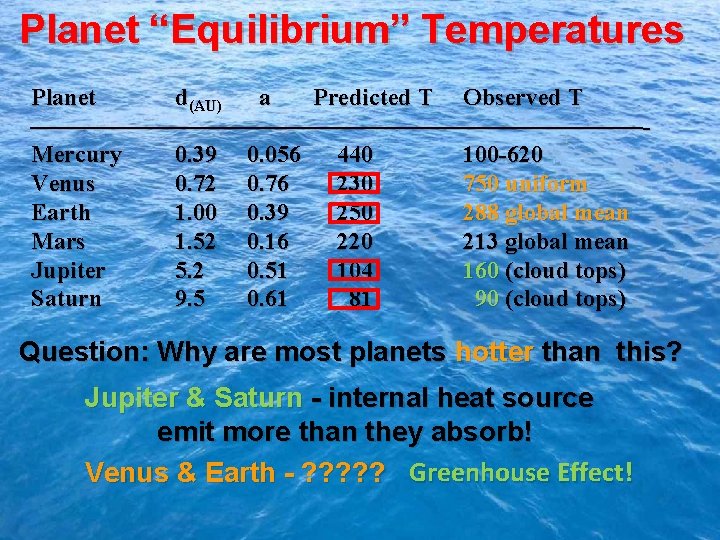
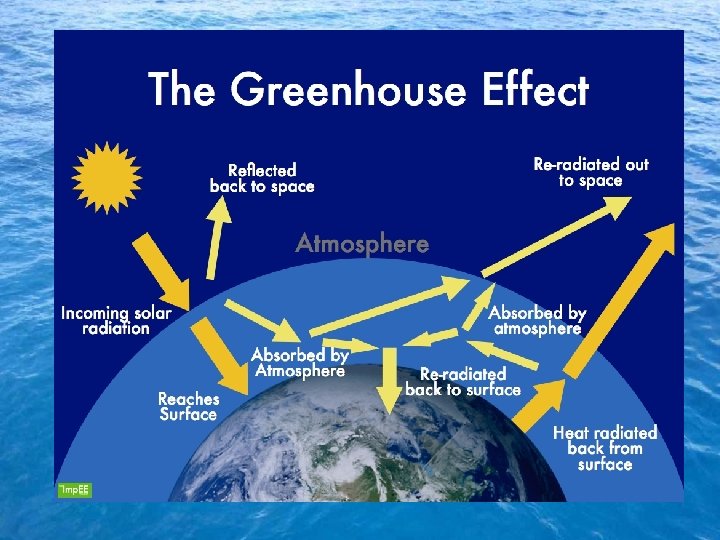
Planet “Equilibrium” Temperatures Planet d(AU) a Predicted T Observed T ––––––––––––––––––––––––––Mercury 0. 39 0. 056 440 100 -620 Venus 0. 72 0. 76 230 750 uniform Earth 1. 00 0. 39 250 288 global mean Mars 1. 52 0. 16 220 213 global mean Jupiter 5. 2 0. 51 104 160 (cloud tops) Saturn 9. 5 0. 61 81 90 (cloud tops) Question: Why are most planets hotter than this? Jupiter & Saturn - internal heat source emit more than they absorb! Venus & Earth - ? ? ? Greenhouse Effect!
Question A planet’s temperature reaches equilibrium when _______. A. people quit burning fossil fuels B. the solar energy absorbed by the planet is balanced by the total energy that it emits back into space C. all life on Earth goes extinct D. the Sun has burned all of the hydrogen in its core E. another snowball Earth episode occurs
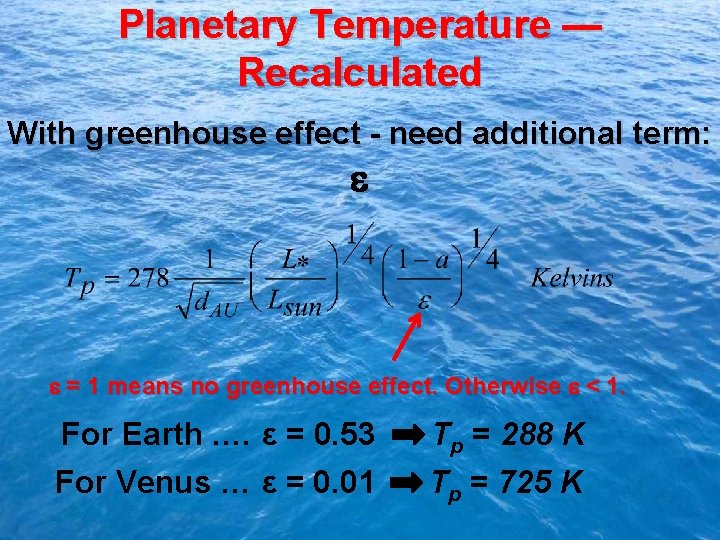
Planetary Temperature — Recalculated With greenhouse effect - need additional term: = 1 means no greenhouse effect. Otherwise < 1. For Earth. … ε = 0. 53 For Venus … ε = 0. 01 Tp = 288 K Tp = 725 K
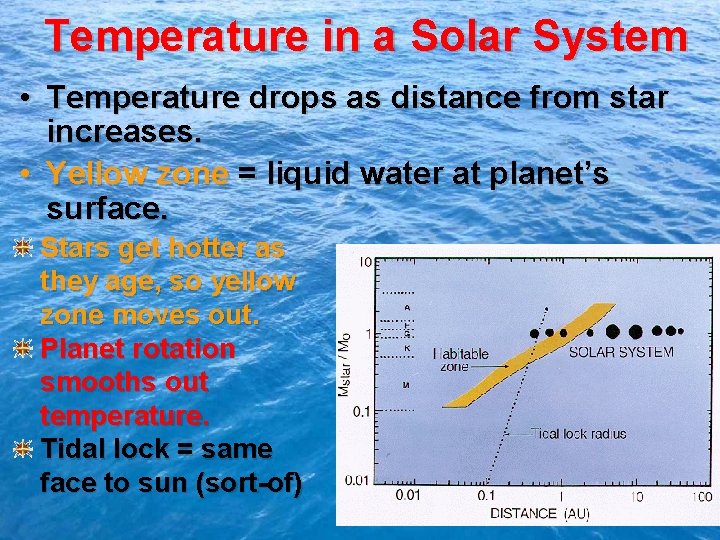
Temperature in a Solar System • Temperature drops as distance from star increases. • Yellow zone = liquid water at planet’s surface. Stars get hotter as they age, so yellow zone moves out. Planet rotation smooths out temperature. Tidal lock = same face to sun (sort-of)
The Inner Edge of the HZ • The limiting factor for the inner boundary of the HZ must be the ability of the planet to avoid a runaway greenhouse effect. • Theoretical models by James Kasting predict that an Earth-like planet would convert all its ocean into the water vapor ~0. 84 AU. • However it is likely that a planet will lose water at somewhat greater distances than that!
Moist Greenhouse Effect At 0. 95 AU, Solar Intensity is 10% greater … Ø Ø Ø Ø Higher surface temperature More H 2 O vapor in atmosphere Even higher temperatures More CO 2 in atmosphere Even higher temperatures H 2 O broken apart by UV Hydrogen escapes into space Permanent loss of water
Venus’ Fate • Venus has very high D/H ratio (~120 times higher than Earth’s) suggesting huge hydrogen loss … why? • H 2 O is lighter than ‘HDO’ and H more easily lost than D from atmosphere. • The implication is clear … Venus once had water but lost it all because of the onset of a runaway (or moist) greenhouse effect.
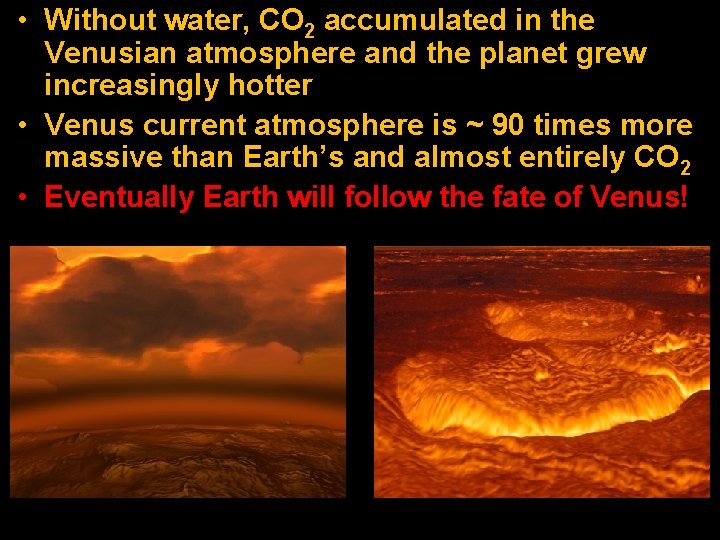
• Without water, CO 2 accumulated in the Venusian atmosphere and the planet grew increasingly hotter • Venus current atmosphere is ~ 90 times more massive than Earth’s and almost entirely CO 2 • Eventually Earth will follow the fate of Venus!
If the Earth were moved to where Venus is Question today, _______. A. the oceans would evaporate, blocking light from the Sun and causing global temperatures to fall B. carbon dioxide would be released from the oceans leading to higher temperatures but liquid water could still exist on the surface C. the oceans would evaporate slightly producing a slightly warmer, more humid planet D. dinosaurs would evolve again and take over the planet E. the oceans would evaporate and CO 2 would build up in the atmosphere triggering a runaway (or moist) greenhouse causing the temperature to rise as high as the one that exists on Venus today
The Outer Edge of the HZ • The outer edge of the HZ is the distance from the Sun at which even a strong greenhouse effect would not allow liquid water on the planetary surface. • A CO 2 cycle can extend the outer edge of the HZ somewhat by helping a planet maintain a rich CO 2 atmosphere … partially offsetting low solar luminosity.
Limit From CO 2 Greenhouse • At low solar luminosities, high CO 2 abundance required to keep planet warm. • But high CO 2 abundance does not produce as much net warming because it also scatters solar radiation. • Theoretical models predict that no matter how high CO 2 abundance is in atmosphere, the temperature would not exceed the freezing point of water if a planet is further than 1. 7 A. U.
Limit From CO 2 Condensation … A problem at high CO 2 abundances and low temperatures • CO 2 can start to condense out (like water condenses into rain and snow) • Atmosphere would not be able to build CO 2 if a planet is further than 1. 4 A. U.
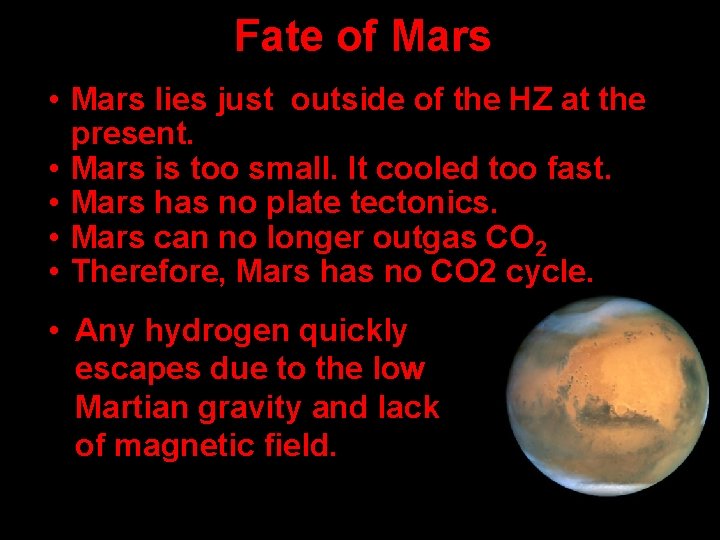
Fate of Mars • Mars lies just outside of the HZ at the present. • Mars is too small. It cooled too fast. • Mars has no plate tectonics. • Mars can no longer outgas CO 2 • Therefore, Mars has no CO 2 cycle. • Any hydrogen quickly escapes due to the low Martian gravity and lack of magnetic field.
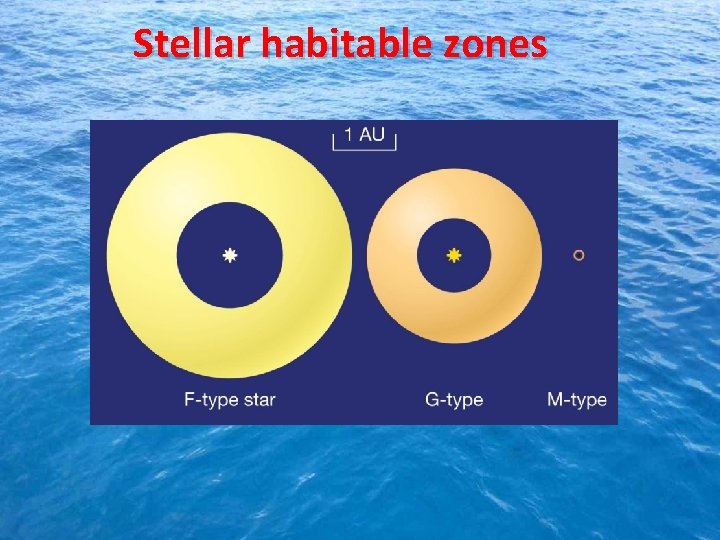
Stellar habitable zones
Question The habitable zone is the area where A. temperatures on a planet are reasonable. B. terrestrial planets can form around a star. C. terrestrial planets could have liquid water on their surfaces. D. liquid water can condense into rain in the atmosphere. E. Sun-like stars can exist in the Milky Way Galaxy.
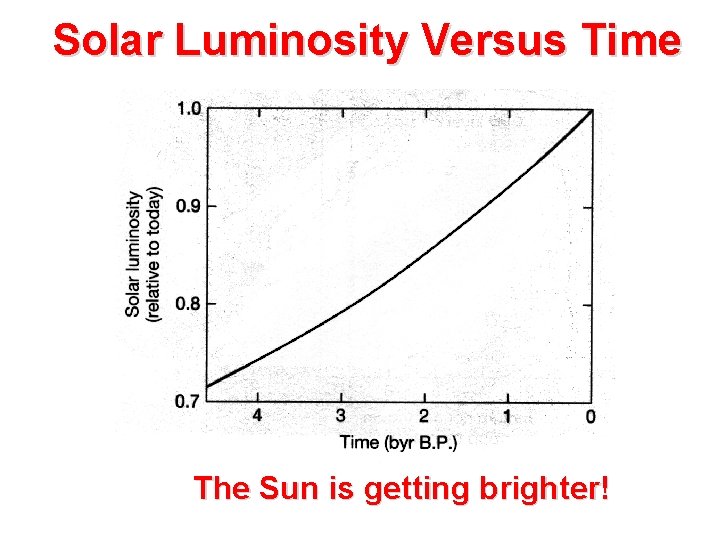
Solar Luminosity Versus Time The Sun is getting brighter!
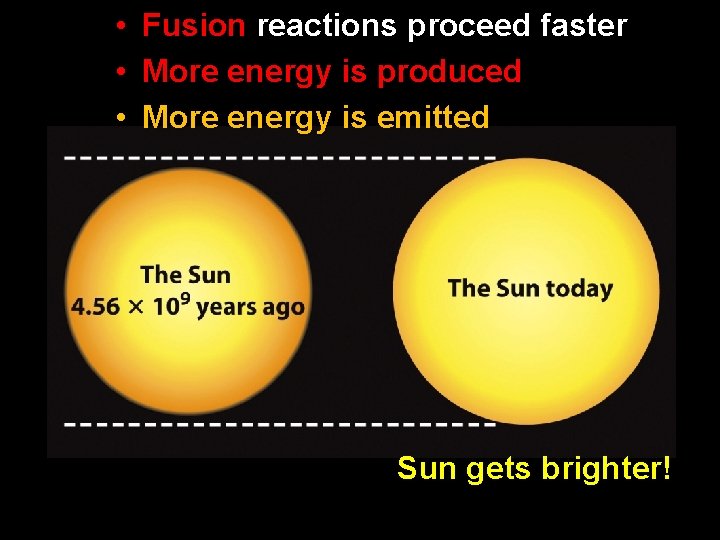
• Fusion reactions proceed faster • More energy is produced • More energy is emitted Sun gets brighter!
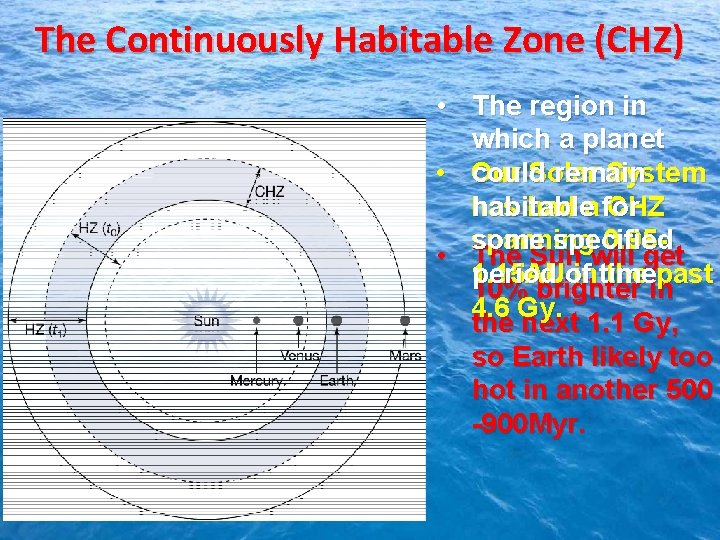
The Continuously Habitable Zone (CHZ) • The region in which a planet could remain • Our Solar System habitable has had a for CHZ some specified spanning 0. 95 • The Sun will get period of 1. 15 AU in time the past 10% brighter in 4. 6 Gy. the next 1. 1 Gy, so Earth likely too hot in another 500 -900 Myr.
Question Compared to today, a billion years in the future, the Sun’s habitable zone will be _____. A. B. C. D. E. wider and closer to the Sun narrower and farther from the Sun wider and farther from the Sun rapidly approaching the star Alpha Centauri

CONTINUOUS HABITABLE ZONES Hart (1978 Icarus, 33, 23 -39) Included the following processes: The criteria assumed for life to arise: Rate of outgassing of volatiles (H, C, N, O) Condensation of H 2 O vapor into oceans Atmospheric gases soluble in oceans UV breakup of H 2 O in the upper atmosphere and escape of H Chemical reactions in atmospheric gases Presence of life and variations in biomass Photosynthesis and burial of organic sediments Urey reaction (Ca. Si. O 3 + CO 2 Ca. CO 3 + Si. O 2) Oxidation of surface minerals (2 Fe. O+O Fe 2 O 3) Variations in the luminosity of the Sun Variations in the albedo of the Earth Greenhouse effect Liquid water @ T < 42 C for 0. 8 Gyr Concurrent presence of C and N in atmosphere and oceans Absence of free O in atmosphere Starting conditions: No atmosphere Albedo (reflectivity) = 0. 15 (rock) Start 4. 5 Gyr ago Calculation process: Using time steps of 2. 5 Myr, vary the composition of juvenile volatiles until the best fit to present conditions is reached.
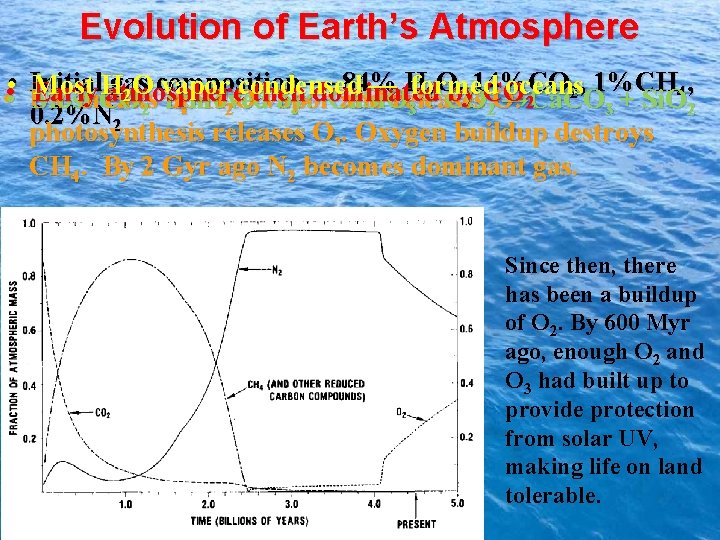
Evolution of Earth’s Atmosphere • • Initial gas composition — 84% H 14%CO Most H O vapor condensed — formed oceans 2 O, 2, 1%CH 4, 2 Early atmosphere then dominated by CO Most CO 2 removed by: Ca. Si. O → 2 Ca. CO 3 + Si. O 2 UV breaks up H 2 O vapor and releases 3 + CO 2 O: 0. 2%N 2 photosynthesis releases O, . Oxygen buildup destroys CH 4. By 2 Gyr ago N 2 becomes dominant gas. Since then, there has been a buildup of O 2. By 600 Myr ago, enough O 2 and O 3 had built up to provide protection from solar UV, making life on land tolerable.
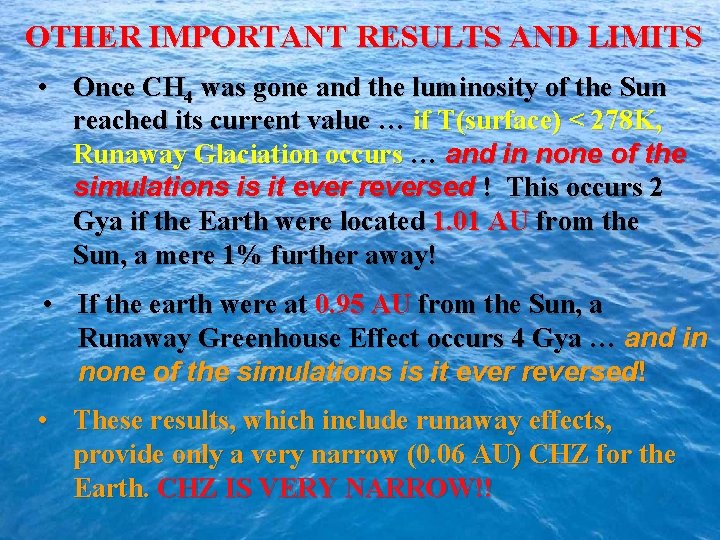
OTHER IMPORTANT RESULTS AND LIMITS • Once CH 4 was gone and the luminosity of the Sun reached its current value … if T(surface) < 278 K, Runaway Glaciation occurs … and in none of the simulations is it ever reversed ! This occurs 2 Gya if the Earth were located 1. 01 AU from the Sun, a mere 1% further away! • If the earth were at 0. 95 AU from the Sun, a Runaway Greenhouse Effect occurs 4 Gya … and in none of the simulations is it ever reversed! • These results, which include runaway effects, provide only a very narrow (0. 06 AU) CHZ for the Earth. CHZ IS VERY NARROW!!
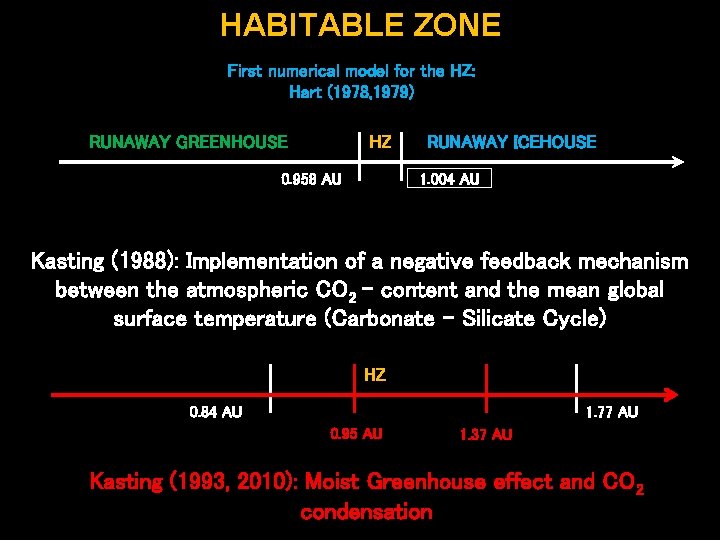
HABITABLE ZONE First numerical model for the HZ: Hart (1978, 1979) RUNAWAY GREENHOUSE HZ 0. 958 AU RUNAWAY ICEHOUSE 1. 004 AU Kasting (1988): Implementation of a negative feedback mechanism between the atmospheric CO 2 - content and the mean global surface temperature (Carbonate – Silicate Cycle) HZ 0. 84 AU 1. 77 AU 0. 95 AU 1. 37 AU Kasting (1993, 2010): Moist Greenhouse effect and CO 2 condensation
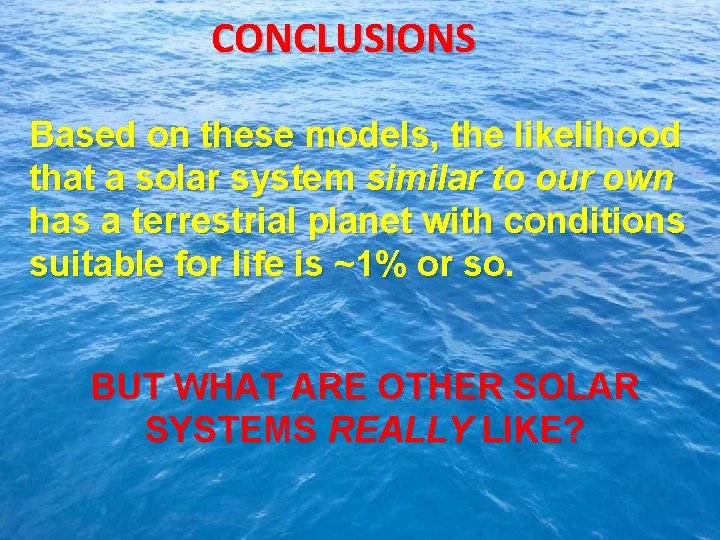
CONCLUSIONS Based on these models, the likelihood that a solar system similar to our own has a terrestrial planet with conditions suitable for life is ~1% or so. BUT WHAT ARE OTHER SOLAR SYSTEMS REALLY LIKE?
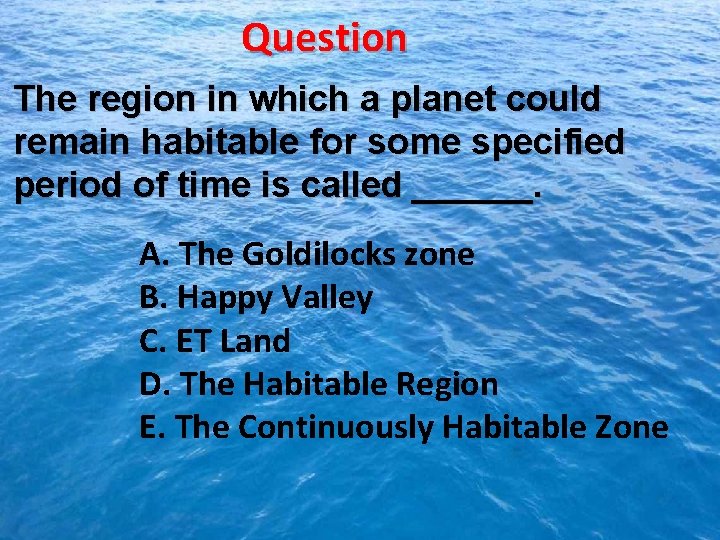
Question The region in which a planet could remain habitable for some specified period of time is called ______. A. The Goldilocks zone B. Happy Valley C. ET Land D. The Habitable Region E. The Continuously Habitable Zone
- Slides: 58