
THE GROWTH of GEORGIA 1789 1840 After the

- Slides: 46
THE GROWTH of GEORGIA (1789 -1840)
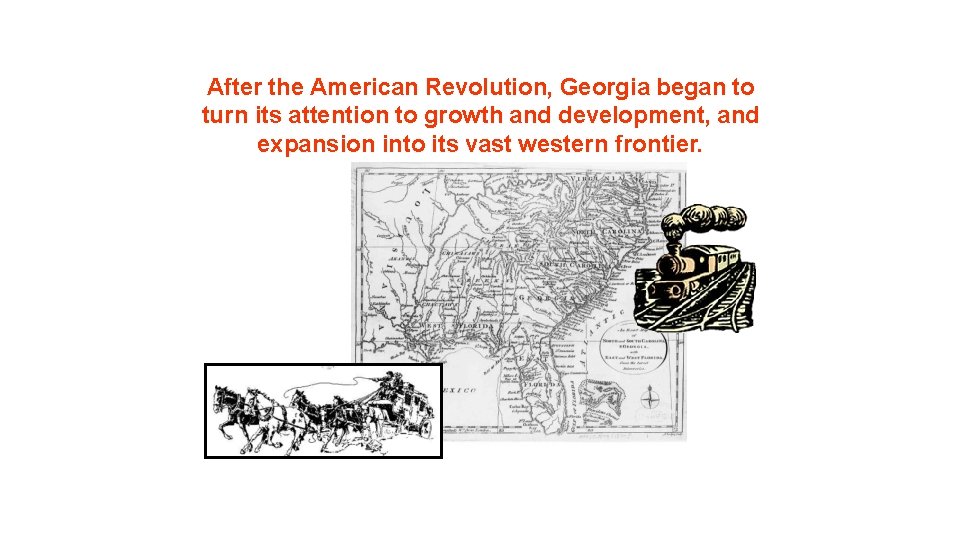
After the American Revolution, Georgia began to turn its attention to growth and development, and expansion into its vast western frontier.
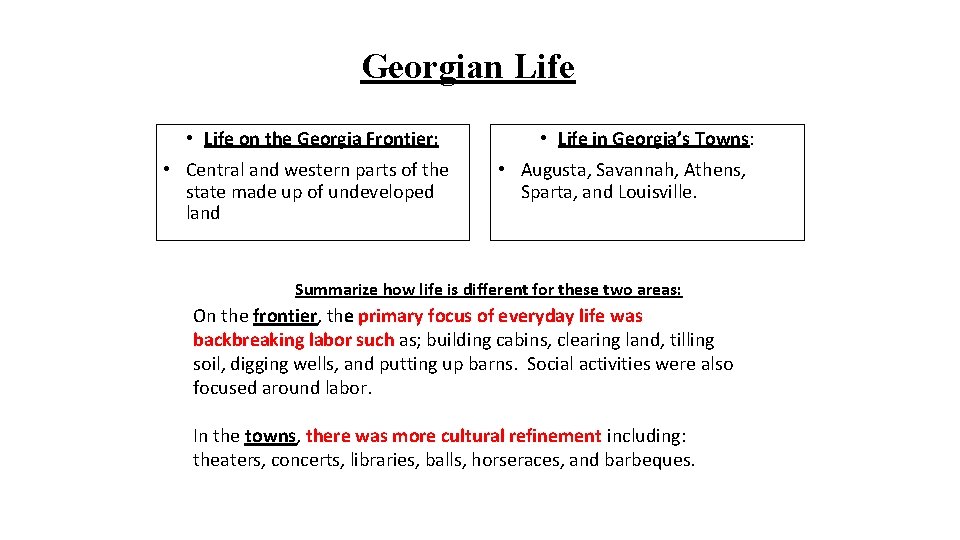
Georgian Life • Life on the Georgia Frontier: • Central and western parts of the state made up of undeveloped land • Life in Georgia’s Towns: • Augusta, Savannah, Athens, Sparta, and Louisville. Summarize how life is different for these two areas: On the frontier, the primary focus of everyday life was backbreaking labor such as; building cabins, clearing land, tilling soil, digging wells, and putting up barns. Social activities were also focused around labor. In the towns, there was more cultural refinement including: theaters, concerts, libraries, balls, horseraces, and barbeques.
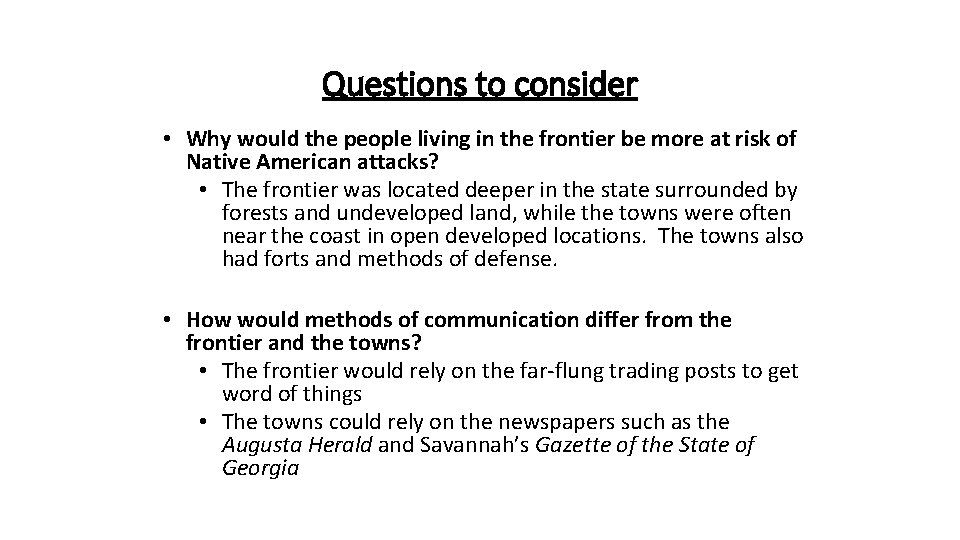
Questions to consider • Why would the people living in the frontier be more at risk of Native American attacks? • The frontier was located deeper in the state surrounded by forests and undeveloped land, while the towns were often near the coast in open developed locations. The towns also had forts and methods of defense. • How would methods of communication differ from the frontier and the towns? • The frontier would rely on the far-flung trading posts to get word of things • The towns could rely on the newspapers such as the Augusta Herald and Savannah’s Gazette of the State of Georgia
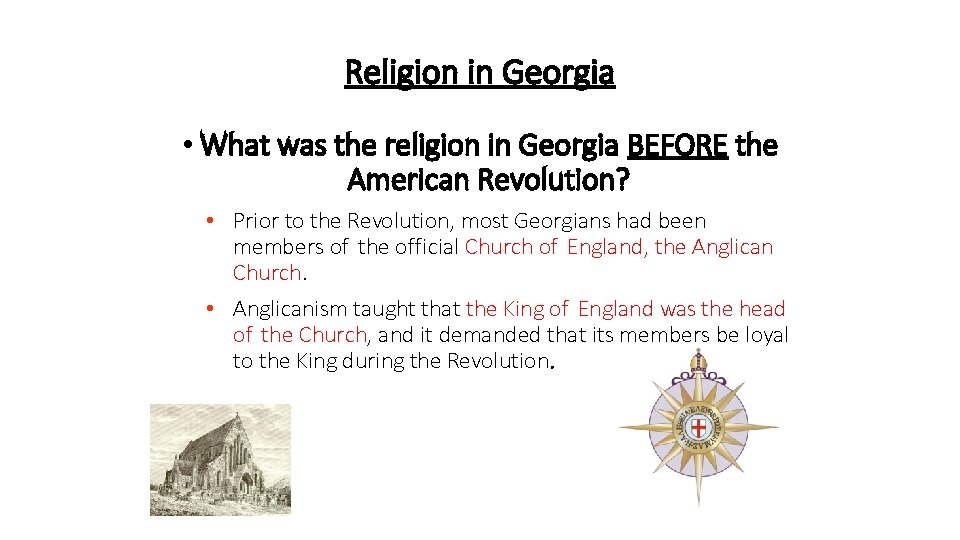
Religion in Georgia • What was the religion in Georgia BEFORE the American Revolution? • Prior to the Revolution, most Georgians had been members of the official Church of England, the Anglican Church. • Anglicanism taught that the King of England was the head of the Church, and it demanded that its members be loyal to the King during the Revolution.
Religion in Georgia • What was the religion in Georgia DURING and After the American Revolution? • Anglican priests identified with the Tories and, so they left or were forced to leave GA by Whigs. • Anglicans who did not support the King left the Church and England joined the Methodist Church, led by John Wesley and George Whitefield. • The Revolutionary War nearly destroyed what remained of organized religion in Georgia, as many churches were damaged or destroyed.
Spread of Religion in Georgia • Two largest denomination are Baptist and Methodist. • What is The Second Great Awakening: • A protestant revival period from 1790 – 1830 where Georgians began to identify with a denomination.
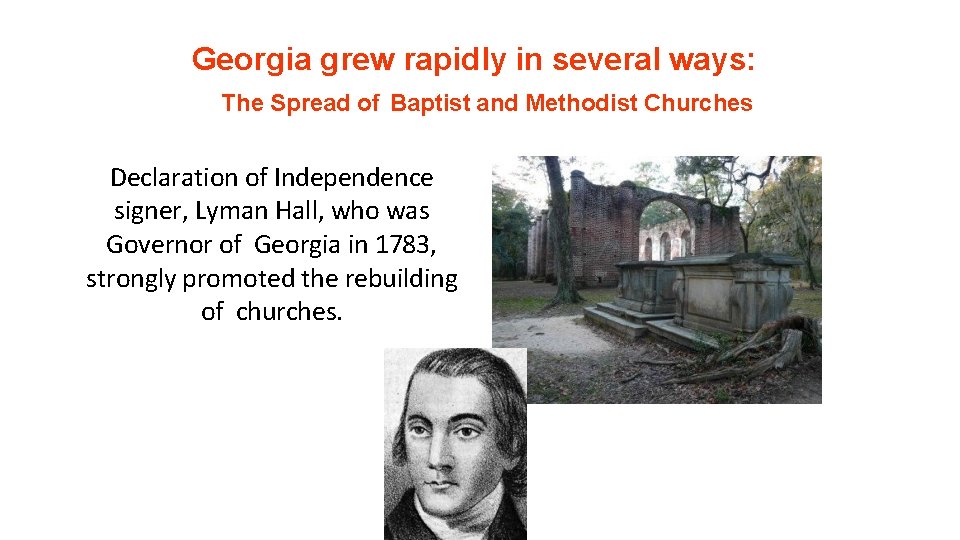
Georgia grew rapidly in several ways: The Spread of Baptist and Methodist Churches Declaration of Independence signer, Lyman Hall, who was Governor of Georgia in 1783, strongly promoted the rebuilding of churches.
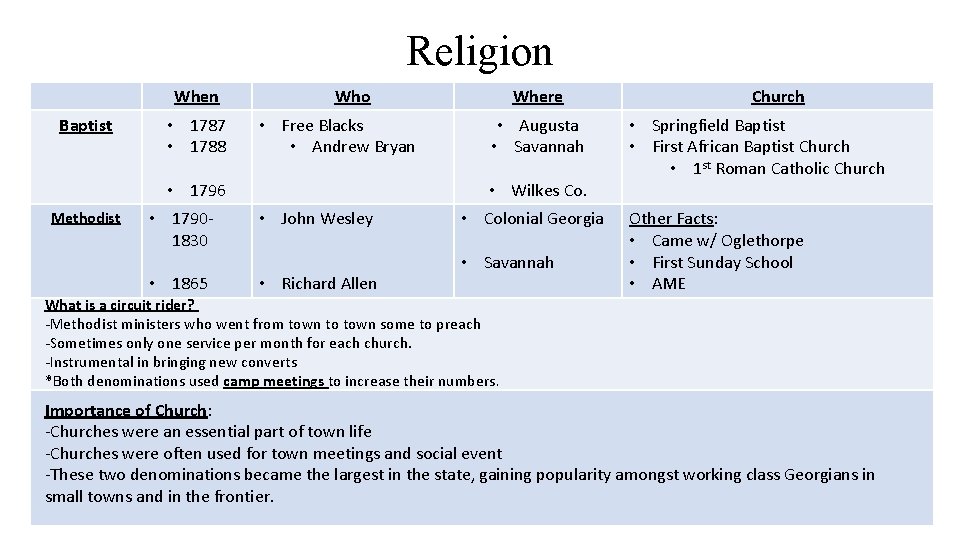
Religion When Baptist • 1787 • 1788 Who • Free Blacks • Andrew Bryan • 1796 Methodist Where • Augusta • Savannah • Wilkes Co. • 17901830 • John Wesley • 1865 • Richard Allen • Colonial Georgia • Savannah Church • Springfield Baptist • First African Baptist Church • 1 st Roman Catholic Church Other Facts: • Came w/ Oglethorpe • First Sunday School • AME What is a circuit rider? -Methodist ministers who went from town to town some to preach -Sometimes only one service per month for each church. -Instrumental in bringing new converts *Both denominations used camp meetings to increase their numbers. Importance of Church: -Churches were an essential part of town life -Churches were often used for town meetings and social event -These two denominations became the largest in the state, gaining popularity amongst working class Georgians in small towns and in the frontier.
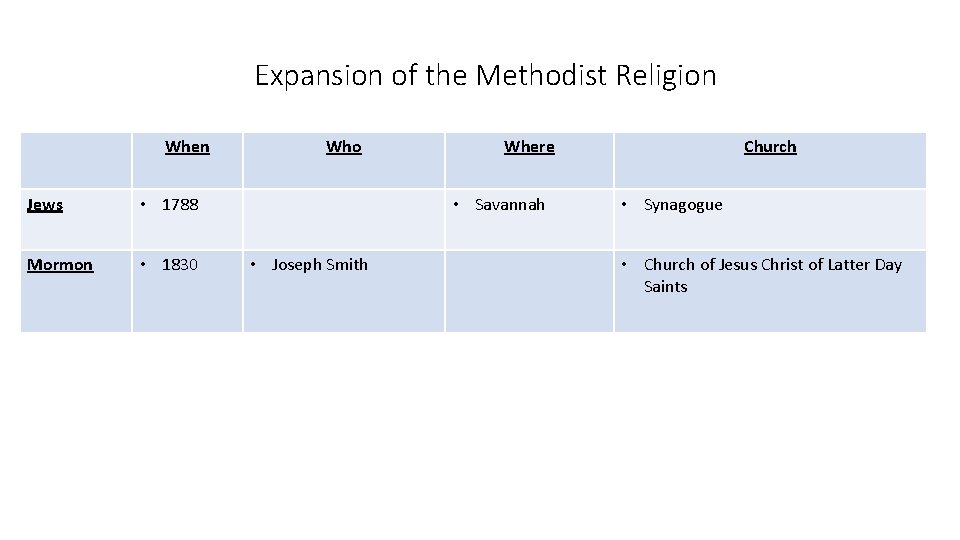
Expansion of the Methodist Religion When Jews • 1788 Mormon • 1830 Who Where • Savannah • Joseph Smith Church • Synagogue • Church of Jesus Christ of Latter Day Saints
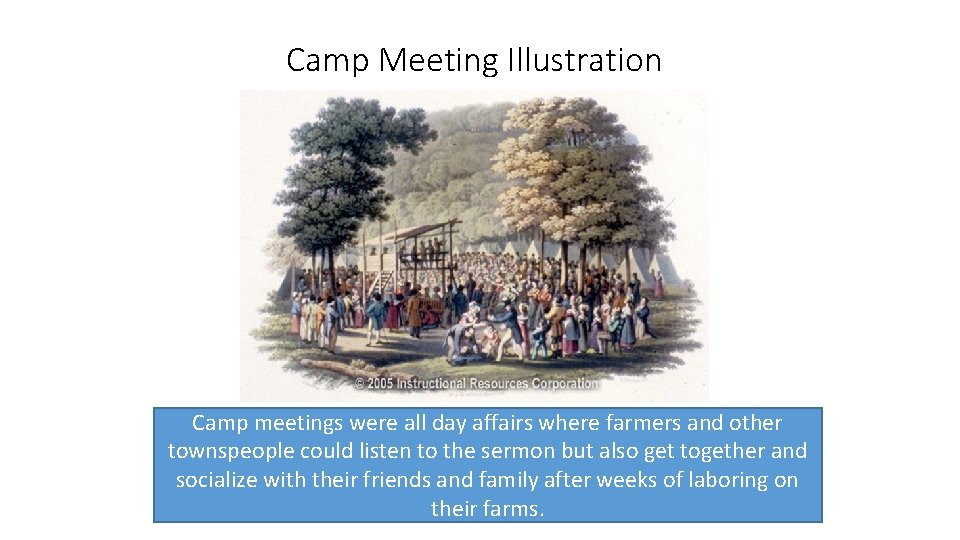
Camp Meeting Illustration Camp meetings were all day affairs where farmers and other townspeople could listen to the sermon but also get together and socialize with their friends and family after weeks of laboring on their farms.
Education in Georgia • Describe the education of most in the early years. • Most received a few years of elementary school • Farmers knew little about reading and math • Most did not attend school at all
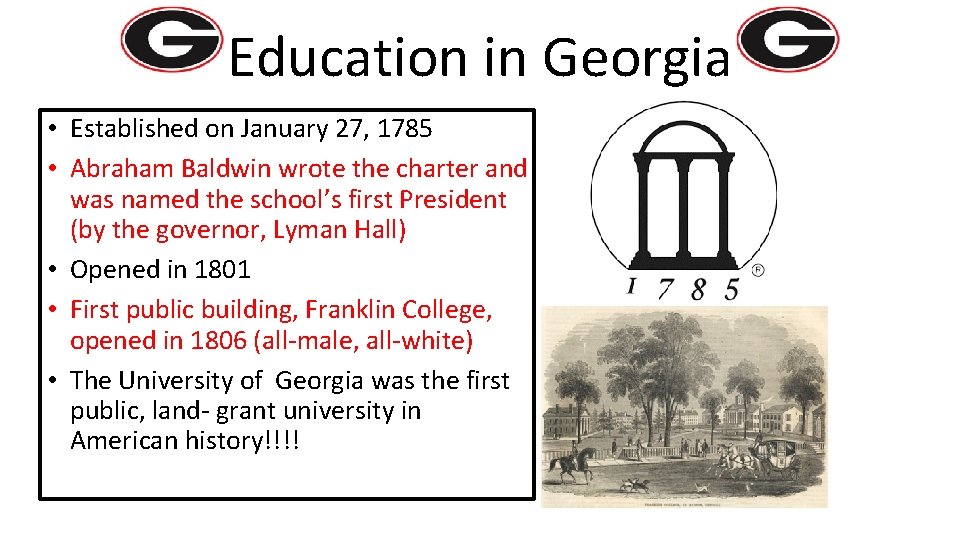
Education in Georgia • Established on January 27, 1785 • Abraham Baldwin wrote the charter and was named the school’s first President (by the governor, Lyman Hall) • Opened in 1801 • First public building, Franklin College, opened in 1806 (all-male, all-white) • The University of Georgia was the first public, land- grant university in American history!!!!
Educational Differences Males: • • Greek Latin Grammar Math Females: • Wesleyan College, 1836 in Macon • French • Literature • Science • Piano, arts and foreign language • Many girls were not sent to school, instead they learned sewing, cooking and childcare. Video Link
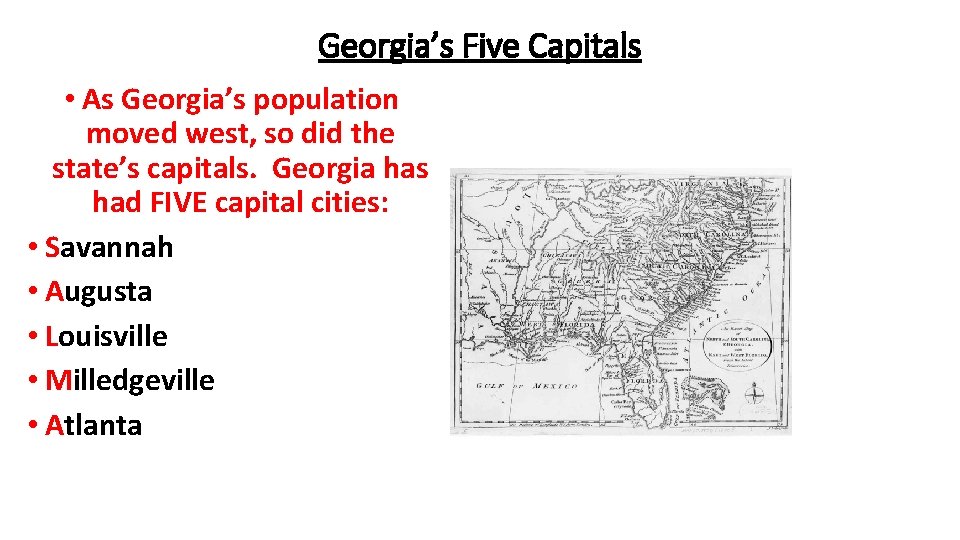
Georgia’s Five Capitals • As Georgia’s population moved west, so did the state’s capitals. Georgia has had FIVE capital cities: • Savannah • Augusta • Louisville • Milledgeville • Atlanta
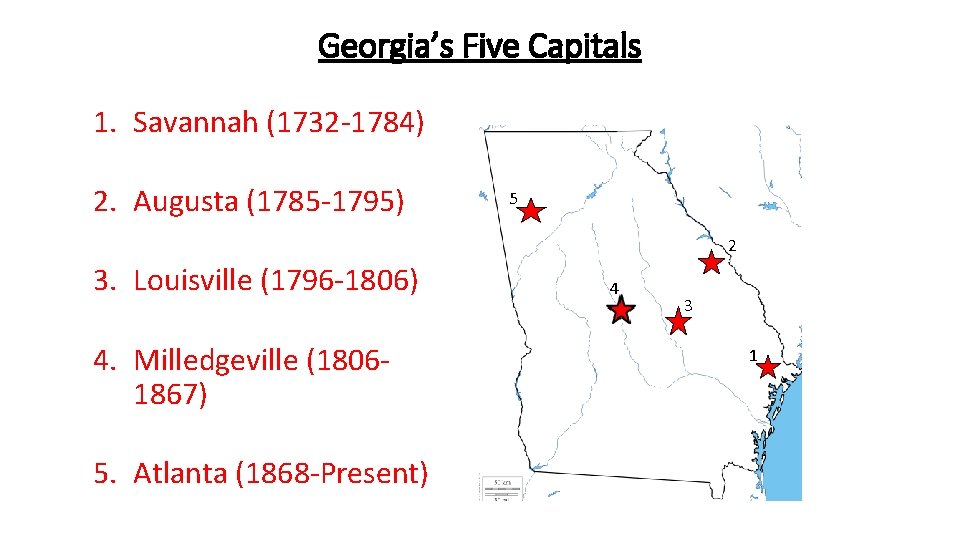
Georgia’s Five Capitals 1. Savannah (1732 -1784) 2. Augusta (1785 -1795) 5 2 3. Louisville (1796 -1806) 4. Milledgeville (18061867) 5. Atlanta (1868 -Present) 4 3 1
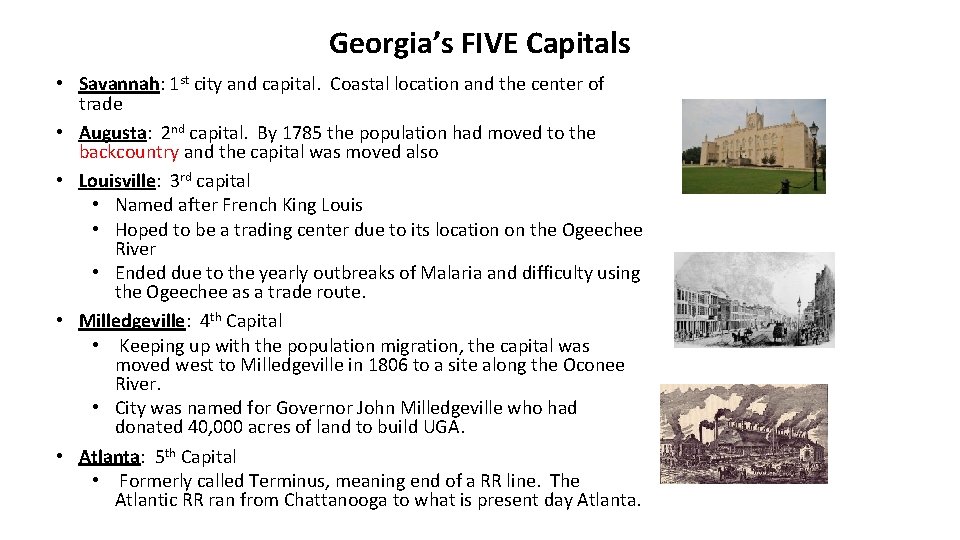
Georgia’s FIVE Capitals • Savannah: 1 st city and capital. Coastal location and the center of trade • Augusta: 2 nd capital. By 1785 the population had moved to the backcountry and the capital was moved also • Louisville: 3 rd capital • Named after French King Louis • Hoped to be a trading center due to its location on the Ogeechee River • Ended due to the yearly outbreaks of Malaria and difficulty using the Ogeechee as a trade route. • Milledgeville: 4 th Capital • Keeping up with the population migration, the capital was moved west to Milledgeville in 1806 to a site along the Oconee River. • City was named for Governor John Milledgeville who had donated 40, 000 acres of land to build UGA. • Atlanta: 5 th Capital • Formerly called Terminus, meaning end of a RR line. The Atlantic RR ran from Chattanooga to what is present day Atlanta.
What do you remember about… the growth of Georgia? ? ? University of Georgia 1. The first public, land-grant institution of higher learning in U. S. history was. Augusta 2. Georgia’s second capital city was . Louisville 3. Georgia’s third capital city, named after the King of France, was. Abraham Baldwin 4. The author of the charter for the University of Georgia was . England 5. Prior to the Revolution, most Georgians were members of the Church of Baptist Methodist 6. The two largest denominations in Georgia are the and the Lyman Hall 7. The governor who encouraged the rebuilding of churches was . . .
Education in Georgia • Describe the education of most in the early years. • Some received a few years of elementary school • Farmers knew little about reading and math • Most did not attend school at all
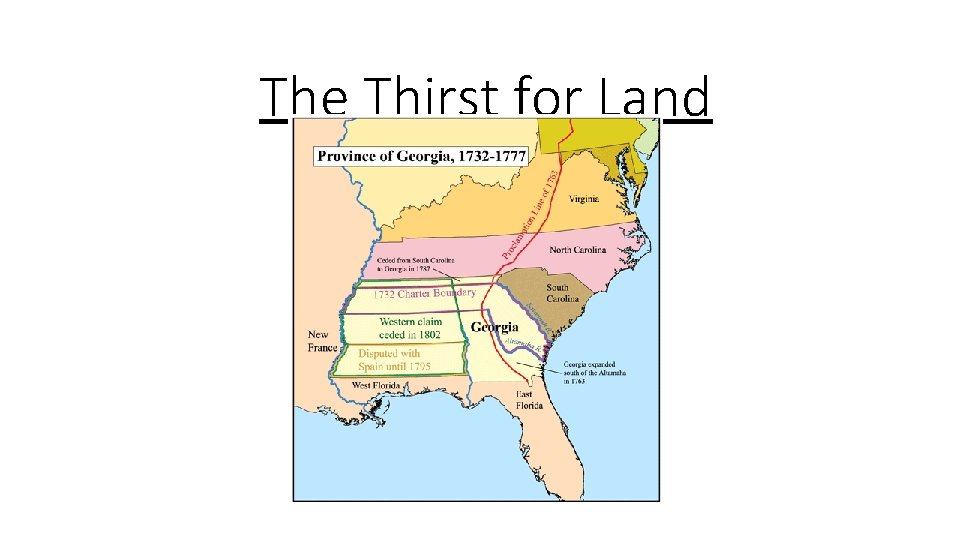
The Thirst for Land
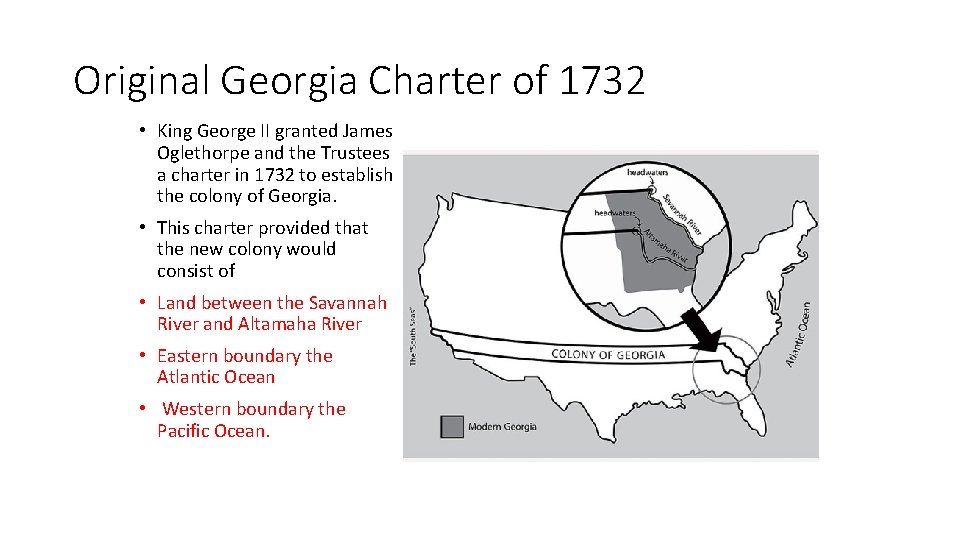
Original Georgia Charter of 1732 • King George II granted James Oglethorpe and the Trustees a charter in 1732 to establish the colony of Georgia. • This charter provided that the new colony would consist of • Land between the Savannah River and Altamaha River • Eastern boundary the Atlantic Ocean • Western boundary the Pacific Ocean.
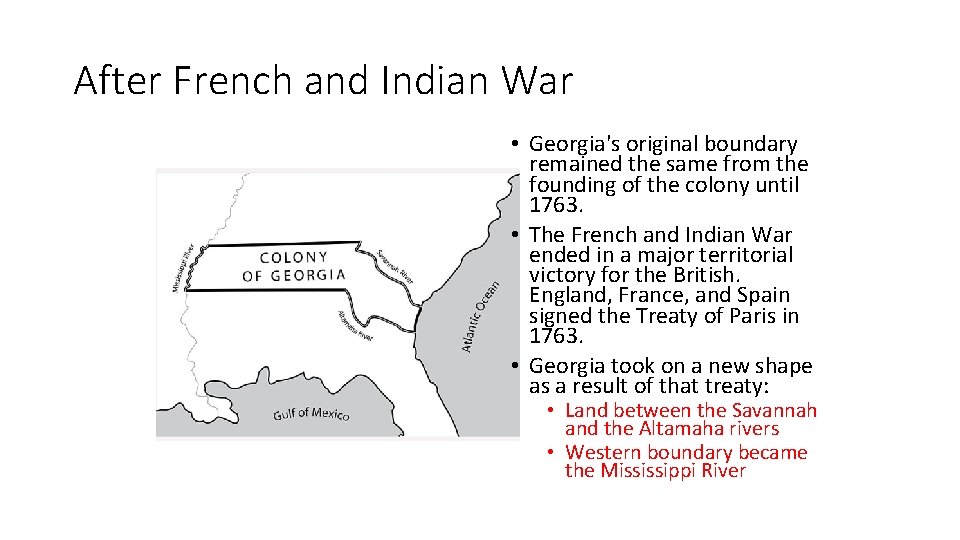
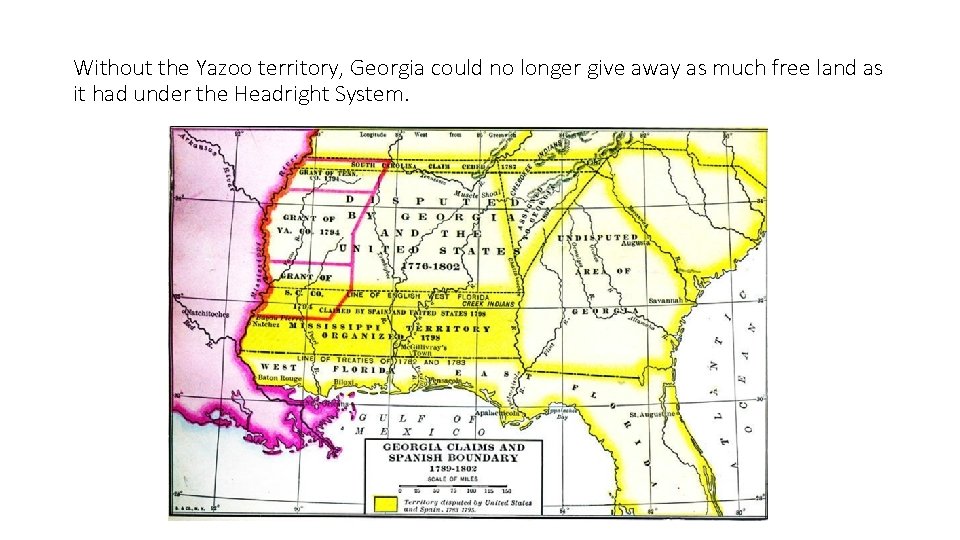
After French and Indian War • Georgia's original boundary remained the same from the founding of the colony until 1763. • The French and Indian War ended in a major territorial victory for the British. England, France, and Spain signed the Treaty of Paris in 1763. • Georgia took on a new shape as a result of that treaty: • Land between the Savannah and the Altamaha rivers • Western boundary became the Mississippi River
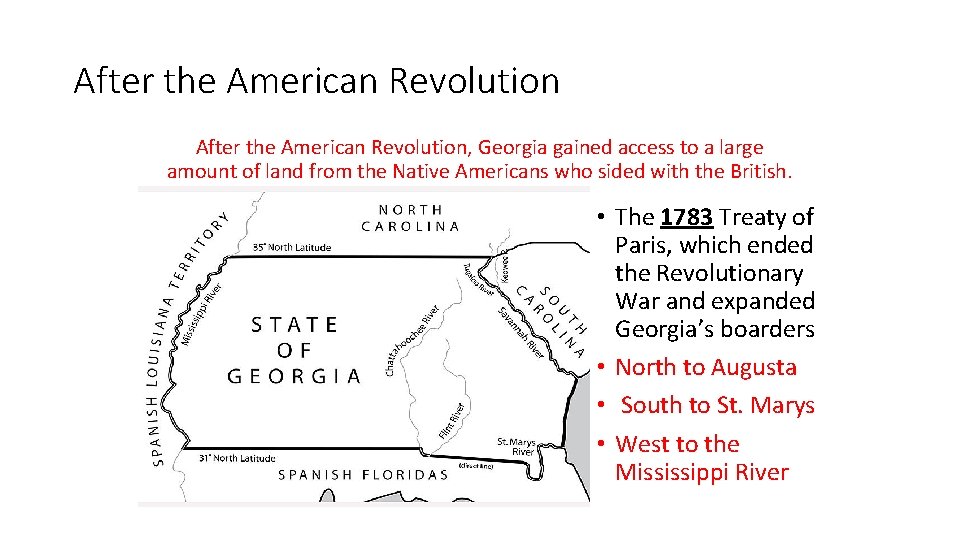
After the American Revolution, Georgia gained access to a large amount of land from the Native Americans who sided with the British. • The 1783 Treaty of Paris, which ended the Revolutionary War and expanded Georgia’s boarders • North to Augusta • South to St. Marys • West to the Mississippi River
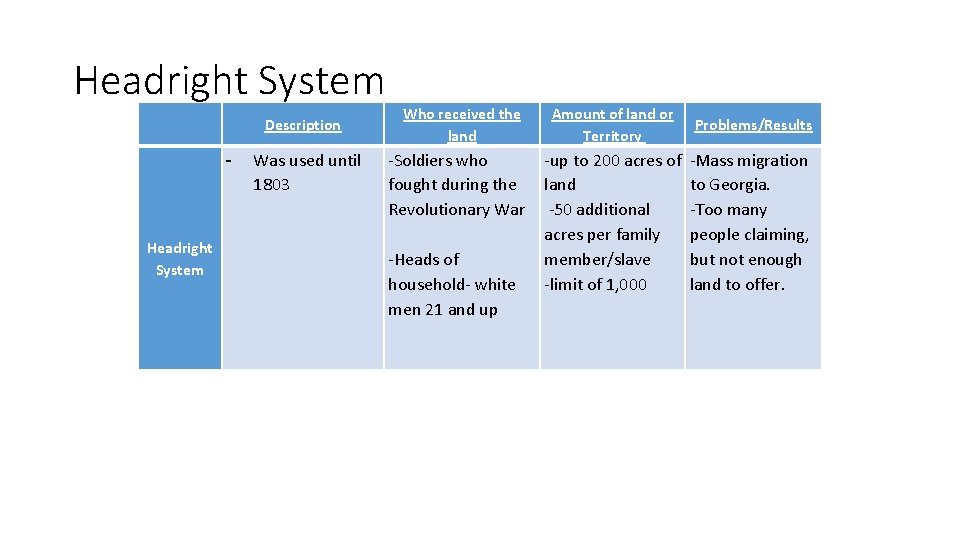
Headright System (until 1803) • Under this system, Georgia gave thousands of acres of land to soldiers who fought during the Revolutionary War (including Austin Dabney) • Men who did not fight also received free land. The Details: • Heads of households, white men 21 and up, could receive up to 200 acres of land • Men who had families or slaves would receive an additional 50 acres per family member (slaves included) with a limit of 1, 000 acres causing a massive migration to Georgia. The problem: • too many people claiming, but not enough land to offer.
Headright System Description - Headright System Was used until 1803 Who received the land -Soldiers who fought during the Revolutionary War -Heads of household- white men 21 and up Amount of land or Territory Problems/Results -up to 200 acres of -Mass migration land to Georgia. -50 additional -Too many acres per family people claiming, member/slave but not enough -limit of 1, 000 land to offer.
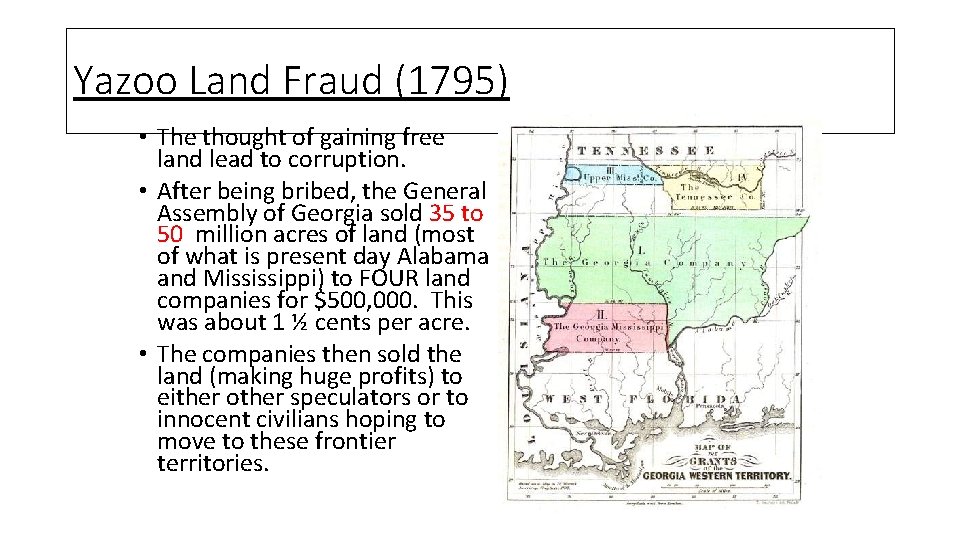
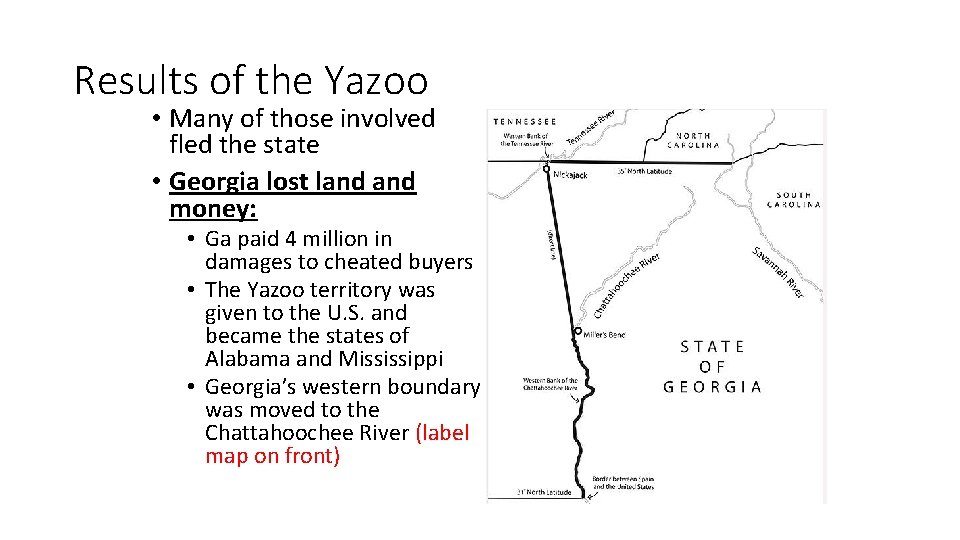
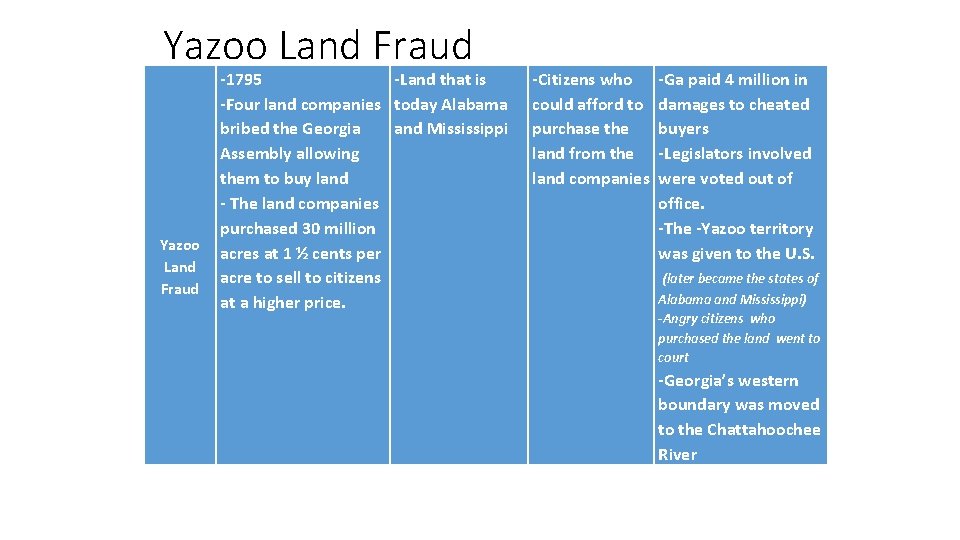
Yazoo Land Fraud (1795) • The thought of gaining free land lead to corruption. • After being bribed, the General Assembly of Georgia sold 35 to 50 million acres of land (most of what is present day Alabama and Mississippi) to FOUR land companies for $500, 000. This was about 1 ½ cents per acre. • The companies then sold the land (making huge profits) to either other speculators or to innocent civilians hoping to move to these frontier territories.
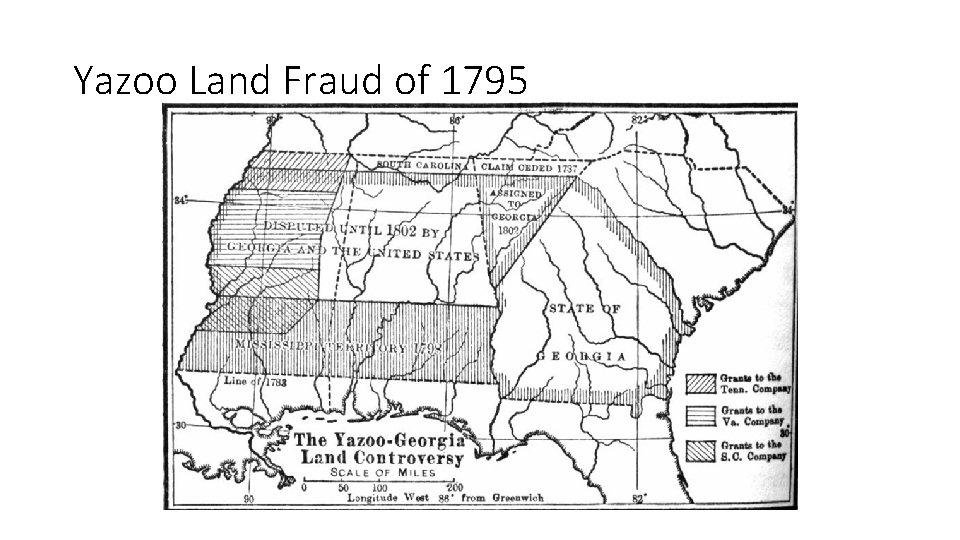
Yazoo Land Fraud of 1795
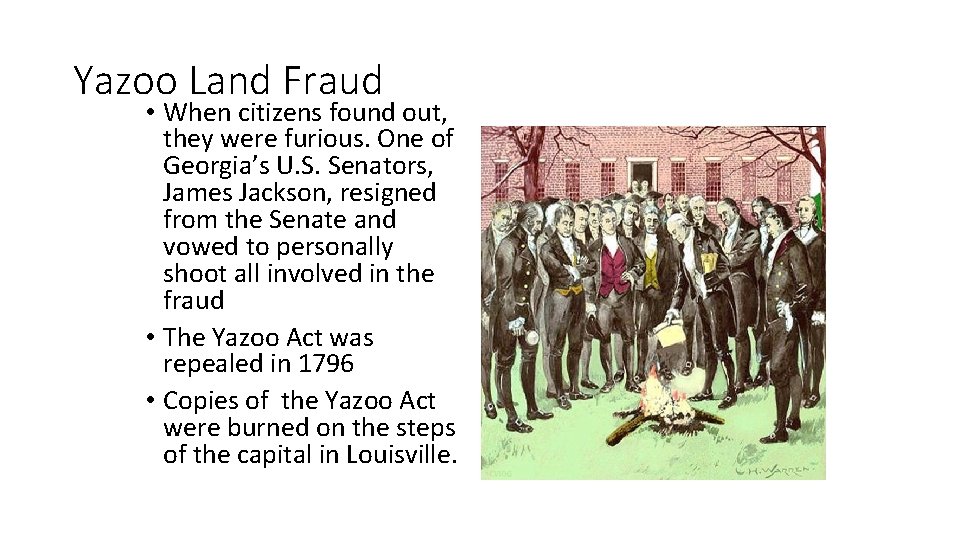
Yazoo Land Fraud • When citizens found out, they were furious. One of Georgia’s U. S. Senators, James Jackson, resigned from the Senate and vowed to personally shoot all involved in the fraud • The Yazoo Act was repealed in 1796 • Copies of the Yazoo Act were burned on the steps of the capital in Louisville.
Results of the Yazoo • Many of those involved fled the state • Georgia lost land money: • Ga paid 4 million in damages to cheated buyers • The Yazoo territory was given to the U. S. and became the states of Alabama and Mississippi • Georgia’s western boundary was moved to the Chattahoochee River (label map on front)
Yazoo Land Fraud -1795 -Land that is -Four land companies today Alabama bribed the Georgia and Mississippi Assembly allowing them to buy land - The land companies purchased 30 million Yazoo acres at 1 ½ cents per Land acre to sell to citizens Fraud at a higher price. -Citizens who -Ga paid 4 million in could afford to damages to cheated purchase the buyers land from the -Legislators involved land companies were voted out of office. -The -Yazoo territory was given to the U. S. (later became the states of Alabama and Mississippi) -Angry citizens who purchased the land went to court -Georgia’s western boundary was moved to the Chattahoochee River
Without the Yazoo territory, Georgia could no longer give away as much free land as it had under the Headright System.
Land Lottery 1805 - 1833 • Eight land lotteries were held • These lotteries gave white males 21 or older the opportunity to gain land for pennies on the dollar • HEAD OF HOUSEHOLD WITH CHILDREN • WAR VETERANS • WIDOWS • Land won in the lottery varied in size from 500 to 50 acres (much smaller than the 1000 acres in the Headright System) Who was allowed to participate: • All free white men living in Georgia for one year were given one chance.
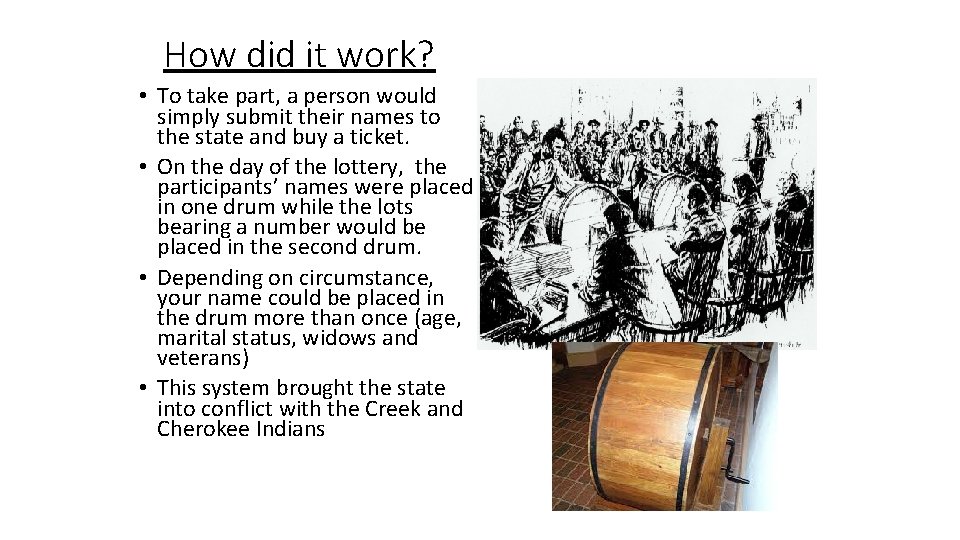
How did it work? • To take part, a person would simply submit their names to the state and buy a ticket. • On the day of the lottery, the participants’ names were placed in one drum while the lots bearing a number would be placed in the second drum. • Depending on circumstance, your name could be placed in the drum more than once (age, marital status, widows and veterans) • This system brought the state into conflict with the Creek and Cherokee Indians
Land Lottery -1805 - 1833 -Eight land lotteries were held -These lotteries gave the average Georgian the opportunity to gain Land land for pennies on Lottery the dollar -Participants’ names were placed in one drum while the lots bearing a number would be placed in the second drum. -Land won in the lottery varied in size from 500 to 50 acres -All free white men living in Georgia for one year were given one chance. -Depending on circumstance, your name could be placed in the drum more than once (age, marital status, widows and veterans) -This system brought the state into conflict with the Creek and Cherokee Indians
Land Lottery Simulation • You will be allowed to enter your name if you meet one of the following criteria: • If you are a male who plays a sport, enter your name first • Females who have younger siblings • Males who are 14 or older with brown hair. • What does each descriptor represent from the original Land Lottery? • What did the different types of candy represent? • • Peppermint Other Candy
Discussion Question • Did you feel this was a fair way to distribute candy (land)? Why or why not? • What descriptors were out of your control? • Do you feel that any of the citizens had a right to land over others? If so, who?
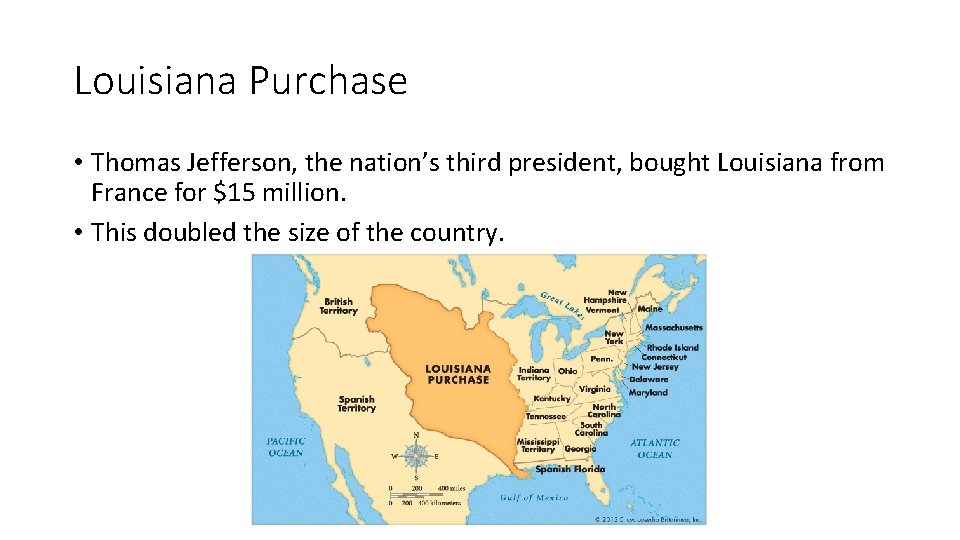
Louisiana Purchase • Thomas Jefferson, the nation’s third president, bought Louisiana from France for $15 million. • This doubled the size of the country.
Technology Does it help or hurt?
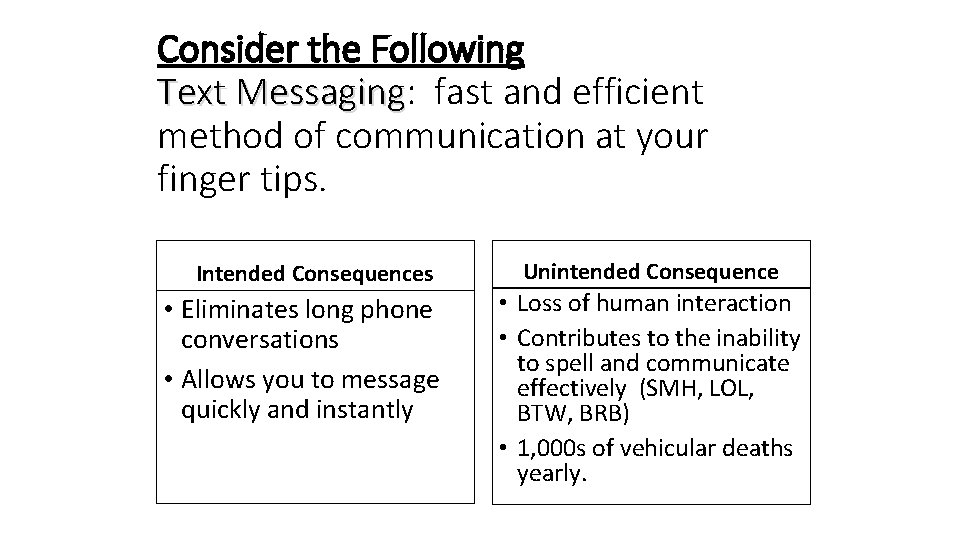
Consider the Following Text Messaging: Messaging fast and efficient method of communication at your finger tips. Intended Consequences • Eliminates long phone conversations • Allows you to message quickly and instantly Unintended Consequence • Loss of human interaction • Contributes to the inability to spell and communicate effectively (SMH, LOL, BTW, BRB) • 1, 000 s of vehicular deaths yearly.
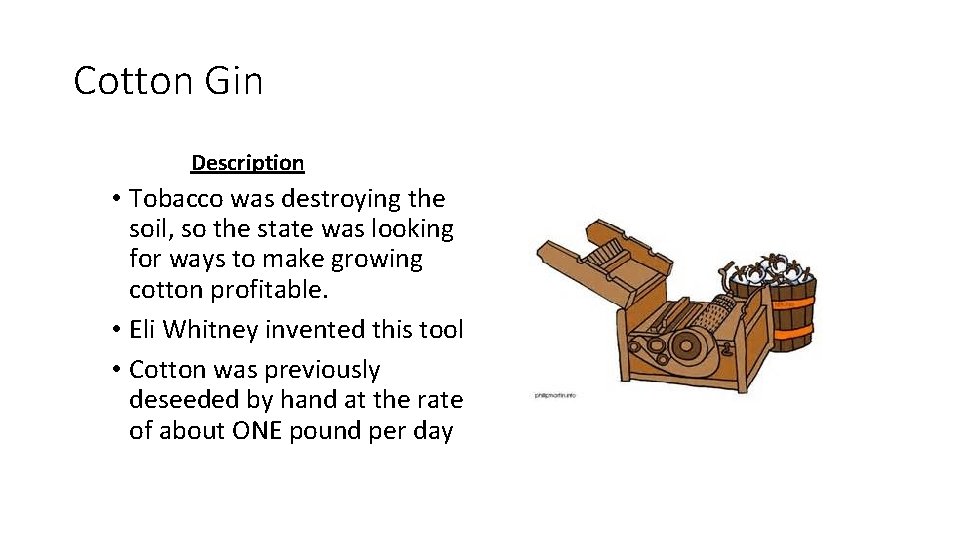
Cotton Gin Description • Tobacco was destroying the soil, so the state was looking for ways to make growing cotton profitable. • Eli Whitney invented this tool • Cotton was previously deseeded by hand at the rate of about ONE pound per day
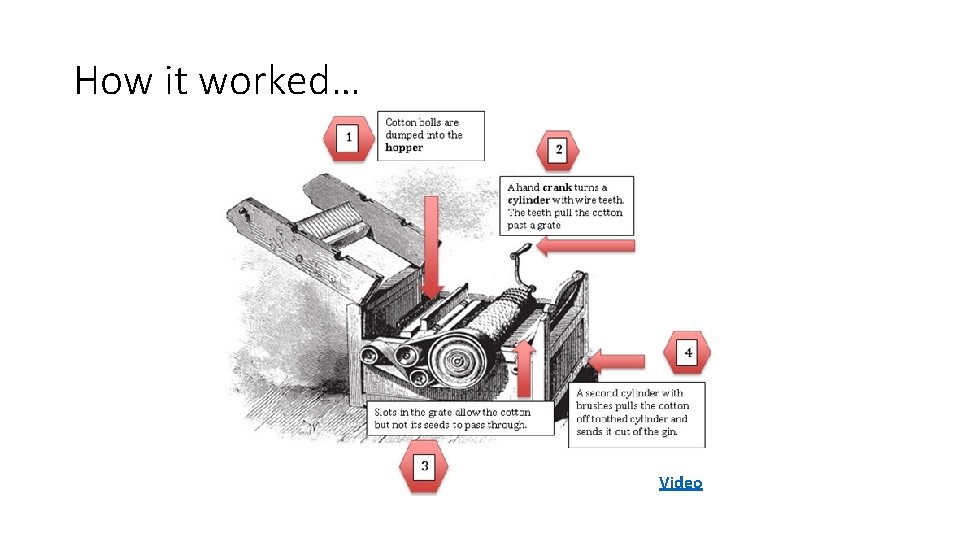
How it worked… Video
Cotton Gin Intended Consequences Unintended Consequences • Was able to remove the seeds from 50 pounds of cotton each day • The south grew a majority of the world’s cotton by the end of the 19 th century • Led to Westward Expansion Negatives: • The south became dependent on one crop • Increased slavery
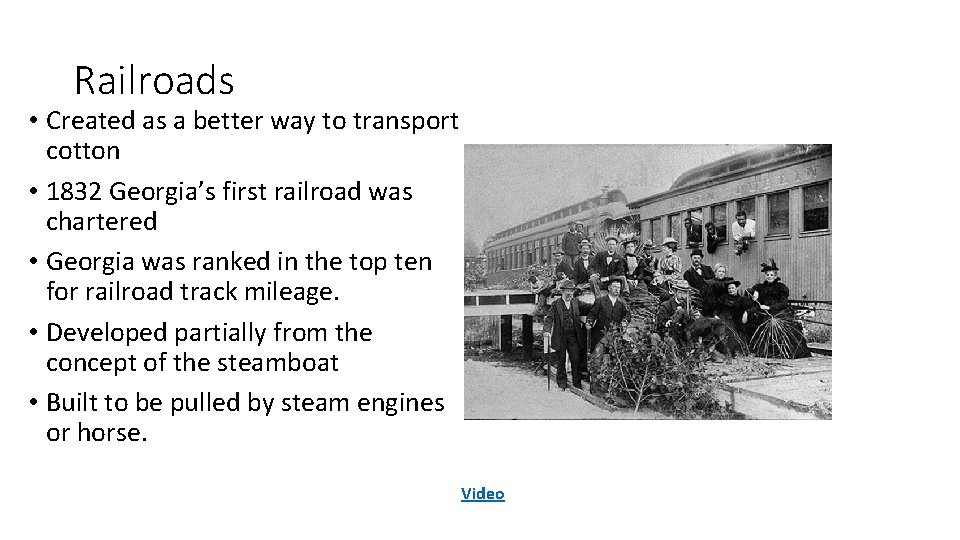
Railroads • Created as a better way to transport cotton • 1832 Georgia’s first railroad was chartered • Georgia was ranked in the top ten for railroad track mileage. • Developed partially from the concept of the steamboat • Built to be pulled by steam engines or horse. Video
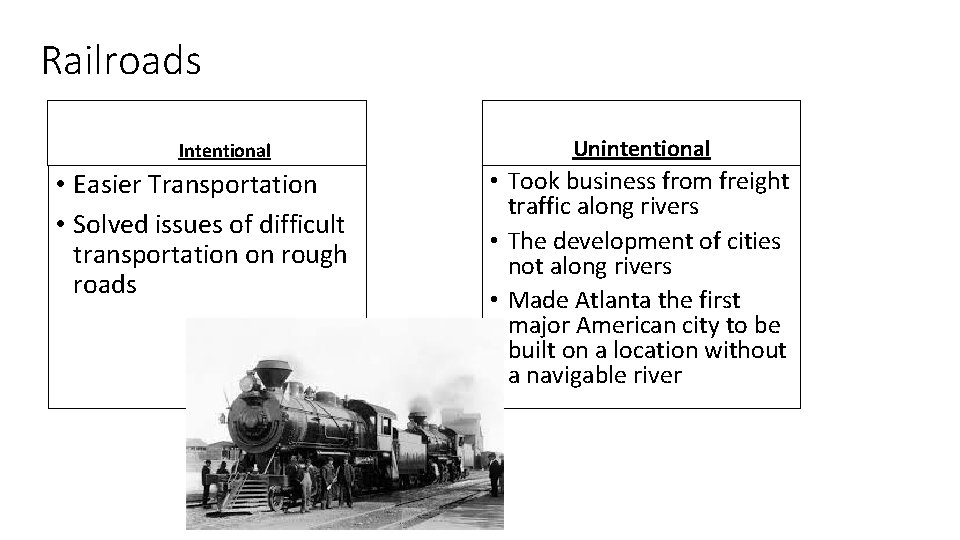
Railroads Intentional • Easier Transportation • Solved issues of difficult transportation on rough roads Unintentional • Took business from freight traffic along rivers • The development of cities not along rivers • Made Atlanta the first major American city to be built on a location without a navigable river
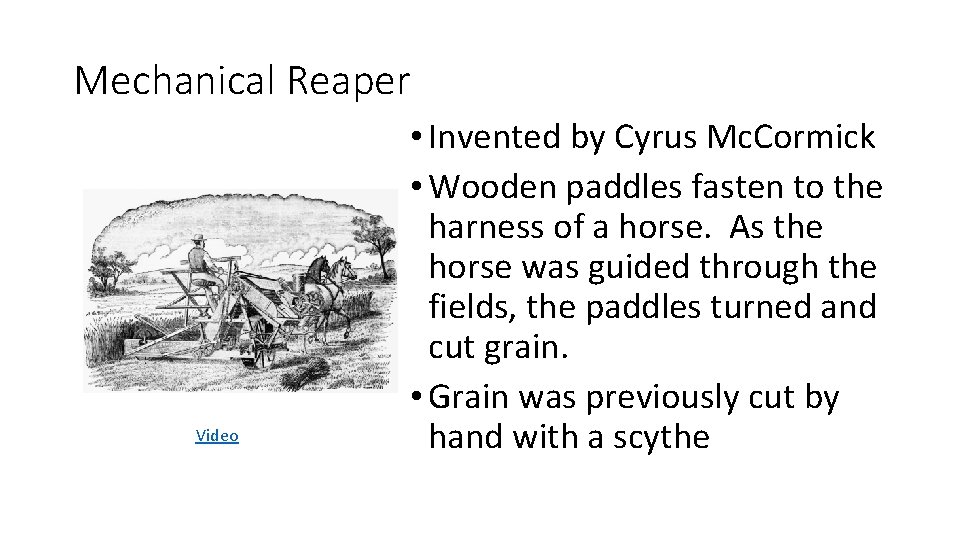
Mechanical Reaper Video • Invented by Cyrus Mc. Cormick • Wooden paddles fasten to the harness of a horse. As the horse was guided through the fields, the paddles turned and cut grain. • Grain was previously cut by hand with a scythe
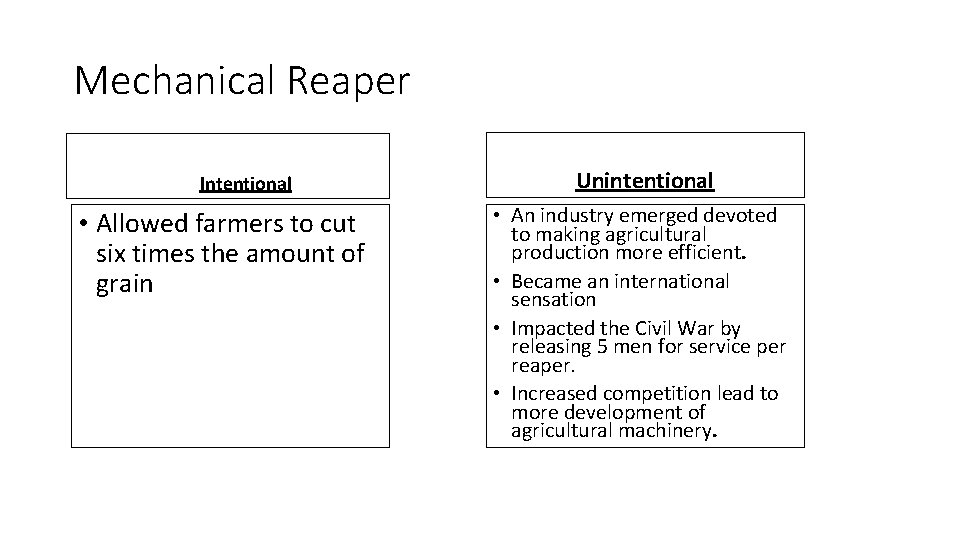
Mechanical Reaper Intentional • Allowed farmers to cut six times the amount of grain Unintentional • An industry emerged devoted to making agricultural production more efficient. • Became an international sensation • Impacted the Civil War by releasing 5 men for service per reaper. • Increased competition lead to more development of agricultural machinery.