
The Growth Imperative I wanna be a billionaire
The Growth Imperative

I wanna be a billionaire… I wanna be on the cover of Forbes magazine…
The growth imperative What we will discuss • Shift happens/change occurs • How might it impact us? • What can we do about it? – Three strategies to “future-proof” you business
The growth imperative Shift happens • clients are demanding more value from you • new regulations are making the industry more transparent • rising number of do-it-yourselfers • other advisors are improving their game

The growth imperative Shift happens
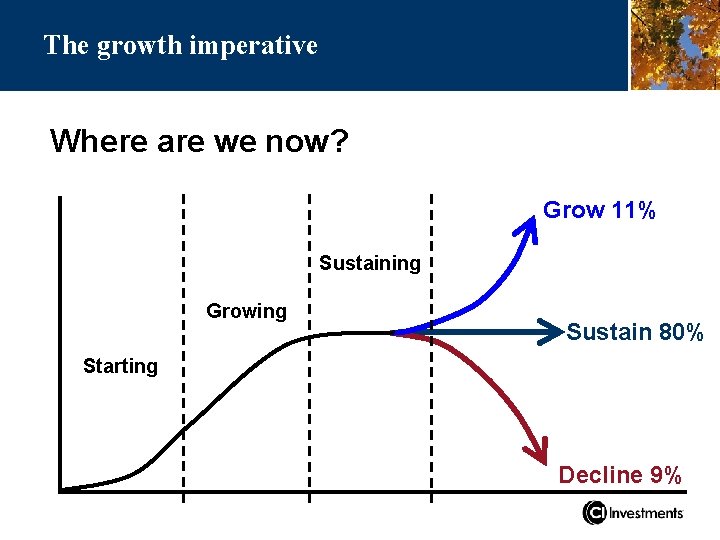
The growth imperative Where are we now? Grow 11% Sustaining Growing Sustain 80% Starting Decline 9%
The growth imperative Maybe I just don’t “wanna” build a really huge business. Is there something wrong with that?

The growth imperative GREATNESS doesn’t depend on SIZE
The growth imperative CAPABILITY
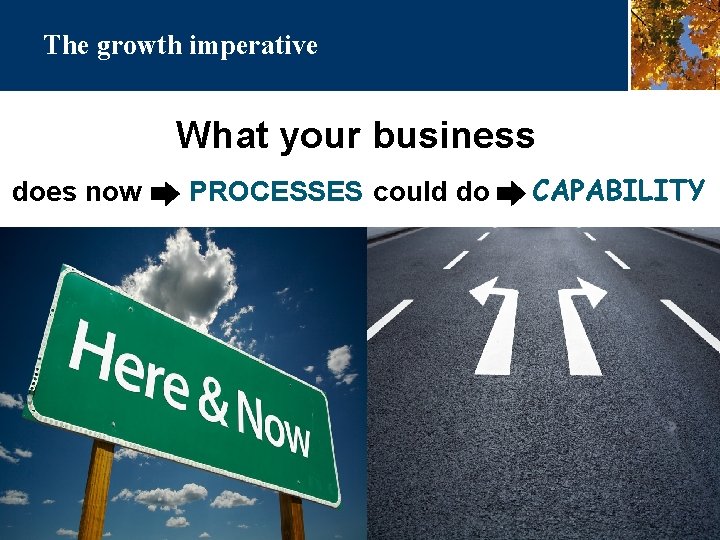
The growth imperative What your business does now PROCESSES could do CAPABILITY
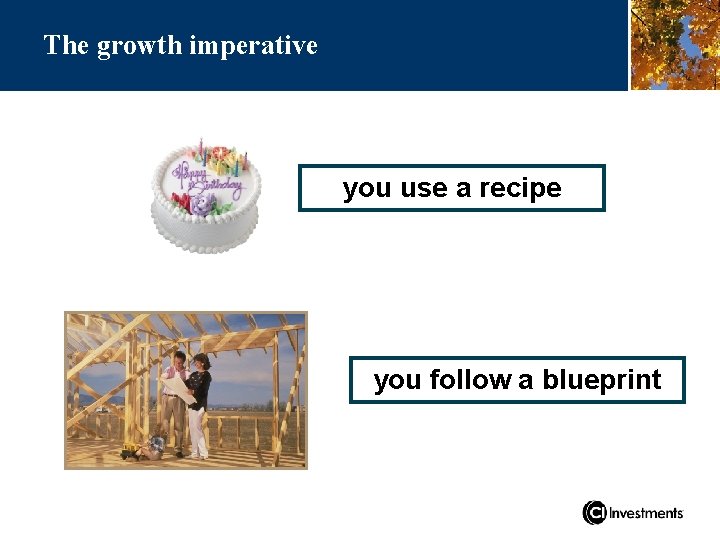
The growth imperative you use a recipe you follow a blueprint
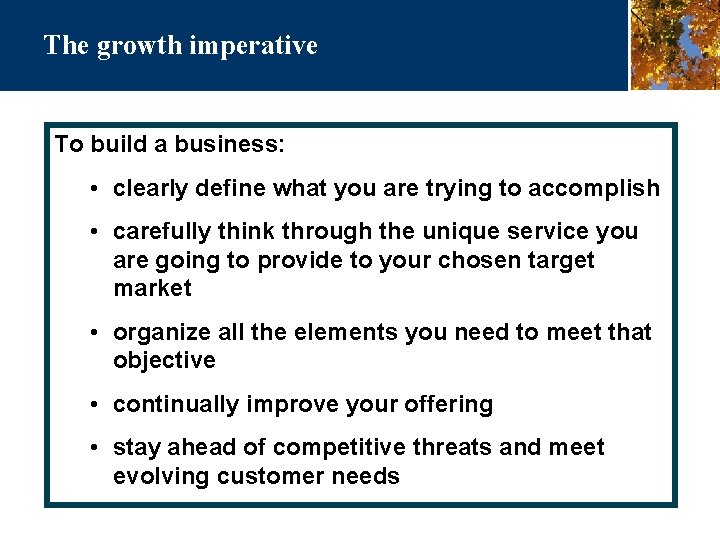
The growth imperative To build a business: • clearly define what you are trying to accomplish • carefully think through the unique service you are going to provide to your chosen target market • organize all the elements you need to meet that objective • continually improve your offering • stay ahead of competitive threats and meet evolving customer needs
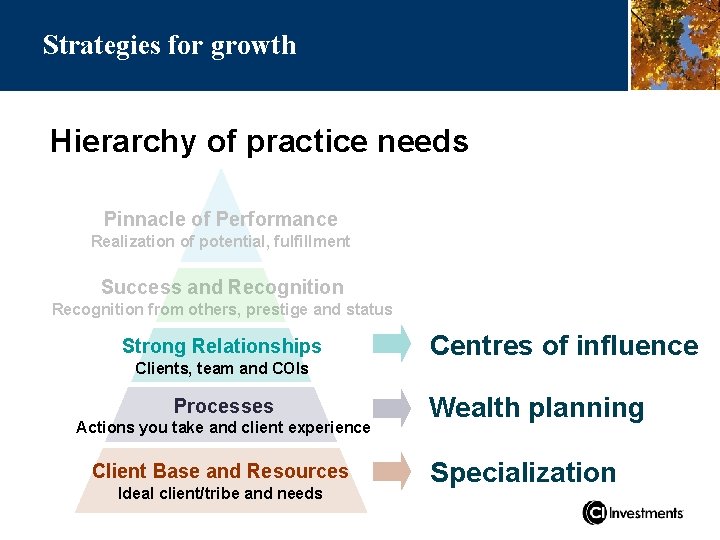
Strategies for growth Hierarchy of practice needs Pinnacle of Performance Realization of potential, fulfillment Success and Recognition from others, prestige and status Strong Relationships Clients, team and COIs Processes Actions you take and client experience Client Base and Resources Ideal client/tribe and needs Centres of influence Wealth planning Specialization
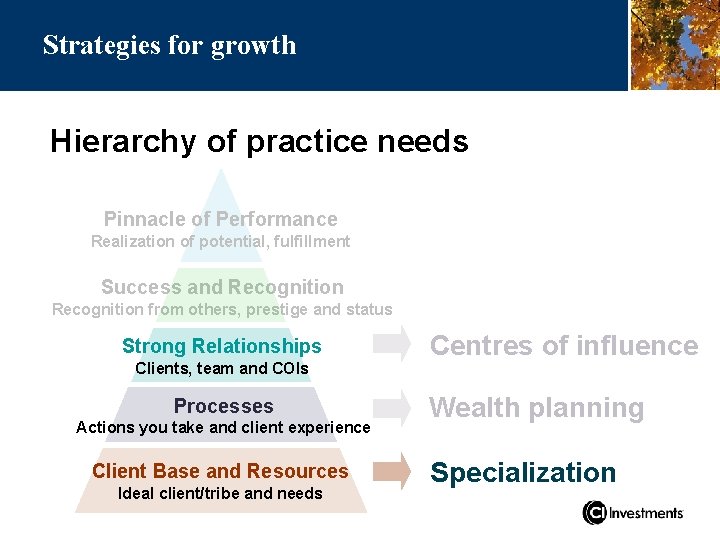
Strategies for growth Hierarchy of practice needs Pinnacle of Performance Realization of potential, fulfillment Success and Recognition from others, prestige and status Strong Relationships Clients, team and COIs Processes Actions you take and client experience Client Base and Resources Ideal client/tribe and needs Centres of influence Wealth planning Specialization

Specialization
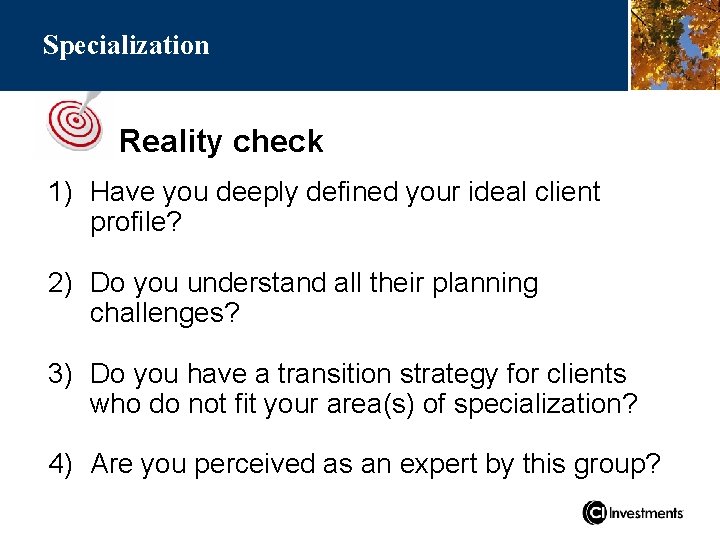
Specialization Reality check 1) Have you deeply defined your ideal client profile? 2) Do you understand all their planning challenges? 3) Do you have a transition strategy for clients who do not fit your area(s) of specialization? 4) Are you perceived as an expert by this group?
Specialization Why specialize? • be viewed as the expert by your ideal clients and COIs • prospects will be more receptive • increase your perceived value • differentiate yourself and limit competitors
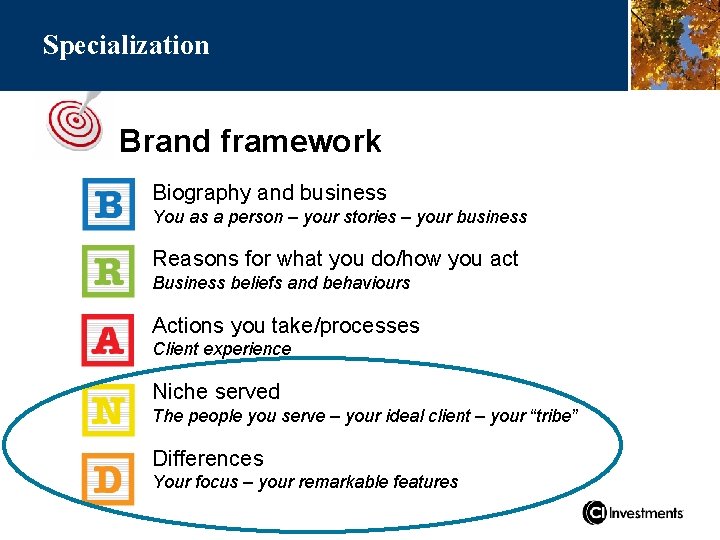
Specialization Brand framework Biography and business You as a person – your stories – your business Reasons for what you do/how you act Business beliefs and behaviours Actions you take/processes Client experience Niche served The people you serve – your ideal client – your “tribe” Differences Your focus – your remarkable features
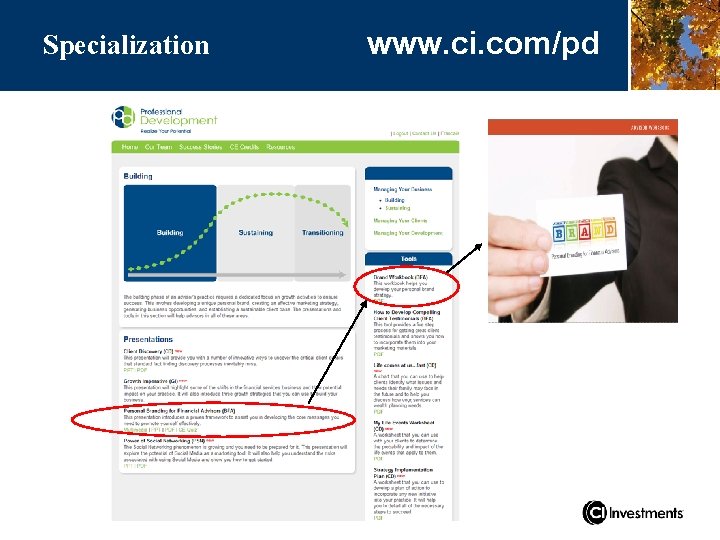
Specialization www. ci. com/pd
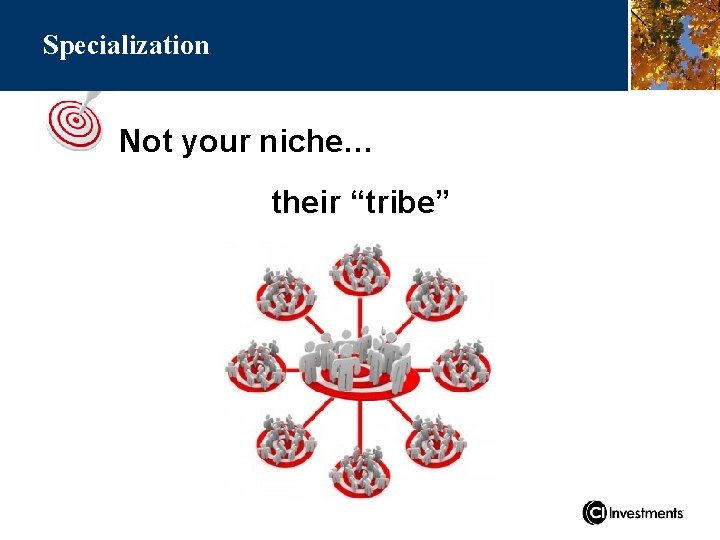
Specialization Not your niche… their “tribe”
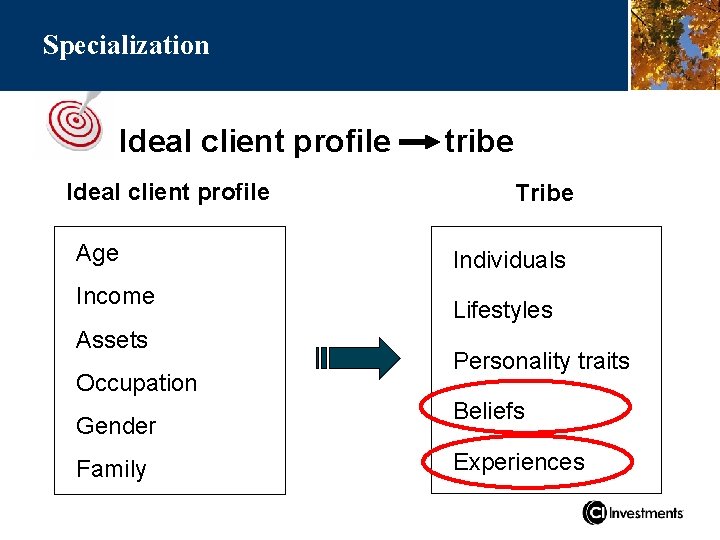
Specialization Ideal client profile Age Income Assets Occupation Gender Family tribe Tribe Individuals Lifestyles Personality traits Beliefs Experiences
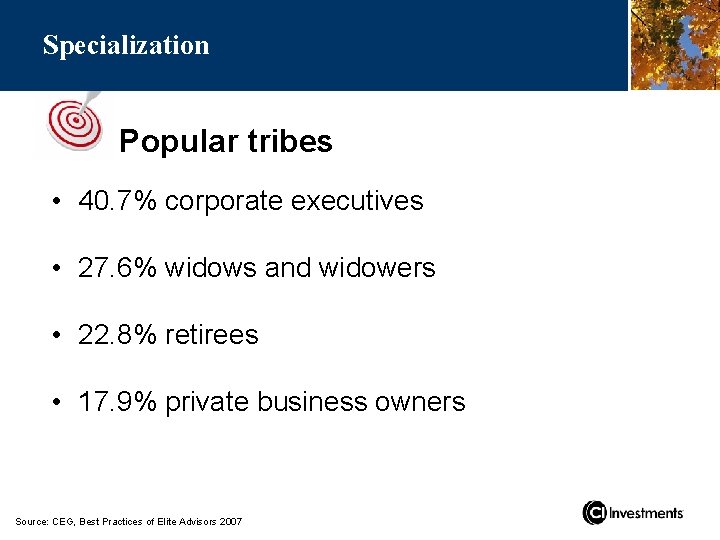
Specialization Popular tribes • 40. 7% corporate executives • 27. 6% widows and widowers • 22. 8% retirees • 17. 9% private business owners Source: CEG, Best Practices of Elite Advisors 2007
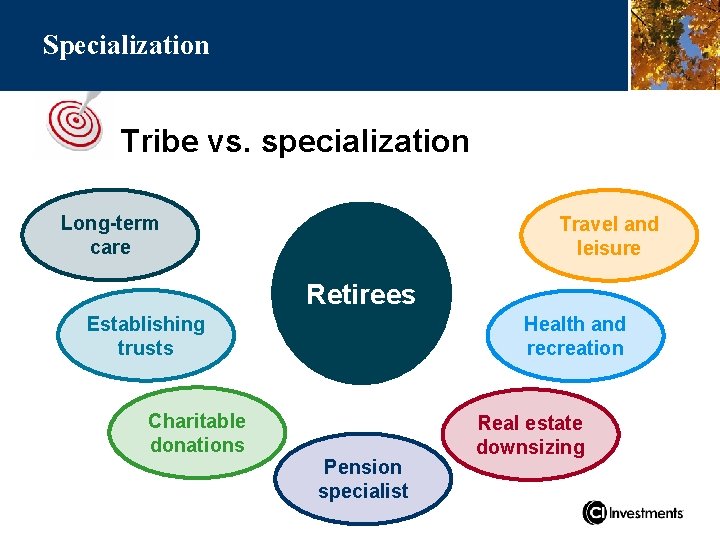
Specialization Tribe vs. specialization Long-term care Travel and leisure Retirees Establishing trusts Charitable donations Health and recreation Pension specialist Real estate downsizing
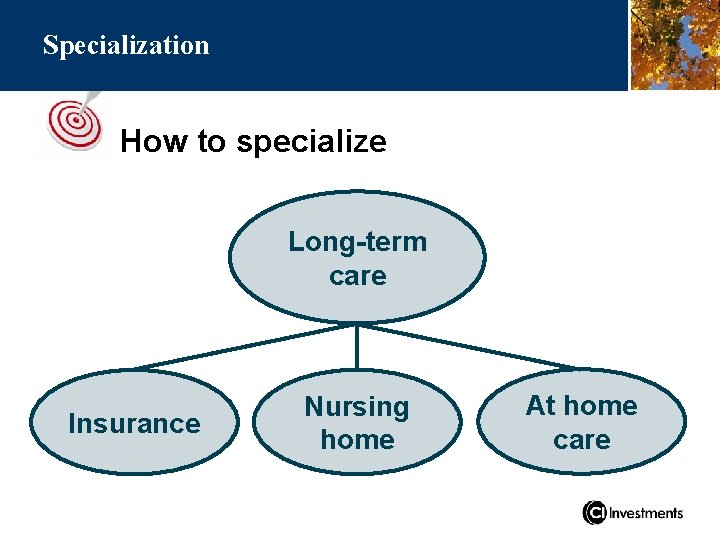
Specialization How to specialize Long-term care Insurance Nursing home At home care
Specialization Becoming part of a tribe • has a tribe already selected you? • locate their “watering holes” – regular meetings – common periodicals/publication – COI’s – websites • package your entire offering to be uniquely attractive to this group
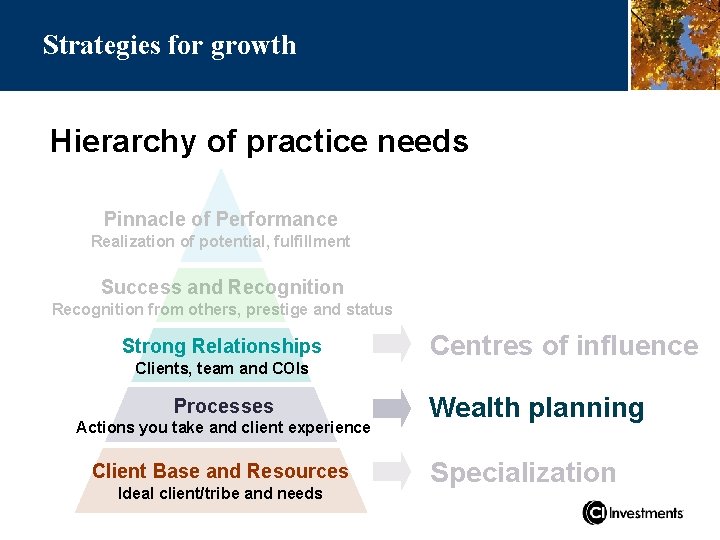
Strategies for growth Hierarchy of practice needs Pinnacle of Performance Realization of potential, fulfillment Success and Recognition from others, prestige and status Strong Relationships Clients, team and COIs Processes Actions you take and client experience Client Base and Resources Ideal client/tribe and needs Centres of influence Wealth planning Specialization

Wealth planning
Wealth planning Reality check 1) Are you going beyond investments? 2) Do you know what both spouses/family are concerned about? 3) Do you know what assets your clients may hold elsewhere? 4) Do you know if your clients have proper insurance in place? 5) Do you know when your clients last reviewed their wills?
Wealth planning Why provide true planning? • if you don’t, someone else will! • a deeper relationship with your clients and their families will: – protect you and your practice – help you help them • become your clients’ single and most-valued resource for all their financial advice • higher income as a wealth manager • increase referrals from client and COIs
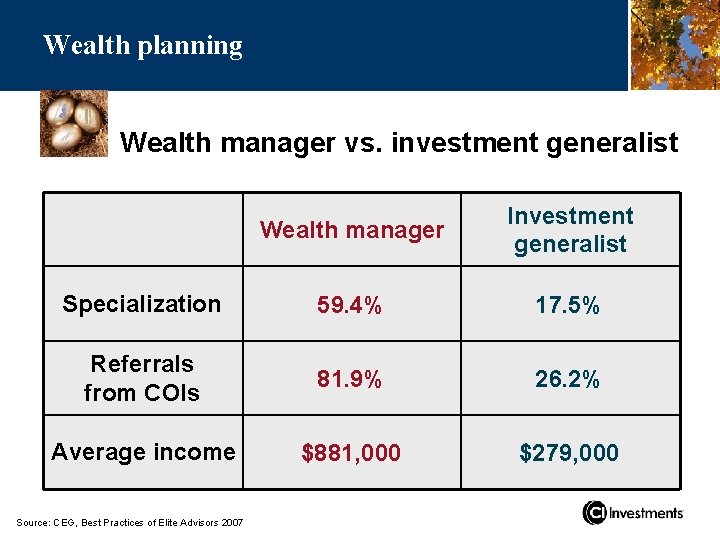
Wealth planning Wealth manager vs. investment generalist Wealth manager Investment generalist Specialization 59. 4% 17. 5% Referrals from COIs 81. 9% 26. 2% Average income $881, 000 $279, 000 Source: CEG, Best Practices of Elite Advisors 2007
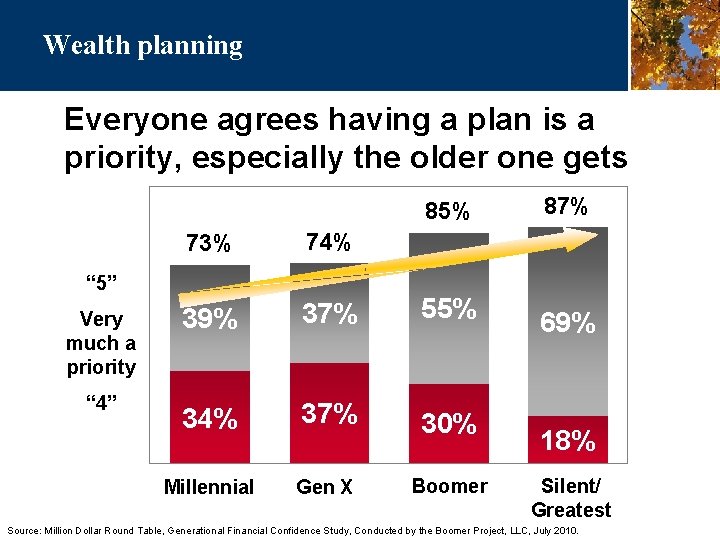
Wealth planning Everyone agrees having a plan is a priority, especially the older one gets 85% 73% 74% 39% 37% 55% 34% 37% 30% Millennial Gen X Boomer “ 5” Very much a priority “ 4” 87% 69% 18% Silent/ Greatest Source: Million Dollar Round Table, Generational Financial Confidence Study, Conducted by the Boomer Project, LLC, July 2010.
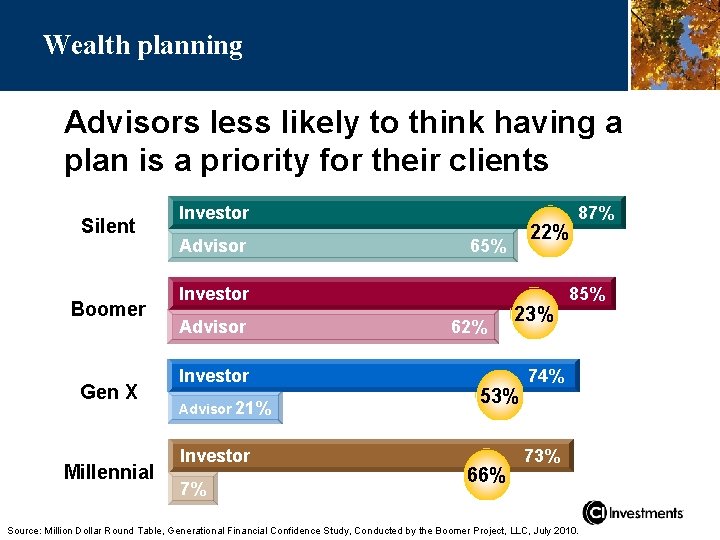
Wealth planning Advisors less likely to think having a plan is a priority for their clients Silent Boomer Gen X Millennial Investor Advisor 65% Investor Advisor 21% Investor 7% 22% 62% 23% 53% 66% 87% 85% 74% 73% Source: Million Dollar Round Table, Generational Financial Confidence Study, Conducted by the Boomer Project, LLC, July 2010.
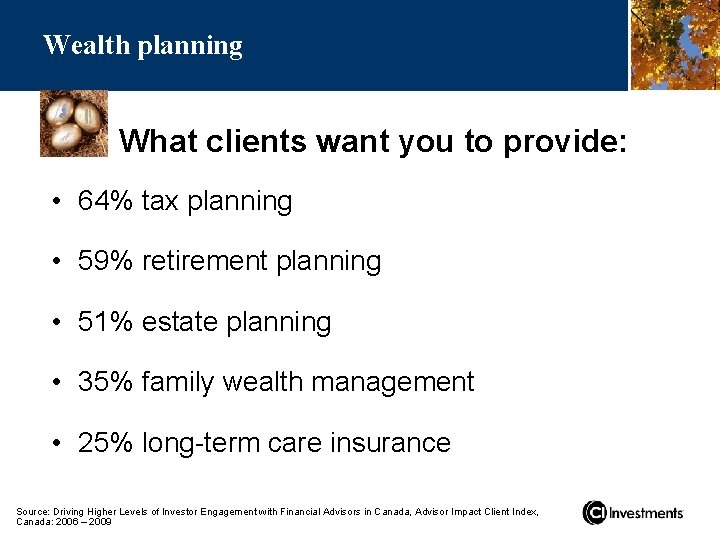
Wealth planning What clients want you to provide: • 64% tax planning • 59% retirement planning • 51% estate planning • 35% family wealth management • 25% long-term care insurance Source: Driving Higher Levels of Investor Engagement with Financial Advisors in Canada, Advisor Impact Client Index, Canada: 2006 – 2009
Wealth planning Opportunities with wealthy Canadians • 32% of wealthy Canadians do not have financial planners at all 1 • 36% have insurance policies they expect to turn into cash 1 • 47% say they have never held a family meeting to discuss plans for their estates 2 • 59% have not consulted a professional about taking income from their investments – 85% plan to in the future 1 Source: 1 CSI Affluent Market Survey, Insights Inc. , March 2008. 2 Key Strategies For Building Optimal Client Relationships: Analysis Of Advisor End-Client Feedback, Schwab Institutional, May 23, 2005.
Wealth planning Opportunities with retirees • private sector individuals retire at average of 62 – public sector age 59 – self-employed age 65 • 50% of Canadian tax filers have no private savings vehicle for retirement at all • 73% of the population working in the private sector does not have any form of registered pension plan Source: CFIB is calling for restored fairness for all Canadians on pension inequity, Canadian Federation Of Independent Business, December 11, 2009.
Wealth planning Opportunities with business owners • business owner households represent 50% of the wealth management client base – 76% have children – only 30% have created family trusts 1 • 33% have not sought advice from a planner 1 • over the next five years one-third of independent business owners plan to exit ownership or transfer control of their business 2 Source: 1 CSI Affluent Market Survey, Insights Inc. , March 2008. 2 CFIB is calling for restored fairness for all Canadians on pension inequity, Canadian Federation Of Independent Business, December 11, 2009.
Wealth planning Opportunities with women • 57% of women have no plan for the sudden death of a spouse 1 • 70% of widows will fire their husband's financial advisor within three years of their husband's death 2 Source: 1 TD Waterhouse 2007 Female Investor Poll, 2 Widows' needs being ignored by advisers, Investment News, Lisa Shidler, June 21, 2009
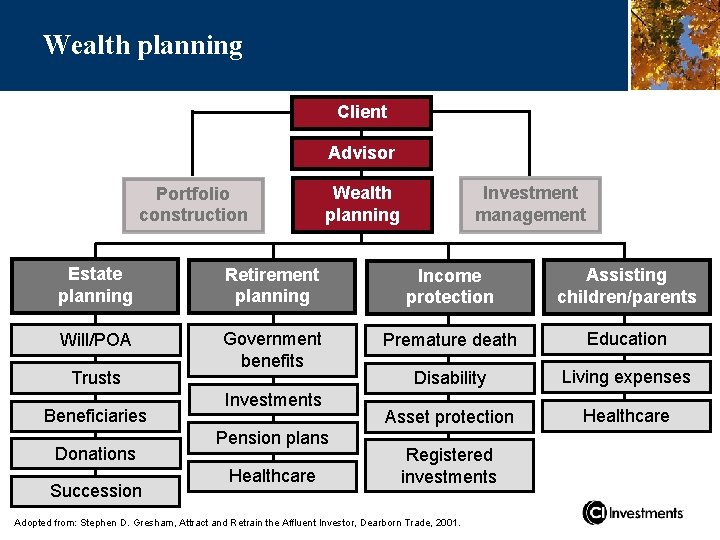
Wealth planning Client Advisor Portfolio construction Wealth planning Investment management Estate planning Retirement planning Income protection Assisting children/parents Will/POA Government benefits Premature death Education Disability Living expenses Asset protection Healthcare Trusts Beneficiaries Donations Succession Investments Pension plans Healthcare Registered investments Adopted from: Stephen D. Gresham, Attract and Retrain the Affluent Investor, Dearborn Trade, 2001.
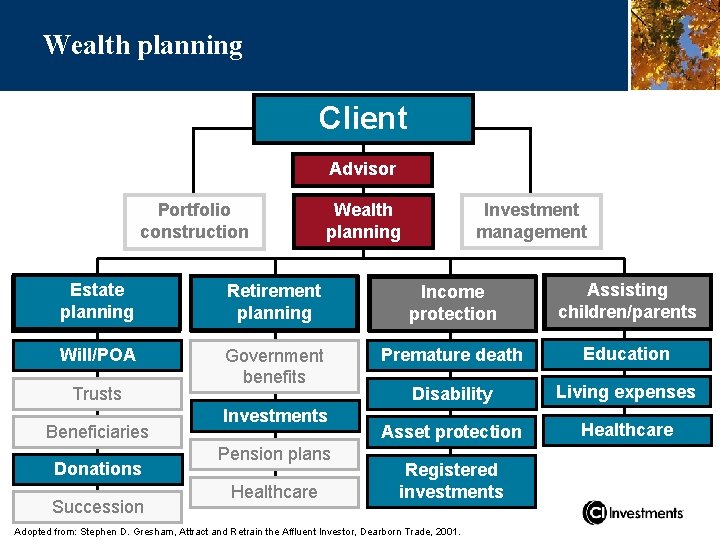
Wealth planning Client Advisor Portfolio construction Wealth planning Investment management Estate planning Retirement planning Income protection Assisting children/parents Will/POA Government benefits Premature death Education Disability Living expenses Asset protection Healthcare Trusts Beneficiaries Donations Succession Investments Pension plans Healthcare Registered investments Adopted from: Stephen D. Gresham, Attract and Retrain the Affluent Investor, Dearborn Trade, 2001.
Wealth planning How to become a wealth manager • build the support team – identify other professionals you want to work with based on specific needs of target clients you want to address • control the process – you are at the centre of the relationships to facilitate the process • make the move – be patient, the full transition can take up to 18 months Source: Become the center of your boomer client's wealth management team 2007

Strategies for growth Hierarchy of practice needs Pinnacle of Performance Realization of potential, fulfillment Success and Recognition from others, prestige and status Strong Relationships Clients, team and COIs Processes Actions you take and client experience Client Base and Resources Ideal client/tribe and needs Centres of influence Wealth planning Specialization
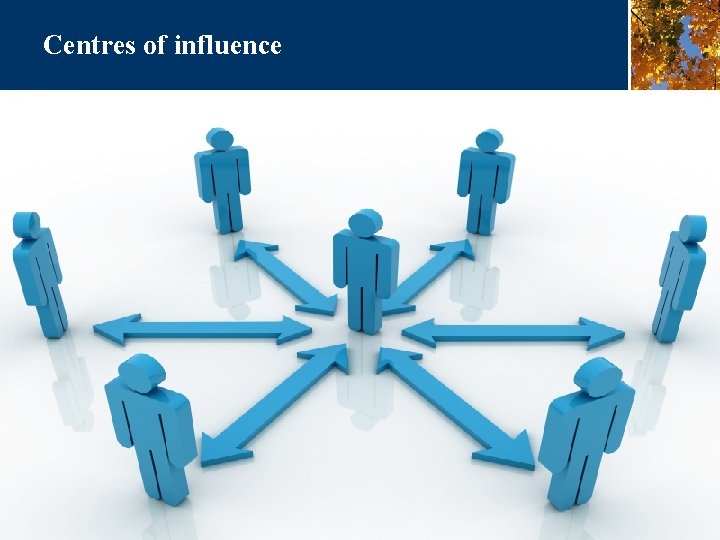
Centres of influence
Centres of influence Reality check 1) Has your COI referred a prospect to you within the last year? – Have you? 2) Did that prospect fit your ideal client profile? – Did the prospect fit theirs? 3) Can your COI articulate what you do and how you are different? – Can you articulate what they do and how they are different?
Centres of influence Why work with COIs? • best way to increase high-quality referrals • bring their expertise to your existing clients and prospects • foster communication with your clients’ outside advisors and ensure strategies are aligned

Centres of influence Broken trust Source: Trusted. Advisor Associates 2008

INMATE # 61727054
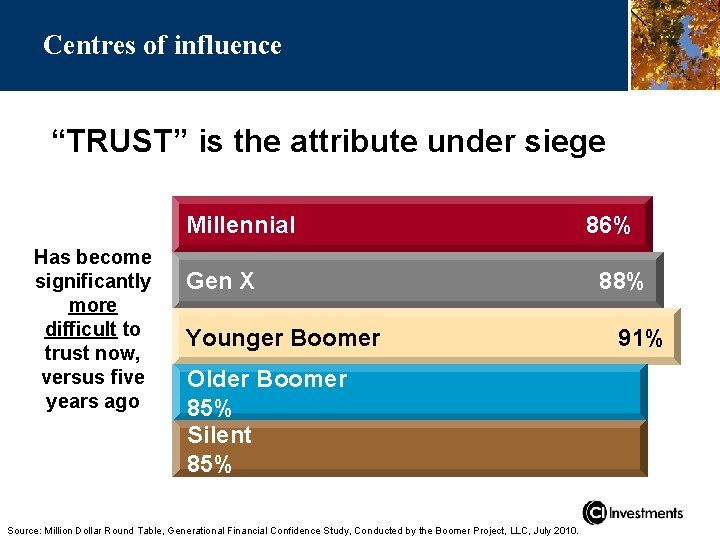
Centres of influence “TRUST” is the attribute under siege Millennial Has become significantly more difficult to trust now, versus five years ago Gen X Younger Boomer Older Boomer 85% Silent 85% Source: Million Dollar Round Table, Generational Financial Confidence Study, Conducted by the Boomer Project, LLC, July 2010. 86% 88% 91%
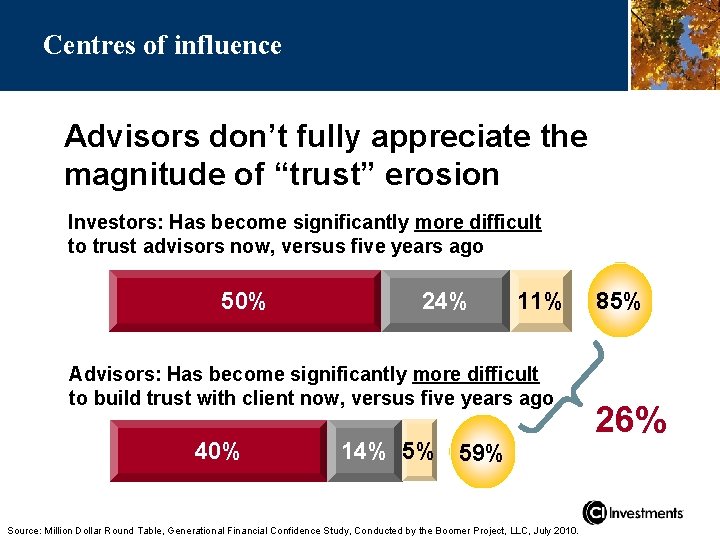
Centres of influence Advisors don’t fully appreciate the magnitude of “trust” erosion Investors: Has become significantly more difficult to trust advisors now, versus five years ago 50% 24% 11% Advisors: Has become significantly more difficult to build trust with client now, versus five years ago 40% 14% 5% 59% Source: Million Dollar Round Table, Generational Financial Confidence Study, Conducted by the Boomer Project, LLC, July 2010. 85% 26%
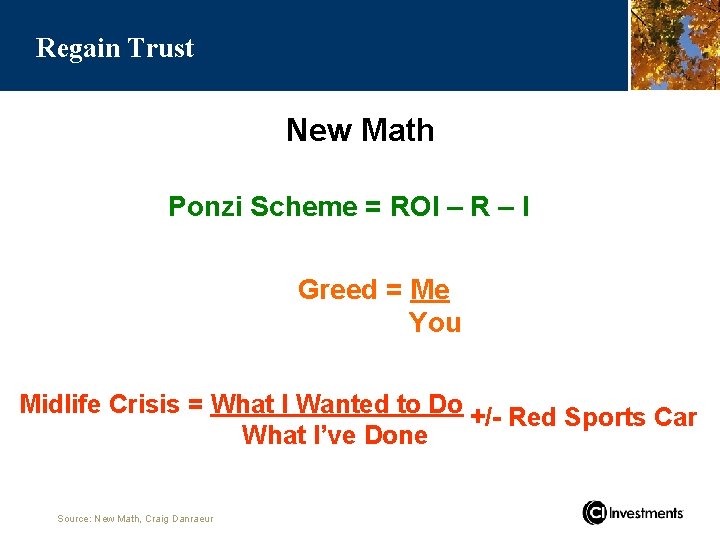
Regain Trust New Math Ponzi Scheme = ROI – R – I Greed = Me You Midlife Crisis = What I Wanted to Do +/- Red Sports Car What I’ve Done Source: New Math, Craig Danraeur
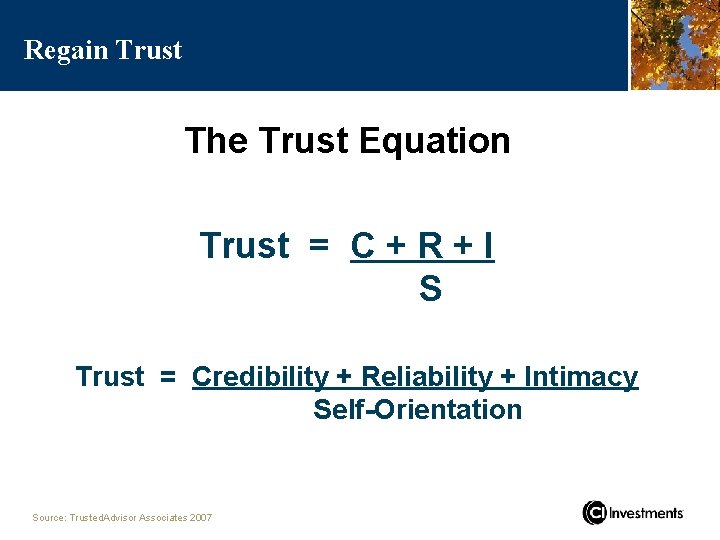
Regain Trust The Trust Equation Trust = C + R + I S Trust = Credibility + Reliability + Intimacy Self-Orientation Source: Trusted. Advisor Associates 2007
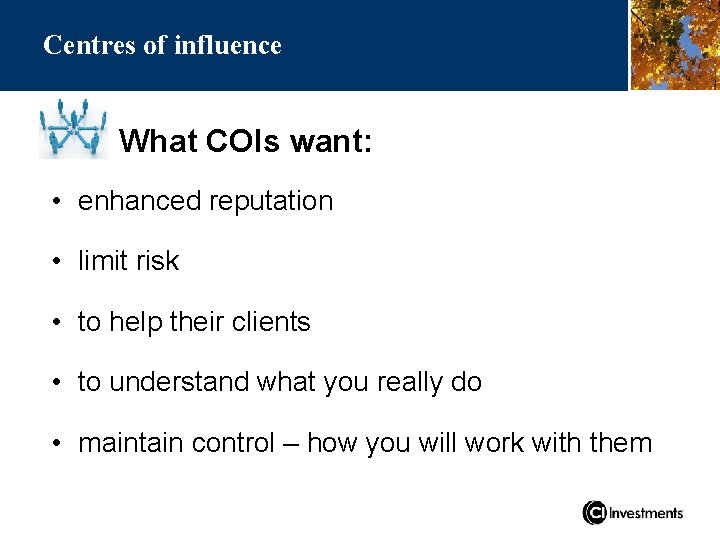
Centres of influence What COIs want: • enhanced reputation • limit risk • to help their clients • to understand what you really do • maintain control – how you will work with them
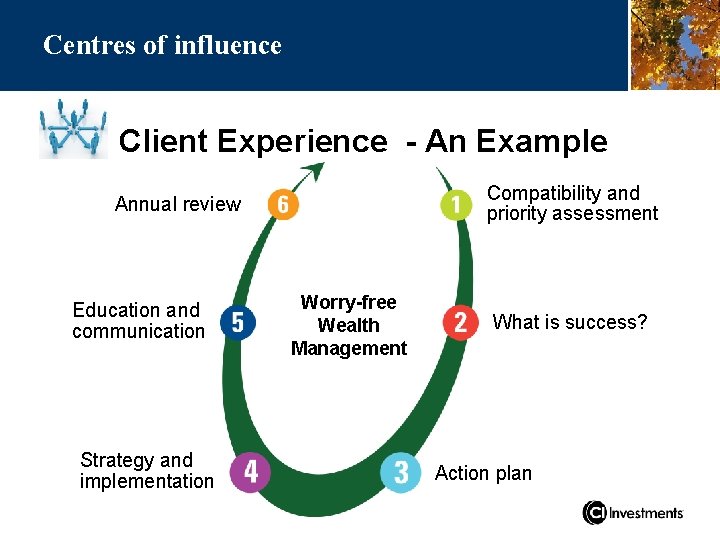
Centres of influence Client Experience - An Example Compatibility and priority assessment Annual review Education and communication Strategy and implementation Worry-free Wealth Management What is success? Action plan
Centres of influence How to work with COIs • qualify them up front – discovery meetings • help them with their business challenges • recognize it will take time to develop the relationship • differentiate yourself from other advisors
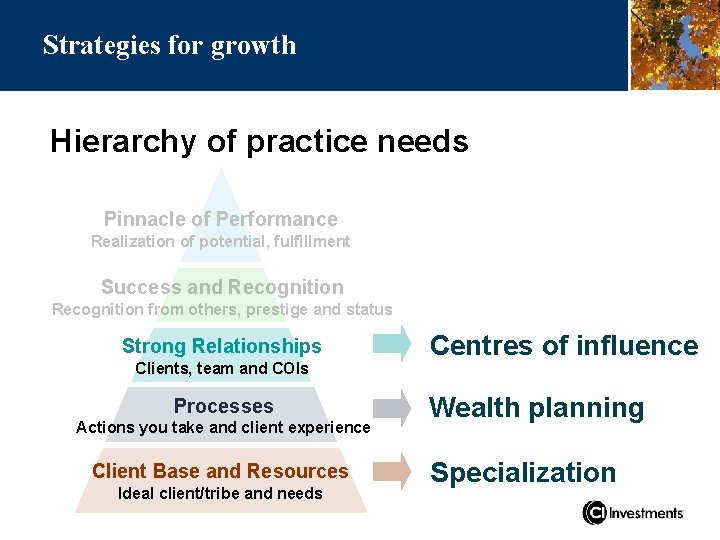
Strategies for growth Hierarchy of practice needs Pinnacle of Performance Realization of potential, fulfillment Success and Recognition from others, prestige and status Strong Relationships Clients, team and COIs Processes Actions you take and client experience Client Base and Resources Ideal client/tribe and needs Centres of influence Wealth planning Specialization

Thank you www. ci. com/pd Commissions, trailing commissions, management fees and expenses all may be associated with mutual fund investments. Please read the prospectus before investing. Mutual funds are not guaranteed, their values change frequently and past performance may not be repeated. ®CI Investments the CI Investments design, Harbour Advisors, Harbour Funds, Signature and Signature Global Advisors are registered trademarks of CI Investments Inc.
- Slides: 55