
THE GROWTH AND CHALLENGES OF THE MANUFACTURING SECTOR
- Slides: 20
THE GROWTH AND CHALLENGES OF THE MANUFACTURING SECTOR July 2013
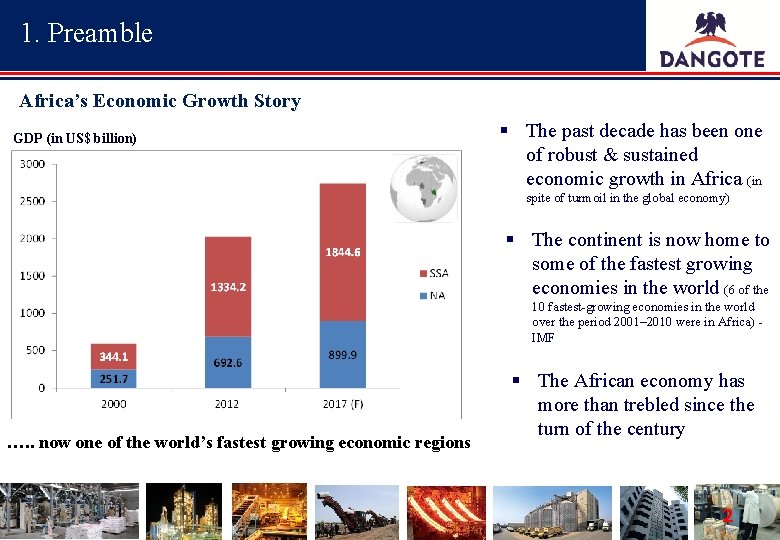
1. Preamble Africa’s Economic Growth Story GDP (in US$ billion) § The past decade has been one of robust & sustained economic growth in Africa (in spite of turmoil in the global economy) § The continent is now home to some of the fastest growing economies in the world (6 of the 10 fastest-growing economies in the world over the period 2001– 2010 were in Africa) IMF …. . now one of the world’s fastest growing economic regions § The African economy has more than trebled since the turn of the century 2
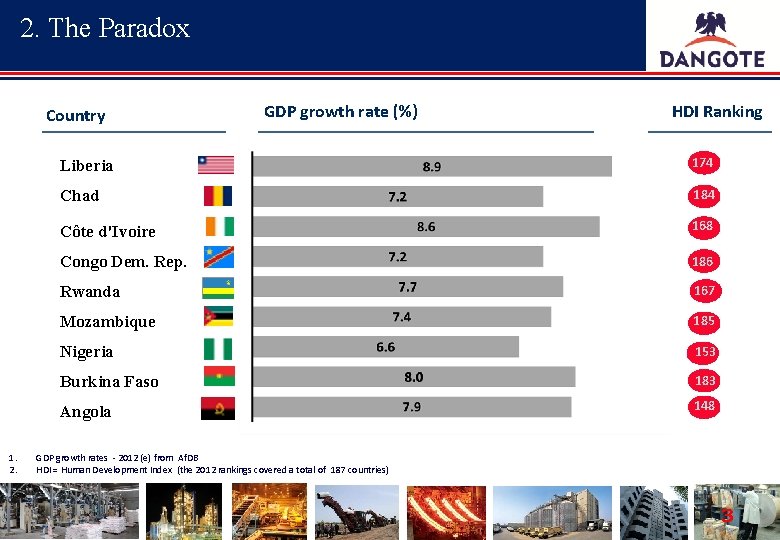
2. The Paradox Country 1. 2. GDP growth rate (%) HDI Ranking Liberia 174 Chad 184 Côte d'Ivoire 168 Congo Dem. Rep. 186 Rwanda 167 Mozambique 185 Nigeria 153 Burkina Faso 183 125 Angola 148 GDP growth rates - 2012 (e) from Af. DB HDI = Human Development Index (the 2012 rankings covered a total of 187 countries) 3
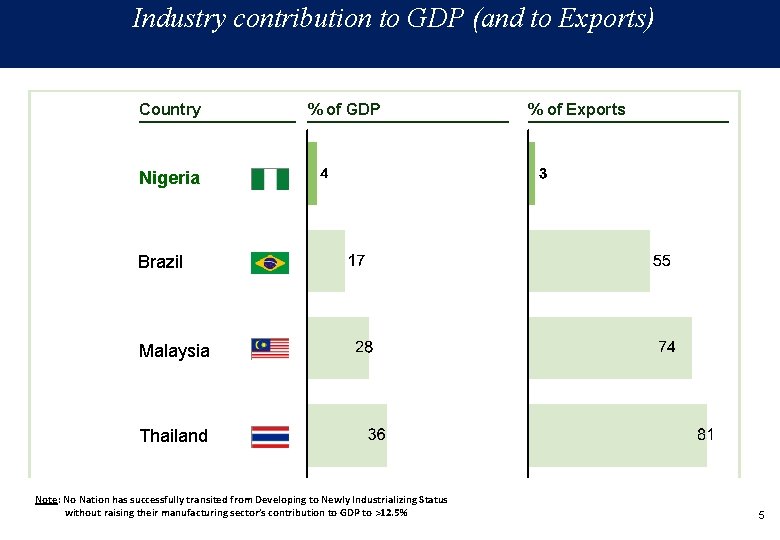
3. Reversing this Paradox § African countries have to leverage on their rich resource endowments to drive growth in the productive sector of the economy § Local value addition has to increase – to facilitate wealth creation, generate employment, develop skills and improve living standards § The Manufacturing Sector needs to contribute a lot more to GDP in a number of African countries eg- Nigeria 4
Industry contribution to GDP (and to Exports) Country % of GDP % of Exports Nigeria Brazil Malaysia Thailand Note: No Nation has successfully transited from Developing to Newly Industrializing Status without raising their manufacturing sector’s contribution to GDP to >12. 5% rce: Country Central Banks; WTO, ILO; Comrade through WITS; ITC; Global Insights; UNCTAD; NBS; 5
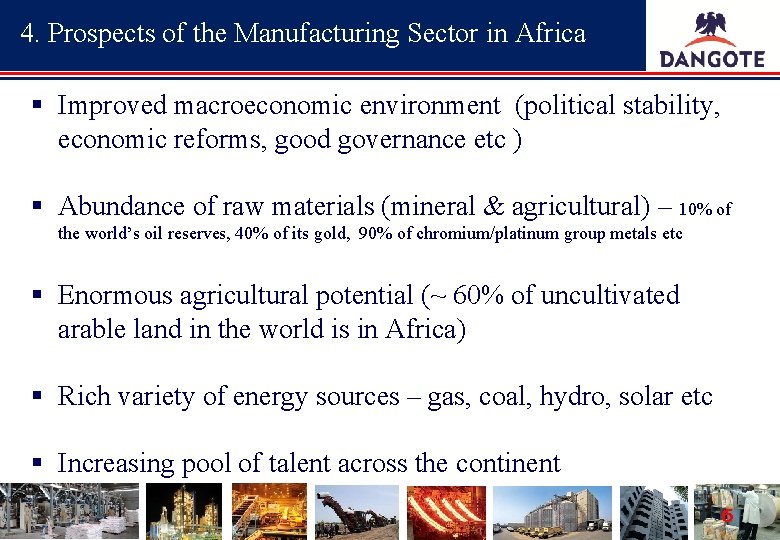
4. Prospects of the Manufacturing Sector in Africa § Improved macroeconomic environment (political stability, economic reforms, good governance etc ) § Abundance of raw materials (mineral & agricultural) – 10% of the world’s oil reserves, 40% of its gold, 90% of chromium/platinum group metals etc § Enormous agricultural potential (~ 60% of uncultivated arable land in the world is in Africa) § Rich variety of energy sources – gas, coal, hydro, solar etc § Increasing pool of talent across the continent 6
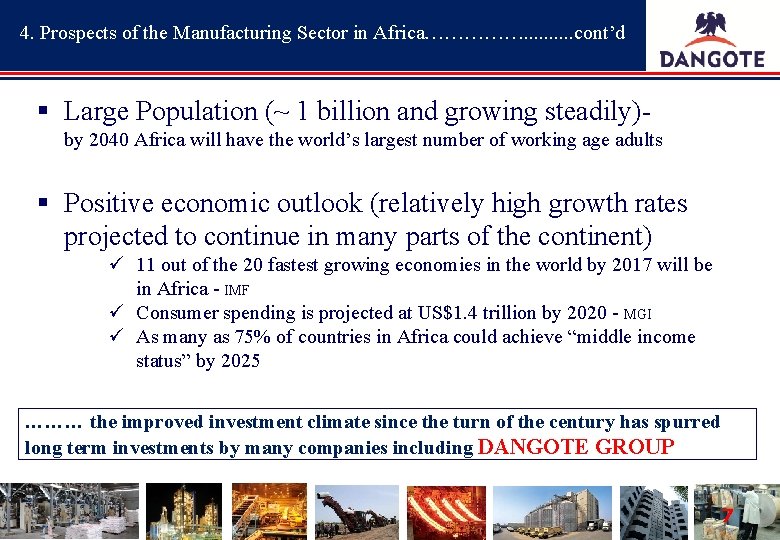
4. Prospects of the Manufacturing Sector in Africa……………. . cont’d § Large Population (~ 1 billion and growing steadily)by 2040 Africa will have the world’s largest number of working age adults § Positive economic outlook (relatively high growth rates projected to continue in many parts of the continent) ü 11 out of the 20 fastest growing economies in the world by 2017 will be in Africa - IMF ü Consumer spending is projected at US$1. 4 trillion by 2020 - MGI ü As many as 75% of countries in Africa could achieve “middle income status” by 2025 ……… the improved investment climate since the turn of the century has spurred long term investments by many companies including DANGOTE GROUP 7
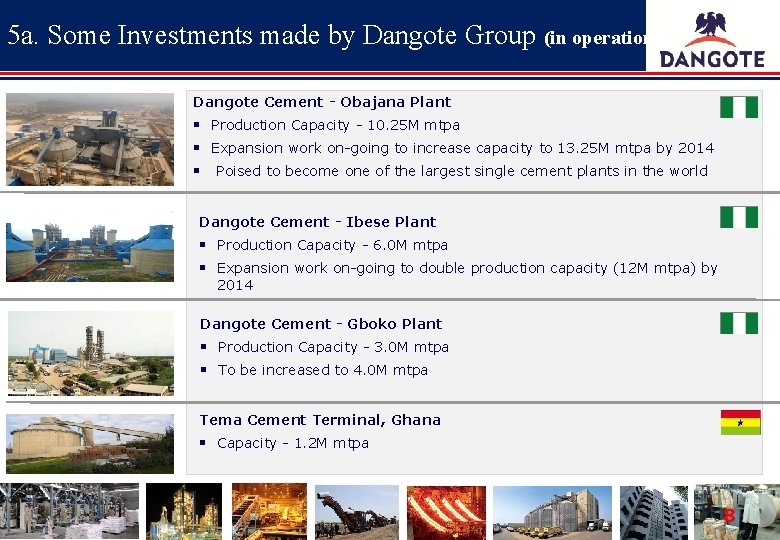
5 a. Some Investments made by Dangote Group (in operation) Dangote Cement - Obajana Plant § Production Capacity - 10. 25 M mtpa § Expansion work on-going to increase capacity to 13. 25 M mtpa by 2014 § Poised to become one of the largest single cement plants in the world Dangote Cement - Ibese Plant § Production Capacity - 6. 0 M mtpa § Expansion work on-going to double production capacity (12 M mtpa) by 2014 Dangote Cement - Gboko Plant § Production Capacity - 3. 0 M mtpa § To be increased to 4. 0 M mtpa Tema Cement Terminal, Ghana § Capacity - 1. 2 M mtpa 8
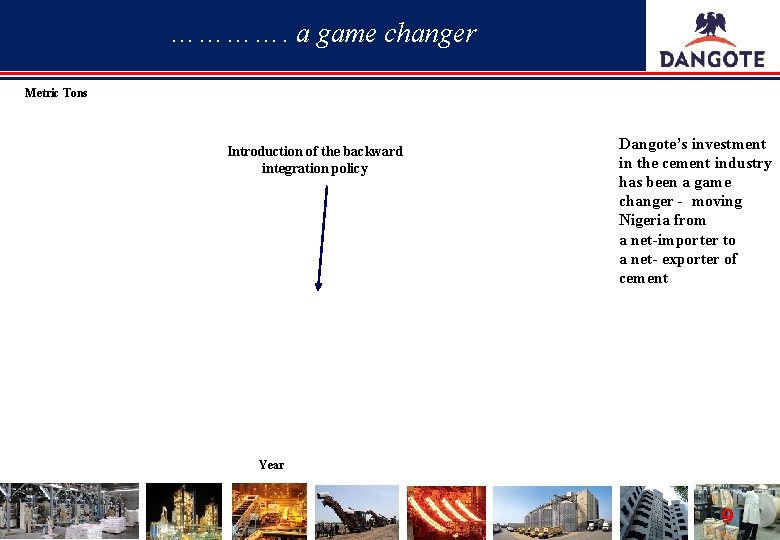
…………. a game changer Metric Tons Introduction of the backward integration policy Dangote’s investment in the cement industry has been a game changer - moving Nigeria from a net-importer to a net- exporter of cement Year 9
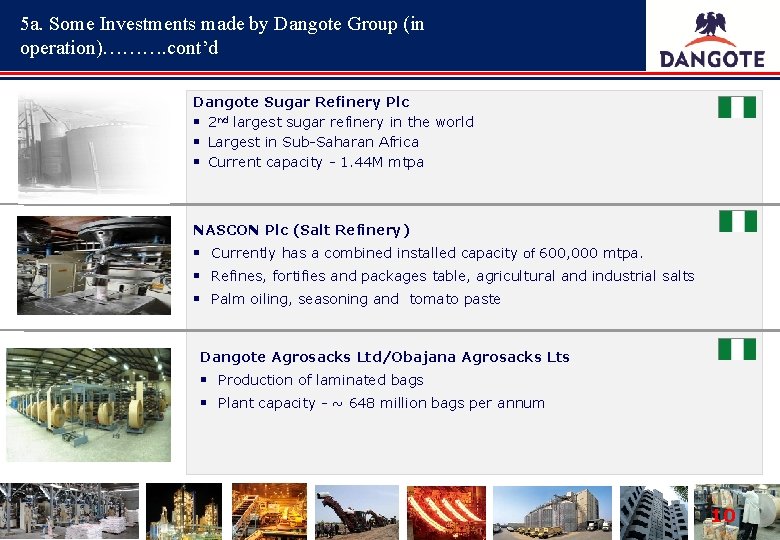
5 a. Some Investments made by Dangote Group (in operation)………. cont’d Dangote Sugar Refinery Plc § 2 nd largest sugar refinery in the world § Largest in Sub-Saharan Africa § Current capacity - 1. 44 M mtpa NASCON Plc (Salt Refinery) § Currently has a combined installed capacity of 600, 000 mtpa. § Refines, fortifies and packages table, agricultural and industrial salts § Palm oiling, seasoning and tomato paste Dangote Agrosacks Ltd/Obajana Agrosacks Lts § Production of laminated bags § Plant capacity - ~ 648 million bags per annum 10
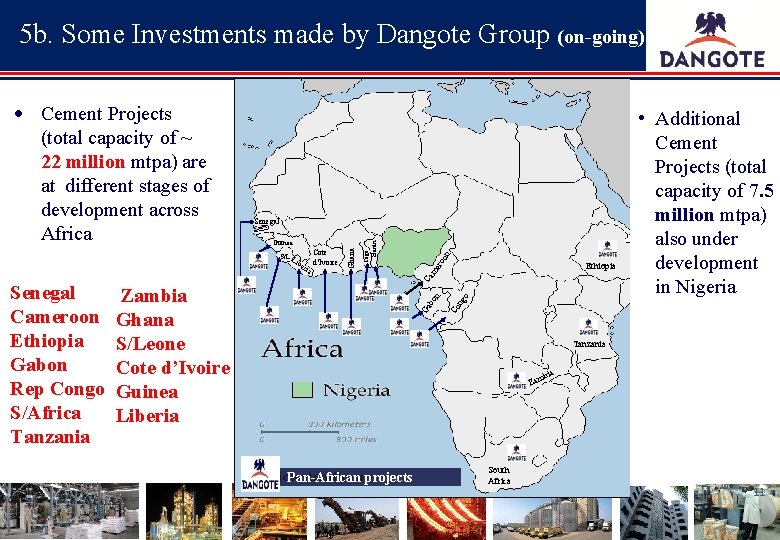
5 b. Some Investments made by Dangote Group (on-going) • Additional Ethiopia Cement Projects (total capacity of 7. 5 million mtpa) also under development in Nigeria Co ng o Ca bo n Zambia Ghana S/Leone Cote d’Ivoire Guinea Liberia Ga Senegal Cameroon Ethiopia Gabon Rep Congo S/Africa Tanzania ria Cote d’Ivoire on ibe me ro S/L L Togo Guinea Benin Senegal Ghana Cement Projects (total capacity of ~ 22 million mtpa) are at different stages of development across Africa Tanzania bia Zam Pan-African projects South Africa 11
5 b. Some Investments made by Dangote Group (on-going)………. . . cont’d Fertilizer Refinery/ Petrochemicals Fertilizer Plant § Urea and Ammonia § 2. 8 M mtpa Refinery/Petrochemical § 400, 000 bpd refining capacity § 650, 000 mtpa Polypropylene § 300, 000 mtpa feedstock of carbon black § 100, 000 mtpa LPFO Integrated Plantation/ Refinery Complexes Sugar § 1. 5 M mtpa refined sugar capacity § Adamawa State, Taraba State, Kebbi State, Sokoto State, Jigawa State, Kwara State 12
6. …………. . there are challenges § Top of the list is the high cost of doing business (and its impact on business competitiveness) Ø ~ 30 countries are affected by chronic power problems Ø transportation costs are high – increasing the costs of goods by at least 75% in some landlocked countries Ø only 4 % of Africa’s GDP is invested in infrastructure, compared to ~14% in China. Africa needs to spend ~ $90 billion/year over the next decade to expand, upgrade and maintain its infrastructure - ADB 13
7. Expectations of Local Manufacturers Country Level (as applicable) üEstablishment of industrial clusters – well located and fully functional üLong term development funding needs to be available, affordable and accessible üRevamp and expand key transport arteries (PPP in rail transport and in road construction/management). Inland waterways, where available should also be fully utilized üMore efficient border management (land, air and sea) 14
7. Expectations of Local Manufacturers…………. . . . …. cont’d üImport tariff structure should be structured to discourage “dumping” and encourage local production (in our areas of competitive advantage) üTackle the menace of smuggled, fake & adulterated goods üRegulatory institutions should be strengthened to monitor product quality and enforce laid down standards üProperly resource the National Bureau of Statistics to enable them provide a vast array of data across different sectors of the economy (to facilitate fact-based analysis). 15
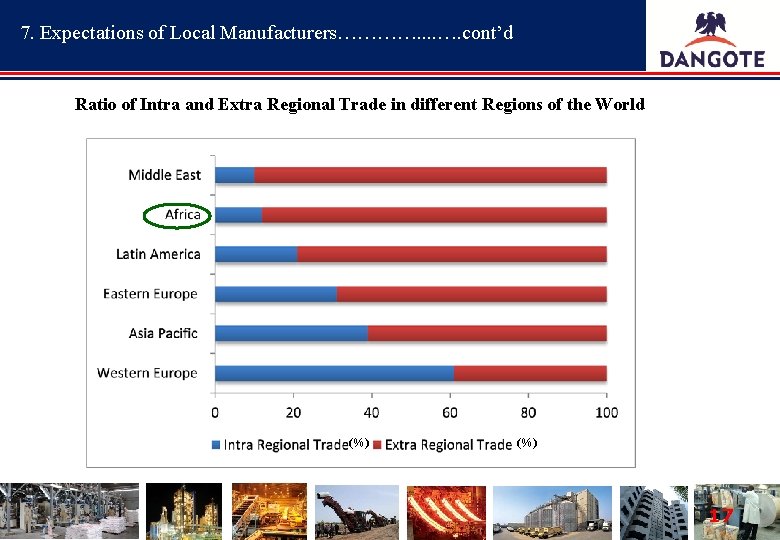
7. Expectations of Local Manufacturers…………. . …. cont’d üPolicy makers should put in place attractive sector specific incentive packages – and periodically benchmark incentive regimes against regional and global peers. üRe-orientation of citizens to patronize locally made goods ( this must start at a very early age and should be part of the School Curriculum) Regional Level üAll effort must be made to promote greater intra-African trade (since 2006 intra-African trade has increased from about US$48 billion/year to over US$100 billion/year)……. . . but more still needs to be done 16
7. Expectations of Local Manufacturers…………. . …. cont’d Ratio of Intra and Extra Regional Trade in different Regions of the World (%) 17
7. Expectations of Local Manufacturers…………. . …. cont’d üGreater Intra African Investment – recent trends have been encouraging Ø Manufacturing (Tiger Brand, Dangote Group etc) Ø Telecoms (Globacom, MTN etc) Ø Banking (UBA, Stanbic, GTB, Zenith, Access etc) Ø Retail (Shoprite) üRegional collaboration in delivering major infrastructure projects Ø build on the successes of projects such as WAGP Ø actualize other mega projects – eg Grand INGA Hydo Project, Trans-Sahara Gas Pipeline, Regional Power Pools, Several Regional Road and Rail projects etc 18
8. Conclusion “There has been more risk in Western Europe in the last five years than in Africa” …………. . Mr. Jay Ireland (President & CEO, General Electric Africa) § The opportunities in the manufacturing sector in Africa are huge and largely untapped. § African entrepreneurs (big and small) must be at the forefront of the continent’s industrial transformation § Foreigners will be more willing to invest in the manufacturing sector when Africans take the lead 19
Thank you for your attention 20